
Mann U. Principles of Chemical Reactor Analysis and Design: New Tools for Industrial Chemical Reactor Operations
Подождите немного. Документ загружается.


The main difficulty in determining the reaction rate r is that the extent is not a
measurable quantity. Therefore, we have to derive a relationship between the reac-
tion rate and the appropriate measurable quantity. We do so by using the design
equation and stoichiometric relations. Also, since the characteristic reaction time
is not known a priori, we write the design equation in terms of operating time
rather than dimensionless time. Assume that we measure the concentration of
species j, C
j
(t), as a function of time in an isothermal, constant-volume batch reac-
tor. To derive a relation between the reaction rate, r, and C
j
(t), we divide both sides
of Eq. 6.2.4, by t
cr
and obtain
dZ
dt
¼
1
C
0
r (6:2:37)
From Eq. 6.1.12,
C
j
(t) ¼ C
0
[ y
j
(0) þ s
j
Z(t)] (6:2:38)
Differentiating Eq. 6.2.38 with respect to time,
dZ
dt
¼
1
C
0
s
j
dC
j
dt
(6:2:39)
and substituting it into Eq. 6.2.37,
r ¼
1
s
j
dC
j
dt
(6:2:40)
Since the determination of an r involves differentiating of experimental data with
respect to time and applying the differential form of the design equation, it is com-
monly called the differential method.
Before we illustrate how to apply Eq. 6.2.40, a comment on numerical differen-
tiation is in order. To achieve higher accuracy of the derivatives, we use second-
order differentiation relations (see Appendix C). Therefore, when the data points
are equally spaced, we calculate the slope of each point, except the two endpoints,
using the central differentiation equation. For the first point, we use the backward
differentiation equation, and, for the last point, we use the forward differentiation
equation. When the points are not equally spaced, we use the central differentiation
equation for the midpoint between any two adjacent data points. Hence, for n data
points on species concentrations, we obtain n 2 1 derivative values for the mid-
points concentrations.
Next, we discuss how to determine the parameters of the rate expression. The
determination of the rate expression is usually carried out in three steps:
†
Determining the form of the rate expression [function h( C
j
’s) in Eq. 3.3.1 and
Eq. 6.1.5]
190 IDEAL BATCH REACTOR

†
Determining the value of the rate constant, k(T ), at a given operating
temperature
†
Determining the activation energy
The determination of the rate constant’s parameters (activation energy and the fre-
quency factor) is carried out by calculating the rate constant at a series of different
temperatures and then applying the procedure described in Section 3.3. Below, we
describe methods to determine the parameters of rate expressions that are power
functions of the species concentrations. Similar procedures are used for other
forms of the rate expression.
C onsider a chemical r eaction whose ra te expression is powers of the concentr ations:
r ¼ kC
A
a
C
B
b
(6:2:41)
When the reaction rate is determined at differ ent r ea ctant concentr ations, we r e write
Eq. 6.2.41 as
ln r ¼ ln k þ a ln C
A
þ b ln C
B
(6:2:42)
Combining Eqs. 6.2.40 and 6.2.42,
ln
1
s
j
dC
j
dt
¼ ln k þa ln C
A
þ b ln C
B
(6:2:43)
T o determine the rea ction of individual orders (a, b, ...), we apply multivariable linear
regression. To obtain reliable values for the orders, we need many data points of the
reaction r ate at differ ent rea ctant concentra tions. In many cases, we w ant a quick esti-
mate of the orders. To obtain these, we conduct a few experiments while maintaining
the concentr ation of some rea ctants cons tant. W e write Eq. 6.2.41 for two runs and
tak e the ratio betw een them:
r
1
r
2
¼
k
1
k
2
C
A
1
C
A
2
a
C
B
1
C
B
2
b
(6:2:44)
Thus if, for example, the two runs ar e conducted at the same temper ature, (k
1
¼ k
2
), and
in both of them, C
B
isthesame(C
B1
¼ C
B2
), we can calcula te the order of A, a,from
a ¼
ln (r
1
=r
2
)
ln (C
A1
=C
A2
)
(6:2:45)
Example 6.6 Kinetic measurements of the reaction
A þ B ! C
6.2 ISOTHERMAL OPERATIONS WITH SINGLE REACTIONS 191

were carried out in an isothermal, constant-volume batch reactor at 808C. Based
on the data below, determine the rate expression. Data:
Solution Noting that C
B1
¼ C
B2
, and since the temperature is constant,
k
1
¼ k
2
, we write Eq. 6.2.44 for runs 1 and 2,
1:30
2:60
¼
0:5
1:0
a
and find that a ¼ 1. Similarly, noting that C
A1
¼ C
A3
and k
1
¼ k
3
, we write Eq.
6.2.44 for runs 1 and 3,
1:30
1:84
¼
0:5
1:0
b
and find that b ¼ 0.5. The rate expression is r ¼ kC
A
C
B
0.5
. Now that we know
the orders, we can determine the value of the rate constant at 808C. For each run,
k ¼
r
C
A
2
C
B
0:5
The average value of k for the three runs is 6.13 L
1.5
mol
21.5
min
21
.
Once the form of the rate expression is known, we can determine the reaction
rate constant, k(T ), by using the integral form of the design equation. Consider
the integral form of the design equation (Eq. 6.2.5):
t ¼
C
0
t
cr
ð
Z(t)
0
dZ
r
¼
C
0
t
cr
G[Z(t)] (6:2:46)
The right-hand side of Eq. 6.2.46 is a function of Z(t), denoted by G[Z(t)], that
depends on the extent at the end of the operation. For rate expressions that are
powers of the concentrations, we can readily calculate the values of the function
Concentration
(mol/L)
Rate
(mol/min L)Run C
A
C
B
1 0.5 0.5 1.30
2 1.0 0.5 2.60
3 0.5 1.0 1.84
192 IDEAL BATCH REACTOR

G[Z(t)] at different values of t. For example, for reactions whose stoichiometry is
A ! Products and whose rate expression is of the form r ¼ kC
A
a
, we derive
G[Z(t)] from Eq. 6.2.46:
G[Z(t)] ¼ln [1 Z(t)] for a ¼ 1(6:2:47a)
G[Z(t)] ¼
1
a 1
Z(t)
1 Z(t)
a1
1
()
for a = 1(6:2:47b)
Now, recalling the definition of the dimensionless operating time, t ¼ t/t
cr
, and,
using Eq. 6.2.46, by plotting G[Z(t)] versus the operating time t, we obtain a
straight line that passes through the origin, whose slope is 1/t
cr
. Once we determine
the value of t
cr
from the slope, we calculate the value of the rate constant k, using
Eq. 6.2.9. Because the integral form of the design equation is used, this method is
commonly referred to as the integral method.
Two comments on the integral method are in order. First, since the extent is not a
measurable quantity, to obtain G[Z(t)], we have to express Z(t) in terms of a mea-
surable quantity (species concentration, pressure, etc.) using stoichiometric
relations. Second, the integral method can be applied to determine the form of
the rate expression. The determination of the rate expression goes as follows:
first, we assume (hypothesize) the form of the rate expression and use Eq. 6.1.12
to derive the function G[Z(t)]. Next, we plot G[Z(t)] versus the operating time t
to check whether the experimental data fit the function G[Z( t)]. When the exper-
imental data fit the derived straight line, we accept the hypothesized rate expression.
Then, we use the slope of the line to determine the reaction rate constant. If the
experimental data do not fit the straight line for the derived G[Z(t)], we reject the
hypothesized rate expression and test a different one. Note that each trial
involves the integration of the rate expression, and the procedure is tedious and
time-consuming. Hence, we usually apply the differential method to determine
the form of the reaction, and then use the integral method to determine the value
of the reaction rate constant.
Example 6.7 illustrates the determination of the reaction order, a, and the rate
constant, k(T), when the progress of the reaction is monitored by measuring the
reactor pressure.
Example 6.7 Consider the decomposition of di-tert-butyl peroxide in a
constant-volume batch reactor. The chemical reaction is
(CH
3
)
3
COOC(CH
3
)
3
! C
2
H
6
þ 2CH
3
COCH
3
6.2 ISOTHERMAL OPERATIONS WITH SINGLE REACTIONS 193

Di-tert-butyl peroxide is charged into an isothermal, constant-volume batch
reactor operated at 480 8 C. Based on the data below, determine:
a. The order of the reaction, using the differential method
b. The reaction rate constant, using the integral method
Data: Time (min) 0:02:55:010:015:020:0
Pressure (mm Hg) 7:510:512:515:817:919:4
Solution We can describe the reaction as A ! B þ 2C, whose stoichiometric
coefficients are
s
A
¼1 s
B
¼ 1 s
C
¼ 2 D ¼ 2
Since only reactant A is charged into the reactor, y
A
(0) ¼ 1 and
y
B
(0) ¼ y
C
(0) ¼ 0.
a. From Eq. 6.2.37,
r ¼ C
0
dZ
dt
(a)
where the rate expression is r ¼ kC
A
a
. Using Eq. 6.1.12,
C
A
(t) ¼ C
0
(1 Z) (b)
Substituting (b) into the rate expression and the latter in the design equation,
dZ
dt
¼ kC
0
a1
(1 Z)
a
(c)
Taking the log of both sides,
ln
dZ
dt
¼ ln (kC
0
a1
) þ a ln(1 Z) (d)
To determine a, we plot ln(dZ/dt) versus ln(1 2 Z) and obtain a from the
slope. In this case, we have data of P(t), so we have to derive a relation
between P(t) and Z(t). Selecting the initial state as the reference state and
using Eq. 2.7.6. for an ideal gas in a constant-volume reactor
P(t)
P(0)
¼
N
tot
(t)
N
tot
(0)
¼ 1 þ 2Z(t) (e)
194 IDEAL BATCH REACTOR

which reduces to
Z(t) ¼
1
2
P(t)
P(0)
1
(f)
Differentiating (f) with time,
dZ
dt
¼
1
2P(0)
dP
dt
(g)
We substitute (g) and (f) into (d),
ln
dP
dt
¼ (constant) þa ln 3
P(t)
P(0)
(h)
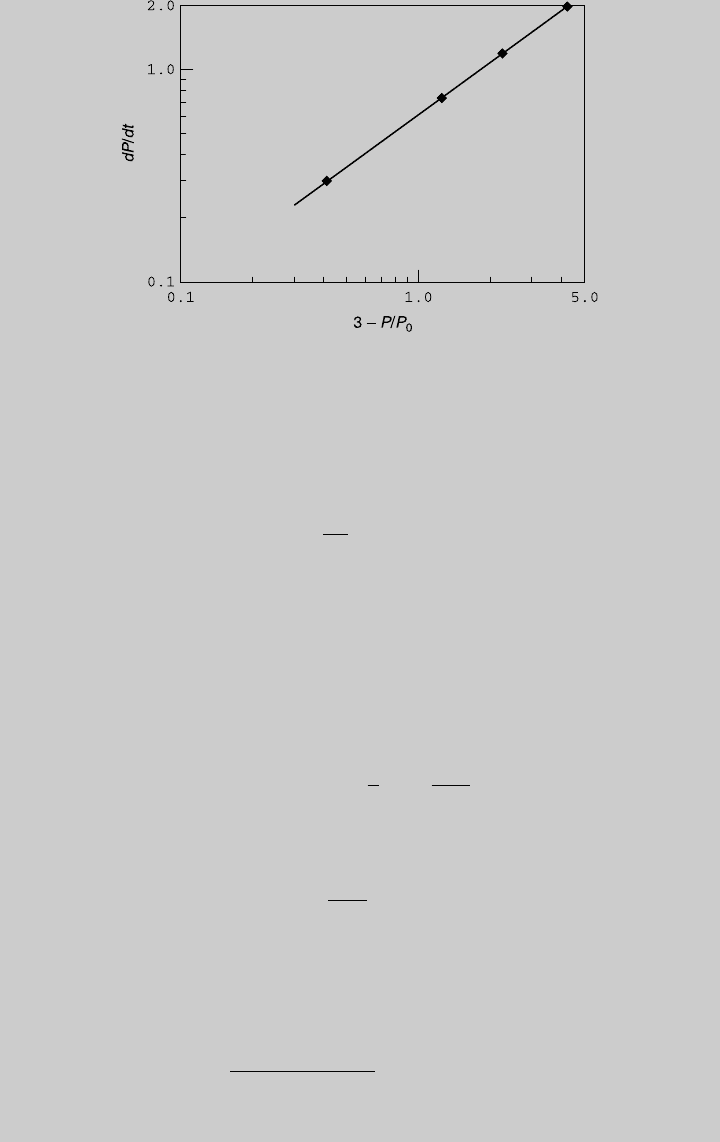
Thus, we plot ln(dP/dt) versus ln[32P(t)/P(0)] to determine the value of a.
We calculate the derivatives numerically, using second-order forward, center,
and backward numerical differentiation formulas, and obtain the following:
The plot is shown in Figure E6.7.1. The slope of the line is
a ¼
ln (1:0) ln (0:2)
ln (1:6) ln (0: 31)
¼ 0:98 1:0
Note that the points are spread around the line. This is typical in plots based
on numerical differentiation. It is common to round the value on the order to
the nearest multiple of 0.5.
b. In this case, the rate expression is r ¼ kC
A
, and, from Eq. 3.5.4, for first-order
reactions,
t
cr
¼
1
k
(i)
Run t (min) P (mm Hg) DtdP/dt
3 2 P(t)/
P(0)
1 0 7.5 1.40 2.000
2 2.5 10.5 2.5 1.00 1.600
3 5.0 12.5 2.5 0.69 1.333
4 10.0 15.8 5.0 0.54 0.893
5 15.0 17.9 5.0 0.42 0.613
6 20.0 19.4 5.0 0.30 0.413
6.2 ISOTHERMAL OPERATIONS WITH SINGLE REACTIONS 195
Substituting
a
¼ 1 into the rate expression and the latter into Eq. 6.2.4, and
using (i), the design equation becomes
dZ
dt
¼ 1 Z (j)
Separating the variables and integrating, using the initial condition that at
Z(0) ¼ 0,
t ¼ k t ¼ln [1 Z(t)] (k)
To determine k, we plot ln(12Z) versus t and obtain a straight line whose
slope is 2k. Using (f),
1 Z(t) ¼
1
2
3
P(t)
P(0)
(l)
Substituting (l) into (k) and rearranging,
ln 3
P(t)
P(0)
¼ ln 2 kt (m)
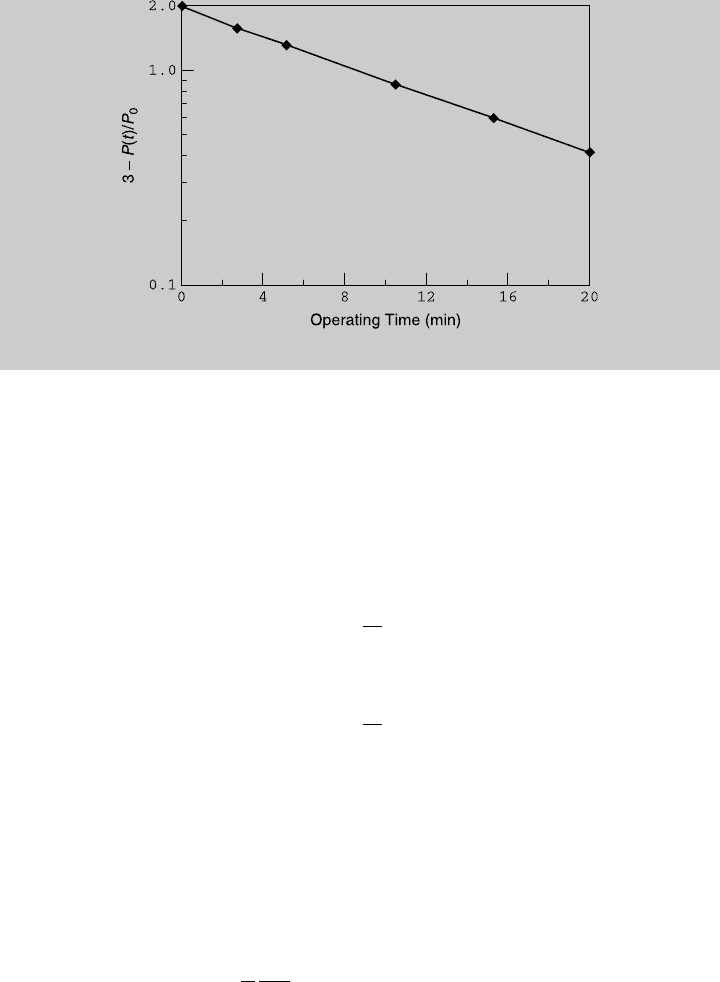
Hence, by plotting ln [3 2 P(t)/P(0)] versus operating time, t, we obtain a
straight line whose slope is 2 k. We calculate the needed quantities and
show the plot in Figure E6.7.2. From the plot, the slope is
k ¼
ln(2:0) ln(0:5)
0 17:5
¼7:92 10
2
min
1
Therefore, the reaction rate constant at 4808Cisk ¼ 7.9210
22
min
21
.
Figure E6.7.1 Determination of the reaction order.
196 IDEAL BATCH REACTOR
We conclude the discussion with a brief description of several techniques to sim-
plify the determination of the parameters of the rate expression. We can mix the
reactants in proportions that are convenient for the determination of the individual
orders or the overall orders. Commonly, one of the following mixtures is used:
Stoichiometric Proportion When the two reactants are in stoichiometric
proportion,
C
B
(0) ¼
s
B
s
A
C
A
(0) (6:2:48)
it follows from Eq. 2.3.6 that for constant-volume reactors,
C
B
(t) ¼
s
B
s
A
C
A
(t)(6:2:49)
Substituting Eq. 6.2.49, Eq. 5.2.41 becomes
r ¼ k
0
C
A
aþb
(6:2:50)
where k
0
¼ k(s
B
/s
A
) is a new constant. When the concentration of species j, C
j
(t), is
the measured quantity, from Eq. 6.2.50,
ln
1
s
j
dC
j
dt
¼ ln k
0
þ (a þ b)lnC
A
(6:2:51)
By plotting ln [(1=s
j
)(dC
j
=dt)] versus ln C
A
, we obtain a straight line whose slope is
a þ b. Hence, by conducting experiments with the reactants in stoichiometric pro-
portion, we obtain the overall order of the reaction. To determine the orders of the
individual species, we use one of the other methods below.
Figure E6.7.2 Determination of the rate constant.
6.2 ISOTHERMAL OPERATIONS WITH SINGLE REACTIONS 197

Large Excess of One Reactant When C
B
(0) (s
B
/s
A
)C
A
(0), the relative
change in C
B
is small, C
B
(t) C
B
(0), and Eq. 6.2.41 becomes
r ¼ k
00
C
A
a
(6:2:52)
where k
00
¼ kC
B
(0). Sunstituting Eq. 6.2.52 in Eq. 6.2.44
ln
1
s
A
dC
A
dt
¼ ln k
00
þ a ln C
A
(6:2:53)
By plotting ln [1=s
j
(dC
j
=dt)] versus ln C
A
, we obtain a. Hence, by conducting
experiments with a large excess of one reactant, we obtain the order of the limiting
reactant. We determine the individual species orders by repeating the procedure
with different mixtures, each time using a different limiting reactant.
Keeping the Concentration of One Reactant Constant Assume we conduct an
experiment while maintaining C
B
constant. Equation 6.2.40 becomes
r ¼ k
000
C
A
a
(6:2:54)
where k
000
¼ kC
B
. The method is similar to the one using the excess amount, except
that experimentally, this one is more difficult to perform.
Initial Rate Method For reversible reactions, we use a modified differential
method—the initial rate method. In this case, a series of experiments are conducted
at selected initial reactant compositions, and each run is terminated at low conver-
sion. From the collected data, we calculate (by numerical differentiation) the reac-
tion rate at the initial conditions. Since the reaction extent is low, the reverse
reaction is negligible, and we can readily determine the orders of the forward reac-
tion from the known initial compositions. The rate of the reversible reaction is
determined by conducting a series of experiments when the reactor is charged
with selected initial product compositions. The initial rate method is also used to
determine the rates for complex reactions since it enables us to isolate the effect
of different reactants.
6.3 ISOTHERMAL OPERATIONS WITH MULTIPLE REACTIONS
When more than one chemical reaction takes place in the reactor, we have to address
several issues before we start the design procedure. We have to determine how many
independent reactions take place in the reactor and select a set of independent reac-
tions for the design formulation. Next, we have to identify all the reactions that actu-
ally take place (including the dependent reactions) and express their rates. To
determine the reactor compositions and all other state quantities, we have to write
Eq. 6.1.1 for each of the independent chemical reactions. To solve the design
198 IDEAL BATCH REACTOR
equations (obtain relationships between Z
m
’s and t), we have to express the rates of
the individual chemical reactions, r
m
’s and r
k
’s, in terms of Z
m
’s and t. The procedure
for designing batch reactors with multiple reactions goes as follows:
1. Identify all the chemical reactions that take place in the reactor and define
the stoichiometric coefficients of each species in each reaction.
2. Determine the number of independent chemical reactions.
3. Select a set of independent reactions from among the reactions whose rate
expressions are given.
4. For each dependent reaction, determine its a
km
multipliers with each inde-
pendent reaction, using Eq. 2.4.9.
5. Select a reference state [determine (N
tot
)
0
, T
0
, C
0
, V
R0
] and the initial
species compositions, y
j
(0)’s.
6. Write Eq. 6.1.1 for each independent chemical reaction.
7. Select a leading (or desirable) reaction and determine the expression of the
characteristic reaction time, t
cr
, and its numerical value.
8. Express the reaction rates in terms of the dimensionless extents of the inde-
pendent reactions, Z
m
’s.
9. Solve the design equations (Z
m
’s as functions of t) and obtain the reaction
operating curves.
10. Calculate the species curves of all species, using Eq. 2.7.4.
11. Determine the reactor operating time based on the most desirable value of t
obtained from the dimensionless operating curves.
Below, we describe the design formulation of isothermal batch reactors with
multiple reactions for various types of chemical reactions (reversible, series, paral-
lel, etc.). In most cases, we solve the equations numerically by applying a numeri-
cal technique such as the Runge-Kutta method, but, in some simple cases,
analytical solutions are obtained. Note that, for isothermal operations, we do not
have to consider the effect of temperature variation, and we use the energy balance
equation to determine the dimensionless heat-transfer number, HTN, required to
maintain the reactor isothermal.
We start the analysis with single reversible reactions. When a reversible reaction
takes place, there is only one independent reaction; hence, only one design equation
should be solved. However, the rates of both forward and backward reactions
should be considered. The design procedure is similar to the one discussed in
Section 6.2. To illustrate the effect of the reverse reaction, consider the reversible
elementary isomerization reaction A
!
B in a constant-volume batch reactor. We
treat a reversible reaction as two chemical reactions:
Reaction 1: A ! B
Reaction 2: B ! A
6.3 ISOTHERMAL OPERATIONS WITH MULTIPLE REACTIONS 199