
Mann U. Principles of Chemical Reactor Analysis and Design: New Tools for Industrial Chemical Reactor Operations
Подождите немного. Документ загружается.


Equation 8.1.10 becomes
v
out
¼ v
0
(F
tot
)
in
(F
tot
)
0
þ
X
n
I
m
D
m
Z
m
out
"#
u
out
P
0
P
out
(8:1:11)
where u
out
¼ T
out
/T
0
. Substituting Eq. 8.1.11 into Eq. 8.1.7, the outlet concen-
tration is
C
j
out
¼ C
0
[(F
tot
)
in
=(F
tot
)
0
]y
j
in
þ
P
n
I
m
(s
j
)
m
Z
m
out
(F
tot
)
in
=(F
tot
)
0
þ
P
n
I
m
D
m
Z
m
out
u
out
P
out
P
0
(8:1:12)
When we select the inlet stream as the reference stream, Eq. 8.1.12 becomes
C
j
out
¼ C
0
y
j
0
þ
P
n
I
m
(s
j
)
m
Z
m
out
1 þ
P
n
I
m
D
m
Z
m
out
u
out
P
out
P
0
(8:1:13)
Equation 8.1.13 provides the species concentrations in terms of the extents of the
independent reactions for gas-phase reactions in CSTRs.
Since the reactor temperature, u
out
, may be different than the inlet temperature,
we have to solve the energy balance equation simultaneously with the design
equations. For CSTRs with negligible viscous and shaft work, the energy balance
equation, derived in Chapter 5, is
HTNt(u
F
u
out
) ¼
X
n
I
m
DHR
m
(Z
m
out
Z
m
in
) þ CF(Z, u)
out
(u
out
1)
CF(Z, u)
in
(u
in
1)
(8:1:14)
where HTN is the dimensionless heat-transfer number defined by Eq. 5.2.22:
HTN ¼
Ut
cr
C
0
^
c
p0
S
V
(8:1:15)
DHR
m
is the dimensionless heat of reaction of the mth-independent chemical
reaction, defined by Eq. 5.2.23:
DHR
m
¼
DH
R
m
(T
0
)
T
0
^
c
p0
(8:1:16)
and CF(Z
m
, u) is the correction factor of the heat capacity of the reacting fluid,
defined by Eq. 5.2.54. The term on the left of Eq. 8.1.14 is the dimensionless
heat-transfer rate:
_
Q
(F
tot
)
0
^
c
p
0
T
0
¼ HTNt(u
F
u)(8:1:17)
320 CONTINUOUS STIRRED-TANK REACTOR

The first term on the right of Eq. 8.1.14 represents the heat generated (or consumed)
by the chemical reactions in the reactor.
The specific molar specific heat capacity of the reference state, c
ˆ
p0
, is determined
differently for gas-phase and liquid-phase reactions. For gas-phase reactions, it is
defined by Eq. 5.2.58,
^
c
p
0
;
X
J
j
y
j
0
^
c
p
j
(T
0
)(8:1:18)
and for liquid-phase reactions, it is defined by Eq. 5.2.60,
^
c
p
0
;
_
m
c
p
(F
tot
)
0
(8:1:19)
To solve Eq. 8.1.14, we have to specify the value of HTN. However, its value
depends on the heat transfer coefficient, U, which in turn depends on the flow
conditions in the reactor, the properties of the fluid, and the heat-transfer area
per unit volume (S/V ). These parameters are not known a priori. Therefore, we
develop a procedure to estimate the range of HTN. For isothermal operation
(u
out
¼ u
in
), we can determine the HTN of a given reactor from Eq. 8.1.14
(taking the reactor temperature as the reference temperature, u
in
¼ 1),
HTN
iso
(t) ¼
1
(u
F
1)t
X
n
I
m
DHR
m
(Z
m
out
Z
m
in
)(8:1:20)
Note that the value of HTN varies with the volume of the CSTR. We define an
average isothermal HTN over a range of reactor volumes by
HTN
ave
;
1
t
tot
ð
t
tot
0
HTN(t) dt (8:1:21)
where t
tot
is the total dimensionless space time of the largest reactor. Recall
that for adiabatic operation HTN ¼ 0. In most cases, the heat-transfer number
would be
0 , HTN HTN
ave
(8:1:22)
Equation 8.1.22 provides only an estimate on the range of the value of HTN to be
used in the design. We select a specific value after examining the reactor perform-
ance with different values of HTN. When multiple reactions take place, it is
important to examine the reactor operation for different values of HTN, since it
is difficult to predict the effect of the heat transfer on the relative rates of the indi-
vidual reactions. Once a specific reactor vessel has been designed, it is necessary to
verify that the reactor configuration and the flow conditions in the reactor actually
provide the specified value of HTN.
8.1 DESIGN EQUATIONS AND AUXILIARY RELATIONS 321

For convenience, Tables A.3a and A.3b in Appendix A provide the design
equation and the auxiliary relations used in the design of CSTRs. Table A.4
provides the energy balance equation.
In the remainder of the chapter, we discuss how to apply the design equations
and the energy balance equations to determine various quantities related to the
operations of CSTRs. In Section 8.2 we examine isothermal operations with
single reactions to illustrate how the rate expressions are incorporated into the
design equation and how rate expressions are determined. In Section 8.3, we
expand the analysis to isothermal operations with multiple reactions. In Section
8.4, we consider nonisothermal operations with multiple reactions.
8.2 ISOTHERMAL OPERATIONS WITH SINGLE REACTIONS
We start the analysis of CSTRs by considering isothermal operations with single
chemical reactions. Isothermal CSTRs are defined as those where u
out
¼ u
in
.
Since we do not have to determine the reactor temperature, we have to solve
only the design equations. The energy balance equation provides the heating (or
cooling) load necessary to maintain the isothermal conditions. Also, for isothermal
operations, the individual reaction rates depend only on the species concentrations,
and, when the reactor temperature is taken as the reference temperature, T ¼ T
0
, and
Eq. 8.1.5 reduces to
r
i
¼ k
i
(T
0
)h
i
(C
j
’s) (8:2:1)
When a single chemical reaction takes place in a CSTR, there is only one
independent reaction and no dependent reactions, and Eq. 8.1.1 reduces to
Z
out
Z
in
¼ r
out
t
t
cr
C
0
(8:2:2)
where Z
out
and Z
in
are the dimensionless extents of the reaction at the reactor outlet
and inlet, respectively, and r
out
is the reaction rate. We can rearrange Eq. 8.2.2 as
t ¼
C
0
t
cr
Z
out
Z
in
r
out
(8:2:3)
Note that the values of Z
in
and Z
out
depend on the selection of the reference stream.
Also note that if we use the definition of the characteristic reaction time (Eq. 3.5.1),
Eq. 8.2.3 reduces to
t ¼
r
0
r
out
(Z
out
Z
in
)(8:2:4)
The solution of the design equation, Z
out
versus t, provides the dimensionless reac-
tion operating curve. It describes the progress of the chemical reaction as a function
of the reactor volume. Also, once Z
out
is known, we can apply Eq. 2.7.8 to obtain the
322 CONTINUOUS STIRRED-TANK REACTOR

species operating curves, indicating the species molar flow rates as a function of the
reactor volume. Note that for given inlet conditions, Eq. 8.2.2 has three variables:
the dimensionless space time, t, the reaction extent at the reactor outlet, Z
out
,and
the reaction rate, r
out
. We use the design equation to determine any one of those
variables when the other two are pr ovided. A typical design problem is to determine
the reactor volume needed to obtain a specified extent (or conversion) for a given
feed rate and reaction rate. The second application is to determine the extent (or con-
version) at the reactor outlet for a given reactor volume and reaction rate. The third
application is to determine the reaction rate when the extent (or conversion) at the
reactor outlet is provided for a given feed rate.
If one prefers to express the design equation in terms of the reactor volume, V
R
,
rather than the dimensionless space time t, substituting Eq. 8.1.3, into Eq. 8.2.2:
V
R
¼ (F
tot
)
0
Z
out
Z
in
r
out
(8:2:5)
For CSTRs with single chemical reactions, the common practice has been to
express the design equation in terms of the conversion of the limiting reactant,
f
A
. Using Eq. 2.6.5,
Z ¼
y
A
0
s
A
f
A
and Eq. 8.2.5 becomes
V
R
¼ F
A
0
f
A
out
f
A
in
(r
A
)
out
(8:2:6)
where (2r
A
)
out
¼ 2 s
A
r
out
, is the depletion rate of reactant A.
To solve Eq. 8.2.2, we have to express the reaction rate, r
out
, in terms of the
dimensionless extent, Z
out
. To do so, we express the species concentrations
in terms of Z
out
. For single liquid-phase reactions, Eq. 8.1.9 reduces to
C
j
out
¼ C
0
( y
j
0
þ s
j
Z
out
)(8:2:7)
For single gas-phase reactions, Eq. 8.1.12 reduces to
C
j
out
¼ C
0
y
j
0
þ s
j
Z
out
1 þ D Z
out
(8:2:8)
Below, we analyze the operation of isothermal CSTRs with single reactions for
different types of chemical reactions. For convenience, we divide the analysis
into two sections: reactor design and determination of the rate expression. In the
former, we determine the size of the reactor or the production rate of a given reactor
for a known reaction rate, and, in the latter, we determine the rate expression from
experimental reactor operating data.
8.2 ISOTHERMAL OPERATIONS WITH SINGLE REACTIONS 323
8.2.1 Design of a Single CSTR
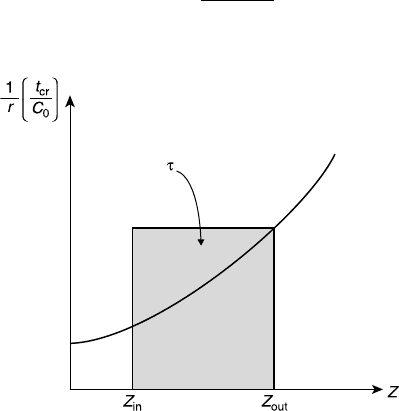
Examining Eq. 8.2.4, w e see that if we kno w ho w the reaction rate, r, varies with Z,
we can plot r
0
/r versus Z, as sho wn in Figure 8.2. The area of the rectangle betw een
Z
in
and Z
out
is equal to the dimensionless spa ce time, t. The required reactor volume,
V
R
, is readily determined from the dimensionless space time by V
R
¼ v
0
t
cr
t.Recall
tha t for a plug-flow rea ctor (Fig. 7.2) the dimensionless spa ce time, t,isprovided
by the area under the curve. Hence, for common rate expressions, the volume of a
CSTR needed to achieve a certain extent is larger than that of a plug-flow reactor.
The r eason for the different performance is the concentr a tion profiles of the reactants
in each reactor. In a plug-flow reactor, the reactant concentrations decrease gradually
along the reactor, whereas in a CSTR, the outlet low concentrations exist everywhere
in the reactor. For common kinetics, the reaction rate is faster at higher concentrations.
Hence, a plug-flo w rea ctor with the same volume as a CSTR (same space time)
provides a higher conv ersion (or extent) than the CSTR. In fact, a plug-flow rea ctor
represents the “best” reactor configura tion, whereas a CSTR repr esents the “worse”
configuration fr om a v olume utiliza tion perspective. Actual reactors (neither pluglik e
nor well mixed) usually perform in between these two extremes.
We start the analysis of isothermal CSTRs with single chemical reactions and
consider a first-order gas-phase chemical reaction:
A ! Products
and a stream with known composition to be fed to the reactor (y
j
in
’s, are specified).
For this case, s
A
¼ 21, D depends on the reaction’s stoichiometry, and the rate
expression is r ¼ kC
A
. Using Eq. 8.2.8, the reaction rate, expressed in terms of
extent, is
r ¼ kC
0
y
A
0
Z
1 þ D Z
(8:2:9)
Figure 8.2 Graphical presentation of the CS TR design equation for single reactions.
324 CONTINUOUS STIRRED-TANK REACTOR
Substituting Eq. 8.2.9 into Eq. 8.2.2,
Z
out
Z
in
¼ kC
0
t
y
A
0
Z
out
1 þ D Z
out
t
cr
C
0
(8:2:10)
We select the inlet stream as the reference stream, Z
in
¼ 0, when only reactant A is
fed into the reactor, y
A
0
¼ 1. Using Eq. 3.5.4, the characteristic reaction time is
t
cr
¼
1
k
and the design equation reduces to
Z
out
¼ t
1 Z
out
1 þ D Z
out
(8:2:11)
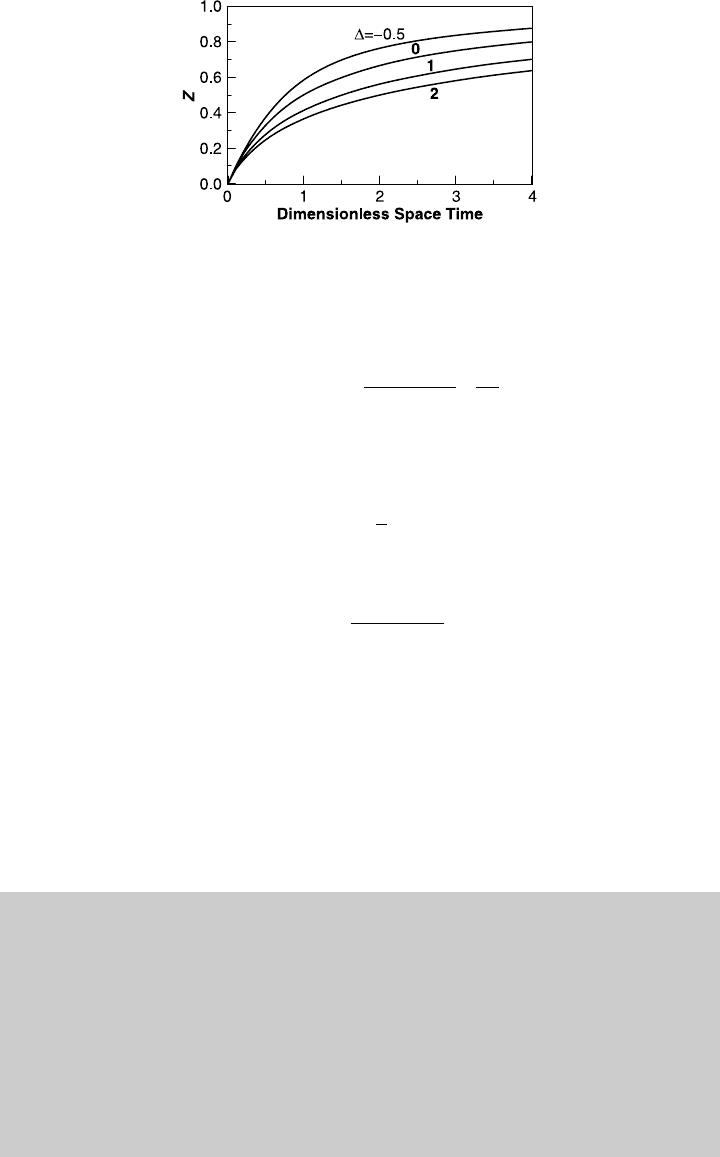
The solution of Eq. 8.2.11 for differ ent values of D is sho wn in Figure 8.3. Note that for
larger D, a larger r ea ctor v olume is r equir ed to achiev e a giv en level of extent.
The design of CSTRs and the values of calculated quantities (reactor volume,
species production rates, etc.) do not depend on the specific reference stream
selected. Example 8.2 illustrates the use of a fictitious stream as a reference
stream and the behavior of a CSTR when one product is condensable. Example
8.3 illustrates the design of a CSTR with a chemical reaction whose rate expression
is not a power function of the concentrations.
Example 8.1 The first-order, gas-phase, reaction
A ! B þC
takes place in an isothermal CSTR. The reaction is first order, and its rate con-
stant at the operating temperature is k ¼ 0.1 s
21
. A gaseous stream of reactant A
(C
A
0
¼ 0:04 mol=L) is fed into the reactor at a rate of 10 mol/min.
a. Determine the volume of the reactor needed to achieve 80% conversion.
b. Determine the volume of the reactor needed to achieve 80% conversion if, by
mistake, we use D ¼ 0.
Figure 8.3 Reaction operating curves for a single first-order reaction of the form A !
products; effect of expansion factor.
8.2 ISOTHERMAL OPERATIONS WITH SINGLE REACTIONS 325

c. Determine the actual conversion obtained in a CSTR with the volume calcu-
lated in (b).
d. Determine the feed flow rate to a CSTR with the volume calculated in (b) if
we want to maintain 80%.
Solution The stoichiometric coefficients are
s
A
¼1 s
B
¼ 1 s
C
¼ 1 D ¼ 1
We select the inlet stream as the reference stream Z
in
¼ 0 and (F
tot
)
0
¼ F
A
in
, and,
since only reactant A is fed into the reactor, y
A
0
¼ 1, y
B
0
¼ y
C
0
¼ 0, C
0
¼ C
A
in
.
The volumetric feed rate is
v
0
¼
(F
tot
)
0
C
0
¼ 250 L=min
Using Eq. 2.6.5 to relate the extent to the conversion,
Z
out
¼
y
A
0
s
A
f
A
out
¼ 0:80
a. For a CSTR with a single chemical reaction, the design equation Eq. 8.2.2 is
Z
out
Z
in
¼ rt
t
cr
C
0
(a)
We use Eq. 8.2.8 to express C
A
, and the reaction rate is
r ¼ kC
0
1 Z
1 þ D Z
(b)
Using Eq. 3.5.4, for a first-order reaction, the characteristic reaction time is
t
cr
¼
1
k
¼ 10 s ¼ 0:167 min (c)
Substituting (b) and (c) into (a), the design equation is
Z
out
¼ t
1 Z
out
1 þ Z
out
(d)
We solve (d) for different values of t to obtain the reaction curve, shown in
Figure E8.1.1. Note that each t represents a tank with a different volume.
Once we have Z
out
, we use Eq. 2.7.8 to obtain the species curves:
F
A
out
(N
tot
)
0
¼ 1 Z
out
F
B
out
(N
tot
)
0
¼
F
C
out
(N
tot
)
0
¼ Z
out
326 CONTINUOUS STIRRED-TANK REACTOR
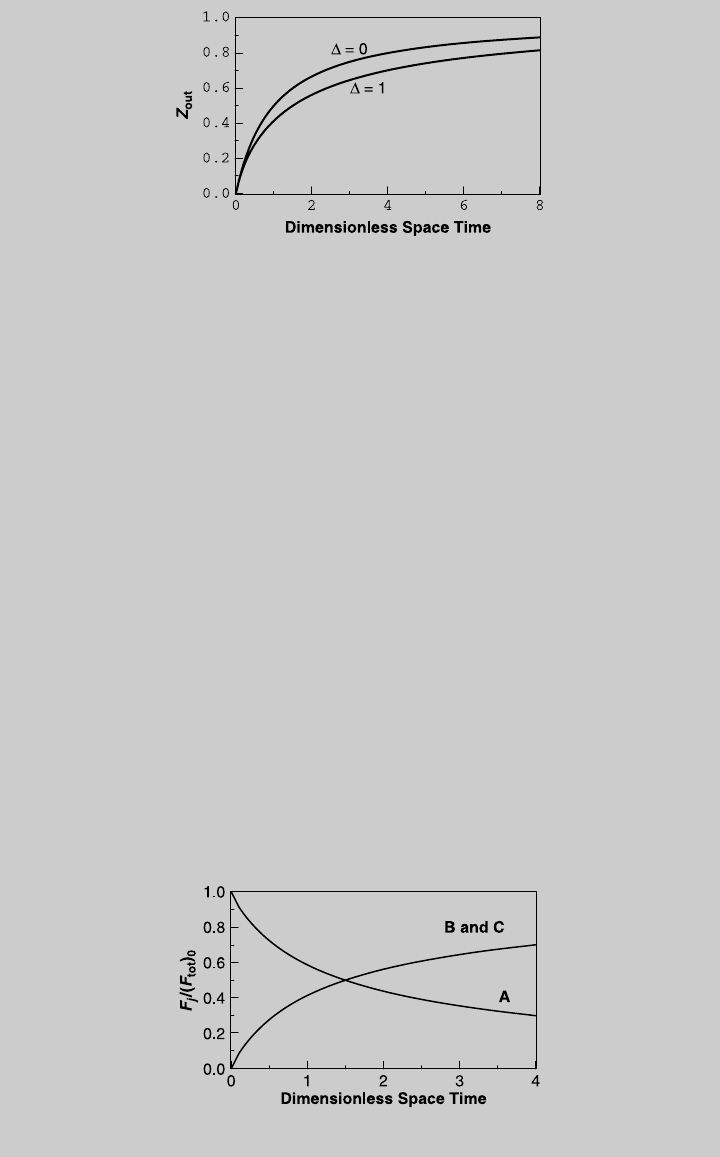
Figure E8.1.2 shows the species curves. From the reaction curve, for
Z
out
¼ 0.8, t ¼ 7.20. Using Eq. 8.1.3 and (c), the needed reactor volume is
V
R
¼ tv
0
t
cr
¼ 300 L (e)
b. If we do not account for the change in the volumetric flow rate (and use
D ¼ 0), the design equation is
Z
out
¼ t(1 Z
out
)(f)
and, for Z
out
¼ 0.8, the solution is t ¼ 4.0. Hence, the calculated reactor
volume is
V
R
¼ tv
0
t
cr
¼ 166:7 L (g)
Note that if we use a wrong concentration expression, we specify a reactor
volume that is only 55% of the required volume.
c. To calculate the actual outlet conversion on a CSTR with volume of 166.7 L,
we solve (d) for t ¼ 4.0, and the solution is Z
out
¼ f
a
out
¼ 0:701. Hence, we
obtain only 70.1% conversion instead of the desired 80%.
d. To attain a conversion of 0.80 on the 166.7-L reactor, the feed flow rate
should be reduced. We know that to obtain 80% conversion, t should be
Figure E8.1.1 Reaction operating curve.
Figure E8.1.2 Species operating curves.
8.2 ISOTHERMAL OPERATIONS WITH SINGLE REACTIONS 327

7.2. We substitute in (e) V
R
¼ 166.7 L, t ¼ 7.20; hence,
v
0
¼
V
R
tt
cr
¼ 138:9L=min (h)
and the molar feed rate is
(F
tot
)
0
¼ v
0
C
0
¼ 5:55 mol=min
Hence, if we use the wrong expression for the species concentration and want
to maintain the specified conversion, we can process only 5.55 mol/min
instead of 10 mol/min.
Example 8.2 The elementary, gas-phase reaction
A þ B ! C
is carried out in an isothermal-isobaric CSTR operated at 2 atm and 1708C. At
this temperature, k ¼ 90 L mol
21
min
21
, and the vapor pressure of the product,
C, is 0.3 atm. The reactor is fed with two gas streams: the first one consists of
80% A, 10% B, 10% inert (I), and is at 2.5 atm and 1508C; the second consists
of 80% B, 20% I, and is at 3 atm and 1808C. The first stream is fed at a rate of
100 mol/min and the second at a rate of 120 mol/min.
a. Determine the conversion of reactant A when product C begins to condense.
b. What is the reactor volume if C just starts to condense?
c. What reactor volume is needed for 85% conversion of A?
d. Plot the reaction and species operating curves.
Solution At low conversion of reactant A, all the species are gaseous, and the
reaction is
A(g) þ B(g) ! C(g) (a)
and the stoichiometric coefficients are
s
A
¼1 s
B
¼1 s
C
¼ 1 D ¼ D
gas
¼1
We select a fictitious reference stream formed by combining the two feed
streams and select 2 atm and 1708C (the reactor operating conditions) as refer-
ence pressure and temperature. Hence,
F
A
0
¼ 0:8F
1
¼ (0:8)(100) ¼ 80 mol=min
F
B
0
¼ 0:1F
1
þ 0:8F
2
¼ (0:1)(100) þ(0:8)(120) ¼ 106 mol=min
328 CONTINUOUS STIRRED-TANK REACTOR

F
I
0
¼ 0:1F
1
þ 0:2F
2
¼ (0:1)(100) þ (0:2)(120) ¼ 34 mol=min
(F
tot
)
0
¼ 220 mol=min
The composition of the reference stream is y
A
0
¼ 0:364, y
B
0
¼ 0:482,
y
I
0
¼ 0:154, and Z
in
¼ 0. Assuming ideal-gas behavior, the reference concen-
tration is
C
0
¼
P
0
RT
0
¼ 0:055 mol=L
The volumetric flow rate of the reference stream is
v
0
¼
(F
tot
)
0
C
0
¼ 4000 L=min
a. Product C starts to condense when its partial pressure in the reactor is 0.3 atm,
P
C
¼ y
C
P ¼
F
C
F
tot
P
Using Eqs. 2.7.8 and 2.7.10,
P
C
¼
s
C
Z
out
1 þ D
gas
Z
out
P ¼
Z
out
1 Z
out
(2 atm) ¼ 0:3 atm (b)
Solving (b), Z
out
¼ 0.130, and using Eq. 2.6.5, the conversion is
f
A
out
¼
s
A
y
A
0
Z
out
¼
1
0:364
0:130 ¼ 0:358
b. Using Eq. 8.2.2, with Z
in
¼ 0,
Z
out
¼ r
out
t
t
cr
C
0
Z
out
0:13 (c)
Since the reaction is elementary, the rate expression is r ¼ kC
A
C
B
. Using
Eq. 8.2.8 to express the species concentrations, the reaction rate is
r
out
¼ kC
0
2
( y
A0
Z
out
)( y
B0
Z
out
)
(1 þ D
gas
Z
out
)
2
(d)
Using Eq. 3.5.4, for second-order reactions, the characteristic reaction time is
t
cr
¼
1
kC
0
¼ 0:202 min (e)
Substituting (d) and (e) into (c), the design equation becomes
t ¼
Z
out
(1 Z
out
)
2
(0:364 Z
out
)(0:482 Z
out
)
Z
out
0:13 ( f)
8.2 ISOTHERMAL OPERATIONS WITH SINGLE REACTIONS 329