
Mann U. Principles of Chemical Reactor Analysis and Design: New Tools for Industrial Chemical Reactor Operations
Подождите немного. Документ загружается.


We select the inlet stream as the reference stream; hence, Z
1
in
¼ Z
2
in
¼ 0, and
T
0
¼ 423 K. Also,
C
0
¼
P
0
RT
0
¼ 0:0576 mol=L
(F
tot
)
0
¼ v
0
C
0
¼ 23:04 mol=min
and y
A
0
¼ 0:40, y
B
0
¼ 0:40, y
I
0
¼ 0:20, and y
V
0
¼ y
W
0
¼ 0. Using Eq. 5.2.58,
the specific molar heat capacity of the reference stream is
^
c
p
0
¼
X
J
j
y
j
0
^
c
p
j
(T
0
) ¼ y
A
0
^
c
p
A
(T
0
) þ y
B
0
^
c
p
B
(T
0
) þ y
I
0
^
c
p
I
(T
0
) ¼ 11:6 cal=mol K
The dimensionless heat of reactions of the two chemical reactions are
DHR
1
¼
DH
R
1
(T
0
)
^
c
p
0
T
0
¼2:45 DHR
2
¼
DH
R
2
(T
0
)
^
c
p
0
T
0
¼1:834
Using Eq. 5.2.61, the correction factor of the heat capacity of the reacting fluid is
CF(Z
m
, u) ¼ 1 þ
1
^
c
p
0
X
J
j
^
c
p
j
(u)
X
n
I
m
(s
j
)
m
Z
m
¼ 1 þ
1
^
c
p
0
[
^
c
p
A
( Z
1
) þ
^
c
p
B
( Z
1
Z
2
) þ
^
c
p
C
(Z
1
Z
2
) þ
^
c
p
D
Z
2
]
CF(Z
m
, u) ¼
11:6 4Z
1
2Z
2
11:6
(c)
Using 7.1.15 to express the species concentrations, the rates of the two
reactions are
r
1
¼ k
1
C
A
C
B
¼ k
1
(T
0
)e
g
1
(u1)=u
C
2
0
( y
A
0
Z
1
)( y
B
0
Z
1
Z
2
)
[(1 Z
1
Z
2
)u]
2
(d)
r
2
¼ k
2
C
C
C
B
¼ k
2
(T
0
)e
g
2
(u1)=u
C
2
0
(Z
1
Z
2
)( y
B
0
Z
1
Z
2
)
[(1 Z
1
Z
2
)u]
2
(e)
where the dimensionless activation energies of the two reactions are
g
1
¼
E
a
1
RT
0
¼ 5:89 g
2
¼
E
a
2
RT
0
¼ 9:14
290 PLUG-FLOW REACTOR

We select a characteristic reaction time on the basis of Reaction 1:
t
cr
¼
1
k
1
(T
0
)C
0
¼ 1:45 min ( f)
Substituting (d), (e), and (f) into (a) and (b), the two design equations become
dZ
1
dt
¼
( y
A
0
Z
1
)( y
B
0
Z
1
Z
2
)
[(1 Z
1
Z
2
)u]
2
e
g
1
(u1)=u
(g)
dZ
2
dt
¼
k
2
(T
0
)
k
1
(T
0
)
(Z
1
Z
2
)( y
B
0
Z
1
Z
2
)
[(1 Z
1
Z
2
)u]
2
e
g
2
(u1)=u
(h)
Using Eq. 7.1.16, the energy balance equation becomes
du
dt
¼
1
CF(Z
m
, u)
HTN(u
F
u) DHR
1
dZ
1
dt
DHR
2
dZ
2
dt
(i)
We have to solve (g), (h), and (i) simultaneously, subject to the initial condition
that at t ¼ 0, Z
1
¼ Z
2
¼ 0 and u ¼ 1. Once we solve the design equations, we
can determine the species curves, using Eq. 2.7.8:
F
A
(F
tot
)
0
¼ 0:4 Z
1
(j)
F
B
(F
tot
)
0
¼ 0:4 Z
1
Z
2
(k)
F
V
(F
tot
)
0
¼ Z
1
Z
2
(l)
F
W
(F
tot
)
0
¼ Z
2
(m)
a. For isothermal operation, u ¼ 1, and the two design equations, (g) and (h),
reduce to
dZ
1
dt
¼
(0:4 Z
1
)(0:4 Z
1
Z
2
)
(1 Z
1
Z
2
)
2
(n)
dZ
2
dt
¼ (0:5)
(Z
1
Z
2
)(0:4 Z
1
Z
2
)
(1 Z
1
Z
2
)
2
(o)
We solve (n) and (o) numerically. Figure E7.11.1 shows the reaction curves.
Once we have the solution, we use (j) through (m) to determine the species
7.4 NONISOTHERMAL OPERATIONS 291
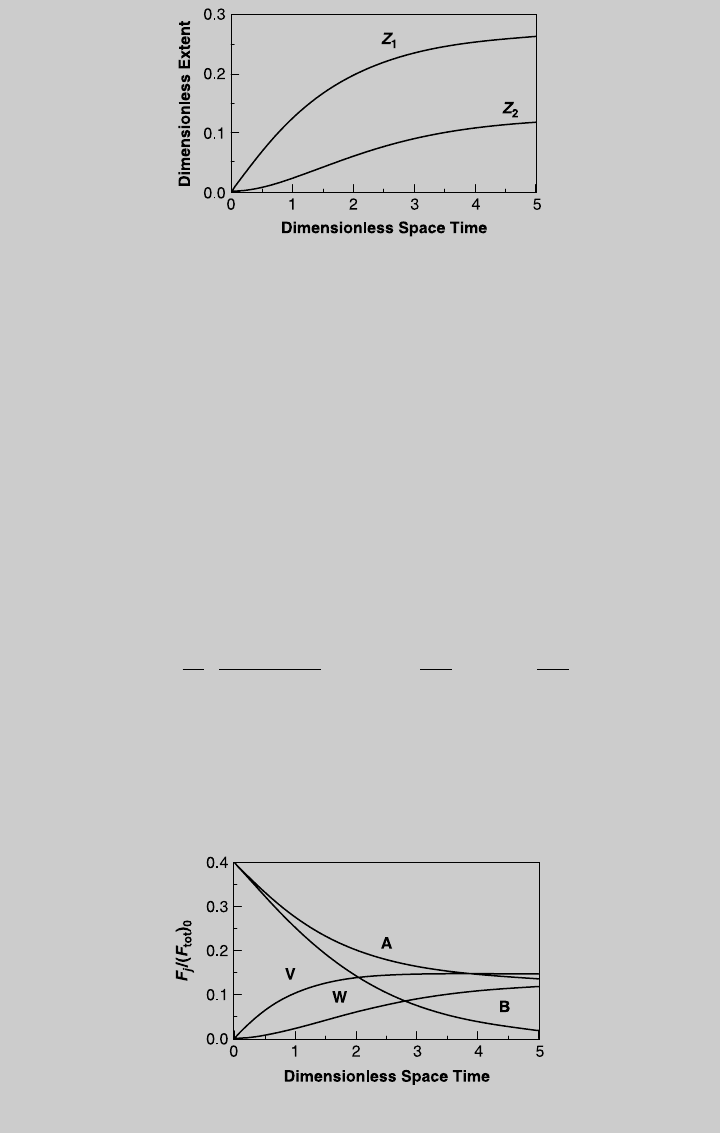
curves, shown in Figure E7.11.2. From the curve of product V, the highest
value of F
V
/(F
tot
)
0
is 0.147, and it is reached at t ¼ 3.85. At that space
time, Z
1
¼ 0.253 and Z
2
¼ 0.106. Hence, using Eq. 7.1.3, the reactor
volume is
V
R
¼ v
0
t
cr
t ¼ 2233 L
Using (l), the production rate of product V is
F
V
¼ (23:04)(0:253 0:105) ¼ 3:41 mol=min
b. Combining Eqs. 7.1.16 and 7.1.19, the local dimensionless heat-transfer rate
along the reactor is
d
dt
_
Q
(F
tot
)
0
^
c
p
0
T
0
¼ DHR
1
dZ
1
dt
þ DHR
2
dZ
2
dt
(p)
Integrating (p), the total heating/cooling load is
_
Q ¼ [(F
tot
)
0
^
c
p
0
T
0
][DHR
1
Z
1
þ DHR
2
Z
2
] ¼91:75 kcal=min
The negative sign indicates that heat is removed from the reactor.
Figure E7.11.1 Reaction operating curves—isothermal operation.
Figure E7.11.2 Species operating curves—isothermal operation.
292 PLUG-FLOW REACTOR
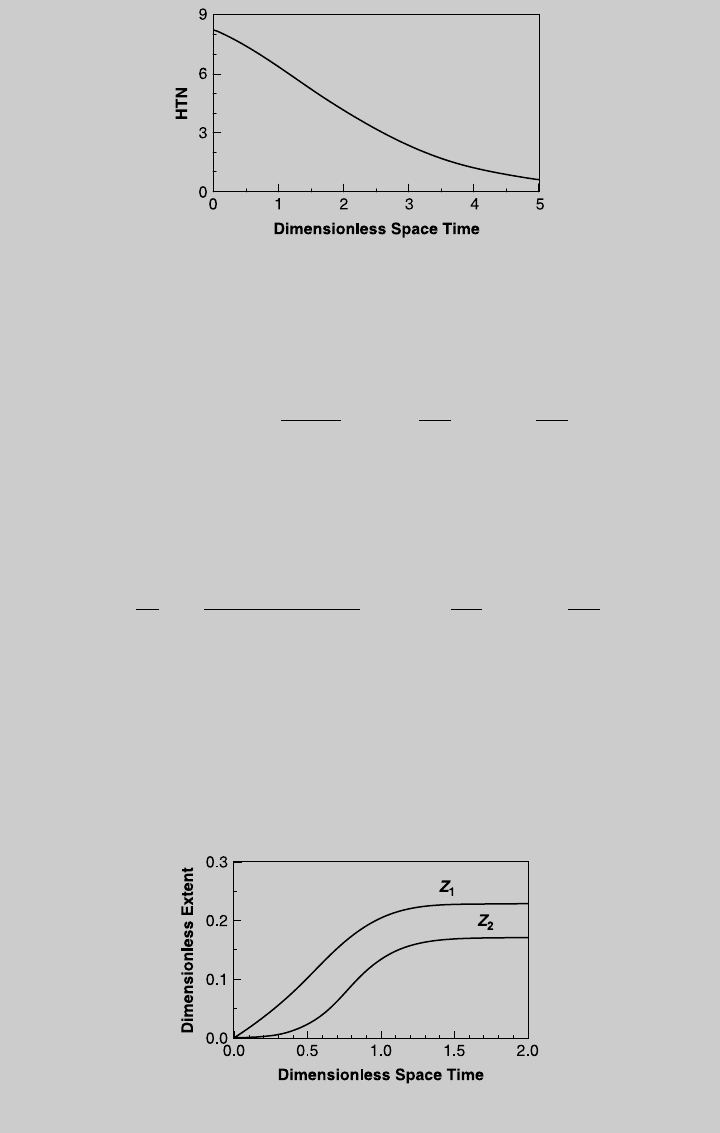
c. Using Eq. 7.1.22, the local isothermal HTN is
HTN
iso
(t) ¼
1
u
F
1
DHR
1
dZ
1
dt
þ DHR
2
dZ
2
dt
(q)
where u
F
¼ 0.953. Figure E7.11.3 shows the local isothermal HTN. Using
Eq. 7.1.23, for t
op
¼ 3.85, the average isothermal HTN is 4.5.
d. For adiabatic operations, HTN ¼ 0, and (h) reduces to
du
dt
¼
11:6
11:6 4Z
1
2Z
2
DHR
1
dZ
1
dt
þ DHR
2
dZ
2
dt
(r)
W e solve (f), (g), and (r) numerically , subject to the initial condition that a t
t ¼ 0, Z
1
¼ Z
2
¼ 0, and u ¼ 1. Figur e E7.11.4 shows the r ea ction curv es, and
Figure E7.11.5 shows the tempera tur e curve. Once w e hav e the solution, we
use ( j) through (m) to determine the species curves, shown in Figur e E7.11.6.
From the curve of product V , the highes t value of F
V
/(F
tot
)
0
¼ 0.0891, and it
Figure E7.11.3 HTN curve.
Figure E7.11.4 Reaction operating curves—adiabatic operation.
7.4 NONISOTHERMAL OPERATIONS 293
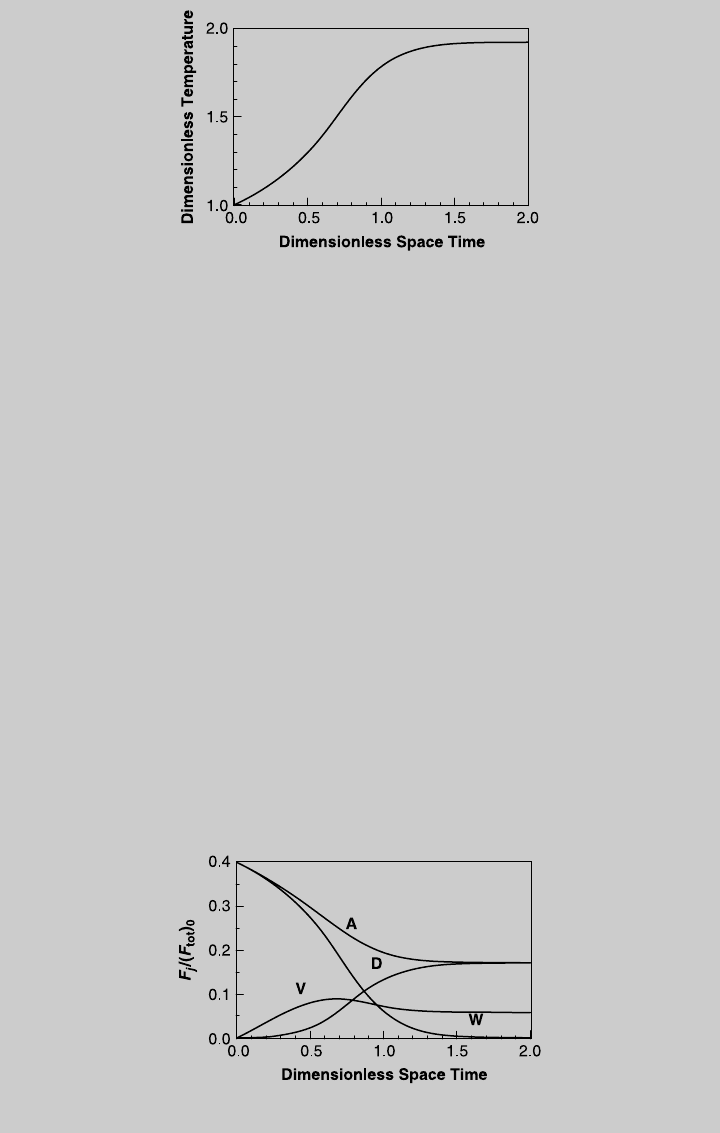
is rea ched at t ¼ 0.68. At that space time, Z
1
¼ 0.1468, Z
2
¼ 0.0577,
and u ¼ 1.4797. Using Eq. 7.1.3, the rea ctor volume is
V
R
¼ v
0
t
cr
t ¼ 394:4L
Using (e), the production r a te of pr oduct V is
F
V
¼ (23:04)(0:1468 0:0577) ¼ 2:05 mol=min
The exit temper atur e is T ¼ T
0
u ¼ (423)(1.4797) ¼ 625.9 K
e. To examine the effect of HTN on the reactor operation, we solve (f), (g), and
(h) for different values of HTN. Figure E7.11.7 shows the effect on the reac-
tor temperature, Figure E7.11.8 shows the effect on the progress of Reaction
1, Figure E7.11.9 shows the effect on the progress of Reaction 2, and
Figure E7.11.10 shows the effect on the production of product V. Note
that when HTN ! 1, the temperature of the reactor is the same as the
jacket temperature (1308C, u ¼ 0.9527). Also, since the activation energy
of Reaction 2 is higher than that of Reaction 1, by operating at lower temp-
erature, the reactor produces more product V, but a larger reactor is required.
Figure E7.11.5 Temperature curve—adiabatic operation.
Figure E7.11.6 Species operating curves—adiabatic operation.
294 PLUG-FLOW REACTOR
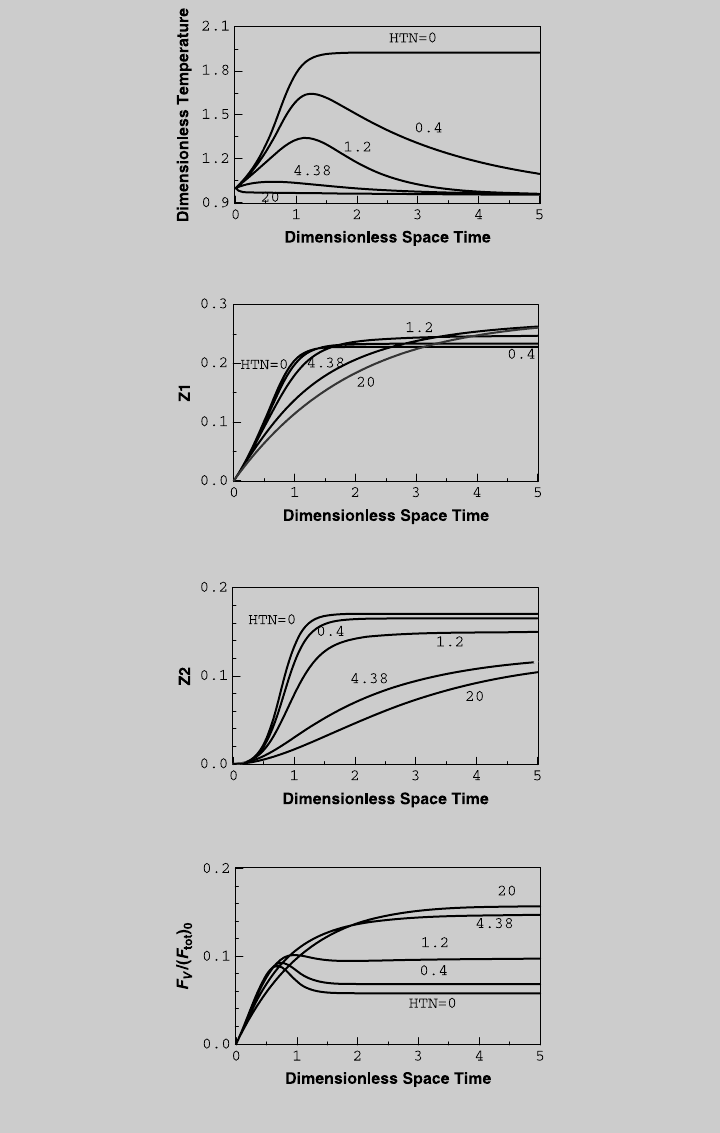
Figure E7.11.7 Effect of HTN on the temperature profile.
Figure E7.11.8 Effect of HTN on Reaction 1.
Figure E7.11.9 Effect of HTN on Reaction 2.
Figure E7.11.10 Effect of HTN on the production of product V.
7.4 NONISOTHERMAL OPERATIONS 295

7.5 EFFECTS OF PRESSURE DROP
In the preceding sections, we discussed the operation of plug-flow reactors with
gas-phase reactions under the assumption that the pressure does not vary along
the reactor. However, in some applications, the pressure significantly changes
and, therefore, affects the reaction rates. In this section, we incorporate the variation
in pressure into the design equations. For convenience, we divide the discussion
into two parts: tubular tube with uniform diameter and packed-bed reactors.
We consider first a cylindrical reactor of uniform diameter D . To derive an
expression for the pressure drop, we write the steady-state momentum balance
equation for a reactor element of length dL and cross-sectional area A:
AdP F
f
¼
_
mdu (7:5:1)
where 2(AdP) is the pressure force, and F
f
is the friction force. Expressing the
friction force in terms of a friction factor, f, and the kinetic energy, for an empty
cylindrical tube of diameter D,
F
f
¼ f (pDdL)
1
2
ru
2
and Eq. 7.5.1 becomes
dP
dL
¼ 4f
_
m
DA
1
2
u þ
_
m
A
du
dL
(7:5:2)
The first term on the right indicates the pressure drop due to friction, and the second
indicates the pressure drop due to change in velocity (kinetic energy). In many
applications, the second term in Eq. 7.5.2 is small in comparison to the first, and
noting that u ¼ v/A, the momentum balance equation reduces to
dP
dL
2 f
_
m
DA
2
v (7:5:3)
where v is the local volumetric flow rate. Using Eq. 7.1.12 and noting from Eq.
7.1.3 that dL ¼ (v
0
t
cr
/A) dt, Eq. 7.5.3 becomes
d(P=P
0
)
dt
2 f
_
mv
2
0
t
cr
DA
3
P
0
1 þ
X
n
I
m
D
m
Z
m
!
u
P
0
P
(7:5:4)
Equation 7.5.4 provides an approximate relation for the changes in pressure along
a plug-flow reactor, expressed in terms of dimensionless extents and temperature.
It is applicable when the velocity does not exceed 80– 90% of the sound velocity.
For these situations, we solve Eq. 7.5.4 simultaneously with the design equation
296 PLUG-FLOW REACTOR

(Eq. 7.1.1) and energy balance equation (Eq. 7.1.16), subject to specified initial
conditions. Note that the first parenthesis on the right is a dimensionless friction
number for the reference stream.
When the gas velocity approaches the sound velocity, the kinetic energy and vis-
cous work terms in the energy balance equation are not negligible (as assumed in
Chapter 5). For these cases, we write the general energy balance equation for a
differential plug-flow reactor with length dL (see Eq. 5.2.44),
d
_
Q d
_
W
vis
¼
_
md hþ
1
2
u
2
þ gz
(7:5:5)
Assuming negligible change in the potential energy,
d
_
Q
_
m
d
_
W
vis
_
m
¼ dh þ udu
For flow in cylindrical conduits, the viscous work per unit mass of the fluid is
expressed in terms of a friction factor and a specific kinetic energy by
d
_
W
vis
_
m
¼ 4f
dL
D
1
2
u
2
(7:5:6)
and the energy balance equation becomes
d
_
Q 4f
_
m
dL
D
1
2
u
2
¼
_
mdhþ
_
mu du (7:5:7)
Multiplying Eq. 7.5.7 by r and then subtracting Eq. 7.5.2, we obtain
dP
dL
¼ v
d
_
Q
dL
_
m
dh
dL
(7:5:8)
For cylindrical reactors,
d
_
Q ¼ U(pDdL)(T
F
T)(7:5:9)
and, differentiating Eq. 5.2.47, the differential enthalpy difference of the reacting
fluid is
_
mdh¼ d
_
H ¼
X
n
I
m
DH
R
m
(T
0
) d
_
X
m
þ
X
J
j
F
j
^
c
p
j
!
dT (7:5:10)
Substituting these relationships into Eq. 7.5.7 and using Eqs. 5.2.54 and 7.1.11,
we obtain
7.5 EFFECTS OF PRESSURE DROP 297

dP
dL
¼
(P=P
0
)[UpD(T
F
T)
P
n
I
m
DH
R
m
(T
0
)(d
_
X
m
=dL)(F
tot
)
0
^
c
p
0
(CF)(dT=dL)]
v
0
1þ
P
n
I
m
D
m
Z
m
u
(7:5:11)
From Eq. 7.1.3, dL ¼ (v
0
t
cr
/A) dt, using Eqs. 3.3.4, 7.1.2, 7.1.4, 5.2.22, and
5.2.23, and, noting that for ideal gas, RC
0
¼ P
0
/T
0
, Eq. 7.5.11 reduces to
d(P=P
0
)
dt
¼
(
^
c
p
0
=R)(P=P
0
)[HTN(u
F
u)
P
n
I
m
DHR
m
(dZ
m
=dt)(CF)(du=dt)]
1þ
P
n
I
m
D
m
Z
m
u
(7:5:12)
Equation 7.5.12 provides the changes in pressure along a plug-flow reactor, and it
should be solved simultaneously with the design equations, and the energy balance
equation. Note that the expression inside the parenthesis in the numerator on right-
hand side of Eq. 7.5.12 is the energy balance equation derived under the assump-
tion that the kinetic energy term and the friction work term are negligible. Indeed,
under this assumption, d(P/P
0
)/dt ¼ 0. To design a plug-flow reactor with
pressure drop, we have to derive the energy balance equation that includes terms
for kinetic energy and the friction work.
To derive an expression for the temperature variation in a tubular plug-flow reac-
tor, we rearrange the general energy balance equation Eq. 7.5.7:
d
_
Q
dL
2f
_
m
1
D
u
2
¼
_
m
dh
dL
þ
_
mu
du
dL
(7:5:13)
For a reactor with uniform cross-sectional area A, u ¼ v/A, and, using Eq. 7.1.12,
u ¼
v
0
A
1 þ
X
n
I
m
D
m
Z
m
!
u
P
0
P
(7:5:14)
Differentiating Eq. 7.5.14 with dL,
du
dL
¼
v
0
A
1 þ
X
n
I
m
D
m
Z
m
!
P
0
P
du
dL
þ
v
0
A
u
P
0
P
X
n
I
m
D
m
dZ
m
dL
v
0
A
1 þ
X
n
I
m
D
m
Z
m
!
P
0
P
2
u
dP
dL
(7:5:15)
298 PLUG-FLOW REACTOR

We substitute Eqs. 7.5.15 and 7.5.14 into Eq. 7.5.13 and note from Eq. 7.1.3 that
dL ¼ (v
0
t
cr
/A) dt. We convert Eqs. 7.5.13 and 7.5.15 to dimensionless forms by
using Eqs. 3.3.4, 7.1.2, 7.1.4, 5.2.22, and 5.2.23, and noting that, for an ideal
gas, RC
0
¼ P
0
/T
0
. The first terms in Eq. 7.5.13 reduce to
d
_
Q
dL
¼
v
0
t
cr
A
d
_
Q
dt
¼
A
v
0
t
cr
HTNF
0
^
c
p
0
T
0
(u
F
u)
The second term in Eq. 7.5.13 reduces to
2f
_
m
1
D
u
2
¼ 2f
_
m
1
D
v
0
2
A
2
1 þ
X
n
I
m
D
m
Z
m
!
2
u
2
P
0
P
2
The third term in Eq. 7.5.13 reduces to
_
m
dh
dL
¼
A
v
0
t
cr
d
_
H
dt
¼
A
v
0
t
cr
F
0
^
c
p
0
T
0
X
n
I
m
DHR
m
dZ
m
dt
þ (CF)
du
dt
!
The fourth term in Eq. 7.5.13 reduces to
_
mu
du
dL
¼
A
v
0
t
cr
_
mu
du
dt
¼
A
v
0
t
cr
_
m
v
0
A
1 þ
X
n
I
m
D
m
Z
m
!
u
P
0
P
du
dt
¼
_
mv
0
At
cr
1 þ
X
n
I
m
D
m
Z
m
!
2
u
P
0
P
2
du
dt
þ
_
mv
0
At
cr
1 þ
X
n
I
m
D
m
Z
m
!
2
u
2
P
0
P
2
X
n
I
m
D
m
dZ
m
dt
_
mv
0
At
cr
1 þ
X
n
I
m
D
m
Z
m
!
2
u
2
P
0
P
3
d(P=P
0
)
dt
Substituting those terms into Eq. 7.5.13 and using Eq. 7.5.12,
du
dt
¼
(TERM)
(Denominator)
(7:5:16)
7.5 EFFECTS OF PRESSURE DROP 299