
Mann U. Principles of Chemical Reactor Analysis and Design: New Tools for Industrial Chemical Reactor Operations
Подождите немного. Документ загружается.

When both reactant solutions are charged initially into the reactor, we use the
design equation of batch reactor with C
0
¼ 3.0 mol/L and y
A
(0) ¼
y
B
(0) ¼ 0.5. Using Eq. 6.1.10 to express the species concentrations, the
rates of the reactions are
r
1
¼ k
1
(T
0
)C
2
0
(0:5 Z
1
2Z
2
)(0:5 Z
1
)e
g
1
(u1=u)
(p)
r
2
¼ k
2
(T
0
)C
2
0
(0:5 Z
1
2Z
2
)
2
e
g
2
(u1=u)
(q)
The design equations are
dZ
1
dt
¼ (0:5 Z
1
2Z
2
)(0:5 Z
1
)e
g
1
(u1=u)
(r)
dZ
2
dt
¼
k
2
(T
0
)
k
1
(T
0
)
(0:5 Z
1
2Z
2
)
2
e
g
2
(u1=u)
(s)
For isothermal operation, u ¼ 1, and we solve these equations and calculate
the dimensionless species operating curves. To compare semibatch and batch
operations, we plot the species operating curves for V and W, shown above.
For adiabatic batch operation, the energy balance equation is
du
dt
¼ DHR
1
dZ
1
dt
þ DHR
2
dZ
2
dt
(t)
We solve (t) simultaneously with (r) and (s) subject to the initial conditions
that Z
1
(0) ¼ Z
2
(0) ¼ 0 and u(0) ¼ 1, and obtain the reaction and species
operating curves for batch operation. An examination of the product operat-
ing curves indicates the advantage of selecting the semibatch mode to reduce
the production of undesirable product W.
9.2 PLUG-FLOW REACTOR WITH DISTRIBUTED FEED
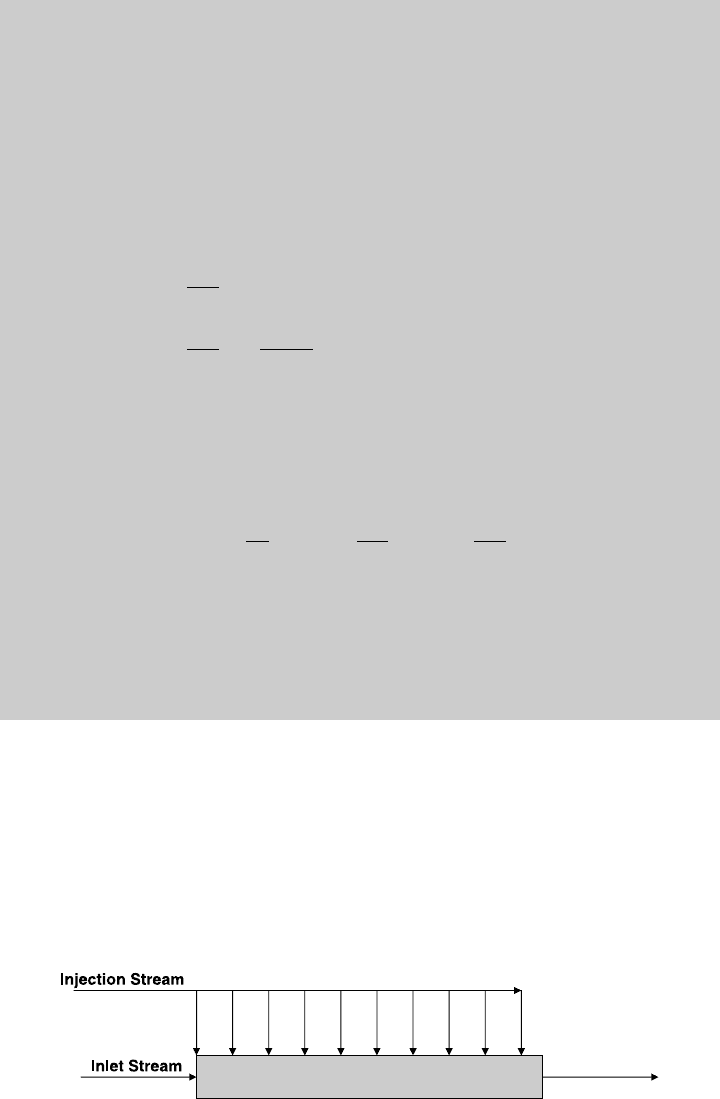
In this section, we discuss the operation of a plug-flow reactor with a distributed
feed along the reactor length, shown schematically in Figure 9.2. This reactor con-
figuration is the flow reactor analog to semibatch operation. While in semibatch
reactors products are generated over time, here products are generated over space
Figure 9.2 Plug-flow reactor with distributed feed.
400 OTHER REACTOR CONFIGURATIONS
(volume). As for semibatch reactors, a plug-flow reactor with a distributed feed is
used when it is desirable to maintain one reactant at a high concentration and
another reactant at low concentration in order to improve the yield of a desirable
product. In practice, it is not easy to control the injection rate along the reactor.
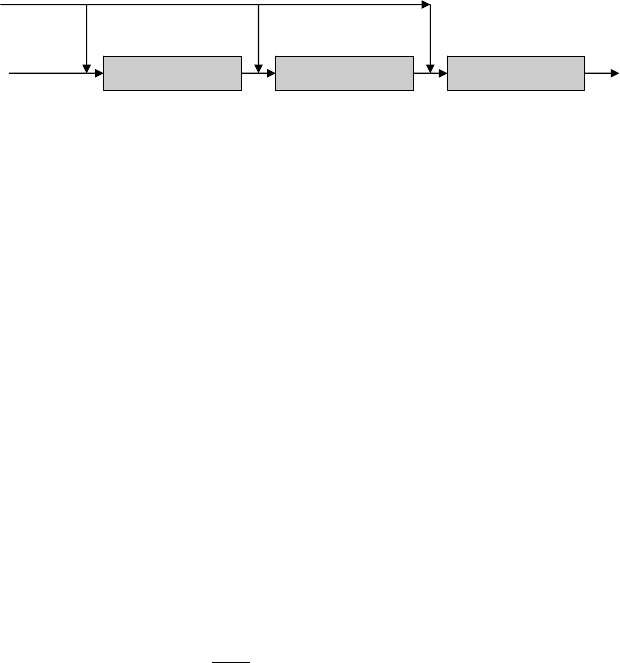
Rather, the plug-flow reactor is divided into distinct sections, each with an injection
stream as shown in Figure 9.3. Nevertheless, a plug-flow reactor with a distributed
feed serves as the limiting model when the number of sections approaches infinity.
To derive the design equation of a plug-flow reactor with a distributed feed, we
write a species balance equation for any species, say species j, that is not injected
along the reactor over reactor element dV. Since the species is not fed or withdrawn,
its molar balance equation is
dF
j
¼ (r
j
) dV (9:2:1)
We follow the same procedure as the one used in Chapter 4 to derive the reaction-
based design equation of a plug-flow reactor and obtain
d
_
X
m
dV
¼ r
m
þ
X
n
D
k
a
km
r
k
(9:2:2)
where
_
X
m
is the extent per unit time of the mth-independent reaction. Equation
9.2.2 is the differential design equation for a plug-flow reactor with a distributed
feed, written for the mth-independent chemical reaction. Note that it is identical
to the design equation of a plug-flow reactor. The only difference between the
two is the way the volumetric flow rate and the species concentrations vary
along the reactor.
To reduce the design equation to a dimensionless form, we select a reference
stream that combines the inlet steam and the injection stream. Hence, its total volu-
metric flow rate is
v
0
; v
in
þ v
inj
(9:2:3)
Its molar flow rate is
(F
tot
)
0
; (F
tot
)
in
þ ( F
tot
)
inj
(9:2:4)
Figure 9.3 Actual implementation of distributed feed.
9.2 PLUG-FLOW REACTOR WITH DISTRIBUTED FEED 401

The reference concentration is defined by
C
0
;
(F
tot
)
0
v
0
(9:2:5)
The dimensionless extent of the m-th independent reaction is defined by
Z
m
;
_
X
m
(F
tot
)
0
(9:2:6)
Also, the dimensionless space time (or dimensionless volume) is defined by
t ;
V
v
0
t
cr
(9:2:7)
Differentiating Eqs. 9.2.6 and 9.2.7, d
_
X
m
¼ (F
tot
)
0
dZ
m
, and dV ¼ (v
0
t
cr
) dt, and
substituting these into Eq. 9.2.2, the design equation reduces to
dZ
m
dt
¼ r
m
þ
X
n
D
k
a
km
r
k
!
t
cr
C
0
(9:2:8)
Equation 9.2.8 is the dimensionless design equation, written for the mth-indepen-
dent reaction. To describe the reactor operation, we have to write Eq. 9.2.8 for each
independent reaction.
To solve the design equations, we have to express reaction rates in terms of the
extents of the independent reactions. Using stoichiometric relation (Eq. 2.3.3), the
local molar flow rate of species j at volume V from the inlet is
F
j
¼ (F
j
)
in
þ
ð
V
0
l(x)(C
j
)
inj
dx þ
X
n
I
m
(s
j
)
m
_
X
m
(9:2:9)
where l(x ) is the local volumetric injection rate per unit reactor volume, (C
j
)
inj
is
the concentration of species j in the injection stream, and (F
j
)
in
is the rate species
j is fed at the reactor inlet. In general, the mode of the injection rate along the reac-
tor, l(x), should be specified. The local concentration of species j is
C
j
¼
F
j
v
¼
1
v
(F
j
)
in
þ
ð
V
0
l(x)(C
j
)
inj
dx þ
X
n
I
m
(s
j
)
m
_
X
m
2
4
3
5
(9:2:10)
where v is the local volumetric flow rate. The first term in the bracket indicates
the molar flow rate of species j fed at the reactor inlet, the second indicates the
402 OTHER REACTOR CONFIGURATIONS

amount injected, and the third indicates the amount generated by the chemical
reactions.
For liquid-phase reactions, the density of the reacting fluid does not vary much
(and it is assumed equal to that of the inlet stream and the injected stream), the volu-
metric flow rate at any point in the reactor is
v ¼ v
in
þ
ð
V
0
l(x) dx (9:2:11)
When the injection flow rate is uniform,
l(x) ¼ l
0
¼
v
inj
V
R
tot
(9:2:12)
where V
R
tot
is the total volume of the reactor, and the local volumetric flow rate is
v ¼ v
in
þ v
inj
V
V
R
tot
(9:2:13)
Substituting Eq. 9.2.13 into Eq. 9.2.10, the local species concentration is
C
j
¼ C
0
(v
in
=v
0
)(C
j
)
in
=C
0
þ (v
inj
=v
0
)(t=t
tot
)(C
j
)
inj
=C
0
þ
P
n
I
m
(s
j
)
m
Z
m
(v
in
=v
0
) þ (v
inj
=v
0
)(t=t
tot
)
(9:2:14)
where t
tot
is the total dimensionless space time of the reactor, defined by
t
tot
;
V
R
tot
v
0
t
cr
(9:2:15)
For gas-phase reactions, assuming ideal-gas behavior, the local volumetric flow
rate is
v ¼ v
0
F
tot
(F
tot
)
0
T
T
0
P
0
P
(9:2:16)
where F
tot
is the local total molar flow rate given by
F
tot
¼ (F
tot
)
in
þ
ð
V
0
l(x)(C
tot
)
inj
dx þ
X
n
I
m
D
m
_
x
m
(9:2:17)
9.2 PLUG-FLOW REACTOR WITH DISTRIBUTED FEED 403

For uniform injection along the reactor, and assuming negligible pressure drop, the
local volumetric flow rate is
v ¼ v
0
(F
tot
)
in
(F
tot
)
0
þ
(F
tot
)
inj
(F
tot
)
0
t
t
tot
þ
X
n
I
m
D
m
Z
m
"#
u (9:2:18)
where (F
tot
)
in
and (F
tot
)
inj
are the molar flow rates of the inlet and the injection
streams, respectively. Combining Eqs. 9.2.18 and 9.2.10, the local species concen-
tration is
C
j
¼ C
0
(F
j
)
in
(F
tot
)
0
þ
(F
j
)
inj
(F
tot
)
0
t
t
tot
þ
X
n
I
m
(s
j
)
m
Z
m
(F
tot
)
in
(F
tot
)
0
þ
(F
tot
)
inj
(F
tot
)
0
t
t
tot
þ
X
n
I
m
D
m
Z
m
"#
u
(9:2:19)
For nonisothermal operations, we have to use the energy balance equation to
express temperature variation along the reactor. Consider a section of volume V
from the reactor inlet. Assuming negligible kinetic and potential energies, the
energy balance equation is
_
H(V)
_
H
in
¼
_
Q(V) þ
_
m
inj
(V)h
inj
(9:2:20)
where
_
H(V)
_
H
in
is the rate enthalpy flows in and out of a reactor section of
volume V,
_
Q(V) is the rate heat is added to the section, and
_
m
inj
(V)h
inj
is the rate
enthalpy added to the section by the injection stream (h
inj
is the specific mass-
based enthalpy of the injection stream). For reacting fluids,
_
H(V)
_
H
in
¼
_
m(V)
c
p
(T T
0
)
_
m
in
c
p
(T
in
T
0
) þ
X
n
I
m
DH
R
m
_
X
m
(9:2:21)
The first two terms on the right-hand side indicate the change in the sensible heat,
and the third indicates the change in enthalpy due to the chemical reactions.
Differentiating Eq. 9.2.20 with respect to the reactor volume,
d
_
H
dV
¼
d
_
Q
dV
þ (lr
inj
)h
inj
(9:2:22)
Differentiating Eq. 9.2.21 with respect to the reactor volume,
d
_
H
dV
¼
_
m
c
p
dT
dV
þ
d
_
m
dV
c
p
(T T
0
) þ
X
n
I
m
DH
R
m
d
_
X
m
dV
(9:2:23)
404 OTHER REACTOR CONFIGURATIONS

From overall material balance,
d
_
m
dV
¼ lr
inj
and the rate heat transferred per unit volume is
d
_
Q
dV
¼ U(T
F
T)
S
V
Combining Eqs. 9.2.22 and 9.2.23, and using these relations, the energy balance
equation becomes
dT
dV
¼
1
_
m
c
p
U
S
V
(T
F
T) þ(lr
inj
)h
inj
( lr
inj
)
c
p
(T T
0
)
X
n
I
m
DH
R
m
d
_
X
m
dV
"#
(9:2:24)
Equation 9.2.24 describes the change of temperature along the reactor. To reduce it
to dimensionless form, recall that
dV ¼ v
0
t
cr
dt dT ¼ T
0
du d
_
X
m
¼ (F
tot
)
0
dZ
HTN ¼
Ut
cr
C
0
^
c
p
0
S
V
DHR
m
¼
DH
R
m
(T
0
)
T
0
^
c
p
0
and using a correction factor of the heat capacity, defined by
CF ;
_
m
c
p
(F
tot
)
0
^
c
p
0
Equation 9.2.24 reduces to
du
dt
¼
1
CF
HTN(u
F
u) þ
(lr
inj
)t
cr
C
0
^
c
p
0
T
0
h
inj
(lr
inj
)
c
p
t
cr
C
0
^
c
p
0
(u 1)
X
n
I
m
DHR
m
dZ
m
dt
"#
(9:2:25)
For uniform injection rate,
l ¼
v
inj
V
R
tot
¼
v
inj
v
0
v
0
V
R
tot
9.2 PLUG-FLOW REACTOR WITH DISTRIBUTED FEED 405

and the energy balance equation reduces to
du
dt
¼
1
CF
HTN(u
F
u) þ
1
t
tot
v
inj
v
0
r
inj
h
inj
C
0
^
c
p
0
T
0
1
t
tot
v
inj
v
0
r
inj
c
p
C
0
^
c
p
0
(u 1)
X
n
I
m
DHR
m
dZ
m
dt
"#
(9:2:26)
where t
tot
, the total dimensionless space time, is defined in Eq. 9.2.15. When the
injection stream does not involve phase change,
h
inj
¼
c
p
inj
(T
inj
T
0
)(9:2:27)
For most liquid-phase reactions, the density and the mass-based specific heat
capacity of the reacting fluid and the injection stream are assumed to be the
same and constant. For uniform injection rate, Eq. 9.2.26 reduces to
du
dt
¼
1
CF
HTN(u
F
u) þ
1
t
tot
v
inj
v
0
r
c
p
C
0
^
c
p
0
[u
inj
u]
X
n
I
m
DHR
m
dZ
m
dt
"#
(9:2:28)
where the specific molar heat capacity of the reference stream is
^
c
p
0
;
(
_
m
in
þ
_
m
inj
)
c
p
(F
tot
)
0
(9:2:29)
and the correction factor of the heat capacity is
CF ¼
c
p
(F
tot
)
0
^
c
p
0
_
m
in
þ
_
m
inj
t
t
tot
(9:2:30)
Note that although the specific heat capacity of the reacting liquid is constant, the
correction factor varies along the reactor because the mass flow rate changes.
For gas-phase reactions, the heat capacity of the reacting fluid depends on both
composition and temperature. Also, the specific heat capacity of the injection
stream is usually different from that of the inlet stream. To account for the effect
of composition and temperature, molar-based specific heat capacities are used.
The molar-based and the mass-based specific heat capacities are related by
_
m
c
p
;
X
J
j
F
j
^
c
p
j
(u)
_
m
inj
c
p
;
X
J
j
(F
j
)
inj
^
c
p
j
(u
inj
)(9:2:31)
406 OTHER REACTOR CONFIGURATIONS

Substituting Eq. 9.2.31 into Eq. 9.2.20,
_
H
_
H
in
;
_
Q þ
X
J
j
F
j
inj
^
c
p
j
(T)
"#
(T
inj
T
0
)(9:2:32)
Substituting Eq. 9.2.31 into Eq. 9.2.21,
_
H
_
H
in
;
X
J
j
F
j
^
c
p
j
(T)
"#
(T T
0
)
X
J
j
(F
j
)
in
^
c
p
j
(T
in
)
"#
(T
in
T
0
)þ
X
n
I
m
DH
R
m
(T
0
)
_
X
m
(9:2:33)
Differentiating these relations with respect to the volume V,
d
_
H
dV
¼
d
_
Q
dV
þ
X
J
j
d(F
j
)
inj
dV
^
c
p
j
(T
inj
)
"#
(T
inj
T
0
)(9:2:34)
d
_
H
dV
¼
X
J
j
dF
j
dV
^
c
p
j
(T)
"#
(T T
0
)þ
X
J
j
F
j
^
c
p
j
(T)
"#
dT
dV
þ
X
n
I
m
DH
R
m
(T
0
)
d
_
X
m
dV
(9:2:35)
Combining Eqs. 9.2.34 and Eq. 9.2.35 and rearranging,
dT
dV
¼
1
P
J
j
F
j
^
c
p
j
(T)
d
_
Q
dV
þ
X
J
j
d(F
j
)
inj
dV
^
c
p
j
(T
inj
)
!
(T
inj
T
0
)
"
X
J
j
dF
j
dV
^
c
p
j
(T)
!
(T T
0
)
X
n
I
m
DH
R
m
(T
0
)
d
_
X
m
dV
#
(9:2:36)
Using a material balance over species j,
dF
j
dV
¼
d(F
j
)
inj
dV
þ
X
n
I
m
(s
j
)
m
d
_
X
m
dV
(9:2:37)
9.2 PLUG-FLOW REACTOR WITH DISTRIBUTED FEED 407

and Eq. 9.2.36 reduces to
dT
dV
¼
1
P
J
j
F
j
^
c
p
j
d
_
Q
dV
þ
X
J
j
d(F
j
)
inj
dV
^
c
p
j
(T
inj
)
!
(T
inj
T
0
)
"
X
J
j
^
c
p
j
X
n
I
m
(s
j
)
m
d
_
X
m
dV
!
(T T
0
)
X
n
I
m
DH
R
m
(T
0
)
d
_
X
m
dV
#
(9:2:38)
We reduce Eq. 9.2.38 to dimensionless form similar to the way we reduced
Eq. 9.2.24. When the species heat capacities do not vary with temperature, the
energy balance equation for gas-phase reactions is
du
dt
¼
1
CF
HTN(u
F
u)þ
X
J
j
d
dt
(F
j
)
inj
(F
tot
)
0
^
c
p
j
^
c
p
0
(u
inj
u)
"
X
J
j
^
c
p
j
^
c
p
0
X
n
I
m
(s
j
)
m
dZ
m
dt
!
(u1)
X
n
I
m
DH
R
m
(T
0
)
dZ
m
dt
#
(9:2:39)
where CF is the correction factor of the heat capacity of the reacting fluid,
defined by
CF;
P
J
j
F
j
^
c
p
j
(F
tot
)
0
^
c
p
0
(9:2:40)
and the specific molar heat capacity of the reference stream is
^
c
p
0
¼
X
J
j
(F
j
)
in
þ(F
j
)
inj
(F
tot
)
0
^
c
p
j
(9:2:41)
When the side injection rate is uniform,
d
dt
(F
j
)
inj
(F
tot
)
0
¼
1
t
tot
(F
j
)
inj
(F
tot
)
0
Equation 9.2.39 reduces to
du
dt
¼
1
CF
HTN(u
F
u)þ
1
t
tot
X
J
j
(F
j
)
inj
(F
tot
)
0
^
c
p
j
^
c
p
0
(u
inj
u)
"
X
J
j
^
c
p
j
^
c
p
0
X
n
I
m
(s
j
)
m
dZ
m
dt
!
(u1)
X
n
I
m
DH
R
m
(T
0
)
dZ
m
dt
#
(9:2:42)
408 OTHER REACTOR CONFIGURATIONS

The correction factor of the heat capacity is
CF(Z
m
,u)¼
1
^
c
p
0
X
J
j
(F
j
)
in
(F
tot
)
0
þ
(F
j
)
inj
(F
tot
)
0
t
t
tot
þ
X
n
I
m
(s
j
)
m
Z
m
(t)
"#
^
c
p
j
(u)(9:2:43)
We solve the design equations simultaneously with the energy balance equation,
subject to the initial condition that at t ¼ 0, the extents of all the independent reac-
tions and the dimensionless temperature are specified. Note that we solve these
equations for a specified value of t
tot
(or reactor volume). The reaction operating
curves of plug-flow reactors with side injection are the final value of Z
m
’s and u
for different values of t
tot
.
Example 9.3 Valuable product V is produced in a plug-flow reactor with a
distributed feed. The following simultaneous, gas-phase chemical reactions
take place in the reactor:
Reaction 1: A þ B ! V
Reaction 2: 2A ! W
The reaction rates are r
1
¼ k
1
C
A
C
B
, and r
2
¼ k
2
C
A
2
. Two equal streams
(50 mol/min each), one of reactant A and one of reactant B, are to be processed
in the reactor. Reactant A is injected uniformly along the reactor, and reactant B
is fed into the reactor inlet. The reactor is operated at 2 atm.
a. Derive the design equations, and plot the reaction and species operating
curves for adiabatic operation with inlet temperature of 3008C and injection
temperature of 2508C.
b. Compare the operation to that of an adiabatic plug-flow reactor.
c. For each operation, what is the reactor volume, and what are the species pro-
duction rates at 90% conversion of reactant A?
d. Examine the effect of the inlet temperature on the performance of the reactor
(for T
inj
¼ 2508C).
Data: At 3008C, k
1
¼ 0:8L=mol sec
1
k
2
¼ 1:6L=mol sec
1
DH
R
1
¼5000 cal=mol DH
R
2
¼3750 cal=mol
E
a
1
¼ 12,000 cal =mol E
a
2
¼ 24,000 cal=mol
^
c
P
A
¼ 30 cal=mol K
1
^
c
P
B
¼ 10 cal=mol K
1
^
c
P
V
¼ 32 cal=mol K
1
^
c
P
W
¼ 40 cal=mol K
1
9.2 PLUG-FLOW REACTOR WITH DISTRIBUTED FEED 409