
Mann U. Principles of Chemical Reactor Analysis and Design: New Tools for Industrial Chemical Reactor Operations
Подождите немного. Документ загружается.


Using the correction factor of the heat capacity (Eq. 5.2.54), Eq. 9.4.23 reduces to
ð
u
1
1
CF(Z
m
, u)
1
du ¼
ð
u
4
1
CF(Z
m
, u)
4
du (9:4:25)
which relates to the various process variables by
ð
u
1
1
X
J
j
(1 þ R)y
j
0
þ R
X
n
I
m
(s
j
)
m
Z
m
out
"#
^
c
p
j
(u
1
)du
¼
ð
u
4
1
R
X
J
j
y
j
0
þ
X
n
I
m
(s
j
)
m
Z
m
out
"#
^
c
p
j
(u
4
) du (9:4:26)
We solve Eq. 9.4.26 to express u
1
in terms of u
4
. When the heat capacities of the
species are independent of the temperature, Eq. 9.4.25 reduces to
u
1
¼ 1 þ
CF(Z
m
, u)
4
CF(Z
m
, u)
1
u
4
1(9:4:27)
For liquid-phase reactions, assuming constant density and a constant specific
heat capacity, CF(Z
m
, u) ¼
_
m=
_
m
0
, and Eq. 9.2.27 becomes, for u
4
¼ u
out
,
u
1
¼ 1 þ
R
1 þ R
u
out
1(9:4:28)
Note that, when R ¼ 0, u
1
¼ 1, and, when R ! 1, u
1
¼ u
out
.
For gas-phase reactions with constant species heat capacities, Eq. 9.4.27
becomes, for u
4
¼ u
out
,
u
1
¼ 1 þ
R
P
J
j
( y
j
)
0
þ
P
n
I
m
(s
j
)
m
Z
m
out
^
c
p
j
P
J
j
(1 þ R)( y
j
)
0
þ R
P
n
I
m
(s
j
)
m
Z
m
out
^
c
p
j
u
out
1(9:4:29)
With the concentration relations and an expression for u
1
, we can now complete
the design formulation of recycle reactors. Substituting the species concentrations
and u in the individual reactions rates, r
m
’s and r
k
’s, we obtain a set of first-order,
nonlinear differential equations that should be solved simultaneously with the
energy balance equation for the initial condition that at t ¼ 0, Z
m
’s ¼ 0 and u ¼
u
1
. Note that we solve these equations for a given value of t
tot
corresponding to
a given reactor volume. The solutions indicate how the extents and temperature
vary along the reactor for the specified reactor. To obtain the operating curves of
recycle reactors (for a given recycle ratio), we repeat the calculations for different
430 OTHER REACTOR CONFIGURATIONS

values of t
tot
and for each case determine the final value of Z
m
’s and u. Also note
that the species concentrations are expressed in terms of the extents at the reactor
outlet. Therefore, the solutions are obtained by an iterative procedure. We first
guess the outlet extents, Z
m
out
’s, solve the set of differential equations, and then
check if the calculated outlet extents agree with the assumed values.
Example 9.5 Autocatalytic reactions are chemical reactions where a product
of the reaction affects its rate. For such reactions, a recycle reactor provides
better performance. This example examines the use of a recycle reactor to
carry out an autocatalytic reaction. Consider the liquid-phase chemical reaction
A ! B þC
whose rate expressions is r ¼ kC
A
C
C
. A 450-L tubular reactor is available in the
plant, and a stream consisting of 95% of reactant A and 5% of product C (mole
%) is to be processed in the reactor. The volumetric flow rate of the stream is
300 L/min and its total molar flow rate is 1500 mol/min. The stream tempera-
ture is 608C.
a. Determine the optimal recycle ratio for isothermal operation.
b. Determine the optimal recycle ratio for adiabatic operation.
c. Compare the production rate in each case to that of a plug-flow reactor and a
CSTR operating at the same conditions.
Data:At608C, k ¼ 0:4L=mol min, DH
R
¼8 kcal=mol, E
a
¼ 6 kcal=mol
The density of the stream ¼ 0.9 kg/L and its mass-based specific heat capacity
is 0.85 kcal/kg K.
Solution The stoichiometric coefficients of the chemical reaction are
s
A
¼1 s
B
¼ 1 s
C
¼ 1 D ¼ 1
We select the feed stream as the reference stream; hence, the reference concen-
tration is
C
0
¼
(F
tot
)
0
v
0
¼ 5 mol=L
The composition of the reference stream is y
A
0
¼ 0:95, y
B
0
¼ 0, and y
C
0
¼ 0:05.
For liquid-phase reactions, the specific molar heat capacity of the reference
stream is
^
c
p
0
¼
v
0
r
c
p
(F
tot
)
0
¼ 153 cal=mol K
9.4 RECYCLE REACTOR 431

The reference temperature is T
0
¼ 333.15 K, and the dimensionless heat of
reaction is
DHR ¼
DH
R
(T
0
)
T
0
^
c
p
0
¼0:16
The dimensionless activation energies of reaction is
g ¼
E
a
RT
0
¼ 9:06
Using Eq. 9.4.5, the design equation of a recycle reactor is
dZ
dt
¼ r
t
cr
C
0
0 t t
tot
(a)
Using Eq. 9.4.19, the local concentrations of reactant A and product C at any
point in the reactor are
C
A
¼ C
0
y
A
0
R
1 þ R
Z
out
1
1 þ R
Z
(b)
C
C
¼ C
0
y
C
0
þ
R
1 þ R
Z
out
þ
1
1 þ R
Z
(c)
The local rate of the chemical reaction is
r ¼k(T
0
) y
A
0
R
1 þR
Z
out
1
1 þR
Z
y
C
0
þ
R
1 þR
Z
out
þ
1
1 þR
Z
e
g(u1)=u
(d)
The characteristic reaction time is
t
cr
¼
1
k(T
0
)C
0
¼0:5 min (e)
Substituting (d) and (e) into (a), the design equation reduces to
dZ
dt
¼ y
A
0
R
1 þR
Z
out
1
1 þR
Z
y
C
0
þ
R
1 þR
Z
out
þ
1
1 þR
Z
e
g(u1)=u
0 t t
tot
(f)
Using 9.4.22, the energy balance equation for a recycle reactor is
du
dt
¼
1
CF(Z
m
, u)
HTN(u
F
u) DHR
dZ
dt
0 t t
tot
(g)
432 OTHER REACTOR CONFIGURATIONS
For liquid-phase reactions, assuming a constant specific mass-based heat
capacity, the local correction factor is
CF(Z
m
, u) ¼
v
v
0
¼1 þR (h)
Using Eq. 9.4.28, the relationship between the inlet reactor temperature and the
outlet temperature is
u
1
¼1 þ
R
1 þR
(u
out
1) (i)
For the given reactor,
t
tot
¼
V
R
v
0
t
cr
¼3(j)
a. For isothermal operation, u ¼ 1, and we solve (f) for different values of
recycle ratio, R, subject to the initial conditions Z(0) ¼ 0. Note that each sol-
ution involves iterations because Z
out
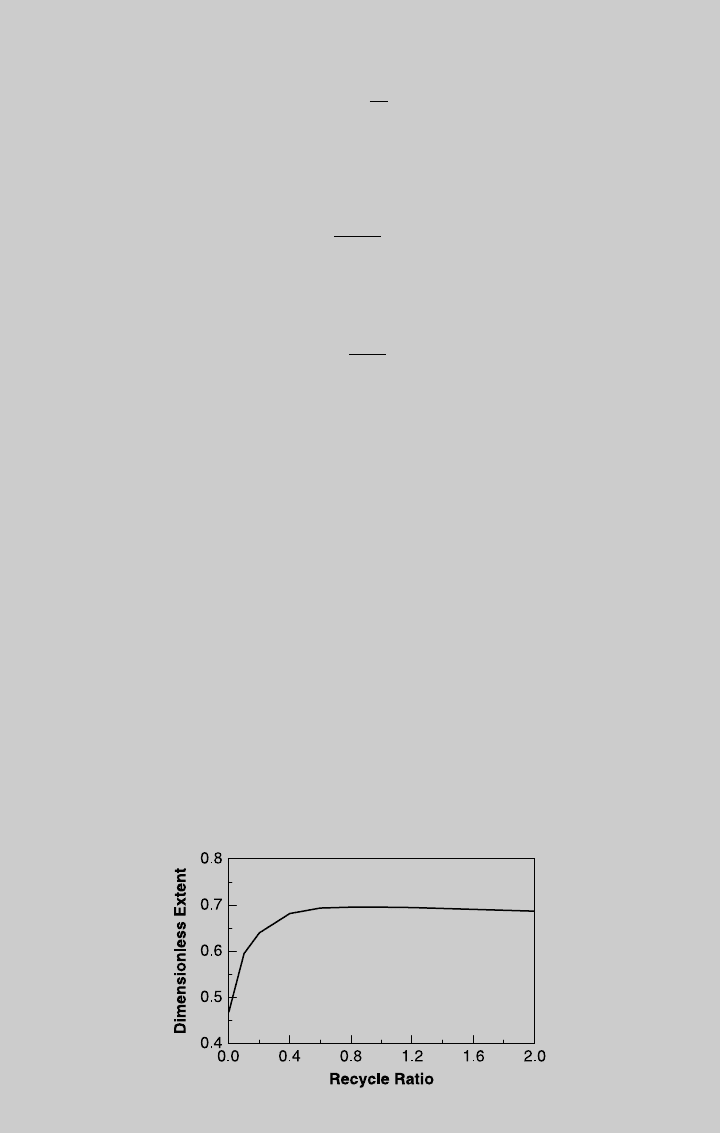
is not known a priori. Figure E9.5.1
shows the reaction extent at the reactor outlet as a function of recycle ratio.
From the curve, highest production of product B (highest Z
out
) is achieved
at R ¼ 0.9, with Z
out
¼ 0.696. The production rate of product B is
F
B
out
¼ (F
tot
)
0
y
B
0
þ Z
out
ðÞ¼1044 mol=min
For comparison, for isothermal plug-flow reactor (R ¼ 0) of the same
volume, the outlet extent is Z
out
¼ 0.469, and the production rate of product
B is 703.5 mol/min. For isothermal CSTR (R ¼ 1) of the same volume, the
outlet extent is Z
out
¼ 0.641, and the production rate of product B is
961.5 mol/min.
b. For adiabatic operation, HTN ¼ 0, and we solve (f) and (g) simultaneously,
subject to the initial conditions Z(0) ¼ 0, and u(0) ¼ u
1
, where u
1
is given by
Figure E9.5.1 Effect of recycle ratio—isothermal operation.
9.4 RECYCLE REACTOR 433
(i). Here too, the solution involves iterations because Z
out
and u
out
are not
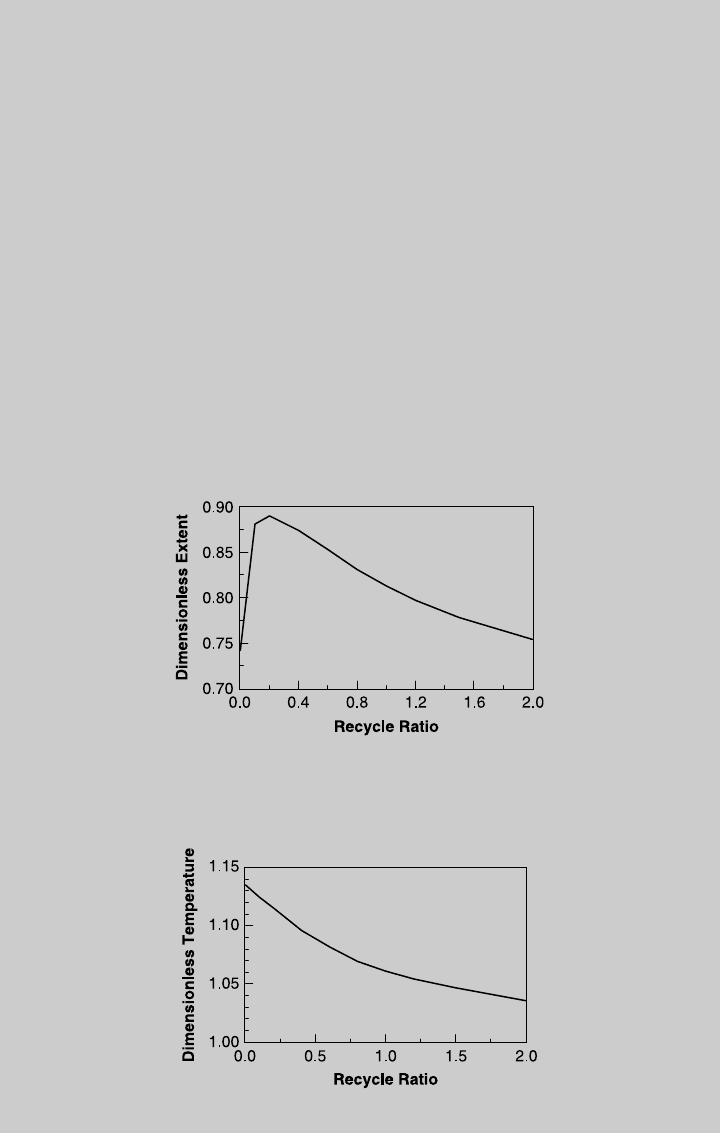
known a priori. Figure E9.5.2 shows the reaction extent at the reactor
outlet as a function of recycle ratio, and Figure E9.5.3 shows the exit temp-
erature as a function of the recycle ratio. From Figure E9.5.2, the highest Z
out
is achieved at R ¼ 0.2, with Z
out
¼ 0.890 and u
out
¼ 1.152. The production
rate of product B is
F
B
out
¼ (F
tot
)
0
y
B
0
þ Z
out
ðÞ¼1335 mol=min
For comparison, for adiabatic plug-flow reactor (R ¼ 0) of the same volume,
the outlet extent is Z
out
¼ 0.742, and u
out
¼ 1.135. The production rate of pro-
duct B is 1,131 mol /min. For adiabatic CSTR (R ¼ 1) of the same volume,
the outlet extent is Z
out
¼ 0.841, and u
out
¼ 1.132. The production rate of
product B is 1260 mol/min. Note that for both isothermal and adiabatic oper-
ation, a recycle reactor provides a higher production rate of product B than a
corresponding plug-flow reactor and a CSTR.
Figure E9.5.2 Effect of recycle ratio—adiabatic operation.
Figure E9.5.3 Effect of recycle ratio on outlet temperature—adiabatic operation.
434 OTHER REACTOR CONFIGURATIONS
9.5 SUMMARY
In this chapter, we discussed the design of different reactor configurations. We
showed how the reaction-based design formulation is used to describe the oper-
ations of these reactors with multiple reactions. We covered in some detail the fol-
lowing reactor models:
a. Semibatch reactor
b. Plug-flow reactor with a distributed feed
c. Distillation reactor
d. Recycle reactor
The reader is challenged to derive design formulations to other reactor configur-
ations and models.
PROBLEMS*
9.1
4
Chlorinations of hydrocarbons are notorious for their undesirable side
reactions, where the desired products are further chlorinated to bi- or tri-
substitutions. You are on a research team that is assigned to examine the
operating mode of a chlorination reactor. The following homogeneous,
gas-phase reactions take place in the reactor:
A þ B ! V
A þ V ! W
A þ W ! P
where A is the chlorine, B is the hydrocarbon, and V is the desired product
(monochlorinated hydrocarbon). The team was assigned the task to design a
continuous reactor. Two members of the team suggest two different
approaches. One engineer suggests using a plug-flow reactor, feeding it
with a stoichiometric proportion of A and B. The second engineer suggests
using a plug-flow reactor feeding the hydrocarbon (B) at the inlet and inject-
ing the chlorine (A) uniformly along the reactor. Here too, A and B are fed in
stoichiometric proportion. Each reactant stream is available at 300 K and
1 atm. The flow rate of the hydrocarbon stream is 10 mol/min.
*
Subscript 1 indicates simple problems that require application of equations provided in the text.
Subscript 2 indicates problems whose solutions require some more in-depth analysis and modifi-
cations of given equations. Subscript 3 indicates problems whose solutions require more comprehen-
sive analysis and involve application of several concepts. Subscript 4 indicates problems that requires
the use of a mathematical software or the writing of a computer code to obtain numerical solutions.
PROBLEMS 435
a. Derive the design equations and plot the reaction and species operating
curves for each mode.
b. Determine the optimal reactor volume for maximizing the production of
product V for each mode.
c. Suggest the preferred operating mode (check t
tot
¼ 10 t
cr
; t
tot
¼ 8 t
cr
;
t
tot
¼ 5 t
cr
).
The rate expressions are
r
1
¼ k
1
C
0:5
A
C
B
r
2
¼ k
2
C
A
C
V
r
3
¼ k
3
C
A
C
W
Data: At 300 K: k
1
C
0:5
0
¼ 0:5 min
1
; k
2
C
0
¼ 1:0 min
1
; k
3
C
0
¼ 1:2 min
1
9.2
4
You are on a research team that is assigned to examine the opera ting mode of a
chemical reactor. The following liquid-phase reactions take place in the reactor
A ! 2V
A þ V ! W
One engineer suggests operating the reactor as a batch reactor, charging it with
reactant A. The second engineer sugges ts operating the rea ctor as a semiba tch
reactor with a cons tant injection r ate.
a. Derive the design equations and plot the reaction and species operating
curves for isothermal operation of each mode (at 350 K).
b. Derive and plot the heating curve and determine the isothermal HTN for
each mode.
c. Determine the optimal operating time for maximizing the production of
product V for each mode.
d. Repeat (a) and (b) for adiabatic operation of each mode.
The rate expressions are: r
1
¼ k
1
C
A
r
2
¼ k
2
C
A
C
V
Data: Feed properties: r¼ 0:85 kg=L C
A
¼ 2 mol=L
At 350 K: k
1
¼ 0:2 min
1
k
2
C
0
¼ 0:01 min
1
E
a
1
¼ 12 kcal=mol E
a
2
¼ 6 kcal=mol
DH
R
1
¼ 15 kcal=mol DH
R
2
¼20 kcal=mol
9.3
4
The elementary gas-phase reactions
2A ! B
A þ B ! C
436 OTHER REACTOR CONFIGURATIONS
take place in an isothermal recycle reactor. Product B is the desirable pro-
duct. Derive and plot the reaction curves and the species curves for a recycle
reactor when the recycle ratio is 5. Reactant A is fed to the reactor at 1378C
and 2 atm at a volumetric flow rate of 10 L/s.
a. Derive and plot the reaction curves and the species curves.
b. What should be the volume of the reactor to obtain the highest production
rate of product B?
At the r eactor opera ting temperature, k
1
¼ 200 L/mol s
21
, k
2
¼ 50 L/mol s
21
.
9.4
4
The homogeneous catalytic liquid-phase reaction
2A ! R
is catalyzed by species B (the catalyst), and the reaction rate expression is
r ¼ kC
2
A
C
B
. The reaction is taking place in a semibatch reactor in
which 100 L of a solution containing reactant A (2 mol/L) is initially
charged to the reactor. A solution containing species B (0.5 mol/L) is
injected at a uniform rate of 0.5 L/min. At the operating condition k ¼
0.2 L
2
mol
22
min
21
.
a. Derive the design equation and plot the reaction and species curves.
b. How many moles of product R are in the reactor after half an hour?
c. Repeat parts (a) and (b) for the case where the reactor is filled initially
with 100 L of the B solution, and the solution of reactant A is fed to
the reactor at a constant rate of 5 L/min.
d. Which operation is preferable?
9.5
4
You are asked to design a semibatch reactor to be used in the production of
specialized polymers (ethylene glycol–ethylene oxide co-polymers). The
semi-batch operation is used to improve the molecular-weight distribution.
Reactant B (EG) and a fixed amount of homogeneous catalyst are charged
initially into the reactor (the proportion is 6.75 moles of catalyst per 1000
moles of Reactant B). Reactant A (EO) is injected at a constant rate
during the operation. The polymerization reactions are represented by the
following liquid-phase chemical reactions:
Reaction 1: A þ B ! C
Reaction 2: A þ C ! D
Reaction 3: A þ D ! E
Reaction 4: A þ E ! F
PROBLEMS 437

The rates of the chemical reactions are:
r
1
¼ k
1
C
cat
C
A
C
B
C
B
þ C
C
þ C
D
þ C
E
þ C
F
r
2
¼ k
2
C
cat
C
A
C
C
C
B
þ C
C
þ C
D
þ C
E
þ C
F
r
3
¼ k
3
C
cat
C
A
C
D
C
B
þ C
C
þ C
D
þ C
E
þ C
F
r
4
¼ k
4
C
cat
C
A
C
E
C
B
þ C
C
þ C
D
þ C
E
þ C
F
A batch has to process 4 k-moles of Reactant B (1000 liter) and 8 k-mole of
Reactant A (2000 liter). The catalyst (KOH) is dissolved in the solution of
Reactant B. The overall objective is to maximize the production of
Product D and to minimize the amounts of the other products. Your task
is to determine whether semibatch operation is preferable, and to specify
the duration of the operation. Consider the following operations:
a. Isothermal operation at 1258C. Derive and plot the reaction and species
curves, and compare them to those of batch reactors.
b. What is the required heating load during the semibatch and batch oper-
ations in (a)—show the heating/cooling curve, and indicate the total
load (in kcal).
c. If the temperature of the jacket is 1108C, what is the isothermal HTN in
(a)—show the HTN curve, and estimate the average value.
d. Adiabatic operation. Derive and show the reaction, species, and tempera-
ture curves, and compare them to those of adiabatic batch reactor.
e. Adiabatic operation, but Reactant A is injected at 1008C.
f. Nonisothermal operation. Repeat part (e) with HTN ¼ 0.8 of the average
isothermal, with Reactant A injected at 1008C.
Data: At 1258C, the reaction rate constants (in m
3
/mol min
21
)are:
k
1
¼ 1:936 10
10
; k
2
¼ k
3
¼ k
4
¼ 1:446 10
6
The activation energies of the chemical reactions (in kcal/mol) are:
E
a1
¼ 21:7; E
a2
¼ E
a3
¼ E
a4
¼ 15:8:
The heat of reaction of all the chemical reactions (in kcal/mol) is 20.523 (exo-
thermic). The density of the reacting fluid (assumed constant) is 950 g/liter.
The heat capacity of the reacting fluid (assumed constant) is 0.5 kcal/kg K
21
.
438 OTHER REACTOR CONFIGURATIONS
9.6
4
The liquid-phase, autocatalytic chemical reaction
2A ! R
Has the rate expression r ¼ kC
2
A
C
R
mol=L min
1
. An aqueous solution of
reactant A (C
A
¼ 2 mol/L) is fed into an isothermal recycle reactor. We
wish to achieve 85% conversion.
a. What should the recycle ratio be to obtain the highest production rate of
product R?
b. What volumetric feed rate can we process if the volume the reactor
is 10 L?
PROBLEMS 439