
Mann U. Principles of Chemical Reactor Analysis and Design: New Tools for Industrial Chemical Reactor Operations
Подождите немного. Документ загружается.


Solution The stoichiometric coefficients of the chemical reactions are
s
A
1
¼1 s
B
1
¼1 s
V
1
¼ 1
W
1
¼ 0 D
1
¼1
s
A
2
¼2 s
B
2
¼ 0 s
V
2
¼ 0 s
W
2
¼ 1 D
2
¼1
Since each reaction has a species that does not appear in the other, the two
reactions are independent, and there is no dependent reaction. We select
the total feed into the reactor as the reference stream. Hence,
(F
tot
)
0
¼ (F
A
)
0
þ (F
B
)
0
¼ 100 mol/h. We also select the reference state at
T
0
¼ 3008C and P
0
¼ 2 atm; hence
C
0
¼
P
0
RT
0
¼ 0:0425 mol=L
v
0
¼
(F
tot
)
0
C
0
¼ 2353 L=h ¼ 0:653 L=sec
Since only reactant B is fed into the reactor inlet, (F
tot
)
in
¼ (F
B
)
in
¼ 50 mol=h,
and (F
A
)
in
¼ 0. Since only reactant A is injected along the reactor,
(F
A
)
inj
¼ (F
tot
)
inj
¼ 50 mol/h, and (F
B
)
inj
¼ 0.
a. We write design equation Eq. 9.2.8 for each independent reaction:
dZ
1
dt
¼ r
1
t
cr
C
0
0 t t
tot
(a)
dZ
2
dt
¼ r
2
t
cr
C
0
0 t t
tot
(b)
Using Eq. 9.2.19, the concentrations of the reactants at any point in the
reactor are
C
A
¼ C
0
0:5(t=t
tot
) Z
1
2Z
2
[0:5[(t
tot
þ t)=t
tot
] Z
1
Z
2
]u
(c)
C
B
¼ C
0
0:5 Z
1
[0:5[(t
tot
þ t)=t
tot
] Z
1
Z
2
]u
(d)
The rates of the reactions are
r
1
¼ k
1
(T
0
)C
2
0
[0:5(t=t
tot
) Z
1
2Z
2
](0:5 Z
1
)
[0:5[(t
tot
þ t)=t
tot
] Z
1
Z
2
]
2
u
2
e
g
1
(u1)=u
(e)
r
2
¼ k
2
(T
0
)C
2
0
[0:5(t=t
tot
) Z
1
2Z
2
]
2
[0:5[(t
tot
þ t)=t
tot
] Z
1
Z
2
]
2
u
2
e
g
2
(u1)=u
(f)
410 OTHER REACTOR CONFIGURATIONS

We select Reaction 1 as the leading reaction; hence, the characteristic reaction
time is
t
cr
¼
1
k
1
(T
0
)C
0
¼ 29:4s¼ 0:49 min (g)
Substituting (e), (f), and (g) into (a) and (b), the design equations reduce to
dZ
1
dt
¼
[0:5(t=t
tot
)Z
1
2Z
2
](0:5Z
1
)
[0:5[(t
tot
þt)=t
tot
]Z
1
Z
2
]
2
u
2
e
g
1
(u1)=u
0 t t
tot
(h)
dZ
2
dt
¼
k
2
(T
0
)
k
1
(T
0
)
[0:5(t=t
tot
)Z
1
2Z
2
]
2
[0:5[(t
tot
þt)=t
tot
)]Z
1
Z
2
]
2
u
2
e
g
2
(u1)=u
0 t t
tot
(i)
To set up the energy balance equation, we have to determine first several
related parameters. Using Eq. 9.2.41, the specific molar heat capacity of
the reference stream is
^
c
p
0
¼(0:5)
^
c
p
A
(T
0
)þ(0:5)
^
c
p
B
(T
0
) ¼20 cal=molK
The reference temperature is T
0
¼ 573 K, and the dimensionless heats of
reaction are
DHR
1
¼
DH
R
1
(T
0
)
T
0
^
c
p
0
¼0:436 DHR
2
¼
DH
R
2
(T
0
)
T
0
^
c
p
0
¼0:327
The dimensionless activation energies of the two reactions are
g
1
¼
E
a
1
RT
0
¼10:54 g
2
¼
E
a
2
RT
0
¼21:07
When T
inj
¼ 2508C, u
inj
¼ 0.8255. For adiabatic operation, HTN ¼ 0. Using
Eq. 9.2.43, the correction factor of the heat capacity is
CF(Z
m
, u) ¼
1
^
c
p
0
(0:5)
t
t
tot
Z
1
2Z
2
^
c
p
A
þ(0:5 Z
1
)
^
c
p
B
þZ
1
^
c
p
V
þZ
2
^
c
p
W
¼(0:25) þ(0:75)
t
t
tot
(0:4)Z
1
Z
2
(j)
9.2 PLUG-FLOW REACTOR WITH DISTRIBUTED FEED 411
Substituting these parameters and ( j) into Eq. 9.2.42, the energy balance
equation reduces to
du
dt
¼
0:75(t=t
tot
)(u
inj
u)þDHR
1
(dZ
1
=dt)þDHR
2
(dZ
2
=dt)
(0:25)þ(0:75)
t
t
tot
(0:4)Z
1
Z
2
0tt
op
(k)
We solve (k) simultaneously with (h) and (i) subject to the initial conditions
(reactor inlet) Z
1
(0) ¼ Z
2
(0) ¼ 0, u(0) ¼ 1, for different values of total space
time, t
tot
, and determine the final extents and u at each t
tot
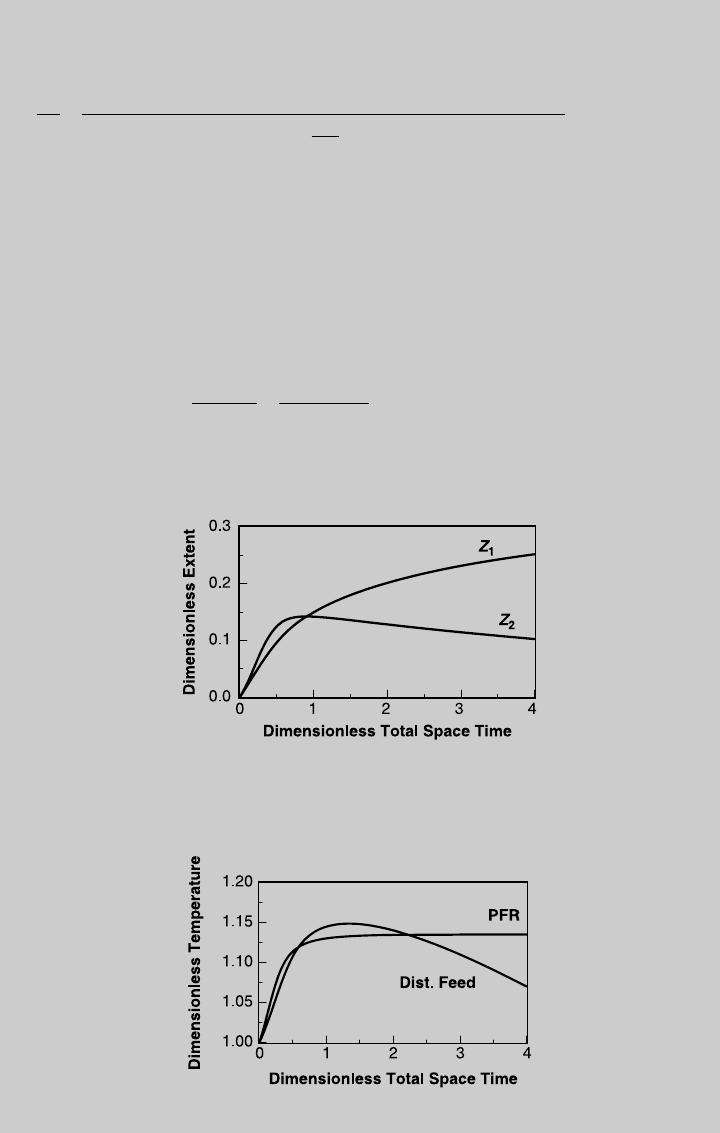
. Figure E9.3.1
shows the reaction operating curves, and Figure E9.3.2 shows the temperature
curve. To obtain the species operating curves, we use Eq. 2.7.8 to express the
species molar flow rates at the reactor outlet,
F
A
(t
tot
)
(F
tot
)
0
¼
F
A
in
þF
A
inj
(F
tot
)
0
Z
1
(t
tot
)2Z
2
(t
tot
) (l)
Figure E9.3.1 Reaction operating curves; distributed feed, adiabatic operation.
Figure E9.3.2 Temperature curve; adiabatic operation.
412 OTHER REACTOR CONFIGURATIONS

F
B
(t
tot
)
(F
tot
)
0
¼
F
B
in
þF
B
inj
(F
tot
)
0
Z
1
(t
tot
) (m)
F
V
(t
tot
)
(F
tot
)
0
¼Z
1
(t
tot
) (n)
F
W
(t
tot
)
(F
tot
)
0
¼Z
2
(t
tot
) (o)
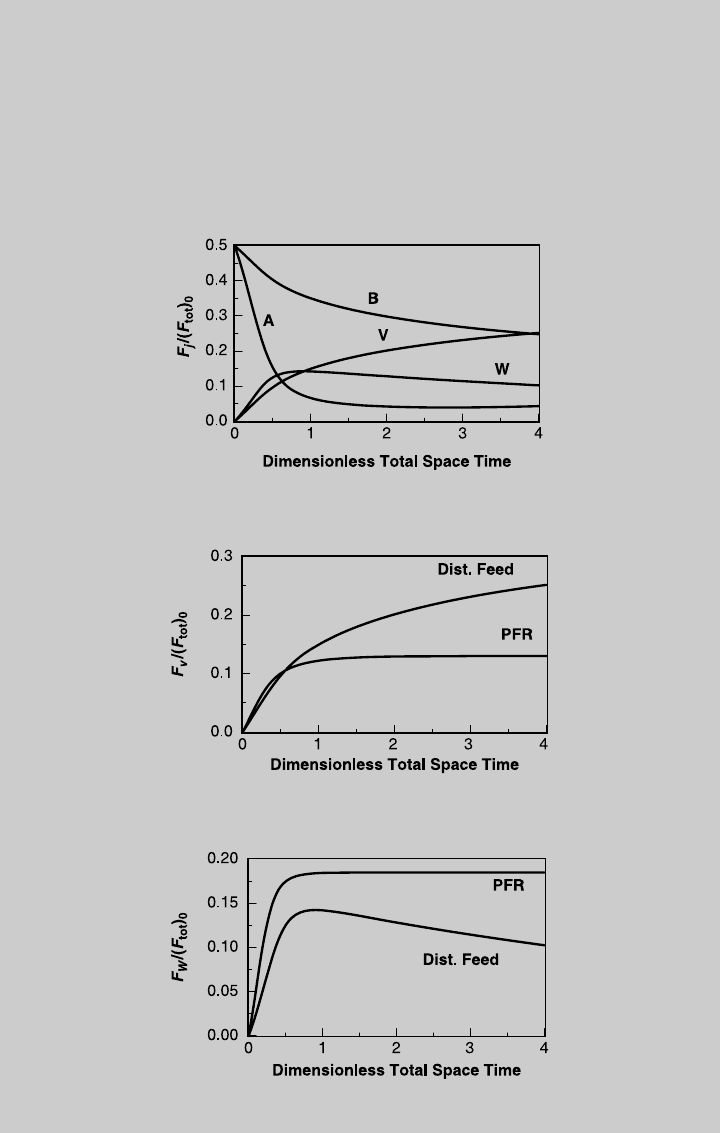
Figure E9.3.3 shows the species operating curves.
b. For plug-flow reactors, the species concentrations at any point in the
reactor are
C
A
¼ C
0
0:5 Z
1
2Z
2
(1 Z
1
Z
2
)u
(p)
C
B
¼ C
0
0:5 Z
1
(1 Z
1
Z
2
)u
(q)
The design equations are
dZ
1
dt
¼
(0:5 Z
1
2Z
2
)(0:5 Z
1
)
(1 Z
1
Z
2
)
2
u
2
e
g
1
(u1)=u
(r)
dZ
2
dt
¼
k
2
(T
0
)
k
1
(T
0
)
(0:5 Z
1
2Z
2
)
2
(1 Z
1
Z
2
)
2
u
2
e
g
2
(u1)=u
(s)
The correction factor for the heat capacity is
CF(Z
m
, u) ¼ 1 (0:4)Z
1
Z
2
(t)
For adiabatic plug-flow operation, HTN ¼ 0, and the energy balance
equation is
du
dt
¼
DHR
1
(dZ
1
=dt) þ DHR
2
(dZ
2
=dt)
1 (0:4)Z
1
Z
2
(u)
For adiabatic plug-flow reactor, we solve (r), (s), and (u) simultaneously, sub-
ject to the initial conditions that Z
1
(0) ¼ Z
2
(0) ¼ 0, u(0) ¼ 1. Figure E9.3.3
shows a comparison of the V production between the adiabatic distributed-
feed reactor and the adiabatic plug flow reactor with T
in
¼ 300ºC. Figure
E9.3.4 compares the production of V.
c. For the adiabatic plug-flow reactor with distributed-feed, 90% conversion of
Reactant A (F
A
/(F
A
)
0
¼ 0.05), is reached at t
tot
¼ 1.4 and 3.30. Using 9.2.7
and (g), the reactor volume is
V
R
tot
¼ v
0
t
cr
t
tot
¼ 1612 L
9.2 PLUG-FLOW REACTOR WITH DISTRIBUTED FEED 413
At t
tot
¼ 1.4, F
V
/(F
tot
)
0
¼ 0.1748 and F
W
/(F
tot
)
0
¼ 0.1372, and u ¼ 1.149.
Hence, the production rate of Product V is 17.48 mol/min and of product W
is 13.72 mol/min. The outlet temperature of the reactor is 385ºC. For the
adiabatic plug-flow reactor, 90% conversion of Reactant A is reached at
t
tot
¼ 0.5. Using 9.2.7 and (g), the reactor volume is 576 L. For t
tot
¼ 0.5,
F
V
/(F
tot
)
0
¼ 0.107 and F
W
/(F
tot
)
0
¼ 0.1745, and u ¼ 1.114. Hence, the
Figure E9.3.3 Species operating curves; distributed feed, adiabatic operation.
Figure E9.3.4 Comparison of V production; adiabatic operation.
Figure E9.3.5 Comparison of W production; adiabatic operation.
414 OTHER REACTOR CONFIGURATIONS
production rate of Product V is 10.7 mol/min and of product W is 17.4 mol/
min. The outlet temperature of the reactor is 3658C.
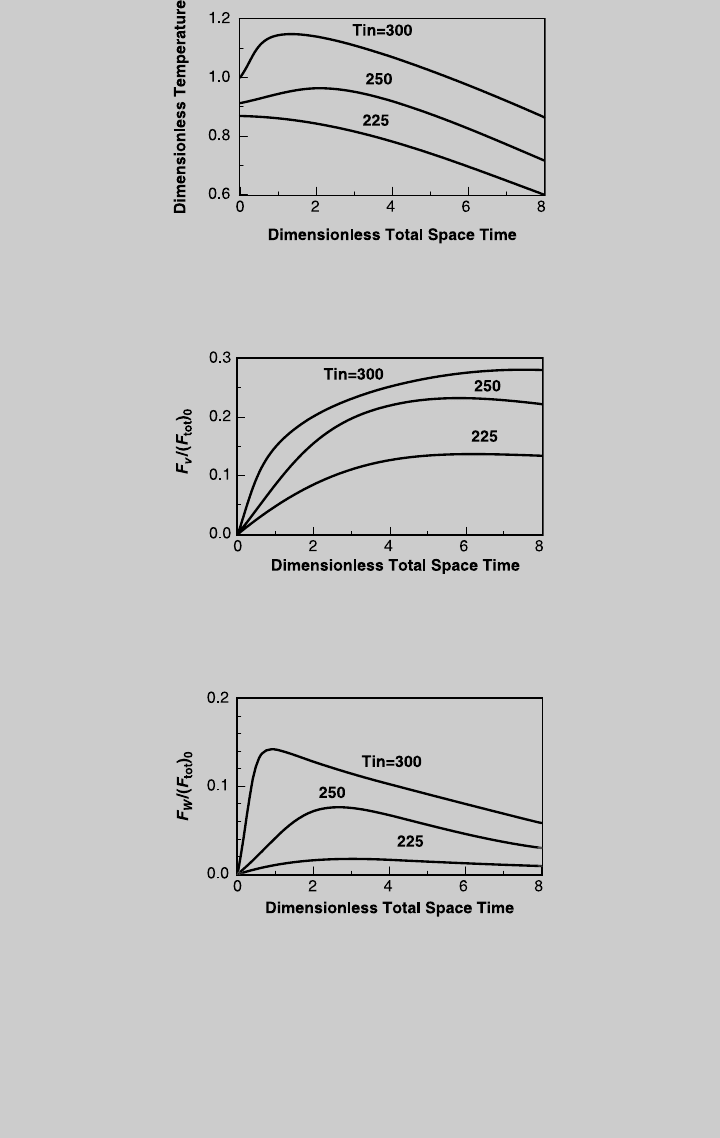
d. To examine the effect of the inlet temperature on the performance of the adia-
batic distributed-feed reactor, we solve (h), (i), and (k) simultaneously for
Figure E9.3.6 Effect of inlet temperature on exit temperature; distributed feed, adiabatic
operation.
Figure E9.3.8 Effect of inlet temperature on the production of product W; distributed
feed, adiabatic operation.
Figure E9.3.7 Effect of inlet temperature on the production of product V; distributed
feed, adiabatic operation.
9.2 PLUG-FLOW REACTOR WITH DISTRIBUTED FEED 415
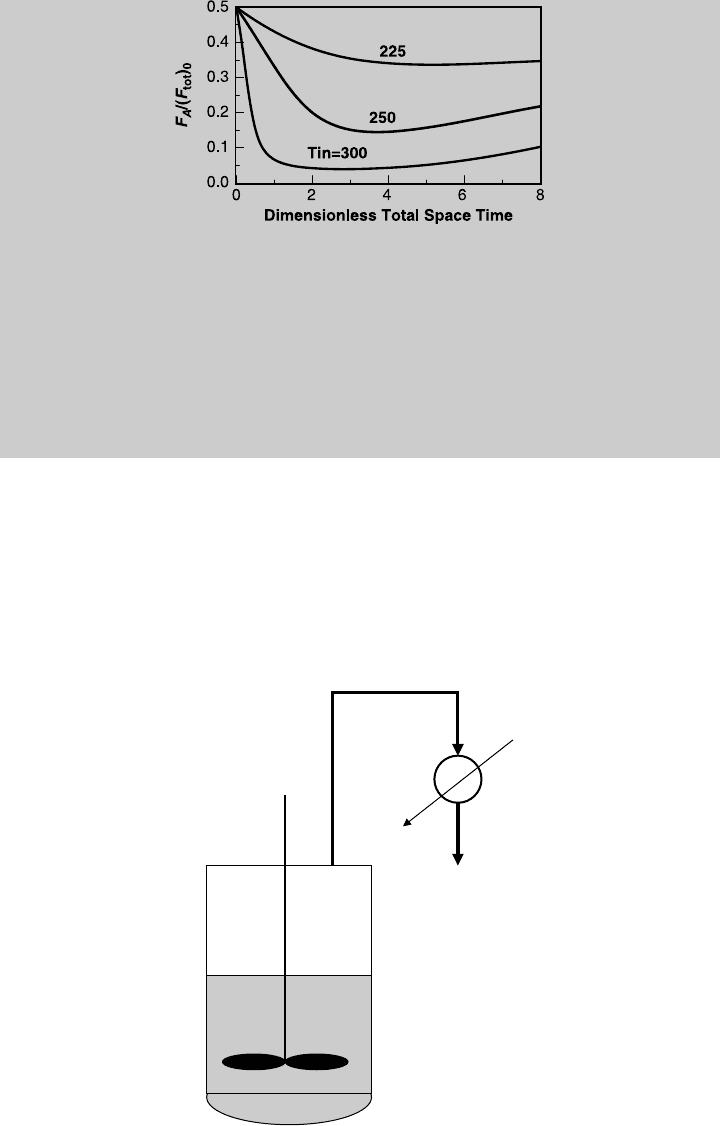
different values of inlet temperature. Figure E9.3.6 shows a comparison of
the exit temperature, Figure E9.3.7 compares the production of product V,
Figure E9.3.8 compares the production of product W, and Figure E9.3.9
compares the consumption of reactant A.
9.3 DISTILLATION REACTOR
A distillation reactor is a liquid-phase ideal batch reactor where volatile products are
generated and continuously removed from the reactor, as shown schematically in
Figure 9.4. Because species are removed, the volume of the reacting fluid reduces
during the operation.
Figure E9.3.9 Effect of inlet temperature on the consumption of reactant A; distributed
feed, adiabatic operation.
Figure 9.4 Distillation reactor.
416 OTHER REACTOR CONFIGURATIONS

To derive a design equation, we write a species balance equation for species j
that is not removed from the reactor:
dN
j
dt
¼ (r
j
)V
R
(t)(9:3:1)
We use Eq. 2.3.3 to relate the moles of species j in the reactor at operating time t to
the extents of the independent reactions, X
m
(t)’s, following the procedure described
in Chapter 4 for a batch reactor, and obtain
dX
m
dt
¼ r
m
þ
X
n
D
k
a
km
r
k
!
V
R
(t)(9:3:2)
This is the differential design equation for a distillation reactor, written for the
mth-independent chemical reaction. Note that Eq. 9.3.2 is identical to the
design equation of an ideal batch reactor. The difference between the two cases
is in the variation of the reactor volume and species concentrations during the
operation.
To derive a relation for the reactor volume, we write an overall material balance
over the reacting fluid. Assuming the mass of the gaseous species inside the reactor
is negligible, the reduction in the total mass of the reactor during operating time t is
equal to the mass of the volatile species removed,
r(0)V
R
(0) r(t)V
R
(t) ¼
X
n
evap
j
MW
j
N
j
(t)(9:3:3)
where MW
j
is the molecular weight, and N
j
(t) is the mole of gaseous species j
formed during the operation. Note that the summation in Eq. 9.3.3 is only over
species that evaporate and are removed from the reactor. Assuming the density
of the reacting liquid does not vary during the operation, r(t) ¼ r(0) ¼ r, differen-
tiating Eq. 9.3.3, with respect to time:
dV
R
dt
¼
1
r
X
n
evap
j
MW
j
dN
j
dt
(9:3:4)
To relate the formation rates of these species to the extents of the independent reac-
tions, we differentiate stoichiometric relation Eq. 2.3.3,
dN
j
dt
¼
X
n
I
m
(s
j
)
m
dX
m
dt
(9:3:5)
9.3 DISTILLATION REACTOR 417

Substituting this into Eq. 9.3.4,
dV
R
dt
¼
1
r
X
n
evap
j
MW
j
X
n
I
m
(s
j
)
m
dX
m
dt
(9:3:6)
Multiplying both sides by dt and integrating,
V
R
(t) ¼ V
R
(0)
1
r
X
n
evap
j
MW
j
X
n
I
m
(s
j
)
m
X
m
(t)
!
(9:3:7)
Equation 9.3.7 provides an expression for the volume of the reactor in terms of the
extents of the independent chemical reactions.
To reduce Eqs. 9.3.2 and 9.3.7 to dimensionless form, we select the initial reac-
tor state as the reference state, (N
tot
)
0
¼ N
tot
(0), V
R
0
¼ V
R
(0), and define a dimen-
sionless extent of the mth-independent reaction by
Z
m
(t) ;
X
m
(t)
(N
tot
)
0
(9:3:8)
and the reference concentration, C
0
,by
C
0
;
(N
tot
)
0
V
R
0
(9:3:9)
As for batch reactors, we define the dimensionless time by
t ¼
t
t
cr
(9:3:10)
where t
cr
is the characteristic reaction time, defined by Eq. 3.5.1. Dividing both
sides of Eq. 9.3.7 by V
R
(0) and N
tot
(0), and, using Eqs. 9.3.8 and 9.3.9,
V
R
(t)
V
R
(0)
¼ 1
C
0
r
X
n
evap
j
MW
j
X
n
I
m
(s
j
)
m
Z
m
(t)
!
(9:3:11)
Differentiating Eqs. 9.3.8 and 9.3.10,
dX
m
¼ (N
tot
)
0
dZ
m
dt ¼ t
cr
dt
418 OTHER REACTOR CONFIGURATIONS

Substituting these into Eq. 9.3.2 and using Eq. 9.3.11,
dZ
m
dt
¼ r
m
þ
X
n
D
k
a
km
r
k
!
1
C
0
r
X
n
evap
j
MW
j
X
n
I
m
(s
j
)
m
Z
m
(t)
!$%
t
cr
C
0
(9:3:12)
Equation 9.3.12 is the dimensionless, reaction-based design equation for distillation
reactors, written for the mth-independent reaction. To describe the operation, we
have to write Eq. 9.3.12 for each independent reaction.
To solve the design equations, we express the species concentrations in terms of
the extents of the independent reactions. Using stoichiometric relation (Eq. 2.7.4)
and accounting for changes in the reactor volume, the concentration of species j is
C
j
(t) ¼ C
0
V
R
(0)
V
R
(t)
y
j
(0) þ
X
n
I
m
(s
j
)
m
Z
m
(t)
"#
(9:3:13)
Substituting Eq. 9.3.11 into Eq. 9.3.13, the species concentrations are
C
j
(t) ¼ C
0
y
j
(0) þ
P
n
I
m
(s
j
)
m
Z
m
(t)
1 (C
0
=r)
P
n
evap
j
MW
j
P
n
I
m
(s
j
)
m
Z
m
(t)
!
(9:3:14)
Due to evaporation, most distillation reactors operate isothermally. To determine
the rate, heat is transferred to (or from) the reactor, we also have to solve the energy
balance equation. We modify the energy balance equation (Eq. 5.2.8) by adding a
term to account for the enthalpy removed from the reactor by the evaporating species:
DH( t) ¼ Q(t)
ð
t
0
(
_
m
out
h
out
) dt W
sh
(t)(9:3:15)
where m
˙
out
h
out
is the rate enthalpy is removed from the reactor by the gaseous species.
Differentiating Eq. 9.3.15 with respect to time,
dH
dt
¼
_
Q
_
m
out
h
out
_
W
sh
(9:3:16)
Assuming constant specific mass-based heat capacity, the enthalpy change of the
reacting liquid in the reactor is
H(t) H(0) ¼ M(t)
c
p
[T(t) T
0
] M(0)
c
p
[T(0) T
0
] þ
X
n
I
m
DH
R
m
(T
0
)X
m
(t)
(9:3:17)
9.3 DISTILLATION REACTOR 419