
Mann U. Principles of Chemical Reactor Analysis and Design: New Tools for Industrial Chemical Reactor Operations
Подождите немного. Документ загружается.


10
ECONOMIC-BASED OPTIMIZATION
In the preceding chapters, we described how to design chemical reactors—how to
determine the reactor size (or operating time) to obtain a specified production rate,
and how to determine the production rate attainable on an existing reactor.
However, we have not addressed the following question: Is it desirable to achieve
high reaction extents (and use large reactors) or to utilize smaller reactors and
recycle unconverted reactants? When more than one reactant is used, we also
have to ask what is the most economical proportion of the reactants? The answers
to those questions are not straightforward. They depend on the value of the pro-
ducts, the cost of the reactants, the cost of operating the reactor, as well as
the cost of recovering unconverted reactants. The underlying motivation to the
design and operation of chemical reactors is their economic performance. The
dimensionless species operating curves generated from the reactor design relate
the species production rates to the reactor size (through dimensionless operating
or space time, t). The dimensionless energy balance equation ties the utilities
(heating/cooling) needed for the operation to the extents and t. Together, they
provide the means to conduct an economic-based optimization of reactor oper-
ations. In this chapter, we discuss briefly how to apply these relations to optimize
the design and operations of chemical reactors.
Principles of Chemical Reactor Analysis and Design, Second Edition. By Uzi Mann
Copyright # 2009 John Wiley & Sons, Inc.
441

10.1 ECONOMIC-BASED PERFORMANCE OBJECTIVE FUNCTIONS
Optimization of chemical processes is based on the objective of maximizing the
profit of the entire process. For processes involving chemical reactions, we can
write the objective function as
Profit
rate
($=time)
()
¼
Rate of
value of
products
($=time)
8
>
<
>
:
9
>
=
>
;
Rate of
cost of
reactants
($=time)
8
>
<
>
:
9
>
=
>
;
Rate of
operating
expense
($=time)
8
>
<
>
:
9
>
=
>
;
(10:1:1)
For convenience, the operating expenses are divided into different categories:
Rate of
operating
expense
($=time)
8
>
<
>
:
9
>
=
>
;
¼
Rate of
cost of
utilities
($=time)
8
>
<
>
:
9
>
=
>
;
þ
Rate of
cost of
labor
($=time)
8
>
<
>
:
9
>
=
>
;
þ
Rate
of
cost of
maintenance
($=time)
8
>
<
>
:
9
>
=
>
;
þ
Rate of
amortization of
capital equipment
($=time)
8
>
<
>
:
9
>
=
>
;
(10:1:2)
The revenue portion of Eq. 10.1.1 depends on the composition of the reactor outlet.
A higher purity product is more valuable, and the economics of the process
depends on whether unconverted reactants and undesirable by-products are separ-
ated from the final product. When species are separated, the separation cost should
be incorporated into the analysis of the reactor operation. To maximize the profit of
the process, an engineer can adjust the design and several operating parameters:
†
The feed rate per reactor volume (expressed in terms of dimensionless
operating or space time)
†
The proportion of reactants (expressed in terms of y
j
0
’s)
†
The hea tin g (or cooling) rate (by adjusting the temperature of the heating fluid, u
F
)
The profit objective function (Eq. 10.1.1) is then expressed in terms of these (and
other) operating parameters, and we determine the optimal values of the parameters
by solving the following equations:
q{Profit rate}
@t
¼ 0
q{Profit rate}
@y
j
(0)
¼ 0
q{Profit rate}
@u
F
¼ 0 (10:1:3)
For most operations with single chemical reactions, the profit function is expressed
in terms of relatively simple functions of these parameters, and Eq. 10.1.3 can be
solved analytically. For operations with multiple chemical reactions, we have to
determine the optimal parameters numerically.
Next, we derive the gross revenue function of the process, expressed in terms of
the extents of the independent reactions. Let Val
j
denote the value of species j
442 ECONOMIC-BASED OPTIMIZATION
expressed in $/mol. When all the species in the reactor outlet are separated, using
Eq. 2.7.8, the value of the product stream is
X
J
j
F
j
out
Val
j
¼ (F
tot
)
0
X
J
j
Val
j
y
j
0
þ
X
n
I
m
(s
j
)
m
Z
m
"#
(10:1:4)
The value of the feed stream is
X
J
j
F
j
in
Val
j
¼ (F
tot
)
in
X
J
j
Val
j
y
j
in
(10:1:5)
Hence, when the inlet stream is selected as the reference stream, the gross revenue
of the process is
Rate of
gross
revenue
($=time)
8
>
>
<
>
>
:
9
>
>
=
>
>
;
¼ (F
tot
)
0
X
J
j
Val
j
X
n
I
m
(s
j
)
m
Z
m
(10:1:6)
In many instances, the separation expense is expressed in terms of cost per mole of
product recovered, SC
j
(in $/mol of j); hence, the separation expense rate is
Rate of
separation
expense
($=time)
8
>
>
<
>
>
:
9
>
>
=
>
>
;
¼ (F
tot
)
0
X
J
j
SC
j
y
j
0
þ
X
n
I
m
(s
j
)
m
Z
m
"#
(10:1:7)
Combining Eqs. 10.1.6 and 10.1.7, the gross income rate of the reactor operation
(without accounting for reactor operation expense) is
Rate of
gross
income
($=time)
8
>
>
<
>
>
:
9
>
>
=
>
>
;
¼ (F
tot
)
0
X
J
j
(Val
j
SC
j
)
X
n
I
m
(s
j
)
m
Z
m
X
J
j
(SC
j
y
j
0
)
"#
(10:1:8)
When the species in the reactor effluent stream are not separated (unconverted
reactants are discarded with the product), the gross revenue rate is
Gross
revenue
rate
($=time)
8
>
>
<
>
>
:
9
>
>
=
>
>
;
¼ (F
tot
)
0
X
J
j¼1
Val
j
y
j
0
þ
X
n
I
m
(s
j
)
m
Z
m
out
!
( F
tot
)
0
X
J
j¼1
Val
j
y
j
0
(10:1:9)
Note that the summation in the first term on the right of Eq. 10.1.9 is over the
species in the outlet, but the value of products that are not being sold is zero
10.1 ECONOMIC-BASED PERFORMANCE OBJECTIVE FUNCTIONS 443

(i.e., unconverted reactants that are discarded with the product). Also, note that
polluting species in the product stream may have a negative value (the cost of
removing them to meet environmental specifications). To obtain the net profit of
the operation, we have to substitute into Eq. 10.1.1 the operating expenses of the
reactor, itemized in Eq. 10.1.2.
The example below illustrates an economic-based optimization procedure.
Example 10.1 Product V is produced by reacting reactant A with reactant B
where the following liquid-phase, elementary chemical reaction take place:
Reaction 1: A þ B ! V
Reaction 2: V þ B ! W
where product W is undesirable. A stream of reactant A (C
A
¼ 16 mol/L,
r ¼ 800 g/L) and a stream of reactant B (C
B
¼ 20 mol/L, r ¼ 800 g/L) are
available in the plant, and we want to utilize an available 200-L tubular reactor
(plug-flow). The reactor is operated isothermally at 1908C. When each stream is
fed at the same volumetric flow rate, determine:
a. The total feed rate needed to maximize the yield of product V
b. The total feed rate needed to maximize the profit when the outlet stream of
the reactor is not separated
c. The total feed rate when the outlet stream undergoes separation
Data: At 1908C, k
1
¼ 0:01 L=mol h
1
k
2
¼ 0:02 L=mol h
1
Values of the reactants: A ¼ 1$=mol B ¼ 2$=mol
V alues of the products: V(raw) ¼ 30 $=mol V( pure) ¼36 $=mol W ¼3$=mol
Species separ a tion costs: A ¼ 0:02 B ¼ 0:3V¼ 0:3W¼ 0:03 $=mol
Solution The stoichiometric coefficients of the chemical reactions are
s
A
1
¼1 s
B
1
¼1 s
V
1
¼ 1 s
W
1
¼ 0 D
1
¼1
s
A
2
¼ 0 s
B
2
¼1 s
V
2
¼1 s
W
2
¼ 1 D
2
¼1
Since each reaction has a species that does not participate in the other, the two
reactions are independent and there is no dependent reaction. We select the inlet
stream to the reactor as a reference stream and denote its flow rate by v
0
, where
v
0
¼ v
1
þ v
2
. The concentration of the reference stream is
C
0
¼
(F
tot
)
0
v
0
¼
v
1
C
A
þ v
2
C
B
v
1
þ v
2
¼ w
1
C
A
þ (1 w
1
)C
B
(a)
444 ECONOMIC-BASED OPTIMIZATION

where w
1
¼ v
1
/(v
1
þ v
2
) is the volumetric fraction of stream 1 (w
1
¼ 0.5). The
molar fractions of the species in the reference stream are
y
A
0
¼ w
1
C
A
C
0
y
B
0
¼ (1 w
1
)
C
B
C
0
(b)
y
V
0
¼ y
W
0
¼ 0, and Z
1
in
¼ Z
2
in
¼ 0. We write Eq. 7.1.1 for each independent
reaction:
dZ
1
dt
¼ r
1
t
cr
C
0
(c)
dZ
2
dt
¼ r
2
t
cr
C
0
(d)
Using Eq. 2.7.8, the local species molar flow rates are
F
A
¼ (F
tot
)
0
( y
A
0
Z
1
) (e)
F
B
¼ (F
tot
)
0
( y
B
0
Z
1
Z
2
)(f)
F
V
¼ (F
tot
)
0
(Z
1
Z
2
) (g)
F
W
¼ (F
tot
)
0
Z
2
(h)
For liquid-phase reactions, we use Eq. 7.1.11 to express the species concen-
trations, and the rates are
r
1
¼ k
1
C
0
2
( y
A
0
Z
1
)( y
B
0
Z
1
Z
2
) (i)
r
2
¼ k
2
C
0
2
(Z
1
Z
2
)( y
B
0
Z
1
Z
2
)(j)
We define the characteristic reaction time on the basis of reaction 1; hence,
t
cr
¼
1
k
1
C
0
(k)
Substituting (i), ( j), and (k) into (c) and (d), the design equations reduce to
dZ
1
dt
¼ ( y
A
0
Z
1
)( y
B
0
Z
1
Z
2
) (l)
dZ
2
dt
¼
k
2
k
1
(Z
1
Z
2
)( y
B
0
Z
1
Z
2
) (m)
a. We solve (l) and (m) numerically subject to the initial condition that at t ¼ 0,
Z
1
¼ Z
2
¼ 0. Once we obtain Z
1
and Z
2
as functions of t, we use (e) through
(h) to obtain the species operating curves. Figure E10.1.1 shows the reaction
curves, and Figure E10.1.2. shows the species operating curves. From
the curve of product V we determine that highest F
V
/(F
tot
)
0
¼ 0.111,
10.1 ECONOMIC-BASED PERFORMANCE OBJECTIVE FUNCTIONS 445
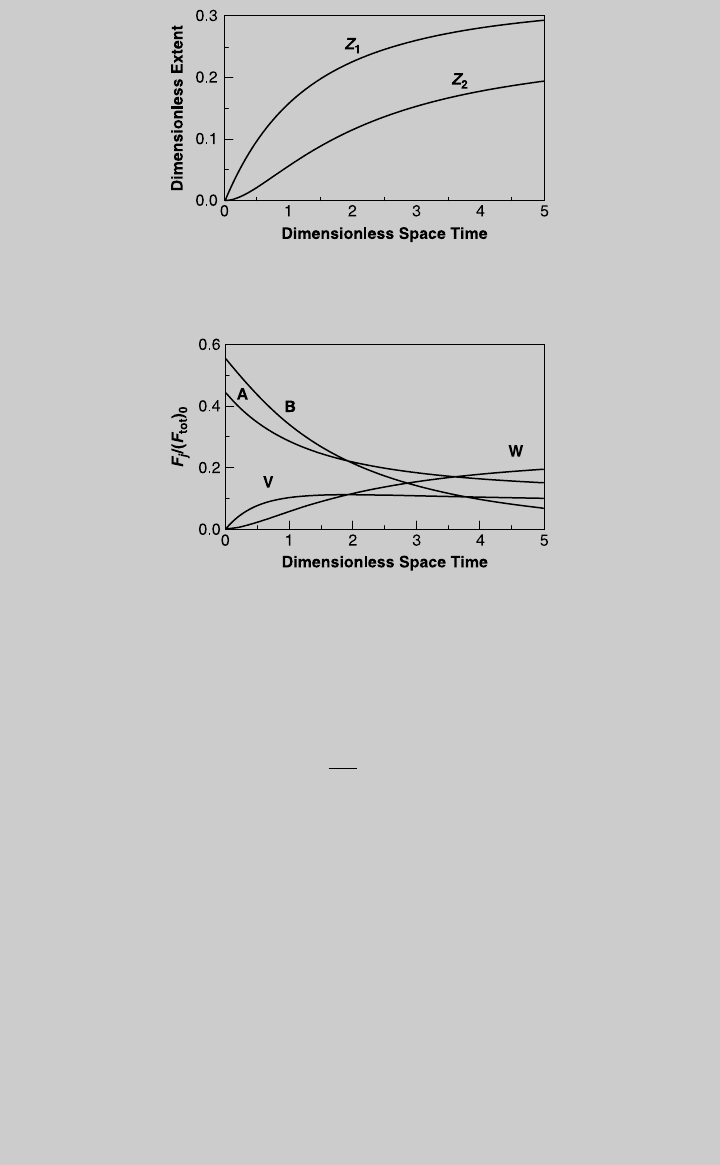
and it is achieved at about t ¼ 1.9. The feed flow rate that provides the high-
est profit rate is
v
0
¼
V
R
tt
cr
¼ 18:9L=h
b. When the reactor is operated without a separator, product V is contaminated
with unconverted reactants and product W. The profit rate of the operation is
calculated by combining Eqs. 10.1.5 and 10.1.6:
Profit rate
fg
¼ F
V
Val
V
þ F
W
Val
W
(F
A
0
Val
A
þ F
B
0
Val
B
) (n)
where F
V
and F
W
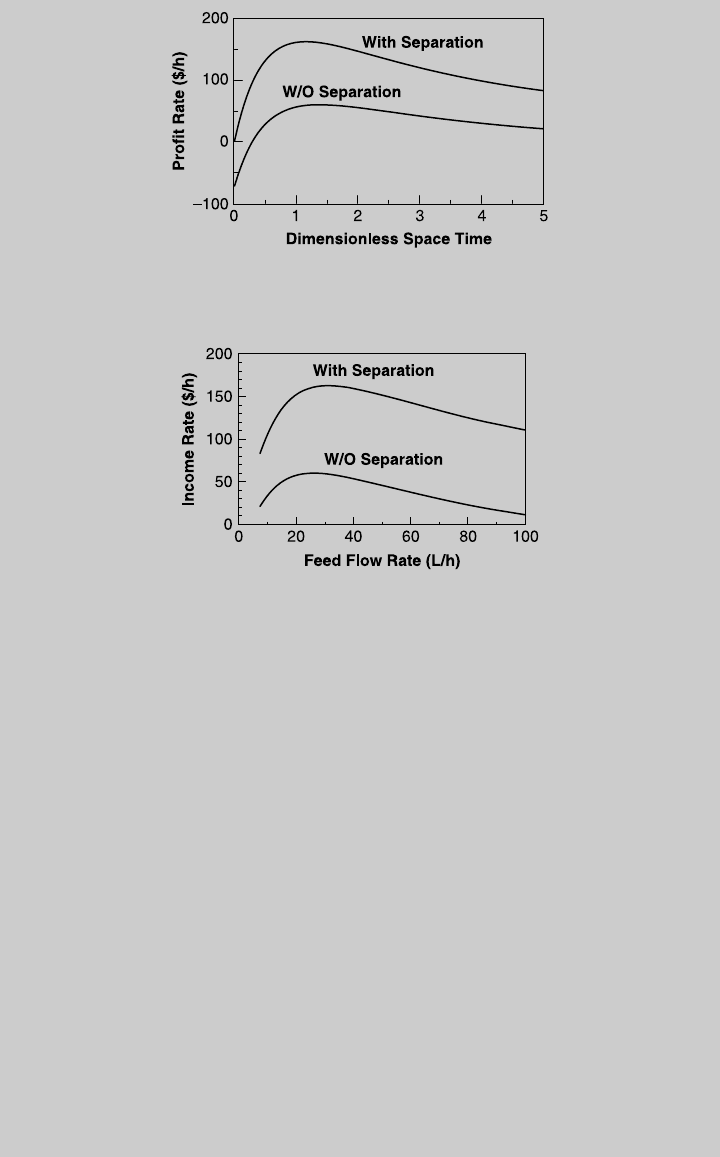
are given by (g) and (h), respectively. Figure E10.1.3 shows
the profit rate as a function of the dimensionless space time. The curve indi-
cates that the highest profit rate is 60.2 $/h, and it is achieved at t ¼ 1.4. The
feed flow rate that provides the highest profit rate is 25.7 L/h. Note that cal-
culation involves iteration since the value of v
0
in not known a priori. Once v
0
is known, we can plot the profit rate as a function of the feed rate, as shown in
Figure E10.1.4.
Figure E10.1.2 Species operating curves.
Figure E10.1.1 Reaction operating curves.
446 ECONOMIC-BASED OPTIMIZATION
c. When the effluent stream of the reactor is fed to a separator, the profit rate of
the combined operation is calculated by Eq. 10.1.9,
Profit rate
fg
¼ F
V
(36 0:03) þ F
W
(3 0:03) þ F
A
(0:1 0:02)
þ F
B
(0:2 0:03) [F
A
0
(0:1) þ F
B
0
(0:2)] (o)
where F
A
, F
B
, F
V
,andF
W
are given by (e), (f), (g), and (h), respectively.
Figure E.3 shows the pr ofit r a te of this operation as a function of the dimension-
less spa ce time. The curve indica tes that the highest profit rate is 162.8 $/h, and
it is achieved at t ¼ 1.15. The feed flo w rate tha t provides the highes t profit rate
is 31.3 L/h. The plot of the profit ra te as a function of the feed rate is shown in
Figure E10.1.4.
Note that the feed flow rate that provides the maximum profit depends on the
mode of opera tion (with or without separation) and is differ ent fr om the feed
flow ra te that pro vides the highest yield of product V. Also note tha t this example
considered a given proportion of the reactants. The procedure can be repeated
for differ ent r eactant proportions to determine the proportion tha t pr o v ides the
highest pr ofit.
Figure E10.1.4 Profit vs. feed flow rate.
Figure E10.1.3 Profit curve.
10.1 ECONOMIC-BASED PERFORMANCE OBJECTIVE FUNCTIONS 447

10.2 BATCH AND SEMIBATCH REACTORS
The designs of batch and semibatch reactors, covered in Chapters 6 and 9, addressed
only the operating time needed to obtain a given conversion (or extent). The size
of the batch was not considered. The latter is determined by the required production
rate of the unit. The operation of batch reactors usually consists of four steps:
1. Preparation and filling, in duration time of t
f
2. The reaction time (or the operating time), t
r
3. Discharging time, t
d
4. Idle time, t
i
The size of the batch and the duration of the reaction time are determined on the
basis of economic consideration. Usually, the desired production rate of a product,
F
P
, is specified, and the size of the batch, expressed in terms of (N
tot
)
0
,is
F
P
¼
(N
tot
)
0
t
f
þ t
r
þ t
d
þ t
i
y
P
0
þ
X
n
I
m
(s
P
)
m
Z
m
"#
(10:2:1)
where (N
tot
)
0
¼ C
0
V
0
. The extents of the independent reactions are determined by
the design equations for a given operating time. Below, we discuss the determi-
nation of the optimal operating time.
Let us denote the respective operating costs per unit time of these steps by W
f
,
W
r
, W
d
, and W
i
. The total cost of the operation is therefore
Cost
tot
¼ t
f
W
f
þ t
r
W
r
þ t
d
W
d
þ t
i
W
i
(10:2:2)
When the species in the reactor discharge are not separated, the gross revenue of a
batch is
Gross
revenue
per batch
($)
8
>
>
<
>
>
:
9
>
>
=
>
>
;
¼ (N
tot
)
0
X
J
j¼1
Val
j
y
j
0
þ
X
n
I
m
(s
j
)
m
Z
m
!
(N
tot
)
0
X
J
j¼1
Val
j
y
j
0
(10:2:3)
Combining Eqs. 10.1.1 and 10.1.2, the net profit rate is
Net
profit
rate
($=time)
8
>
>
<
>
>
:
9
>
>
=
>
>
;
¼
(N
tot
)
0
t
f
þ t
r
þ t
d
þ t
i
X
sold
j¼1
Val
j
y
j
0
þ
X
n
I
m
(s
j
)
m
Z
m
!
X
J
j¼1
Val
j
y
j
0
"#
t
f
W
f
þ t
r
W
r
þ t
d
W
d
þ t
i
W
i
t
f
þ t
r
þ t
d
þ t
i
(10:2:4)
448 ECONOMIC-BASED OPTIMIZATION

Note that the reaction time is expressed in terms of the dimensionless operating
time, t
r
¼ t
cr
t, and relates to the extents by the design equations and to (N
tot
)
0
by
Eq. 10.2.1. To optimize the operation, we determine the values of the parameters
by solving the following equations:
@ profit rate
fg
@t
¼ 0,
@ profit rate
fg
@( y
j
)
0
¼ 0 (10:2:5)
For operations with multiple chemical reactions, the optimal parameters are usually
determined numerically. For most operations with single chemical reactions, the
profit function is expressed in terms of relatively simple functions of these par-
ameters, and the optimal operating time can be determined analytically. This is
illustrated in the example below.
Example 10.2 The liquid-phase, first-order reaction
A ! B þ C
is carried out in a batch reactor. The value of reactant A is 0.50 $/mol, the value
of product B is 1 $/mol, and the value of product C is 1.50 $/mol. The sum of
the feed, discharge, and idle times is 30 mins. The operating cost of the reactor is
$0.10/min. Determine:
a. The optimal operating (reaction) time.
b. The optimal extent.
c. The reactor volume if the desired production rate of product B is 5 mol/min.
Data: C
A
(0) ¼ 2 mol=L k ¼ 0:1 min
1
Solution The stoichiometric coefficients are
s
A
¼1 s
B
¼ 1 s
C
¼ 1
We select the initial state as the reference state; hence, C
0
¼ C
A
(0) ¼ 2 mol/L,
and y
A
0
¼ 1 and y
B
0
¼ y
C
0
¼ 0. For a first-order reaction, the characteristic reac-
tion time is
t
cr
¼
1
k
¼ 10 min (a)
Using Eq. 2.7.6,
N
A
¼ (N
tot
)
0
(1 Z) (b)
N
B
¼ N
C
¼ (N
tot
)
0
Z (c)
The dimensionless design equation, in this case, is
dZ
dt
¼ 1 Z (d)
10.2 BATCH AND SEMIBATCH REACTORS 449