
Mann U. Principles of Chemical Reactor Analysis and Design: New Tools for Industrial Chemical Reactor Operations
Подождите немного. Документ загружается.


Solving (d) subject to the initial condition that Z(0) ¼ 0, we obtain
Z(t) ¼ 1 e
t
(e)
a. Using Eq. 10.2.4, the net profit rate of the operation is
Rate of
net
profit
($=time)
8
>
>
<
>
>
:
9
>
>
=
>
>
;
¼ (N
tot
)
0
Val
B
Z þ Val
C
Z Val
A
y
A
0
t
r
W
r
t
f
þ t
r
þ t
d
þ t
i
¼ (N
tot
)
0
(2:5)Z 0:5 t
r
0:1
30 þ t
r
(f)
where t
r
¼ t
cr
t is the operating time to be determined. Substituting (e) into (f)
and taking the derivative, we find that the optimal dimensionless time is
t ¼ 0.895. Hence, the optimal operating time is t
r
¼ t
cr
t ¼ 8.95 min, and
the duration of a cycle is 38.95 min.
b. Using (e), the optimal extent is Z ¼ 0.591.
c. Using Eq. 10.2.1, the specified production rate of product B is
5 mol=min ¼
(N
tot
)
0
t
f
þ t
r
þ t
d
þ t
i
Z ¼
(N
tot
)
0
38:95
(0:591) (g)
Solving (g), (N
tot
)
0
¼ 329.53 mol, and the required reactor volume is
V
R
(0) ¼
(N
tot
)
0
C
0
¼
329:53 mol
2 mol=L
¼ 164:76 L
10.3 FLOW REACTORS
The economic-based optimization may be based on other criteria than those dis-
cussed in Section 10.1. In some cases, the production rate is specified, and the
value of the product is fixed. In such cases, we would like to minimize the total
operating cost. This is illustrated in the example below.
Example 10.3 We want to produce 1000 mol of product R per hour from an
aqueous solution of reactant A (C
A
¼ 2 mol/L) in a CSTR. Product R is formed
by the first-order chemical reaction
A ! 2R
450 ECONOMIC-BASED OPTIMIZATION

The cost of the feed stream is 0.40 $/mol A, and the cost of operating the reactor
(labor, recovery of capital cost, overhead, etc.) is 0.10 $/L h. The unconverted
reactant A is being discarded. Based on the data below:
a. Determine the optimal operating conditions of V
R
, Z
out
,(F
tot
)
0
.
b. Calculate the cost of producing R under these conditions.
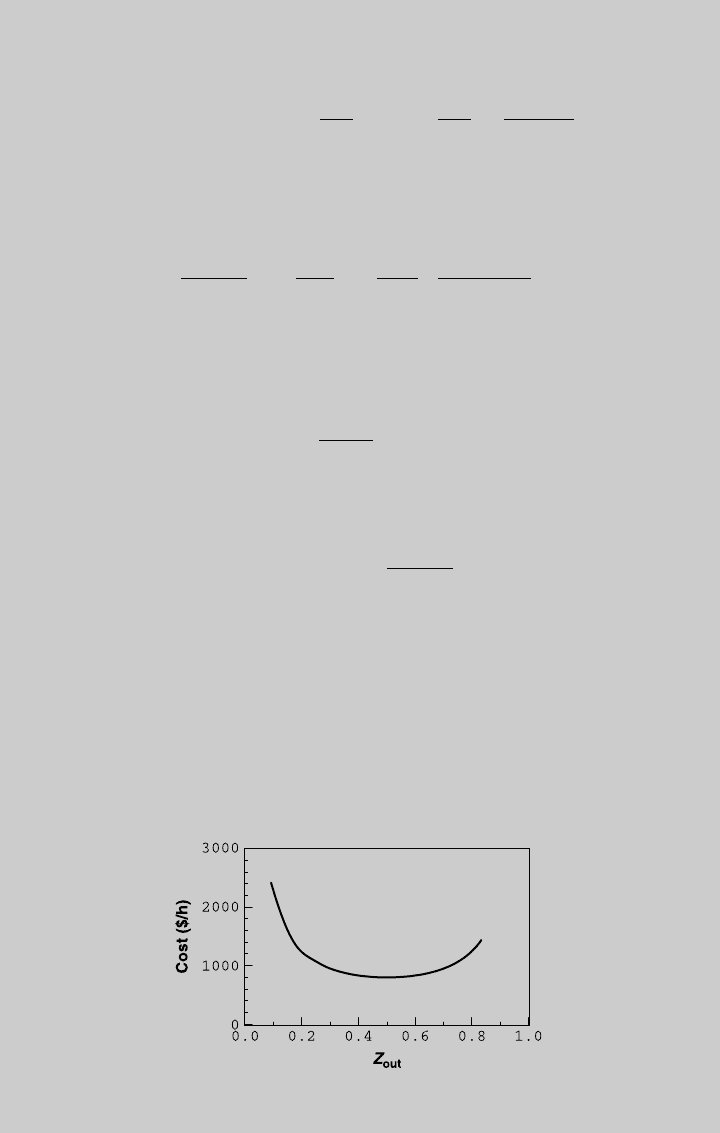
c. Plot the production cost as a function of the extent.
Data: At the operating conditions k ¼ 0:125 h
1
:
Solution The stoichiometric coefficients of the reaction are
s
A
¼1 s
R
¼ 2 D ¼ 1
The rate expression is r ¼ kC
A
. We select the inlet stream as the reference stream;
hence, C
0
¼ C
A
0
, y
A
0
¼ 1, and Z
in
¼ 0. The characteristic reaction time is
t
cr
¼
1
k
¼ 8 h (a)
Using Eq. 2.7.8,
F
A
¼ (F
tot
)
0
(1 Z) (b)
F
R
¼ (F
tot
)
0
2Z (c)
The design equation of a CSTR, for this case, is
t ¼
Z
out
1 Z
out
(d)
where the dimensionless space time is
t ¼
V
R
v
0
t
cr
(e)
a. The cost of the operation is
Cost($=h) ¼ (0:4)(F
tot
)
0
y
A
0
þ (OC) V
R
(f)
where OC is the reactor operating cost, OC ¼ 0.10 $/L h. Based on the speci-
fied production rate of product R and using (c),
(F
tot
)
0
¼
1000
2Z
out
(g)
From (d) and (e),
V
R
¼ v
0
t
cr
Z
out
1 Z
out
(h)
10.3 FLOW REACTORS 451
Substituting (g) and (h) into (f) and noting that (F
tot
)
0
¼ v
0
C
0
, the cost of the
operation is
Cost($=h) ¼ (0:4)
500
Z
out
þ (0:1)
500
C
0
t
cr
1
1 Z
out
(i)
To determine the minimum cost for the given production rate of product R,
we take the derivative of the cost with respect to Z
out
and equate it to zero,
d(Cost)
dZ
out
¼
200
Z
2
out
þ
50t
cr
C
0
1
(1 Z
out
)
2
¼ 0(j)
Substituting numerical values, we obtain Z
out
¼ 0.50, and, from (g),
(F
tot
)
0
¼ 1000 mol/h, and
v
0
¼
(F
tot
)
0
C
0
¼ 500 L=h
From (h), the optimal volume of the reactor is
V
R
¼ (500 L=h)(8 h)
0:5
1 0:5
¼ 4000 L
b. Using (i), the cost of producing R is
Cost($=h) ¼ 0:4(1000) þ 0:1(4000) ¼ 800=h
c. The cost plot is shown in Figure E10.3.1.
Figure E10.3.1 Profit vs. extent.
452 ECONOMIC-BASED OPTIMIZATION
10.4 SUMMARY
In this chapter, we discussed briefly the optimization of chemical reactor operations
on the basis of economic criteria. We showed how stoichiometric relations are com-
bined with economic data and the design equations to describe the profitability of
the operations. We covered the following topics:
1. Economic objective function of reactor operations
2. Economic objective function of reactor and separation operations
3. Economic-based optimization
4. Sizing and optimizing batch reactor operations
The reader is challenged to apply the methods described in this chapter to other
applications.
PROBLEMS*
10.1
2
The plug-flow reactor is to produce 1000 mol of product R per hour from an
aqueous feed of A (C
A
0
¼ 1 mol/L). The reaction is
2A ! R
and its rate expression is r ¼ 2kC
A
2
. The cost of reactant stream is 0.50 $/
mol A, and the cost of operating the reactor comes to 0.20 $/L h. Find
V
R
, f
A
, and F
A
0
for optimum operations under the following conditions:
a. The unconverted A is discarded.
b. What is the cost of producing R in (a)?
c. The unconverted A is recovered and recycled at a loss of 0.10 $/mol A.
d. What is the cost of producing R in (c)?
Data: k ¼ 1L/mol h
21
.
10.2
2
Aqueous feed (C
A
¼ 1 mol/L), (v
in
¼ 1000 L/h) is available at a cost of
$1.00/mol of reactant A. We can produce product R by the second-order
chemical reaction
2A ! R
The reaction rate constant is 2 L/mol h
21
. The value of product R is $3.70/
mol. The operating cost of a CSTR and a product purification unit is 0.20
*Subscript 1 indicates simple problems that require application of equations provided in the text.
Subscript 2 indicates problems whose solutions require some more in-depth analysis and modifi-
cations of given equations. Subscript 3 indicates problems whose solutions require more comprehen-
sive analysis and involve application of several concepts. Subscript 4 indicates problems that require
the use of a mathematical software or the writing of a computer code to obtain numerical solutions.
PROBLEMS 453
$/L of reactor per hour (labor, utilities, value of money). Unconverted reac-
tant A is destroyed when the product is purified. Find the best way to oper-
ate such a system (V
R
, Z
out
, F
R
, hourly profit rate) and then recommend a
course of action.
10.3
2
We want to produce 500 mol /h of product R (value $3/mol) by the chemi-
cal reaction
A þ B ! R
The rate expression is r ¼ kC
A
C
B
. The cost of reactant A is $0.80/mol, and
that of reactant B is $0.20/mol. Unconverted reactant A is recovered and
recycled to the reactor at a cost of $0.10/mol, and unconverted
reactant B is discarded. The cost of operating the reactor is $0.40/Lh.
Determine:
a. The optimal conversion and feed ratio F
B
in
=F
A
in
.
b. The size of the reactor (CSTR).
c. The profit ($/h) of the operation.
Data: k ¼ 2L=mol h
1
C
A
in
¼ 1 mol=L v
in
¼ 500 L=h
BIBLIOGRAPHY
More detailed trea tment of optimizing the oper ation of batch rea ctors can be found in:
R. B. Aris, An Introduction to Chemical Reactor Analysis, Prentice-Hall, Eng lewood Cliffs,
NJ, 1960.
A concise review of reactor optimization is provided by:
O. Levenspiel, Chemical Reaction Engineering, 3rd ed., Wiley, New York, 1999.
A general treatment of optimizing reactor operations and chemical processes can be
found in:
L. T. Biegler, I. E. Grossman, and A. W. Weterberg, Systematic Methods of Chemical
Process Design, Prentice-Hall, Englewood Cliffs, NJ, 1997.
454 ECONOMIC-BASED OPTIMIZATION

APPENDIX A
SUMMARY OF KEY RELATIONSHIPS
Principles of Chemical Reactor Analysis and Design, Second Edition. By Uzi Mann
Copyright # 2009 John Wiley & Sons, Inc.
455

TABLE A.1 Stoichiometric Relations
General relationships Definition of stoichiometric coefficients:
aA þ bB ! cC þ dD
s
A
¼as
B
¼bs
C
¼ cs
D
¼ d (A)
D ¼
X
J
j
s
j
¼a b þ c þ d (B)
Mathematical condition for a balanced chemical reaction:
X
J
j
s
j
MW
j
¼ 0 j ¼ A, B, ..., (C)
Relationship between the kth-dependent reaction and the independent reactions:
X
n
I
m
a
km
(s
j
)
m
¼ (s
j
)
k
j ¼ A, B, ..., (D)
Closed (Batch) Reactor Steady-Flow Reactor
Definitions Extent of the ith chemical reaction:
X
i
(t) ;
(n
j
(t) n
j
0
)
i
(s
j
)
i
Dimensionless extent of the ith reaction:
Z
i
(t) ;
X
i
(t)
(N
tot
)
0
Conversion of reactant A:
f
A
(t) ;
N
A
(0) N
A
(t)
N
A
(0)
Extent per time of the ith chemical reaction:
_
X
i
;
1
(s
j
)
i
d(n
j
)
i
dt
j ¼ A, B, ..., (E)
Dimensionless extent of the ith reaction:
Z
i
;
_
X
i
(F
tot
)
0
(F)
Conversion of reactant A:
f
A
;
F
A
in
F
A
F
A
in
(G)
456

Stoichiometric relations for
multiple reactions
N
j
(t) ¼ N
j
(0) þ
X
n
I
m
(s
j
)
m
X
m
(t)
N
tot
(t) ¼ N
tot
(0) þ
X
n
I
m
D
m
X
m
(t)
N
j
(t) ¼ (N
tot
)
0
N
tot
(0)
(N
tot
)
0
y
j
(0) þ
X
n
I
m
(s
j
)
m
Z
m
(t)
"#
N
tot
(t) ¼ (N
tot
)
0
N
tot
(0)
(N
tot
)
0
þ
X
n
I
m
D
m
Z
m
(t)
"#
F
j
¼ F
j
in
þ
X
n
I
m
(s
j
)
m
_
X
m
j ¼ A, B, ..., (H)
F
tot
¼ (F
tot
)
in
þ
X
n
I
m
D
m
_
X
m
(I)
F
j
¼ (F
tot
)
0
(F
tot
)
in
(F
tot
)
0
y
j
in
þ
X
n
I
m
(s
j
)
m
Z
m
"#
(J)
F
tot
¼ (F
tot
)
0
(F
tot
)
in
(F
tot
)
0
þ
X
n
I
m
D
m
Z
m
"#
(K)
Stoichiometric relations for
single reactions
N
j
(t) ¼ N
j
(0) þ
s
j
s
A
[N
A
(t) N
A
(0)]
f
A
(t) ¼
s
A
N
A
(0)
X(t) ¼
s
A
y
A
(0)
Z(t)
N
j
(t) ¼ N
j
(0)
s
j
s
A
N
A
(0)f
A
(t)
N
tot
¼ N
tot
(0)
D
s
A
N
A
(0)f
A
(t)
F
j
¼ F
j
in
þ
s
j
s
A
(F
A
F
A
in
) j ¼ B, C, ..., (L)
f
A
¼
s
A
F
A
in
_
X ¼
s
A
y
A
in
Z (M)
F
j
¼ F
j
in
s
j
s
A
F
A
in
f
A
j ¼ B, C, ..., (N)
F
tot
¼ (F
tot
)
in
D
s
A
F
A
in
f
A
(O)
457

TABLE A.2 Summary of Kinetic Relations
Definition of species formation rates:
(r
j
) ;
1
V
dN
j
dt
(r
j
)
S
;
1
S
dN
j
dt
(r
j
)
W
;
1
W
dN
j
dt
j ¼ A, B, ..., (A)
Relations between the different formation rates:
(r
j
) ¼
S
V
(r
j
)
S
(r
j
) ¼
W
V
(r
j
)
W
j ¼ A, B, ..., (B)
Definition of the rate of a chemical reaction:
r ;
1
V
dX
dt
r
S
;
1
S
dX
dt
r
W
;
1
W
dX
dt
(C)
Relation between a species formation rate and rates of chemical reactions:
(r
j
) ¼
X
n
all
i¼1
(s
j
)
i
r
i
j ¼ A, B, ..., (D)
Power function rate expression:
r ¼ k(T)
Y
J
j
C
a
j
j
(E)
where k( T ), the reaction rate constant, is expressed by
k(T) ¼ k
0
e
(E
a
=RT)
(F)
k(u) ¼ k(T
0
)e
g(u1)=u
(G)
where a
j
¼ order of the jth species
E
a
¼ activation energy
k
0
¼ preexponential factor
u ¼ dimensionless temperature, T/T
0
g ¼ dimensionless activation energy, E
a
/RT
0
Characteristic reaction time:
t
cr
;
characteristic concentration
characteristic reaction rate
¼
C
0
r
0
(H)
For reactions with an overall order of n:
t
cr
¼
1
k(T
0
)C
0
n1
(I)
458 APPENDIX A

TABLE A.3a Design Equations for Ideal Reactors—Simplified Form
a
Batch Reactor Plug-Flow Reactor CSTR
Design equation
for the mth
independent
reaction
dZ
m
dt
¼ r
m
þ
X
n
D
k
a
km
r
k
!
t
cr
C
0
V
R
V
R
0
dZ
m
dt
¼ r
m
þ
X
n
D
k
a
km
r
k
!
t
cr
C
0
Z
m
out
Z
m
in
¼ r
m
þ
X
n
D
k
a
km
r
k
!
t
t
cr
C
0
Auxiliary
relations
Species molar composition:
N
j
¼ (N
tot
)
0
y
j
0
þ
X
n
I
m
(s
j
)
m
Z
m
!
Constant volume:
V
R
¼ V
R
0
Variable volume gas phase:
V
R
¼ V
R
0
1 þ
X
n
I
m
D
m
Z
m
!
u
P
0
P
Species concentration in constant-volume
reaction:
C
j
¼ C
0
y
j
0
þ
X
n
I
m
(s
j
)
m
Z
m
!
Concentration in variable-volume
gas-phase reactor:
C
j
¼ C
0
y
j
0
þ
P
n
I
m
(s
j
)
m
Z
m
(1 þ
P
n
I
m
D
m
Z
m
)u
P
P
0
Species molar flow rate:
F
j
¼ (F
tot
)
0
y
j
0
þ
X
n
I
m
(s
j
)
m
Z
m
!
Volumetric flow rate for liquid phase:
v ¼ v
0
Volumetric flow rate for gas phase:
v ¼ v
0
1 þ
X
n
I
m
D
m
Z
m
!
u
P
0
P
Species concentration in liquid phase:
C
j
¼
F
j
v
¼ C
0
y
j
0
þ
X
n
I
m
(s
j
)
m
Z
m
!
Species concentration in gas phase:
C
j
¼
F
j
v
¼ C
0
y
j
0
þ
P
n
I
m
(s
j
)
m
Z
m
(1 þ
P
n
I
m
D
m
Z
m
)u
P
P
0
(Continued)
459