
Marder M.P. Condensed Matter Physics
Подождите немного. Документ загружается.

Polymers 123
The use of the quadrupole moment rather than the dipole moment is dictated by
the fact that nematic molecules are unchanged when flipped through 180°, and one
does not want to get into the business of deciding which way they are pointing. If
they are taken to point up and down with equal frequency, then a dipole moment
vanishes. Another possible order parameter is produced by the tensor of dielectric
constants, or of magnetic susceptibility, both of which change their symmetries
when nematic ordering sets in. So that the result vanish in an isotropie phase, one
might define
Qaß =
Caß —
^αβ 2_^ £77, (5.55)
7
which picks out the anisotropie part of the dielectric tensor. For a computation of
the mechanical properties of nematic liquid crystals, see Section
12.4.1,
and for
more detailed discussions of the topic see Chandrasekhar (1992), de Gennes and
Prost (1993), and Chaikin and Lubensky (1995).
5.8 Polymers
Polymers, like liquid crystals, are built from rod-like molecules, but now the rods
are floppy and exceptionally long. Polyethylene, for example, consists of thou-
sands of repeating units of
CH2.
One repeating unit is a homopolymer, while two
or more in alternation form a copolymer. The degree of polymerization is the num-
ber of basic units repeating in a typical chain. In useful materials, this number may
be in the tens to hundreds of thousands.
It may seem unlikely that any conceptually simple picture could capture fea-
tures of polymer behavior. It is from the enormous lengths of the individual poly-
mer chains that simplifications can flow. The molecules are so long that they be-
have like ideal floppy chains, wiggling randomly in an environment produced
self-
consistently by all the other polymers. The starting point for study of polymers is
therefore a single polymer chain immersed in a solvent liquid.
View the polymer as a collection of identical rigid segments, connected by
joints,
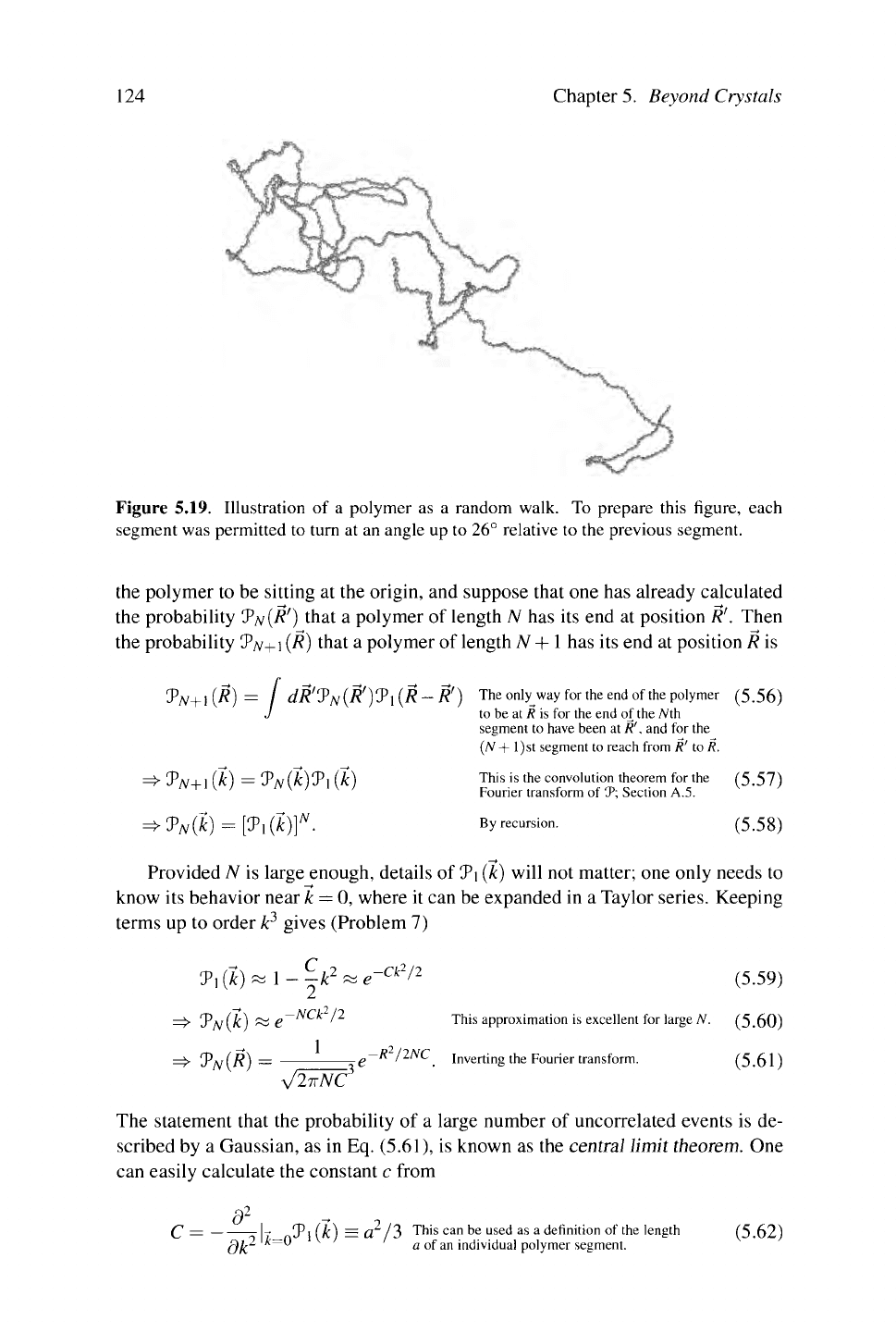
each of which is completely free to rotate as it wishes, depicted in Figure
5.19. Different segments of the chain are even free to rotate right through each
other, an admittedly unrealistic feature of the model that needs to be corrected in a
more sophisticated treatment. It may also seem unrealistic to reduce complicated
bending energies to rigid rods and joints, but this particular simplification makes
little difference.
5.8.1 Ideal Radius of Gyration
One of
the
most important features of an isolated polymer chain is its characteristic
size,
called the radius of gyration Jl, which is the root mean square distance from
one end of the polymer to the other. This quantity is the same as the mean square
distance traveled by a random walker, Section 5.2.4, but it is interesting to derive
it in a different way more directly related to polymer physics. Suppose one end of
124
Chapter 5. Beyond Crystals
Figure 5.19. Illustration of a polymer as a random walk. To prepare this figure, each
segment was permitted to turn at an angle up to 26° relative to the previous segment.
the polymer to be sitting at the origin, and suppose that one has already calculated
the probability 3V(/?') that a polymer of length N has its end at position R'. Then
the probability JV+i (R) that a polymer of length N +
1
has its end at position R is
T
N+i
(R)=
[ dR"y
N
{R')y\{R~R') The ontyway for the end of the polymer (5.56)
J to be at R is for the end of the
/Vth
segment to have been at R', and for the
(JV
+ l)st segment to reach from R' to R.
=4>
7
N+
i(k)
=
7
Ν
(Ϊ)7\
(k) This is the convolution theorem for the (5.57)
Fourier transform of
CP;
Section A.5.
=> 7
Ν
(%) = [7\
(k)}
N
.
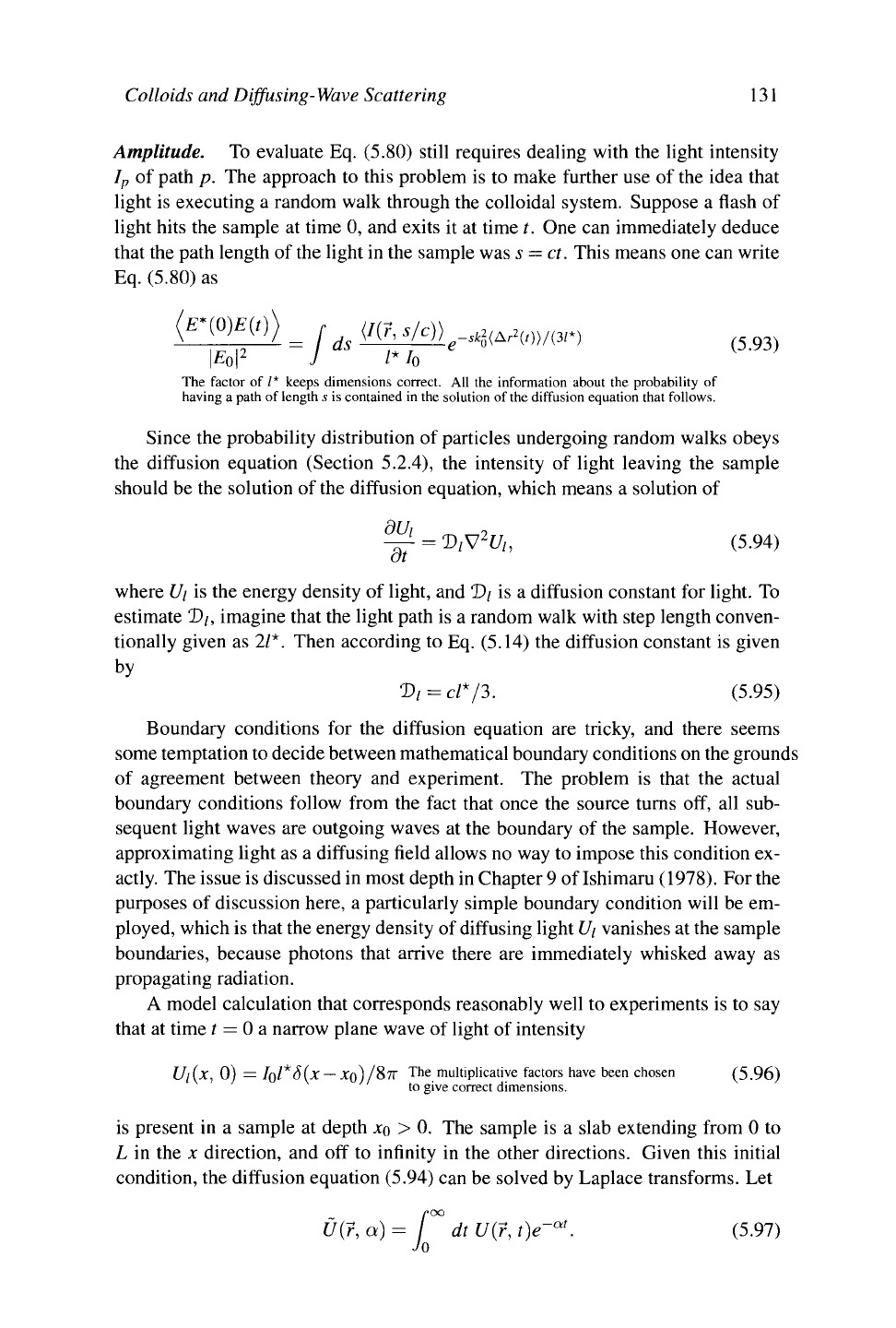
By recursion. (5.58)
Provided N is large enough, details of 3Ί (k) will not matter; one only needs to
know its behavior near k = 0, where it can be expanded in a Taylor series. Keeping
terms up to order k
3
gives (Problem 7)
3>,
(it) «
1
- |/t
2
«
e~
ck2
/
2
(5.59)
=> 3V(£) xie~
NCk2
/
2
This approximation is excellent for large N. (5.60)
=>■ 7N{R} — e /2A'C Inverting the Fourier transform. (5.61)
VÏ^NC
3
The statement that the probability of a large number of uncorrelated events is de-
scribed by a Gaussian, as in Eq. (5.61), is known as the central limit theorem. One
can easily calculate the constant c from
d
2
Ç= \- iPt(Â:)=û /3 This can be used as a definition of the length (5.62)
ßfc2 £=0
α 0
f
an
individual polymer segment.
Polymers
125
and can also relate
it to the
ideal radius
of
gyration
Uli
of
the polymer,
%
2
=
f
dRR
2
T
N
(R)
=
3CN
= a
2
N
write«
2
=
RJ
+RJ
+
R
2
Z
,
note that the
(5.63)
J three terms
in the
sum must have
the
same integral,
and
perform
the
integral
for any one
of
them.
=φ.
3^i = a\N.
This expression
is
identical
to
Eq. (5.16) with (5.64)
N
= t/to, but has
been derived
in a
different
way.
Polymer Interactions. Two features
of
this calculation appear questionable. First,
the polymer
is not
actually composed
of
identical segments that pivot completely
independently
of
one another.
In
reality, the polymer
is
rather stiff when viewed
at
the molecular level. However,
two
stiff springy units placed
end to end
have half
the spring constant
of
the original unit, four placed together have one-fourth
the
spring constant,
and by the
time
one has a
chain made
up of a
million segments,
one
can
safely view
it as
composed
of, say,
20,000 completely floppy sections,
each built from
50 of the
original springs. Making this idea more precise
is the
subject
of
Problem
8. The
result
is
that expressions (5.61)
and
(5.64) survive,
but
the constant
a
must
be
defined
in a
more general way.
The more serious defect
of
the calculation
is
that
it
allows different points
of
the polymer to slide freely through each other. One should recognize that the poly-
mer
can
never visit
the
same point twice during
its
path;
the
polymer describes
a
self-avoiding random walk (SARW). Such
a
calculation presents many formal
dif-
ficulties. A considerably simpler method begins
by
calculating
the
forces needed
to extend
or
compress
an
idealized polymer,
and
then
it
determines whether
the
interactions between polymer segments
are
powerful enough
to
cause
the
overall
shape
of
the polymer
to
alter noticeably from
its
idealized shape.
Stretching
a
Polymer. From
Eq.
(5.61)
one can
determine
the
force needed
to
stretch a polymer. Fix one end at the origin, grab the
far
end, and move it to location
R.
This motion costs
no
energy (because
all
polymer segments rotate freely)
but
reduces
the
entropy.
For
example,
if the end
were
to be
pulled
far
enough that
the whole polymer was made completely straight,
it
could
no
longer move,
and its
entropy would
be
zero. More generally,
the
entropy associated with
any
restricted
configuration is just Boltzmann's constant
k
B
times
the log of
the probability that
the configuration will occur. Because Eq. (5.61) gives
the
probability that
the end
of the polymer be found
at
R, one has immediately that
■2
»2
S
= So k
B
y Use
also
Eq.
(5.64) relating
a and X,. S
0
is
(5.65)
2
3^T a
constant independent
of R
whose value
is
unimportant.
The free energy resulting from this entropy
is
3
=
?0+lk
B
T^=3
Q
+
h
B
T^-.
Use
Eq.
(5.64).
(
5
.66)
2
%
z
2 a
z
N
126 Chapter
5.
Beyond Crystals
and the force F needed to pull the end of the polymer away from its preferred
location at R = 0 is
F =
3k
B
T-^
=
3i
^R = -R. (5.67)
ft
T
2
a
2
N N
The polymer behaves like an ideal spring of vanishing equilibrium length, with a
spring constant that rises in proportion to temperature, and that falls in proportion
to the molecular weight
3l\
oc yv
of the polymer chains.
Compressing a Polymer. While the force needed to stretch a polymer is well
indicated by grabbing the far ends and pulling outwards, this calculation says noth-
ing about the forces needed to compress a polymer into a small volume, because
not only the far end, but all intermediate points, must now be pressed inwards. A
simple estimate of the forces needed for this compression is obtained by imagining
a polymer molecule trapped within a sphere of diameter Jl <C 3?i. Suppose that
wherever the polymer hits the wall of the sphere it sticks permanently, and guess
that by finding the free energy of a configuration of this type, one obtains a rea-
sonable estimate of the free energy in the more realistic situation where points of
contact between polymer and sphere change with time.
The typical number M of monomers separating points of contact along the
polymer should be
K
2
M r^i Since a polymer of length M has characteris- (5.68)
Ü tic size
\/~Ma
oc
"X
So now one has N/M segments of molecular weight M, each stretched out to dis-
tance
01.
According to Eq. (5.66), the free energy of such a collection of polymers
is
N λ 1ί
2
^ιΝ ri
2
W,
2
The pressure the chamber exerts upon the polymer is therefore
(5.69)
d a
2
k
B
T{N/M)
^ ~ ~ ΛΦ3"
ß
^ö?2
^ ΦΤ— '
Drop constants of order umty
· (5.70)
which is j ust the pressure of an ideal gas of N/M particles in volume Ji
3
.
Volume
Interactions. Although the calculations of the forces needed to extend or
compress a polymer will later have direct use in finding the mechanical properties
of polymer mixtures, the goal now is to use them in order to determine the impor-
tance of interactions between portions of the polymer chain which are not directly
adjacent to one another. These interactions are rare when the polymer describes a
random walk within a solvent, and therefore their contribution to the free energy
should be contained within the virial expansion of statistical mechanics. One need
know nothing of the elaborate techniques used to find the coefficients in this ex-
pansion; one simply needs to use the fact that the virial expansion is in powers of
the density of particles.
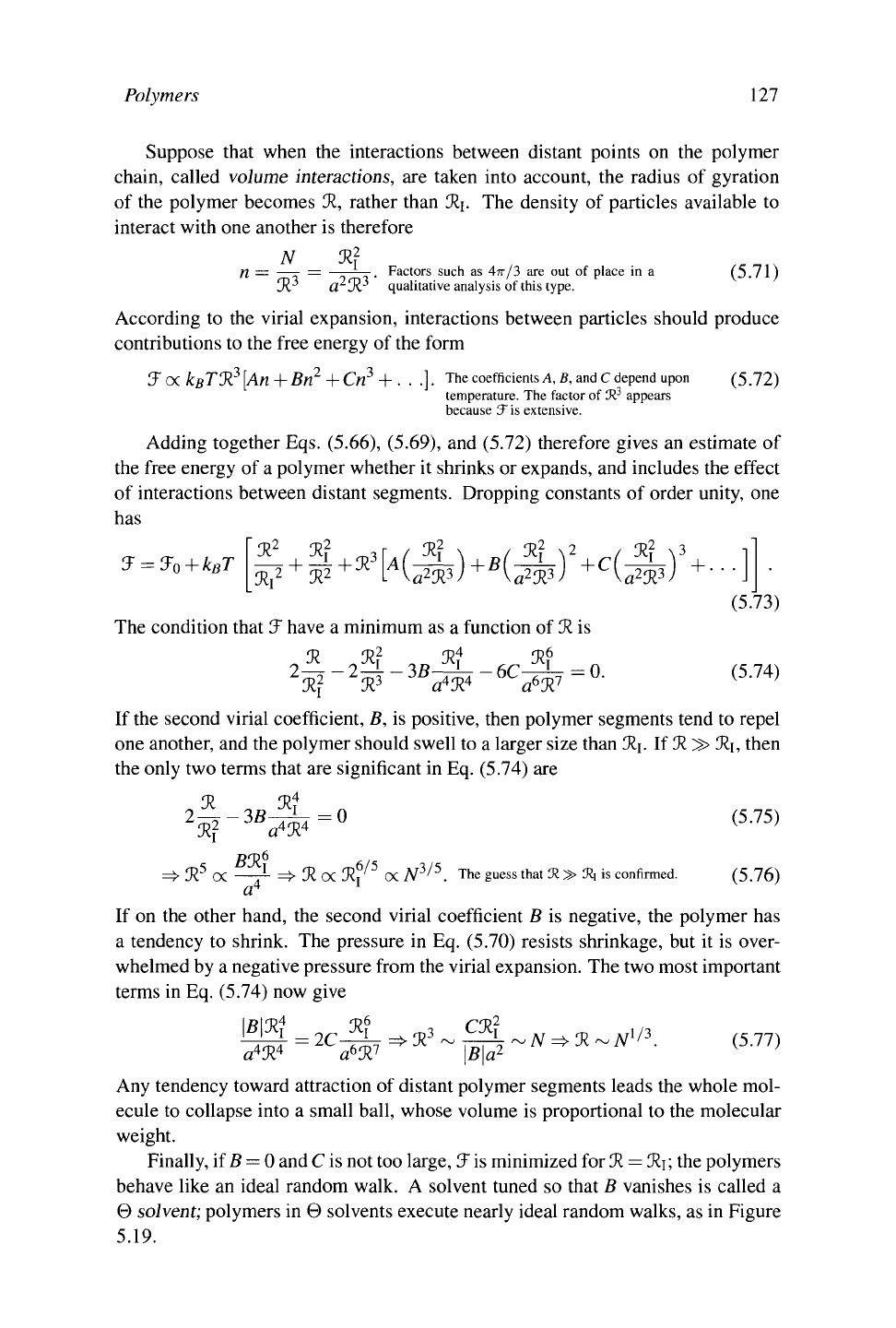
Polymers
127
Suppose that when the interactions between distant points on the polymer
chain, called volume interactions, are taken into account, the radius of gyration
of the polymer becomes ul, rather than %. The density of particles available to
interact with one another is therefore
/V 'V?
fi
= —- = Factors such as 4π/3 are out of place in a (5.71)
3? ü ÜI qualitative analysis of this type.
According to the virial expansion, interactions between particles should produce
contributions to the free energy of the form
J (X k
B
T$.
3
[An + Bn
2
+ Cn
3,
+ . . .]. The coefficients A, B, and C depend upon (5.72)
temperature. The factor of X
3
appears
because 3 is extensive.
Adding together Eqs. (5.66), (5.69), and (5.72) therefore gives an estimate of
the free energy of a polymer whether it shrinks or expands, and includes the effect
of interactions between distant segments. Dropping constants of order unity, one
has
3
r
=
3
r
o
+ k
B
T
ft
2
ft?
m
-\\.f ft? \ / ft? \
2
„( ft? λ
3
+
.
.
(5.73)
The condition that 3 have a minimum as a function of
31
is
rn <τ>2
<Τ)4 φ6
>-f\- *A.T ^Λ,τ J\.r
2^-2-^
r
-3ß-
i
-i-r-6C-^=0. (5.74)
utf
ft
3
α
4
3?
4
α
6
Κ
7
If the second virial coefficient, B, is positive, then polymer segments tend to repel
one another, and the polymer should swell to a larger size than
Ui\.
If
"R
^> 3£i, then
the only two terms that are significant in Eq. (5.74) are
4"
3s
^
=o
(5
·
75)
=*> 3?
5
OC —~r =>- 3Ì
OC
JU
/5
OC
N
3/5
. The guess that % » % is confirmed. (5.76)
cr
If on the other hand, the second virial coefficient B is negative, the polymer has
a tendency to shrink. The pressure in Eq. (5.70) resists shrinkage, but it is over-
whelmed by a negative pressure from the virial expansion. The two most important
terms in Eq. (5.74) now give
Any tendency toward attraction of distant polymer segments leads the whole mol-
ecule to collapse into a small ball, whose volume is proportional to the molecular
weight.
Finally, if B = 0 and C is not too large,
3"
is minimized for
3?
= 3tr; the polymers
behave like an ideal random walk. A solvent tuned so that B vanishes is called a
Θ solvent; polymers in θ solvents execute nearly ideal random walks, as in Figure
5.19.
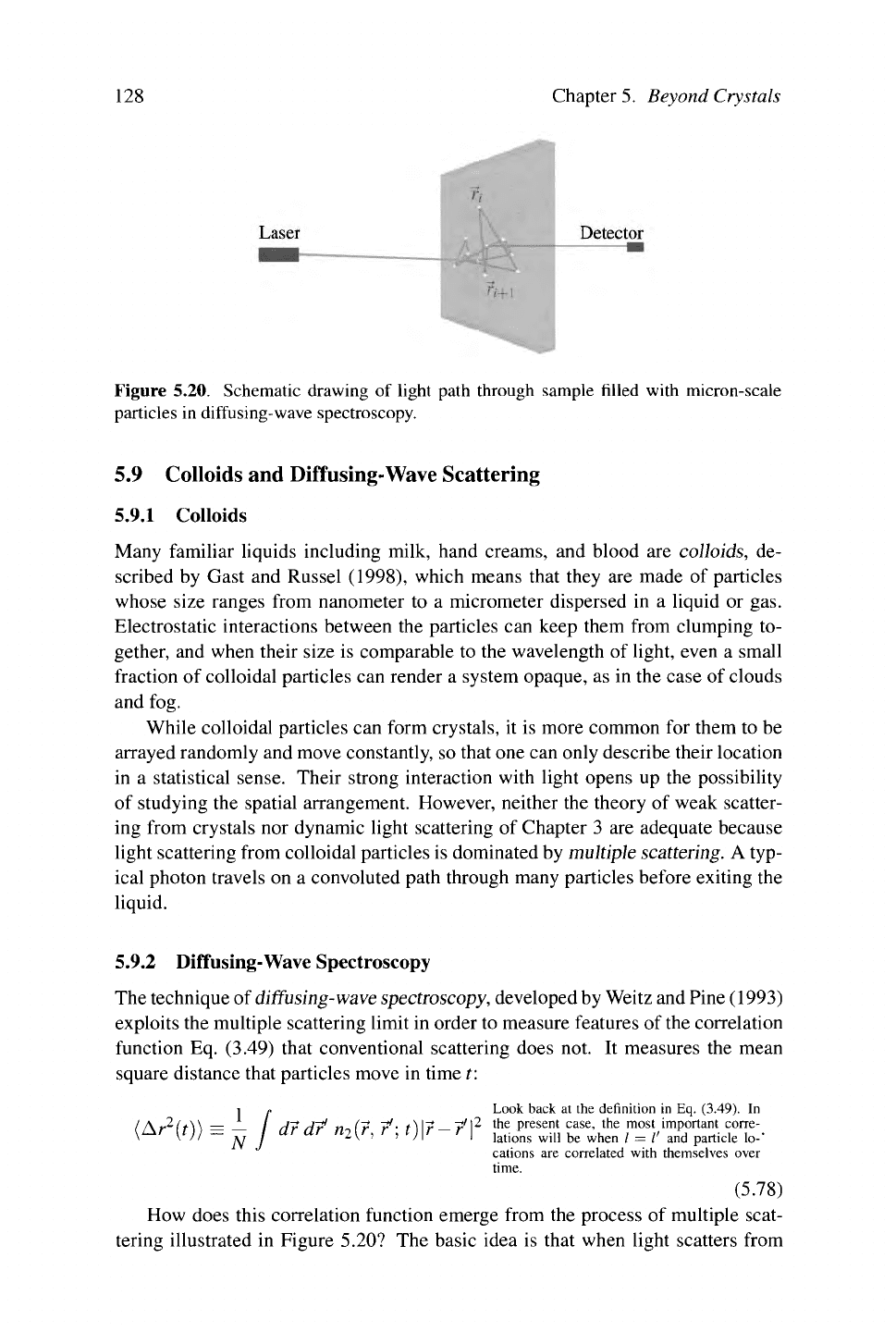
128
Chapter 5. Beyond Crystals
Figure 5.20. Schematic drawing of light path through sample filled with micron-scale
particles in diffusing-wave spectroscopy.
5.9 Colloids and Diffusing-Wave Scattering
5.9.1 Colloids
Many familiar liquids including milk, hand creams, and blood are colloids, de-
scribed by Gast and Rüssel (1998), which means that they are made of particles
whose size ranges from nanometer to a micrometer dispersed in a liquid or gas.
Electrostatic interactions between the particles can keep them from clumping to-
gether, and when their size is comparable to the wavelength of light, even a small
fraction of colloidal particles can render a system opaque, as in the case of clouds
and fog.
While colloidal particles can form crystals, it is more common for them to be
arrayed randomly and move constantly, so that one can only describe their location
in a statistical sense. Their strong interaction with light opens up the possibility
of studying the spatial arrangement. However, neither the theory of weak scatter-
ing from crystals nor dynamic light scattering of Chapter 3 are adequate because
light scattering from colloidal particles is dominated by multiple
scattering.
A typ-
ical photon travels on a convoluted path through many particles before exiting the
liquid.
5.9.2 Diffusing-Wave Spectroscopy
The technique of diffusing-wave spectroscopy, developed by Weitz and Pine (1993)
exploits the multiple scattering limit in order to measure features of the correlation
function Eq. (3.49) that conventional scattering does not. It measures the mean
square distance that particles move in time t:
i n Look back at the definition in Eq. (3.49). In
(Ar
2
(t)) = - drdr n
2
(r, f\ t)\f- r'\
2
!
h
t
e
Ρ
Γε8εη
< ef <\
the
most important corre-_
N I ±\ ' ' /\ I lations will be when / = / and particle lo-
cations are correlated with themselves over
time.
(5.78)
How does this correlation function emerge from the process of multiple scat-
tering illustrated in Figure
5.20?
The basic idea is that when light scatters from
Colloids and Diffusing-Wave Scattering 129
many particles, its phase when
it
exits the sample is determined by the total path
length through which it has traveled. Even small changes in the locations of parti-
cles produce changes in phase. Indeed, multiple scattering increases sensitivity to
particle motions. Dynamic light scattering can detect particle motions on the order
of a wavelength of light, while diffusing-wave spectroscopy is sensitive to much
smaller motions just so long as the cumulative total distance moved by particles in
a light path is comparable to a wavelength.
The starting point is the Siegelt relation
of
Eq. (3.64) which- shows that the
dynamic correlation function (E(t)*E(0)) can be deduced from measurements over
time of light intensity exiting a sample at a point.
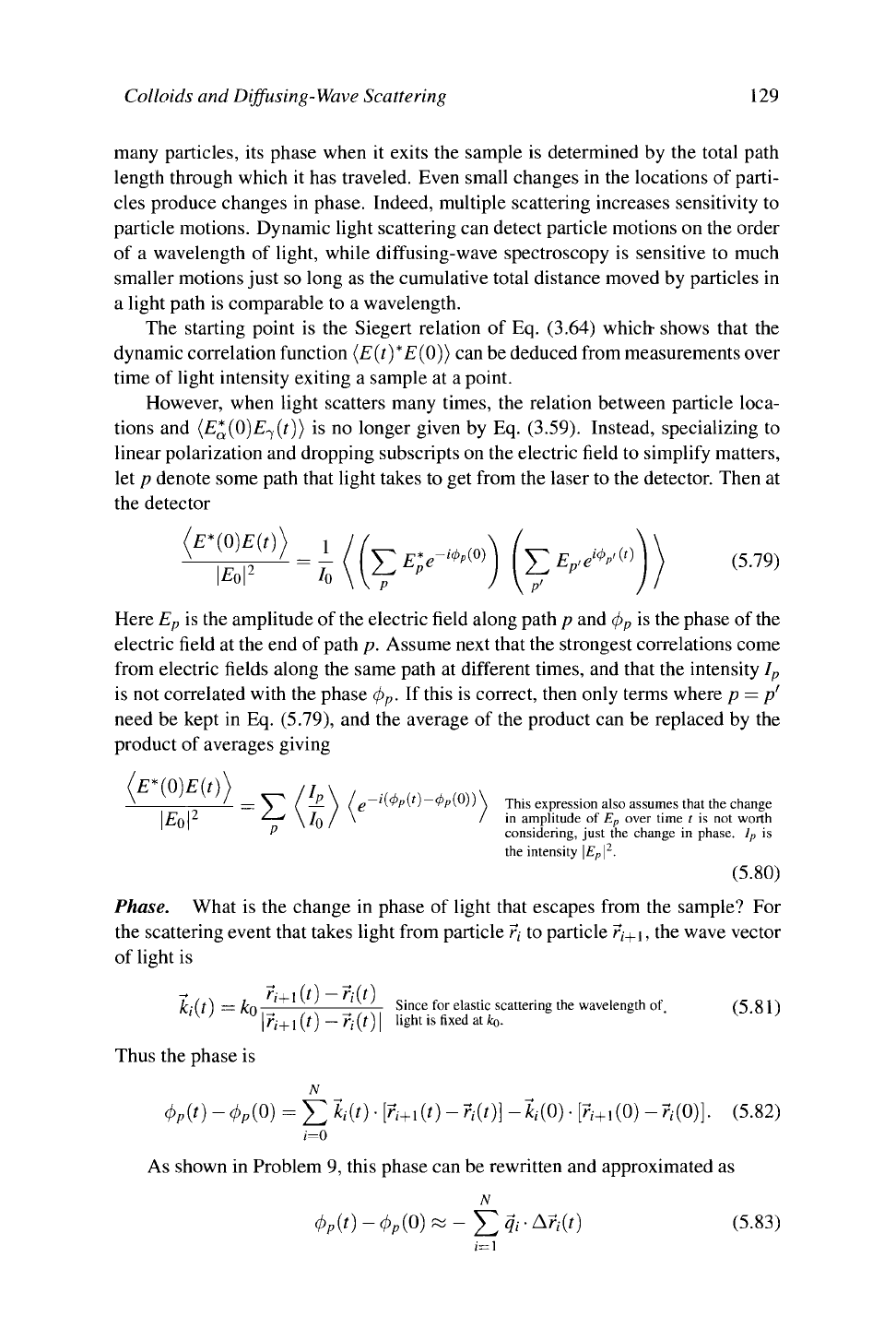
However, when light scatters many times, the relation between particle loca-
tions and (££(0)£
7
(f)) is no longer given by Eq. (3.59). Instead, specializing to
linear polarization and dropping subscripts on the electric field to simplify matters,
let p denote some path that light takes to get from the laser to the detector. Then at
the detector
E*(0)E(t]
\Eo\
2
=
T
0
( (Σ E>"
M0)
) (E
Ε,&Α \
(5.79)
Here E
p
is the amplitude of the electric field along path p and φ
ρ
is the phase of the
electric field at the end of path p. Assume next that the strongest correlations come
from electric fields along the same path at different times, and that the intensity I
p
is not correlated with the phase φ
ρ
. If this is correct, then only terms where
p
= p'
need be kept in Eq. (5.79), and the average of the product can be replaced by the
product of averages giving
E*(0)E(t))
,
IJL
_
c
ί(Φ
Ρ
{ή-Φρ(0))\ ,.
r
.
„ _
.„^
|£ol £—' \
In
/ \ /in
amplitude of E
p
over time
t is
not worth
P considering, just the change
in
phase.
l
p
is
the intensity
\E
P
\
2
.
(5.80)
Phase. What is the change in phase of light that escapes from the sample? For
the scattering event that takes light from particle r, to particle r
i+
i, the wave vector
of light is
k:(t) = kn—
Since for elastic scattering the wavelength
of (5 81)
W
\r
i+
i(t)-7i(t)\ light is
fixed
at
%
Thus the phase is
N
φ
ρ
(ή-φ
ρ
(0)
- Σ Ut)
■
[r,
+1
(i)-r,(0] -*i(0) · [r,-+i(0)
-r,-(0)].
(5.82)
i"=0
As shown in Problem 9, this phase can be rewritten and approximated as
N
Φ
Ρ
(ή -φ
ρ
(0)π-Σ
Âi ■
ΔΓ/(ί) (5.83)
i=l
130
Chapter 5. Beyond Crystals
where hqi is the momentum transfer of the scattering event from particle i
— 1
:
£,
=
*,·(())-jfc;_i(0)
and
An{t) = n{t) -r,(0). (5.84)
It is now possible to evaluate contributions from the phase in Eq. (5.80). Write
-ΐ(Φ„(ί)-φ
Ρ
(0))\
= h
Σ;
?.ΓΔΟ(0\
From
Eq.
(5
.83).
(5
.
85)
Uj^+i^j-Ar^-^qj-Arjit)]
2
(5.86)
(
_^
\
Odd powers of
cjj
should vanish since
TT
(
1
-
Jr [fl / ·
Ar
jit)}
2
. . .))
positive and negative values are equally
(5 87)
-li.
\
l
vl
J
■>
λ
'' j I
likely. Furthermore products such as
j
'
Ar^Ar
1
^ should vanish because
motions
of different particles are
uncorrelated.
«Πθ-ϊ^-ΔθίΟ]
2
))
(5-88)
j
(
\ The justification for this move is called
Σ
4
<[^·ΔΟ(0]
2
) ^ffi^Ä
(
5
-
89
)
j
)
normally distributed random variables
in
Triantafyllopoulos
(2003).
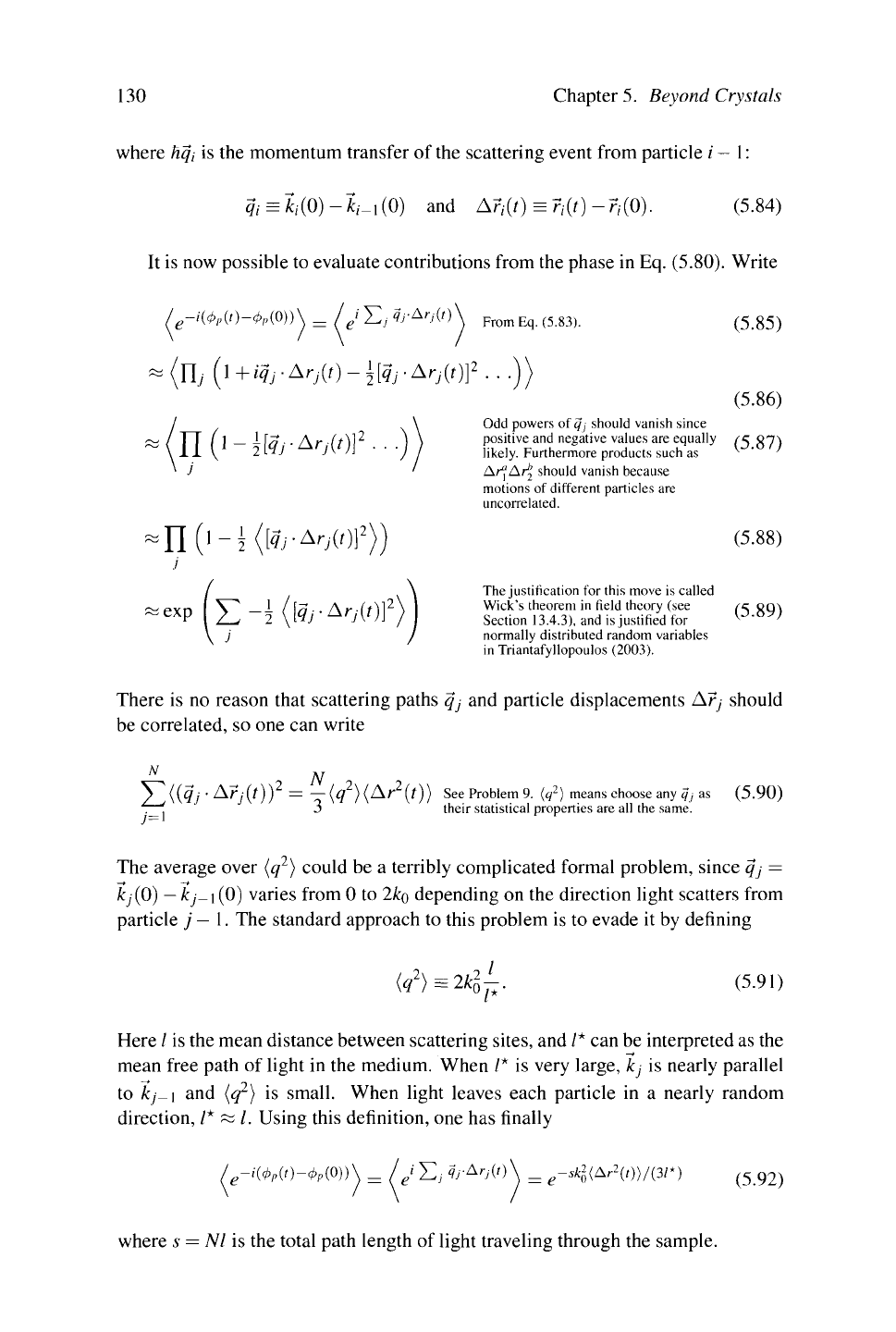
There is no reason that scattering paths
q*j
and particle displacements A7j should
be correlated, so one can write
N
N
y2((qj
■
A7j(t))
2
=
— (q
2
) (Ar
2
(t)} See Problem 9. (q
2
) means choose any q
s
as (5.90)
T
--
?
3
their statistical properties are all the
same.
;=i
The average over (g
2
) could be a terribly complicated formal problem, since q
f
=
kj(0) —kj-\(0) varies from 0 to
2ko
depending on the direction light scatters from
particle
j
—
1. The standard approach to this problem is to evade it by defining
(q
2
)^2k
2
^.
(5.91)
Here / is the mean distance between scattering sites, and
/*
can be interpreted as the
mean free path of light in the medium. When /* is very large, kj is nearly parallel
to kj-\ and (q
2
) is small. When light leaves each particle in
a
nearly random
direction, /*
«
/. Using this definition, one has finally
e
-iï>„(r)-<M0))\
=
h
Σ; ?;-ΔΓ;(/)\
=
É
,-^(Ar
2
(/))/(3/*)
(5
_
92)
where s = NI is the total path length of light traveling through the sample.
Colloids and Diffusing-Wave Scattering 131
Amplitude. To evaluate Eq. (5.80) still requires dealing with the light intensity
Ip of path p. The approach to this problem is to make further use of the idea that
light is executing a random walk through the colloidal system. Suppose a flash of
light hits the sample at time 0, and exits it at time t. One can immediately deduce
that the path length of the light in the sample was s = ct. This means one can write
Eq. (5.80) as
77,/^im^^w
(5
.
93)
|£br J
l
*
;
o
The factor of /* keeps dimensions correct. All the information about the probability of
having a path of length s is contained in the solution of the diffusion equation that follows.
Since the probability distribution of particles undergoing random walks obeys
the diffusion equation (Section 5.2.4), the intensity of light leaving the sample
should be the solution of the diffusion equation, which means a solution of
dU,
9
-^- =
T>,W
2
U
h
(5.94)
where
\J\
is the energy density of light, and D/ is a diffusion constant for light. To
estimate D/, imagine that the light path is a random walk with step length conven-
tionally given as
21*.
Then according to Eq. (5.14) the diffusion constant is given
by
T>i
=
cl*/3.
(5.95)
Boundary conditions for the diffusion equation are tricky, and there seems
some temptation to decide between mathematical boundary conditions on the grounds
of agreement between theory and experiment. The problem is that the actual
boundary conditions follow from the fact that once the source turns off, all sub-
sequent light waves are outgoing waves at the boundary of the sample. However,
approximating light as a diffusing field allows no way to impose this condition ex-
actly. The issue is discussed in most depth in Chapter 9 of Ishimaru (1978). For the
purposes of discussion here, a particularly simple boundary condition will be em-
ployed, which is that the energy density of diffusing light £// vanishes at the sample
boundaries, because photons that arrive there are immediately whisked away as
propagating radiation.
A model calculation that corresponds reasonably well to experiments is to say
that at time t = 0 a narrow plane wave of light of intensity
Ui(x, 0) = ΙοΙ*δ(χ — Χο)/8π The multiplicative factors have been chosen (5.96)
to give correct dimensions.
is present in a sample at depth
XQ
> 0. The sample is a slab extending from 0 to
L in the x direction, and off to infinity in the other directions. Given this initial
condition, the diffusion equation (5.94) can be solved by Laplace transforms. Let
poo
Ü(r, a) = /
Jo
dt U(r, t)e~
at
. (5.97)
132 Chapter 5. Beyond Crystals
kj
tq
10
-/ _
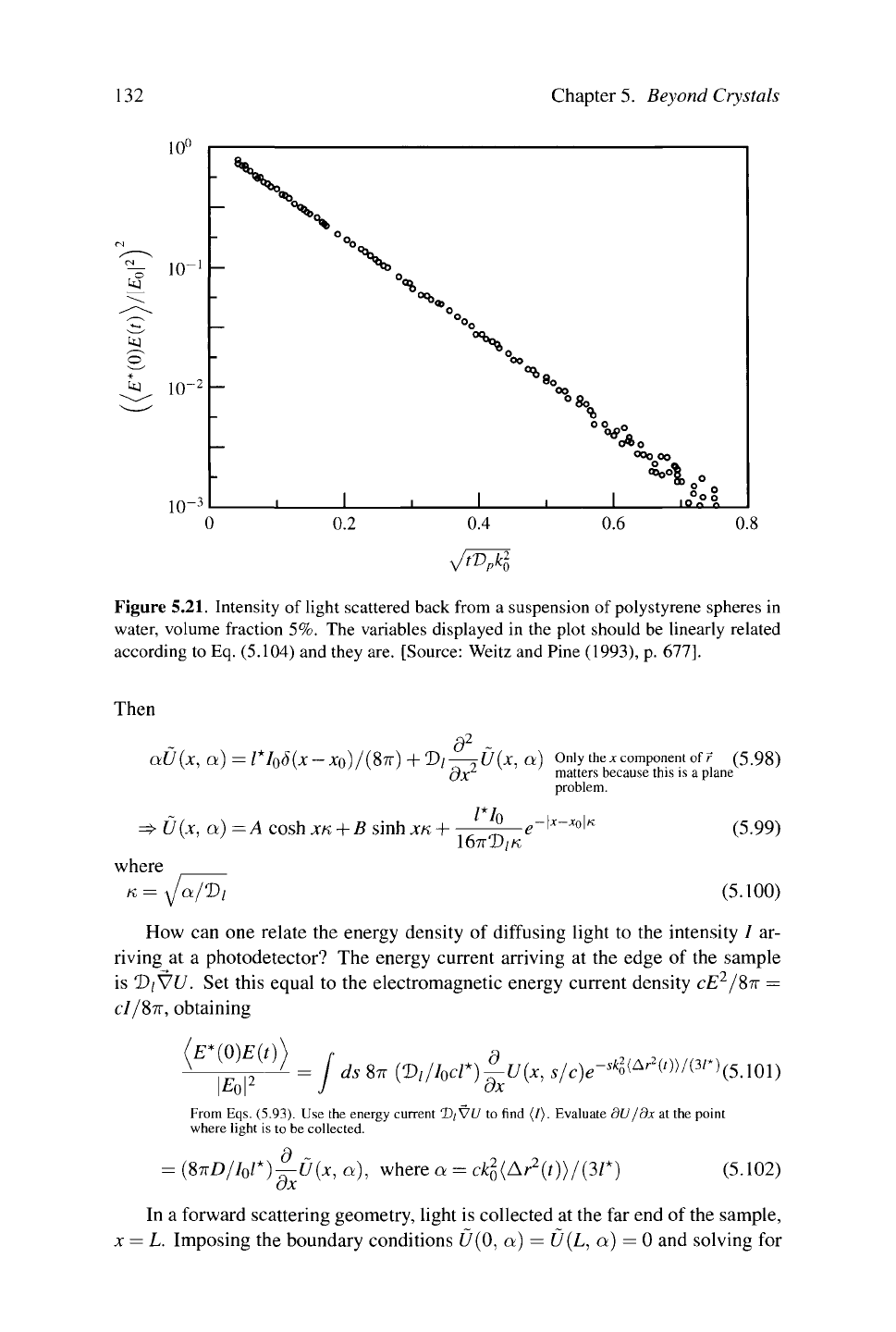
Figure 5.21. Intensity of light scattered back from a suspension of polystyrene spheres in
water, volume fraction 5%. The variables displayed in the plot should be linearly related
according to Eq. (5.104) and they are. [Source: Weitz and Pine (1993), p. 677].
Then
&
αυ(χ,α)=1*Ι
0
δ(χ-Χο)/(8π) + Τ>ι^υ(χ,α) Only thexcomponent of r (5.98)
dx
matters because this is a plane
problem.
Ü(x, a)=A cosh
XK
+ B sinhxK+ . , J?
e
-l*-*ol«
IÓTTU/K
where
(5.99)
(5.100)
How can one relate the energy density of diffusing light to the intensity / ar-
riving at a photodetector? The energy current arriving at the edge of the sample
is D/Vi/. Set this equal to the electromagnetic energy current density cE
2
/8n =
cl/ΰπ, obtaining
E*(0)E(t]
\E
0
\
2
From Eqs. (5.93). Use the energy current D/Vi/ to find (/). Evaluate dU/dx at the point
where light is to be collected.
[ ds 8π {Vi/I
0
cl*)^-U{x, s/c)e-
sk
°
{Ar2{t))/{3n
(5A0l)
(SKD/I
0
1*)—U(X,
a), where a = ckl(Ar
2
(t))/{3l*
(5.102)
In a forward scattering geometry, light is collected at the far end of the sample,
x = L. Imposing the boundary conditions t/(0, a) = Ü(L, a) = 0 and solving for