
Marder M.P. Condensed Matter Physics
Подождите немного. Документ загружается.

Quasicrystals
133
A and B in Eq. (5.98) gives
^
|£o|2
' = ^5ΠΓΤ
β
'
K
= \A*o<Ar2(
f
))/(3D/*). (5.103)
In a backscattering geometry, light is collected instead at x = 0 and the opposite
sign of the derivative must be used in Eq. (5.102). In the limit L
—>
oo the result is
(E*(0)E(t)) ,
X
|£o|2
' = e~™\
K
= ^/ck
2
0
(Ar^t))/(3Dl*). (5.104)
Now suppose that the particles in the fluid are diffusing with particle diffusion
constant
T>
p
,
so that according to Eq. (5.16) the square distance a particle moves in
time t is is Δ^(ί) =
6T>
p
t.
Then one has
K
=
^^6tk
2
0
1)
p
.
(5.105)
Weitz and Pine (1993) recommend taking xo/l* « 2.1 in order to compare with
experiment. As shown in Figure 5.21, the log of (E*(0)E(t)) is a linear function
of
y/T>
p
t.
The slope of such curves can be used to find T)
p
and hence as shown in
Problem 10 can be used to estimate particle sizes in suspensions that are not dilute.
5.10 Quasicrystals
First Observation. Shechtman et al. (1984) were not setting out to challenge
crystallography, but were preparing melt-spun ribbons of AlgöMn^. The alloys
were made to cool at rates of 10
6
K s~' by pouring molten metal onto a rapidly
spinning wheel, cooling rates that could be expected to produce a metallic glass.
After examination with an electron microscope, the samples were placed under X-
ray diffraction. The startling result was a set of diffraction patterns indicating axes
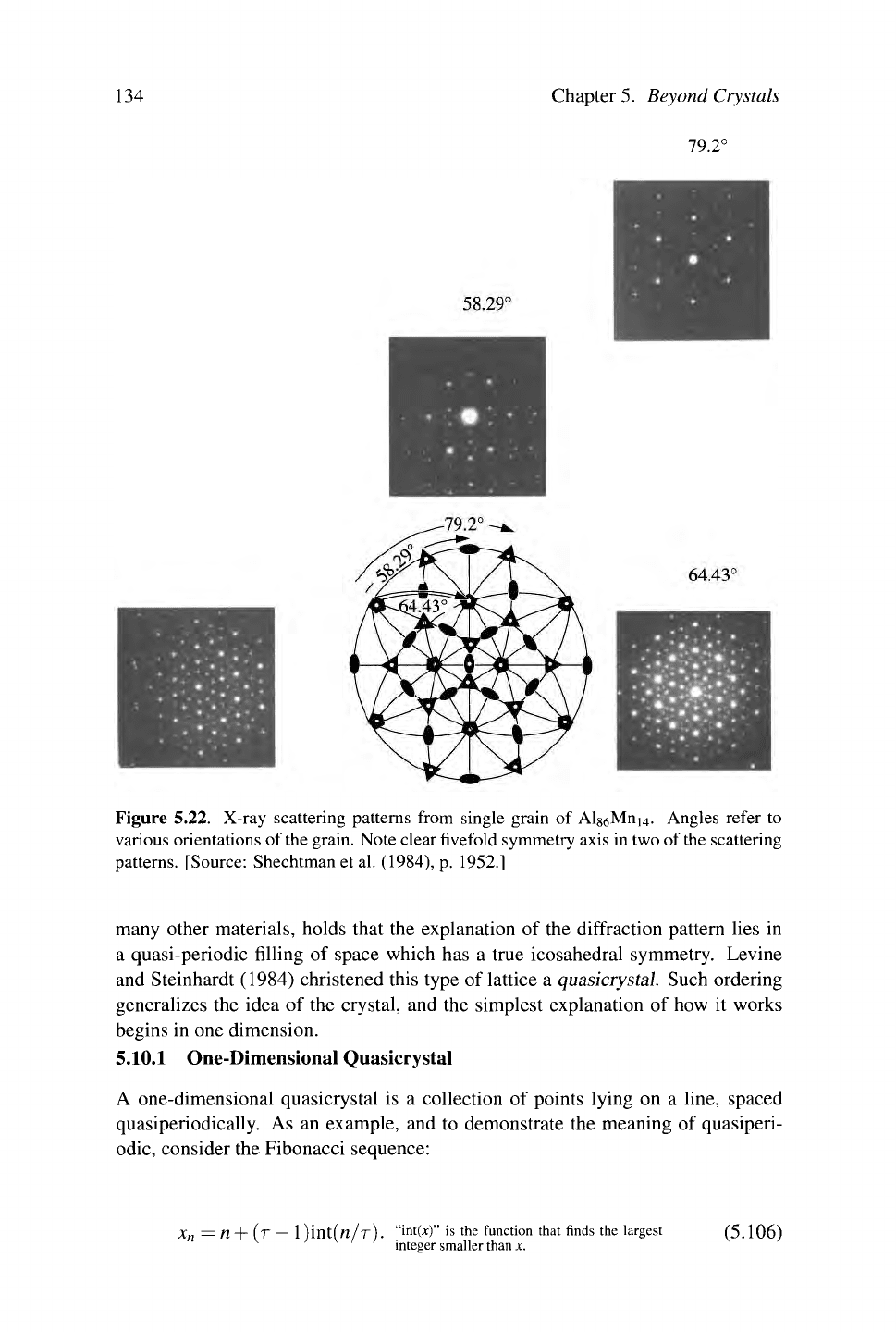
of threefold and fivefold symmetry, shown in Figure 5.22. Fivefold symmetry was
completely unexpected, since as proved in Problem 4 of Chapter 1, a fivefold axis
is crystallographically impossible. It is impossible to build a lattice with a fivefold
axis.
Nonetheless, the data unambiguously indicated that the system had this sym-
metry. In fact, the scattering patterns exhibited the symmetry of an icosahedron,
giving tenfold, sixfold, and fivefold symmetric diffraction patterns when tilted at
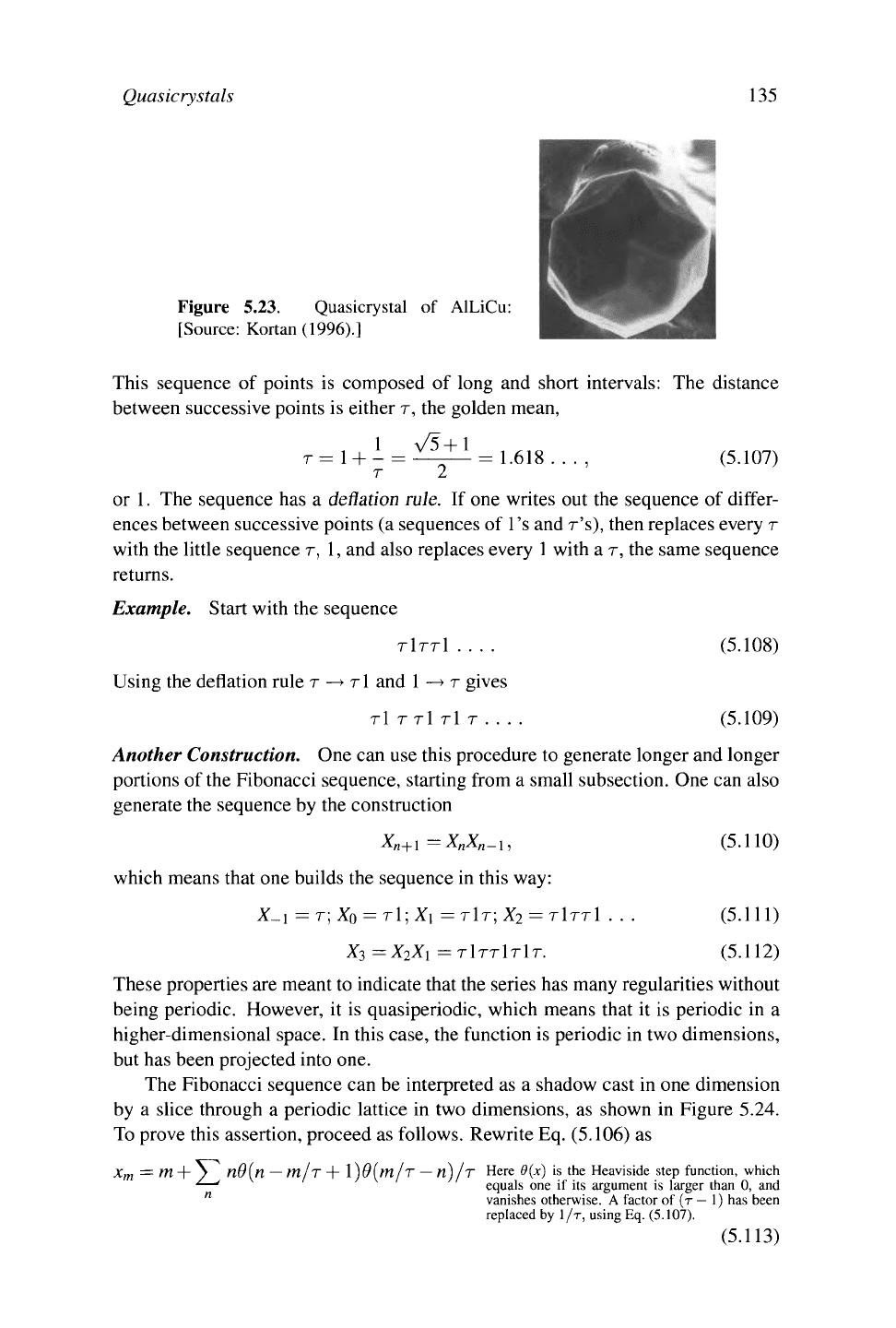
appropriate angles. A picture of a small crystal exhibiting such symmetry appears
in Figure 5.23.
The claim that nature had found a way to realize true fivefold symmetries met
with some resistance. A collection of five crystals might conceivably bond together
at five different orientations to produce an apparent fivefold axis. They would not
fit together perfectly, but the scattering pattern would not easily reveal this fact,
and such a point of view was vigorously advanced by Pauling (1985). In some
materials it turned out to be correct. However, the most interesting proposal, and
the one that seems to have carried the day for the original AIMn alloy as well as
134 Chapter 5. Beyond Crystals
79.2°
Figure 5.22. X-ray scattering patterns from single grain of AlgóMn^. Angles refer to
various orientations of the grain. Note clear fivefold symmetry axis in two of the scattering
patterns. [Source: Shechtman et al. (1984), p. 1952.]
many other materials, holds that the explanation of the diffraction pattern lies in
a quasi-periodic filling of space which has a true icosahedral symmetry. Levine
and Steinhardt (1984) christened this type of lattice a quasicrystal. Such ordering
generalizes the idea of the crystal, and the simplest explanation of how it works
begins in one dimension.
5.10.1 One-Dimensional Quasicrystal
A one-dimensional quasicrystal is a collection of points lying on a line, spaced
quasiperiodically. As an example, and to demonstrate the meaning of quasiperi-
odic,
consider the Fibonacci sequence:
71+ (r — 1)ϊηί(η/τ). "intOO" is the function that finds the largest (5.106)
integer smaller than x.
Quasicrystals 135
Figure 5.23. Quasicrystal of AlLiCu:
[Source: Kortan (1996).]
This sequence of points is composed of long and short intervals: The distance
between successive points is either r, the golden mean,
r=l + -= „
+1
=1.618. . . , (5.107)
T 2
or 1. The sequence has a deflation rule. If one writes out the sequence of differ-
ences between successive points (a sequences of l's and r's), then replaces every r
with the little sequence r, 1, and also replaces every 1 with a r, the same sequence
returns.
Example. Start with the sequence
rlrrl (5.108)
Using the deflation rule r
—>
rl and 1
—>
r gives
rlrrlrlr (5.109)
Another Construction. One can use this procedure to generate longer and longer
portions of the Fibonacci sequence, starting from a small subsection. One can also
generate the sequence by the construction
Xn+i =-X/i-Xn-i, (5.110)
which means that one builds the sequence in this way:
X-i
=T;X
0
= T1;X\ =
Τ
1τ; Χ
2
= τΐττΐ . . . (5.111)
X
3
=X
2
X
{
= rlrrlrlr. (5.112)
These properties are meant to indicate that the series has many regularities without
being periodic. However, it is quasiperiodic, which means that it is periodic in a
higher-dimensional space. In this case, the function is periodic in two dimensions,
but has been projected into one.
The Fibonacci sequence can be interpreted as a shadow cast in one dimension
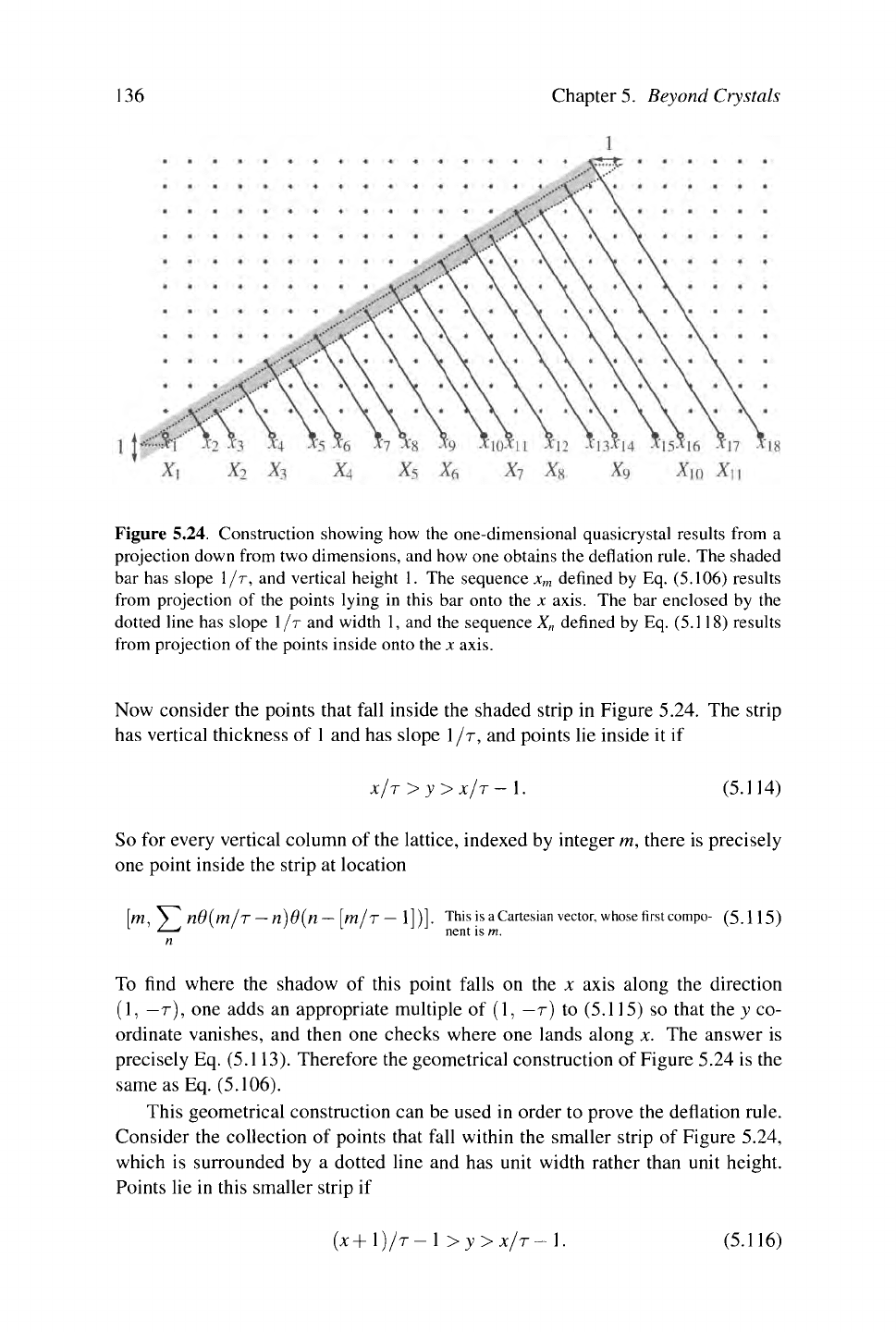
by a slice through a periodic lattice in two dimensions, as shown in Figure 5.24.
To prove this assertion, proceed as follows. Rewrite Eq. (5.106) as
X
m
= m + y ηθ(η — m/τ +
1
)θ(ΐη/τ — η)/τ Here θ(χ) is the Heaviside step function, which
^—' equals one if its argument is larger than 0, and
" vanishes otherwise. A factor of (τ
— 1 )
has been
replaced by l/τ, using Eq. (5.107).
(5.113)
136
Chapter 5. Beyond Crystals
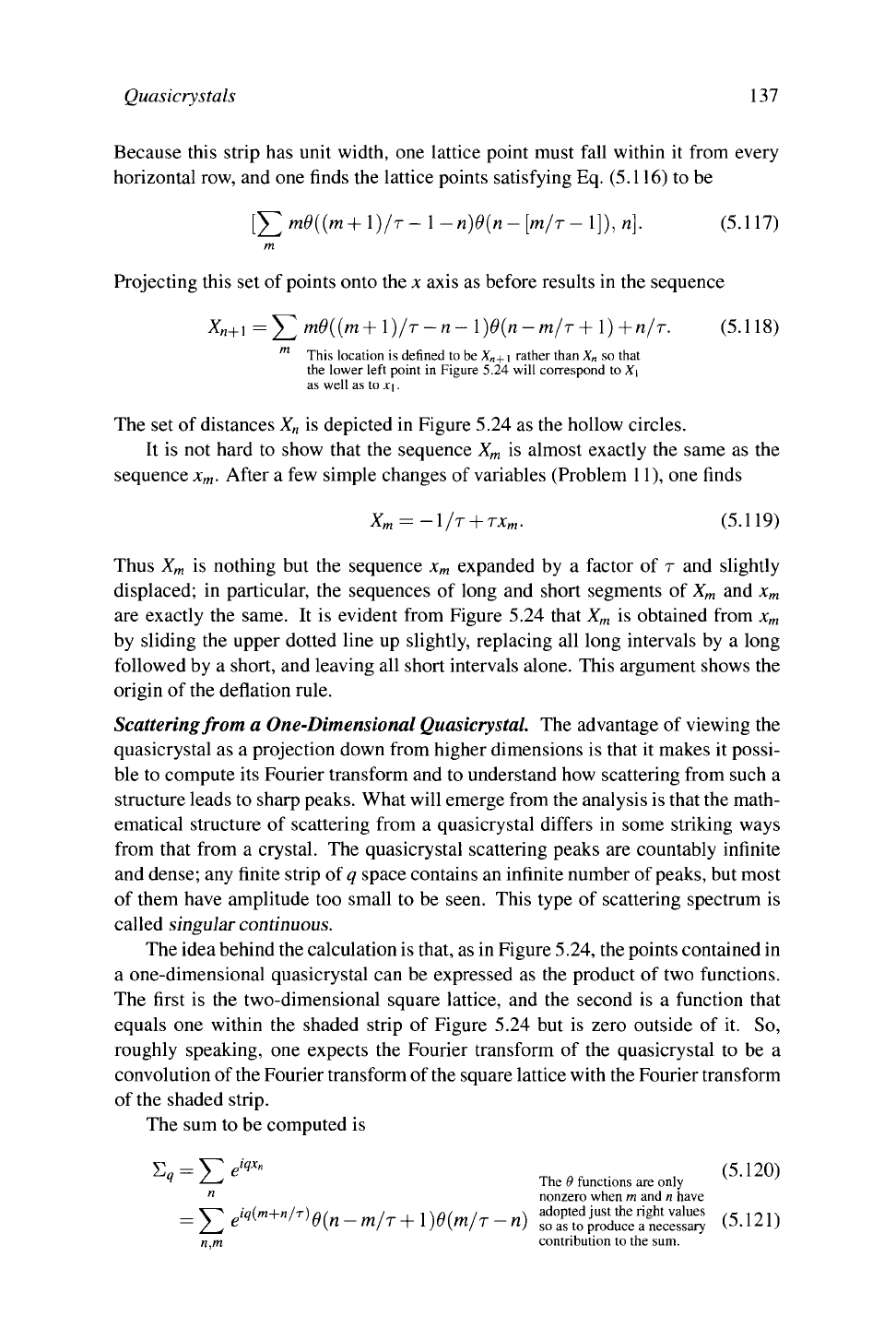
Figure 5.24. Construction showing how the one-dimensional quasicrystal results from a
projection down from two dimensions, and how one obtains the deflation rule. The shaded
bar has slope 1/r, and vertical height 1. The sequence x
m
defined by Eq. (5.106) results
from projection of the points lying in this bar onto the x axis. The bar enclosed by the
dotted line has slope l/τ and width 1, and the sequence
X„
defined by Eq. (5.118) results
from projection of the points inside onto the x axis.
Now consider the points that fall inside the shaded strip in Figure 5.24. The strip
has vertical thickness of
1
and has slope 1/r, and points lie inside it if
x/r>y>x/r-l.
(5.114)
So for every vertical column of the lattice, indexed by integer m, there is precisely
one point inside the strip at location
[m,
y^
ηθ(ηΐ/τ
—
η)θ(η—
[m/r— 1])].
This
js a Cartesian vector, whose first compo- (5.115)
n
To find where the shadow of this point falls on the
x
axis along the direction
(1,
—τ), one adds an appropriate multiple of (1, —r) to (5.115) so that the y co-
ordinate vanishes, and then one checks where one lands along x. The answer is
precisely Eq. (5.113). Therefore the geometrical construction of Figure 5.24 is the
same as Eq. (5.106).
This geometrical construction can be used in order to prove the deflation rule.
Consider the collection of points that fall within the smaller strip of Figure 5.24,
which is surrounded by a dotted line and has unit width rather than unit height.
Points lie in this smaller strip if
(JC+1)/T-1
>y>x/r-
1.
(5.116)
Quasicrystals 137
Because this strip has unit width, one lattice point must fall within it from every
horizontal row, and one finds the lattice points satisfying Eq. (5.116) to be
[J2 m9((m+ l)/r -
1
-η)θ(η - [m/r - 1]), n}. (5.117)
m
Projecting this set of points onto the x axis as before results in the sequence
X
n+]
=^m0((m+l)/T-/i-l)0(n-/n/r + l)+/i/i"· (5.118)
m
This location is defined to be
X
n
+1
rather than X
n
so that
the lower left point in Figure 5.24 will correspond to X\
as well as to x\.
The set of distances X
n
is depicted in Figure 5.24 as the hollow circles.
It is not hard to show that the sequence X
m
is almost exactly the same as the
sequence x
m
. After a few simple changes of variables (Problem 11), one finds
X
m
= -\/T + Tx
m
. (5.119)
Thus X
m
is nothing but the sequence x
m
expanded by a factor of r and slightly
displaced; in particular, the sequences of long and short segments of X
m
and x
m
are exactly the same. It is evident from Figure 5.24 that X
m
is obtained from x
m
by sliding the upper dotted line up slightly, replacing all long intervals by a long
followed by a short, and leaving all short intervals alone. This argument shows the
origin of the deflation rule.
Scattering from a One-Dimensional Quasicrystal. The advantage of viewing the
quasicrystal as a projection down from higher dimensions is that it makes it possi-
ble to compute its Fourier transform and to understand how scattering from such a
structure leads to sharp peaks. What will emerge from the analysis is that the math-
ematical structure of scattering from a quasicrystal differs in some striking ways
from that from a crystal. The quasicrystal scattering peaks are countably infinite
and dense; any finite strip of
q
space contains an infinite number of
peaks,
but most
of them have amplitude too small to be seen. This type of scattering spectrum is
called singular continuous.
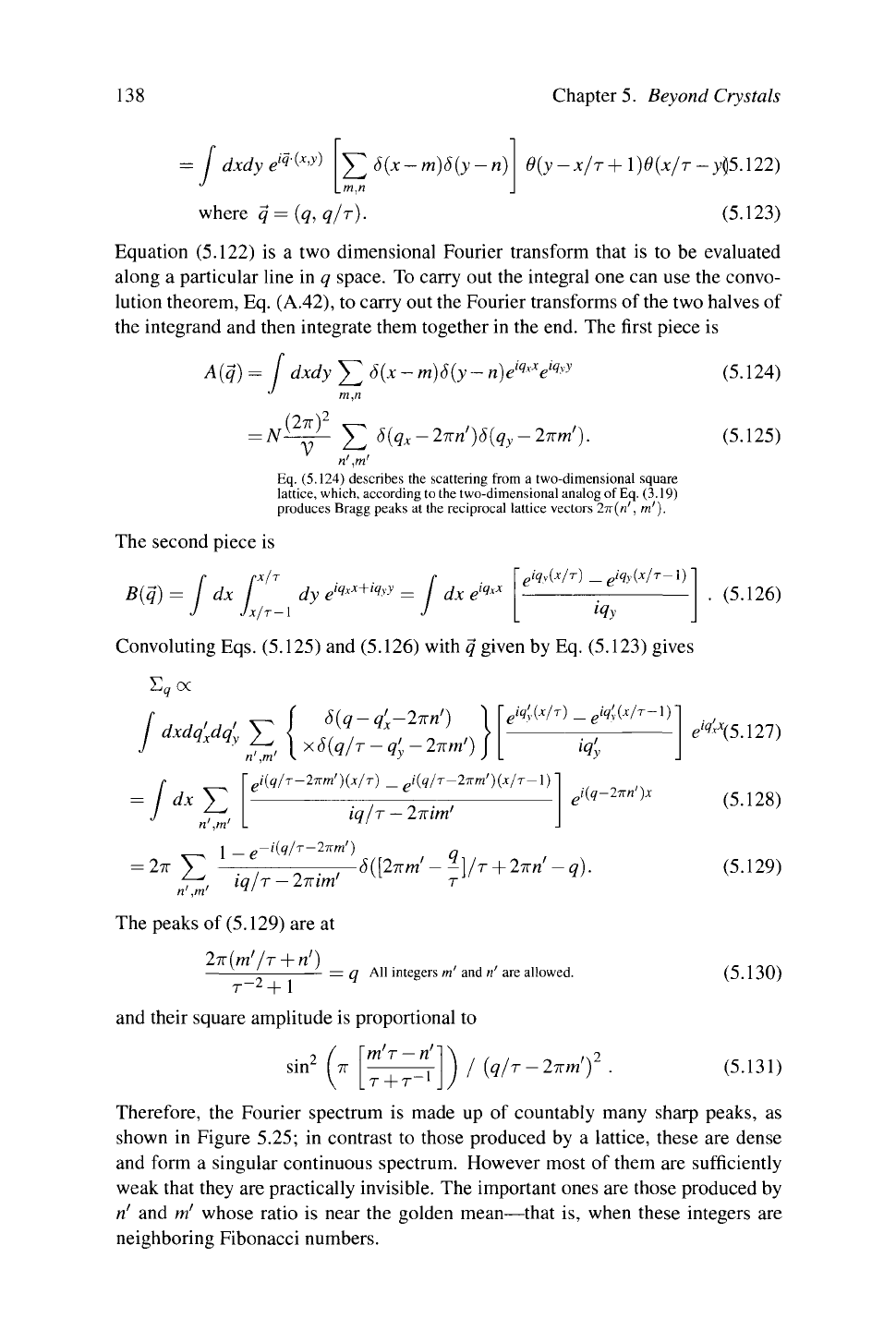
The idea behind the calculation is that, as in Figure 5.24, the points contained in
a one-dimensional quasicrystal can be expressed as the product of two functions.
The first is the two-dimensional square lattice, and the second is a function that
equals one within the shaded strip of Figure 5.24 but is zero outside of it. So,
roughly speaking, one expects the Fourier transform of the quasicrystal to be a
convolution of
the
Fourier transform of
the
square lattice with the Fourier transform
of the shaded strip.
The sum to be computed is
E, = Ve
i?I
" ^
ac
■ , (5.120)
v z
—' The
Θ
functions are only
n
nonzero when m and n have
= J2e
i
^^e(n-m/r+l)9(m/r-n) ^j^^^ (5.121)
n,m contribution to the sum.
138
Chapter 5. Beyond Crystals
= / dxdy e
iH*,y)
yj
δ(χ —
m)S(y
—
n)
where q = (q, q/τ).
0(y -χ/τ + 1)θ(χ/τ -
yt>5A22)
(5.123)
Equation (5.122) is a two dimensional Fourier transform that is to be evaluated
along a particular line in q space. To carry out the integral one can use the convo-
lution theorem, Eq. (A.42), to carry out the Fourier transforms of the two halves of
the integrand and then integrate them together in the end. The first piece is
A{q) = j dxdy Σ δ{χ-πι)δ{
γ
-η)ε^
χ
ε
ί
^
m,n
=
Ν
^ψ~ Σ S{q
x
-2irn')6(q
y
-2irm!).
(5.124)
(5.125)
Eq. (5.124) describes the scattering from a two-dimensional square
lattice, which, according to the two-dimensional analog of
Eq.
(3.19)
produces Bragg peaks at the reciprocal lattice vectors 2π(η', m
1
).
The second piece is
B{q) = [ dx f
XT
dy
e
ic
<*
x+ici
>
y
= ί dx e^
x
J Jx/τ-Ι J
*W
T
) —
e
'1y(x/T-\)
iq
y
(5.126)
Convoluting Eqs. (5.125) and (5.126) with q given by Eq. (5.123) gives
E^oc
/
ö(q-q'
x
-2Kn')
dxdq'
x
dq'
y
^
η',ηι' K '^V
1
// ' Hy
,ί(η/τ—2πιη')(χ/τ) _ J(q/r—2nm')(x/T—l)
^Σ
n'
,m'
x5(q/r
—
q'y
—
2πηι')
■e
i{
ίφ/τ) _Aq[,(x/T-\)
iq/r
—
2nim'
i(q-2irn')x
-i(q/T—2nm')
:
271"
> ; —δ(\2πιη' ]/τ + 2πη'
—
q).
f^, iar-l-Kim'
u
r
J/
^'
n'
m'
ί
'
The peaks of (5.129) are at
2π(ηι'
/τ + n')
r-2 + 1
q All integers m' and n' are allowed.
and their square amplitude is proportional to
sin 7Γ
m'r
—
n'
1
T +
T
j (q/τ
—
2nm'
>\
2
e'^(5.127)
(5.128)
(5.129)
(5.130)
(5.131)
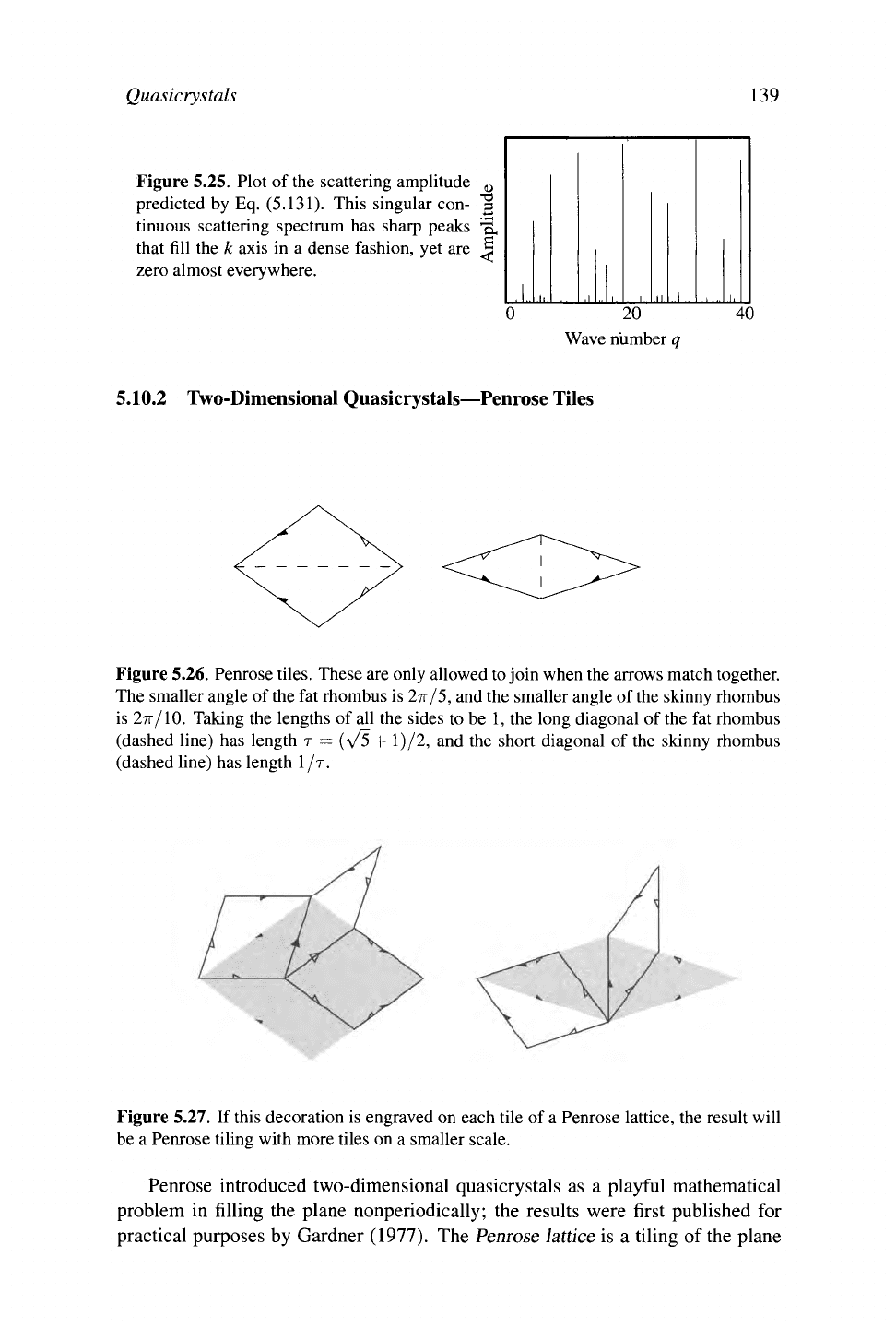
Therefore, the Fourier spectrum is made up of countably many sharp peaks, as
shown in Figure 5.25; in contrast to those produced by a lattice, these are dense
and form a singular continuous spectrum. However most of them are sufficiently
weak that they are practically invisible. The important ones are those produced by
n'
and m' whose ratio is near the golden mean—that is, when these integers are
neighboring Fibonacci numbers.
Quasicrystals
139
Figure 5.25. Plot
of
the scattering amplitude
ω
predicted
by Eq.
(5.131). This singular con-
Ή
tinuous scattering spectrum
has
sharp peaks
■§,
that fill
the k
axis
in a
dense fashion,
yet are 3
zero almost everywhere.
20
Wave number
q
40
5.10.2 Two-Dimensional Quasicrystals—Penrose Tiles
Figure 5.26. Penrose tiles. These are only allowed
to
join when the arrows match together.
The smaller angle
of
the
fat
rhombus
is
2π/5, and the smaller angle
of
the skinny rhombus
is 2π/10. Taking
the
lengths
of
all
the
sides
to be 1, the
long diagonal
of
the
fat
rhombus
(dashed line)
has
length
r = (\/5 +
l)/2,
and the
short diagonal
of the
skinny rhombus
(dashed line) has length
1/r.
Figure 5.27.
If
this decoration
is
engraved
on
each tile
of
a Penrose lattice,
the
result will
be
a
Penrose tiling with more tiles
on a
smaller scale.
Penrose introduced two-dimensional quasicrystals as a playful mathematical
problem in filling the plane nonperiodically; the results were first published for
practical purposes by Gardner (1977). The Penrose lattice is a tiling of the plane
140 Chapter 5. Beyond Crystals
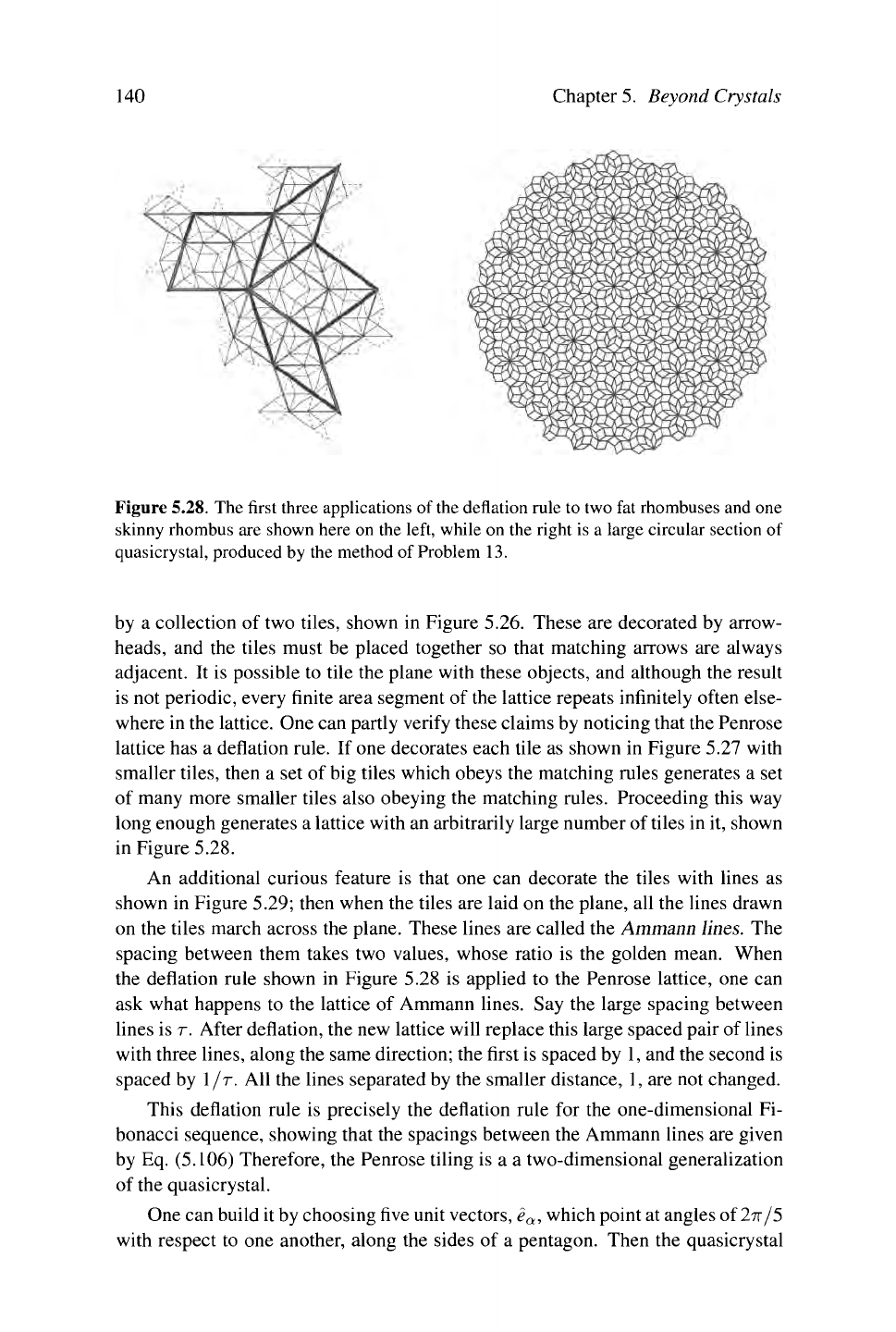
Figure 5.28. The
first
three applications of
the
deflation rule to two fat rhombuses and one
skinny rhombus are shown here on the left, while on the right is a large circular section of
quasicrystal, produced by the method of Problem 13.
by a collection of two tiles, shown in Figure 5.26. These are decorated by arrow-
heads,
and the tiles must be placed together so that matching arrows are always
adjacent. It is possible to tile the plane with these objects, and although the result
is not periodic, every finite area segment of the lattice repeats infinitely often else-
where in the lattice. One can partly verify these claims by noticing that the Penrose
lattice has a deflation rule. If one decorates each tile as shown in Figure 5.27 with
smaller tiles, then a set of big tiles which obeys the matching rules generates a set
of many more smaller tiles also obeying the matching rules. Proceeding this way
long enough generates a lattice with an arbitrarily large number of
tiles
in it, shown
in Figure 5.28.
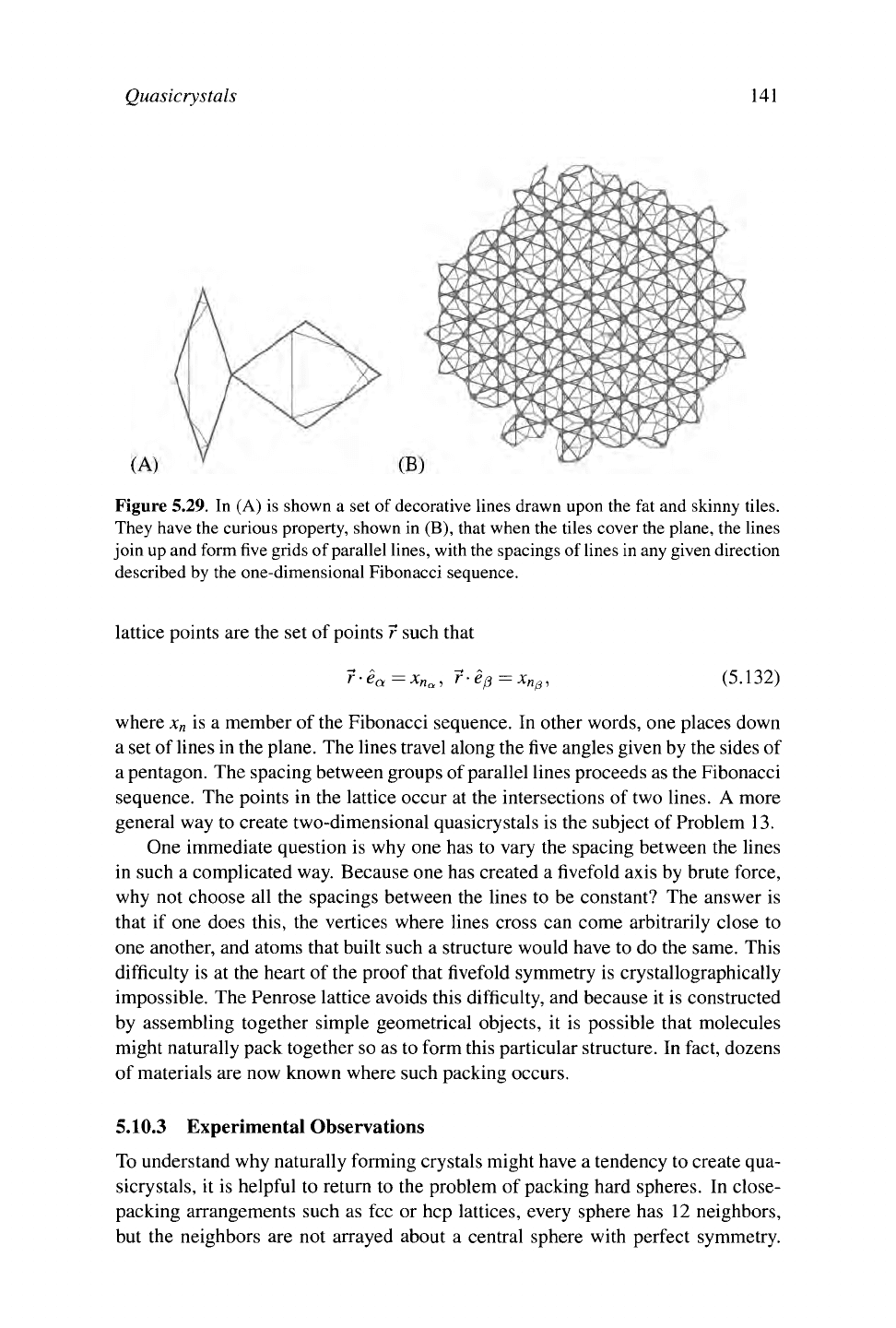
An additional curious feature is that one can decorate the tiles with lines as
shown in Figure 5.29; then when the tiles are laid on the plane, all the lines drawn
on the tiles march across the plane. These lines are called the Ammanti lines. The
spacing between them takes two values, whose ratio is the golden mean. When
the deflation rule shown in Figure 5.28 is applied to the Penrose lattice, one can
ask what happens to the lattice of Ammann lines. Say the large spacing between
lines is r. After deflation, the new lattice will replace this large spaced pair of lines
with three lines, along the same direction; the first is spaced by 1, and the second is
spaced by
1
/r. All the lines separated by the smaller distance, 1, are not changed.
This deflation rule is precisely the deflation rule for the one-dimensional Fi-
bonacci sequence, showing that the spacings between the Ammann lines are given
by Eq. (5.106) Therefore, the Penrose tiling is a a two-dimensional generalization
of the quasicrystal.
One can build it by choosing five unit vectors, ê
a
, which point at angles of 2π/5
with respect to one another, along the sides of a pentagon. Then the quasicrystal
Quasicrystals 141
Figure 5.29. In (A) is shown a set of decorative lines drawn upon the fat and skinny tiles.
They have the curious property, shown in
(B),
that when the tiles cover the plane, the lines
join
up
and form
five
grids of
parallel
lines, with the spacings of
lines
in any given direction
described by the one-dimensional Fibonacci sequence.
lattice points are the set of points r such that
r-ê
a
=x
na
, r-eß=x
nß
, (5.132)
where x
n
is a member of the Fibonacci sequence. In other words, one places down
a set of
lines
in the plane. The lines travel along the five angles given by the sides of
a pentagon. The spacing between groups of parallel lines proceeds as the Fibonacci
sequence. The points in the lattice occur at the intersections of two lines. A more
general way to create two-dimensional quasicrystals is the subject of Problem 13.
One immediate question is why one has to vary the spacing between the lines
in such a complicated way. Because one has created a fivefold axis by brute force,
why not choose all the spacings between the lines to be constant? The answer is
that if one does this, the vertices where lines cross can come arbitrarily close to
one another, and atoms that built such a structure would have to do the same. This
difficulty is at the heart of the proof that fivefold symmetry is crystallographically
impossible. The Penrose lattice avoids this difficulty, and because it is constructed
by assembling together simple geometrical objects, it is possible that molecules
might naturally pack together so as to form this particular structure. In fact, dozens
of materials are now known where such packing occurs.
5.10.3
Experimental Observations
To understand why naturally forming crystals might have a tendency to create qua-
sicrystals, it is helpful to return to the problem of packing hard spheres. In close-
packing arrangements such as fee or hep lattices, every sphere has 12 neighbors,
but the neighbors are not arrayed about a central sphere with perfect symmetry.
142
Chapter 5. Beyond Crystals
Suppose one takes a sphere and places 12 identical spheres around it in the most
symmetrical arrangement. Connecting the centers of the neighbors with lines, one
finds that they form an icosahedron, as shown in Figure 5.30. Because of the five-
fold symmetry evident in this structure, one knows immediately that it cannot fill
space uniformly. Approximate icosahedral symmetry is the basis for a complicated
arrangement of atoms first proposed by Frank and Kasper (1958), and reviewed
more recently by Nelson and Spaepen (1989). In the Frank-Kasper
phases,
a unit
cell is packed with several approximate icosahedra; they must be distorted to fit
together, and the unit cell is very complicated. Quasicrystalline phases can be un-
derstood as another way for materials to realize icosahedral symmetry.
Figure 5.30. Twelve neighbors symmetri-
cally arranged about a sphere form an icosa-
hedron.
The first quasicrystals were only metastable, and were filled with defects, but
alloys such as AI6L13CU have since been found for which the quasicrystalline phase
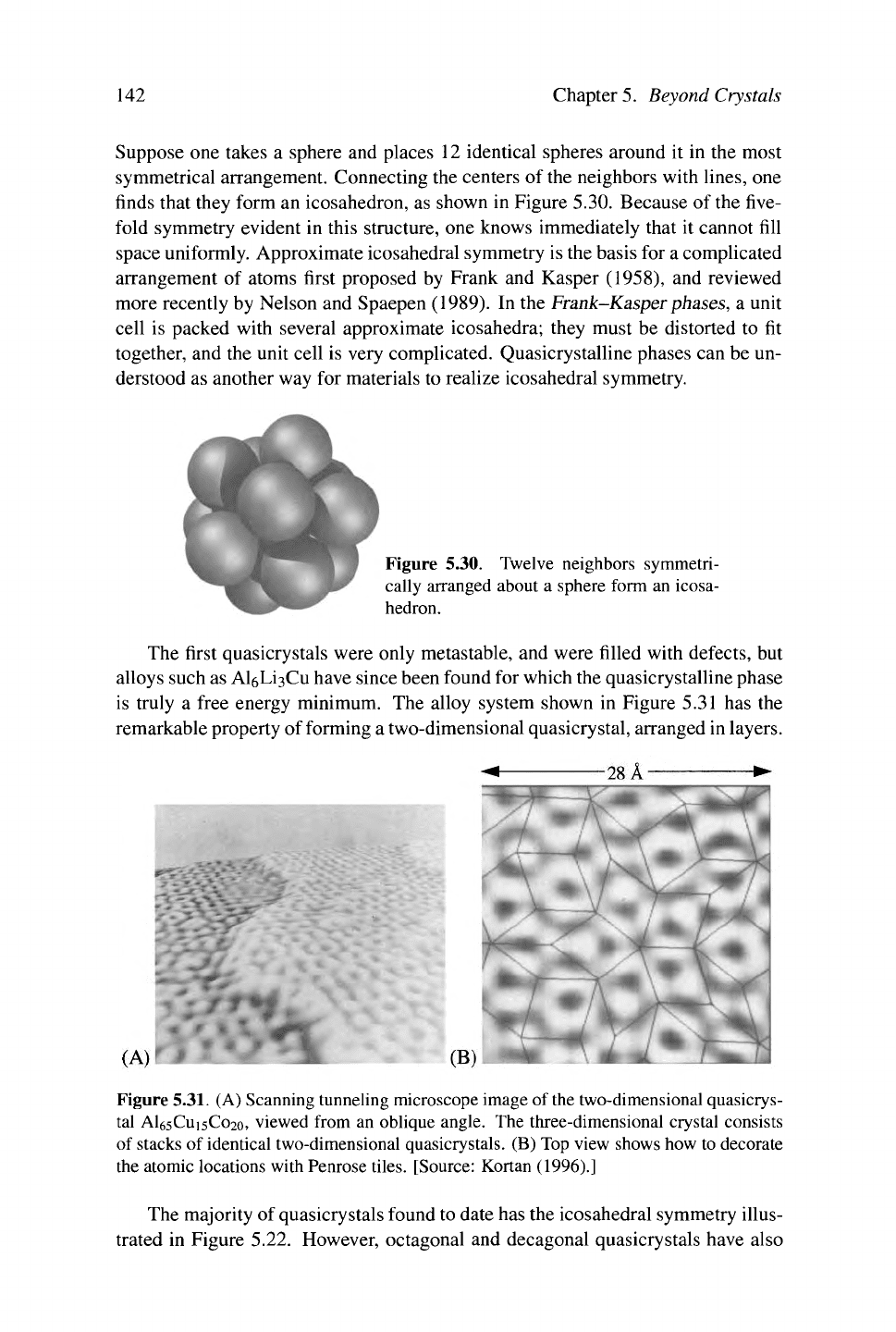
is truly a free energy minimum. The alloy system shown in Figure 5.31 has the
remarkable property of forming a two-dimensional quasicrystal, arranged in layers.
Figure
5.31.
(A) Scanning tunneling microscope image of
the
two-dimensional quasicrys-
tal AI65CU15C020, viewed from an oblique angle. The three-dimensional crystal consists
of stacks of identical two-dimensional quasicrystals. (B) Top view shows how to decorate
the atomic locations with Penrose tiles. [Source: Kortan (1996).]
The majority of quasicrystals found to date has the icosahedral symmetry illus-
trated in Figure 5.22. However, octagonal and decagonal quasicrystals have also