
Marder M.P. Condensed Matter Physics
Подождите немного. Документ загружается.

Statistical Mechanics of Noninteracting Electrons 163
One- and Two-Dimensional Formulae. Both because certain types of calcula-
tions are simpler in one and two dimensions and because techniques associated
with microfabrication make it possible to construct experimental systems that are
effectively one- and two-dimensional, it is useful to have corresponding formulae
for other dimensions. The general expression for density of electron states in d
dimensions is
Di =
2(±)
d
.
(6.34)
In two dimensions, the density of energy states is
m
D(£) = —2, (6.35)
πη
while the density of energy states in one dimension is
Problems 4 and 7 derive Eqs. (6.35) and (6.36) and extend them to arbitrary dimen-
sions.
General Ground States for Noninteracting Electrons. The ground states of
collections of electrons obeying Eq. (6.2) can be constructed in a manner analogous
to that used for the free Fermi gas. Order the energies of the one electron states so
that
£θ ^ £l "^ £? · · · · These are the energies appearing in Eq. (6.3). For the free Fermi gas, (6.37)
the energies would be £ίί, with k ranging over all allowed values and
k
each energy appearing twice to account for spin.
The ground state for N electrons is built out of electrons occupying energy
levels So · · ·
&N-
The most energetic occupied level is still called the Fermi energy.
The energy density of states D(E) remains defined as the number of single electron
states D(E)d£ to be found per volume in an energy range between £ and £ + dE.
When the potential U is periodic, it will be shown possible to index states by a wave
vector k as well, but for nonperiodic U such a description is usually impossible.
6.4 Statistical Mechanics of Noninteracting Electrons
A first example of the role played by
D(&F)
in determining the response of elec-
trons to outside influence is provided by calculating the specific heat of free elec-
trons.
To make this calculation possible, it is necessary to recall the statistical
mechanics of noninteracting Fermi particles. This calculation also provides a way
to obtain a quantitative criterion for when an ensemble of electrons behaves in a
basically classical, as opposed to essentially quantum-mechanical, way. At
suf-
ficiently high temperatures or low densities, electrons are classical, but at room
temperature and at the densities common in metals, quantum mechanical effects
164 Chapter 6. The Free Fermi Gas and Single Electron Model
are of fundamental importance. This calculation will be carried out for the general
case of noninteracting electrons, not just the free Fermi gas.
The grand canonical partition function provides the most convenient formal
means for studying this problem. Consider a volume V in contact with a tem-
perature reservoir, and with a reservoir of electrons, which flow in and out. The
state of the electrons can completely be described by a collection of integers n\,
«2 . . ., which equal zero or one and indicate for each of the quantum energy states
in Eq. (6.37) whether the state is occupied or not. One can sum over all possible
ways that electrons can inhabit the volume by summing over all possible values of
all the integers «/. So the grand partition function Z
gr
is expressed as
z
gr
=E
α
β(μΝ-ε)
states
1 1 1
β^2,"ι(μ-^ι)
«1=0 «2=0 «3=0
Using the mathematical fact that
N N N M M ( N
Σ Σ-ΣΠ^Π E^r>
n,=0 n
2
=0 «
M
=0/=l l=\ \ηι=Ό
one has that
*r =
II Σ
α
β η,Ιμ-ε,]
I l«;=0
= Jj[l+^-£/l
Therefore the grand potential is given by
Π
Ξ — kßT In Z
gr
= -k
B
T^la
\\+^-
E
'
-k
B
TV
ί dED(Z)
In
l+e
ß\M-Z]
This is the definition of the grand ,, .„,
partition function. The symbol ß is \P·-'"/
Ι/kßT,
where ke is Boltzmann's
constant and T is the temperature.
The total number of particles N is (6.39)
y\ «/, and the total energy £ is
given by J2i
η
'
ε
ι-
The identity follows by just asking , _
what happens as one multiplies (6.4(J)
everything out on the right-hand
side.
(6.41)
The sum over each «/ has just been (6.42)
carried out explicitly.
See Landau and Lifshitz
(
1980),
(6 43)
p.
108.
(6.44)
Here is an example showing the
utility of defining the density of
states D(E).
(6.45)
Fermi Function. From the grand potential all other thermodynamic quantities
can be obtained. For example, the average number of electrons N is given by
N =
8μ
(6.46)
V / dE' D(E')-.
„βμ-βΕ'
- From Eq. (6.38), N = k
B
Td{Z
iT
/d
ß
)/Z
SI
. (6.47)
\
+e
ßß-ßt>
N
f
n= — = / ί/ε' D(E') f (£') « is the density of conduction electrons. (6.48)
Statistical Mechanics of Noninteracting Electrons
165
where
/(£)
1
(6.49)
β
β(ε-
μ
) _|_ ι
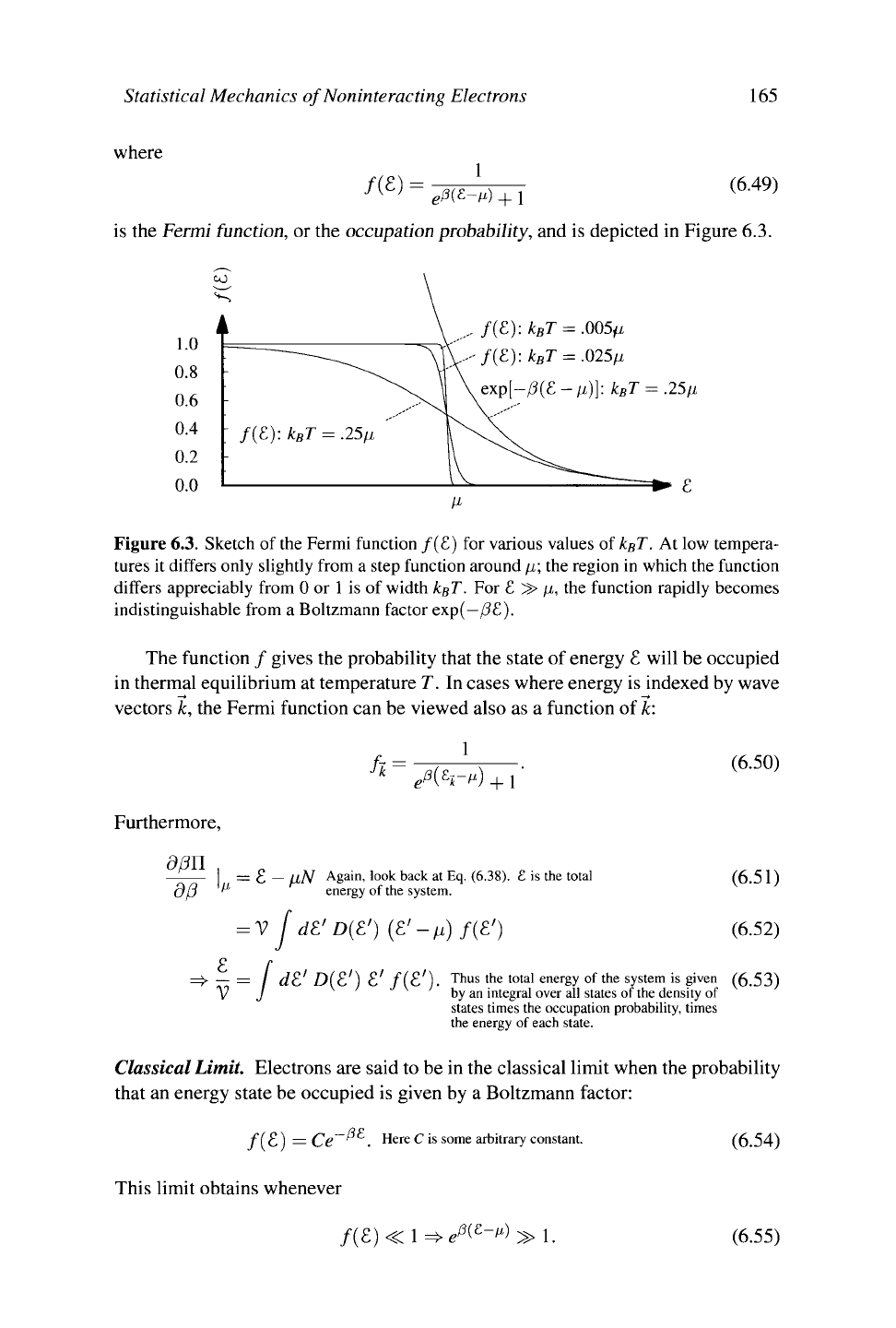
is the Fermi function, or the occupation probability, and is depicted in Figure 6.3.
/(£):
Λ
Β
Γ = .005μ
--/(£):
£
β
Γ = .025μ
exp[—/?(£
—
μ)]:
k
B
T = .25μ
Figure 6.3. Sketch of the Fermi function /(£) for various values of kßT. At low tempera-
tures it differs only slightly from a step function around μ; the region in which the function
differs appreciably from 0 or
1
is of width kßT. For £
^>
μ, the function rapidly becomes
indistinguishable from a Boltzmann factor exp(—β£).
The function / gives the probability that the state of energy £ will be occupied
in thermal equilibrium at temperature T. In cases where energy is indexed by wave
vectors k, the Fermi function can be viewed also as a function of k:
h
1
Ah-ü
+ ι
(6.50)
Furthermore,
δβΠ. ,
= £ — μΝ Again, look back at Eq. (6.38). £ is the total
Qß I
1
energy of the system.
(6.51)
(6.52)
V
V [ d£' D(E') (Ζ'-μ) /(£')
: / ί/δ' D(E') E' /(£')· Thus the total energy of the system is given (6.53)
J by an integral over all states of the density of
states times the occupation probability, times
the energy of each state.
Classical Limit. Electrons are said to be in the classical limit when the probability
that an energy state be occupied is given by a Boltzmann factor:
f(£,)=Ce . Here C is some arbitrary constant.
This limit obtains whenever
/(ε)<ι=Φ/(
£
-^»ι.
(6.54)
(6.55)
166 Chapter 6. The Free Fermi Gas and Single Electron Model
When conditions (6.55) apply for all conduction electrons up to the Fermi level,
one says that
classical
or Boltzmann statistics apply and that the electrons are non-
degenerate, because all the energy states are far from being doubly occupied. Oth-
erwise one says that Fermi, or Fermi-Dirac statistics apply and that the electrons
are degenerate. Thus, the larger and more positive μ becomes, the more pro-
nounced are quantum effects; as μ increases, density increases, so the non-classical
limit is associated with high densities and low temperatures.
As temperature heads toward zero one sees that
f(£) —> θ(β — £). The
Θ
function is zero when its argument is (6.56)
less than zero, and one otherwise.
At very low temperatures all states are occupied below the critical energy μ and
are unoccupied above it, the same conclusion that was reached in constructing the
ground state of the many-electron system. At T = 0 the Fermi energy ξ,ρ is equal
to the chemical potential μ. This zero temperature limit is intrinsically quantum
mechanical, because all states below the Fermi level have occupation number equal
to 1, and conditions (6.55) are violated.
It is impossible to determine what "low" and "high" temperatures might cor-
respond to without putting in numbers for real physical systems. One can pretend
that metals are nothing but free-electron gases, use a conventional number of con-
duction electrons per atom and the known density of the various metals to compute
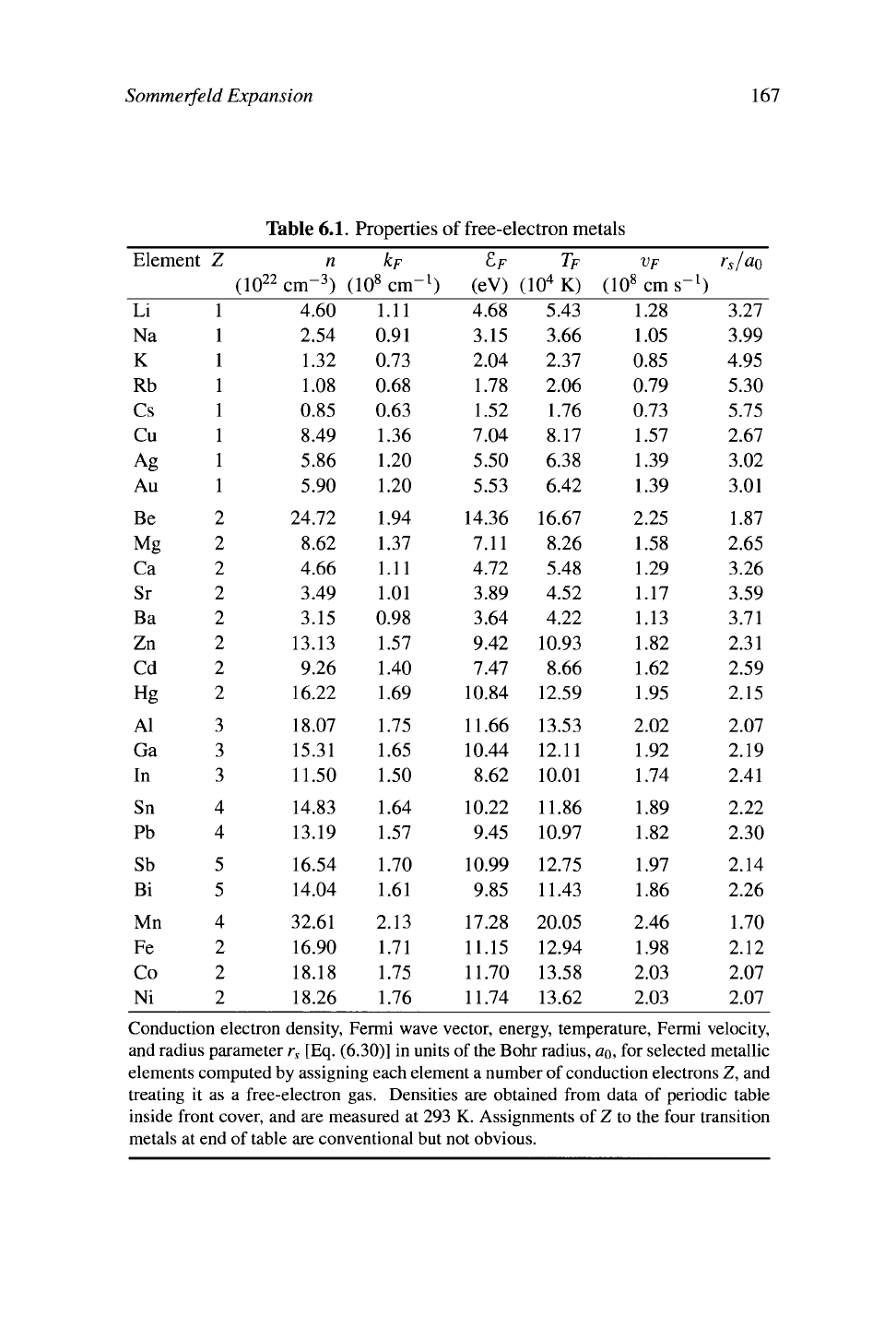
kf and Ef for the metallic elements. The results appear in Table 6.1. One sees
by consulting this table that Fermi energies are on the order of electron volts. In
order for electrons to be excited with appreciable probability to such energies in a
classical system, they would need to be at a temperature on the order of
7> = E
F
/k
B
, (6.57)
where Tf is called the Fermi
temperature.
Fermi temperatures are on the order of
10 000 K and higher. Therefore, at room temperature, the electron gas in metals is
at very low temperatures and is highly degenerate.
Indeed, the single most important fact about metals is that their conduction
electrons form a highly degenerate Fermi gas. No subsequent elaborations of the
theory will change this central conclusion.
6.5 Sommerfeld Expansion
The temperatures at which metals remain solid are low in comparison with typical
Fermi temperatures, so it makes sense to work out a low temperature expansion
for thermodynamic properties. This expansion is due to Sommerfeld (1928), and
it makes use of the idea that at low temperatures electrons are only active within
a small energy range, kßT of the Fermi energy. To understand why, consider, for
example, the process of adding heat to a metal. As the temperature of a metal rises,
the average energy of electrons in it must increase. This increase can only hap-
pen if electrons make transitions to higher energy states. Only right in the vicinity
Sommerfeld Expansion 167
Table 6.1. Properties of free-electron metals
Element Z
(10
Z2
cm"
J
)
(10
8
cm"
1
) (eV) (10
4
K)
(IO
8
cm s"
r
s
/a
0
Li
Na
K
Rb
Cs
Cu
Ag
Au
Be
Mg
Ca
Sr
Ba
Zn
Cd
Hg
Al
Ga
In
Sn
Pb
Sb
Bi
Mn
Fe
Co
Ni
2
2
2
2
2
2
2
2
3
3
3
4
4
5
5
4
2
2
2
4.60
2.54
1.32
1.08
0.85
8.49
5.86
5.90
24.72
8.62
4.66
3.49
3.15
13.13
9.26
16.22
18.07
15.31
11.50
14.83
13.19
16.54
14.04
32.61
16.90
18.18
18.26
1.11
0.91
0.73
0.68
0.63
1.36
1.20
1.20
1.94
1.37
1.11
1.01
0.98
1.57
1.40
1.69
1.75
1.65
1.50
1.64
1.57
1.70
1.61
2.13
1.71
1.75
1.76
4.68
3.15
2.04
1.78
1.52
7.04
5.50
5.53
14.36
7.11
4.72
3.89
3.64
9.42
7.47
10.84
11.66
10.44
8.62
10.22
9.45
10.99
9.85
17.28
11.15
11.70
11.74
5.43
3.66
2.37
2.06
1.76
8.17
6.38
6.42
16.67
8.26
5.48
4.52
4.22
10.93
8.66
12.59
13.53
12.11
10.01
11.86
10.97
12.75
11.43
20.05
12.94
13.58
13.62
1.28
1.05
0.85
0.79
0.73
1.57
1.39
1.39
2.25
1.58
1.29
1.17
1.13
1.82
1.62
1.95
2.02
1.92
1.74
1.89
1.82
1.97
1.86
2.46
1.98
2.03
2.03
3.27
3.99
4.95
5.30
5.75
2.67
3.02
3.01
1.87
2.65
3.26
3.59
3.71
2.31
2.59
2.15
2.07
2.19
2.41
2.22
2.30
2.14
2.26
1.70
2.12
2.07
2.07
Conduction electron density, Fermi wave vector, energy, temperature, Fermi velocity,
and radius parameter r
s
[Eq. (6.30)] in units of the Bohr radius,
ao>
for selected metallic
elements computed by assigning each element a number of conduction electrons Z, and
treating it as a free-electron gas. Densities are obtained from data of periodic table
inside front cover, and are measured at 293 K. Assignments of Z to the four transition
metals at end of table are conventional but not obvious.
168 Chapter 6. The
Free
Fermi Gas and Single Electron Model
of the Fermi energy are there both (a) an appreciable population of electrons and
(b) vacant states of slightly higher energy to which they can move. The number
of electron states is proportional to D(Ep), and the number of states that partici-
pate in the specific heat is proportional to T. Fermi statistics predicts that at low
temperatures
c
v
<xTD(E
F
), (6.58)
and in this way resolves the difficulty with specific heats noted by Thomson (1907).
i
20
10
0
L
-
-
J
yk
B
T = .005μ
,k
B
T = ·025μ
( ,ΛΒΤ = 25μ
^==-
hi
μ
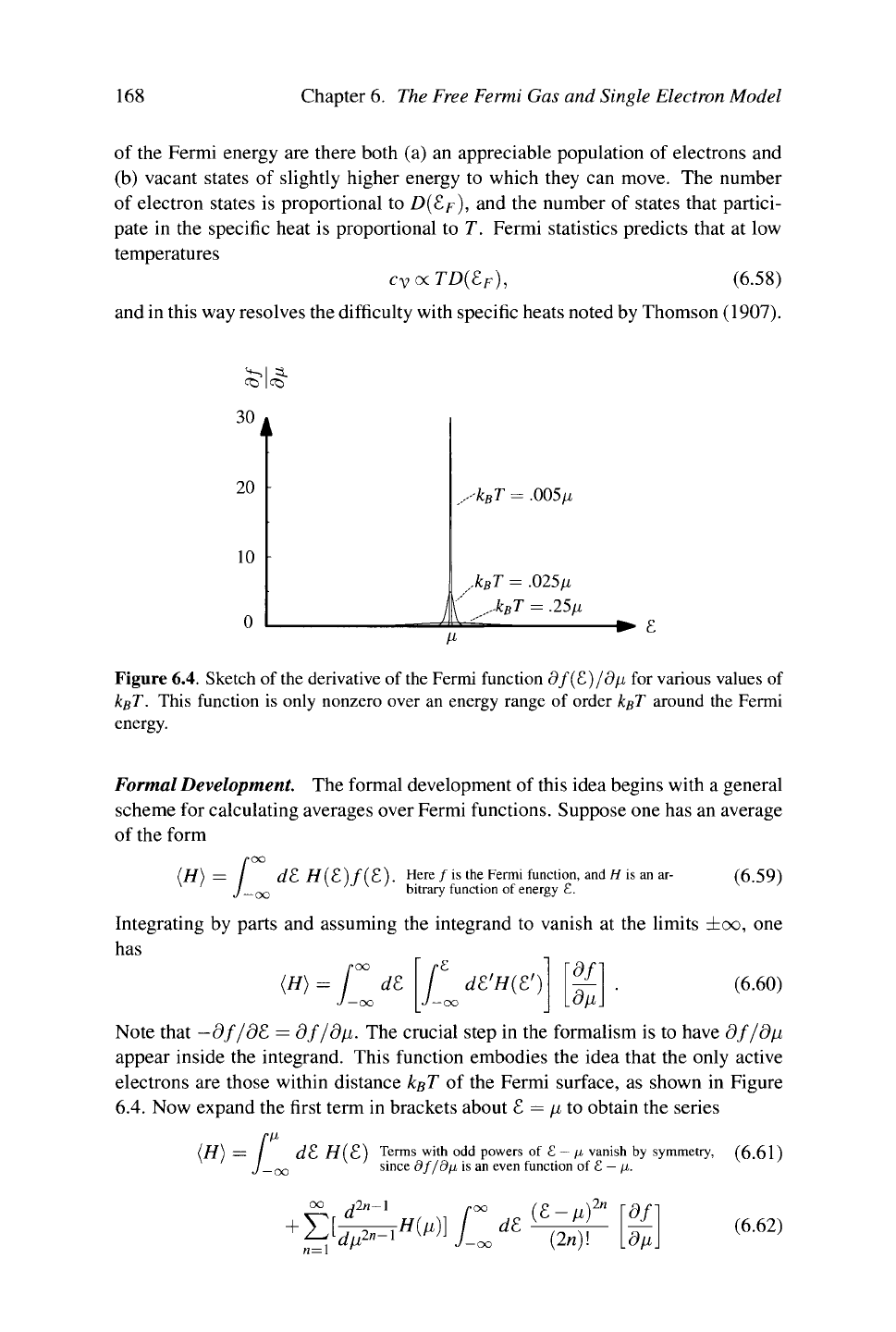
Figure 6.4. Sketch of
the
derivative of
the
Fermi function δ/(Ε)/3μ for various values of
kßT. This function is only nonzero over an energy range of order k
B
T around the Fermi
energy.
Formal Development. The formal development of this idea begins with a general
scheme for calculating averages over Fermi functions. Suppose one has an average
of the form
/
oo
dE H(E)f(E). Here / is the Fermi function, and tt is an ar- (6.59)
^
oc
bitrary function of energy £.
Integrating by parts and assuming the integrand to vanish at the limits ±00, one
has
/
oo re
dl \ dZ'H{l'
-00 J—00
3μ
(6.60)
Note that —df/dC = df/θμ. The crucial step in the formalism is to have df/Ομ
appear inside the integrand. This function embodies the idea that the only active
electrons are those within distance kßT of the Fermi surface, as shown in Figure
6.4. Now expand the first term in brackets about £ = μ to obtain the series
{H) =
dE //(£) Terms with odd powers of E
—
μ vanish by symmetry, (6.61)
since df/θμ is an even function of £
—
μ.
+ΣΙ
n=\
j2n-\
άμ
2/7-1
Η(μ)}
J_
00
dE^-ri-
(2n)\
In
Of
3μ
(6.62)
Sommerfeld Expansion 169
dEH(E) + Σ a
n
[k
B
T]
2n
-^^H(p) (6.63)
with
d IT-
2
"
/
oo
-oo
oo
dxe
x
+l
d\
2n
Γ &π
(2»)!
(6.64)
sin
Ζ?π
Proving this relation is the (6.65)
b=Q subject of Problem 6.
(2n)\
\db)
\H) = I do //(c) One seldom needs any terms beyond T
2
. This expansion (6.66)
7—oo
can be viewed as a power series in kßT lu, which at room i power series in
kßT/'μ,
temperature is 1/40 or less.
+ 4
[kBT]
2
Η'{μ) + ^ [k
B
T]
4
H"(μ) +. . . . (6.67)
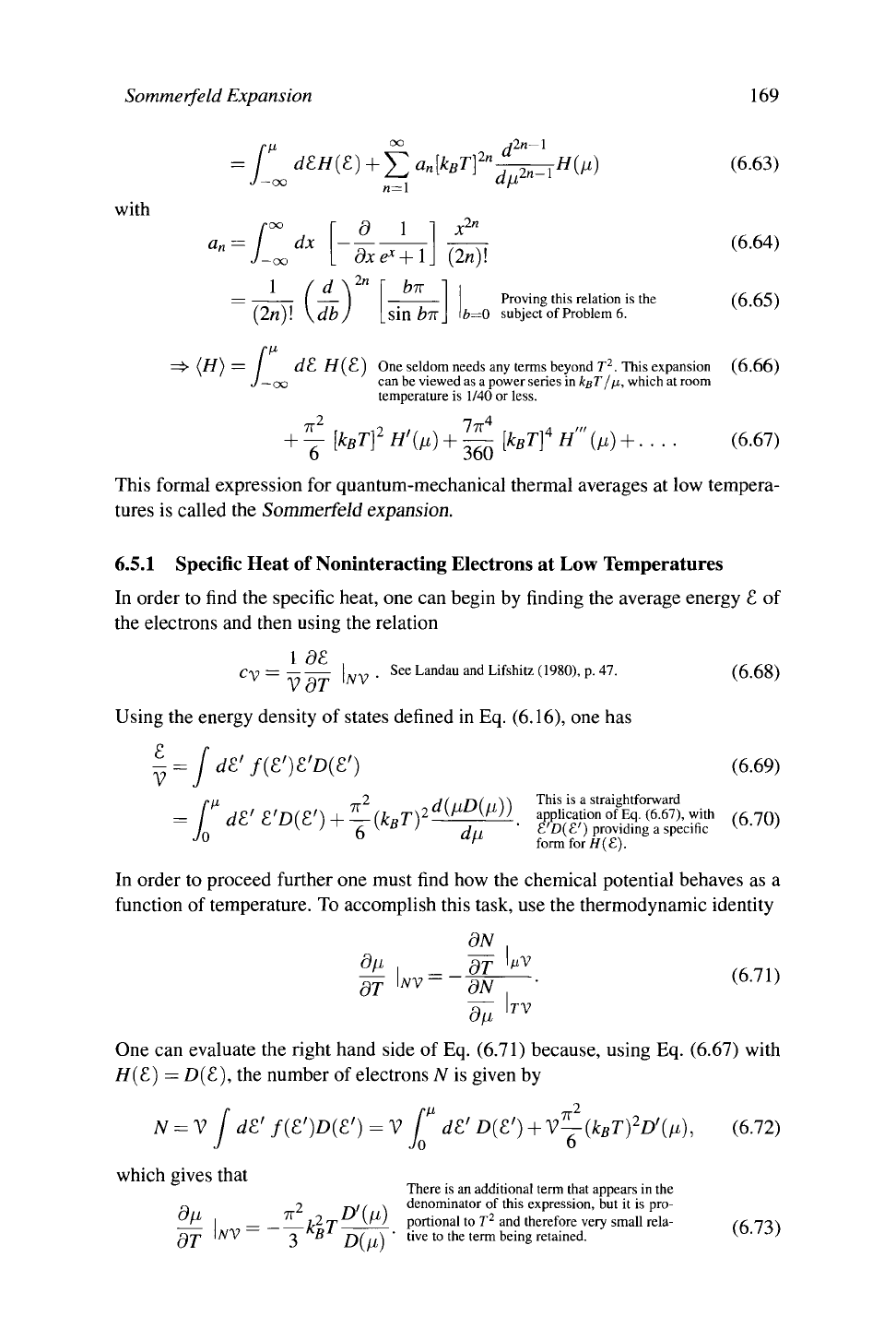
This formal expression for quantum-mechanical thermal averages at low tempera-
tures is called the Sommerfeld expansion.
6.5.1 Specific Heat of Noninteracting Electrons at Low Temperatures
In order to find the specific heat, one can begin by finding the average energy δ of
the electrons and then using the relation
1 dE ,
C
V
= \
NV
. See Landau and Lifshitz (1980), p. 47. (6.68)
Using the energy density of states defined in Eq. (6.16), one has
|
=
^ε'/(ε')ε'ο(ε') (6.69)
ru -7Γ
2
rKiiDiiiW This is a straightforward
AC' Ρ'ΓΛίΡ'λ ι
η
η^τ^"^^^)) application of Ea. (6.67),
irovid
ru π
2
rHiiDlnW This is a straightforward
= / dE' E'D(E') + —
(k
B
T)
2
α[
-
μυ
^
μ)>
. application of Eq. (6.67), with
(6J0)
L· \ J ' c. \ D j j fcD(fc) providing a specific
v
'
J0 αμ
form for Hit).
In order to proceed further one must find how the chemical potential behaves as a
function of temperature. To accomplish this task, use the thermodynamic identity
dN
ομ _ Qf ^
v
(61l)
dT
\NV- g^ · lo./i;
δμ
ÌTV
One can evaluate the right hand side of Eq. (6.71) because, using Eq. (6.67) with
H(E) = D(E), the number of electrons N is given by
N = V [ dE' f{E')D(E') = V Γ dE' D(E') + V~(k
B
T)
2
D'(ß), (6.72)
J Jo 6
which gives that
There is an additional term that appears in the
Λ 2 rV ( \ denominator of this expression, but it is pro-
r I __ ]p-T ^ ' portional to T
2
and therefore very small rela-
(6>ΊΎ\
βγ ÌNV τ Β Γ)( ιΛ ' tive to the term being retained. ^ ' ^
170 Chapter 6. The Free Fermi Gas and Single Electron Model
When the temperature T equals zero, μ equals £,
F
, the Fermi energy, so
μ = Ep — (k
B
T) ———. This expression is valid to order T
2
. (6.74)
6 D (of)
Knowing that μ
—
£
F
is of order T
2
, one can now write to order T
2
that
[
F
dl' Z'D(i') + ?-(k
B
T)
2
D{E
F
)
JO
o
( Ji
ε
^ +B,
F
Uß-E
F
)D{E
F
) + ^{k
B
T)
2
D'{t
F
)\
One replaces μ in Eq. (6.70) using Eq. (6.74). Notice that μ appears as a limit
of integration; here one writes μ =
&F
+ (μ
—
&F)
and expands to first order in
μ
—
Er
.
The term in curly brackets vanishes because of Eq. (6.74).
(6.75)
ε
r
EF
v
f
F
dZ £D(£) + ^(k
B
T)
2
D(E
F
) (6.76)
Jo 6
^C
V
=—
k
2
B
TD(E
F
). Using Eq. (6.68). (6.77)
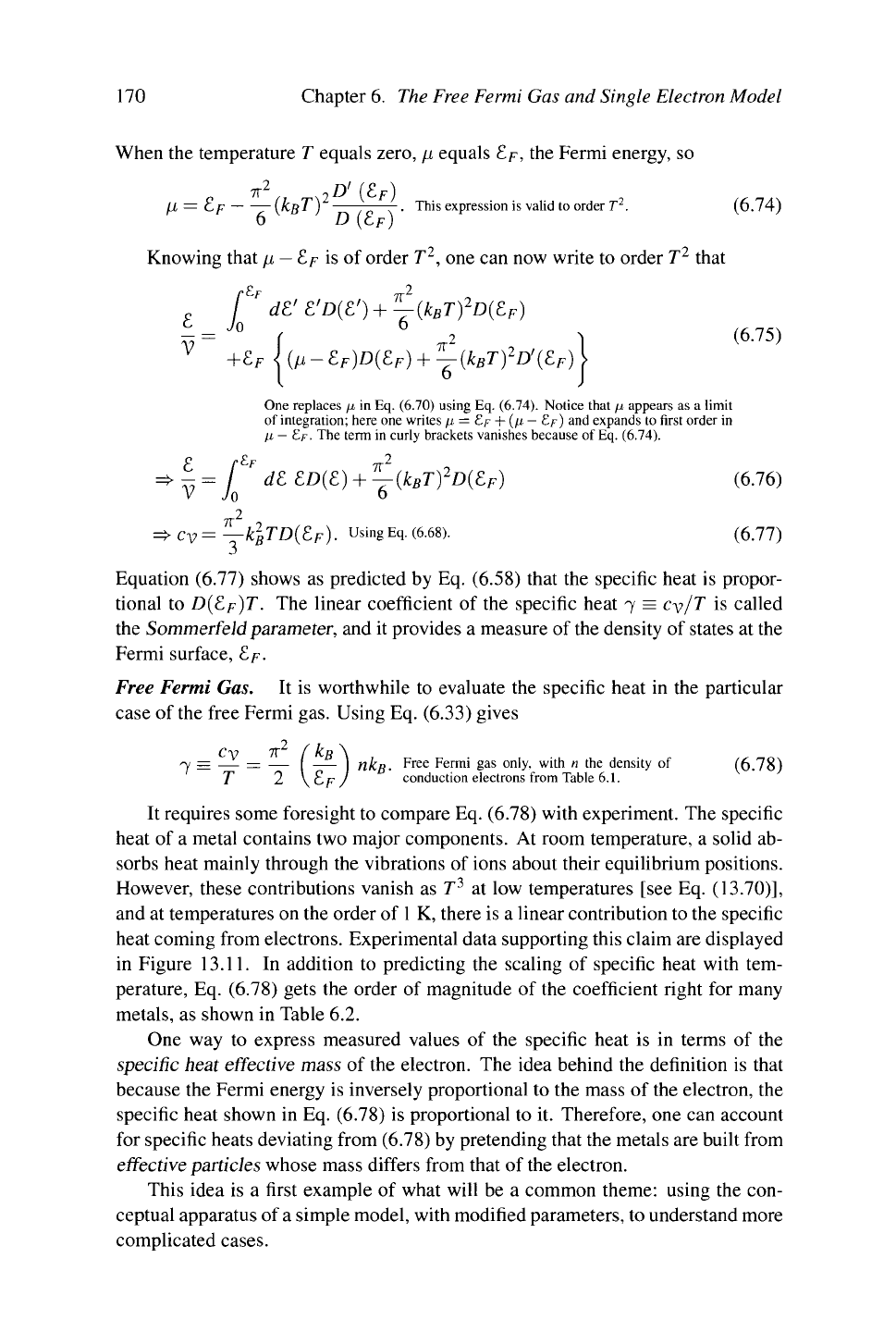
Equation (6.77) shows as predicted by Eq. (6.58) that the specific heat is propor-
tional to
D(E
F
)T.
The linear coefficient of the specific heat 7 = cy/T is called
the Sommerfeld
parameter,
and it provides a measure of the density of states at the
Fermi surface, E
F
.
Free Fermi Gas. It is worthwhile to evaluate the specific heat in the particular
case of the free Fermi gas. Using Eq. (6.33) gives
Cy 7Γ
2
f k
B
\
Ύ = —
=
— nk
B
.
F
ree
Fermi gas only, with n the density of (6.78)
T 2 \8-F J conduction electrons from Table 6.1.
It requires some foresight to compare Eq. (6.78) with experiment. The specific
heat of a metal contains two major components. At room temperature, a solid ab-
sorbs heat mainly through the vibrations of ions about their equilibrium positions.
However, these contributions vanish as Γ
3
at low temperatures [see Eq. (13.70)],
and at temperatures on the order of
1
K, there is a linear contribution to the specific
heat coming from electrons. Experimental data supporting this claim are displayed
in Figure
13.11.
In addition to predicting the scaling of specific heat with tem-
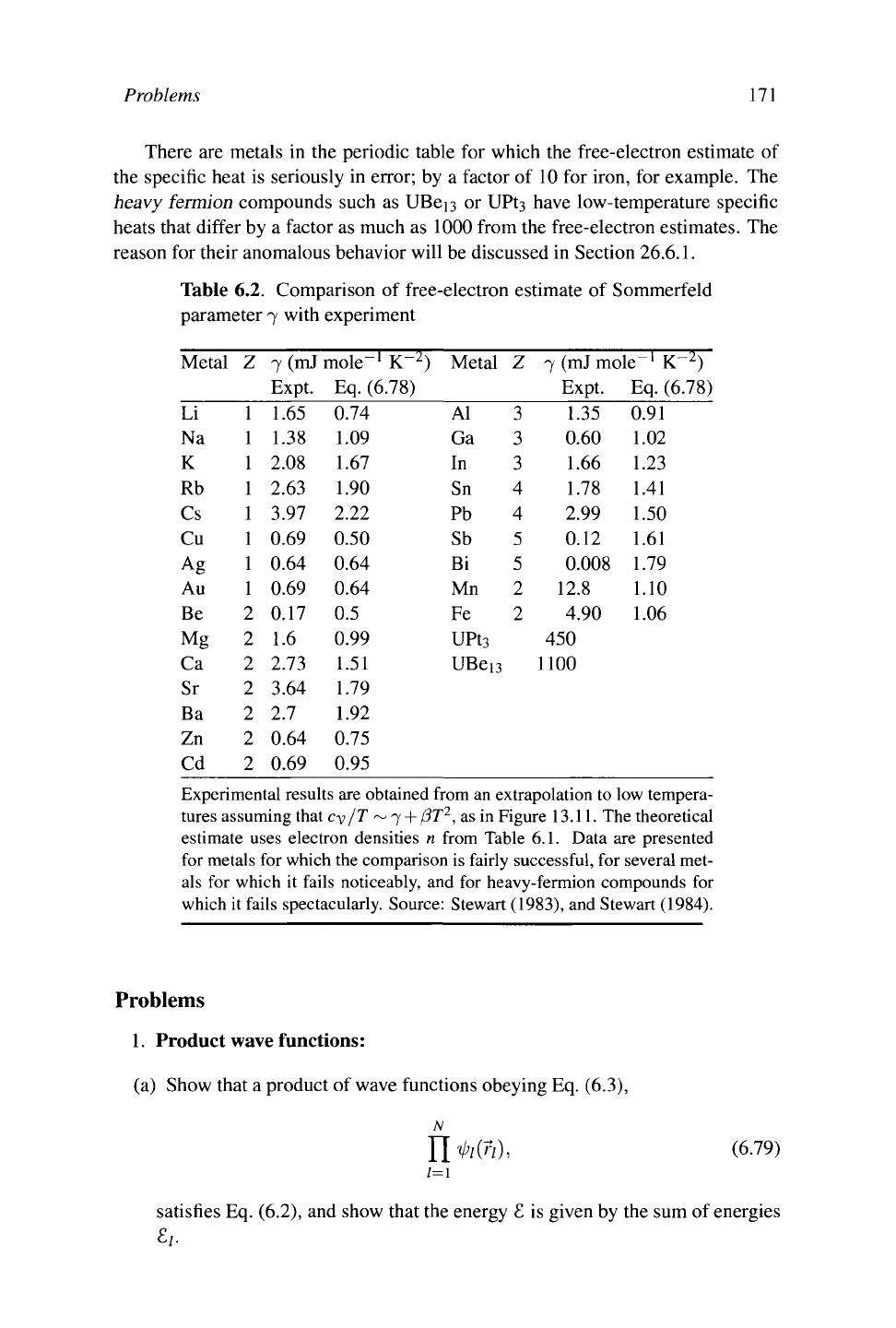
perature, Eq. (6.78) gets the order of magnitude of the coefficient right for many
metals, as shown in Table 6.2.
One way to express measured values of the specific heat is in terms of the
specific heat effective mass of the electron. The idea behind the definition is that
because the Fermi energy is inversely proportional to the mass of the electron, the
specific heat shown in Eq. (6.78) is proportional to it. Therefore, one can account
for specific heats deviating from (6.78) by pretending that the metals are built from
effective particles whose mass differs from that of the electron.
This idea is a first example of what will be a common theme: using the con-
ceptual apparatus of a simple model, with modified parameters, to understand more
complicated cases.
Problems
171
There are metals in the periodic table for which the free-electron estimate of
the specific heat is seriously in error; by a factor of 10 for iron, for example. The
heavy fermion compounds such as UBe^ or UPt3 have low-temperature specific
heats that differ by a factor as much as 1000 from the free-electron estimates. The
reason for their anomalous behavior will be discussed in Section
26.6.1.
Table 6.2. Comparison of free-electron estimate of Sommerfeld
parameter 7 with experiment
Metal Z 7 (mJ mole
-1
K
-2
) Metal Z 7 (mJ mole"
1
K~
2
)
Expt. Eq. (6.78) Expt. Eq. (6.78)
Li
Na
K
Rb
Cs
Cu
Ag
Au
Be
Mg
Ca
Sr
Ba
Zn
Cd
1
1
1
1
1
1
1
1
2
2
2
2
2
2
2
1.65
1.38
2.08
2.63
3.97
0.69
0.64
0.69
0.17
1.6
2.73
3.64
2.7
0.64
0.69
0.74
1.09
1.67
1.90
2.22
0.50
0.64
0.64
0.5
0.99
1.51
1.79
1.92
0.75
0.95
Al
Ga
In
Sn
Pb
Sb
Bi
Mn
Fe
UPt
3
UBe
13
3
3
3
4
4
5
5
2
2
1.35
0.60
1.66
1.78
2.99
0.12
0.008
12.8
4.90
450
1100
0.91
1.02
1.23
1.41
1.50
1.61
1.79
1.10
1.06
Experimental results are obtained from an extrapolation to low tempera-
tures assuming that c\>/T ~ 7 + ßT
2
, as in Figure
13.11.
The theoretical
estimate uses electron densities n from Table 6.1. Data are presented
for metals for which the comparison is fairly successful, for several met-
als for which it fails noticeably, and for heavy-fermion compounds for
which it fails spectacularly. Source: Stewart (1983), and Stewart (1984).
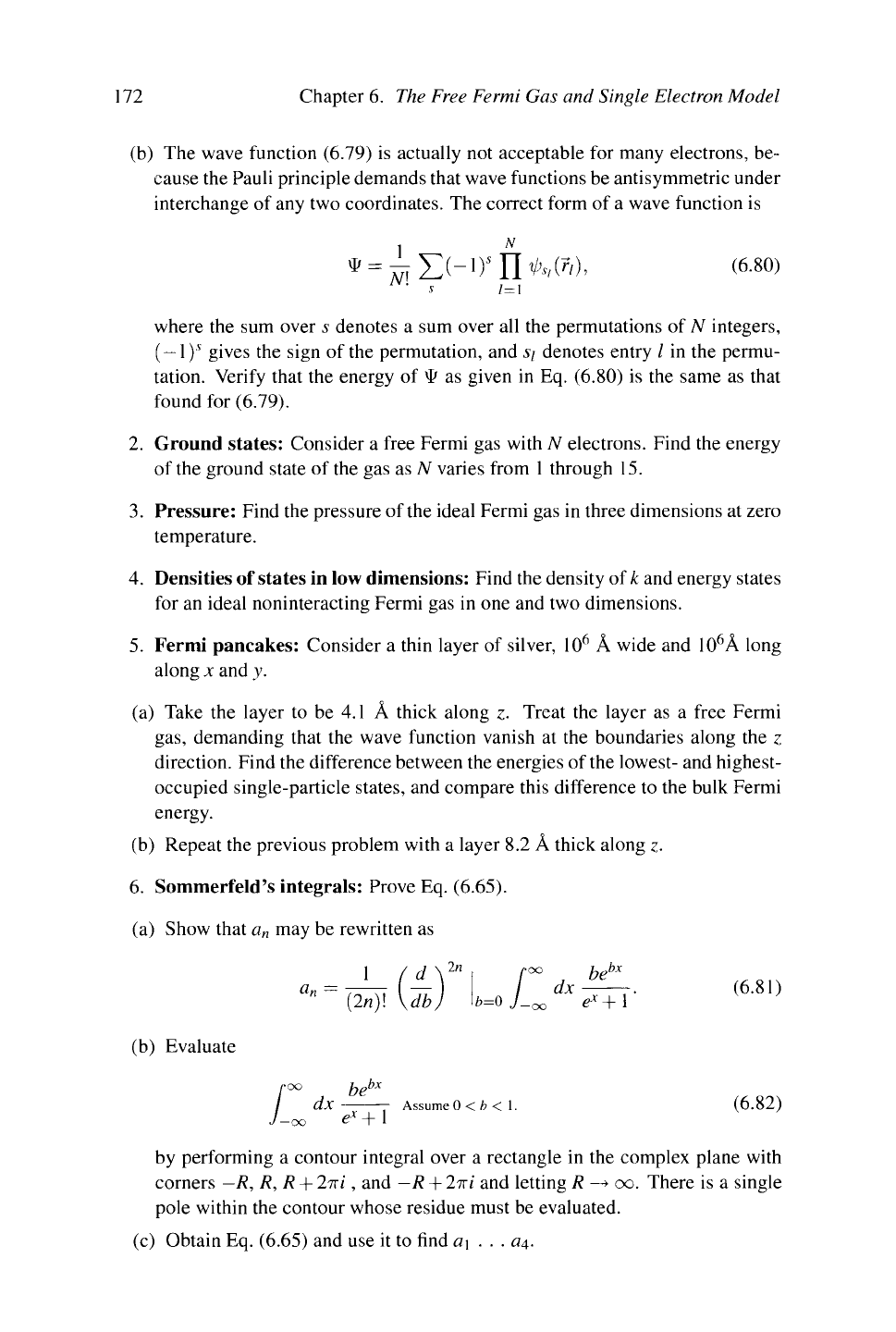
Problems
1.
Product wave functions:
(a) Show that a product of wave functions obeying Eq. (6.3),
N
l=\
satisfies Eq. (6.2), and show that the energy £ is given by the sum of energies
172
Chapter 6. The Free Fermi Gas and Single Electron Model
(b) The wave function (6.79) is actually not acceptable for many electrons, be-
cause the Pauli principle demands that wave functions be antisymmetric under
interchange of any two coordinates. The correct form of a wave function is
Φ
= ^Σ(-
1
)
5
Π^,(θ), (6.80)
where the sum over s denotes a sum over all the permutations of N integers,
( —
1Y gives the sign of the permutation, and si denotes entry / in the permu-
tation. Verify that the energy of Φ as given in Eq. (6.80) is the same as that
found for (6.79).
2.
Ground states: Consider a free Fermi gas with N electrons. Find the energy
of the ground state of the gas as
yv
varies from
1
through 15.
3.
Pressure: Find the pressure of the ideal Fermi gas in three dimensions at zero
temperature.
4.
Densities of states in low dimensions: Find the density of
k
and energy states
for an ideal noninteracting Fermi gas in one and two dimensions.
5.
Fermi pancakes: Consider a thin layer of silver, 10
6
 wide and 10
6
 long
along x and y.
(a) Take the layer to be 4.1 Â thick along z- Treat the layer as a free Fermi
gas,
demanding that the wave function vanish at the boundaries along the z,
direction. Find the difference between the energies of the lowest- and highest-
occupied single-particle states, and compare this difference to the bulk Fermi
energy.
(b) Repeat the previous problem with a layer 8.2 Â thick along z-
6. Sommerfeld's integrals: Prove Eq. (6.65).
(a) Show that a
n
may be rewritten as
1 f d\
2n
i°° , be
bx
a„ — -——
I — I
(b) Evaluate
(2«)!
\db)
dx . (6.81)
*=o7-oo e
x
+\
oo
be
bx
dx Assume 0<fc<l. (6.82)
oo
e
x
+\
by performing a contour integral over a rectangle in the complex plane with
corners
—R,
R, R + 2πί, and
—R
+ 2πί and letting R
—»
oo. There is a single
pole within the contour whose residue must be evaluated.
(c) Obtain Eq. (6.65) and use it to find a\ . . . a^.