
Marder M.P. Condensed Matter Physics
Подождите немного. Документ загружается.

Translational
Symmetry—Bloch 's
Theorem
183
Since for a given value of k, there is still the possibility of many energy eigen-
values, one must introduce the band index n. The classification of eigenfunctions
made possible by periodicity is completed by writing
n^nÙ
=
ε
Λ>
(7.43a)
fÎ\ï[) -) =
e
ik
'^\lp
y). Combine Eqs. (7.39) and (7.42). In the posi- (7.43b)
R "* "*■ tion representation, this reproduces Eq. (7.36).
From Eq. (7.43b) the previous forms of Bloch's theorem can be obtained. Acting
with
(7\
gives
Ψώ?+κ)
=
<
Ρ'
η
Ψώ?)·
(
7
·
44
)
One can also proceed to define
U y (7) ΞΞ \JN e~~ ih y (7). When ψ is normalized over the volume (7.45)
™ ™ V, u is normalized over the unit cell Ω.
It follows from Eq. (7.44) that u is periodic;
u(7 + R) = u(7). For all R in the Bravais lattice. (7.46)
7.2.4 Additional Implications of Bloch's Theorem
Effective Hamiltonian. By virtue of Bloch's theorem, the original Hamilto-
nian, (7.2), can be transformed into an effective Hamiltonian whose solution no
longer needs to be sought over the whole crystal. This Hamiltonian is easily found
by searching for the equation to be obeyed by u. Writing ψ in terms of u from
Eq. (7.45) and writing out (Ä - Ε)ψ = 0 yields
h
2
- -
5kw(r) = —
[-V
2
-2i*·
V +
k
2
}u(7)
+ U(7)u(r) = Eu(r). (7.47)
K
2m
Because u is periodic, this equation can be restricted to a single unit cell, subject to
the boundary conditions that whenever 7 lies on one boundary of the unit cell, and
7 +Ris another boundary point of the cell, then
u(7) = u(7 + R) R is a Bravais lattice vector. (7.48a)
and
h(7)-Vu(7) = -h(7 + R)-'S7u(7+R). n(f) is a unit normal to the cell (7.48b)
boundary at 7.
Using the relation (7.45) between u and ψ, one can equally well write down Schrö-
dinger's equation, and solve it in a single unit cell, subject to the boundary condi-
tions
e
iM
^
k
(7) =
f
i
(7+R)
(7.49a)
and
e
iU
n{7)
■
V^(r) = -n{7+R)-V^
l
{7
+
R). (7.49b)
184
Chapter 7. Non-Interacting Electrons in a Periodic Potential
In a crystal with
IO
23
atoms, Eq. (7.47) requires 10
23
times less numerical effort to
solve than Eq. (7.2).
Counting k. The demonstrations of Bloch's theorem relied on periodic boundary
conditions. As a consequence, as discussed in Section 6.3, there are restrictions
on the permitted values of the Bloch wave vector k. In a cubic crystal of volume
V = L?,k takes the form given in (6.7), just as for free electrons. The density of
allowed k states is therefore still given by Eq. (6.13).
These results can all be generalized to crystals that are not cubic. Consider any
lattice described by three primitive vectors a\, 02, and 03 as in Eq.
(A.
17).
The
vectors k consistent with periodic boundary conditions are of the form
3
](_
= \ Jy, 0 < mi < Ml
M
l g'
ves th
e total number of lattice points along (7.50)
*--' Mi '
—
' direction /; the total number of lattice points is
'=1
M
t
M
2
M
}
.
where b\ . . . ^3 are primitive vectors of the reciprocal lattice and are chosen to
satisfy
bi -aii = 2πδ[ΐι. (7.51)
The primitive vectors b\ . . . £3 describe the boundaries of a primitive cell in
reciprocal space, and the k of (7.50) form a fine network of vectors filling this prim-
itive cell. It is possible to adopt a convention where k takes values outside of this
cell, allowing the integers ni\ to continue on to values greater than M\. However,
the resulting k will be redundant, in the sense that they must differ from some k
within the primitive cell by a reciprocal lattice vector. Any two k that differ pre-
cisely by a reciprocal lattice vector K share the eigenvalue e\p[ik-R] in Eq. (7.43b),
since exp[/^
R}
=
1 ·
Because k is nothing but a label for this eigenvalue, two such
k can be regarded as physically identical.
According to Eq. (7.50), the total number of k states in a primitive cell in k
space is
M1M2M3,
which is also the number of lattice points N in the original real
space lattice. So one has the convenient and general result that the
Number of physically distinct
Bloch wave vectors k = Number of lattice sites, N.
Brillouin Zone. The primitive cell in k space spanned by arbitrary primitive
vectors
t>\
. . . b^ is not convenient to use, because it is not uniquely specified,
nor does it have the full symmetry of the crystal. A primitive cell that overcomes
these defects is the Wigner-Seitz cell of the origin in reciprocal space. As in the
one-dimensional case, it is called the Brillouin zone, or first Brillouin zone. Sums
such as in Eq. (7.57) over k or q are always carried out over the net of vectors in
Eq. (7.50) filling the first Brillouin zone. However, any sum over K is carried out
over a very different set, the reciprocal lattice vectors given by Eq. (3.24d).
Density of States. As in the case of free electrons, it is useful to be able to convert
sums over k into integrals. To carry out a calculation analogous to Eq. (6.10), one
Translational
Symmetry—Bloch 's
Theorem 185
needs to know the volume of reciprocal space associated with each point k. From
Eq. (7.50), this volume is
b\
■
(b
2
x
£3)
The volume of any paralleliped whose (7.53)
M1M2M3
edges are given by three vectors A,
B,
C is
A-(BxC).
2-7Γ
b\
■
(p2
x (a\ x aj))
ατ,
■
(ai
x
Ü2) M1M2M3
(2π)
3
Use
Eq.
(3.24c). (7.54)
Using the identity (7.55)
M1M2M3Ö1 -(22X03) Âx(BxC)=B(Â-C)-C(Â-B)
(2π)
3
V is given by the number of lattice points.
Mi
A/2M3,
times the volume of each
Because the total volume of the crystal (7.56)
is given by the
' "-«■
------
M1A/2AÎ3,
timi
primitive cell.
Therefore any sum that needs
to
be carried out over the states
k in
the first
Brillouin zone can use the relation
Σ^
= ν j[dk]F
h
(7.57)
la
using the density
of
states in Eq. (6.15) just as for free electrons. The density of
energy states in the nth band is similarly given by
D„(£)= f[dk]8{E-E
n
i). Compare with Eq. (6.19). (7.58)
Energy Bands and Group
Velocity.
One of the most important pieces of physical
information
to
be obtained from the energy functions £
n
£
is
the velocity
υ^ of
electrons in the
rath
band with wave number k:
T» _V7^P
^ Vj
means that one takes derivatives with respect
/η cq\
nk
7j k nk
to components of X.
Without embarking on the careful but lengthy justification
of
this relation to be
provided in Chapter 16, one can note that Eq. (7.59) is nothing but the statement
that solutions of wave equations generally have a group velocity
v
= θω/dk.
In
the context
of
wave mechanics,
a
particle
is
actually
a
wave packet, which
is a
sum over wave functions that is contrived so as to have a large peak at position
r,
and simultaneously a dominant wave vector k. The flavor of calculations for wave
packets is easiest to share if one imagines solutions of Schrödinger's equation with
energy £^ and for which u^(r) varies only very weakly in space. Then define
/
Here
φ
is a Bloch wave, and
w
[di'] w(k'
-
k)
e-^'^th,
(?),
is a
fimcti
2
n
sharply peaked
(7.60)
K
about k
—
k!
=
0; thus W
is
mainly built out of waves with
wave vector
k.
186
Chapter 7. Non-Interacting Electrons
in a
Periodic Potential
njk-r-iw*
j
{
sr]
w
Çk")
/M-v
i£i
,/^
w;;(?)j
»^x
(761)
J exponent
to
first order
in k",
because
w is
peaked about
jfc"
=
0.
^ fk-7-iE-
k
t/Hcr(-;_f]
e ,/t\
Assuming the spatial variation
of
u~
k
(r)
can be
ne-
,_ „.
~
e J
y
V
k
G
k
l
'
n
> glected. The value
of
the integral
5"
does
not
mat- \'·
ΌΔ
>
ter; just the fact that
it is in
the form
of
a traveling
wave moving
at
v^
=
Vj£j//i
= Vju^.
7.2.5 Van Hove Singularities
In the course of computing the energy densities of states defined by Eq. (7.58), it
is common to encounter divergences called van Hove singularities.
In one dimension, suppressing the index n on fir. gives
D(£) = ί dk (2/2π)ί (£ - £*) (7.63)
=
— / § (£, — £t) An
additional factor
of
two comes generally
(7 64)
nj
\d£
k
/dk\
V
'
from the fact that
£* = £_*.
2
1
When explicit solutions
of
Bloch's equation
are
found,
as in
Figure 7.7,
it
will
emerge that £„&
is a
periodic function
of k and
that dZ
n
kjdk vanishes
at the
edge
of
the Brillouin zone.
As a
result,
the
density
of
states must diverge there. Assuming
that dE,
n
k/dk vanishes linearly
as k
approaches
π/α, the
divergence
is of
the form
D(E)
-. .
Taking (7.66)
k-π/α V£max-£ 2*~e
ma
x-C(*-7r/
a
)
2
,with
C some constant near the zone
edge.
The only
way for
dE/dk
to
vanish
in one
dimension
is at a
maximum
or a
mini-
mum. Therefore,
van
Hove singularities
in one
dimension tend
to
occur only
at the
beginning
or the end of a
range
of
allowed energies.
In two and
three dimensions,
van Hove singularities typically occur
in the
midst
of
energy intervals
as
well—as
for example
in
Figures 13.9
or
18.4.
The
generalization
of
Eq. (7.65)
is
Γ
- 2
D(E)
= I dk δ(Ε — £r).
Thenumberof dimensions
d
might
be 2 or
3.
(7.67)
Integrals in the form of Eq. (7.67) can also be expressed as integrals over the en-
ergy surface on which δ = £^. To obtain the correct expression, begin with the
observation that
0(£-£j)-0(£-£
2
-£/£)
'
nV
~ d~Ë
δ(Ε
— ε vi = — —
FordE very small.
V nk
>
JO
(7.68)
As shown
in
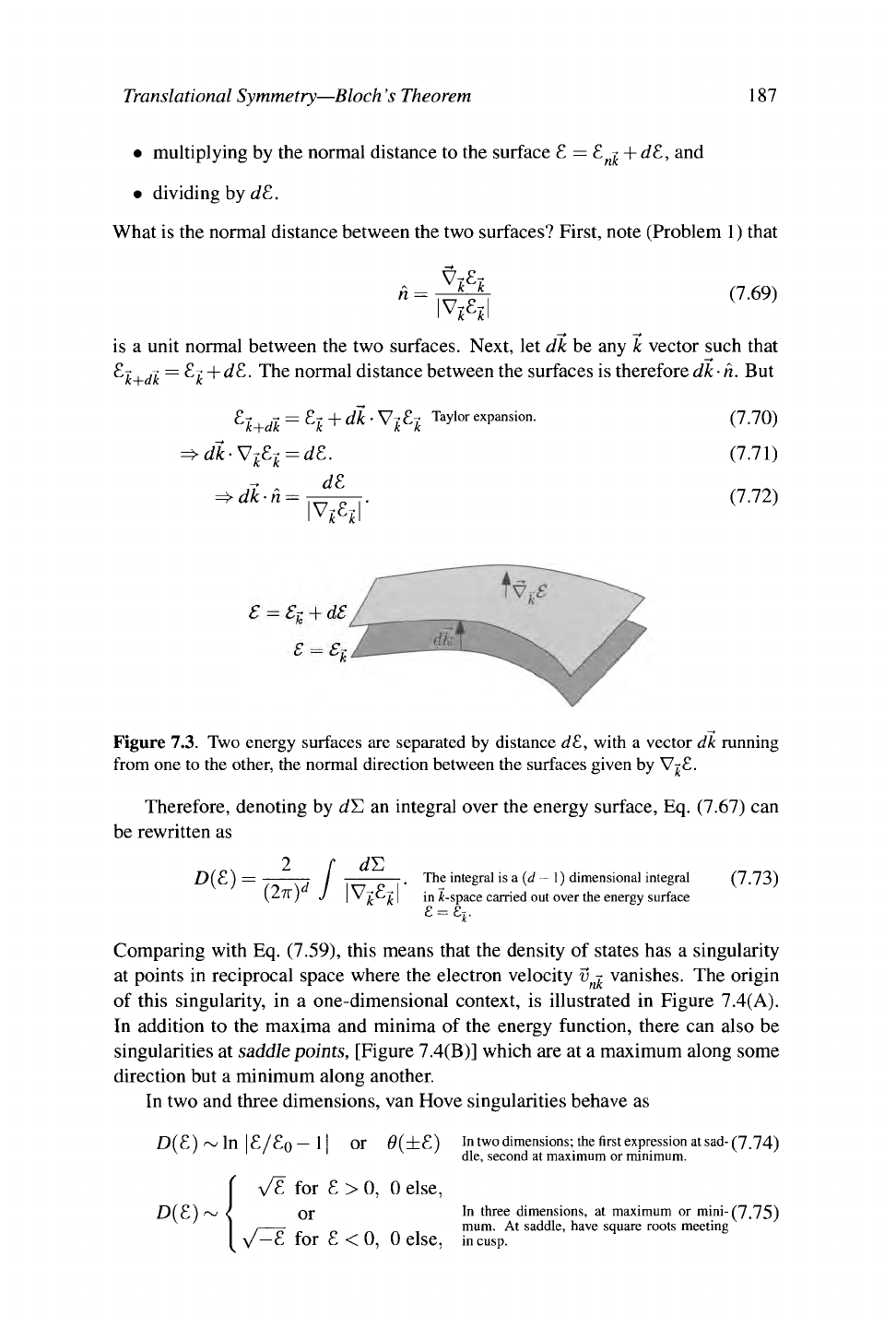
Figure 7.3,
Eq.
(7.67)
is
therefore given
by
integrating over
the
energy surface
£ = £ r
with surface measure
άΣ,,
Translational
Symmetry—Bloch
's
Theorem 187
•
multiplying by the normal distance to the surface £ = £^ + dE, and
•
dividing by dE.
What is the normal distance between the two surfaces? First, note (Problem
1
)
that
Vt£r
"
=
ΚΓΤΜ
(7
·
69)
is a unit normal between the two surfaces. Next, let dk be any k vector such that
^l+dk
=
£%
+
dE.
The normal distance between the surfaces is therefore dk
■
h.
But
£-l
+d
l = £-l + dk- V^^ Taylor expansion. (7.70)
=>dk-'V
i
E
i
= d£.
(7.71)
dl
^dk-ri = —— (7.72)
Ι
ν
ΐ
ο
λΙ
Figure 7.3. Two energy surfaces are separated by distance d£, with a vector dk running
from one to the other, the normal direction between the surfaces given by V^£.
Therefore, denoting by άΣ an integral over the energy surface, Eq. (7.67) can
be rewritten as
2 f dE
D(ß)
= / The integral is a (d
— 1 )
dimensional integral (7 73)
in
fc-space
carried out over the energy surface
Comparing with Eq. (7.59), this means that the density of states has a singularity
at points in reciprocal space where the electron velocity υ^ vanishes. The origin
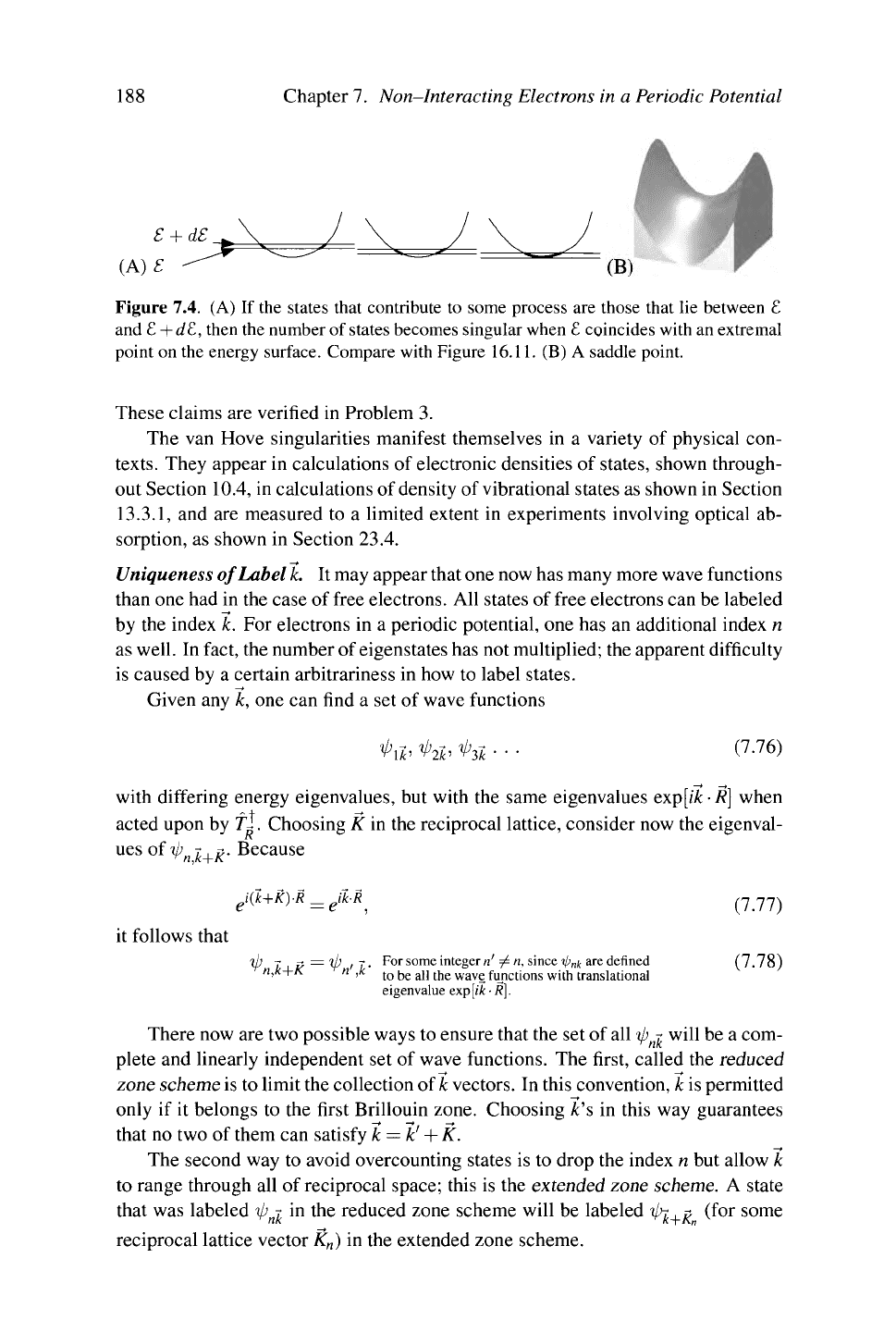
of this singularity, in a one-dimensional context, is illustrated in Figure 7.4(A).
In addition to the maxima and minima of the energy function, there can also be
singularities at saddle points, [Figure 7.4(B)] which are at a maximum along some
direction but a minimum along another.
In two and three dimensions, van Hove singularities behave as
D(E)
~ In
|£/£n—1|
or $(i£) In two
dimensions;
the first expression at sad-(7.74)
die,
second at maximum or minimum.
VE for £ > 0, 0 else,
D(£)~<
Of
In three dimensions, at maximum or mini-(7.75)
—
mum. At saddle, have square roots meeting
-c for t < 0, 0 else,
in
cusp.
188 Chapter 7. Non-Interacting Electrons in a Periodic Potential
Figure 7.4. (A) If the states that contribute to some process are those that lie between £
and E+dE, then
the
number of
states
becomes singular when
E
coincides with an extremal
point on the energy surface. Compare with Figure
16.11.
(B) A saddle point.
These claims are verified in Problem 3.
The van Hove singularities manifest themselves in a variety of physical con-
texts.
They appear in calculations of electronic densities of states, shown through-
out Section 10.4, in calculations of density of vibrational states as shown in Section
13.3.1,
and are measured to a limited extent in experiments involving optical ab-
sorption, as shown in Section 23.4.
Uniqueness of Label
k.
It may appear that one now has many more wave functions
than one had in the case of free electrons. All states of free electrons can be labeled
by the index k. For electrons in a periodic potential, one has an additional index n
as well. In fact, the number of eigenstates has not multiplied; the apparent difficulty
is caused by a certain arbitrariness in how to label states.
Given any k, one can find a set of wave functions
with differing energy eigenvalues, but with the same eigenvalues exp[ik-R] when
acted upon by 7"J. Choosing K in the reciprocal lattice, consider now the eigenval-
ues of ψ
η
£
£. Because
e
i{UKyR
=
e
ik-R^
(7J7)
it follows that
φ j i n = ^ ,7. For some integer n' φη, since ψ^ are defined (7.78)
n,k+K n ,k
tQ
^
e a
|j
tne waV
g functions with translational
eigenvalue exp[ik
■
R\.
There now are two possible ways to ensure that the set of all φ ^ will be a com-
plete and linearly independent set of wave functions. The first, called the reduced
zone scheme is to limit the collection of k vectors. In this convention, k is permitted
only if it belongs to the first Brillouin zone. Choosing k's in this way guarantees
that no two of them can satisfy k = k'+ K.
The second way to avoid overcounting states is to drop the index n but allow k
to range through all of reciprocal space; this is the extended zone scheme. A state
that was labeled φ^ in the reduced zone scheme will be labeled Φι
+
^ (for some
reciprocal lattice vector
K„)
in the extended zone scheme.
Translational
Symmetry—Bloch 's
Theorem 189
Example: Free Electron. One can choose to regard a free electron as periodic
over any lattice desired. This gives great freedom in indexing the states. Moving
to the one-dimensional case for the purpose of illustration, suppose one uses the
fact that a free electron Hamiltonian is periodic subject to translations through R.
Bloch's theorem says in this case to index the wave function in the form
lh
n
L·
= e e'
n
One can regard
n
either as the band index, (7.79)
or as describing the multiple of the recipro-
cal lattice vector K to add to k.
where K is a primitive vector of the reciprocal lattice, and —K/2 < k < K/2 is the
first Brillouin zone. In the reduced zone scheme, the name of the wave function in
Eq. (7.79) is ψ^, with n a band index. In the extended zone scheme, the wave func-
tion is instead named φ^, with k' = k + nK. These two ways of viewing Eq. (7.79)
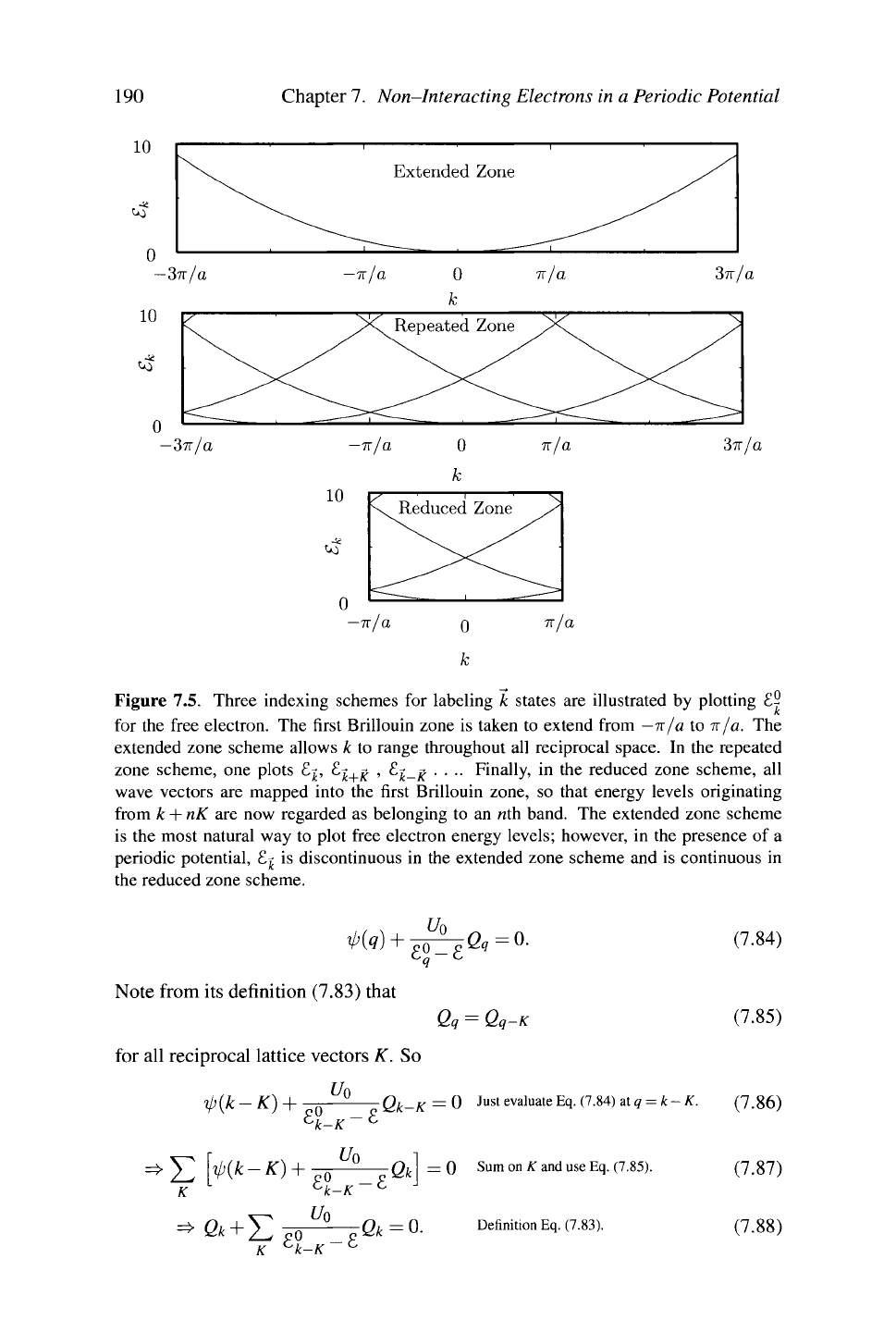
are drawn in in Figure 7.5, together with a third convention, called the repeated
zone scheme, which shows what would happen if both
k
and n were allowed to
range freely over all possible values.
Summary. To recapitulate, first index solutions of Schrödinger's equation by
a
vector k that lies in the first Brillouin zone. For every value of k there is a count-
ably infinite number of energy bands, which can be labeled by band index n (re-
duced zone scheme) or by adding reciprocal lattice vectors K
n
to k (extended zone
scheme). Allowing k to range over all reciprocal space and also retaining the band
index n duplicates each eigenstate infinitely often (repeated zone scheme).
7.2.6 Kronig-Penney Model
Kronig and Penney
(
1931 ) found an exactly soluble model that illustrates the nature
of energy bands. Suppose that in each unit cell of a one-dimensional lattice with
lattice points R = na and reciprocal lattice vectors K, there is a potential of the
form
UoaÔ(x),
a is
the lattice
spacing. (7.80)
where i/o has dimensions of energy. Then
UK
as defined in Eq. (7.26) is simply
U
K
= U
0
, (7.81)
and Eq. (7.33) becomes
0 =
(ε°-ε)φ(ς)
+
ΣνοΨ(ς-Κ).
(7.82)
K
Define
Ö, = £>(<?-*)· (7-83)
K
Then Eq. (7.82) becomes
190
Chapter 7. Non-Interacting Electrons in a Periodic Potential
3π/α
3π/α
Figure 7.5. Three indexing schemes for labeling k states are illustrated by plotting £5
for the free electron. The first Brillouin zone is taken to extend from — π/α to π/α. The
extended zone scheme allows k to range throughout all reciprocal space. In the repeated
zone scheme, one plots £j, £j
+
^ , £^_^ · · ·· Finally, in the reduced zone scheme, all
wave vectors are mapped into the first Brillouin zone, so that energy levels originating
from k + nK are now regarded as belonging to an nth band. The extended zone scheme
is the most natural way to plot free electron energy levels; however, in the presence of a
periodic potential,
E-
k
is discontinuous in the extended zone scheme and is continuous in
the reduced zone scheme.
#?) + girrgßi =
0
·
Note from its definition (7.83) that
for all reciprocal lattice vectors K. So
i/o
Qq = Qq-K
1p(k-K)
+ -g Q
k
-K = 0
Just
evaluate Eq. (7.84) alq = k-K.
Σ k(k-K)+
i/o
^k-K £
Qk
z= 0 Sum on K and use Eq. (7.85).
β*+Σ
i/o
PO _ c
K ^k-K °
Q
k
= 0. Definition Eq. (7.83).
(7.84)
(7.85)
(7.86)
(7.87)
(7.88)
Translational Symmetry—Bloch 's Theorem 191
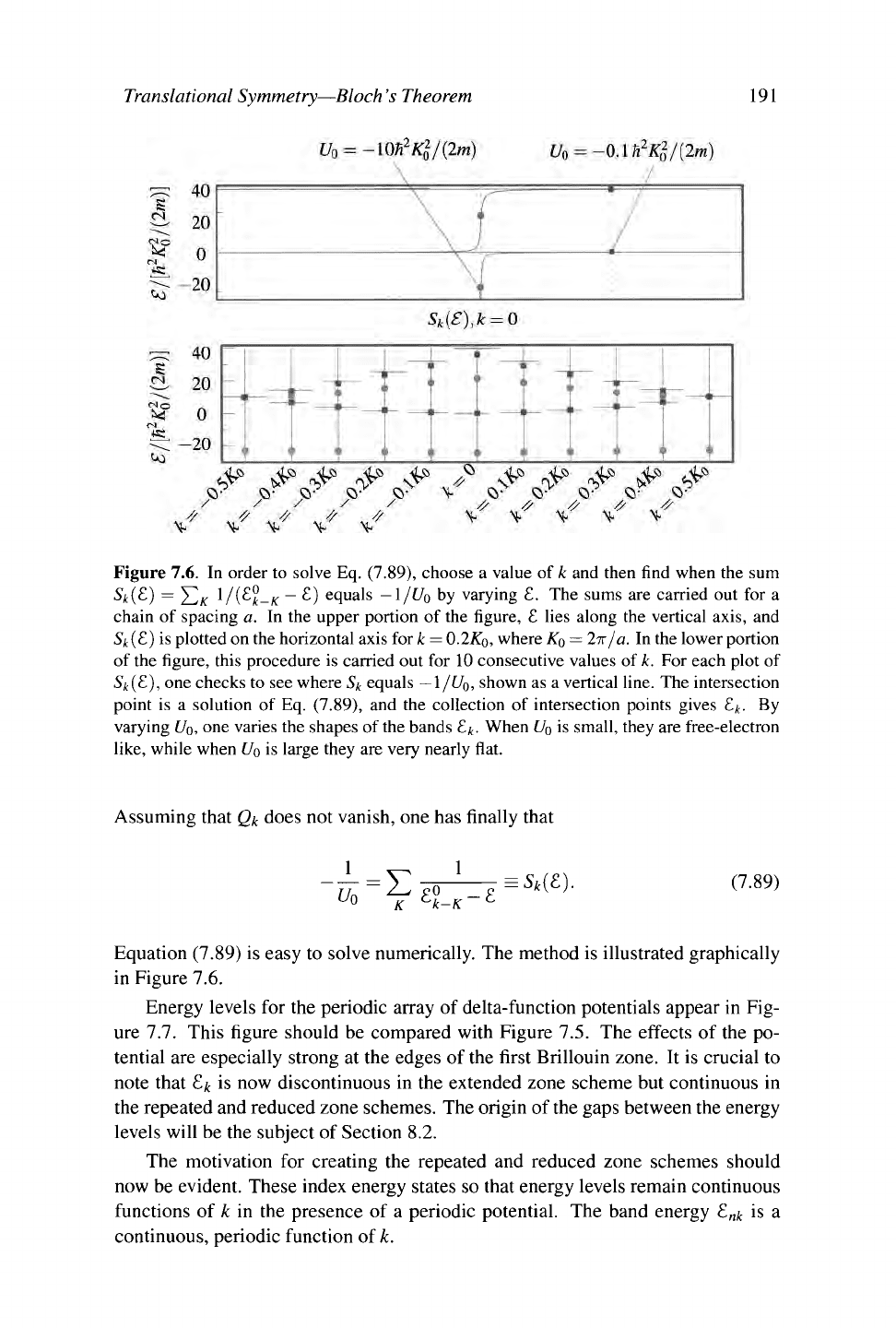
Figure 7.6. In order to solve Eq. (7.89), choose a value of k and then find when the sum
S*(£) = Σκ l/(£*-if
~~
£) equals
—
1/f/o by varying £. The sums are carried out for a
chain of spacing a. In the upper portion of the figure, £ lies along the vertical axis, and
5jt(£) is plotted on the horizontal axis for k = 0.2ΛΌ, where
Ko
= 2π/α. In the lower portion
of the figure, this procedure is carried out for 10 consecutive values of k. For each plot of
Sk(£),
one checks to see where
Sk
equals —I/UQ, shown as a vertical line. The intersection
point is a solution of Eq. (7.89), and the collection of intersection points gives £^. By
varying
UQ,
one varies the shapes of the bands £/;. When
UQ
is small, they are free-electron
like,
while when i/o is large they are very nearly fiat.
Assuming that
Qk
does not vanish, one has finally that
-—
=
Y-ΊΑ
=S
t
(£). (7.89)
Equation (7.89) is easy to solve numerically. The method is illustrated graphically
in Figure 7.6.
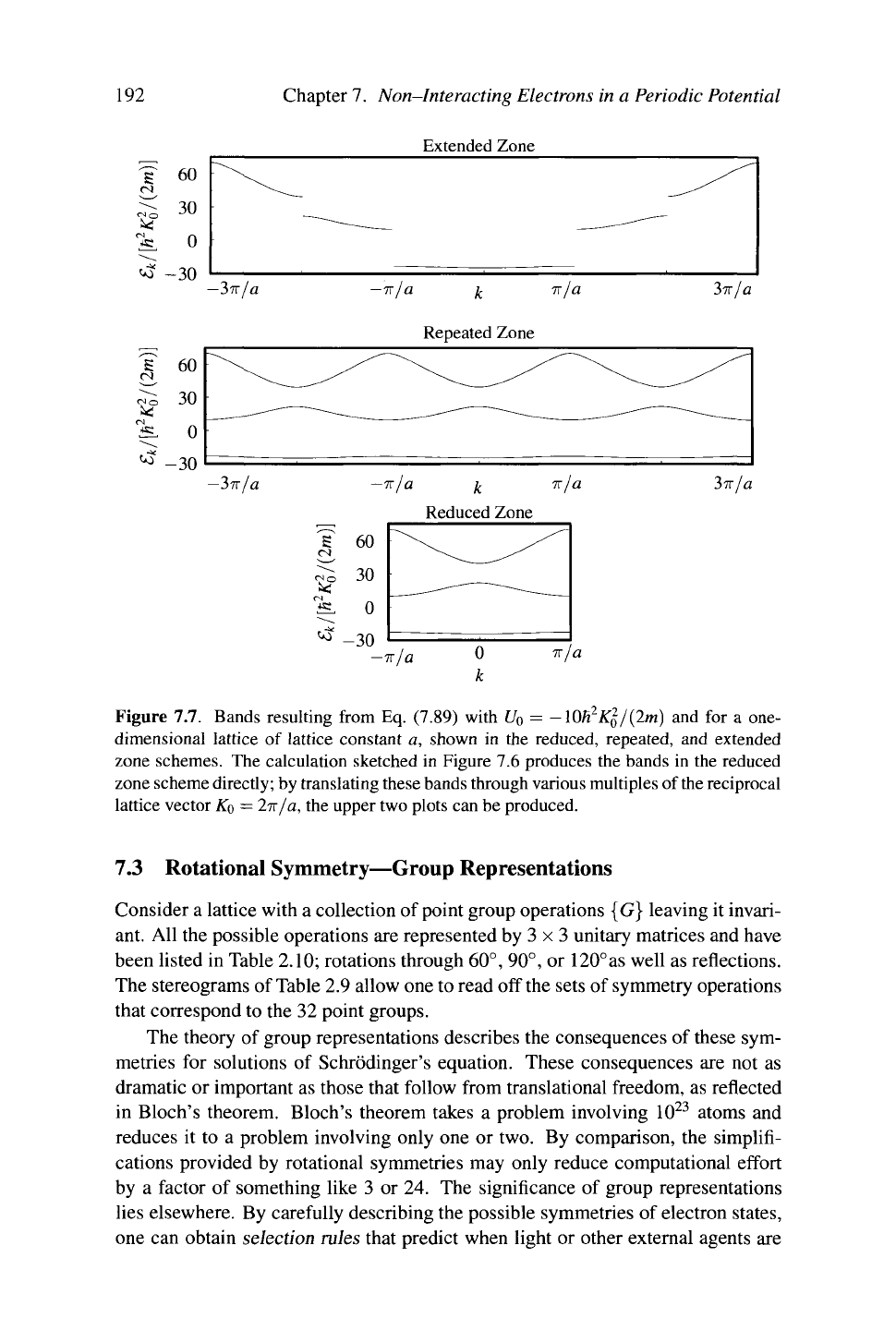
Energy levels for the periodic array of delta-function potentials appear in Fig-
ure 7.7. This figure should be compared with Figure 7.5. The effects of the po-
tential are especially strong at the edges of the first Brillouin zone. It is crucial to
note that
£&
is now discontinuous in the extended zone scheme but continuous in
the repeated and reduced zone schemes. The origin of the gaps between the energy
levels will be the subject of Section 8.2.
The motivation for creating the repeated and reduced zone schemes should
now be evident. These index energy states so that energy levels remain continuous
functions of k in the presence of a periodic potential. The band energy £„£ is a
continuous, periodic function of k.
192
Chapter 7. Non-Interacting Electrons in a Periodic Potential
Extended Zone
Repeated Zone
-3π/α -π/α k π/α
Reduced Zone
3π/α
Figure 7.7. Bands resulting from Eq. (7.89) with U
0
= -l0h
2
K$/(2m) and for a one-
dimensional lattice of lattice constant a, shown in the reduced, repeated, and extended
zone schemes. The calculation sketched in Figure 7.6 produces the bands in the reduced
zone scheme
directly;
by translating these
bands
through various multiples of
the
reciprocal
lattice vector
KQ
= 2π/α, the upper two plots can be produced.
7.3 Rotational Symmetry—Group Representations
Consider a lattice with a collection of point group operations {G} leaving it invari-
ant. All the possible operations are represented by 3 x 3 unitary matrices and have
been listed in Table 2.10; rotations through 60°, 90°, or 120°as well as reflections.
The stereograms of
Table
2.9 allow one to read off the sets of symmetry operations
that correspond to the 32 point groups.
The theory of group representations describes the consequences of these sym-
metries for solutions of Schrödinger's equation. These consequences are not as
dramatic or important as those that follow from translational freedom, as reflected
in Bloch's theorem. Bloch's theorem takes a problem involving 10
23
atoms and
reduces it to a problem involving only one or two. By comparison, the simplifi-
cations provided by rotational symmetries may only reduce computational effort
by a factor of something like 3 or 24. The significance of group representations
lies elsewhere. By carefully describing the possible symmetries of electron states,
one can obtain selection rules that predict when light or other external agents are