
Marder M.P. Condensed Matter Physics
Подождите немного. Документ загружается.

References
173
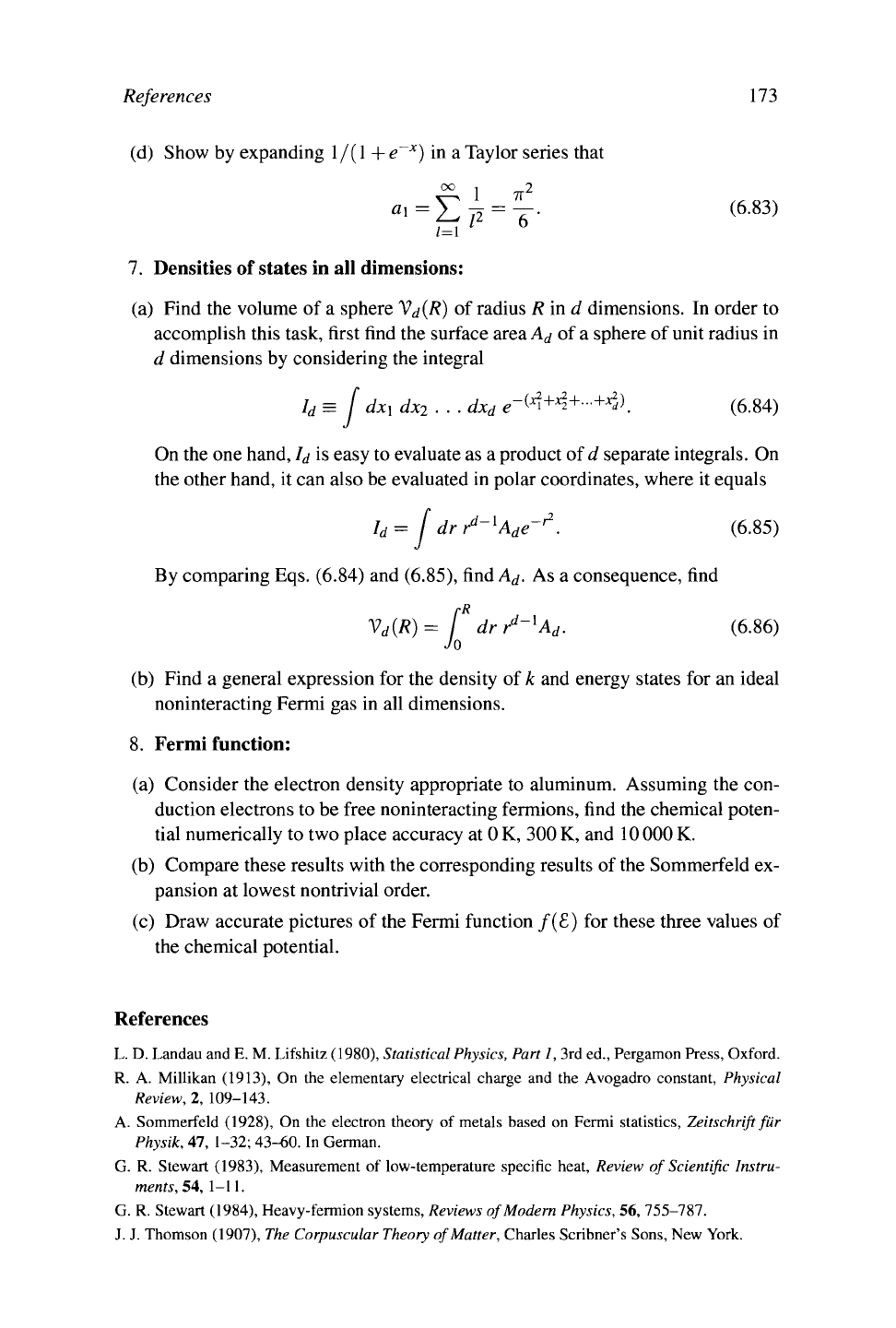
(d) Show by expanding 1/(1 + e
x
) in a Taylor series that
1
β
'
=
Σ^4-
(6
·
83)
ι=ι
7.
Densities of states in all dimensions:
(a) Find the volume of a sphere V
d
(R) of radius Rind dimensions. In order to
accomplish this task, first find the surface area A
d
of a sphere of unit radius in
d dimensions by considering the integral
t, = /*,*,... a« .-«-M-**. (6.84)
On the one hand,
/</
is easy to evaluate as a product of d separate integrals. On
the other hand, it can also be evaluated in polar coordinates, where it equals
I
d
=
[ drr
d
-
x
A
d
e-'
2
. (6.85)
By comparing Eqs. (6.84) and (6.85), find A
d
. As a consequence, find
V
d
(R)=
/ drr
d
-
l
A
d
. (6.86)
io
(b) Find a general expression for the density of k and energy states for an ideal
noninteracting Fermi gas in all dimensions.
8. Fermi function:
(a) Consider the electron density appropriate to aluminum. Assuming the con-
duction electrons to be free noninteracting fermions, find the chemical poten-
tial numerically to two place accuracy at 0 K, 300 K, and
10
000 K.
(b) Compare these results with the corresponding results of the Sommerfeld ex-
pansion at lowest nontrivial order.
(c) Draw accurate pictures of the Fermi function /(£) for these three values of
the chemical potential.
References
L. D. Landau and E. M. Lifshitz
(
1980),
Statistical
Physics,
Part 1, 3rd ed., Pergamon Press, Oxford.
R. A. Millikan (1913), On the elementary electrical charge and the Avogadro constant, Physical
Review, 2, 109-143.
A. Sommerfeld (1928), On the electron theory of metals based on Fermi statistics, Zeitschrift für
Physik,
47, 1-32; 43-60. In German.
G. R. Stewart (1983), Measurement of low-temperature specific heat, Review of Scientific Instru-
ments, 54, 1-11.
G. R. Stewart (1984), Heavy-fermion systems, Reviews of Modern Physics, 56, 755-787.
J. J. Thomson (1907), The Corpuscular Theory of Matter, Charles Scribner's Sons, New York.
7. Non-Interacting Electrons in a
Periodic Potential
7.1 Introduction
While Sommerfeld's theory of the free-electron gas provides an excellent starting
point for the study of metals, it leads to a new fundamental difficulty. "The main
problem was to explain how the electrons could sneak by all the ions in a metal
so as to avoid a mean free path of the order of atomic distances. Such a distance
was much too short to explain the observed resistances, which even demanded that
the mean free path become longer and longer with decreasing temperature" [Bloch
(1976),
p. 26]. Bloch (1928) had provided the solution of
the
problem in his thesis.
Analyzing a single electron moving in a perfectly periodic potential, he says, "... I
found to my delight that the wave differed from the plane wave of free electrons
only by a periodic modulation. This was so simple that I didn't think it could
be much of a discovery, but when I showed it to Heisenberg he said right away:
'That's it!' " [Bloch (1976),p. 26.].
Immediately, the problem was altered from a hard one: "Why is the mean free
path so long?" to an easier
one:
"Why is the mean free path so short?" Scattering of
electrons is caused not by the lattice itself but by defects in the lattice, due either to
thermal fluctuations or to impurities. At low temperatures, electron mean free paths
in metals should increase up to a limit that is set by impurity density (Chapter 18).
This behavior is observed experimentally and gives great plausibility to Bloch's
great idea to study crystals through single electrons in periodic potentials.
7.2 Translational Symmetry—Bloch's Theorem
The free Fermi gas of Chapter 6 treats solids as if they are empty boxes filled
with electrons that interact neither with nuclei nor each other, apart from effects
due to the Pauli exclusion principle. Bloch (1928) added back some some of the
ingredients missing from this simplified view of solids. He first added back the
interaction of electrons with the nuclei, treated as a static external potential.
For general potentials U(r) the problem is still nearly intractable, and Bloch
settled on an additional simplification. He posed the problem of electrons moving
about in a periodic potential U(r), one which obeys
U(7 + R) = U(7). For all R in a Bravais lattice. (7.1)
175
Condensed Matter
Physics,
Second Edition
by Michael P. Marder
Copyright © 2010 John Wiley & Sons, Inc.
176 Chapter 7. Non-Interacting Electrons in a Periodic Potential
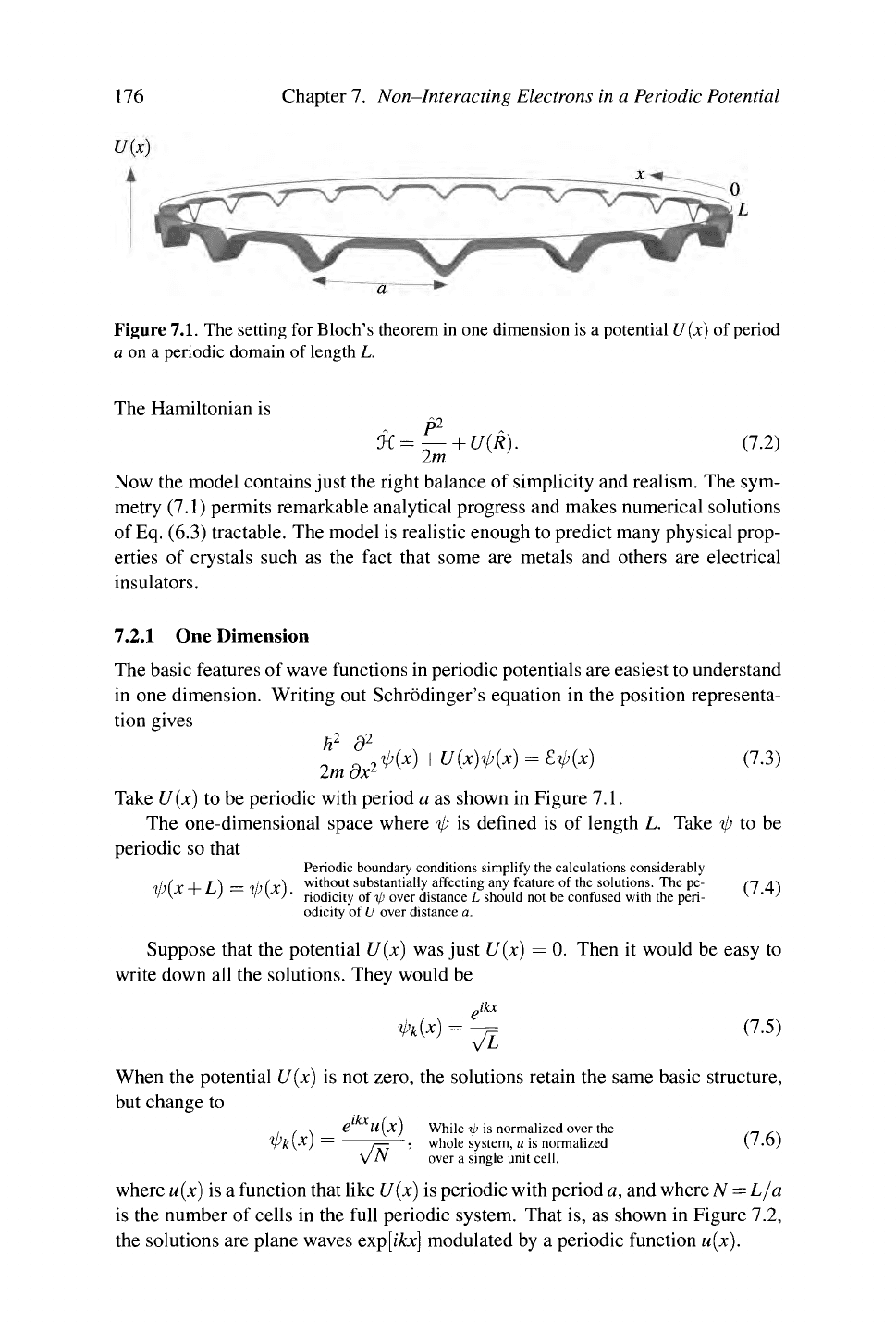
Figure
7.1.
The setting for Bloch's theorem in one dimension is a potential U(x) of period
a on a periodic domain of length L.
The Hamiltonian is
. P
2
K=—
+ U(R). (7.2)
2m
Now the model contains just the right balance of simplicity and realism. The sym-
metry (7.1) permits remarkable analytical progress and makes numerical solutions
of
Eq.
(6.3) tractable. The model is realistic enough to predict many physical prop-
erties of crystals such as the fact that some are metals and others are electrical
insulators.
7.2.1 One Dimension
The basic features of
wave
functions in periodic potentials are easiest to understand
in one dimension. Writing out Schrödinger's equation in the position representa-
tion gives
-^■^ψ{χ) + υ(χ)ψ(χ) = εψ(χ) (7.3)
Take U(x) to be periodic with period a as shown in Figure 7.1.
The one-dimensional space where ψ is defined is of length L. Take ψ to be
periodic so that
Periodic boundary conditions simplify the calculations considerably
ih(x 4- / ) =
i/i(r)
without substantially affecting any feature of the solutions. The pe- ιη Λ\
Ψ\ > ) Ψ\ )■ riodicity of ψ over distance L should not be confused with the peri- ^ ' '
odicity of U over distance a.
Suppose that the potential U(x) was just U(x) = 0. Then it would be easy to
write down all the solutions. They would be
rl>k(x)
= 4= (7.5)
When the potential U(x) is not zero, the solutions retain the same basic structure,
but change to
ilex ( \
, i \ & U\X) While φ is normalized over the .,
Wk\X)
=
7FE -, whole system, u is normalized ('·")
V^» over a single unit cell.
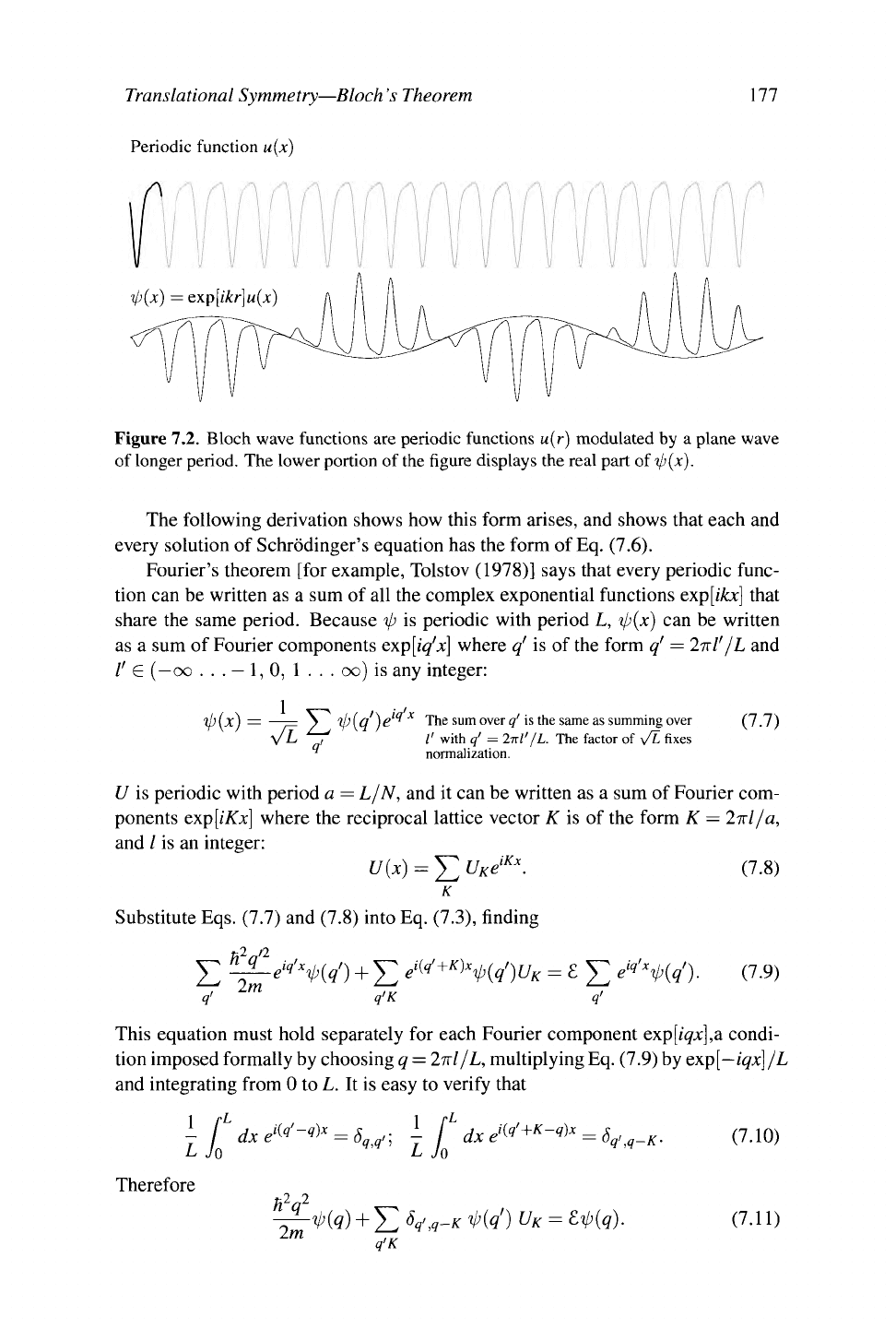
where u(x) is a function that like U(x) is periodic with period
a,
and where N = L/a
is the number of cells in the full periodic system. That is, as shown in Figure 7.2,
the solutions are plane waves exp[/fcc] modulated by a periodic function u{x).
Translational
Symmetry—Bloch 's
Theorem
177
Periodic function u(x)
φ(χ) =
exç[ikr]u{x)
Figure 7.2. Bloch wave functions are periodic functions u(r) modulated by a plane wave
of longer period. The lower portion of
the
figure
displays the real part of ψ(χ).
The following derivation shows how this form arises, and shows that each and
every solution of Schrödinger's equation has the form of
Eq.
(7.6).
Fourier's theorem [for example, Tolstov (1978)] says that every periodic func-
tion can be written as a sum of all the complex exponential functions exp[/fcc] that
share the same period. Because ψ is periodic with period L, φ(χ) can be written
as a sum of Fourier components expD'g'x] where q' is of the form q' = 2irl'/L and
/'
G
(—oo . . .
—
1, 0, 1 . . . oo) is any integer:
ψ(χ)
= —j= ^ 1p(q')e'
qx
The sum over q' is thi
V
L ~f /' with q' =
ΙπΙ'/L.
normalization.
the
same as summing over (7.7)
The
factor of \/L fixes
U is periodic with period a = L/N, and it can be written as a sum of Fourier com-
ponents exp[/ÄJt] where the reciprocal lattice vector K is of the form K
—
2πΙ/α,
and / is an integer:
U(x) = Σ
U
K
e
iKx
.
(7.8)
K
Substitute Eqs. (7.7) and (7.8) into Eq. (7.3), finding
This equation must hold separately for each Fourier component exp[/gx],a condi-
tion imposed formally by choosing q = 2TTI/L, multiplying
Eq.
(7.9) by exp[—iqx]/L
and integrating from 0 to L. It is easy to verify that
-t
L Jo
dx e
i(q'-q)x
=
A
I Γ dxe^'
+K
-^
X
= ô
n/
J
q,q'
;
LJo
'Jq',q-K-
Therefore
2^2
h
z
q
2m
■i,{q) +
Y^5
q
,^
K
^{q')U
K
= ^{q).
q'K
(7.10)
(7.11)
178 Chapter 7. Non-Interacting Electrons in a Periodic Potential
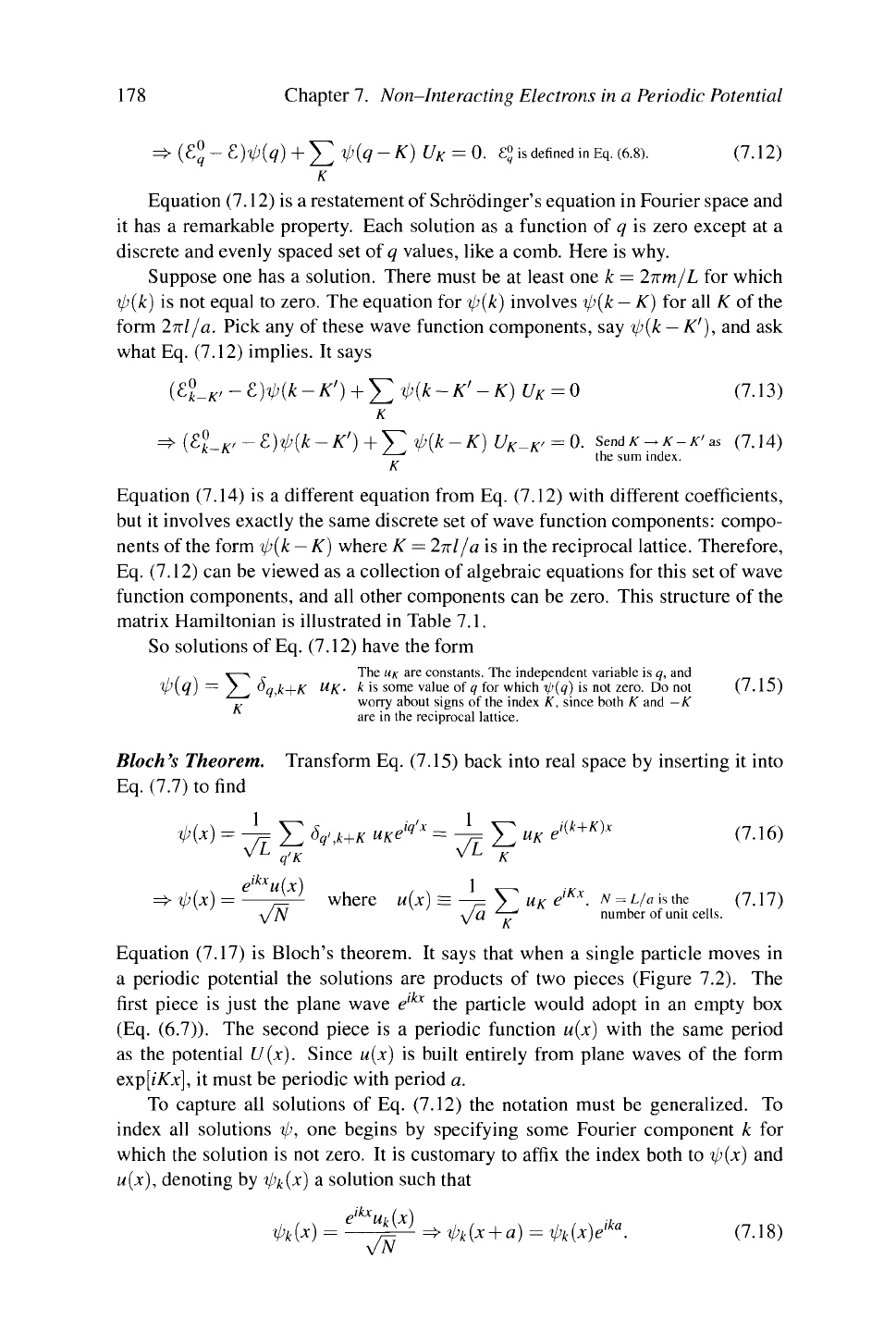
=>(E°
q
-E)tp(q)
+ J2
Φ(
α
~
Κ
)
U
K =
0.
ε» is defined in Eq. (6.8). (7.12)
K
Equation (7.12) is a restatement of Schrödinger's equation in Fourier space and
it has
a
remarkable property. Each solution as
a
function of q is zero except at
a
discrete and evenly spaced set of q values, like a comb. Here is why.
Suppose one has
a
solution. There must be at least one
k
= lirm/L for which
ip(k) is not equal to zero. The equation for ip(k) involves ip(k
—
K) for all K of the
form
2-rrl/a.
Pick any of these wave function components, say
xp(k —
K'), and ask
what Eq. (7.12) implies. It says
(E°
k
_
K
,-E)t(k-K')
+
J2i;(k~K
l
-K)U
K
= 0 (7.13)
K
^
(££_*-,
~E)ïp(k-K')+y 1p{k-K)
U
K
_
K
<=0.
Send
*-
K
-AT'as
(7.14)
~^ the sum index.
K
Equation (7.14) is a different equation from Eq. (7.12) with different coefficients,
but it involves exactly the same discrete set of wave function components: compo-
nents of the form ip(k-K) where K = 2πΙ/α is in the reciprocal lattice. Therefore,
Eq. (7.12) can be viewed as a collection of algebraic equations for this set of wave
function components, and all other components can be zero. This structure of the
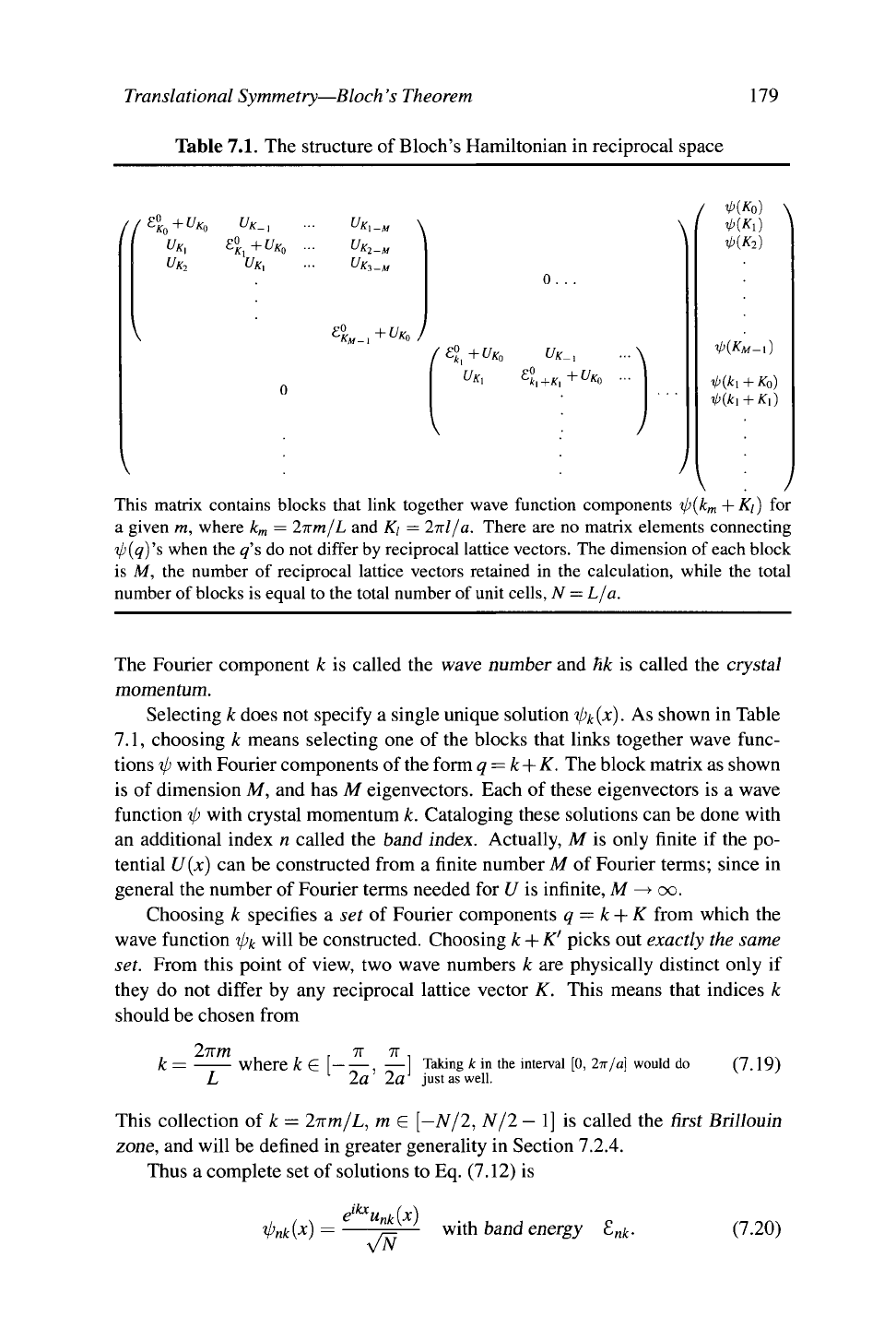
matrix Hamiltonian is illustrated in Table 7.1.
So solutions of Eq. (7.12) have the form
γ-Λ The
UK
are constants. The independent variable is q, and
1p{q) —
/ Oq^^K U/(.
k
is some value of q for which ip(q) is not zero. Do not (7.15)
„ worry about signs of the index K, since both
K
and —K
are in the reciprocal lattice.
Block's Theorem. Transform Eq. (7.15) back into real space by inserting
it
into
Eq. (7.7) to find
^w
=
4τΣ <W+*
u
«
eiq
'
x
=-7f
Σ
«*
e
'
{h+K)x
<
7
·
16
)
VL
q
,
K
VL
K
e
ikx
u(x)
1
=> ψ(
χ
) =
-±-L
where u(x)
Ξ
— V
u
K
e'
Kx
.
N = L/a is the
(7.17)
y
yV
\Ja ^f
number of unit cells.
Equation (7.17)
is
Bloch's theorem.
It
says that when
a
single particle moves
in
a periodic potential the solutions are products
of
two pieces (Figure 7.2).
The
first piece is just the plane wave
e
lkx
the particle would adopt
in
an
empty box
(Eq. (6.7)). The second piece
is a
periodic function u{x) with the same period
as the potential U{x). Since u(x)
is
built entirely from plane waves
of
the form
exp[/ÄJt],
it must be periodic with period a.
To capture all solutions
of
Eq. (7.12) the notation must be generalized.
To
index
all
solutions
φ,
one begins
by
specifying some Fourier component
k
for
which the solution is not zero. It is customary to affix the index both to ψ(χ) and
u(x),
denoting by ι/^(*) a solution such that
φ
κ
(χ)
=
e
^^^
1
p
k
(
x
+
a) = Mx)e
,ka
. (7.18)
yv
Translational
Symmetry—Bloch 's
Theorem 179
Table 7.1. The structure of Bloch's Hamiltonian in reciprocal space
//
UK
2
UK_
-υ«,
v«
U
K
2
-M
\
\
(
£
L_,+^o/
(£-1+UK
0
U
K
_,
UK,
ε°.
'*ι+«Ί
+
UK
0
\
I
Φ{Κι)
ψ(Κ
2
)
\
■Φ{κ
Μ
-Λ
Ψ(*ι+*ι)
V
/
This matrix contains blocks that link together wave function components
ip(k
m
+ Ki)
for
a given m, where k
m
= 2wm/L and
K/
= 2πΙ/α. There are no matrix elements connecting
■ip(q) 's
when the q's do not differ
by
reciprocal lattice vectors. The dimension of each block
is M, the number of reciprocal lattice vectors retained in the calculation, while the total
number of
blocks
is equal to the total number of unit
cells,
N = L/a.
The Fourier component k is called the wave number and
Hk
is called the crystal
momentum.
Selecting k does not specify a single unique solution V^(*)· As shown in Table
7.1,
choosing k means selecting one of the blocks that links together wave func-
tions φ with Fourier components of
the
form q = k+K. The block matrix as shown
is of dimension M, and has M eigenvectors. Each of these eigenvectors is a wave
function ψ with crystal momentum k. Cataloging these solutions can be done with
an additional index n called the band index. Actually, M is only finite if the po-
tential U(x) can be constructed from a finite number M of Fourier terms; since in
general the number of Fourier terms needed for U is infinite, M
—>
oo.
Choosing k specifies a set of Fourier components q = k + K from which the
wave function ψ^ will be constructed. Choosing k + K' picks out exactly the same
set. From this point of view, two wave numbers k are physically distinct only if
they do not differ by any reciprocal lattice vector K. This means that indices k
should be chosen from
2nm π π,
— whence
[--,-]
Taking k in the interval [0, 2π/α] would do (7.19)
just as well.
This collection of k
—
2irm/L, m e
[—N/2,
N/2
—
1] is called the first Brìllouin
zone, and will be defined in greater generality in Section 7.2.4.
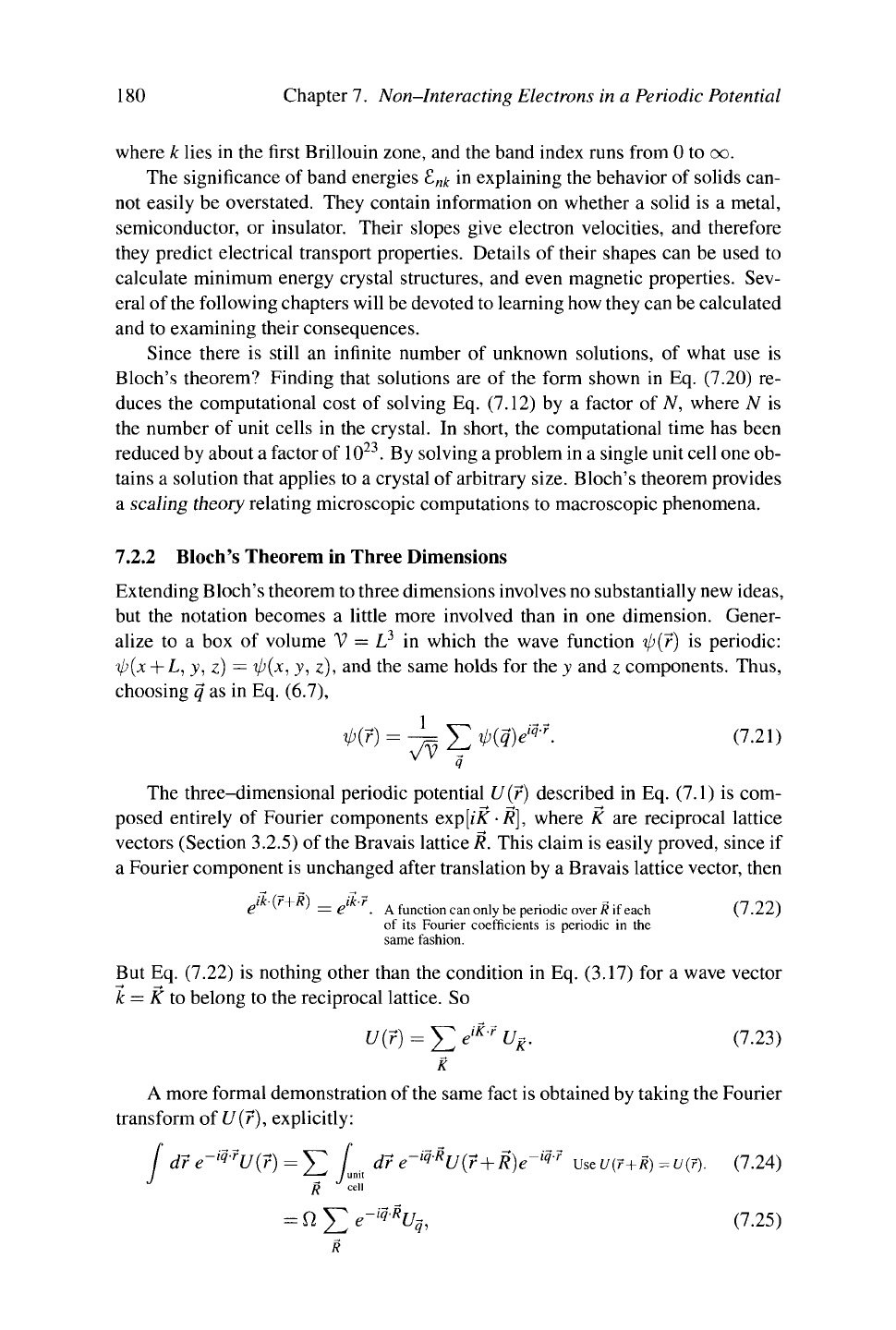
Thus a complete set of solutions to Eq. (7.12) is
^nk(x)
e
lkx
u
nk
{x)
VN
with band energy £„&.
(7.20)
180 Chapter 7. Non-Interacting Electrons in a Periodic Potential
where k lies in the first Brillouin zone, and the band index runs from 0 to oo.
The significance of band energies £„* in explaining the behavior of solids can-
not easily be overstated. They contain information on whether a solid is a metal,
semiconductor, or insulator. Their slopes give electron velocities, and therefore
they predict electrical transport properties. Details of their shapes can be used to
calculate minimum energy crystal structures, and even magnetic properties. Sev-
eral of
the
following chapters will be devoted to learning how they can be calculated
and to examining their consequences.
Since there is still an infinite number of unknown solutions, of what use is
Bloch's theorem? Finding that solutions are of the form shown in Eq. (7.20) re-
duces the computational cost of solving Eq. (7.12) by a factor of N, where N is
the number of unit cells in the crystal. In short, the computational time has been
reduced by about a factor of 10
23
. By solving a problem in a single unit cell one ob-
tains a solution that applies to a crystal of arbitrary size. Bloch's theorem provides
a scaling theory relating microscopic computations to macroscopic phenomena.
7.2.2 Bloch's Theorem in Three Dimensions
Extending Bloch's theorem to three dimensions involves no substantially new ideas,
but the notation becomes a little more involved than in one dimension. Gener-
alize to a box of volume V = L
3
in which the wave function φ{?) is periodic:
ip(x + L, y, z) = ψ(χ, y, z), and the same holds for the y and z components. Thus,
choosing q as in Eq. (6.7),
^ = -i Σ ^)e
rqrr
.
(7.21)
q
The three-dimensional periodic potential U(r) described in Eq. (7.1) is com-
posed entirely of Fourier components exp[iK
■
R],
where K are reciprocal lattice
vectors (Section
3.2.5)
of the Bravais lattice R. This claim is easily proved, since if
a Fourier component is unchanged after translation by a Bravais lattice vector, then
β
=e . A function can only be periodic over S if
each
(J .11)
of
its Fourier coefficients is periodic in the
same
fashion.
But Eq. (7.22) is nothing other than the condition in Eq. (3.17) for a wave vector
k = K to belong to the reciprocal lattice. So
i/(r) = Ç^
?
i/
£
. (7.23)
K
A more formal demonstration of
the
same fact is obtained by taking the Fourier
transform of U(r), explicitly:
ί df
e-^
7
U{r)
= Σ L
d7
e-^
ä
U{r
+ R)e-^
7
Use
U(7+R) =
u{7).
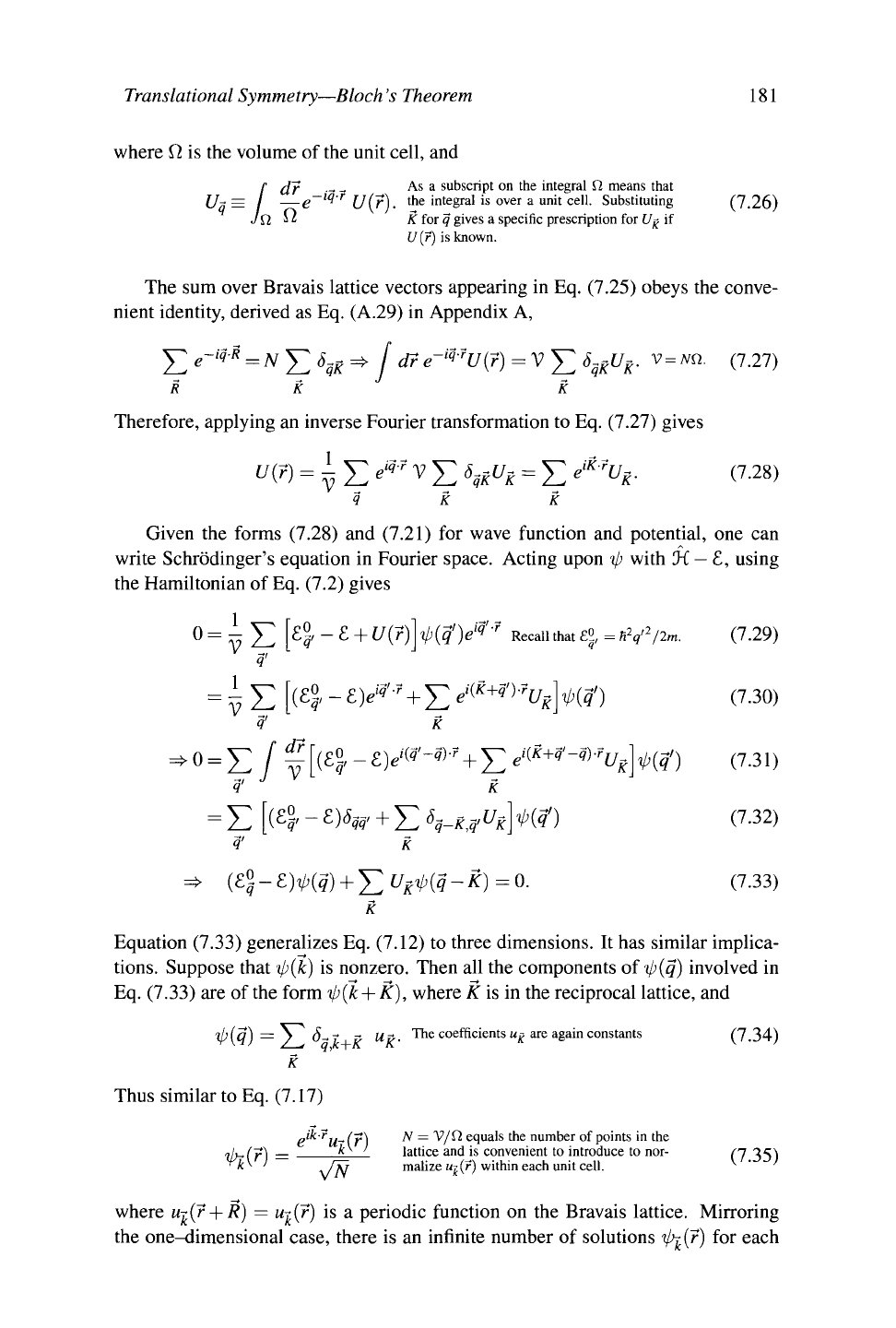
(7.24)
^ cell
= Ω5>-'*%
?
, (7.25)
Translational
Symmetry—Bloch
's
Theorem 181
where Ω is the volume of the unit cell, and
Γ
df —-
As
a
subscript on the integral Ω means that
£/-
= /
—e~
lqr
U(r).
the integral
is
over
a
unit cell. Substituting (7.26)
K for q gives a specific prescription for U^ if
U{r) is known.
The sum over Bravais lattice vectors appearing in Eq. (7.25) obeys the conve-
nient identity, derived as Eq. (A.29) in Appendix A,
R
it K
Therefore, applying an inverse Fourier transformation to Eq. (7.27) gives
vw
=
\ Σ ^
ν
Σ
δ
0
υ
κ
=
Σ
**-%■
(
7
·
28
)
Ά
k k
Given the forms (7.28) and (7.21) for wave function and potential, one can
write Schrödinger's equation in Fourier space. Acting upon ψ with 'K
—
£, using
the Hamiltonian of
Eq.
(7.2) gives
0 = - Σ [
ε
ψ -
£
+
U
(rj\ Ψ$)^''
Τ
Recall that
E\,
=
H
2
q'
2
/2m.
(7.29)
=
k
Σ
[
(£
?'
-
^
ql
'
7
+ Σ ^
+?,)
·^] V>tf) (7.30)
^°=E/f[(4-
£
)^'^
)
''+E^
+9
'"
?)
^]v'(?
/
) (7.31)
Ά
1
k
=
Σ
[(4
-
ε
)<%' +
Σ
h-k«>
U
k]
1>&)
(7-32)
=Φ
(ε
0
ξ
-ε)ψ{ξ)
+
ΣυζΦ(3-Κ)
= 0. (7.33)
Equation (7.33) generalizes Eq. (7.12) to three dimensions. It has similar implica-
tions.
Suppose that ψ(£) is nonzero. Then all the components of
ip(q)
involved in
Eq. (7.33) are of the form
<φ(ί
+ K), where K is in the reciprocal lattice, and
lb
(a) = N S-- - Up.
The coefficients «^ are again constants (7.34)
k
Thus similar to Eq. (7.17)
e
M-
(r)
N
= V/Q equals the number of points in the
ib-('r) =
lattice and is convenient to introduce to nor-
in
'X'>
s
\
^Ί<\
' /Tj
malize uj(r) within each unit cell.
where u^(r + R)
=
u^(r)
is a
periodic function on the Bravais lattice. Mirroring
the one-dimensional case, there is an infinite number of solutions
i/j^(r)
for each
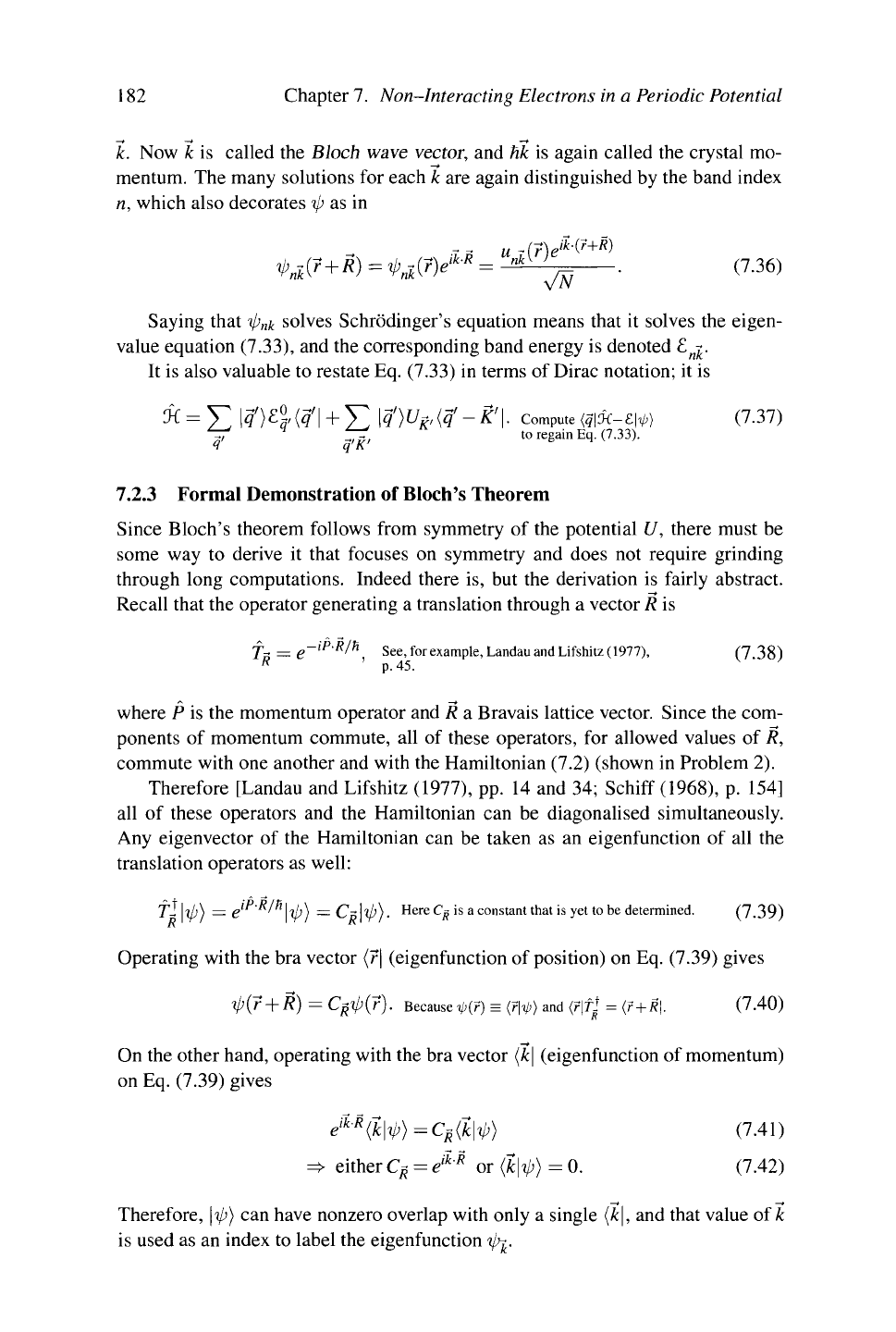
182
Chapter 7. Non-Interacting Electrons in a Periodic Potential
k. Now
k
is called the Bloch wave vector, and hk is again called the crystal mo-
mentum. The many solutions for each k are again distinguished by the band index
n,
which also decorates
φ
as in
-
-
u ^(r)e
ik
'(
7+R
i
VV^+tf) =
VV^V*·*
=
-
JÈ
^ ·
(7-36)
Saying that -φ^ solves Schrödinger's equation means that it solves the eigen-
value equation (7.33), and the corresponding band energy is denoted £^.
It is also valuable to restate Eq. (7.33) in terms of Dirac notation; it is
Λ = Σ \q')£%{q'\ + £ tf)Ufrtf -K'\. Compute <$|Α-ε|ψ>
(7.37)
-,
_,-,
to regain Eq. (7.33).
q
'
q
K
, 6
H
7.2.3 Formal Demonstration of Bloch's Theorem
Since Bloch's theorem follows from symmetry of the potential U, there must be
some way to derive
it
that focuses on symmetry and does not require grinding
through long computations. Indeed there is, but the derivation is fairly abstract.
Recall that the operator generating a translation through a vector R is
f-
—
g-'^/'i
See, forexample, Landau and Lifshitz (1977),
(7
38)
R
'
p.
45.
where P is the momentum operator and R a Bravais lattice vector. Since the com-
ponents of momentum commute, all of these operators, for allowed values of R,
commute with one another and with the Hamiltonian (7.2) (shown in Problem 2).
Therefore [Landau and Lifshitz (1977), pp. 14 and 34; Schiff (1968), p. 154]
all of these operators and the Hamiltonian can be diagonalised simultaneously.
Any eigenvector of the Hamiltonian can be taken as an eigenfunction of all the
translation operators as well:
Τΐ\ψ) =
e
lP
'
R
l
n
\tp)
= Cs
I
ψ)
■
Here C
R
is a
constant that is yet to be determined. (7.39)
Operating with the bra vector (r\ (eigenfunction of position) on Eq. (7.39) gives
1p(?
+ R) =
Cfi1p(r). Because φ{7)
=
(r\ip) and {r\f!
=
(r + R\.
(7.40)
On the other hand, operating with the bra vector (k\ (eigenfunction of momentum)
on Eq. (7.39) gives
€
&
*(ϊ\ψ)=ε
η
(Ϊ\ψ) (7.41)
=*►
either C
n
=
e
ilâ
or (k\ip) = 0. (7.42)
Therefore, \φ) can have nonzero overlap with only a single (k\, and that value of
k
is used as an index to label the eigenfunction ψ^.