
Marder M.P. Condensed Matter Physics
Подождите немного. Документ загружается.

Rotational Symmetry—Group Representations 193
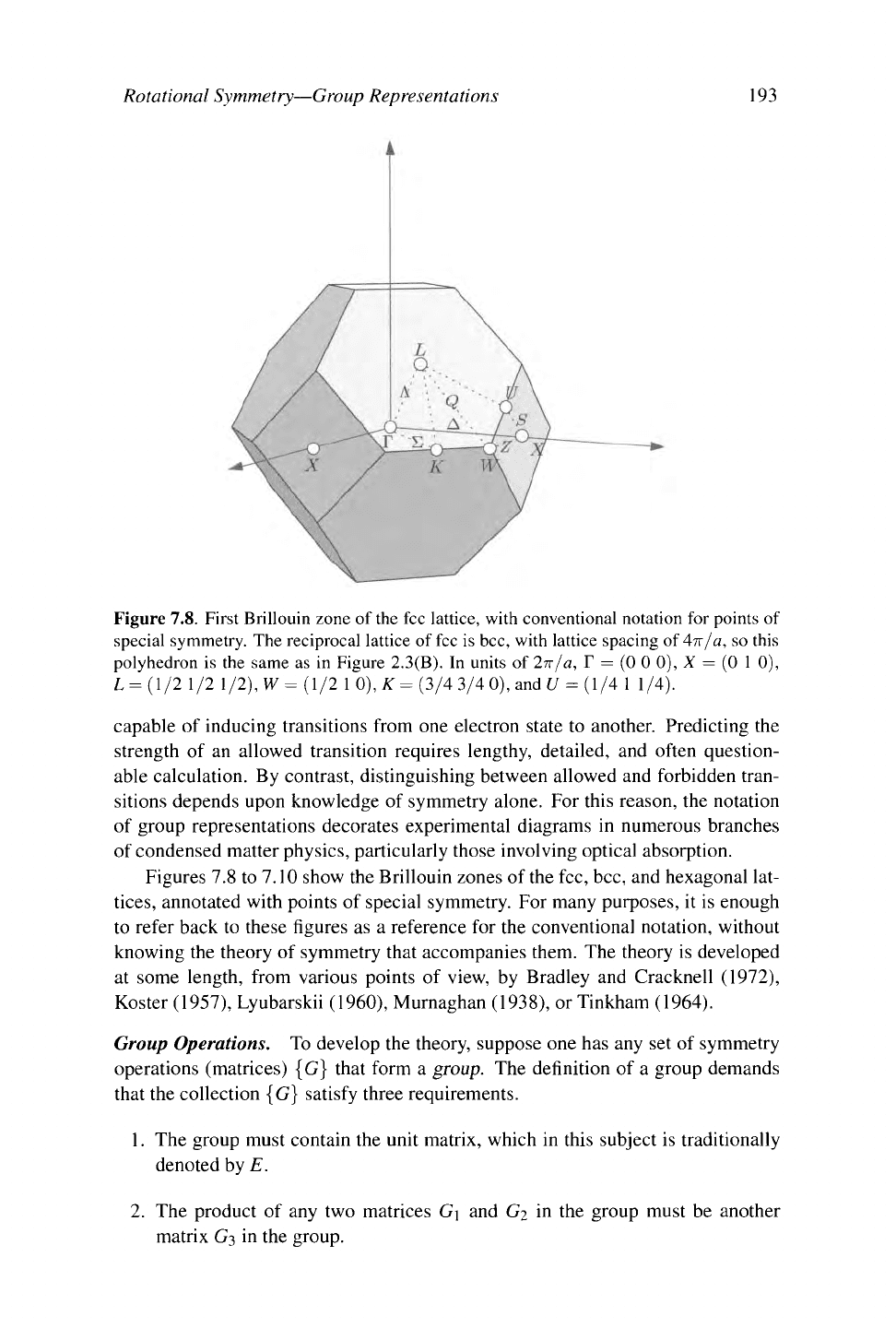
Figure 7.8. First Brillouin zone of the fee lattice, with conventional notation for points of
special symmetry. The reciprocal lattice of fee is bec, with lattice spacing of 4π/α, so this
polyhedron is the same as in Figure 2.3(B). In units of 2π/α, Γ = (0 0 0), X = (0 1 0),
L = (l/2 1/2 1/2), W = (1/2
1
0),
AT
= (3/4 3/4 0), and t/= (1/4
1
1/4).
capable of inducing transitions from one electron state to another. Predicting the
strength of an allowed transition requires lengthy, detailed, and often question-
able calculation. By contrast, distinguishing between allowed and forbidden tran-
sitions depends upon knowledge of symmetry alone. For this reason, the notation
of group representations decorates experimental diagrams in numerous branches
of condensed matter physics, particularly those involving optical absorption.
Figures 7.8 to 7.10 show the Brillouin zones of the fee, bec, and hexagonal lat-
tices,
annotated with points of special symmetry. For many purposes, it is enough
to refer back to these figures as a reference for the conventional notation, without
knowing the theory of symmetry that accompanies them. The theory is developed
at some length, from various points of view, by Bradley and Cracknell (1972),
Koster (1957), Lyubarskii (1960), Murnaghan (1938), or Tinkham (1964).
Group Operations. To develop the theory, suppose one has any set of symmetry
operations (matrices) {G} that form a group. The definition of a group demands
that the collection {G} satisfy three requirements.
1.
The group must contain the unit matrix, which in this subject is traditionally
denoted by E.
2.
The product of any two matrices G\ and Gj in the group must be another
matrix G3 in the group.
194
Chapter 7. Non—Interacting Electrons in a Periodic Potential
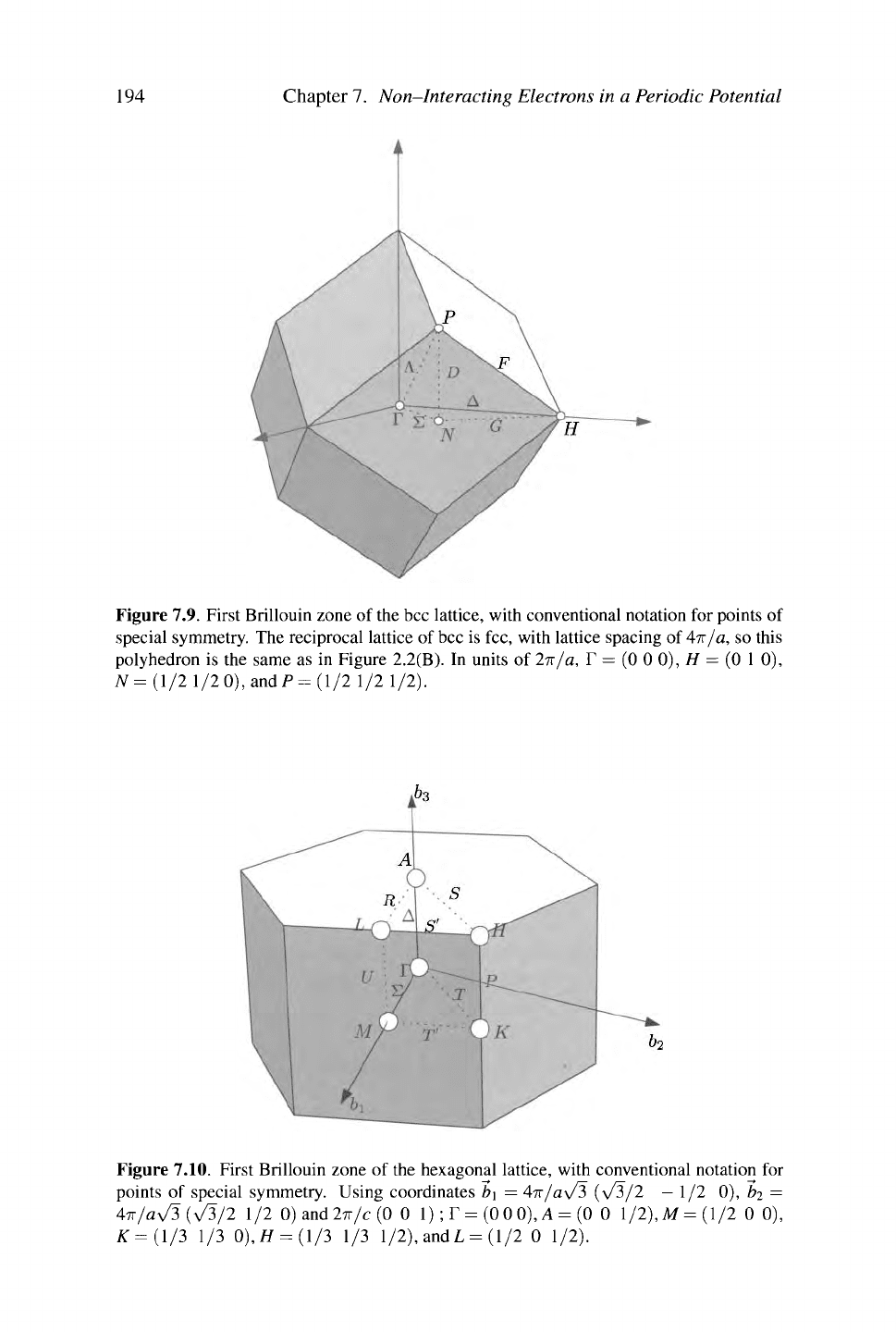
Figure 7.9. First Brillouin zone of the bcc lattice, with conventional notation for points of
special symmetry. The reciprocal lattice of bcc is fee, with lattice spacing of Απ/α, so this
polyhedron is the same as in Figure 2.2(B). In units of 2π/α, Γ = (0 0 0), H = (0 1 0),
N = (1/2 1/2 0), and P= (1/2 1/2 1/2).
Figure 7.10. First Brillouin zone of the hexagonal lattice, with conventional notation for
points of special symmetry. Using coordinates b\ = Απ/α\/3
(\/3/2
—
1/2 0),
t>2
=
Απ/aVÏ
(λ/3/2 1/2 0) and
2TT/C
(0 0 1) ; Γ = (0 0 0), A = (0 0 1/2), M = (1/2 0 0),
K=(l/3 1/3 0),// = (1/3 1/3 1/2), andL= (1/2 0 1/2).
Rotational Symmetry—Group Representations 195
3.
The inverse of every matrix in the group must also belong to the group.
To obtain a representation of the group {G}, pick some function ipj(r), which
in practice might be a wave function. Next, create all the functions ipj(Gr); that
is,
take W>
ana
" rotate and reflect it using all the symmetry operations in {G}.
Actually, ipj{Gr) rotates ipj through G~\ not G, but because G
_1
is also in the
group, it does not matter. Even if the number of matrices in the group, its
order,
is
h,
the number / of linearly independent functions ip(r) generated in this way will
generally be less than or equal to h. For each element G in the group, one must
have
^
i
{Gr) = Y
j
A{G)
ij
^j{r). (7.90)
j
In this fashion, one obtains a matrix A(G) corresponding to each symmetry oper-
ation G; the set of matrices {A} is called a representation of the original group of
symmetry operations. The dimensions of the matrices A generally are quite
dif-
ferent from the dimensions of the original matrices G, because the dimension of
A is determined by the number of linearly independent
V>'s
one happens to obtain
by applying rotations and reflections G to ipj, while all G's are three-dimensional.
Lyubarskii (1960), p. 44, shows that the matrices A can all be taken to be unitary,
so one can assume
/\* =z A as Well as G* = G This is just the definition of a unitary matrix.
(7.91)
in everything that follows.
Two group representations {A
M
} and {A
(m)
} are equivalent if there exists a
single invertible matrix M such that
M'
i
A
(n)
{G)M = A
(m
\G)
This relation has to hold with a single M for
all the different matrices A(G) produced by
varying G.
(7.92)
which means that one obtains {A
(n)
} from
{A
(m)
}
just by changing coordinate sys-
tems.
By making a good choice of M, one will often be able to simplify the matrices
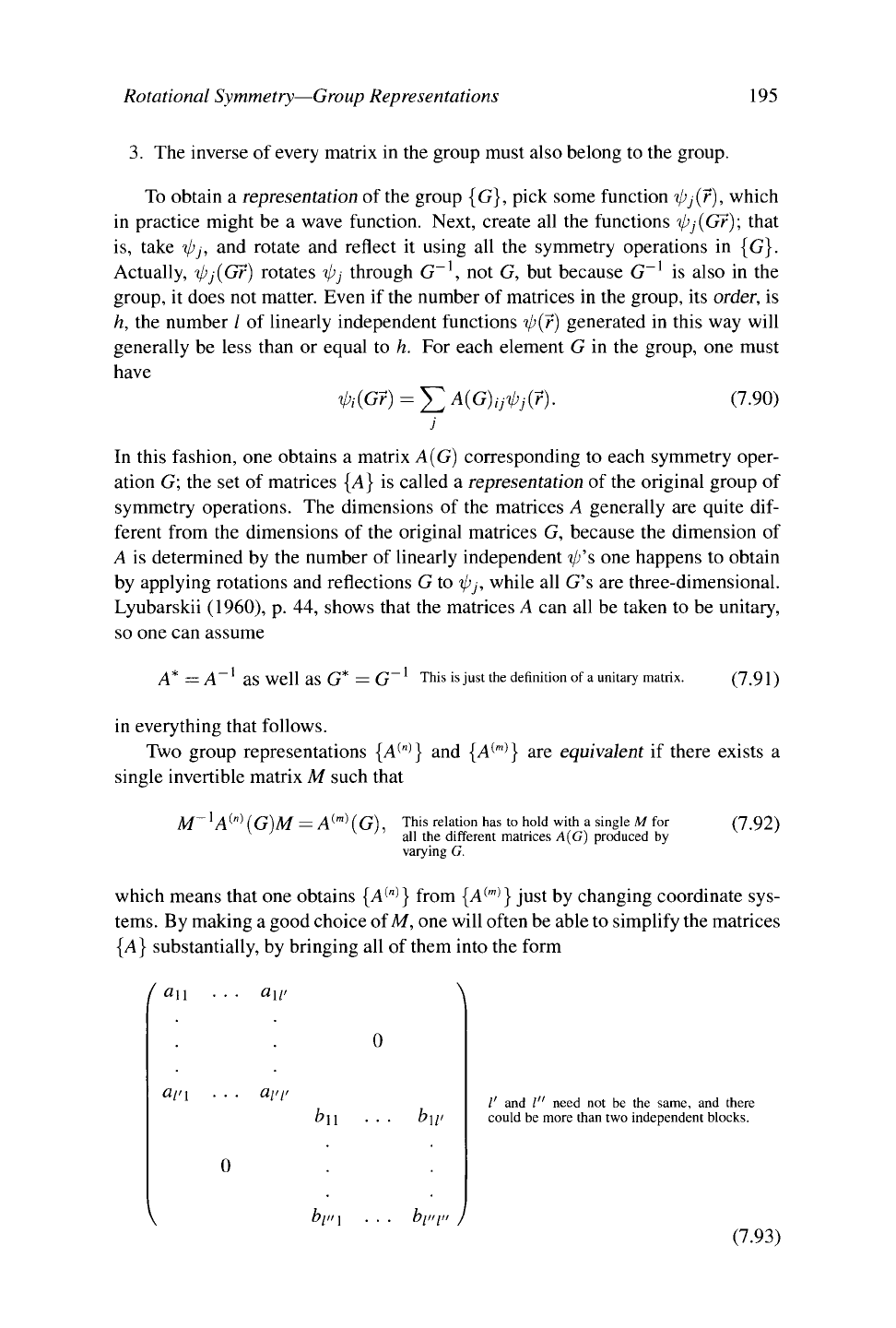
[A] substantially, by bringing all of them into the form
/ an
a
w
ain ... aw
>11
bi"\
\
b\i'
bi"i" Ì
l' and /" need not be the same, and there
could be more than two independent blocks.
(7.93)
196 Chapter 7. Non-Interacting Electrons in a Periodic Potential
The reason that putting all matrices {A} into form (7.93) provides such an advan-
tage is that it means that the wave functions ipj break into two subsets, one contain-
ing
/'
wave functions, the other containing /" wave functions, each of which trans-
forms exclusively into
itself.
The original
I
—
I' + /"-dimensional representation
has been simplified into an /'-dimensional representation and an /"-dimensional
representation, and the original representation is called reducible.
If,
on the other
hand, no M exists which can put all matrices into the form (7.93) simultaneously,
the representation is called irreducible.
Faced with 24 ten-dimensional matrices, the task of finding whether there ex-
ists some
M
to bring them into block diagonal form seems rather daunting.
The
whole question can, however, be settled by diagonalizing a single ten-dimensional
matrix. Begin with an absolutely arbitrary matrix X, let {A
(m)
} and {A
(n)
} be any
two representations of {G} both of dimension /, and form
M
=
^A
(m)
(G)XA
w
(G*). (7.94)
G
Then
A
{m)
{G)M
= Y^A
(m)
{G)A
{m
\G')XA
{n)
{G'*)
G'
=Σ
A(m)
(
GG>
)
χ
A(n)
(
G
'*)
SeeProblem6
G'
E
A
(m)
(G')
X
A
(a)
(G'*G) Change order of summation by
v
'
v
' sending G'^CG'
G'
=
Σ
A(m)
(
G
0
x
A(n)
(G'*)A
(n)
(G)
=
MA
W
(G).
G'
Comparing with Eq. (7.92),
at
first
it
appears that all representations have been
proved to be equivalent. However, A
(m)
andA
(n)
are only equivalent if M has an in-
verse. One can use M to best advantage by remarking that
M*
also obeys Eq. (7.98),
and therefore so does M +
M*
=
P, which is Hermitian. So now one has a Hermi-
tian matrix P with
A
w
(G)/
5
=
PA
(m)
(G). (7.99)
Because P is Hermitian, it can be diagonalized and has an orthonormal basis of real
eigenvalues. Express all the matrices
A
{m)
(G), A
{n)
(G),
and P in this basis. One is
now
in a
position to decompose any given representation into irreducible pieces
and to show that different irreducible representations are orthogonal.
To accomplish the first task, let n = m be the same, and drop this superscript
for the moment. In the basis where
P
is diagonal, one has for the
ij
element of
Eq. (7.99)
A
(G)ijPjj = Pii
A
(G)ij => (P
ii
-Pjj)A(G)
ij
= 0 (7.100)
So there are two possibilities. Either P,·,·
=
Pjj, or else A(G)ij
=
0. However,
if
even
a
single off-diagonal element such as A(G)n vanishes for all G, then A
is
reducible. The reason is this: Saying that A(G)i2 vanishes means that no group
(7.95)
(7.96)
(7.97)
(7.98)
Rotational Symmetry—Group Representations
197
operation transforms ψ\ into
V>2-
This statement means in turn that as one scans
over all the wave functions Οφ\, none of them can be transformed into ^2 either,
for
if
one could, then the product of the two group operations would take ψ\ into
ip2-
Because the sets of wave functions generated by Ωψ\ and
G1P2
are disjoint, the
representation is reducible.
If there are, say, ten nonzero eigenvalues, of which three have value
P\
\, two
have value
P44,
and the rest are all different from one another, then one has reduced
the original ten-dimensional representation into one three-dimensional represen-
tation, one two-dimensional representations, and five one-dimensional representa-
tions.
If,
on the other hand, {A}
is
irreducible, then all the
Pa
are the same, and
therefore P and M are simply multiples of the unit matrix.
When the matrix
X
in Eq. (7.95) is chosen randomly, then the representations
uncovered by Eq. (7.100) are almost certainly irreducible. There are definitive
tests that allow one to decide this question with certainty, resulting from the fact
that either two representations are equivalent or else they are orthogonal
to
one
another, shown as follows:
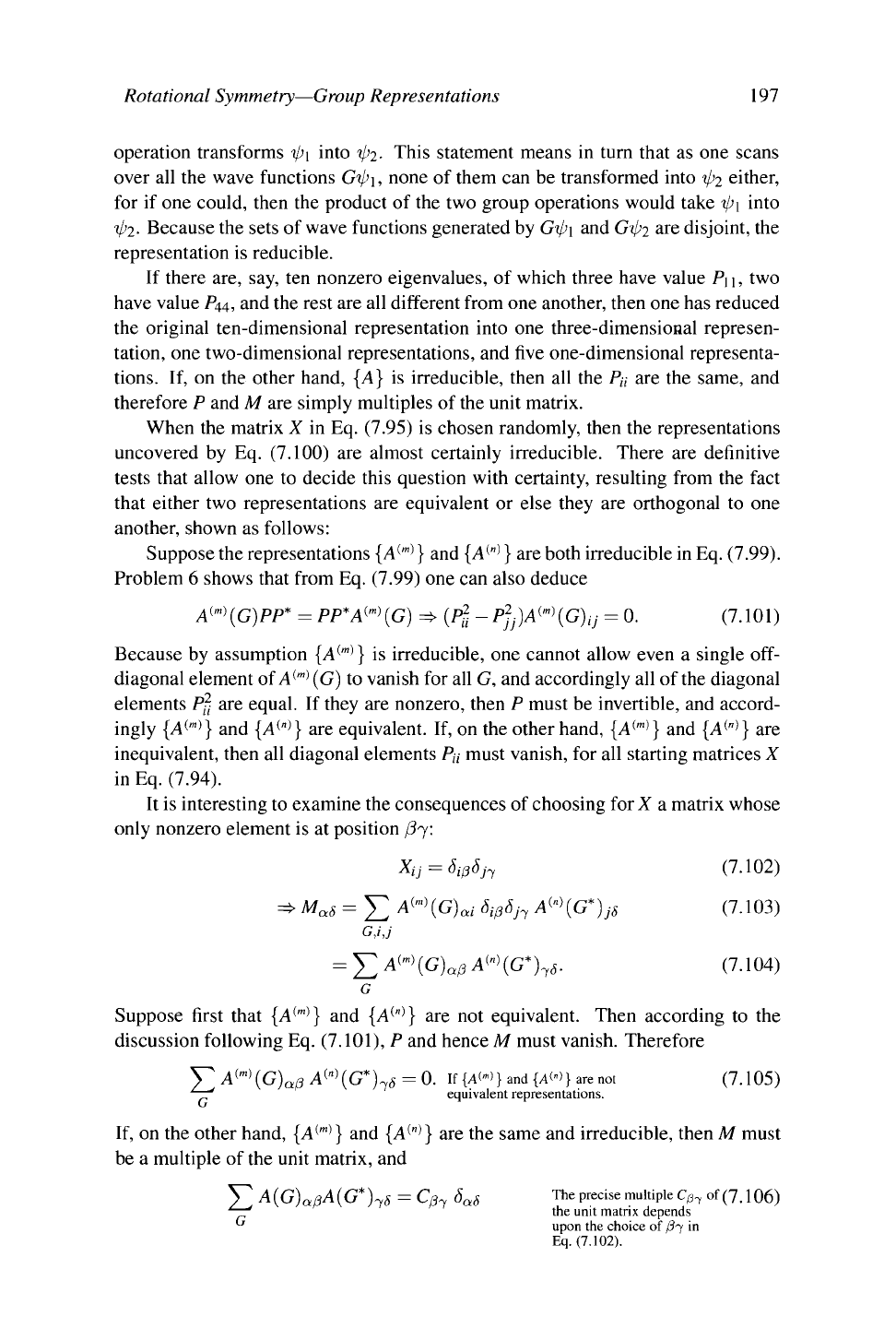
Suppose the representations
{A
{m)
}
and {A
w
}
are both irreducible in Eq. (7.99).
Problem 6 shows that from Eq. (7.99) one can also deduce
A
(m)
{G)PP* = PP*A
(m
\G) => (F$-PJj)A
(m)
(G)ij = 0. (7.101)
Because by assumption {A
(m)
}
is
irreducible, one cannot allow even
a
single
off-
diagonal element of
A
{m)
(G)
to vanish for all G, and accordingly all of the diagonal
elements
P»
are equal. If they are nonzero, then P must be invertible, and accord-
ingly {A
(m>
} and {A
(n)
} are equivalent.
If,
on the other hand, {A
(m)
} and {A
(n)
} are
inequivalent, then all diagonal elements
Pa
must vanish, for all starting matrices X
in Eq. (7.94).
It is interesting to examine the consequences of choosing for X a matrix whose
only nonzero element is at position
βγ
Xij =
S
iß
S
h
(7.102)
=>
Μ
αδ
= Σ
A
{m)
(G)
ai
ö
iß
ö
h
A
M
(G*)js (7.103)
G,i,j
= ^AW(G)
Q
^
w
(G*)
7ä
. (7.104)
G
Suppose first that {i4
(m)
} and {Λ
(η)
} are not equivalent. Then according
to
the
discussion following Eq. (7.101), P and hence M must vanish. Therefore
VA
(m)
(G)
a/3
A
(
"
)
(G*)
7
5
=
0. If
{A«»>}
and {A«} are not (7.105)
~? equivalent representations.
If, on the other hand, {A
(m)
} and {A
(n)
} are the same and irreducible, then M must
be a multiple of the unit matrix, and
V A(G)
aß
A(G*)
lS
= C
ßl
δ
αδ
The precise multiple
C
ßl
of (7.106)
~f the unit matrix depends
upon the choice of βη in
Eq. (7.102).
198
Chapter 7. Non-Interacting Electrons in a Periodic Potential
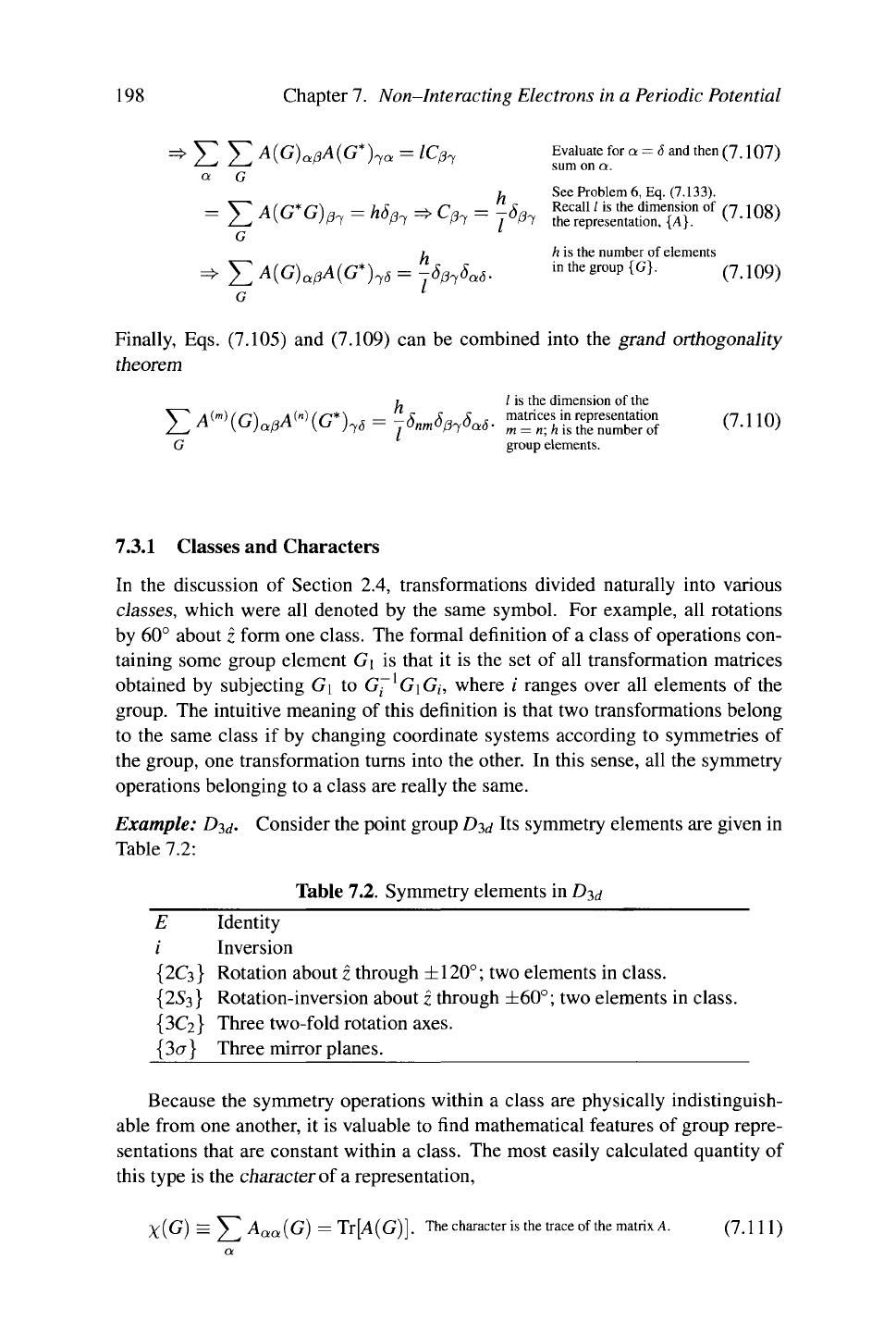
=>
Y V A(G)
ae
A(G*)-y
a
=
ICß^ Evaluate fora
=
5 and then (7.107)
L
—'
z
—'
K
'
K
'
sum on
a.
a
G
n
See Problem 6, Eq. (7.133).
=
£
A{G*G)
ßl
=
hö
ßl
=►
C
ßl
= -δ
βΊ
r^n
h
Ä
e
w
n0f
(
?
·
108
)
G
L·
h is the number of elements
=»
£
A(G)
a/3
A(G*)
7
5
=
-fy
7
i
ai
. in the group
{G}.
(7 109)
G
'
Finally, Eqs. (7.105) and (7.109) can be combined into the grand orthogonality
theorem
u I is the dimension of
the
J2A^(G)
aß
A^(G%
ö
=
Ί
δ
ηηι
δ
βΊ
δ
αδ
.
Γ^^ΓΞΓο"
(
7
·
110
)
G group elements.
7.3.1 Classes and Characters
In the discussion
of
Section 2.4, transformations divided naturally into various
classes, which were all denoted by the same symbol. For example, all rotations
by 60° about z form one class. The formal definition of a class of operations con-
taining some group element Gì is that
it
is the set of all transformation matrices
obtained by subjecting G\
to
G~[
l
G\Gi, where
i
ranges over all elements of the
group. The intuitive meaning of this definition is that two transformations belong
to the same class
if
by changing coordinate systems according to symmetries of
the group, one transformation turns into the other. In this sense, all the symmetry
operations belonging to a class are really the same.
Example:
D^·
Consider the point group
Dj,d
Its symmetry elements are given in
Table 7.2:
Table 7.2. Symmetry elements in
D^
E Identity
i Inversion
{2C3} Rotation about z through ±120°; two elements in class.
{253} Rotation-inversion about z through ±60°; two elements in class.
{3C2} Three two-fold rotation axes.
{3σ} Three mirror planes.
Because the symmetry operations within
a
class are physically indistinguish-
able from one another, it is valuable to find mathematical features of group repre-
sentations that are constant within a class. The most easily calculated quantity of
this type is the
character
of a representation,
X(G)
=
^A
aa
(G) =Tr[A(G)]. The character
is
the trace of
the
matrix
A.
(7.111)
a
Rotational Symmetry—Group Representations 199
The character of two different members of a class must be the same because for
any G\ and
G2
in the same class, one obtains
v(G|)=Tr[Giì =Tr[GÌG
2
G3Ì G, and G
2
are in the same class, by definition, (7.1 12)
if there exists Gj so that G\
=
G^GiG^,.
= Tr[G
2
G
3
G;] (7.113)
= TriG?l
= Y(GI)
Using the cyclic property of the trace,
(7 114)
1
J AV
'
Tr[ASC]=Tr[BCA], easily derived by
writing everything out in component
form.
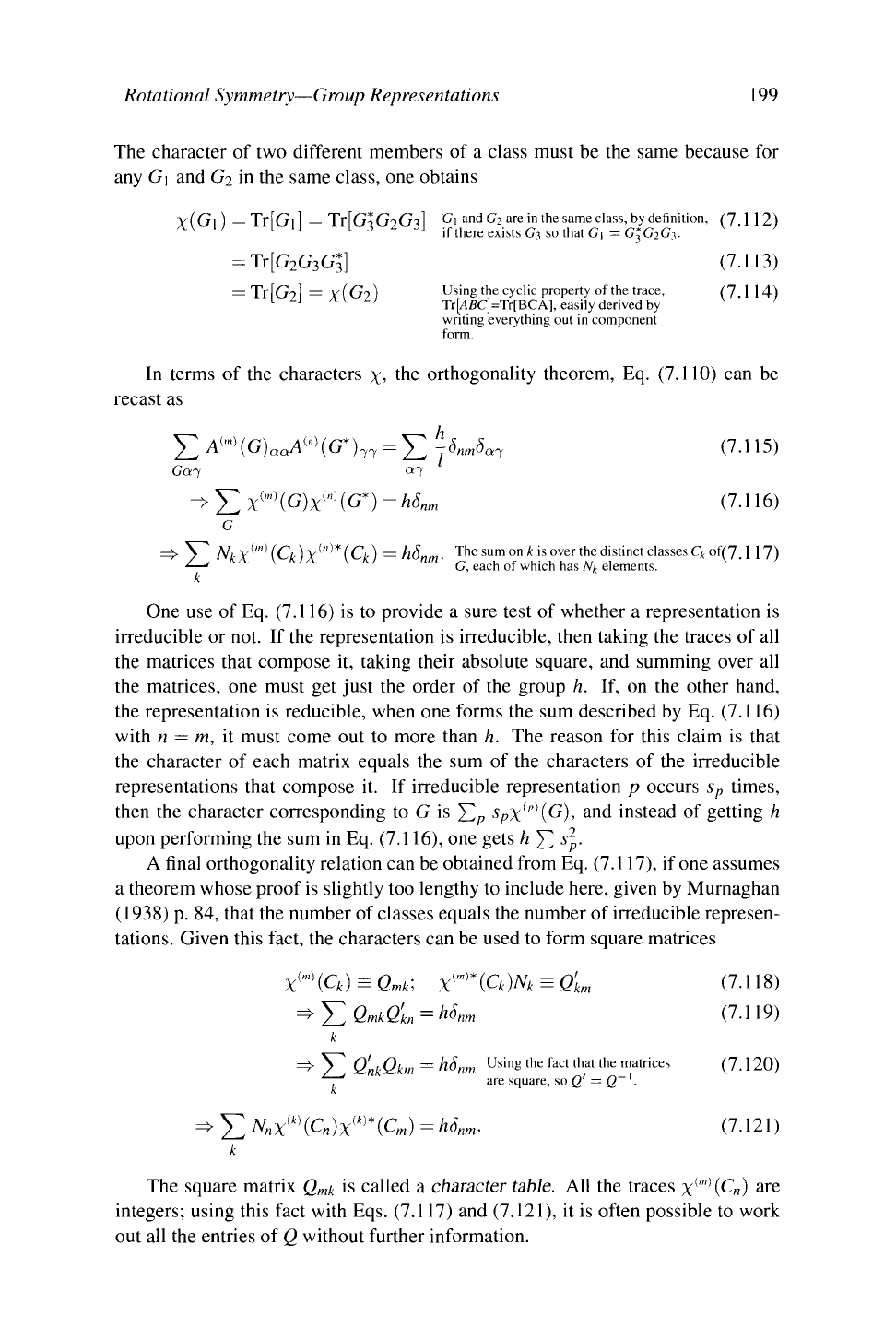
In terms of the characters
χ,
the orthogonality theorem, Eq. (7.110) can be
recast as
Σ A
{m)
{G)
aa
A
i
"\G*)
11
=
Σ
y<WSo7 (7.115)
GQ7
αη
^Y
J
X
{m)
(G)x
{
"\G*)=h5
nm
(7.116)
G
=>
y
N
k
X
i
'"
)
{C
k
)x
(
"
)
*{C
k
)
=
Ιΐδ
ηιη
. The sum on* is over the distinct classes Qof(7.1 17)
*—' G, each of which has M elements.
*
One use of Eq. (7.116) is to provide a sure test of whether a representation is
irreducible or not. If the representation is irreducible, then taking the traces of all
the matrices that compose it, taking their absolute square, and summing over all
the matrices, one must get just the order of the group h.
If,
on the other hand,
the representation is reducible, when one forms the sum described by Eq. (7.116)
with n
=
m,
it
must come out to more than h. The reason for this claim is that
the character of each matrix equals the sum of the characters of the irreducible
representations that compose it. If irreducible representation
p
occurs
s
p
times,
then the character corresponding to G is
Σ
s
p
x
ip)
(G), and instead of getting
h
upon performing the sum in Eq. (7.116), one gets h J2
S
P
-
A final orthogonality relation can be obtained from Eq. (7.117), if one assumes
a theorem whose proof is slightly too lengthy to include here, given by Murnaghan
( 1938)
p. 84, that the number of classes equals the number of irreducible represen-
tations. Given this fact, the characters can be used to form square matrices
X
{m)
{C
k
)
= Q
mk
- x^*(C
k
)N
k
=
Q'
km
(7.118)
^Y
J
Q
m
kQ'
kn
= hö
nm
(7.119)
k
=>
Σ
Q'nkQkm
=
hÔ
nm
Using the fact that the matrices (7.120)
are square, so Q' = Q
'.
=» Σ HnX
ik
\C„)x
w
*(C
m
)=hS
nm
.
(7.121)
k
The square matrix Q
mk
is called a
character
table.
All the traces x
{m)
(C
n
) are
integers; using this fact with Eqs. (7.117) and (7.121), it is often possible to work
out all the entries of Q without further information.
200
Chapter 7. Non-Interacting Electrons in a Periodic Potential
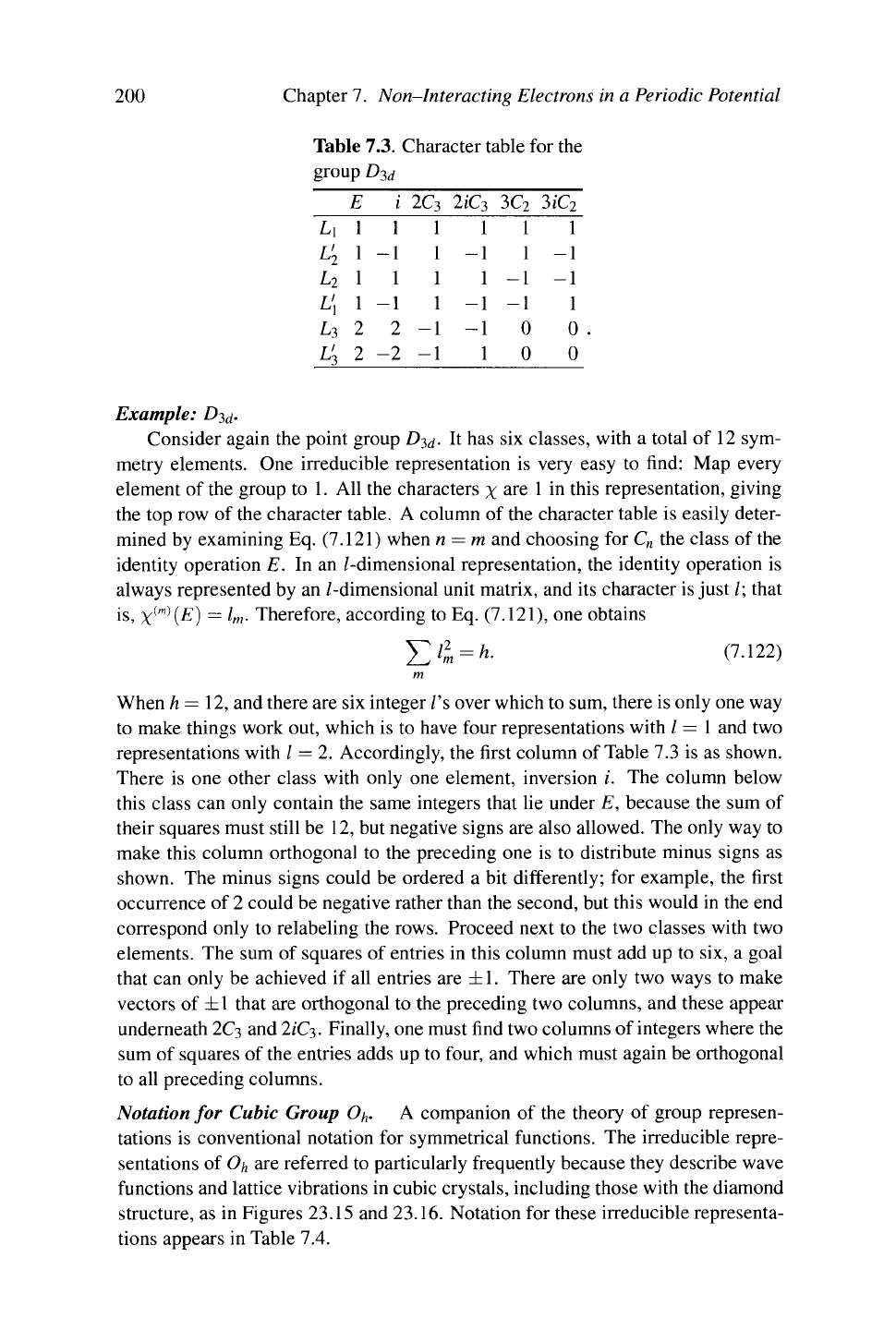
Table 7.3. Character table for the
group D
M
E
U 1
L'
2
1
L
2
1
L\
1
L
3
2
L'
3
2
i
1
-1
1
-1
2
-2
2C
3
—
1
-1
2/C3 3C2 3/C2
1 1 1
-1 1 -1
1 -1 -1
-1 -1 1
-10 0
1 0 0
Example: D34.
Consider again the point group D^. It has six classes, with a total of 12 sym-
metry elements. One irreducible representation is very easy to find: Map every
element of the group to 1. All the characters χ are
1
in this representation, giving
the top row of the character table. A column of the character table is easily deter-
mined by examining Eq. (7.121) when n = m and choosing for C
n
the class of the
identity operation E. In an /-dimensional representation, the identity operation is
always represented by an /-dimensional unit matrix, and its character is just /; that
is,
x
{m)
{E) = l
m
. Therefore, according to Eq. (7.121), one obtains
Y,l
2
m
=
h.
(7.122)
m
When h = 12, and there are six integer /'s over which to sum, there is only one way
to make things work out, which is to have four representations with / =
1
and two
representations with / = 2. Accordingly, the first column of Table 7.3 is as shown.
There is one other class with only one element, inversion /. The column below
this class can only contain the same integers that lie under E, because the sum of
their squares must still be 12, but negative signs are also allowed. The only way to
make this column orthogonal to the preceding one is to distribute minus signs as
shown. The minus signs could be ordered a bit differently; for example, the first
occurrence of
2
could be negative rather than the second, but this would in the end
correspond only to relabeling the rows. Proceed next to the two classes with two
elements. The sum of squares of entries in this column must add up to six, a goal
that can only be achieved if all entries are ±
1.
There are only two ways to make
vectors of ± 1 that are orthogonal to the preceding two columns, and these appear
underneath
2C3
and
2/C3.
Finally, one must find two columns of integers where the
sum of squares of the entries adds up to four, and which must again be orthogonal
to all preceding columns.
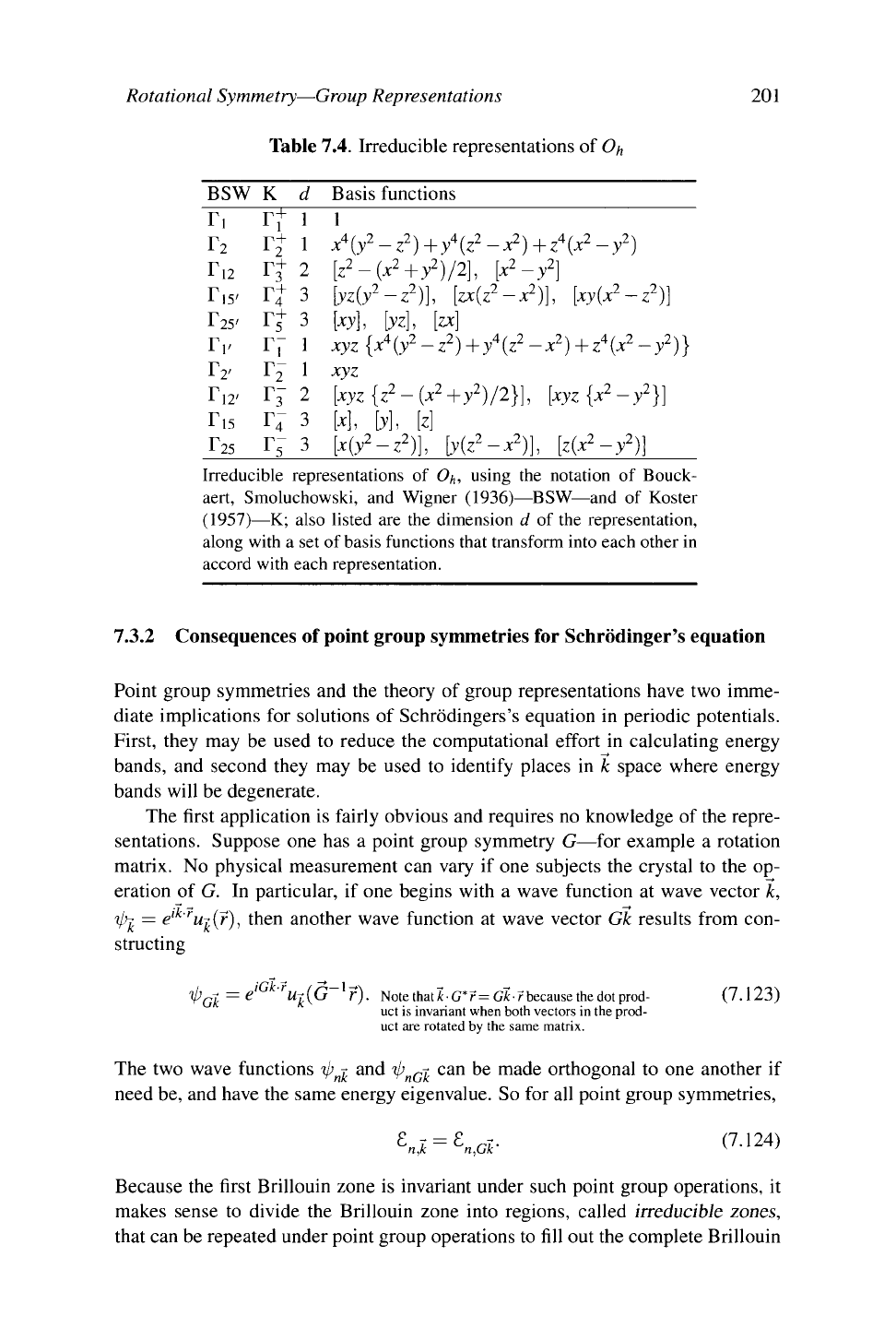
Notation for Cubic Group O^. A companion of the theory of group represen-
tations is conventional notation for symmetrical functions. The irreducible repre-
sentations of
Oh
are referred to particularly frequently because they describe wave
functions and lattice vibrations in cubic crystals, including those with the diamond
structure, as in Figures 23.15 and 23.16. Notation for these irreducible representa-
tions appears in Table 7.4.
Rotational Symmetry—Group Representations 201
Table 7.4. Irreducible representations of 0/,
BSW
Γ,
r
2
Γ12
Γ|
5
'
Γ
2
5'
I>
Γ
ν
Γ
12
'
Γ,
5
Γ
25
K d
Vf 1
Γ+ 1
Γ+ 2
Γ+ 3
Γ+ 3
ιγ
ι
r
?
-
ι
Γί 2
Γ
4
3
Γ
5
- 3
Basis functions
1
x\y
2
-z
2
)+y\z
2
-x
2
)+z\x
2
-y
2
)
[z
2_
{x
2
+y
2
)/2]ì
[x
2_
y2]
[yz(y
2
-z
2
)], [zx{z
2
-x
2
)], [xy(x
2
-z
2
)}
[xy], [yz], [ζχ]
xyz {x\y
2
-z
2
) +y
4
(z
2
-x
2
)+z
4
(x
2
-y
2
)}
xyz
[xyz{z
2
-(x
2
+y
2
)/2}}, [xyz{x
2
-y
2
}}
M,
M, [z]
[x(y
2
-z
2
)},
[y(z
2
-x
2
)], [z(x
2
-y
2
)\
Irreducible representations of
Of,,
using the notation of Bouck-
aert, Smoluchowski, and Wigner (1936)—BSW—and of Koster
(1957)—K; also listed are the dimension d of the representation,
along with a set of
basis
functions that transform into each other in
accord with each representation.
7.3.2 Consequences of point group symmetries for Schrödinger's equation
Point group symmetries and the theory of group representations have two imme-
diate implications for solutions of Schrödingers's equation in periodic potentials.
First, they may be used to reduce the computational effort in calculating energy
bands,
and second they may be used to identify places in k space where energy
bands will be degenerate.
The first application is fairly obvious and requires no knowledge of the repre-
sentations. Suppose one has a point group symmetry
G—for
example a rotation
matrix. No physical measurement can vary if one subjects the crystal to the op-
eration of G. In particular, if one begins with a wave function at wave vector k,
φ^ = e'
k
'
r
u^(r), then another wave function at wave vector Gk results from con-
structing
1p
G
l = e'
Gk
'
r
U^(G~
l
r). Note that
~k-G*r
=
G~k-r
because the dot prod- (7.123)
uct is invariant when both vectors in the prod-
uct are rotated by the same matrix.
The two wave functions ψ^ and ψ
G
i can be made orthogonal to one another if
need be, and have the same energy eigenvalue. So for all point group symmetries,
£ r = £
rt
. (7.124)
n,k η,υκ
ν
'
Because the first Brillouin zone is invariant under such point group operations, it
makes sense to divide the Brillouin zone into regions, called irreducible zones,
that can be repeated under point group operations to fill out the complete Brillouin
202
Chapter 7. Non-Interacting Electrons in a Periodic Potential
zone.
Each irreducible zone is a copy of all the others and has identical energy
surfaces, so one can restrict attention to one such zone.
These arguments, however, rely upon the assumption that the symmetry oper-
ation G acting upon k produced a wave vector physically distinguishable from it,
which is not the case if k and Gk differ only by a reciprocal lattice vector. While
this assumption is true in general, it fails at special points in the irreducible zone.
For these points, a symmetry operation that leaves the wave vector unchanged (up
to a reciprocal lattice vector) may or may not produce a new wave function when
it acts on the wave function one begins with. If the new wave function produced
by the symmetry operation is just a multiple of the old one, there is no particularly
interesting conclusion. But if the symmetry operation produces a linearly inde-
pendent wave function, then more than one wave function corresponds to a single
wave vector in the irreducible zone at a given energy; one has a degeneracy.
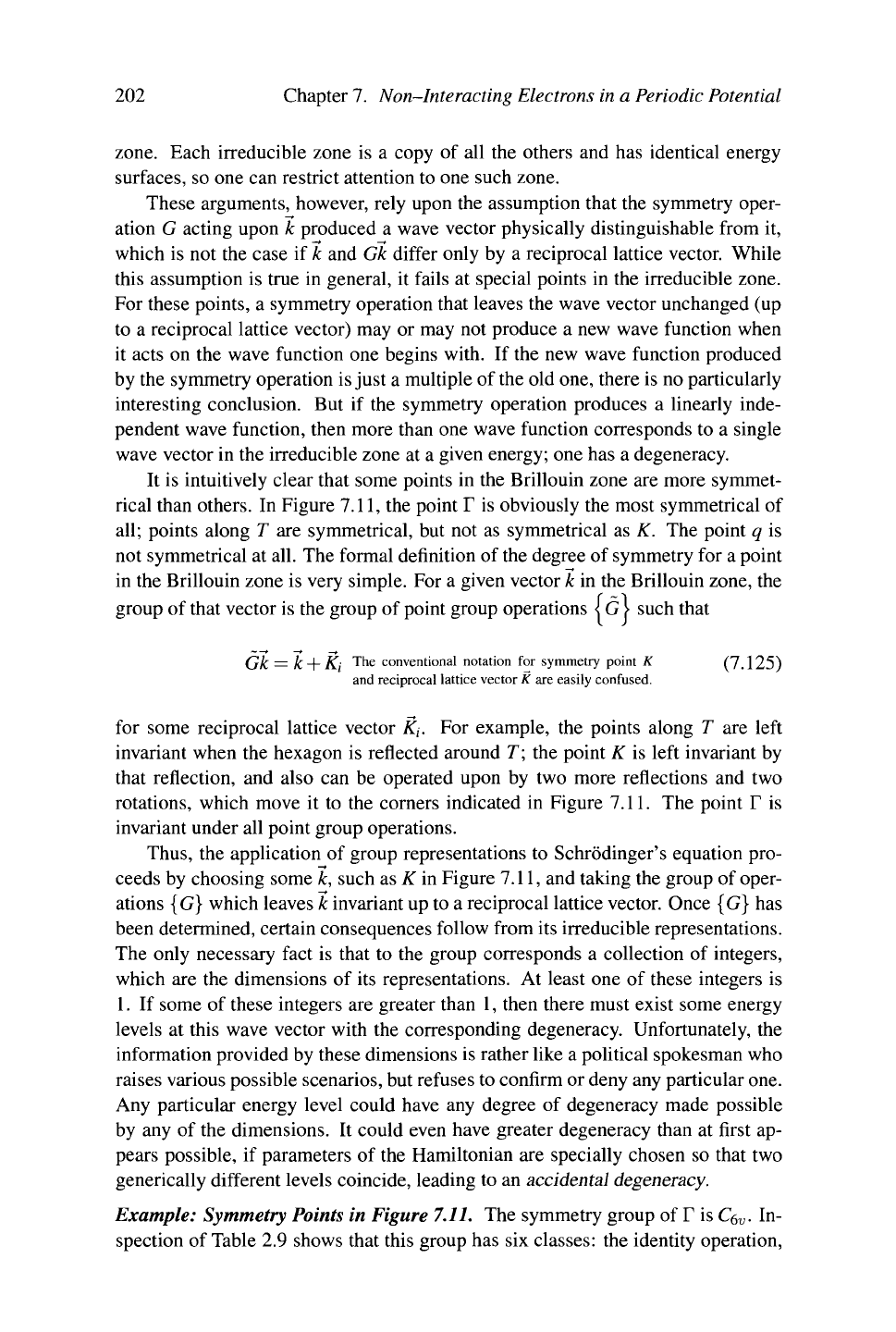
It is intuitively clear that some points in the Brillouin zone are more symmet-
rical than others. In Figure 7.11, the point Γ is obviously the most symmetrical of
all;
points along T are symmetrical, but not as symmetrical as K. The point q is
not symmetrical at all. The formal definition of the degree of symmetry for a point
in the Brillouin zone is very simple. For a given vector k in the Brillouin zone, the
group of that vector is the group of point group operations
<
G
>
such that
Gk = k-\- K: The conventional notation for symmetry point K (7.125)
and reciprocal lattice vector K are easily confused.
for some reciprocal lattice vector £,·. For example, the points along T are left
invariant when the hexagon is reflected around Γ; the point K is left invariant by
that reflection, and also can be operated upon by two more reflections and two
rotations, which move it to the corners indicated in Figure 7.11. The point Γ is
invariant under all point group operations.
Thus,
the application of group representations to Schrödinger's equation pro-
ceeds by choosing some k, such as K in Figure 7.11, and taking the group of oper-
ations {G} which leaves k invariant up to a reciprocal lattice vector. Once {G} has
been determined, certain consequences follow from its irreducible representations.
The only necessary fact is that to the group corresponds a collection of integers,
which are the dimensions of its representations. At least one of these integers is
1.
If some of these integers are greater than 1, then there must exist some energy
levels at this wave vector with the corresponding degeneracy. Unfortunately, the
information provided by these dimensions is rather like a political spokesman who
raises various possible scenarios, but refuses to confirm or deny any particular one.
Any particular energy level could have any degree of degeneracy made possible
by any of the dimensions. It could even have greater degeneracy than at first ap-
pears possible, if parameters of the Hamiltonian are specially chosen so that two
generically different levels coincide, leading to an accidental degeneracy.
Example: Symmetry Points in Figure 7.11. The symmetry group of Γ is C^
v
. In-
spection of Table 2.9 shows that this group has six classes: the identity operation,