
Marder M.P. Condensed Matter Physics
Подождите немного. Документ загружается.

Ionic Crystals
303
large as one wants. The desired result corresponds to a crystal with no net charge
on any surface; thinking of it as a capacitor, one wants it to be discharged. The
technique of Ewald summation accomplishes this goal and provides an extremely
rapid numerical technique for performing the sums as well. The basic idea is that
one should treat all the charges far away as a uniform charge distribution, do an
integral over all the faraway charges, and not bother with the sums past a certain
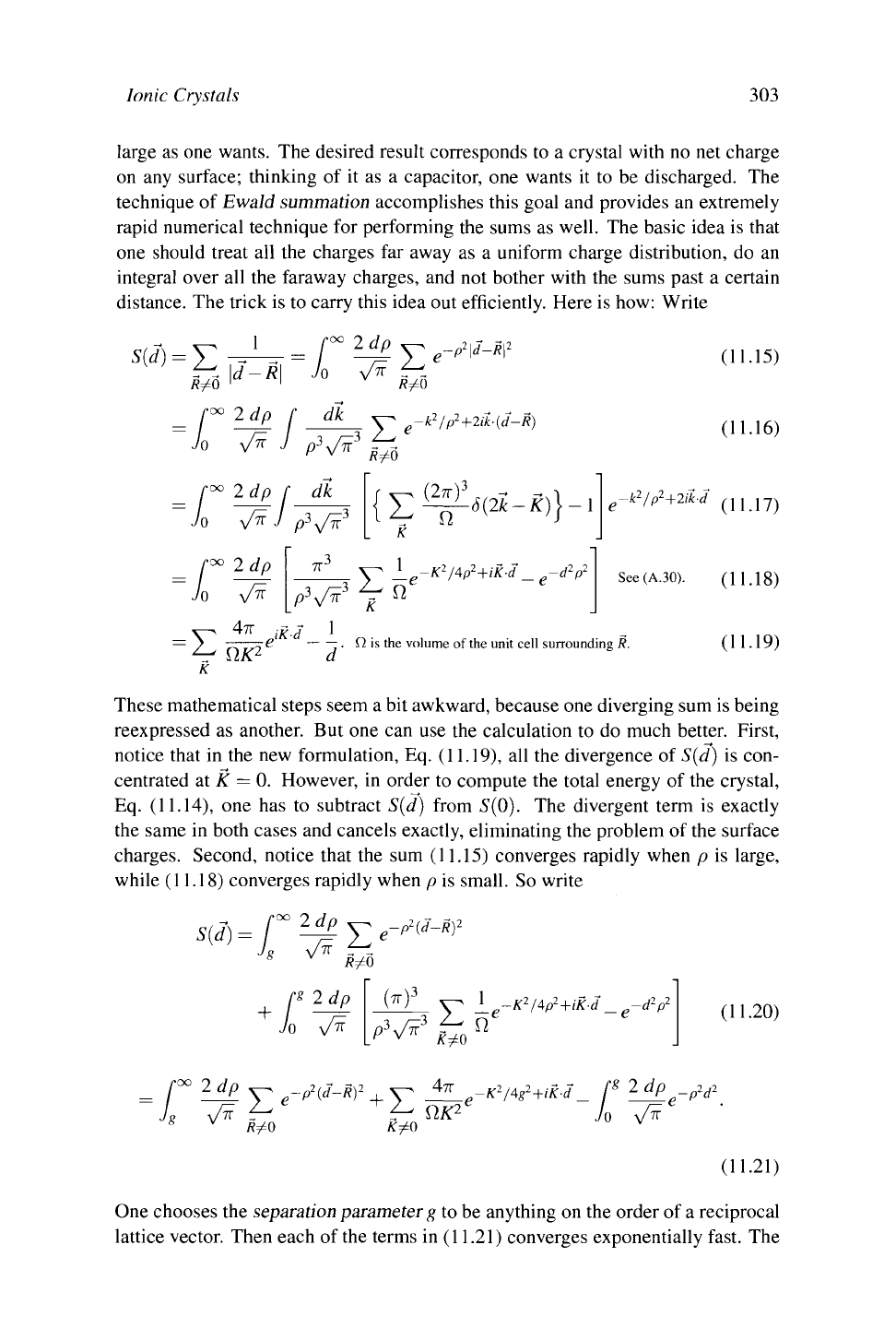
distance. The trick is to carry this idea out efficiently. Here is how: Write
^)
=
Σ
1
\d-R\
2 dp
r°° 2 dp
Jo
o
dk
Σ
-p
2
\d-R\'
Ρ
3
χ/π
3
oo
2 dp
dk
2 dp
7Γ
ρ
3
φτ
3
V"
e
-k
2
/p
2
+2il(d-R)
R^O
(11.15)
(11.16)
-k
2
/p
2
+2ild (n n)
7Γ
Σ
4π
JKd
Σ
,-K
2
/4p
2
+iK-d _-d
2
p
2
d
See(A.30). (11.18)
. Ω is the volume of the unit cell surrounding R. (11.19)
fyft K
Ω
These mathematical steps seem a bit awkward, because one diverging sum is being
reexpressed as another. But one can use the calculation to do much better. First,
notice that in the new formulation, Eq. (11.19), all the divergence of S(d) is con-
centrated at K = 0. However, in order to compute the total energy of the crystal,
Eq. (11.14), one has to subtract S(d) from 5(0). The divergent term is exactly
the same in both cases and cancels exactly, eliminating the problem of the surface
charges. Second, notice that the sum (11.15) converges rapidly when p is large,
while (11.18) converges rapidly when p is small. So write
8
^ R^O
Jo V7T
2 dp
V
e~P
2
^-^
2
(π) ^ 1 K
2
/4p
2
+iKd „-d
2
p
2
P^ RÏO
U
, V
4π
r
-K
2
/4,
2
+iKd f
8
2
d
P
(11.20)
-p
2
d
2
(11.21)
One chooses the separation parameter g to be anything on the order of a reciprocal
lattice vector. Then each of the terms in (11.21) converges exponentially fast. The
304 Chapter
11.
Cohesion of Solids
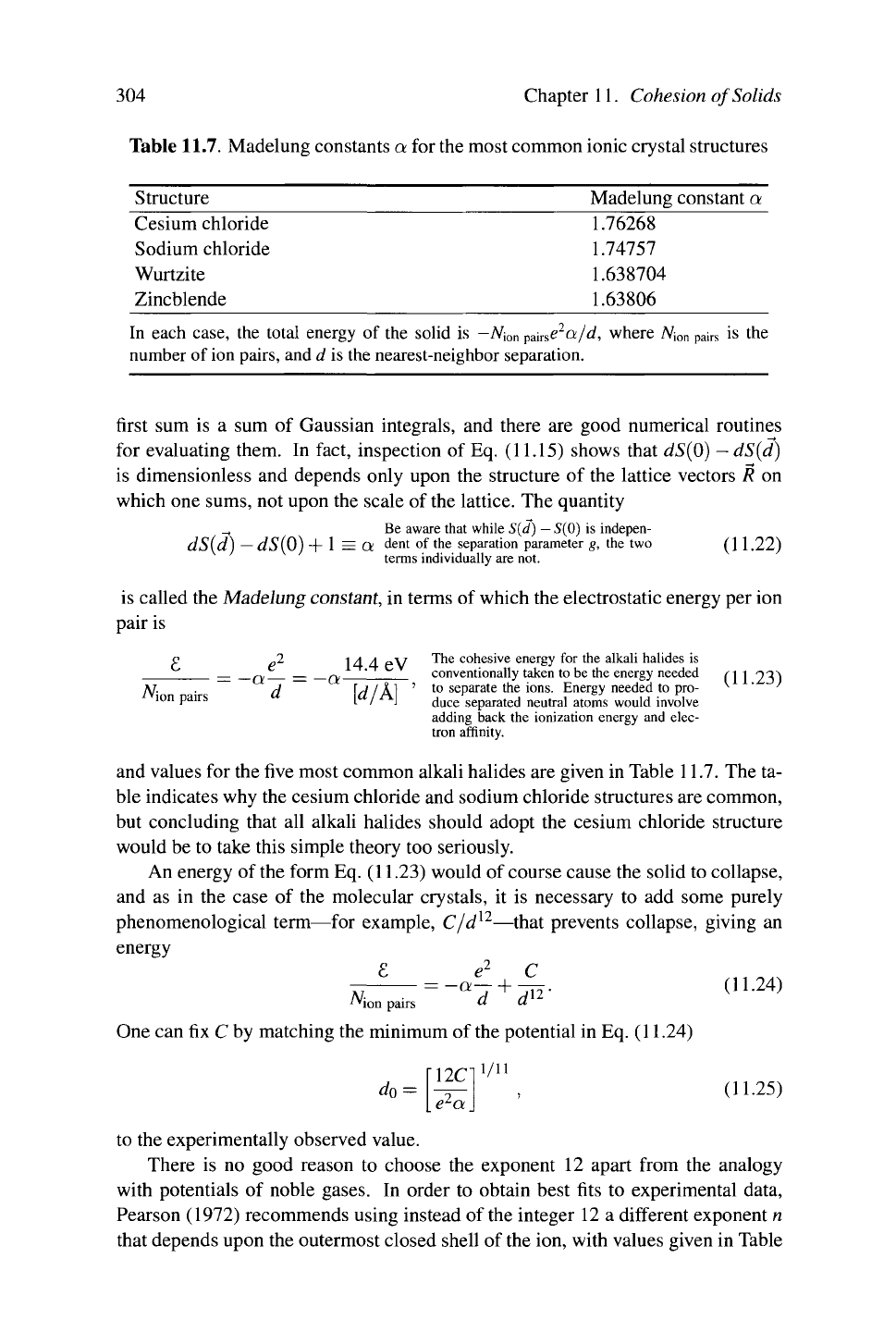
Table 11.7. Madelung constants a for the most common ionic crystal structures
Structure Madelung constant a
Cesium chloride
1.76268
Sodium chloride
1.74757
Wurtzite
1.638704
Zincblende
1.63806
In each case, the total energy of the solid is —
N
lon
p
^
us
e
2
a/d,
where
N
icm
pa
j
rs
is the
number of ion pairs, and d is the nearest-neighbor separation.
first sum is a sum of Gaussian integrals, and there are good numerical routines
for evaluating them. In fact, inspection of Eq. (11.15) shows that dS(0)
—
dS(d)
is dimensionless and depends only upon the structure of the lattice vectors R on
which one sums, not upon the scale of the lattice. The quantity
_ Be aware that while S(d)
—
S(0) is indepen-
dS(d) —dS(0) Ilia dent of the separation parameter g, the two (] 1.22)
terms individually are not.
is called the Madelung
constant,
in terms of which the electrostatic energy per ion
pair is
c 2 14 4 pV ^he
c
°hesive energy for the alkali halides is
_ „, _ „, conventionally taken to be the energy needed (i i 93^
j\j.
. Λ Id / A] ' to separate the ions. Energy needed to pro- ^ ' '
ion pairs [ / J ^
uce
ggp^-^gj neutral atoms would involve
adding back the ionization energy and elec-
tron affinity.
and values for the five most common alkali halides are given in Table 11.7. The ta-
ble indicates why the cesium chloride and sodium chloride structures are common,
but concluding that all alkali halides should adopt the cesium chloride structure
would be to take this simple theory too seriously.
An energy of the form Eq. (11.23) would of course cause the solid to collapse,
and as in the case of the molecular crystals, it is necessary to add some purely
phenomenological term—for example,
C/d
n
—that
prevents collapse, giving an
energy
ε
e
2
c
N— =
-
a
-d
+
d^-
(,L24)
iv
ion pairs
u u
One can fix C by matching the minimum of the potential in Eq. (11.24)
12C
Jo =
e
2
a
1/11
(11.25)
to the experimentally observed value.
There is no good reason to choose the exponent 12 apart from the analogy
with potentials of noble gases. In order to obtain best fits to experimental data,
Pearson (1972) recommends using instead of the integer 12 a different exponent n
that depends upon the outermost closed shell of the ion, with values given in Table
Metals 305
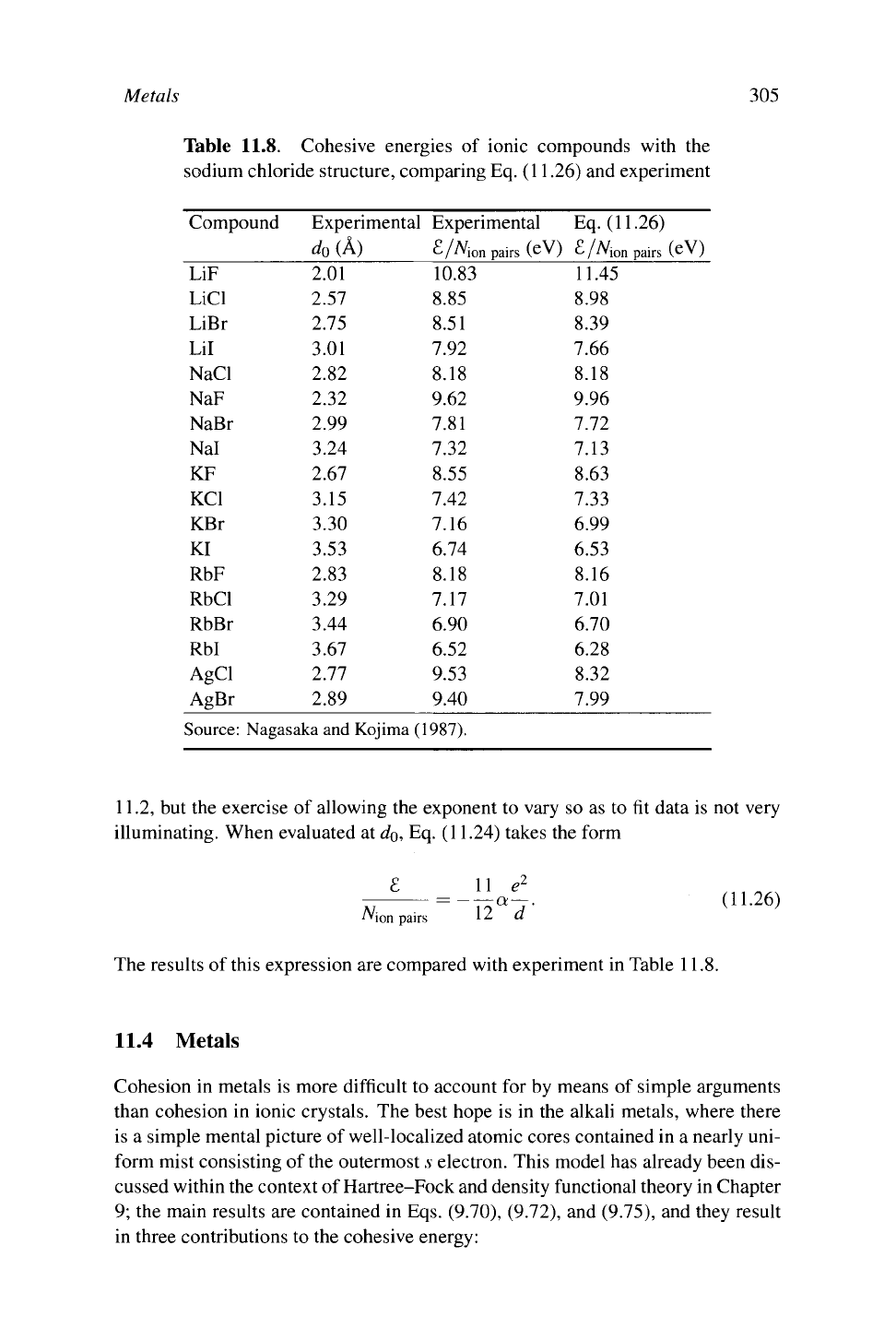
Table 11.8. Cohesive energies of ionic compounds with the
sodium chloride structure, comparing Eq. (11.26) and experiment
Compound Experimental Experimental Eq. (11.26)
dp (A) S/AU pairs (eV) g/Mon pairs (eV)
LiF
LiCl
LiBr
Lil
NaCl
NaF
NaBr
Nal
KF
KC1
KBr
KI
RbF
RbCl
RbBr
Rbl
AgCl
AgBr
2.01
2.57
2.75
3.01
2.82
2.32
2.99
3.24
2.67
3.15
3.30
3.53
2.83
3.29
3.44
3.67
2.77
2.89
10.83
8.85
8.51
7.92
8.18
9.62
7.81
7.32
8.55
7.42
7.16
6.74
8.18
7.17
6.90
6.52
9.53
9.40
11.45
8.98
8.39
7.66
8.18
9.96
7.72
7.13
8.63
7.33
6.99
6.53
8.16
7.01
6.70
6.28
8.32
7.99
Source: Nagasaka and Kojima (1987).
11.2,
but the exercise of allowing the exponent to vary so as to fit data is not very
illuminating. When evaluated at
do,
Eq. (11.24) takes the form
11 e
2
a—. (11.26)
^Mon pairs ^ "
The results of this expression are compared with experiment in Table 11.8.
11.4 Metals
Cohesion in metals is more difficult to account for by means of simple arguments
than cohesion in ionic crystals. The best hope is in the alkali metals, where there
is a simple mental picture of well-localized atomic cores contained in a nearly uni-
form mist consisting of the outermost s electron. This model has already been dis-
cussed within the context of Hartree-Fock and density functional theory in Chapter
9; the main results are contained in Eqs. (9.70), (9.72), and (9.75), and they result
in three contributions to the cohesive energy:
306
Chapter
11.
Cohesion of Solids
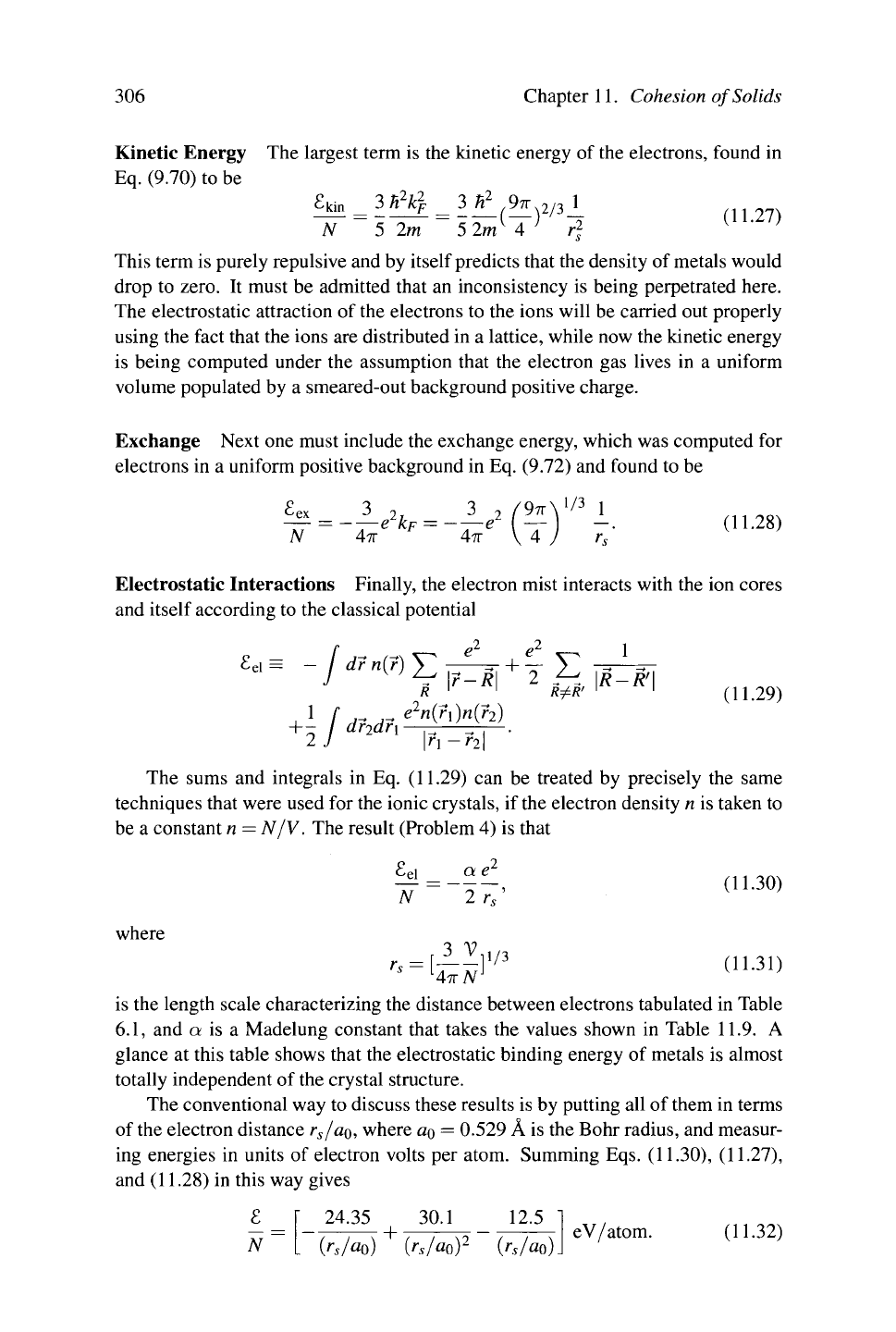
Kinetic Energy The largest term is the kinetic energy of the electrons, found in
Eq. (9.70) to be
ε
ΐΞΞ
=
3^4
=
3^
9vr
2/3
_l_
N 5 2m 52m
K
4
>
ή
Κ
' '
This term is purely repulsive and by itself predicts that the density of metals would
drop to zero. It must be admitted that an inconsistency is being perpetrated here.
The electrostatic attraction of the electrons to the ions will be carried out properly
using the fact that the ions are distributed in a lattice, while now the kinetic energy
is being computed under the assumption that the electron gas lives in a uniform
volume populated by a smeared-out background positive charge.
Exchange Next one must include the exchange energy, which was computed for
electrons in a uniform positive background in Eq. (9.72) and found to be
— = -— ek
F
= -—-e
L
I — -. (11.28)
N
4-7Γ 4-7Γ
\ 4 / r
s
Electrostatic Interactions Finally, the electron mist interacts with the ion cores
and itself according to the classical potential
£el
=
- /
drn{r)
V ,
€
^ +
%-
Y" -=;——
t
J ^ \r-R\ 2 f-t. R-R'\
R '■ "> R^R> ' ' (11.29)
4 f
dhdfi*"™'
1
™
2 7 |n-r
2
|
The sums and integrals in Eq. (11.29) can be treated by precisely the same
techniques that were used for the ionic crystals, if the electron density n is taken to
be a constant n = N/V. The result (Problem 4) is that
N 2 r
s
where
rj =
[i_Z]l/3
(1L31)
is the length scale characterizing the distance between electrons tabulated in Table
6.1,
and a is a Madelung constant that takes the values shown in Table 11.9. A
glance at this table shows that the electrostatic binding energy of metals is almost
totally independent of the crystal structure.
The conventional way to discuss these results is by putting all of them in terms
of the electron distance r
s
/ao, where
ÜQ
= 0.529 Â is the Bohr radius, and measur-
ing energies in units of electron volts per atom. Summing Eqs. (11.30), (11.27),
and (11.28) in this way gives
E_
N
24.35 30.1 12.5
■
+
■
{rs/ao)
{r
s
/a
0
)
2
{r
s
/a
0
)
eV/atom. (11.32)
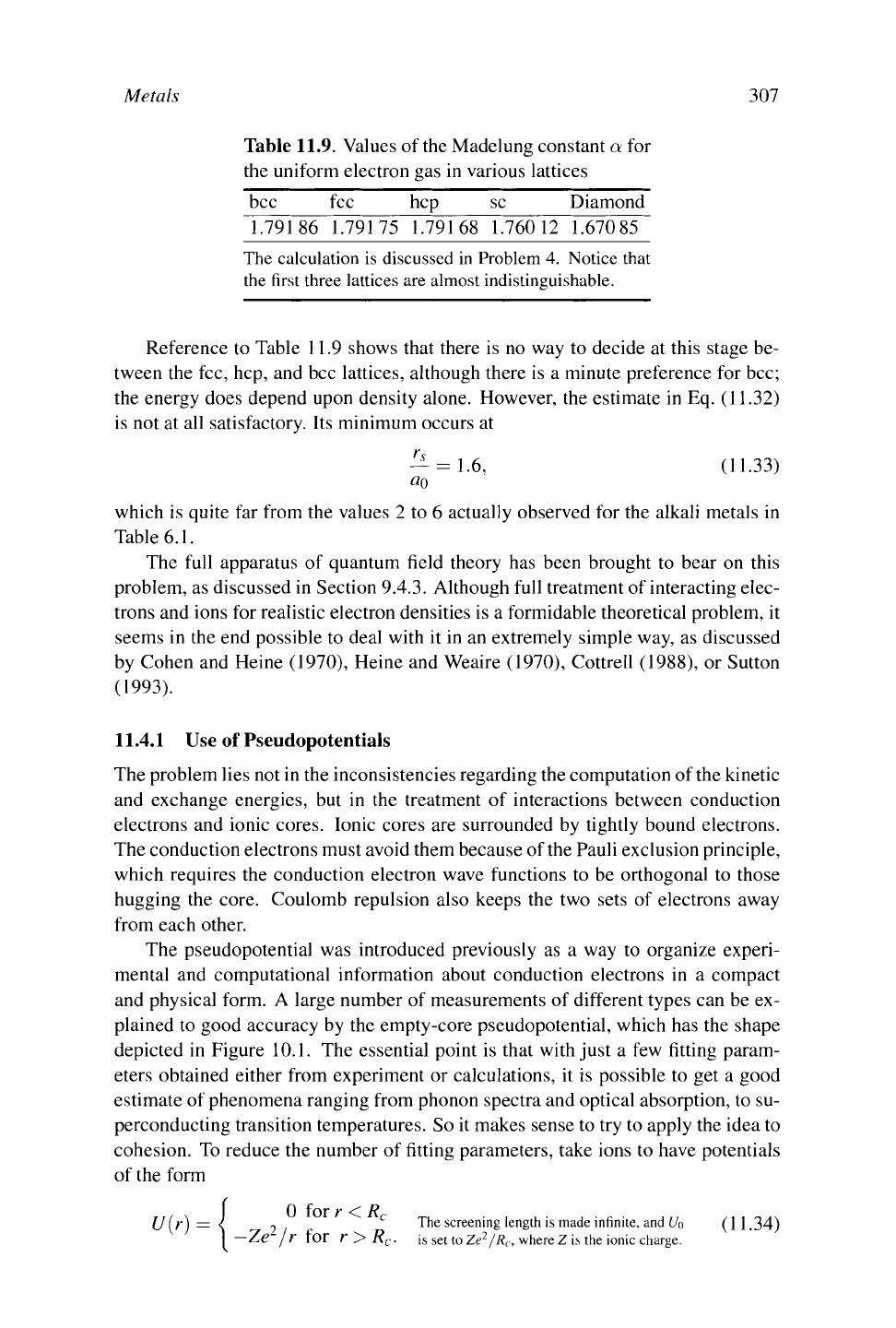
Metals 307
Table 11.9. Values of the Madelung constant a for
the uniform electron gas in various lattices
bcc fee hep sc Diamond
1.79186
1.79175
1.79168
1.76012
1.67085
The calculation is discussed in Problem 4. Notice that
the
first
three lattices are almost indistinguishable.
Reference to Table 11.9 shows that there is no way to decide at this stage be-
tween the fee, hep, and bcc lattices, although there is a minute preference for bcc;
the energy does depend upon density alone. However, the estimate in Eq. (11.32)
is not at all satisfactory. Its minimum occurs at
— = 1.6, (11.33)
Clo
which is quite far from the values 2 to 6 actually observed for the alkali metals in
Table 6.1.
The full apparatus of quantum field theory has been brought to bear on this
problem, as discussed in Section 9.4.3. Although full treatment of interacting elec-
trons and ions for realistic electron densities is a formidable theoretical problem, it
seems in the end possible to deal with it in an extremely simple way, as discussed
by Cohen and Heine (1970), Heine and Weaire (1970), Cottrell (1988), or Sutton
(1993).
11.4.1 Use of Pseudopotentials
The problem lies not in the inconsistencies regarding the computation of
the
kinetic
and exchange energies, but in the treatment of interactions between conduction
electrons and ionic cores. Ionic cores are surrounded by tightly bound electrons.
The conduction electrons must avoid them because of
the
Pauli exclusion principle,
which requires the conduction electron wave functions to be orthogonal to those
hugging the core. Coulomb repulsion also keeps the two sets of electrons away
from each other.
The pseudopotential was introduced previously as a way to organize experi-
mental and computational information about conduction electrons in a compact
and physical form. A large number of measurements of different types can be ex-
plained to good accuracy by the empty-core pseudopotential, which has the shape
depicted in Figure 10.1. The essential point is that with just a few fitting param-
eters obtained either from experiment or calculations, it is possible to get a good
estimate of phenomena ranging from phonon spectra and optical absorption, to su-
perconducting transition temperatures. So it makes sense to try to apply the idea to
cohesion. To reduce the number of fitting parameters, take ions to have potentials
of the form
U(r) = I 9
C
The screening length is made infinite, and i/o (11 34)
v
' I -Ze
z
/r for r > R
c
. is set to Ze
2
/R
c
,
where Z
is
the ionic charge.
Chapter 11. Cohesion of Solids
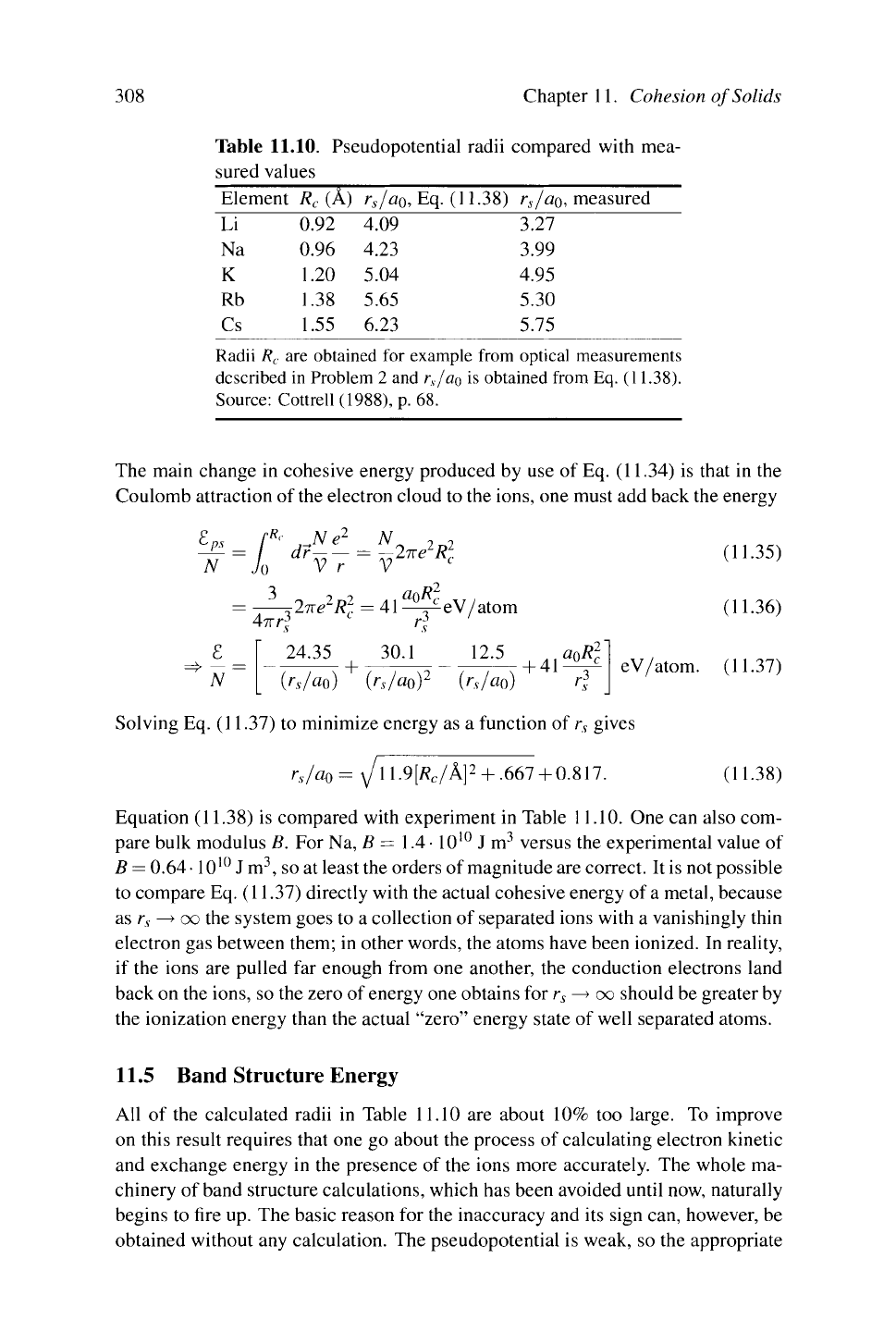
Table 11.10. Pseudopotential radii compared with mea-
sured values
Element
Li
Na
K
Rb
Cs
Re (A)
0.92
0.96
1.20
1.38
1.55
r
s
/ao,
4.09
4.23
5.04
5.65
6.23
Eq. (11.38)
Λ,/ÖO, measured
3.27
3.99
4.95
5.30
5.75
Radii R
c
are obtained for example from optical measurements
described in Problem 2 and r
s
/ao is obtained from Eq. (11.38).
Source: Cottrell (1988), p. 68.
The main change in cohesive energy produced by use of Eq. (11.34) is that in the
Coulomb attraction of the electron cloud to the ions, one must add back the energy
%=(*α£±
^Λζ (Π.35)
N Jo V r V
2^
2
^
= 41-^3
£
eV/atom (11.36)
47rr
3
r\
ε
N
24.35 30.1 12.5
a
0
R
2
r
+ , , ,-, - / , s+41
0,/αο)
(r
s
/a
0
)
2
(r
s
/a
0
) ή
eV/atom. (11.37)
Solving Eq.
(
11.37) to minimize energy as a function of r
s
gives
r
s
/ao= y
/
11.9[tf
c
/Â]
2
+ .667 + 0.817. (11.38)
Equation (11.38) is compared with experiment in Table 11.10. One can also com-
pare bulk modulus B. For Na, B = 1.4
■
10
10
J m
3
versus the experimental value of
B = 0.64
·
10
l()
J m
3
, so at least the orders of magnitude are correct. It is not possible
to compare Eq.
(
11.37) directly with the actual cohesive energy of
a
metal, because
as r
s
—>
oo the system goes to a collection of separated ions with a vanishingly thin
electron gas between them; in other words, the atoms have been ionized. In reality,
if the ions are pulled far enough from one another, the conduction electrons land
back on the ions, so the zero of energy one obtains for r
s
—>
oo should be greater by
the ionization energy than the actual "zero" energy state of well separated atoms.
11.5 Band Structure Energy
All of the calculated radii in Table 11.10 are about 10% too large. To improve
on this result requires that one go about the process of calculating electron kinetic
and exchange energy in the presence of the ions more accurately. The whole ma-
chinery of band structure calculations, which has been avoided until now, naturally
begins to fire up. The basic reason for the inaccuracy and its sign can, however, be
obtained without any calculation. The pseudopotential is weak, so the appropriate
Band Structure Energy 309
calculation to have in mind is the weak perturbation theory of Section 8.2. There
it was shown that the effect of a weak potential was to open up gaps in the free
electron £(k) curves at all k that lie at the edge of the Brillouin zone. Let K be
the reciprocal lattice vector that connects k to its counterpart on the other side of
the zone. At the inside edge of the zone, the energy levels go down by Ug, on the
outside edge of the zone they go up by Ug, where U is the (weak) pseudopotential,
and the net effect is that the energy of the electron gas goes down by an amount
proportional to
\U^\
2
.
This contribution to the energy of a system is called the band
structure energy, and it is the dominant way in which details of the lattice structure
make themselves known to the cohesive energy. Without detailed calculation, one
can see that the first effect of the band structure energy should be to expand or
shrink the lattice in whatever way makes Ug increase slightly. For all of the metals
in Table 11.10, the pseudopotential is positive and of positive slope at the smallest
reciprocal lattice vectors, so U^ increases if K increases, and this leads to a ten-
dency for the size of the lattice to shrink. For some other elements—for example
Ga and In—estimates such as Eq. (11.38) do in fact give too small an answer, and
this result can be traced to the fact that now \Up\
2
increases if K decreases instead.
11.5.1 Peierls Distortion
The principle that lattices rearrange themselves to suit the desires of the conduc-
tion electrons moving through them is most easily illustrated by a one-dimensional
calculation due to Peierls (1955), pp. 108-112.
Suppose one has a one-dimensional lattice, which when perfectly periodic,
has minimum energy for some lattice constant a and for which the elastic energy
penalty that must be paid to move atom n a distance Δ„ away from its lattice site is
^αΚΔ
. y has dimensions of energy per volume and (11.39)
2
" can be understood as Young's modulus for the
one-dimensional
chain.
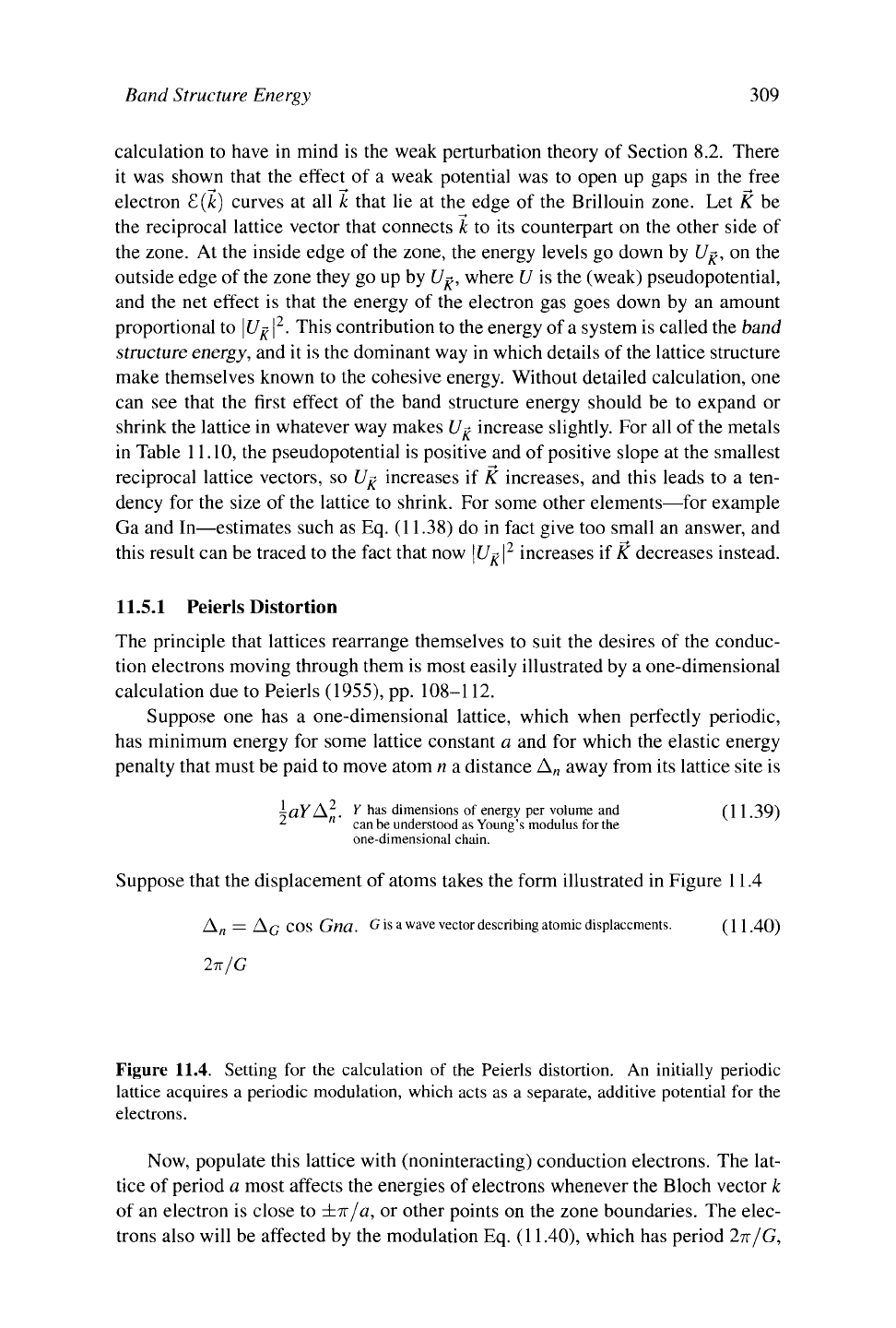
Suppose that the displacement of atoms takes the form illustrated in Figure 11.4
A
n
= Δ(7 COS Gnü. G is a
wave
vector describing atomic
displacements.
(11.40)
2TT/G
Figure 11.4. Setting for the calculation of the Peierls distortion. An initially periodic
lattice acquires a periodic modulation, which acts as a separate, additive potential for the
electrons.
Now, populate this lattice with (noninteracting) conduction electrons. The lat-
tice of period a most affects the energies of electrons whenever the Bloch vector k
of an electron is close to ±π/α, or other points on the zone boundaries. The elec-
trons also will be affected by the modulation Eq. (11.40), which has period 2n/G,
310
Chapter 11. Cohesion of Solids
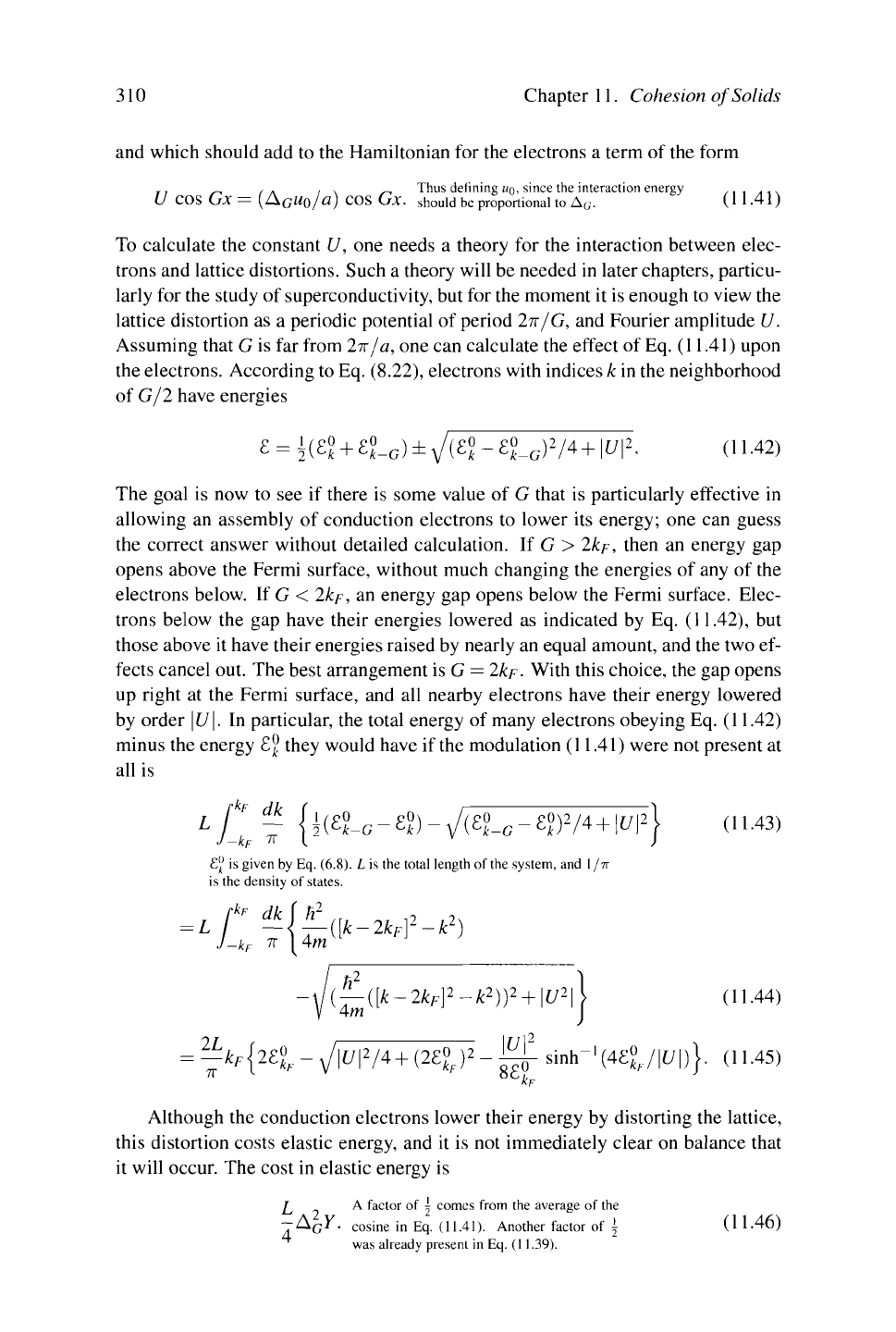
and which should add to the Hamiltonian for the electrons a term of the form
,. , s _ Thus delìning »o, since the interaction energy .
U COS Gx = {A
G
Uo/a) COS Gx. should be proportional to A
a
. (
1 1
-41)
To calculate the constant U, one needs a theory for the interaction between elec-
trons and lattice distortions. Such a theory will be needed in later chapters, particu-
larly for the study of superconductivity, but for the moment it is enough to view the
lattice distortion as a periodic potential of period 2π/G, and Fourier amplitude U.
Assuming that G is far from 2π/α, one can calculate the effect of
Eq.
(11.41 )
upon
the electrons. According to Eq. (8.22), electrons with indices k in the neighborhood
of G/2 have energies
The goal is now to see if there is some value of G that is particularly effective in
allowing an assembly of conduction electrons to lower its energy; one can guess
the correct answer without detailed calculation. If G > 2kf, then an energy gap
opens above the Fermi surface, without much changing the energies of any of the
electrons below. If G < 2kp, an energy gap opens below the Fermi surface. Elec-
trons below the gap have their energies lowered as indicated by Eq. (11.42), but
those above it have their energies raised by nearly an equal amount, and the two ef-
fects cancel out. The best arrangement is G = 2k f. With this choice, the gap opens
up right at the Fermi surface, and all nearby electrons have their energy lowered
by order \U\. In particular, the total energy of many electrons obeying Eq.
(
11.42)
minus the energy £° they would have if the modulation
( 11.41 )
were not present at
all is
L
/lv {i(
£
t
c
-
e
2)-V(
£
2-G-e2)
2
/4+|t/|
2
} (11.43)
£" is given by Eq. (6.8). L is the total length of the system, and
1
/π
is the density of states.
kF
^/«L«*-^]
2
-*
2
)
k
F
7Γ [ Am
-y'(^([*-2*
F
]2-Ä2))2
+
|
i/
2|l (Π.44)
= ^k
F
{2El - V
/
|i/|
2
/4+ (2£°J2 - ^-
sinh-
1
(4£°V|i/|)}.
(11.45)
kf
Although the conduction electrons lower their energy by distorting the lattice,
this distortion costs elastic energy, and it is not immediately clear on balance that
it will occur. The cost in elastic energy is
]_,
Ί
A factor of £ comes from the average of the
—
A
G
Y. cosine in Eq. (11.41). Another factor of \ (11.46)
was already present in Eq.
(
11.39).
Band Structure Energy 311
Add together
Eqs.
( 11.45) and (
11.46),
and substitute AQUQ/U for
U
as in
Eq.
(11.4-1)
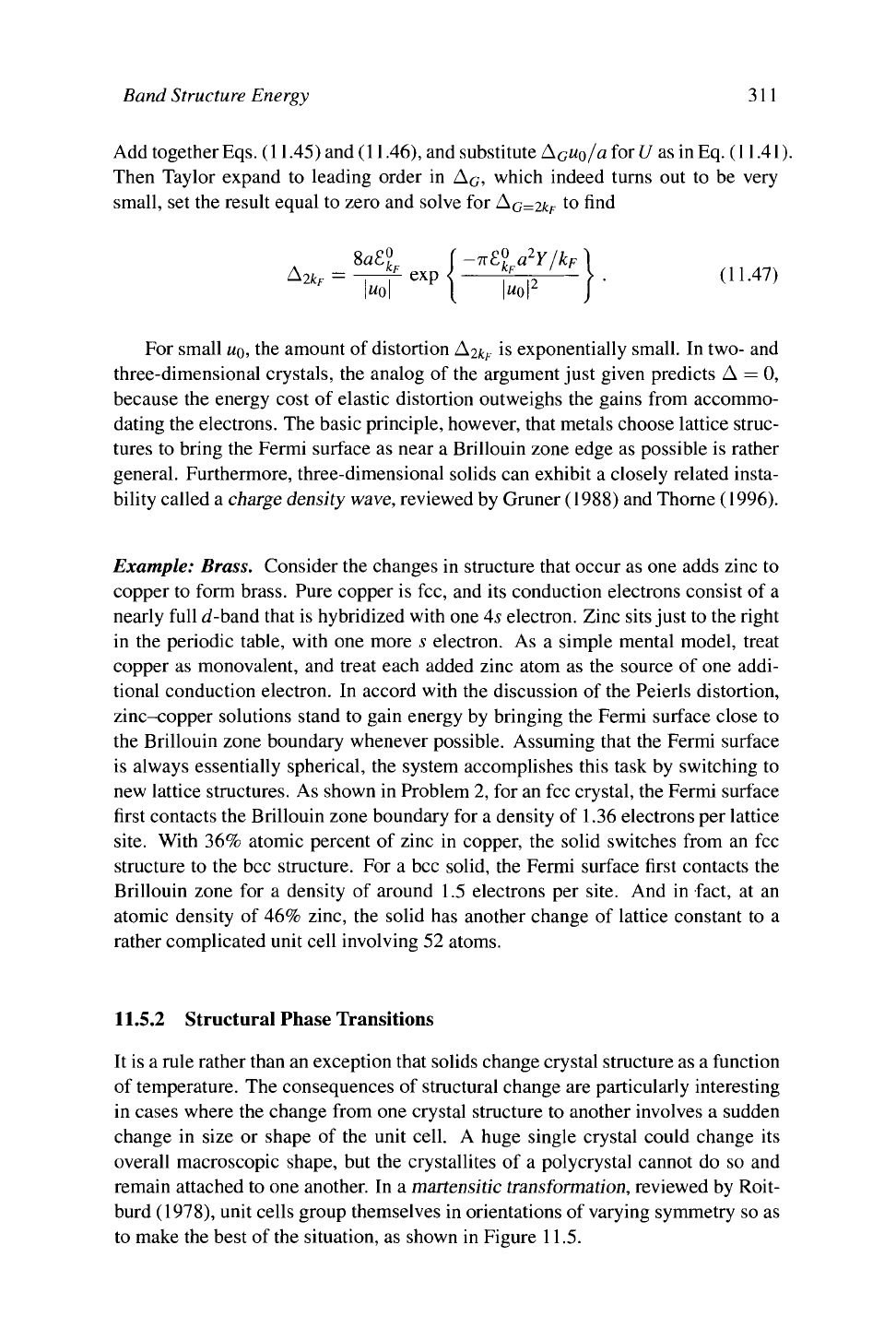
Then Taylor expand to leading order in Ac, which indeed turns out to be very
small, set the result equal to zero and solve for Ac=2k
F
to find
8a£° f -vr£0
a
2
Y/k
F
)
|«o|
[ |«o| J
For small
MO,
the amount of distortion Δ^- is exponentially small. In two- and
three-dimensional crystals, the analog of the argument just given predicts Δ = 0,
because the energy cost of elastic distortion outweighs the gains from accommo-
dating the electrons. The basic principle, however, that metals choose lattice struc-
tures to bring the Fermi surface as near a Brillouin zone edge as possible is rather
general. Furthermore, three-dimensional solids can exhibit a closely related insta-
bility called a
charge
density wave, reviewed by Grüner (1988) and Thorne (1996).
Example: Brass. Consider the changes in structure that occur as one adds zinc to
copper to form brass. Pure copper is fee, and its conduction electrons consist of a
nearly full d-band that is hybridized with one 4s electron. Zinc sits just to the right
in the periodic table, with one more s electron. As a simple mental model, treat
copper as monovalent, and treat each added zinc atom as the source of one addi-
tional conduction electron. In accord with the discussion of the Peierls distortion,
zinc-copper solutions stand to gain energy by bringing the Fermi surface close to
the Brillouin zone boundary whenever possible. Assuming that the Fermi surface
is always essentially spherical, the system accomplishes this task by switching to
new lattice structures. As shown in Problem 2, for an fee crystal, the Fermi surface
first contacts the Brillouin zone boundary for a density of 1.36 electrons per lattice
site.
With 36% atomic percent of zinc in copper, the solid switches from an fee
structure to the bec structure. For a bec solid, the Fermi surface first contacts the
Brillouin zone for a density of around 1.5 electrons per site. And in fact, at an
atomic density of 46% zinc, the solid has another change of lattice constant to a
rather complicated unit cell involving 52 atoms.
11.5.2 Structural Phase Transitions
It is a rule rather than an exception that solids change crystal structure as a function
of temperature. The consequences of structural change are particularly interesting
in cases where the change from one crystal structure to another involves a sudden
change in size or shape of the unit cell. A huge single crystal could change its
overall macroscopic shape, but the crystallites of a polycrystal cannot do so and
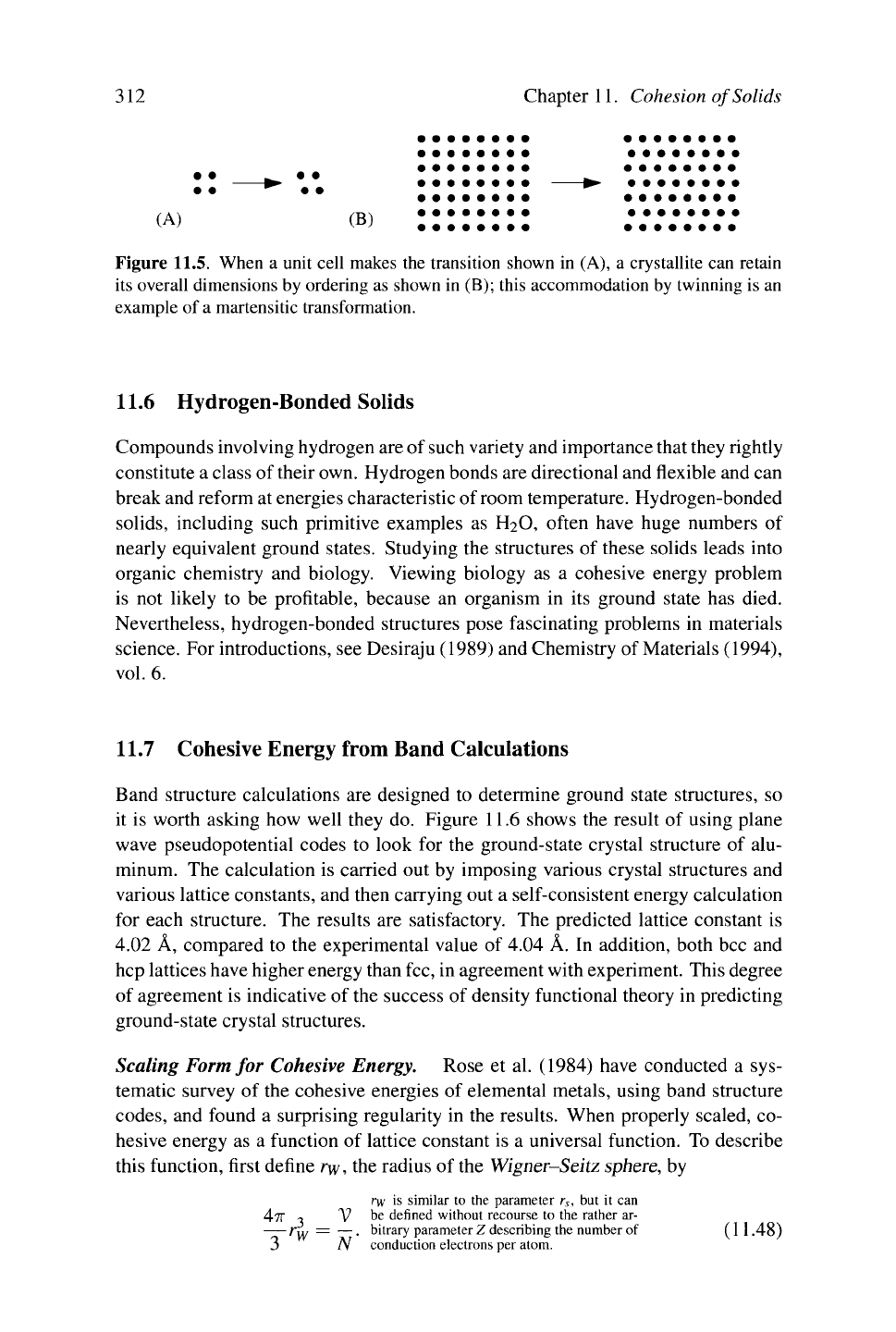
remain attached to one another. In a martensitic
transformation,
reviewed by Roit-
burd (1978), unit cells group themselves in orientations of varying symmetry so as
to make the best of the situation, as shown in Figure 11.5.
312
Chapter 11. Cohesion of Solids
(
A
) (
ß
) ........ ........
Figure 11.5. When a unit cell makes the transition shown in (A), a crystallite can retain
its overall dimensions by ordering as shown in (B); this accommodation by twinning is an
example of
a
martensitic transformation.
11.6 Hydrogen-Bonded Solids
Compounds involving hydrogen are of such variety and importance that they rightly
constitute a class of their own. Hydrogen bonds are directional and flexible and can
break and reform at energies characteristic of room temperature. Hydrogen-bonded
solids, including such primitive examples as H2O, often have huge numbers of
nearly equivalent ground states. Studying the structures of these solids leads into
organic chemistry and biology. Viewing biology as a cohesive energy problem
is not likely to be profitable, because an organism in its ground state has died.
Nevertheless, hydrogen-bonded structures pose fascinating problems in materials
science. For introductions, see Desiraju (1989) and Chemistry of Materials (1994),
vol.
6.
11.7 Cohesive Energy from Band Calculations
Band structure calculations are designed to determine ground state structures, so
it is worth asking how well they do. Figure 11.6 shows the result of using plane
wave pseudopotential codes to look for the ground-state crystal structure of alu-
minum. The calculation is carried out by imposing various crystal structures and
various lattice constants, and then carrying out a self-consistent energy calculation
for each structure. The results are satisfactory. The predicted lattice constant is
4.02 Â, compared to the experimental value of 4.04 Â. In addition, both bcc and
hep lattices have higher energy than fee, in agreement with experiment. This degree
of agreement is indicative of the success of density functional theory in predicting
ground-state crystal structures.
Scaling
Form
for Cohesive Energy. Rose et al. (1984) have conducted a sys-
tematic survey of the cohesive energies of elemental metals, using band structure
codes,
and found a surprising regularity in the results. When properly scaled, co-
hesive energy as a function of lattice constant is a universal function. To describe
this function, first define rw, the radius of the Wigner-Seitz
sphere,
by
rw is similar to the parameter r
s
, but it can
47Γ -> V be defined without recourse to the rather ar-
Tyj =—. bitrary parameter Z describing the number of (11.48)
3 N conduction electrons per atom.