
Marder M.P. Condensed Matter Physics
Подождите немного. Документ загружается.

Cracks
403
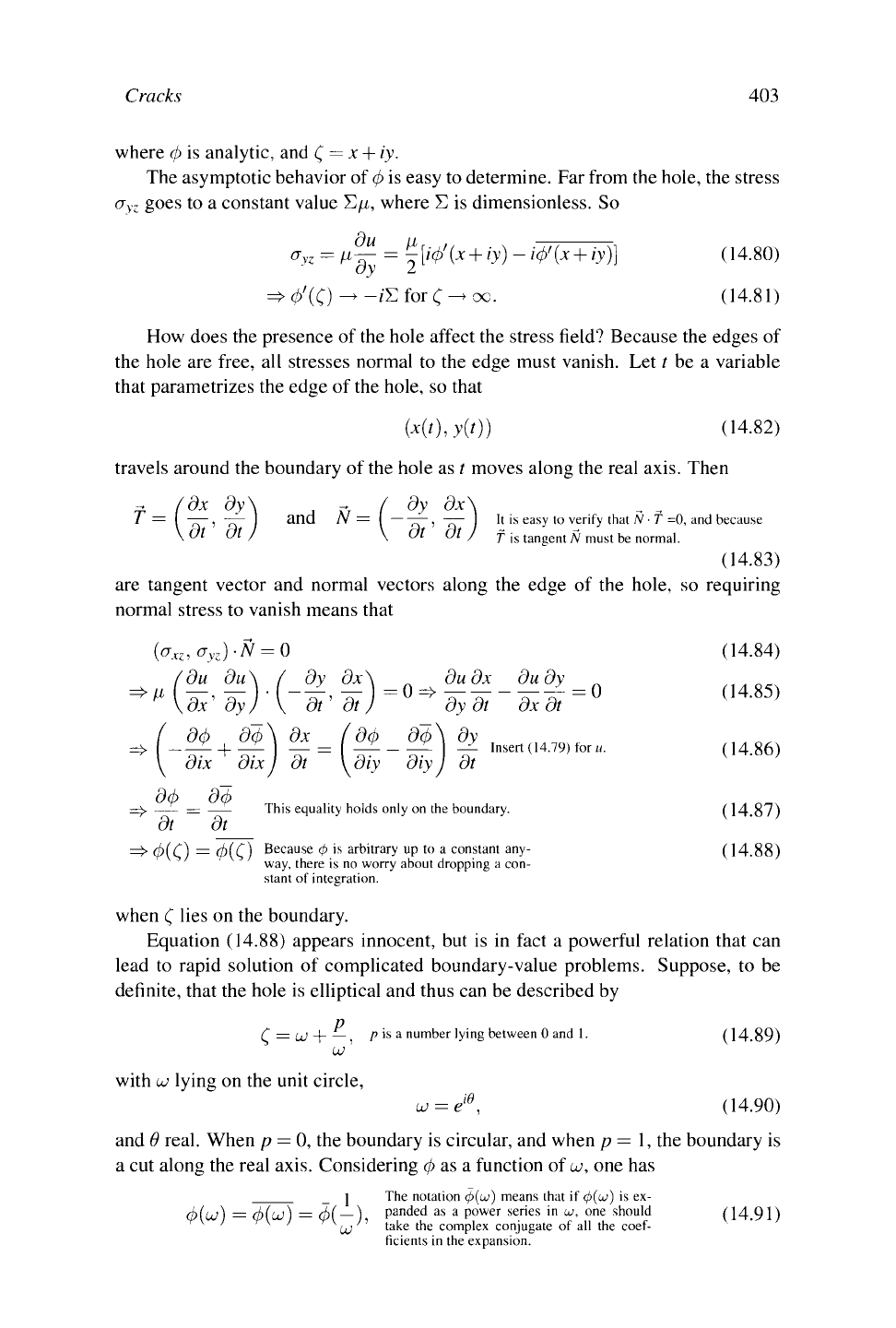
where φ is analytic, and ζ = x + iy.
The asymptotic behavior of φ is easy to determine. Far from the hole, the stress
a
yz
goes to a constant value Σμ, where Σ is dimensionless. So
du μ
σ,
Ζ
= μ~ = ^
[ίφ'(χ
+
iy)
- ίφ'{χ +
iy)]
(14.80)
=>0'(C)->-ffifOrC->oc. (14.81)
How does the presence of the hole affect the stress field? Because the edges of
the hole are free, all stresses normal to the edge must vanish. Let
?
be a variable
that parametrizes the edge of the hole, so that
(x(t),y(t)) (14.82)
travels around the boundary of the hole as t moves along the real axis. Then
dx dy\ -. f dy dx\ _ _
—, — ] and N = I
—
— , — I It is easy to verify that N
■
T =0, and because
dt dt J \ Ot Ot J f
is tangent
fi
must
be „ormai.
(14.83)
are tangent vector and normal vectors along the edge of the hole, so requiring
normal stress to vanish means that
(σ,
ζ
,σ
ν
,)·;ν = 0
(du du\ ( dy dx\ dudx du dy
\dx'
dy
J
V dt' dt J dy dt dx dt
( άφ δφ\ dx ίάφ άφ\ dy
— -J — = —L- L- -L Insert (14.79) for«.
\ dix dix) dt \diy diy
1
dt
θφ dò
—— = —— This equality holds only on the boundary.
dt dt
(14.84)
(14.85)
(14.86)
(14.87)
=> φ(£) = φ(ζ) Because φ is arbitrary up to a constant any- (14.88)
way, there is no worry about dropping a con-
stant of integration.
when ζ lies on the boundary.
Equation (14.88) appears innocent, but is in fact a powerful relation that can
lead to rapid solution of complicated boundary-value problems. Suppose, to be
definite, that the hole is elliptical and thus can be described by
(" = io -\- — p is a number lying between 0 and 1. (14.89)
Lü'
with ω lying on the unit circle,
ω = ε
ίθ
, (14.90)
and
Θ
real. When p = 0, the boundary is circular, and when p= 1, the boundary is
a cut along the real axis. Considering φ as a function of
ω,
one has
_ ] The notation φ(ω) means that if φ(ω) is ex-
φ(ΐθ) = Φ(ί-ϋ) = Φ( ) panded as a power series in ω, one should Π4 91)
CO take the complex conjugate of all the
coef-
ficients in the expansion.
404
Chapter 14. Dislocations and Cracks
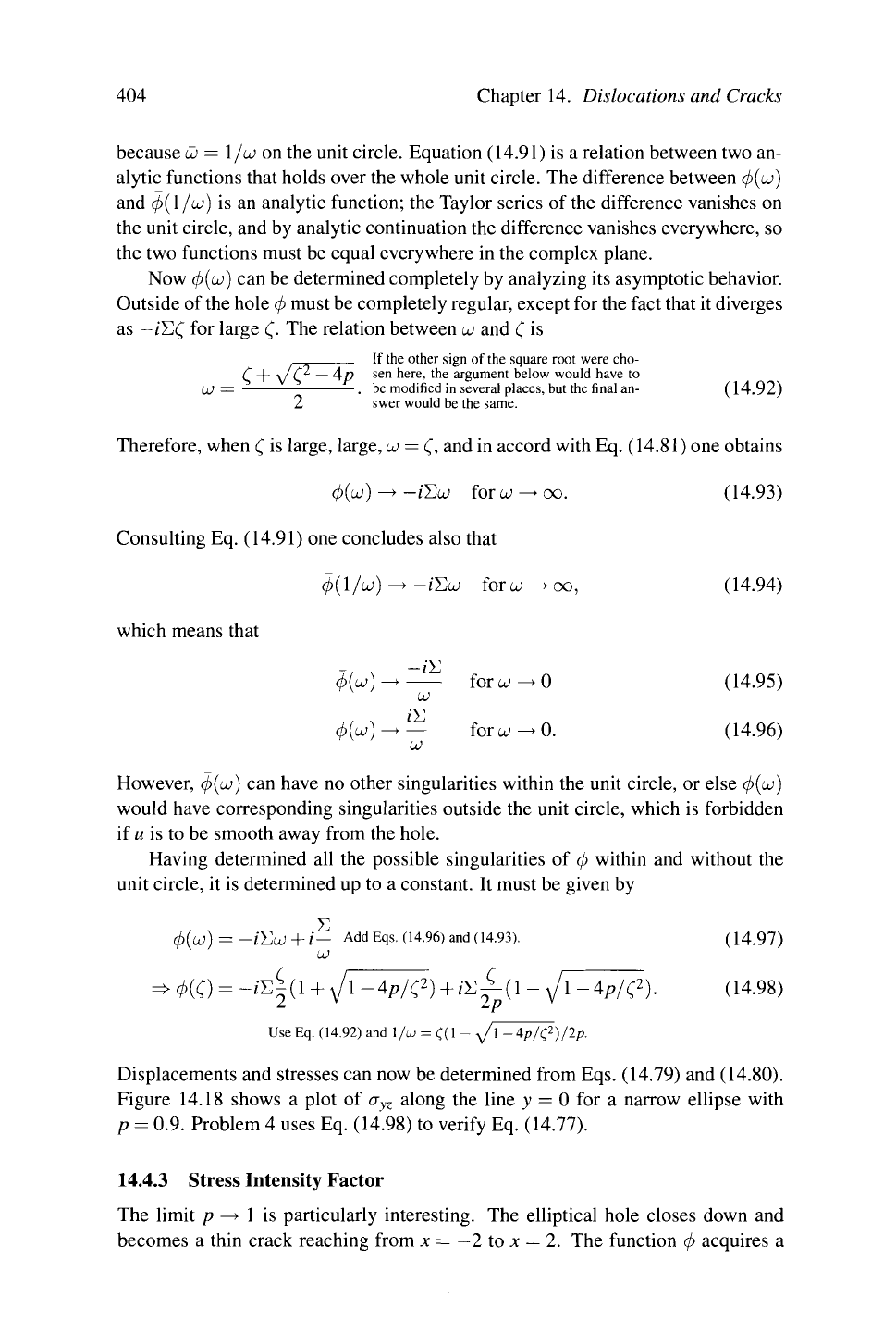
because ώ = Ι/ω on the unit circle. Equation (14.91) is a relation between two an-
alytic functions that holds over the whole unit circle. The difference between φ{ω)
and φ{\/ω) is an analytic function; the Taylor series of the difference vanishes on
the unit circle, and by analytic continuation the difference vanishes everywhere, so
the two functions must be equal everywhere in the complex plane.
Now φ(ω) can be determined completely by analyzing its asymptotic behavior.
Outside of
the
hole φ must be completely regular, except for the fact that it diverges
as — ίΣζ for large ζ. The relation between ω and
ζ
is
If the other sign of the square root were cho-
C
+
v/C
2
—
Ap
sen
here, the argument below would have to
OJ
= .
be modified in several places, but the final
an-
(14.92)
2 swer would be the same.
Therefore, when ζ is large, large, ω = ζ, and in accord with Eq. (14.81) one obtains
φ{ω)
-f
-ίΣω for
ω
-> oo. (14.93)
Consulting Eq. (14.91) one concludes also that
φ{\/ω)^-ίΣω
ΐοτω^οο,
(14.94)
which means that
φ{ω)^
:
^—
foru;->0 (14.95)
φ(ω)^
— forw-^O. (14.96)
ω
However, φ(ω) can have no other singularities within the unit circle, or else φ(ω)
would have corresponding singularities outside the unit circle, which is forbidden
if
u
is to be smooth away from the hole.
Having determined all the possible singularities of φ within and without the
unit circle, it is determined up to a constant. It must be given by
φ(ω)
= -ϊΣω + ΐ—
Add Eqs. (14.96) and (14.93). (14.97)
ω
=>
0(C)
=
-is|(l
+
^/l-4
/
7/C
2
)
+
ffi^(l
-
V/1-4P/C
2
). (14.98)
Use Eq. (14.92) and 1/ω
=
ζ(1
- y/]
-4ρ/ζ
2
)/2ρ.
Displacements and stresses can now be determined from Eqs. (14.79) and (14.80).
Figure 14.18 shows
a
plot of a
yz
along the line
y
= 0 for
a
narrow ellipse with
p = 0.9. Problem 4 uses Eq. (14.98) to verify Eq. (14.77).
14.4.3 Stress Intensity Factor
The limit
p
—>
1 is particularly interesting. The elliptical hole closes down and
becomes a thin crack reaching from x = — 2 to x
—
2. The function φ acquires
a
Cracks
405
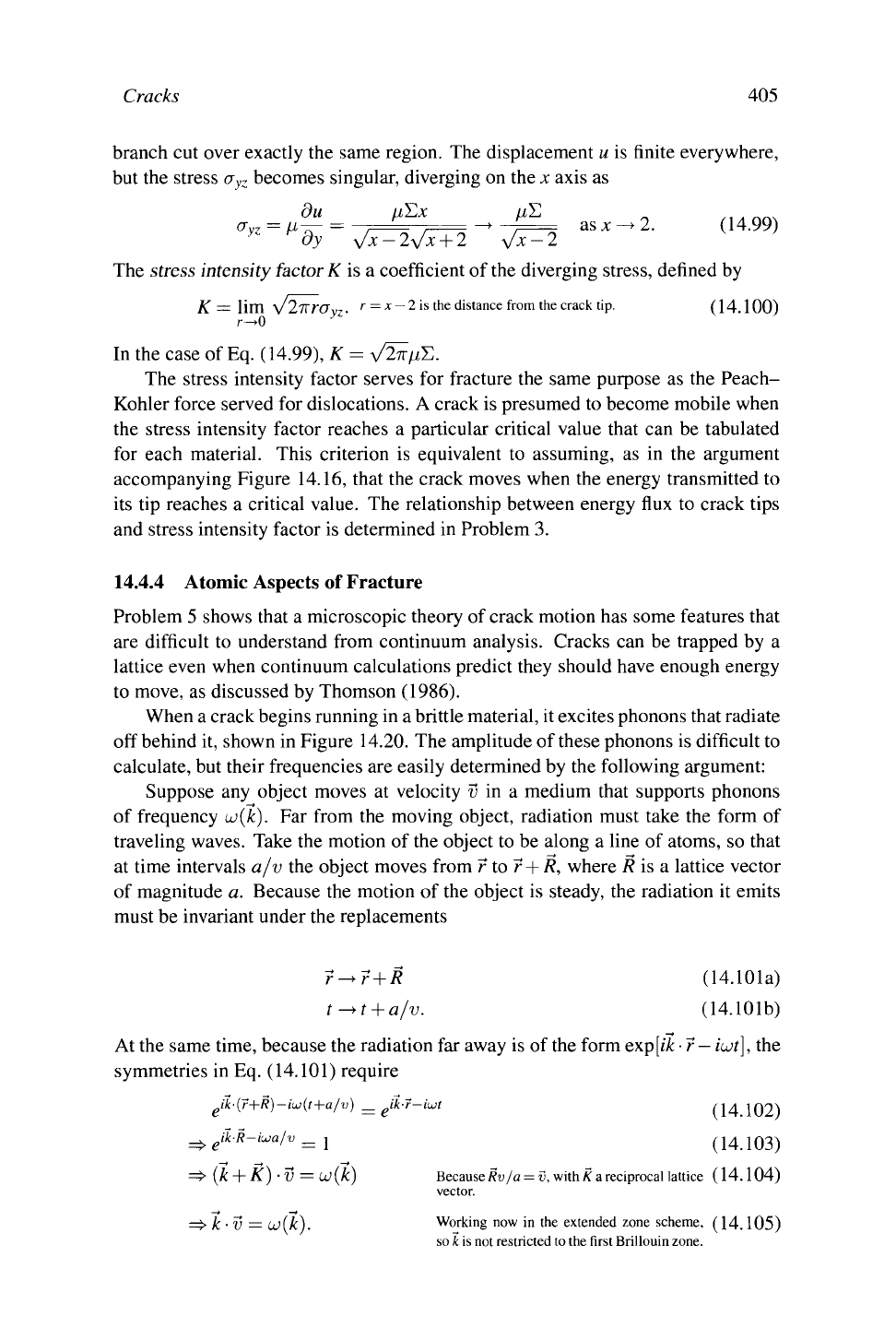
branch cut over exactly the same region. The displacement u is finite everywhere,
but the stress o
yz
becomes singular, diverging on the x axis as
du μΣ,χ μΣ,
'dy ~ yfx-2Λ/Χ + 2 ~* y/x-2
The stress intensity factor K is a coefficient of the diverging stress, defined by
K = lim v2irra
vz
.
r = x
~ 2 is the distance from the crack tip. (14.100)
r—»0
■
yz
= μ— = , \ , _
n
■ -> ]
as*-^2.
(14.99)
In the case of Eq. (14.99), K =
^2-ημΥ,.
The stress intensity factor serves for fracture the same purpose as the Peach-
Kohler force served for dislocations. A crack is presumed to become mobile when
the stress intensity factor reaches a particular critical value that can be tabulated
for each material. This criterion is equivalent to assuming, as in the argument
accompanying Figure 14.16, that the crack moves when the energy transmitted to
its tip reaches a critical value. The relationship between energy flux to crack tips
and stress intensity factor is determined in Problem 3.
14.4.4 Atomic Aspects of Fracture
Problem 5 shows that a microscopic theory of crack motion has some features that
are difficult to understand from continuum analysis. Cracks can be trapped by a
lattice even when continuum calculations predict they should have enough energy
to move, as discussed by Thomson (1986).
When a crack begins running in a brittle material, it excites phonons that radiate
off behind it, shown in Figure 14.20. The amplitude of these phonons is difficult to
calculate, but their frequencies are easily determined by the following argument:
Suppose any object moves at velocity v in a medium that supports phonons
of frequency ω(κ). Far from the moving object, radiation must take the form of
traveling waves. Take the motion of the object to be along a line of atoms, so that
at time intervals a/v the object moves from r to r + R, where R is a lattice vector
of magnitude a. Because the motion of the object is steady, the radiation it emits
must be invariant under the replacements
r^r + R (14.101a)
t->t + a/v. (14.101b)
At the same time, because the radiation far away is of the form exp[ik
■
r
—
ίωί],
the
symmetries in Eq. (14.101) require
e
ik-(r+R)-iui(t+a/v) _
£
ά·7-ίωί (14.102)
^/k-R-iwa/v
= χ
(14.103)
=> (k + K) -V = Uj(k) Because Rv/a = v, with K a reciprocal lattice (14.104)
vector.
=> k · V = U)(k). Working now in the extended zone scheme, (14.105)
so k is not restricted to the first Brillouin zone.
406 Chapter 14. Dislocations and Cracks
4 6
Wave number k
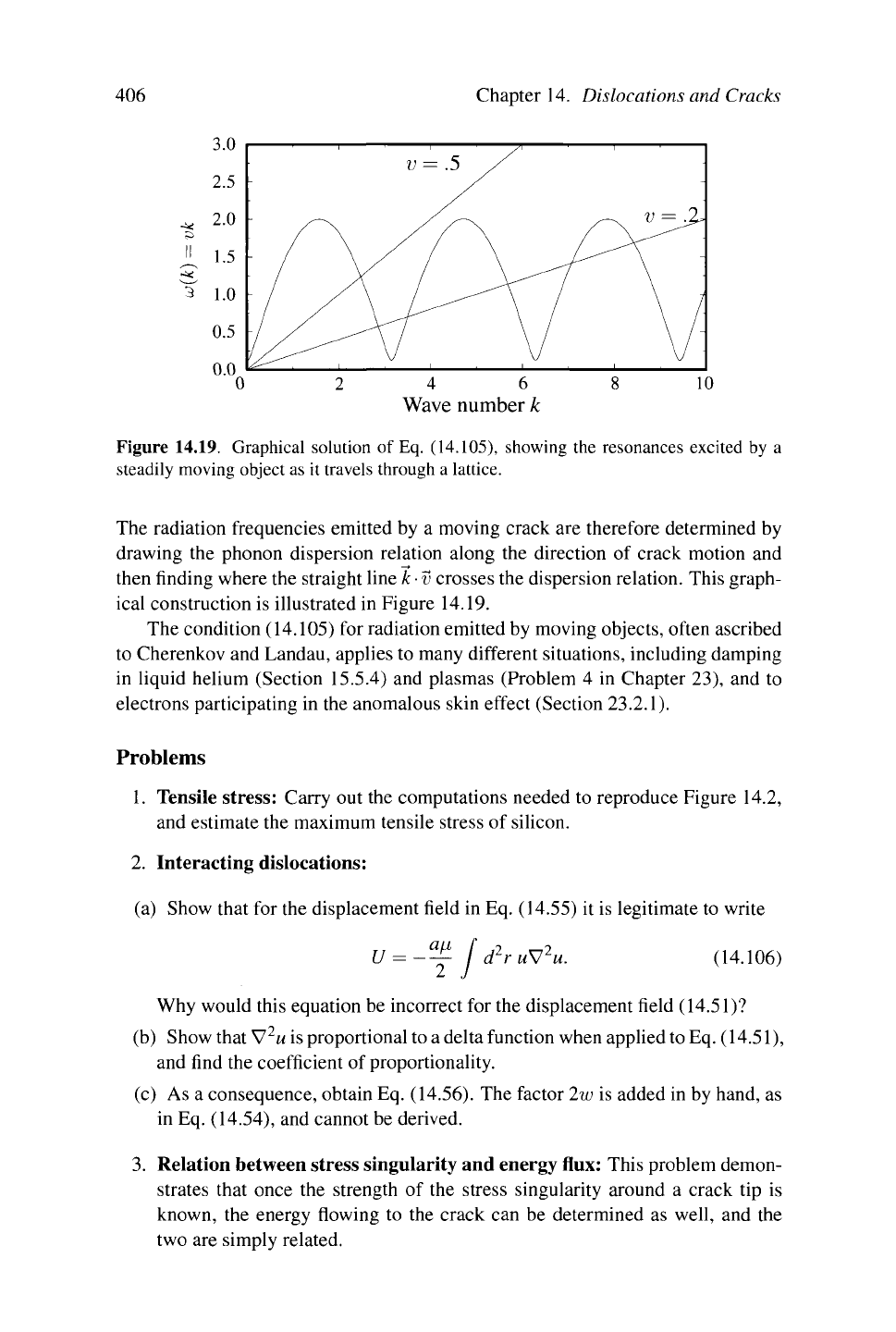
Figure 14.19. Graphical solution of Eq. (14.105), showing the resonances excited by a
steadily moving object as it travels through a lattice.
The radiation frequencies emitted by a moving crack are therefore determined by
drawing the phonon dispersion relation along the direction of crack motion and
then finding where the straight line k
■
v crosses the dispersion relation. This graph-
ical construction is illustrated in Figure 14.19.
The condition (14.105) for radiation emitted by moving objects, often ascribed
to Cherenkov and Landau, applies to many different situations, including damping
in liquid helium (Section 15.5.4) and plasmas (Problem 4 in Chapter 23), and to
electrons participating in the anomalous skin effect (Section 23.2.1).
Problems
1.
Tensile stress: Carry out the computations needed to reproduce Figure 14.2,
and estimate the maximum tensile stress of silicon.
2.
Interacting dislocations:
(a) Show that for the displacement field in Eq. (14.55) it is legitimate to write
υ = -ψ
(d
2
ruV
2
u.
(14.106)
Why would this equation be incorrect for the displacement field (14.51)?
(b) Show that V
2
« is proportional to a delta function when applied to
Eq.
(14.51
),
and find the coefficient of proportionality.
(c) As a consequence, obtain Eq. (14.56). The factor 2w is added in by hand, as
in Eq. (14.54), and cannot be derived.
3.
Relation between stress singularity and energy flux: This problem demon-
strates that once the strength of the stress singularity around a crack tip is
known, the energy flowing to the crack can be determined as well, and the
two are simply related.
Problems 407
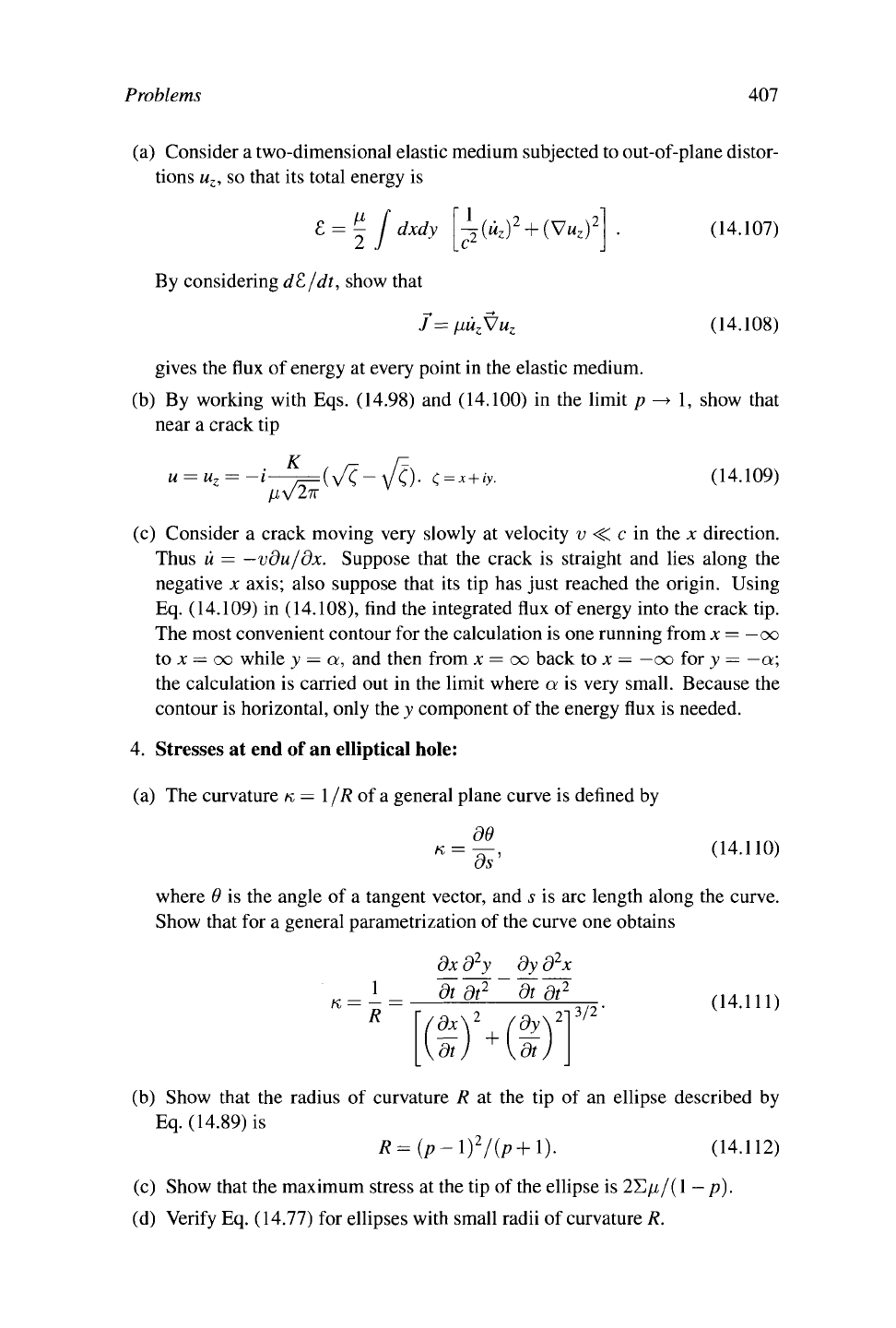
(a) Consider a two-dimensional elastic medium subjected to out-of-plane distor-
tions u
z
, so that its total energy is
£ =
—
/ dxdy
By considering dtjdt, show that
L(ù
z
)
2
+
(vu
z
y
J = ßü
z
Vu
z
gives the flux of energy at every point in the elastic medium.
(b) By working with Eqs. (14.98) and (14.100) in the limit p
near a crack tip
=-'Js^-^
ζ = χ + ίγ.
(14.107)
(14.108)
1,
show that
(14.109)
(c) Consider a crack moving very slowly at velocity v <C c in the x direction.
Thus ù = —vdu/dx. Suppose that the crack is straight and lies along the
negative x axis; also suppose that its tip has just reached the origin. Using
Eq. (14.109) in (14.108), find the integrated flux of energy into the crack tip.
The most convenient contour for the calculation is one running from x = — oc
to x = oo while y
—
a, and then from x = oo back to x
—
— oo for y
—
—a;
the calculation is carried out in the limit where a is very small. Because the
contour is horizontal, only the y component of the energy flux is needed.
4.
Stresses at end of an elliptical hole:
(a) The curvature κ—
1
/R of a general plane curve is defined by
00
K =
ds'
(14.110)
where
Θ
is the angle of a tangent vector, and s is arc length along the curve.
Show that for a general parametrization of the curve one obtains
K
■
1
R
dx d
2
y dy d
2
x
'dt~dt
I
~~dt~dt
i
[d)
,+
(i)l
3/2
(14.111)
(b) Show that the radius of curvature R at the tip of an ellipse described by
Eq. (14.89) is
R={
P
-\y/{p+\).
(14.112)
(c) Show that the maximum stress at the tip of the ellipse is 2Σμ/(
1 —
p).
(d) Verify Eq. (14.77) for ellipses with small radii of curvature R.
408
Chapter 14. Dislocations and Cracks
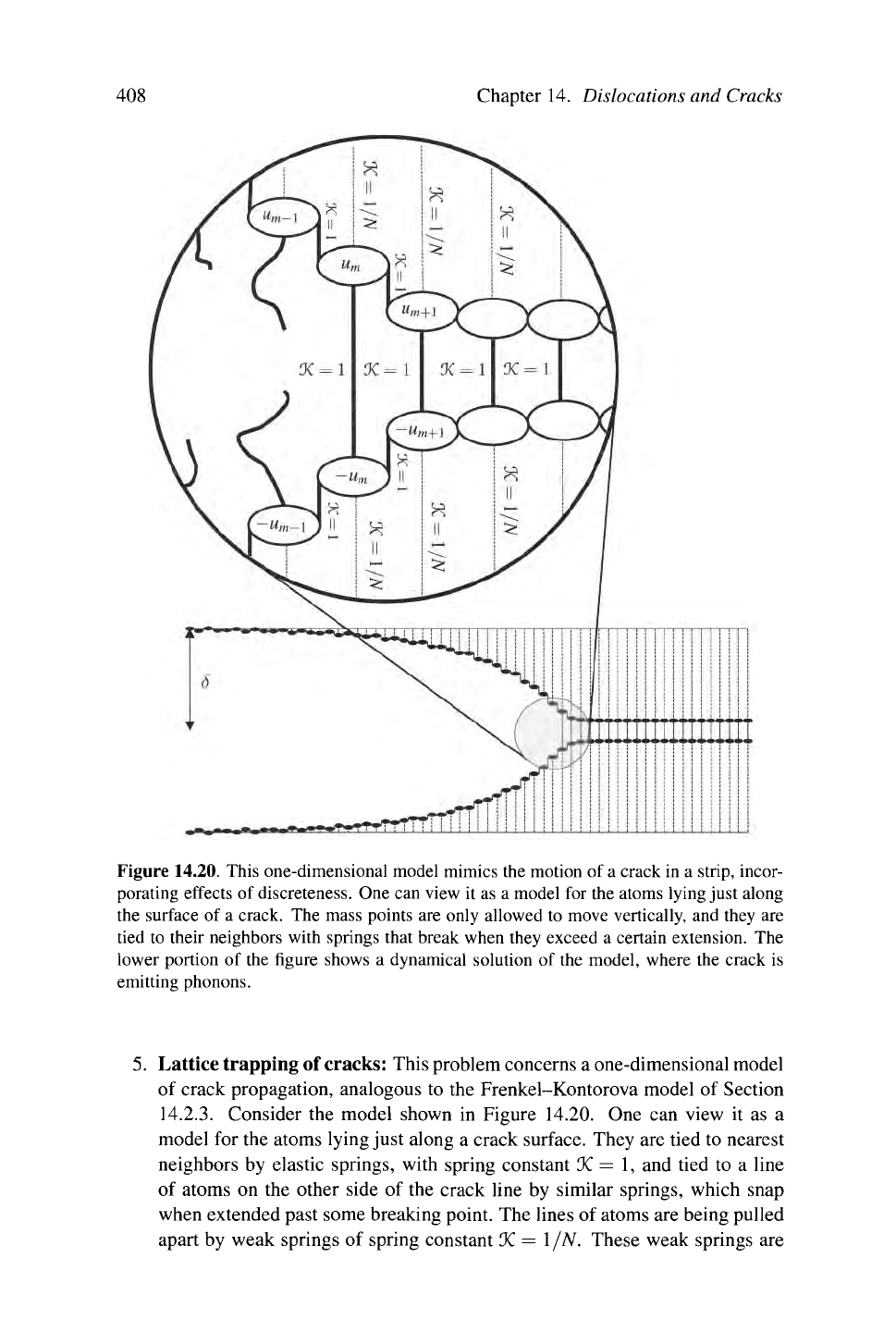
Figure 14.20. This one-dimensional model mimics the motion of a crack in a strip, incor-
porating effects of discreteness. One can view it as a model for the atoms lying just along
the surface of a crack. The mass points are only allowed to move vertically, and they are
tied to their neighbors with springs that break when they exceed a certain extension. The
lower portion of the figure shows a dynamical solution of the model, where the crack is
emitting phonons.
5. Lattice trapping of
cracks:
This problem concerns a one-dimensional model
of crack propagation, analogous to the Frenkel-Kontorova model of Section
14.2.3.
Consider the model shown in Figure 14.20. One can view it as a
model for the atoms lying just along a crack surface. They are tied to nearest
neighbors by elastic springs, with spring constant % = 1, and tied to a line
of atoms on the other side of the crack line by similar springs, which snap
when extended past some breaking point. The lines of atoms are being pulled
apart by weak springs of spring constant X =
1
/N. These weak springs are
References 409
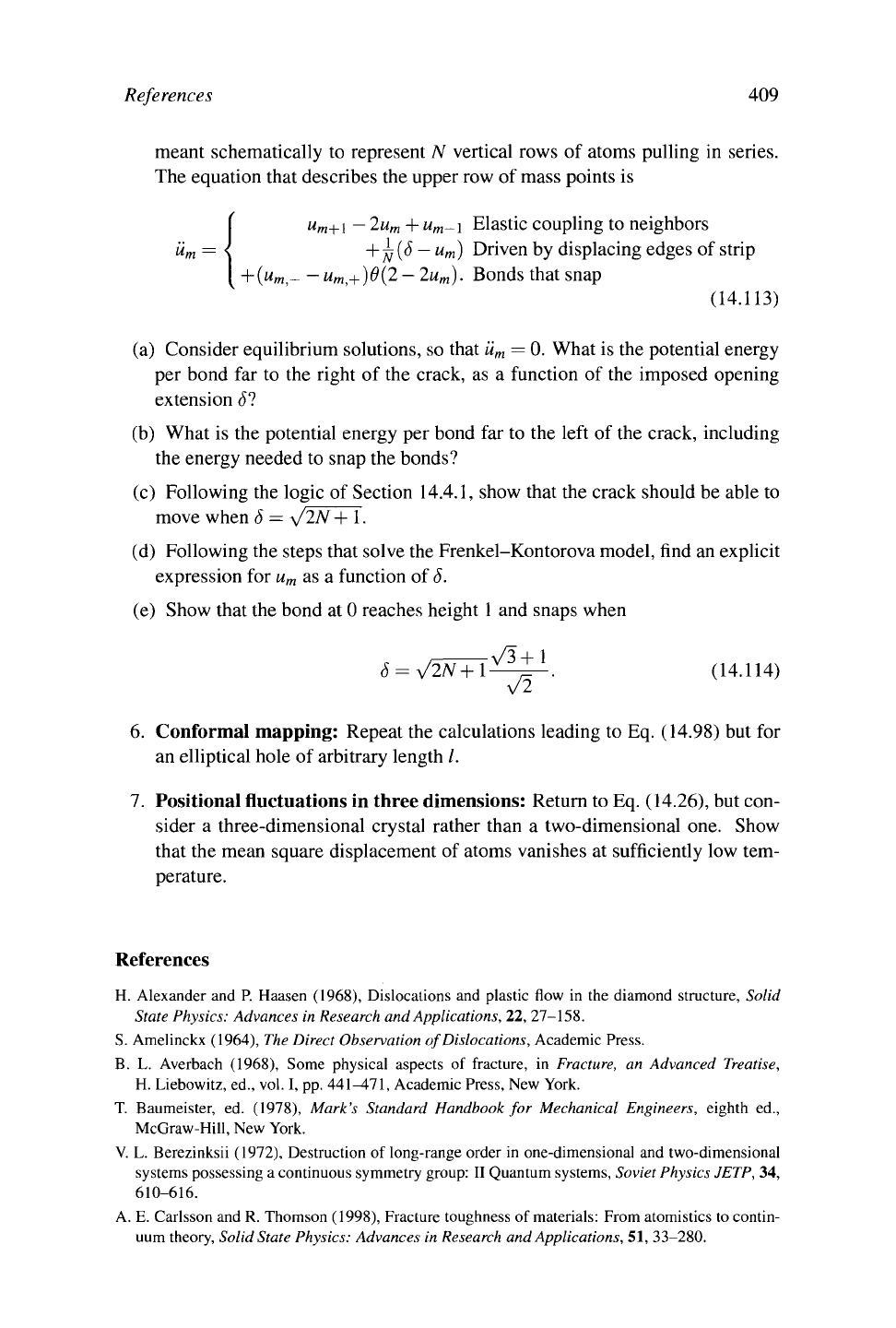
meant schematically to represent N vertical rows of atoms pulling in series.
The equation that describes the upper row of mass points is
u
m+
\
—
2u
m
+ u
m
~\ Elastic coupling to neighbors
+jj(S
—
u
m
) Driven by dispk
+(«
m>
-
—
«
m>+
)ö(2
—
2u
m
). Bonds that snap
+jj
(δ —
u
m
) Driven by displacing edges of strip
(14.113)
(a) Consider equilibrium solutions, so that
U
m
= 0. What is the potential energy
per bond far to the right of the crack, as a function of the imposed opening
extension
<5?
(b) What is the potential energy per bond far to the left of the crack, including
the energy needed to snap the bonds?
(c) Following the logic of Section
14.4.1,
show that the crack should be able to
move when δ
—
^2N + 1.
(d) Following the steps that solve the Frenkel-Kontorova model, find an explicit
expression for function of δ.
(e) Show that the bond at 0 reaches height
1
and snaps when
-N/3
+ 1
S = V2N+l r- . (14.114)
V2
6. Conformai mapping: Repeat the calculations leading to Eq. (14.98) but for
an elliptical hole of arbitrary length /.
7.
Positional fluctuations in three dimensions: Return to Eq. (14.26), but con-
sider a three-dimensional crystal rather than a two-dimensional one. Show
that the mean square displacement of atoms vanishes at sufficiently low tem-
perature.
References
H. Alexander and P. Haasen (1968), Dislocations and plastic flow in the diamond structure, Solid
State Physics: Advances in Research and Applications, 22, 27-158.
S. Amelinckx (1964), The Direct Observation of Dislocations, Academic Press.
B.
L. Averbach (1968), Some physical aspects of fracture, in Fracture, an Advanced Treatise,
H. Liebowitz, ed., vol. I, pp.
441^71,
Academic Press, New York.
T. Baumeister, ed. (1978), Mark's Standard Handbook for Mechanical Engineers, eighth ed.,
McGraw-Hill, New York.
V. L. Berezinksii (1972), Destruction of long-range order in one-dimensional and two-dimensional
systems possessing a continuous symmetry group: II Quantum systems, Soviet Physics JETP, 34,
610-616.
A. E. Carlsson and R. Thomson (1998), Fracture toughness of materials: From atomistics to contin-
uum theory, Solid State Physics: Advances in Research and Applications, 51, 33-280.
410
Chapter 14. Dislocations and Cracks
A. B. Cullis, N. G. Chew, and J. L. Hutchison (1985), Formation and elimination of surface ion
milling defects in cadmium telluride, zinc sulphide, and zinc selenide, Ultramicroscopy, 17, 203-
212.
A. G. Evans and F. W. Zok (1994), The physics and mechanics of brittle matrix composites, Solid
State Physics: Advances in Research and Applications, 47, 177-286.
C. Frank (1985), Some personal reminiscences of the early days of crystal dislocations, in Disloca-
tions and Properties of Real Materials, Institute of Metals, Bristol.
J. Frenkel and
T.
Kontorova (1938), On the theory of plastic deformation and twinning, Physikalische
Zeitschrift der Sowjetunion, 13, 1-10.
J. Friedet (1964), Dislocations, Addison Wesley, Reading, MA.
J. E. Gordon
(
1976),
The New Science of Strong Materials or Why
You
Don't Fall through the Floor,
2nd ed., Princeton University Press, Princeton, New Jersey.
I. S. Grigoriev and E. Z. Meilkhov, eds. (1997), Handbook of Physical Quantities, CRC Press, Boca
Raton, FL.
J. P. Hirth and J. Lothe (1982), Theory of Dislocations, 2nd ed., John Wiley and Sons, New York.
J. M. Kosterlitz and D. J. Thouless (1973), Ordering, metastability and phase transitions in two-
dimensional systems, Journal of Physics C, 6, 1181-1203.
L. D. Landau (1937), On the theory of phase transitions, Physikalische Zeitschrift der Sowjetunion,
11,
26 and 545. In German. Translated in Landau (1965), p. 193-216
L. D. Landau (1965), Collected Papers of L D Landau, D. ter Haar, ed., Gordon and Breach, New
York.
R. M. Lynden-Bell and K. H. Michel (1994), Translation-rotation coupling, phase transitions and
elastic phenomena in orientationally disordered crystals, Reviews of Modern Physics, 66, 721-
762.
M. Marder and J. Fineberg (1996), How things break, Physics
Today,
49(9), 24-29.
N.
D. Mermin (1968), Crystalline order in two dimensions, Physical Review, 176, 250-254.
N.
D. Mermin (1979), The topologica! theory of defects in ordered media, Reviews of Modern
Physics, 51, 591-648.
N.
D. Mermin and H. Wagner (1966), Absence of ferromagnetism or antiferromagnetism in one- or
two-dimensional isotropie Heisenberg models, Physical Review Letters, 17, 1133-1136.
P.
Minnhagen (1987), The two-dimensional Coulomb gas, vortex unbinding and superfluid-
superconducting films, Reviews of Modern Physics, 59, 1001-1066.
C. A. Murray and D. G. Grier (1996), Video microscopy of monodisperse colloidal systems, Annual
Reviews of Physical Chemistry, 47, 421^452.
D.
R. Nelson and B. I. Halperin (1979), Dislocation-mediated melting in two dimensions, Physical
Review B, 19, 2457-2484.
E. Orowan (1934), On crystal plasticity, Zeitschrift für
Physik,
89, 605-659. in German.
M. Peach and J. S. Köhler (1950), The forces exerted on dislocations and the stress fields produced
by them, Physical Review, 80, 436-439.
R. E. Peierls (1934), Remarks on transformation temperatures, Helvetica Physica Ada, 7, Supple-
ment II,
81-83.
In German.
R. Pindak, D. E. Moncton, S. C. Davey, and J. W. Goodby (1981), X-ray observation of a stacked
hexatic liquid-crystal B phase, Physical Review Letters, 46, 1135-1138.
M. Polanyi (1934), On a type of dislocation that makes metals plastic, Zeitschrift für
Physik,
89,
660-666. In German.
A. K. Sood (1991), Structural ordering in colloidal suspensions, Solid State Physics: Advances in
Research and Applications, 45, 1-73.
K. Strandburg (1992), Bond-Orientational Order in Condensed Matter Systems, Springer-Verlag,
New York.
References 411
G. I. Taylor (1934), The mechanism of plastic deformation of crystals., Proceedings of the Royal
Society of London, A145, 362-404. Parts I and II
R. Thomson (1986), The physics of fracture, Solid State Physics: Advances in Research and Appli-
cations, 39,
1-129.
E. Wigner (1936), On the structure of solid bodies, Scientific Monthly, 42, 40-46.
A. P. Young (1979), Melting and the vector coulomb gas in two dimensions, Physical Review B, 19,
1855-1866.