
Marder M.P. Condensed Matter Physics
Подождите немного. Документ загружается.

15.
Fluid Mechanics
15.1 Introduction
Raise the temperature
of
almost any solid sufficiently, and
it
melts, passing into
a
liquid state. The transition
is
dramatic because
of
the change
in
mechanical prop-
erties.
From
a
structural point
of
view, the change
in
the solid
at
the the transition
point
is
the loss
of
long-range order, but there
is
normally no need
to
set up
a
neu-
tron scattering experiment
in
order
to
detect melting. Liquids flow
and
solids
do
not.
15.2 Newtonian Fluids
15.2.1 Euler's Equation
In
a
hydrodynamic description
of a
fluid,
one
specifies
a
velocity vector
at
every
point
in
space. To obtain
an
equation
of
motion,
it is
easiest
to
begin
by
adopting
a reference frame moving with
a
small volume
dV of
fluid.
If fdV is
the net force
acting upon this section
of
fluid,
and p its
mass density, then
the
acceleration
of
the small volume will be given by
f/p.
Now move back to the stationary reference
frame.
If
the velocity
of
the fluid
is
described by
v(r, t) at
time
/,
then
a
short time
dt later
it
will
be
described by
v(r + vdt,t+dt)=v(r,t)+f(7,t)dt/p The
fluid
now at r
+
vdt was at? (15.1)
a time
dt
ago.
=φ.
1-
fy . VÌV = —.
Expand
to
first ordering/. (15.2)
dt
p
The pressure
in a
fluid
is
defined
as the
force
per
unit area across
any
face
one
imagines inscribing within
it.
Therefore, the force
/
acting
on a
small volume
of
fluid may
be
identified with —VP, the gradient
of
the pressure, and Eq. (15.2)
can
be rewritten
as
Euler's equation
dv
- VP
^-
+
(v-V)v +
— =
0. (15.3)
ot
p
The density
p of
a fluid does not have to be constant, but
it
must obey the equation
of continuity
——
=
—V ·
OU. This general statement of conservation of
mass
(15.4)
Qt first appeared
as
Eq. (5.25).
413
Condensed Matter
Physics,
Second Edition
by Michael P. Marder
Copyright © 2010 John Wiley & Sons, Inc.
414 Chapter 15. Fluid Mechanics
Equation (15.3) can be rewritten in the form of a continuity equation for the con-
servation of momentum, so that the time rate of change of momentum equals the
divergence of a momentum flux. The manipulations are simplest if one moves to a
component notation, rewriting Eq. (15.3) as
dpv
a
dp v^ 9 d „
,.,..+.
dt dt ^
H
dr
ß
dr
a
Ci OD (1 Ci Ci
=
X
+
E^(m+V(·
(15.7)
Momentum in a small region changes because of two additive contributions: One
is from forces applied to the region, and the other is from fluxes of neighboring
fluid into the region. The fluid stress tensor σ is defined by
σ
α
β = -ρν
α
υ
β
-
δ
αβ
Ρ,
(15.8)
leading Euler's equation to take the form
dpVr, v-^ d
-JL-^L = )T
—-σ
α0
.
Compare with Eq. (12.35). (15.9)
dt ^ dr
ß
Incompressible Fluids. In many liquids, such as water, the change of pressure
needed to produce any appreciable change in density is larger than readily occurs
even in turbulent flows. In this case, the fluid is best approximated as incompress-
ible, the equation of continuity Eq. (15.4) becomes
V-w = 0, (15.10)
and the pressure P must be determined by the condition that the velocity v contin-
ually obey Eq. (15.10) while evolving according to Eq. (15.7).
The stress tensor in Eq. (15.8) has two physical interpretations. On the one
hand, Eq. (15.9) is in the form of a continuity equation, although missing a minus
sign that might be expected on the right-hand side, so σ
α
β gives the flux of mo-
mentum p
a
in the direction — r
ß
. Sometimes the tensor n
a/
g = — σ
α
β is defined so
as to alter this minus sign convention. The motivation for the sign convention of
Eq. (15.9) is to make it identical to the equation of linear elasticity in Eq. (12.35),
and corresponding to the sketch in Figure 12.3. Thus σ
α
β can also be interpreted
as the force along a per area exerted by material outside upon a fluid region of
interest.
Apart from the superfluids described in Section 15.5, no real liquid comes ter-
ribly close to obeying Euler's equation Eq. (15.7). A fluid obeying Euler's equation
conserves energy in the flow, and a swirl of liquid once started never decays. Real
fluids have dissipation and behave quite differently. The mathematical properties of
Newtonian Fluids
415
Euler's equation are uncertain. Despite tremendous effort, it is not known whether
nonsingular initial conditions remain nonsingular for all times, or whether flow can
concentrate into vortices whose rotation rate becomes infinite at some time, after
which the equations break down.
15.2.2 Navier-Stokes Equation
The correction of Euler's equation to allow for dissipation can take place in two
ways.
It can be done by considering the statistical mechanics of fluids and gases,
or through phenomenological arguments. In either event, the process is greatly
aided by having some idea of the form the theory should take.
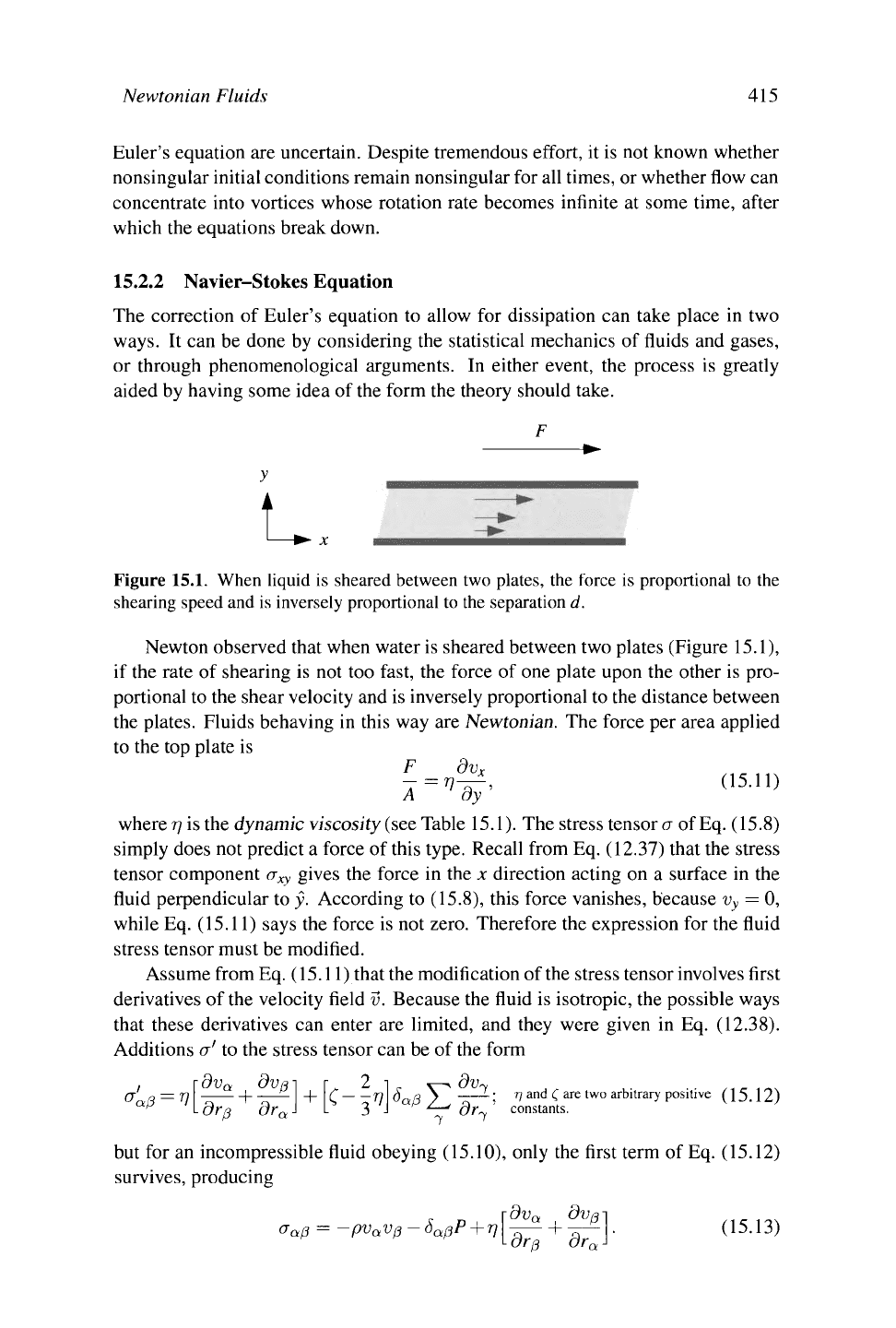
L
Figure 15.1. When liquid is sheared between two plates, the force is proportional to the
shearing speed and is inversely proportional to the separation d.
Newton observed that when water is sheared between two plates (Figure 15.1),
if the rate of shearing is not too fast, the force of one plate upon the other is pro-
portional to the shear velocity and is inversely proportional to the distance between
the plates. Fluids behaving in this way are Newtonian. The force per area applied
to the top plate is
where η is the dynamic viscosity
(see
Table 15.1). The stress tensor σ of
Eq.
(15.8)
simply does not predict a force of this type. Recall from Eq. (12.37) that the stress
tensor component σ^ gives the force in the x direction acting on a surface in the
fluid perpendicular to y. According to (15.8), this force vanishes, because v
y
= 0,
while Eq. (15.11) says the force is not zero. Therefore the expression for the fluid
stress tensor must be modified.
Assume from Eq. (15.11) that the modification of the stress tensor involves first
derivatives of the velocity field v. Because the fluid is isotropie, the possible ways
that these derivatives can enter are limited, and they were given in Eq. (12.38).
Additions σ' to the stress tensor can be of the form
σ
'αβ = ν
9υ
α
dv
0
dr
ß
dr
0
+
2
dv-,
C 77 δ
α
β } -;
?7
and
Ç
are two arbitrary positive (15.12)
1 -<-—' Qf ' constants.
7
'Ί
but for an incompressible fluid obeying (15.10), only the first term of Eq. (15.12)
survives, producing
σ
α
β = -ρν
α
υβ-ο
α
βΡ + ηγ—
Γ
+ —
Γ
γ (15.13)
416
Chapter 15. Fluid Mechanics
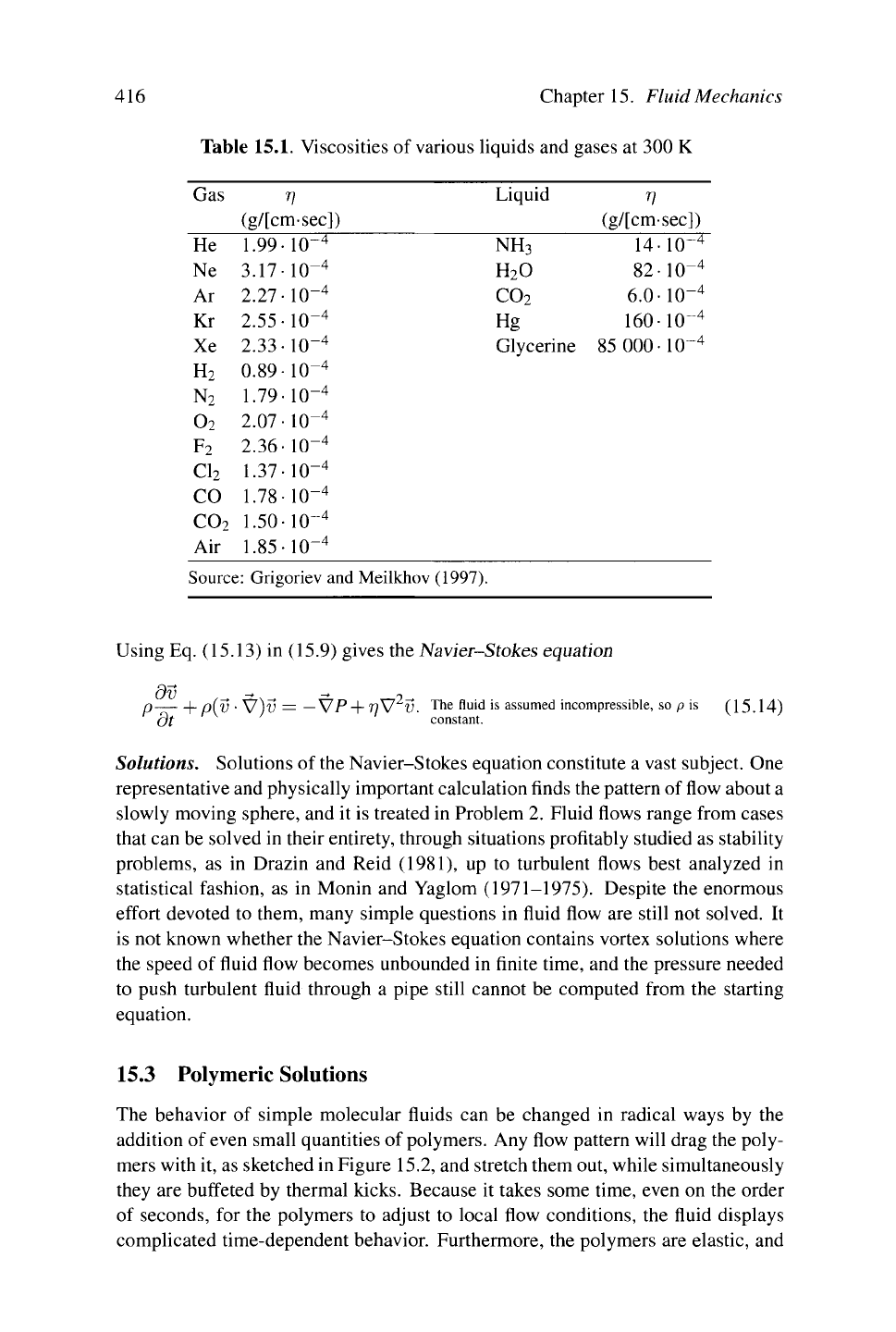
Table 15.1. Viscosities of various liquids and gases at 300 K
Gas
He
Ne
Ar
Kr
Xe
η
(g/[cm-sec])
1.99 ·10~
4
3.17
2.27
2.55
2.33
io-
4
IO"
4
IO"
4
IO"
4
Liquid
NH
3
H
2
0
co
2
Hg
Glycerine
η
(g/[cmsec])
14·10~
4
82·IO"
4
6.0· IO"
4
160-IO"
4
85 000·IO'
4
0
0"
0"
0"
0
n-
-4
-4
-4
-4
-4
Source: Grigoriev and Meilkhov (1997).
Using Eq. (15.13) in (15.9) gives the Navier-Stokes equation
n \- p(v · Vìu =
—
VP + 77V V. The fluid is assumed incompressible, so p is (15.14)
dt constant.
Solutions. Solutions of the Navier-Stokes equation constitute a vast subject. One
representative and physically important calculation finds the pattern of flow about a
slowly moving sphere, and it is treated in Problem 2. Fluid flows range from cases
that can be solved in their entirety, through situations profitably studied as stability
problems, as in Drazin and Reid (1981), up to turbulent flows best analyzed in
statistical fashion, as in Monin and Yaglom (1971-1975). Despite the enormous
effort devoted to them, many simple questions in fluid flow are still not solved. It
is not known whether the Navier-Stokes equation contains vortex solutions where
the speed of fluid flow becomes unbounded in finite time, and the pressure needed
to push turbulent fluid through a pipe still cannot be computed from the starting
equation.
15.3 Polymeric Solutions
The behavior of simple molecular fluids can be changed in radical ways by the
addition of even small quantities of
polymers.
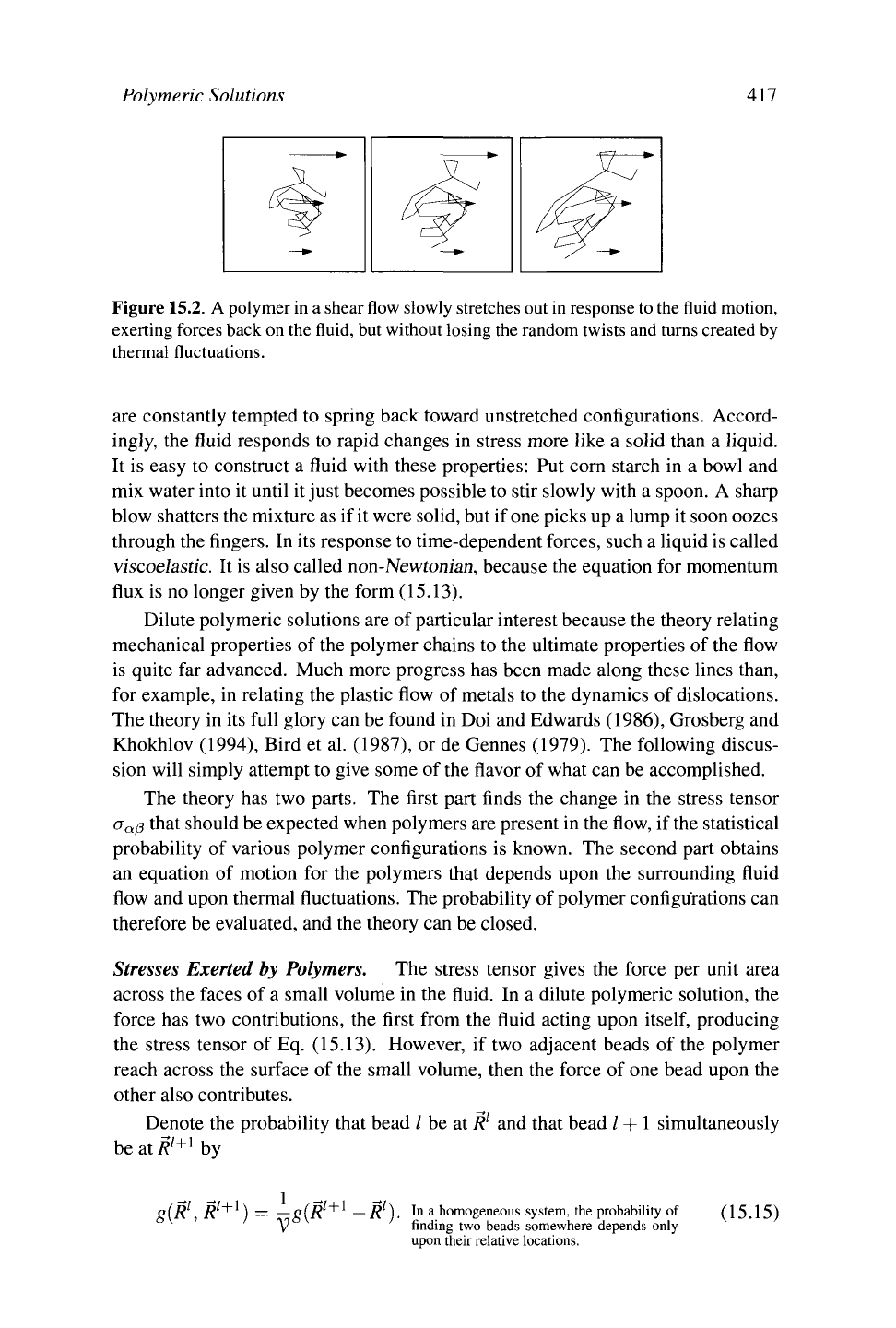
Any flow pattern will drag the poly-
mers with it, as sketched in Figure 15.2, and stretch them out, while simultaneously
they are buffeted by thermal kicks. Because it takes some time, even on the order
of seconds, for the polymers to adjust to local flow conditions, the fluid displays
complicated time-dependent behavior. Furthermore, the polymers are elastic, and
Polymeric Solutions All
Figure 15.2.
A
polymer
in
a shear
flow
slowly stretches out
in
response to the
fluid
motion,
exerting forces back on the
fluid,
but without losing the random twists and turns created by
thermal fluctuations.
are constantly tempted to spring back toward unstretched configurations. Accord-
ingly, the fluid responds to rapid changes in stress more like a solid than a liquid.
It is easy to construct a fluid with these properties: Put corn starch in a bowl and
mix water into it until it just becomes possible to stir slowly with a spoon. A sharp
blow shatters the mixture as if it were solid, but if
one
picks up a lump it soon oozes
through the fingers. In its response to time-dependent forces, such a liquid is called
viscoelastic. It is also called non-Newtonian, because the equation for momentum
flux is no longer given by the form (15.13).
Dilute polymeric solutions are of particular interest because the theory relating
mechanical properties of the polymer chains to the ultimate properties of the flow
is quite far advanced. Much more progress has been made along these lines than,
for example, in relating the plastic flow of metals to the dynamics of dislocations.
The theory in its full glory can be found in Doi and Edwards (1986), Grosberg and
Khokhlov (1994), Bird et al. (1987), or de Gennes (1979). The following discus-
sion will simply attempt to give some of the flavor of what can be accomplished.
The theory has two parts. The first part finds the change in the stress tensor
σ
α
β that should be expected when polymers are present in the flow, if the statistical
probability of various polymer configurations is known. The second part obtains
an equation of motion for the polymers that depends upon the surrounding fluid
flow and upon thermal fluctuations. The probability of polymer configurations can
therefore be evaluated, and the theory can be closed.
Stresses Exerted by Polymers. The stress tensor gives the force per unit area
across the faces of a small volume in the fluid. In a dilute polymeric solution, the
force has two contributions, the first from the fluid acting upon
itself,
producing
the stress tensor of Eq. (15.13). However, if two adjacent beads of the polymer
reach across the surface of the small volume, then the force of one bead upon the
other also contributes.
Denote the probability that bead / be at R
l
and that bead / +
1
simultaneously
beatfl
/+1
by
Q(R
/?'+) = —g(R —R). In a homogeneous system, the probability of (15.15)
V finding two beads somewhere depends only
upon their relative locations.
418 Chapter 15. Fluid Mechanics
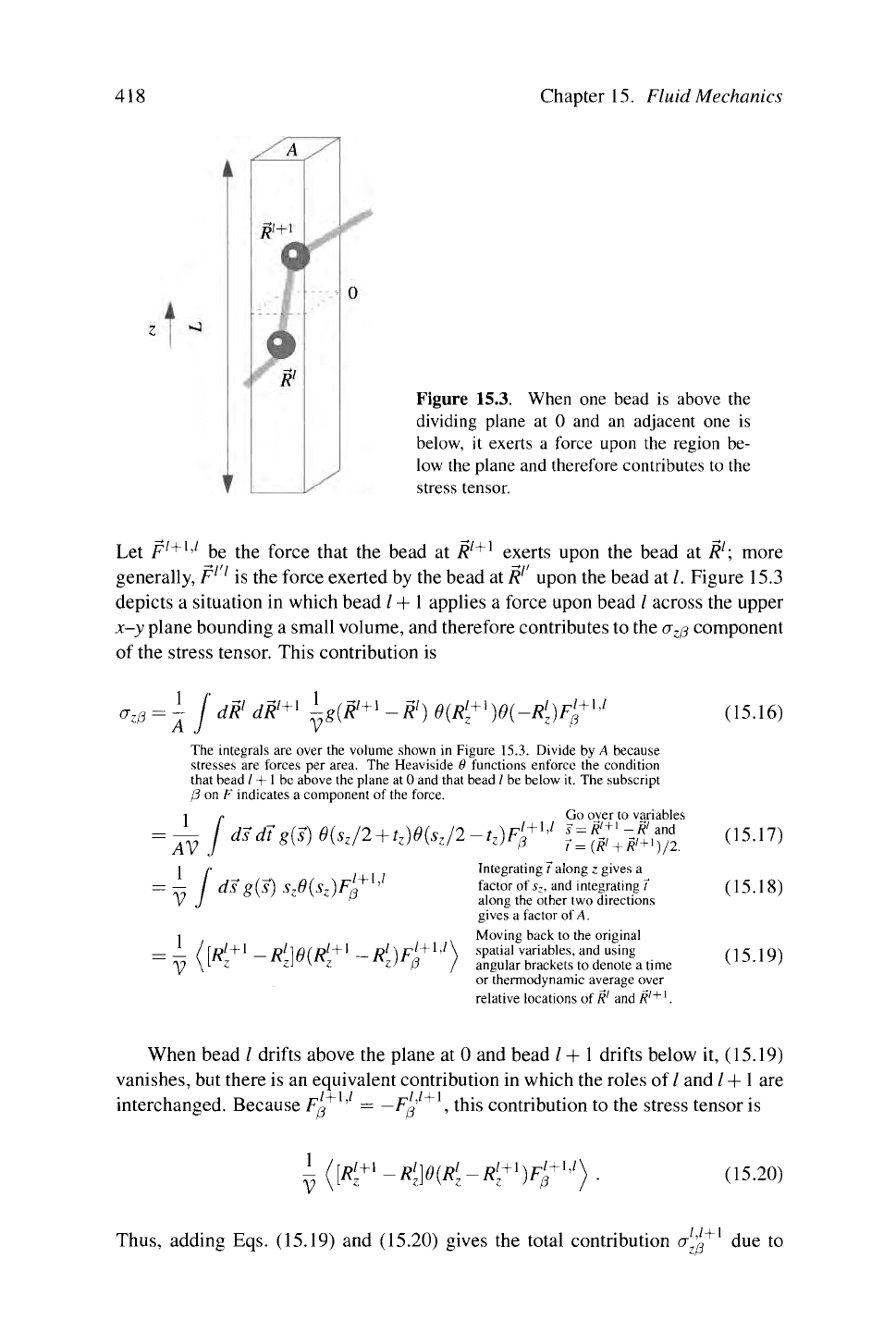
Figure 15.3. When one bead is above the
dividing plane at 0 and an adjacent one is
below, it exerts a force upon the region be-
low the plane and therefore contributes to the
stress tensor.
Let
F
l+l
'
1
be the force that the bead at
R
l+i
exerts upon the bead at R
l
; more
generally, F
l
' is the force exerted by the bead at R
l
upon the bead at /. Figure 15.3
depicts a situation in which bead / +
1
applies a force upon bead / across the upper
x-y
plane bounding a small volume, and therefore contributes to the σ
ζ
β component
of the stress tensor. This contribution is
°zß = \j dR
l
dR
t+i
^g(R
l+i
-R
1
) 9(R
l
z
+]
)9(-R{)F>+
lJ
(15.16)
The integrals are over the volume shown in Figure 15.3. Divide by A because
stresses are forces per area. The Heaviside
Θ
functions enforce the condition
that bead / +
1
be above the plane at 0 and that bead / be below it. The subscript
ß on F indicates a component of the force.
i r- Go over to variables
=— I dsdt
g
(s) e(s
z
/2+t
z
)e(s
z
/2-t
z
)F
i
ß
+i
>
i
*:§:;>?,$
os.n)
\ f Integrating /along z gives a
= — / ds g(s) S
z
9(s
z
)Fß' factor of s
:
, and integrating T (15.18)
V J along the other two directions
gives a factor of A.
i Moving back to the original
= « < \
R
l
+
' - Ml
Θ
(R[
+
' - R[
)
Fl
+
' '' )
s
P
atial
variables, and using (15.19)
Y\
L
z zi \ z z) p I angular brackets to denote a time
v
'
or thermodynamic average over
relative locations of
Ä'
and
/?'
+1
.
When bead / drifts above the plane at 0 and bead / +
1
drifts below it, (15.19)
vanishes, but there is an equivalent contribution in which the roles of / and / +
1
are
interchanged. Because Fß
+
' =
—F~
+
, this contribution to the stress tensor is
1 ([M+
1
-R
l
z
]e{R
l
z
-R[
+x
)F
l
ß
+{
>
1
) . (15.20)
Thus,
adding Eqs. (15.19) and (15.20) gives the total contribution σ '
e
+
due to
Polymeric Solutions
419
beads / and / + 1, which equals
... \ i /-LI ;\ The reason for the factor Ä
z
+
—R[ is that the
σ
ζβ
=
V V-^
z
~^z*^ß ') larger the distance between «^+' and «J in (15.21)
* Figure
15.3,
the larger the probability that the
plane at 0 will lie between them.
1 <
[R
i+i
F
i+hi\
+
l/
R
i
F
i,M\
(l522)
- v V
z
0
I V \
z β
= τζ
(\RÌ
+Ì
F'
+1
'
1
)
+ -
(RÌ^FÌT
1
'
1
)
. Changing the labeling cannot (15.23)
V\
z
P /V\
Z β
I affect the results.
V
'
The contribution to the stress tensor obtained by summing over all the beads is
σ
«/3
= ^Σ(<^'
,/
)·
(15
·
24)
//'
The subscript z has been replaced by a, because it does not matter whether x, y,
or z was chosen. This expression gives the contribution from the polymer beads,
and it must be added to the contribution from the fluid. Equation (15.24) follows
from Eq. (15.23) when beads interact with nearest neighbors, but it is true more
generally.
Polymer Equation of Motion. In order to evaluate Eq. (15.24) one needs to know
the probability that adjacent beads will differ in height by certain amounts, and then
to take averages. These probabilities depend upon the flow in which the polymer
finds
itself,
and also upon the magnitude of thermal fluctuations.
There are two common schemes to calculate the motions of polymers. The
first is called the Rouse model, and it treats the interaction between liquid and
polymer in a fairly naive way. In addition to a shearing force created by the fluid,
the polymer beads are subject to random kicks, and they interact with their nearest
neighbors. This calculation is oversimplified because of the way it treats the fluid
flow around the polymer. In reality, whenever a thermal fluctuation kicks one bead,
its motion moves the surrounding fluid and makes other beads move as well. Incor-
porating the rather long-range effective force between beads due to this effect leads
to the Zimm model. The word "model" is somewhat misleading because the effec-
tive interaction between beads mediated by the fluid is certainly real, and the only
question is whether the approximations used by Zimm (1956) are adequate to treat
the actual complexity. However, for the sake of simplicity, only the calculation of
Rouse (1953) will be presented here.
The motion of bead / is given by
R
l
= — ^2 F
l
'
l
— b(R
l
— v) + ξ
■
As before,
F
1
'>'
gives the force on bead / due (15.25)
Wl ,i to bead /'. m is the mass of the bead.
The form of this equation is in accord with the fluctuation-dissipation theorem
mentioned in Eq. (5.41). The constant b describes damping of the bead propor-
tional to the difference between its velocity and the local velocity of the fluid v.
420
Chapter 15. Fluid Mechanics
The random force ξ
ι
is chosen so that while the time (or thermodynamic) average
of any component \ξ
ι
α
) vanishes, the product of two components obeys
?/)A k ΤΛ(7ί Treating this time correlation function as a
le
(0)£a(t)\
=
a
ß
B
{ I delta function means that the thermal kicks Q5 26)
xsav /SpV 11 ■ are very rapid in comparison with any other ^ ' '
dynamical process in the system.
How exactly one should think about the fluid velocity v is a matter that at first
seems simple, but then becomes complicated after further consideration. In the
view of Rouse (1953), v is simply the average fluid velocity in the vicinity of
the bead at R
l
, and the drag force on the bead is naturally the Stokes drag b =
βπηΐί found in Problem 2. The problem that Zimm (1956) noted with this point of
view is that the bead is not a single isolated sphere moving in a flow that arrives
asymptotically at a value of v. Other beads are nearby, interacting with the flow,
pushing at the bead in question whenever they move, and making it difficult to
determine how v is supposed to be measured.
Neglecting this difficulty, consider the case where particles have sufficiently
light mass and sit in a sufficiently viscous and slowly moving fluid that acceleration
of particles is negligible. Taking forces between nearest neighbors only, with spring
constant % as given by Eq. (5.67), Eq. (15.25) becomes
_; JC -, - -> ?
R
l
= v-\ [R
l+l
— 2R
l
+R'~
1
}
+ —. Eq. (5.67) calculated the spring constant X/N (15.27)
bin b ofyv monomers in series, while what is needed
here is the spring constant 3C between two
monomers.
Sticking with the simple view in which one pretends that the flow v can be set equal
to a large smooth macroscopic flow that might be observed externally, note that the
flow will vary with the precise location of the bead, but that for small motions and
slowly varying flows, only linear spatial variations of v should matter. Let W be
the tensor giving these variations:
Assume that the polymer is sufficiently small
„. _ r»0 , \
Λ
iy nl that W can be considered constant over its full nc 98')
a a
' j
a
P ß
'
extent. Different polymers at different loca- ^ ' '
tions may see different flow features, but each
one sees only a uniform shear flow.
Then Eq. (15.27) becomes
Ri =
U°
+
WR
l
+
—\R
I+1
-2R
l
+R'-
i
} + -. (15.29)
bin b
The resemblance with the tight-binding model of Section 8.4 should suggest
the value of moving to Fourier components to solve Eq.
(
15.29).
Denote the Fourier
modes by
1
N
"φ = —■= y e [R —V t\. Subtracting v°t means going to a reference (15.30)
y N 7~f frame that moves with the mean flow, and N
is the total number of beads in the polymer.
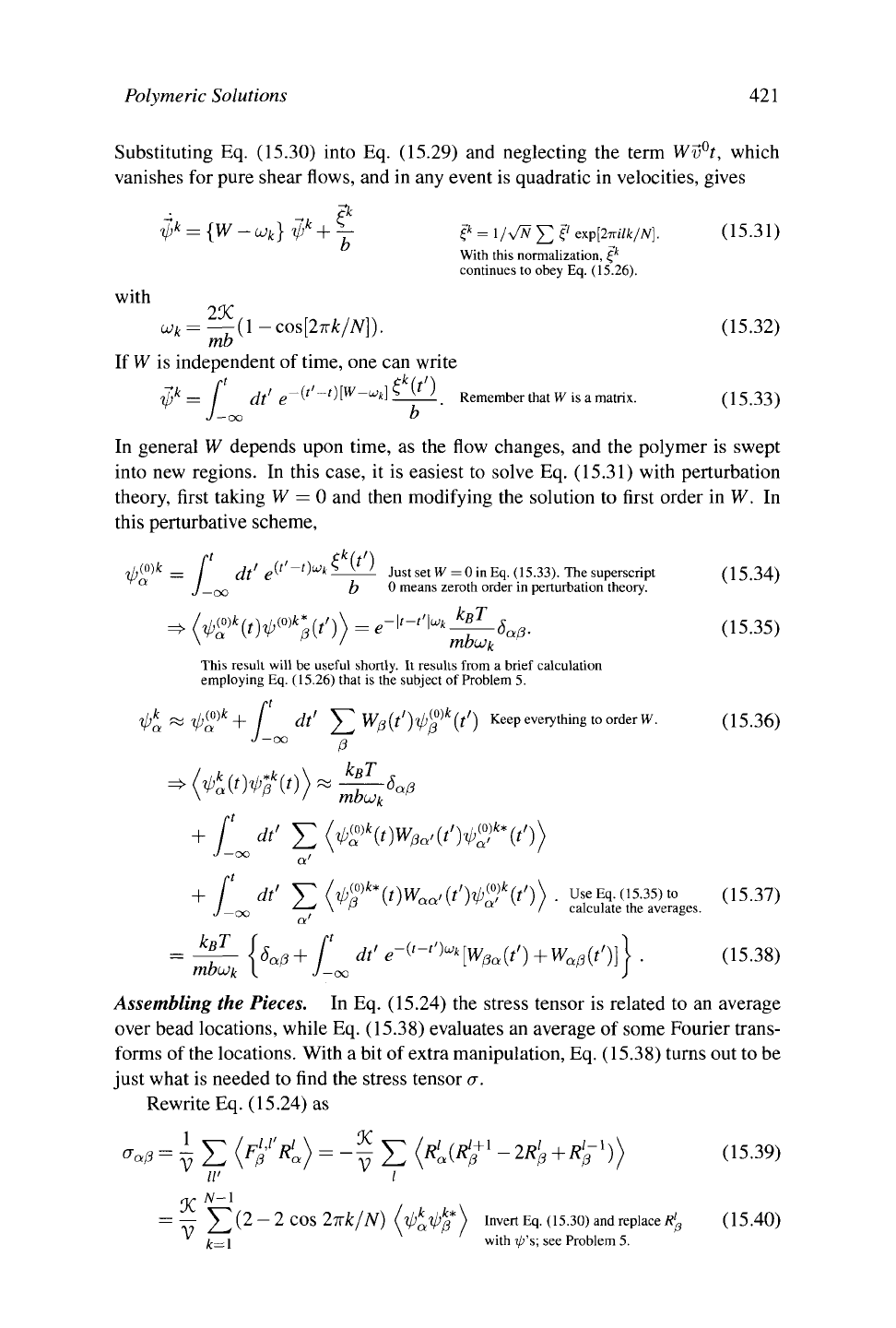
Polymeric Solutions 421
Substituting Eq. (15.30) into Eq. (15.29) and neglecting the term Wv°t, which
vanishes for pure shear flows, and in any event is quadratic in velocities, gives
ψ<
= {W
-
U
k
)
ψ'+η-
ξ" = l/y/N
Σ ?
εχρ[2π/«//ν], (15.31)
With this normalization, ξ*
continues to obey Eq. (15.26).
with
u
k
= —
r
(l-cos[27rk/N\). (15.32)
mo
If W is independent of
time,
one can write
lk_
[' JJ
„-U'-tW-Ui]^')
1p
K
= dt e^
K >[
ki
^-^—
L
. Remember that W is a matrix. (15.33)
In general W depends upon time, as the flow changes, and the polymer is swept
into new regions. In this case, it is easiest to solve Eq. (15.31) with perturbation
theory, first taking W
=
0 and then modifying the solution to first order in W.
In
this perturbative scheme,
dt'
e
^'~'^
k
Just set ^=0 in Eq. (15.33). The superscript (15.34)
_
oc
è
0 means zeroth order in perturbation theory.
=►
(^
)k
{t)r
]
V))
=
*~
M>
^<W
(15.35)
This result will be useful shortly. It results from a brief calculation
employing Eq. (15.26) that is the subject of Problem 5.
^a-V^+Z
dt' Σ
Wß(t')ip
0
°
)k
{t') Keep everything to order W. (15.36)
J-oo
0
J—oo
.
x
'
a'
+
Ji
<*'
Σ «"«»'««.«'«"(O)
■
-iVSi«, <
1537
>
a'
=
^
[δ
αβ
+
J^dt'
e-(
t
-
t
'^[W
ßa
(t')+W
aß
(t')]} .
(15.38)
Assembling the Pieces. In Eq. (15.24) the stress tensor is related to an average
over bead locations, while Eq. (15.38) evaluates an average of some Fourier trans-
forms of the locations. With a bit of extra manipulation, Eq. (15.38) turns out to be
just what is needed to find the stress tensor
σ.
Rewrite Eq. (15.24) as
°°β
=
ΐΣ,
W**)
=
-%
Σ («
1
-24+^-
1
))
(15.39)
//'
ι
=
— ^ (2 - 2
COS 2nk/N) (tpqlpff*) Invert Eq. (15.30) and replace/^ (15.40)
£
=
1 with V's; see Problem 5.
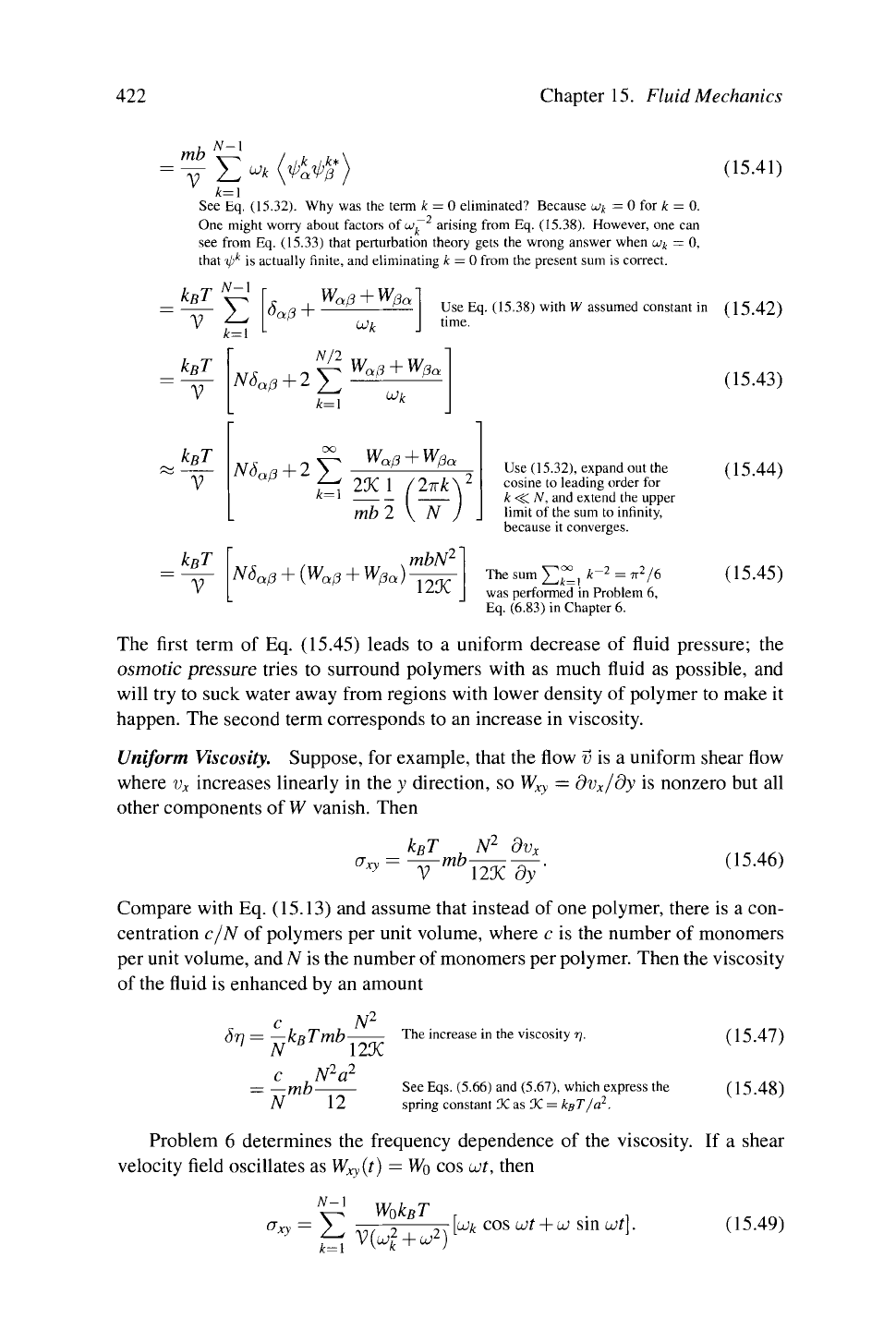
422
Chapter 15. Fluid Mechanics
mo y-^
V
k=\
UJ
k
Ψίψ"β
(15.41)
See Eq. (15.32). Why was the term k = 0 eliminated? Because ω^ = 0 for k = 0.
One might worry about factors of ω^ arising from Eq. (15.38). However, one can
see from Eq. (15.33) that perturbation theory gets the wrong answer when uj
k
= 0,
that ψ* is actually finite, and eliminating k = 0 from the present sum is correct.
k
B
T
V
k
B
T
V
k
B
T
V
k
B
T
V
Σ
k=l
δαβ
+
w
aß
+w
ßo
UJ
k
Use Eq. (15.38) with W assumed constant in
time.
N/2
Νδ
αβ
+
2Σ
k=\
w
aß
+ w
ß0
UJ
k
Νδ
αβ
+ 2
oo
Σ
k=\
w
aß
+w
ßa
2XÌ_
/2nk\
:
~mb2 \N~)
Use (15.32), expand out the
cosine to leading order for
i<i/,
and extend the upper
limit of the sum to infinity,
because it converges.
Nö
aß
+ {W
aß
+ W
ßa
mbN
2
' \2%
The sum ^
■-n
2
/6
(15.42)
(15.43)
(15.44)
(15.45)
was performed in Problem 6,
Eq. (6.83) in Chapter 6.
The first term of Eq. (15.45) leads to a uniform decrease of fluid pressure; the
osmotic pressure tries to surround polymers with as much fluid as possible, and
will try to suck water away from regions with lower density of polymer to make it
happen. The second term corresponds to an increase in viscosity.
Uniform Viscosity. Suppose, for example, that the flow v is a uniform shear flow
where v
x
increases linearly in the y direction, so
Wxy
= dv
x
/dy is nonzero but all
other components of W vanish. Then
' xy
k
B
T N
2
8v
x
~^
mb
ÜX^y-
(15.46)
Compare with Eq. (15.13) and assume that instead of one polymer, there is a con-
centration c/N of polymers per unit volume, where c is the number of monomers
per unit volume, and N is the number of monomers per polymer. Then the viscosity
of the fluid is enhanced by an amount
δη
c N
1
—k
B
Tmb——
N \2X
1„2
c , N
l
a
—
—mo
N 12
The increase in the viscosity η. (15.47)
See Eqs. (5.66) and (5.67), which express the
(15.48)
spring constant 3Cas
OC
= kgT/a
2
.
Problem 6 determines the frequency dependence of the viscosity. If a shear
velocity field oscillates as
Wxy(t)
=
Wo
cos ut, then
σ
xy
N-l
Έ
k=\
W
0
k
B
T
ν(ω
2
+
ω
2
[uJk
cos
ujt
+
ω
sin
cot].
(15.49)