
Marder M.P. Condensed Matter Physics
Подождите немного. Документ загружается.

Plasticity 423
E-,
ü
be
o
log[u*i
s
N/k
B
T]
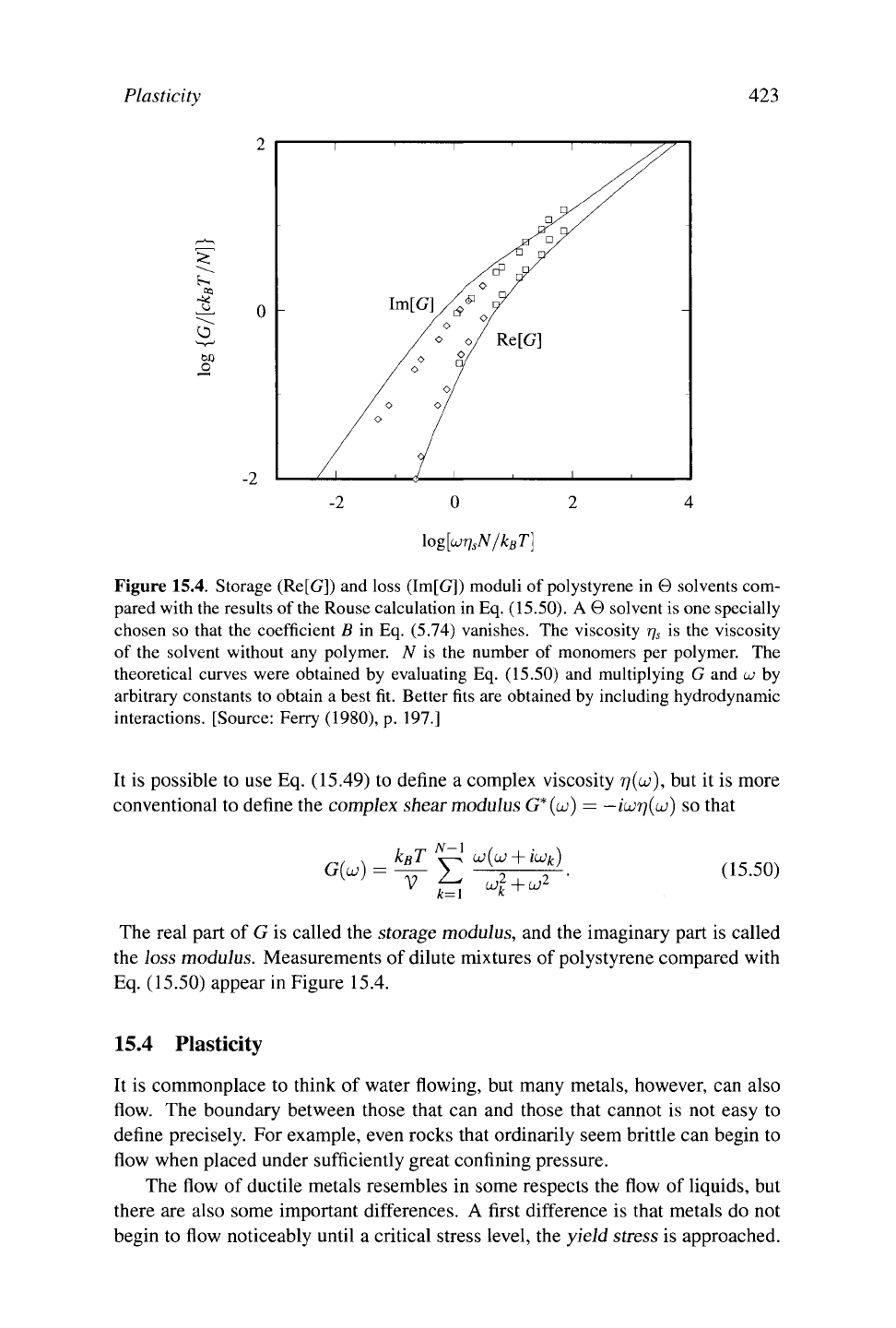
Figure 15.4. Storage (Re[G]) and loss (Im[G]) moduli of polystyrene in Θ solvents com-
pared with the results of the Rouse calculation in Eq. (15.50). A Θ solvent is one specially
chosen so that the coefficient B in Eq. (5.74) vanishes. The viscosity η
5
is the viscosity
of the solvent without any polymer. N is the number of monomers per polymer. The
theoretical curves were obtained by evaluating Eq. (15.50) and multiplying G and ω by
arbitrary constants to obtain a best fit. Better fits are obtained by including hydrodynamic
interactions. [Source: Ferry (1980), p. 197.]
It is possible to use Eq. (15.49) to define a complex viscosity η(ω), but it is more
conventional to define the complex
shear
modulus G*(u) = —ίωη(ω) so that
0{ω)
k
B
T
V
N-]
i . ■ \
k=\
ωί +
ω^
(15.50)
The real part of G is called the storage modulus, and the imaginary part is called
the loss modulus. Measurements of dilute mixtures of polystyrene compared with
Eq. (15.50) appear in Figure 15.4.
15.4 Plasticity
It is commonplace to think of water flowing, but many metals, however, can also
flow. The boundary between those that can and those that cannot is not easy to
define precisely. For example, even rocks that ordinarily seem brittle can begin to
flow when placed under sufficiently great confining pressure.
The flow of ductile metals resembles in some respects the flow of liquids, but
there are also some important differences. A first difference is that metals do not
begin to flow noticeably until a critical stress level, the yield stress is approached.
424
Chapter 15. Fluid Mechanics
The yield stress corresponds to the point where the force per length / on dislo-
cations reaches the critical value needed to make them mobile. Even at very low
stresses, flow of metals can be observed, but it is extremely slow and it results from
exponentially rare thermal fluctuations that permit rearrangement of small portions
of the metal. As a matter of practice, a definite stress at which a metal begins to
display irreversible deformation is a useful quantity to define.
The possibility of plastic flow after the yield stress is exceeded is explained in
principle by dislocation motion. Knowledge of dislocation mobility has some pre-
dictive power for describing flow. Metals in which dislocations are immobile tend
to be brittle; those in which dislocations are mobile along one or two directions can
be deformed in those directions but still are not fully plastic, while those with five
or more independent slip planes will permit flow in any directions, and if assembled
into a polycrystalline aggregate will deform in a fully plastic fashion. Dislocations
provide only one type of mobile defect permitting flow. Some ceramics can flow
at high temperatures through the motion of vacancies, while amorphous materials
can flow through rearrangement of local groups of atoms.
The theory of plasticity is a phenomenological account of deformation that
does not depend upon the microscopic mechanism that makes it possible. Its con-
struction is an interesting combination of guesswork based upon symmetry princi-
ples,
a desire for simplicity, and constraints imposed by experimental observations.
The most common form of the theory is heavily influenced by the characteristic be-
havior of structural steels, which provided the greatest impetus for its creation, and
the theory might have a different form if aluminum or nickel alloys had an equal
practical importance.
Suppose one has an isotropie solid capable of plastic deformation; a practical
definition would be that the solid is capable of being drawn into wire. Whether the
solid begins to flow at any given location depends upon the state of stress there,
described by the stress tensor σ
α
β. The tensor σ is symmetric, so there is some
basis in which it is diagonal, with diagonal elements σ\, σ^, and σ^. The solid is
assumed to be isotropie, it cannot matter how these three elements are numbered,
and the onset of yield must be determined by some symmetrical function
£F
of σ\,
CT2, and
στ,.
Demanding that
3"
be symmetrical is equivalent to requiring it to be a
function of symmetrical combinations of σ\ . . . σ^. There are three conventional
combinations of the elements of the stress tensor, the stress
invariants,
similar to
the strain invariants of
Eq.
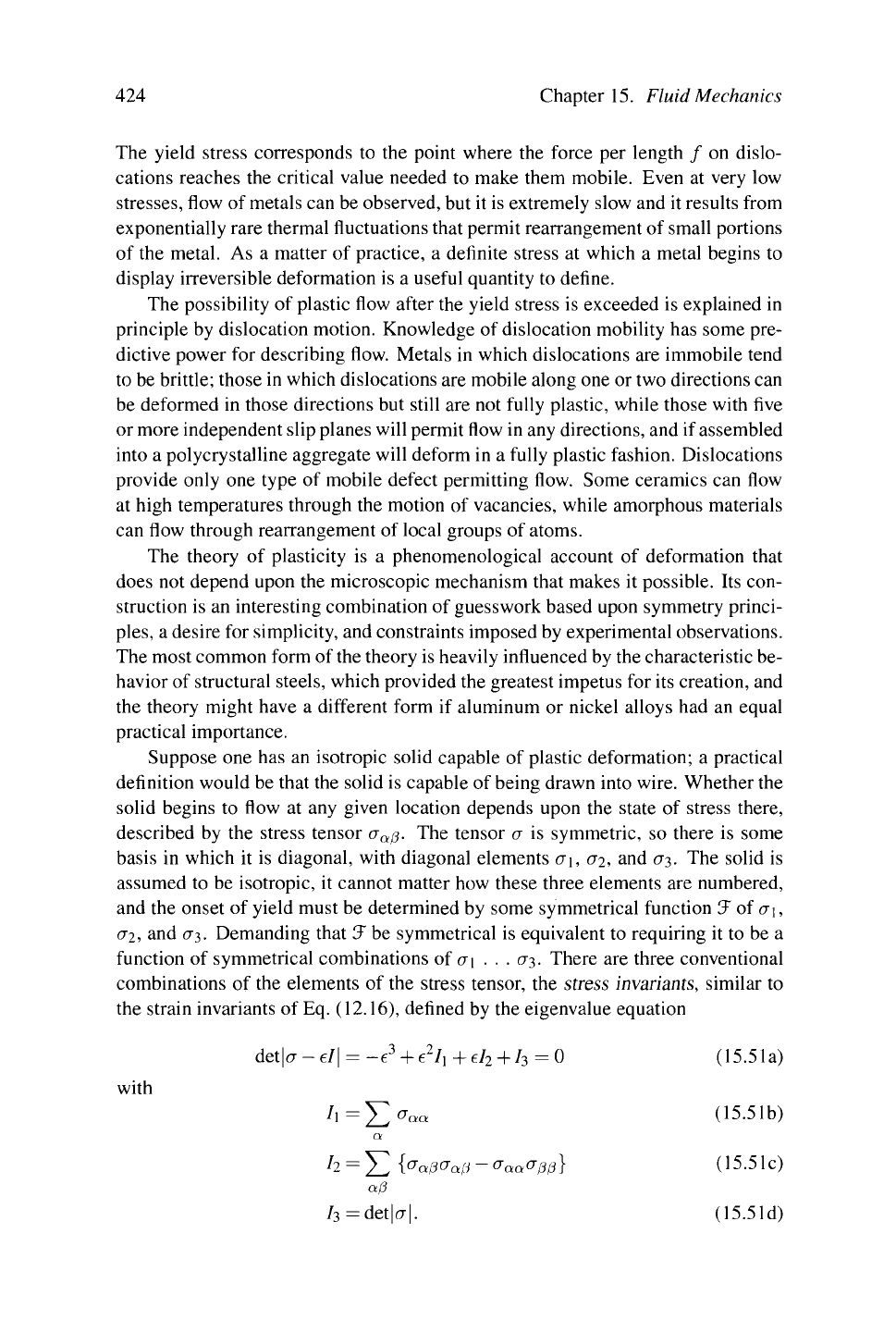
(12.16), defined by the eigenvalue equation
det|a - el\ = -e
3
+ e
2
/, + e/
2
+ h = 0
(15.51
a)
with
Ιι=Σσ
αα
(15.51b)
a
Ι2
= Σ {
σ
αβσ
α
β-σ
αα
σββ} (15.51c)
αβ
7
3
=det|cr|. (15.51d)
Plasticity 425
Bridgeman (1949) found that a uniform hydrostatic pressure or tension, so long
as it is much less than Young's modulus, does not much affect the yield properties
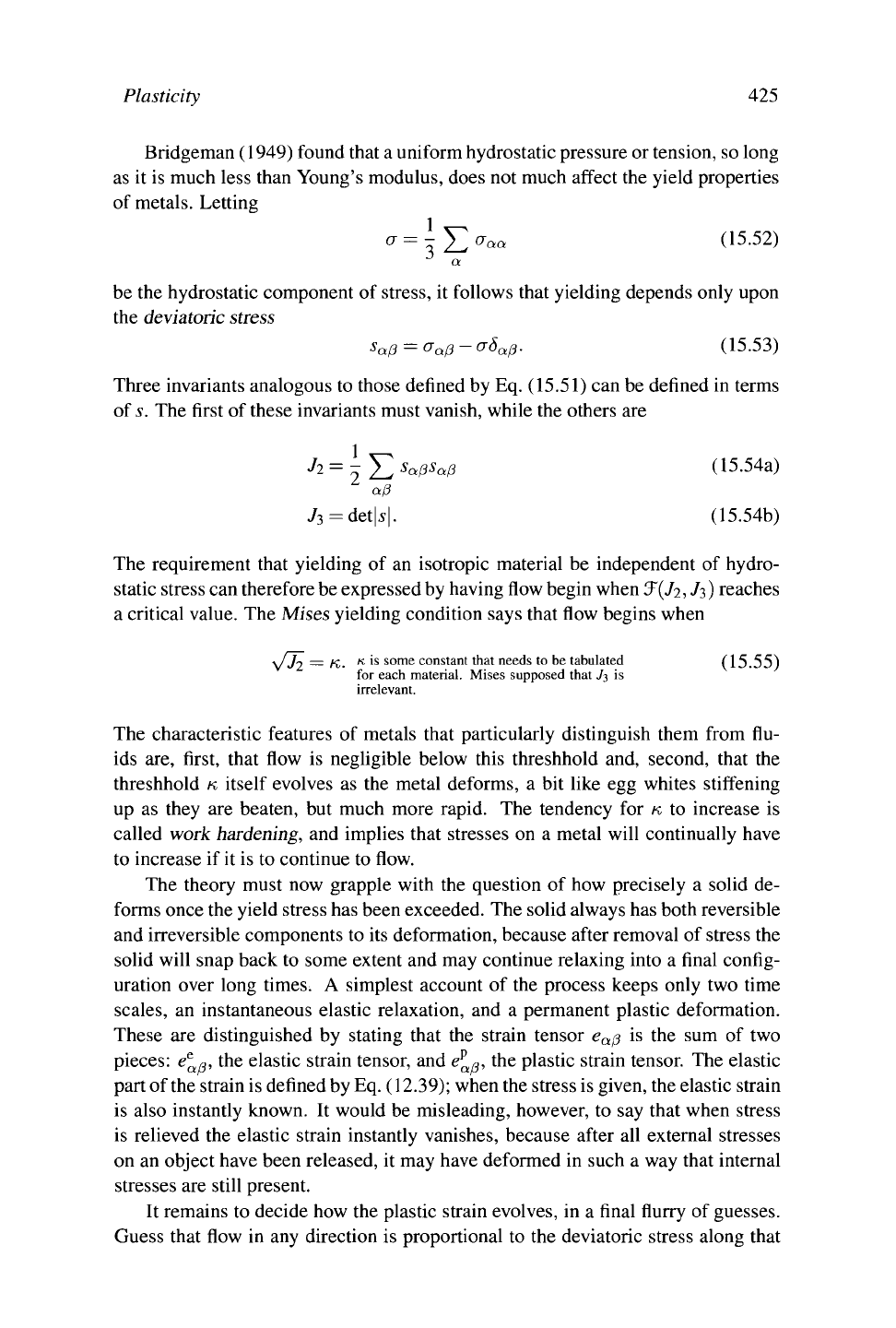
of metals. Letting
σ = -^σ
αα
(15.52)
be the hydrostatic component of stress, it follows that yielding depends only upon
the deviatone stress
^
α
β = σ
α
β-σδ
α
β. (15.53)
Three invariants analogous to those defined by Eq. (15.51) can be defined in terms
of
s.
The first of these invariants must vanish, while the others are
h =
-z
Σ
SaßSaß
(15.54a)
aß
7
3
= det|s|. (15.54b)
The requirement that yielding of an isotropie material be independent of hydro-
static stress can therefore be expressed by having flow begin when
3"(72,
J3)
reaches
a critical value. The Mises yielding condition says that flow begins when
— ft. K is some constant that needs to be tabulated (15.55)
for each material. Mises supposed that J3 is
irrelevant.
The characteristic features of metals that particularly distinguish them from flu-
ids are, first, that flow is negligible below this threshhold and, second, that the
threshhold κ itself evolves as the metal deforms, a bit like egg whites stiffening
up as they are beaten, but much more rapid. The tendency for κ to increase is
called work hardening, and implies that stresses on a metal will continually have
to increase if it is to continue to flow.
The theory must now grapple with the question of how precisely a solid de-
forms once the yield stress has been exceeded. The solid always has both reversible
and irreversible components to its deformation, because after removal of stress the
solid will snap back to some extent and may continue relaxing into a final config-
uration over long times. A simplest account of the process keeps only two time
scales, an instantaneous elastic relaxation, and a permanent plastic deformation.
These are distinguished by stating that the strain tensor e
a
ß is the sum of two
pieces: eig, the elastic strain tensor, and
e
v
a
o,
the plastic strain tensor. The elastic
part of
the
strain is defined by Eq. (12.39); when the stress is given, the elastic strain
is also instantly known. It would be misleading, however, to say that when stress
is relieved the elastic strain instantly vanishes, because after all external stresses
on an object have been released, it may have deformed in such a way that internal
stresses are still present.
It remains to decide how the plastic strain evolves, in a final flurry of guesses.
Guess that flow in any direction is proportional to the deviatoric stress along that
Vh
426
Chapter 15. Fluid Mechanics
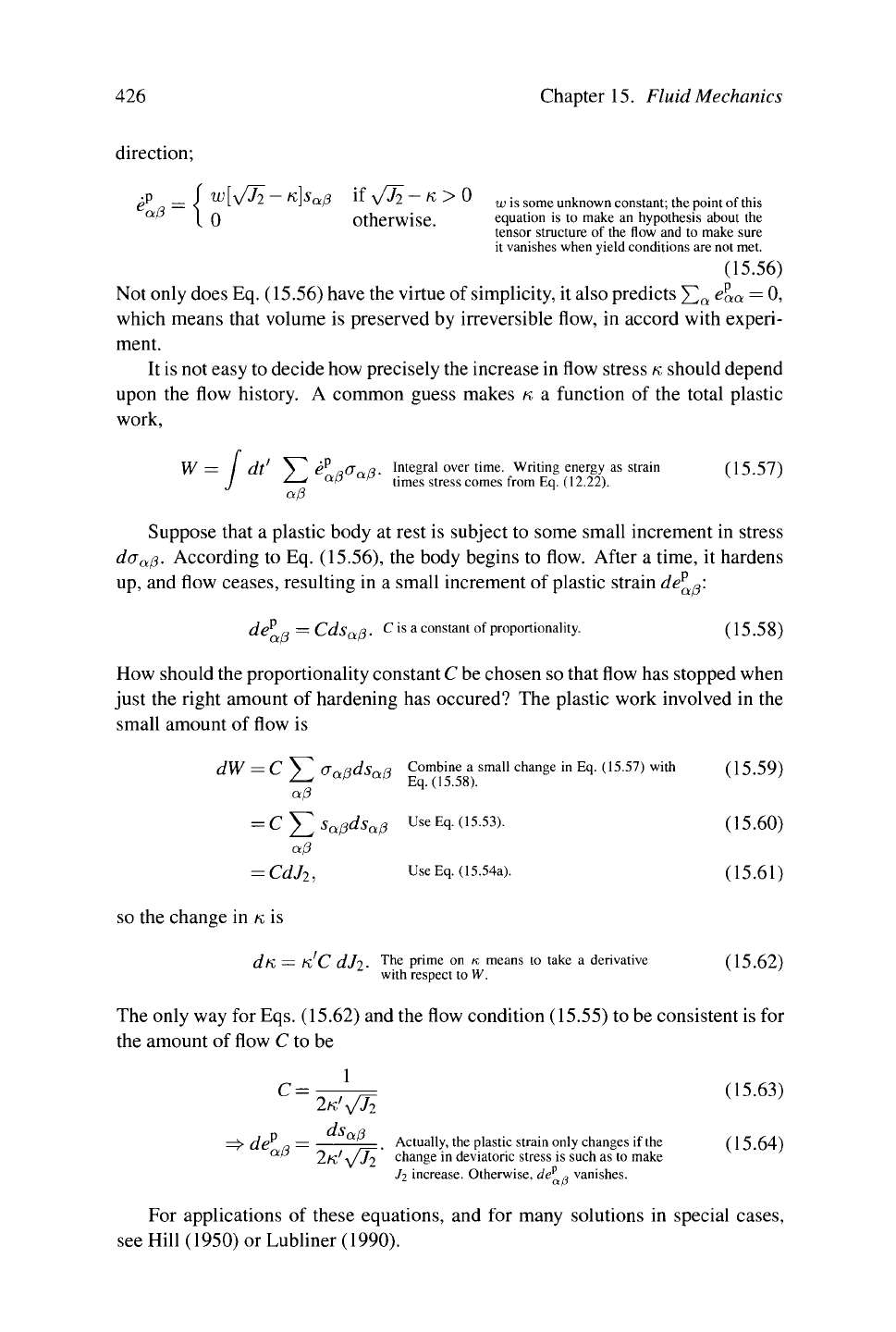
direction;
è
P
„ = \
W
W-^2 — li\S
a
ß II V Jl — ^ > U
w
i
s some
unknown
constant;
the point
of this
a
P
y Q Otherwise. equation is to make an hypothesis about the
tensor
structure of the flow and to make sure
it
vanishes when yield conditions are not met.
(15.56)
Not only does Eq. (15.56) have the virtue of simplicity, it also predicts Σ
α
e
aa
= 0,
which means that volume is preserved by irreversible flow, in accord with experi-
ment.
It is not easy to decide how precisely the increase in flow stress κ should depend
upon the flow history. A common guess makes κ a function of the total plastic
work,
W
= / dt' y^ è
P
η
Ο
α
β. Integral over time. Writing energy as strain (15.57)
J
^—'
a
P times stress comes from Eq. (12.22).
aß
Suppose that a plastic body at rest is subject to some small increment in stress
άσ
α
β. According to Eq. (15.56), the body begins to flow. After a time, it hardens
up,
and flow ceases, resulting in a small increment of plastic strain deL:
d
e
aß
=
Cds
a
ß. C is a constant of
proportionality.
(15.58)
How should the proportionality constant C be chosen so that flow has stopped when
just the right amount of hardening has occured? The plastic work involved in the
small amount of flow is
dW
= C ^ a
n
ßds
n
ß Combine a small change in Eq. (15.57) with (15.59)
^ ap ap
Eq(1558)
v
aß
=
C^2
s
aßds
aß
Use Eq.
(
15.53).
( 15.60)
aß
=
CdJ
2
,
Use Eq. (15.54a). (15.61)
so the change in κ is
du
= K'C dJ2- ^
ne
prime on κ means to take a derivative (15.62)
with
respect to W.
The only way for
Eqs.
(15.62) and the flow condition (15.55) to be consistent is for
the amount of flow C to be
C=^T= (15.63)
de
a = ——. Actually, the plastic strain only changes if
the
( 15.64)
n n
'
nr
~ change in deviatoric stress is such as to '
J?
increase. Otherwise, de
f
„ vanishes.
Δ
aß
For applications of these equations, and for many solutions in special cases,
see Hill (1950) or Lubliner (1990).
Superfluid
A
He
427
15.5 Superfluid
4
He
Failure of Helium to Solidify. Helium stands out among the elements because
at atmospheric pressure it remains liquid down to a temperature of absolute zero.
A tentative explanation for this perplexing fact, simple but not convincing, follows
from data of Table 11.3. Were helium like the other noble gases, then the van der
Waals attraction would cause it to crystallize in an fee structure whose spacing is
given by Eq. (11.10) as 2.8 Â. The zero-point energy of a helium atom confined
to a region this size is approximately h
2
/(Irrido), which, for
4
He, works out to be
2-10
-3
eV. According to Eq. (11.11), the cohesive energy per particle in an fee
structure would be around 7-10
-3
eV. Although from this rough argument crystal-
lizing in fee appears to be favorable, the substance in actuality finds the penalty
of zero-point energy too costly and chooses to remain liquid in the ground state,
rather than solid.
The ground-state liquid has, however, bizarre properties matched by no other
substance on Earth. Poured into a container, it runs up the sides and flows down
over the edges. It flows through tubes as small as 500 Â in diameter without
measurable resistance, while in other respects displaying ordinary liquid viscos-
ity. These facts deserve a more systematic presentation.
Some Experimental Phenomena in
4
He. Liquid
4
He undergoes a phase transi-
tion at 2.186 K and atmospheric pressure, called the λ pointby Keesom, its discov-
erer, because of the appearance of the specific heat curve. Below this temperature,
helium begins to display the strange phenomena that lead it to be known as a su-
perfluid, and thought of as the new phase He II. Out of the dozens of ingenious
experiments designed to probe properties of helium II, here are two that are partic-
ularly revealing.
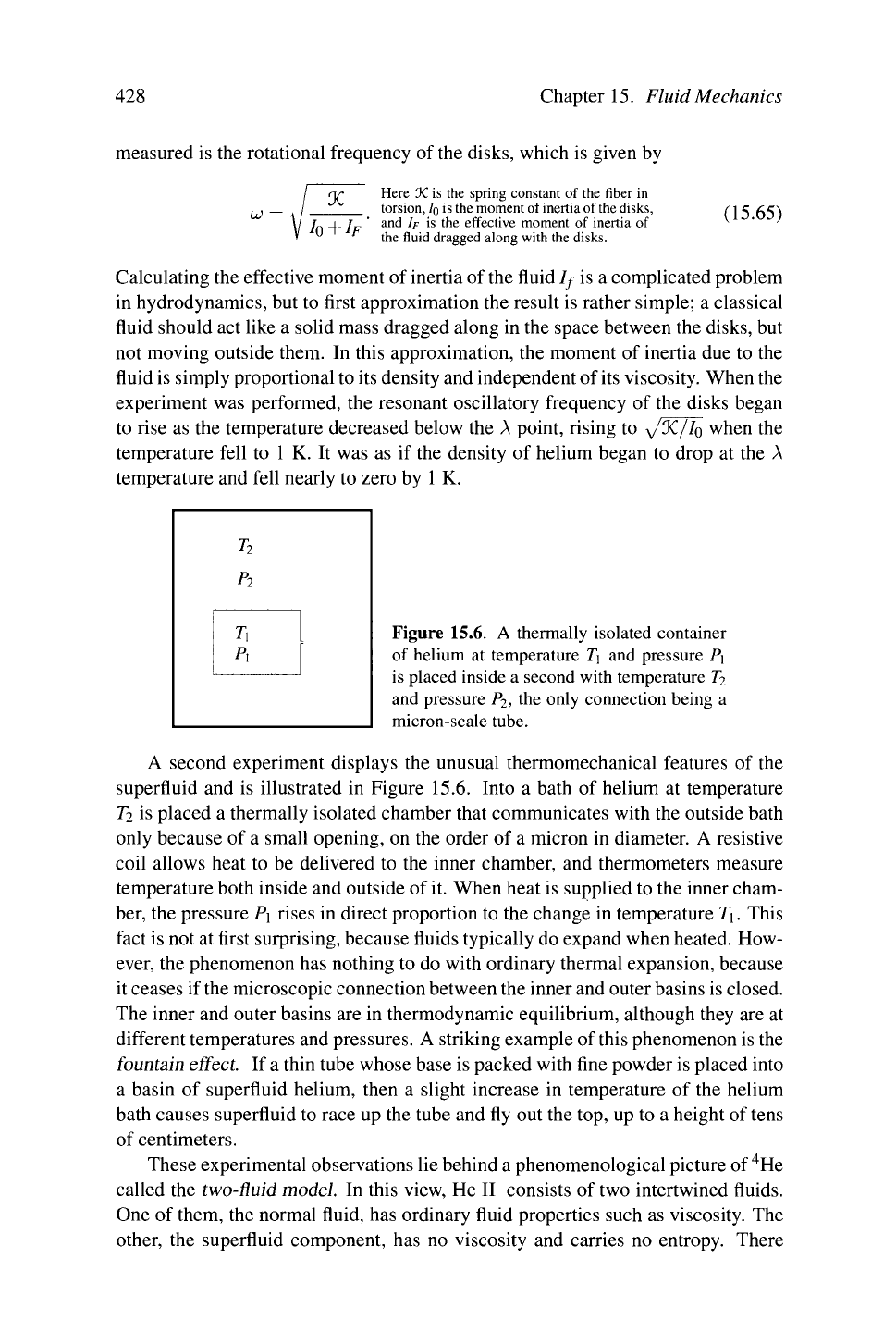
Figure 15.5. Narrowly spaced disks undergo torsional oscillations in
a
bath of
helium
II to
investigate its viscosity.
The peculiar mechanical properties of superfluid helium are best indicated by
an experiment of Andronikashvili (1948), illustrated in Figure 15.5. A collection
of 100 mica disks of around 4 cm in diameter and spaced by 0.2 mm is lowered
into a bath of superfluid helium, suspended upon a fiber. The experimental quantity
428
Chapter 15. Fluid Mechanics
measured is the rotational frequency of the disks, which is given by
ω
■
/ or Here % is the spring constant of the fiber in
torsion,
/o is the moment of
inertia
of
the
disks,
J
n
4- J
F
an
d IF is the effective moment of inertia of
the
fluid dragged along with the
disks.
(15.65)
Calculating the effective moment of inertia of the fluid If is a complicated problem
in hydrodynamics, but to first approximation the result is rather simple; a classical
fluid should act like a solid mass dragged along in the space between the disks, but
not moving outside them. In this approximation, the moment of inertia due to the
fluid is simply proportional to its density and independent of
its
viscosity. When the
experiment was performed, the resonant oscillatory frequency of the disks began
to rise as the temperature decreased below the λ point, rising to
Λ/OC/IQ when the
temperature fell to 1 K. It was as if the density of helium began to drop at the λ
temperature and fell nearly to zero by
1
K.
T
2
Pi
Ά
Pi
Figure 15.6. A thermally isolated container
of helium at temperature
T\
and pressure Pi
is placed inside a second with temperature
T
2
and pressure
P
2
,
the only connection being a
micron-scale tube.
A second experiment displays the unusual thermomechanical features of the
superfluid and is illustrated in Figure 15.6. Into a bath of helium at temperature
Ύ2
is placed a thermally isolated chamber that communicates with the outside bath
only because of a small opening, on the order of a micron in diameter. A resistive
coil allows heat to be delivered to the inner chamber, and thermometers measure
temperature both inside and outside of
it.
When heat is supplied to the inner cham-
ber, the pressure Pi rises in direct proportion to the change in temperature 7\. This
fact is not at first surprising, because fluids typically do expand when heated. How-
ever, the phenomenon has nothing to do with ordinary thermal expansion, because
it ceases if
the
microscopic connection between the inner and outer basins is closed.
The inner and outer basins are in thermodynamic equilibrium, although they are at
different temperatures and pressures. A striking example of
this
phenomenon is the
fountain effect. If a thin tube whose base is packed with fine powder is placed into
a basin of superfluid helium, then a slight increase in temperature of the helium
bath causes superfluid to race up the tube and fly out the top, up to a height of tens
of centimeters.
These experimental observations lie behind a phenomenological picture of
4
He
called the two-fluid model. In this view, He II consists of two intertwined fluids.
One of them, the normal fluid, has ordinary fluid properties such as viscosity. The
other, the superfluid component, has no viscosity and carries no entropy. There
Superfluid
4
He
429
is
no
completely accepted microscopic theory
to
underlie the two-fluid model,
but
clearly helium does
not
actually consist
of two
different fluids.
The
superfluid
component corresponds to
a
low energy state with quantum-mechanical coherence,
while the normal fluid corresponds
to
thermal excitations traveling about on top of
the low energy state.
Andronikashvili's experiment
is
easy
to
explain from this point
of
view.
As
temperature drops below
the λ
point, more
and
more
of the
fluid converts
to the
superfluid component. Because this component lacks viscosity, the oscillating mica
disks
do not
perturb
it, and
only
the
normal component
of the
fluid
is
dragged
along with them.
In
fact,
the
results
of the
experiment
may be
interpreted
as a
measurement,
or
even
a
definition,
of
the density
of
the superfluid component.
The thermomechanical experiment shows that
two
regions
of
helium
may be
in contact, particles flowing from one
to
another,
but
without the two regions shar-
ing
the
same temperature
or
pressure.
Let G\(T\, P\, N\)be
the Gibbs free energy
of the helium bath, with G
2
(T
2
,
P2,
N2)
the
Gibbs free energy
of
the internal con-
tainer. Because the two regions
of
fluid
can
freely exchange particles, equilibrium
demands that
0
_
dG
_dGx{N
{
) +
G
2
(N-N
y
)
dN
{
dN
{
dG\ <9G
2
G
=
G
l
+G
2
andN
=
N
i
+N
2
.
(15 66)
TP
-
«Λ7 «ΛΓ '
μΐ(
Τ
1,Ρΐ)=μ2(Τ
2
,
Pi)- μι
and
μ
2
are
the chemical (15.67)
θΝ\
0Ν2
potentials
of
the two regions.
If entropy could flow between the two fluid regions, then equilibrium would require
the condition
ö£i(Si,Vi) d£
2
(S
2
,
V
2
)
i_^_n
\j_ _ £ν_^ ii _^ ^ —T2:
Not true
for
superfluid helium!
dS\
8S2
(15.68)
thus
the
fact that two fluids
can be in
equilibrium
at
different temperatures while
exchanging particles
is a
demonstration that
the
particles moving between them
somehow contrive
to
carry
no
entropy.
According
to Eq.
(15.67), equality
of
chemical potential
is the
basic require-
ment
for
superfluid equilibrium. When temperature and pressure differ only slightly
in two regions
of
superfluid, then
μ
2
can be expanded to first order in the small
dif-
ferences
AT =
Ύ2 — T]
and AP =
P
2
—
P\. As
a
result
w^
T+
w^
p=0
(15
-
69)
1
AP
=>· s AT
= —AP
=>-
= OS.
s
'
s tne
entropy
per
unit mass,
and p is the
(15.70)
n
AT
mass density
in
region 2; obtain these expres-
sions from
μ =
dG/dN.
The entropy
of
helium can
be
measured directly
by
integrating the specific heat
up
from zero,
so as to
verify (15.70).
430
Chapter 15. Fluid Mechanics
15.5.1 Two-Fluid Hydrodynamics
The superfluid component of helium differs from an ordinary fluid because of the
particular thermodynamic force that makes it move. The thermomechanical effect
demonstrates that superfluid flows so as to equalize the chemical potential. Because
the chemical potential describes the change in energy of
a
small portion of fluid due
to addition of a single particle, the force per particle acting upon the superfluid is
—V/x, and the velocity v
s
of a region of superfluid is described by
_j_
(y . \7)v
s
= . "* is the mass of a helium atom. (15.71)
dt m
As a consequence of the Gibbs-Duhem relation
V S
du=—dP
dT See, for example, Landau and Lifshitz
(
1980) (15 72)
p
N N '
P.
72.
one may write alternatively
dv
s
- VP
~ ~Ί~ (fis ' V^)V
S
=
\~sVT.
P = mass density, and s = S/Nm is entropy (15.73)
dt p per unit mass.
In accord with Eq. (15.70), superfluid can be in equilibrium in the presence of
simultaneous pressure and temperature gradients. Equation (15.73) predicts that
without pressure gradients, thermal gradients can make a superfluid flow as easily
as pressure differences move an ordinary fluid.
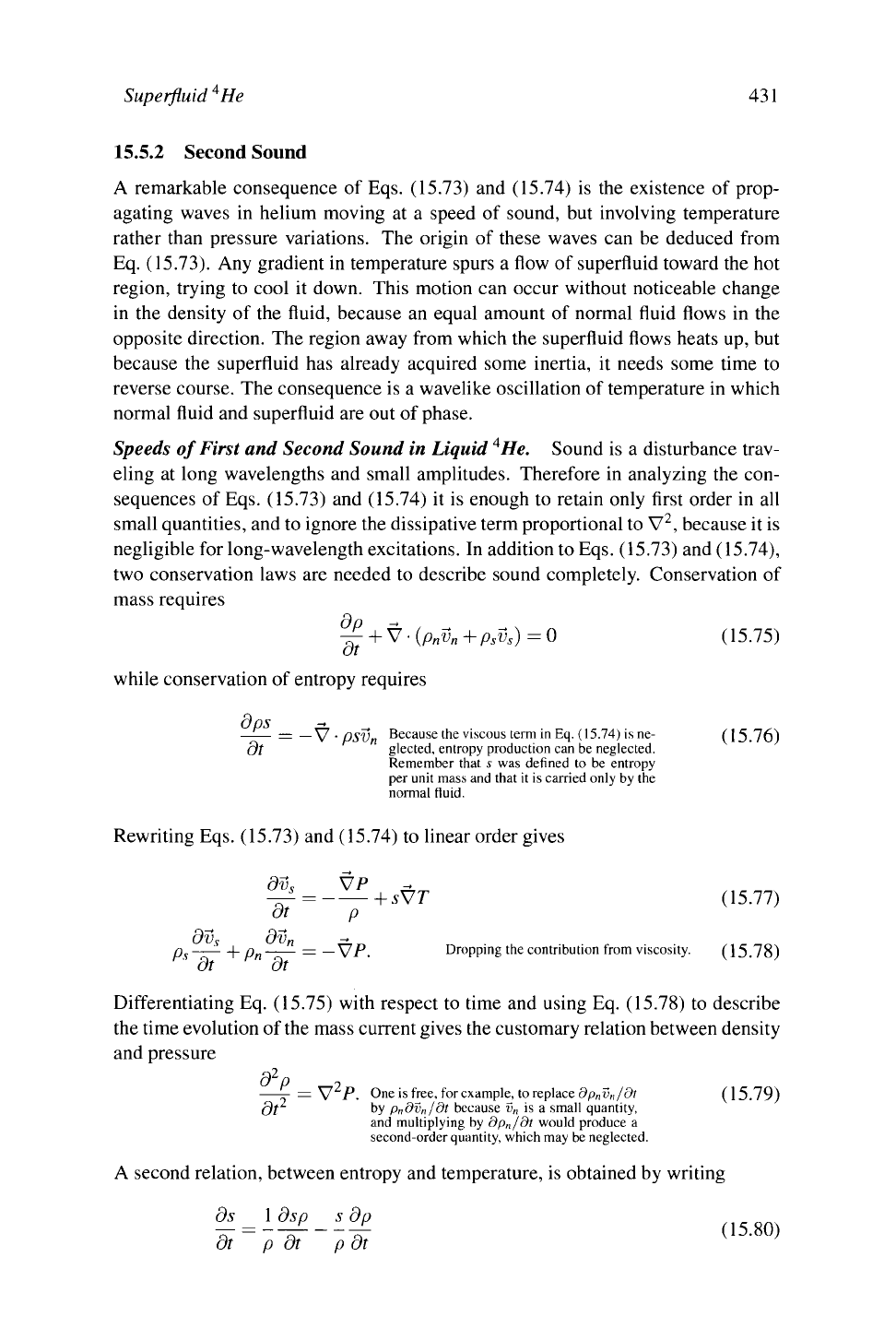
The equation describing motion both of superfluid and normal components of
helium is
+
(ν
5
-ν)ν
5
}+ρ
η
^ + (ν
η
-ν)υ
η
} = -νΡ + ην
2
ν
η
. (15.74)
At first glance, Eq. (15.74) appears obvious, but it is not. The relation between
pressure and acceleration is no longer as clear as for a single-component fluid,
because there is no single reference frame in which all the fluid is stationary and
in which one can measure the pressure. An alternative to Eq. (15.74) might be an
equation in which the left-hand side contains only the total density p
—
p
s
+ p
n
and
the mean velocity (p
n
v
n
+
p
s
v
s
)/p.
A partial justification for Eq. (15.74) is that it
produces the correct acceleration of superfluid or normal components if either the
normal or superfluid density vanishes, and in addition it is an equation for which the
two fluid components are independent; motion of the superfluid does not produce
convective transport of the normal fluid, and vice versa. Such arguments cannot,
however, rule out the presence of a term such as p
s
sVT, because p
s
vanishes in the
normal fluid, while s vanishes in the superfluid. Landau's unambiguous derivation
of Eq. (15.74) is described in the final chapter of Landau and Lifshitz (1987).
Superfluid
4
He
431
15.5.2 Second Sound
A remarkable consequence of Eqs. (15.73) and (15.74)
is
the existence of prop-
agating waves
in
helium moving
at a
speed
of
sound, but involving temperature
rather than pressure variations. The origin
of
these waves can be deduced from
Eq. (15.73). Any gradient in temperature spurs
a
flow
of superfluid toward the hot
region, trying to cool
it
down. This motion can occur without noticeable change
in the density
of
the fluid, because an equal amount of normal fluid flows in the
opposite direction. The region away from which the superfluid flows heats up, but
because the superfluid has already acquired some inertia,
it
needs some time
to
reverse course. The consequence is a wavelike oscillation of temperature in which
normal fluid and superfluid are out of phase.
Speeds of First and Second Sound in Liquid
4
He. Sound is a disturbance trav-
eling at long wavelengths and small amplitudes. Therefore in analyzing the con-
sequences of Eqs. (15.73) and (15.74)
it
is enough to retain only first order in all
small quantities, and to ignore the dissipative term proportional to V
2
, because it is
negligible for long-wavelength excitations. In addition to Eqs. (15.73) and (15.74),
two conservation laws are needed to describe sound completely. Conservation of
mass requires
-^ +
V-(p
n
v
n
+
p
s
v
s
)=0
(15.75)
while conservation of entropy requires
dps
->
=
—
\/■
psv„ Because the viscous term in Eq. (15.74) is ne-
(15.76)
Qt
glected, entropy production can be neglected.
Remember that
s
was defined
to
be entropy
per unit mass and that it is carried only by the
normal fluid.
Rewriting Eqs. (15.73) and (15.74) to linear order gives
(15.77)
Dropping the contribution from viscosity. (15.78)
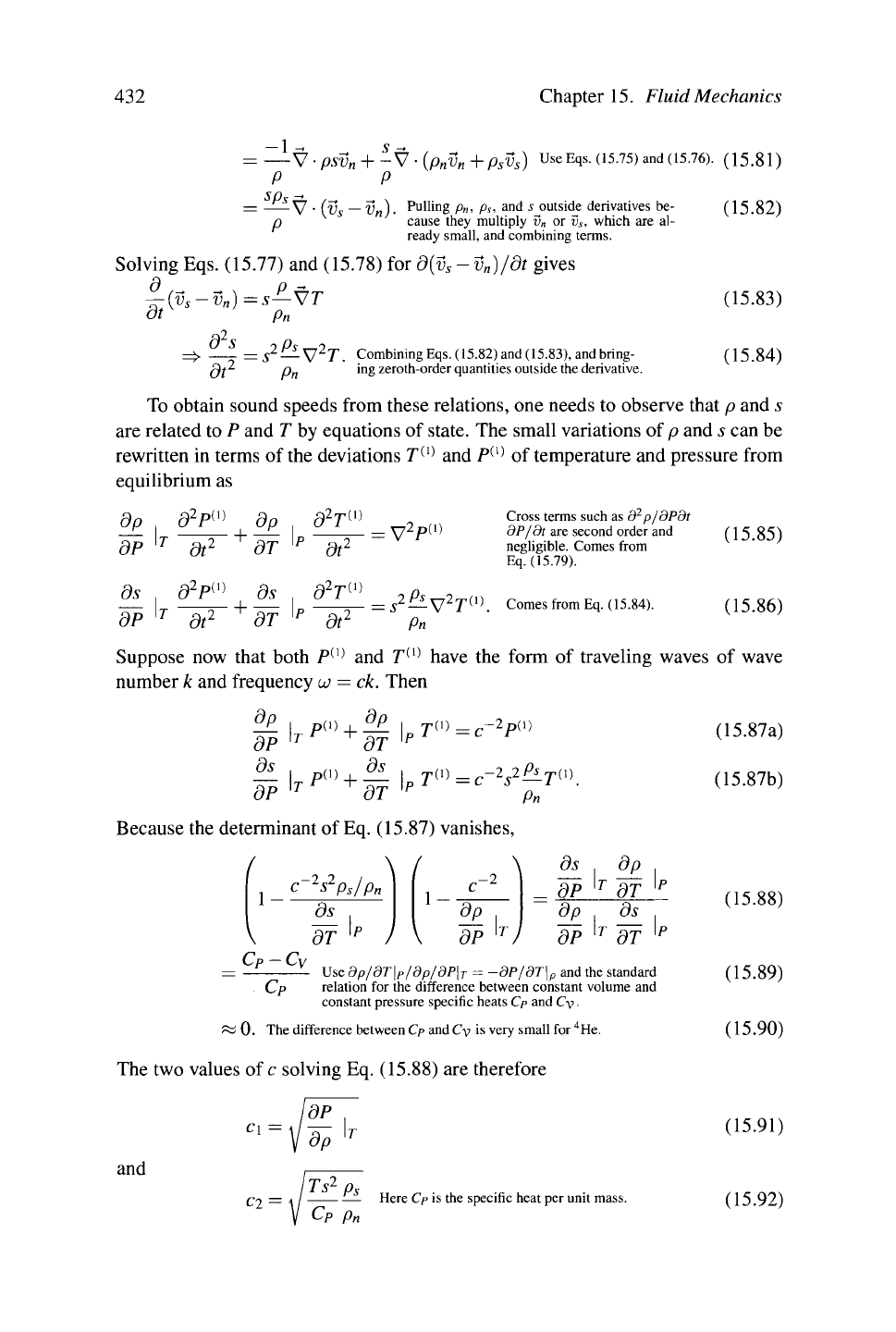
Differentiating Eq. (15.75) with respect to time and using Eq. (15.78) to describe
the time evolution of
the
mass current gives the customary relation between density
and pressure
d
2
p
—r-
=
VP. One is free, forexample, to replace dp„v„/dt
(15.79)
Qt
by p„dv„/dt because
v
n
is a
small quantity,
and multiplying by dp„/di would produce
a
second-order quantity, which may be neglected.
A second relation, between entropy and temperature, is obtained by writing
Ι
=1
^--Ι
<
ΐ5
·
8ο
>
Qt
p at p at
dv
s
dt
~
dv
s
dv
n
p
*-d7
+
Pn
-d7
=
+ sVT
P
-VP.
432
Chapter 15. Fluid Mechanics
—
1-.
s -
=
V ·
psv
n
+ -V ·
(p
n
V„+
p
s
V
s
)
Use Eqs. (15.75) and (15.76). (15.81)
P
P
SO
—*
= ——V
· (v
s
—
V
n
).
Pulling p„,
p
s
,
and
s
outside derivatives be- (15.82)
n cause they multiply
v
n
or v
s
,
which are
al-
ready small, and combining terms.
Solving Eqs. (15.77) and (15.78) for
8{v
s
-
v„)/Bt gives
-{v
s
-v
n
)=s^-VT
(15.83)
Ot
p
n
=>.
—-
=s
2
£l
1
\/
2
T.
Combining Eqs. (15.82) and (15.83), and bring- (15.84)
Qt
n
n
ing zeroth-order quantities outside the derivative.
To obtain sound speeds from these relations, one needs
to
observe that
p
and
s
are related to
P
and
T
by equations
of
state. The small variations
of
p and
s
can be
rewritten
in
terms
of
the deviations T
(1)
and P
(1)
of
temperature and pressure from
equilibrium as
Bn (9
2
P
(1)
Bn
B
2
T
W
Cross terms such as 9
2
p/dP9i
if. I _
L
1SL I _ =
V
2
P
(1)
9P/9i are second order and
(15 85)
ÖP
Bt
2
BT Bt
2
negligible. Comes from
Eq. (15.79).
Bv
B
2
P^ r)ç B
2
T^ n
|ρ"
\τ ^ + Ί^ \Ρ
d
~i^=S
2
^V
2
T^.
Comes from Eq. (15.84). (15.86)
ÔP dr oT
r
dr Pn
Suppose now that both
P
m
and
Γ
(1)
have
the
form
of
traveling waves
of
wave
number
k
and frequency ω
=
ck. Then
%
\r
pW
+ % \
P
T
m
=c~
2
P^
(15.87a)
EH
I PC) , ^1 I
T(i)_
r
-2„2ft
BP
BT p
n
Because the determinant
of
Eq. (15.87) vanishes,
τ
ρΜ + Ρ\
Ρ
Γ
(,)
= c-V^7
(,)
. (15.87b)
/
\ / \ ds dp
— 1
Ί I _1 _ —
1
c
l
s
z
p
s
/p
n
1
C
2
dp
ΘΡ
lr
BT
ip
Bp
Bs
Bs_
_ _ _
\
dT
lp
Ì \ BP
lT
J BP
lT
BT
Cp
—
Cv
(15.88)
Use dp/dT\r/dp/dP\
T
=
-dP/8T\
p
and the standard (15.89)
Cp relation for the difference between constant volume and
constant pressure specific heats Cp and Cv
■
~
0.
The difference between Cp and Cv is very small for
4
He. (15.90)
The two values of
c
solving Eq. (15.88) are therefore
\dP_
Tp
and
C\
=
\\—_\T
(
15
·
91
)
Ts
2
p
C2
= i / —
Here Cp is the specific heat per unit mass.
(
15.92)
V
Cp p
n