
Marder M.P. Condensed Matter Physics
Подождите немного. Документ загружается.

Superfluid He
433
υ
ζ
/ν„
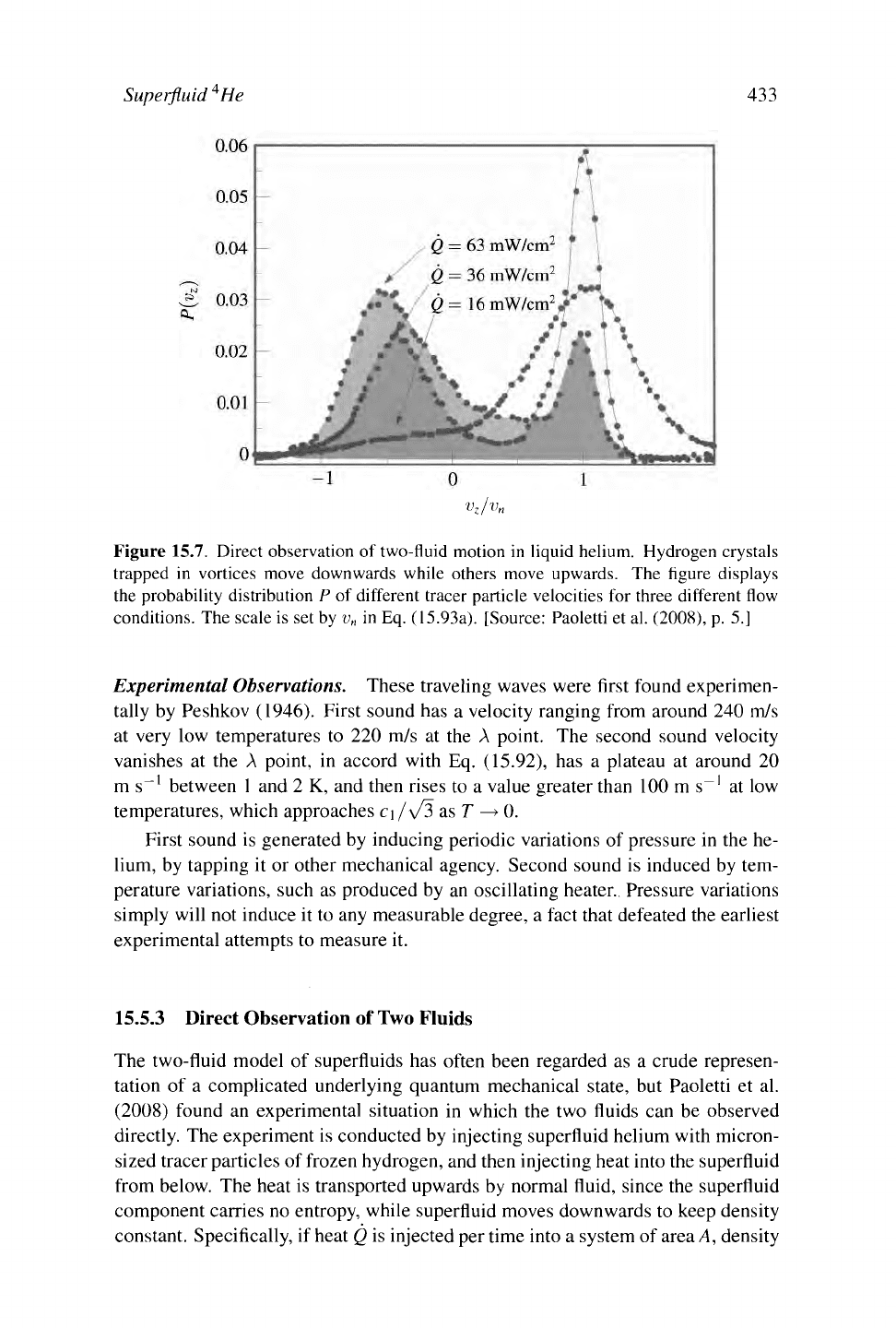
Figure 15.7. Direct observation of two-fluid motion in liquid helium. Hydrogen crystals
trapped in vortices move downwards while others move upwards. The figure displays
the probability distribution P of different tracer particle velocities for three different flow
conditions. The scale is set by
v„
in Eq. (15.93a). [Source: Paoletti et al. (2008), p. 5.]
Experimental Observations. These traveling waves were first found experimen-
tally by Peshkov (1946). First sound has a velocity ranging from around 240 m/s
at very low temperatures to 220 m/s at the λ point. The second sound velocity
vanishes at the λ point, in accord with Eq. (15.92), has a plateau at around 20
m s^
1
between
1
and 2 K, and then rises to a value greater than 100 m s
-1
at low
temperatures, which approaches
c\/\/3
as T
—>
0.
First sound is generated by inducing periodic variations of pressure in the he-
lium, by tapping it or other mechanical agency. Second sound is induced by tem-
perature variations, such as produced by an oscillating heater.. Pressure variations
simply will not induce it to any measurable degree, a fact that defeated the earliest
experimental attempts to measure it.
15.5.3 Direct Observation of Two Fluids
The two-fluid model of superfluids has often been regarded as a crude represen-
tation of a complicated underlying quantum mechanical state, but Paoletti et al.
(2008) found an experimental situation in which the two fluids can be observed
directly. The experiment is conducted by injecting superfluid helium with micron-
sized tracer particles of frozen hydrogen, and then injecting heat into the superfluid
from below. The heat is transported upwards by normal fluid, since the superfluid
component carries no entropy, while superfluid moves downwards to keep density
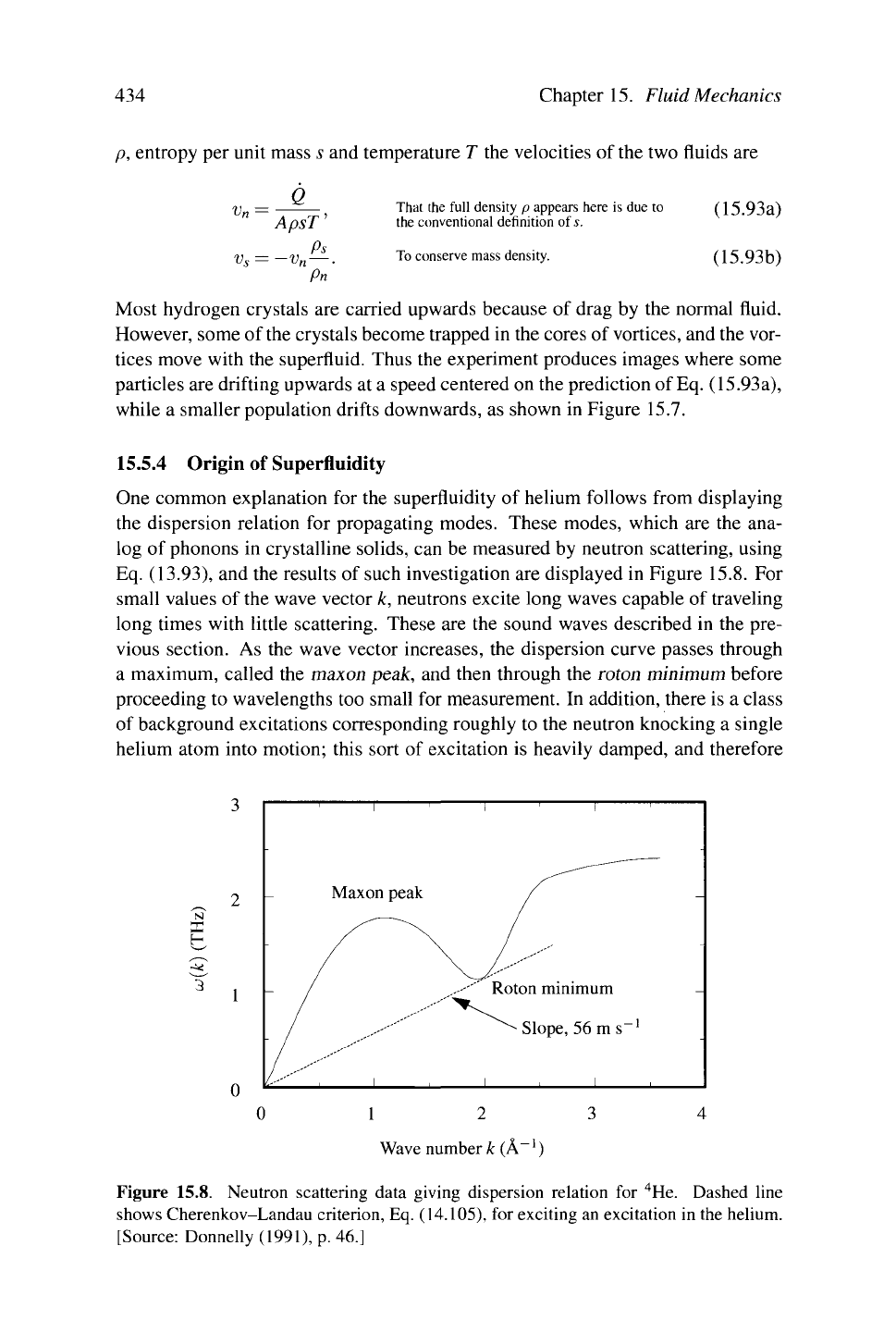
constant. Specifically, if heat Q is injected per time into a system of area
A,
density
434 Chapter 15. Fluid Mechanics
p,
entropy per unit mass s and temperature T the velocities of the two fluids are
That the full density p appears here is due to ( 15.93a)
the conventional definition of s.
To conserve mass density. (15.93b)
Most hydrogen crystals are carried upwards because of drag by the normal fluid.
However, some of the crystals become trapped in the cores of vortices, and the vor-
tices move with the superfluid. Thus the experiment produces images where some
particles are drifting upwards at a speed centered on the prediction of
Eq.
(15.93a),
while a smaller population drifts downwards, as shown in Figure 15.7.
15.5.4 Origin of Superfluidity
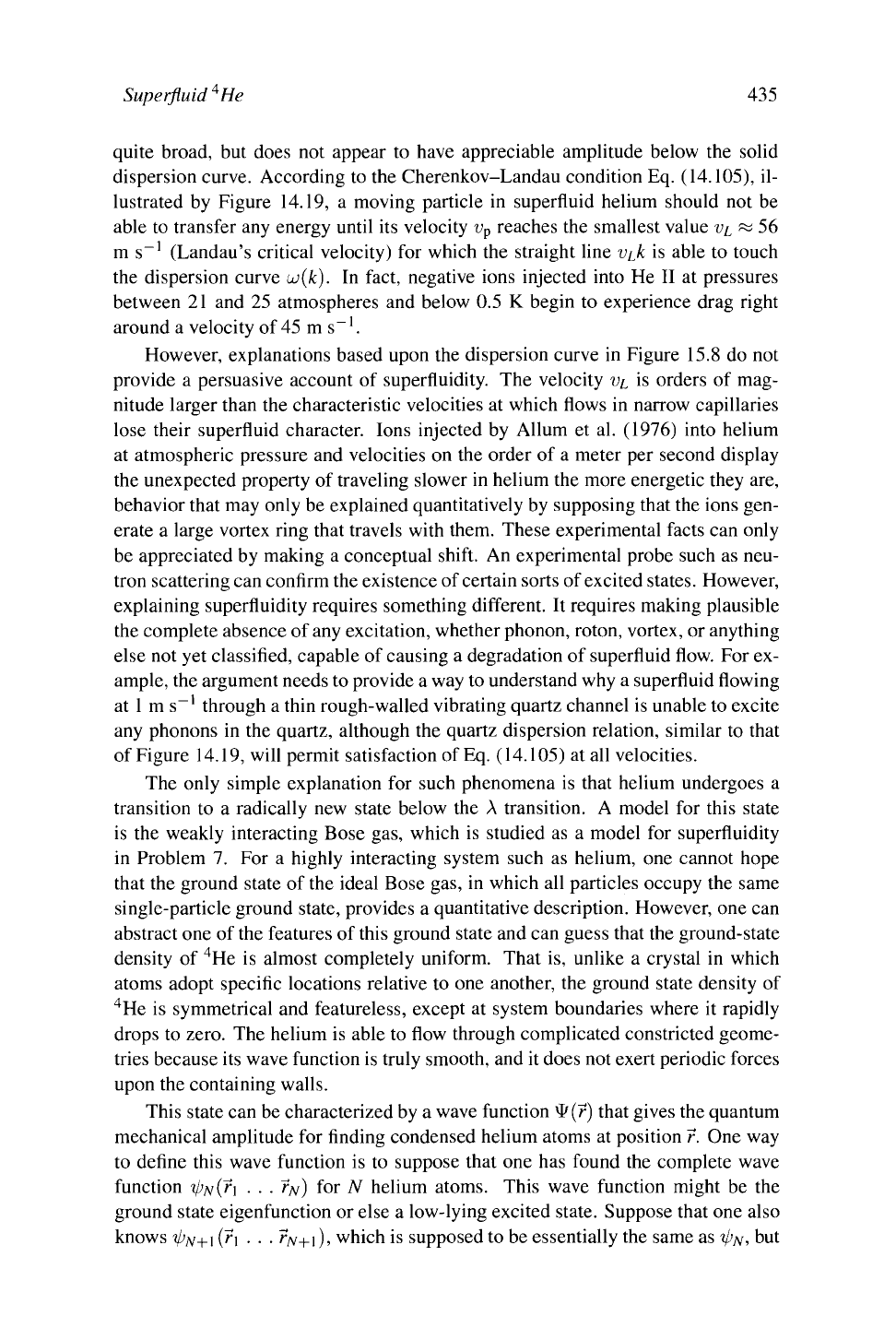
One common explanation for the superfluidity of helium follows from displaying
the dispersion relation for propagating modes. These modes, which are the ana-
log of phonons in crystalline solids, can be measured by neutron scattering, using
Eq. (13.93), and the results of such investigation are displayed in Figure 15.8. For
small values of the wave vector k, neutrons excite long waves capable of traveling
long times with little scattering. These are the sound waves described in the pre-
vious section. As the wave vector increases, the dispersion curve passes through
a maximum, called the maxon peak, and then through the roton minimum before
proceeding to wavelengths too small for measurement. In addition, there is a class
of background excitations corresponding roughly to the neutron knocking a single
helium atom into motion; this sort of excitation is heavily damped, and therefore
3
_ 2
X
5Γ
^ 1
0
0 12 3 4
Wave number k
(Â~
' )
Figure 15.8. Neutron scattering data giving dispersion relation for
4
He. Dashed line
shows Cherenkov-Landau criterion, Eq. (14.105), for exciting an excitation in the helium.
[Source: Donnelly (1991), p. 46.]
Vn
~ApsT'
Ps
V
s
=
-V„
—
Pn
Superfluid
4
He
435
quite broad, but does not appear to have appreciable amplitude below the solid
dispersion curve. According to the Cherenkov-Landau condition Eq. (14.105), il-
lustrated by Figure 14.19, a moving particle in superfluid helium should not be
able to transfer any energy until its velocity v
p
reaches the smallest value vi « 56
m s
-1
(Landau's critical velocity) for which the straight line vik is able to touch
the dispersion curve
uj(k).
In fact, negative ions injected into He II at pressures
between 21 and 25 atmospheres and below 0.5 K begin to experience drag right
around a velocity of
45
m s
_1
.
However, explanations based upon the dispersion curve in Figure 15.8 do not
provide a persuasive account of superfluidity. The velocity
VL
is orders of mag-
nitude larger than the characteristic velocities at which flows in narrow capillaries
lose their superfluid character. Ions injected by Allum et al. (1976) into helium
at atmospheric pressure and velocities on the order of a meter per second display
the unexpected property of traveling slower in helium the more energetic they are,
behavior that may only be explained quantitatively by supposing that the ions gen-
erate a large vortex ring that travels with them. These experimental facts can only
be appreciated by making a conceptual shift. An experimental probe such as neu-
tron scattering can confirm the existence of certain sorts of excited states. However,
explaining superfluidity requires something different. It requires making plausible
the complete absence of any excitation, whether phonon, roton, vortex, or anything
else not yet classified, capable of causing a degradation of superfluid flow. For ex-
ample, the argument needs to provide a way to understand why a superfluid flowing
at
1
m s
_1
through a thin rough-walled vibrating quartz channel is unable to excite
any phonons in the quartz, although the quartz dispersion relation, similar to that
of Figure 14.19, will permit satisfaction of
Eq.
(14.105) at all velocities.
The only simple explanation for such phenomena is that helium undergoes a
transition to a radically new state below the λ transition. A model for this state
is the weakly interacting Bose gas, which is studied as a model for superfluidity
in Problem 7. For a highly interacting system such as helium, one cannot hope
that the ground state of the ideal Bose gas, in which all particles occupy the same
single-particle ground state, provides a quantitative description. However, one can
abstract one of the features of this ground state and can guess that the ground-state
density of
4
He is almost completely uniform. That is, unlike a crystal in which
atoms adopt specific locations relative to one another, the ground state density of
4
He is symmetrical and featureless, except at system boundaries where it rapidly
drops to zero. The helium is able to flow through complicated constricted geome-
tries because its wave function is truly smooth, and it does not exert periodic forces
upon the containing walls.
This state can be characterized by a wave function
Ψ(Γ)
that gives the quantum
mechanical amplitude for finding condensed helium atoms at position r. One way
to define this wave function is to suppose that one has found the complete wave
function ΨΝ(7Ι
■ ■ ■
Ov) for N helium atoms. This wave function might be the
ground state eigenfunction or else a low-lying excited state. Suppose that one also
knows ΨΝ
+
\(?\ . . . 7N+\), which is supposed to be essentially the same as ψκ, but
436 Chapter 15. Fluid Mechanics
with one extra atom added at
?N+\.
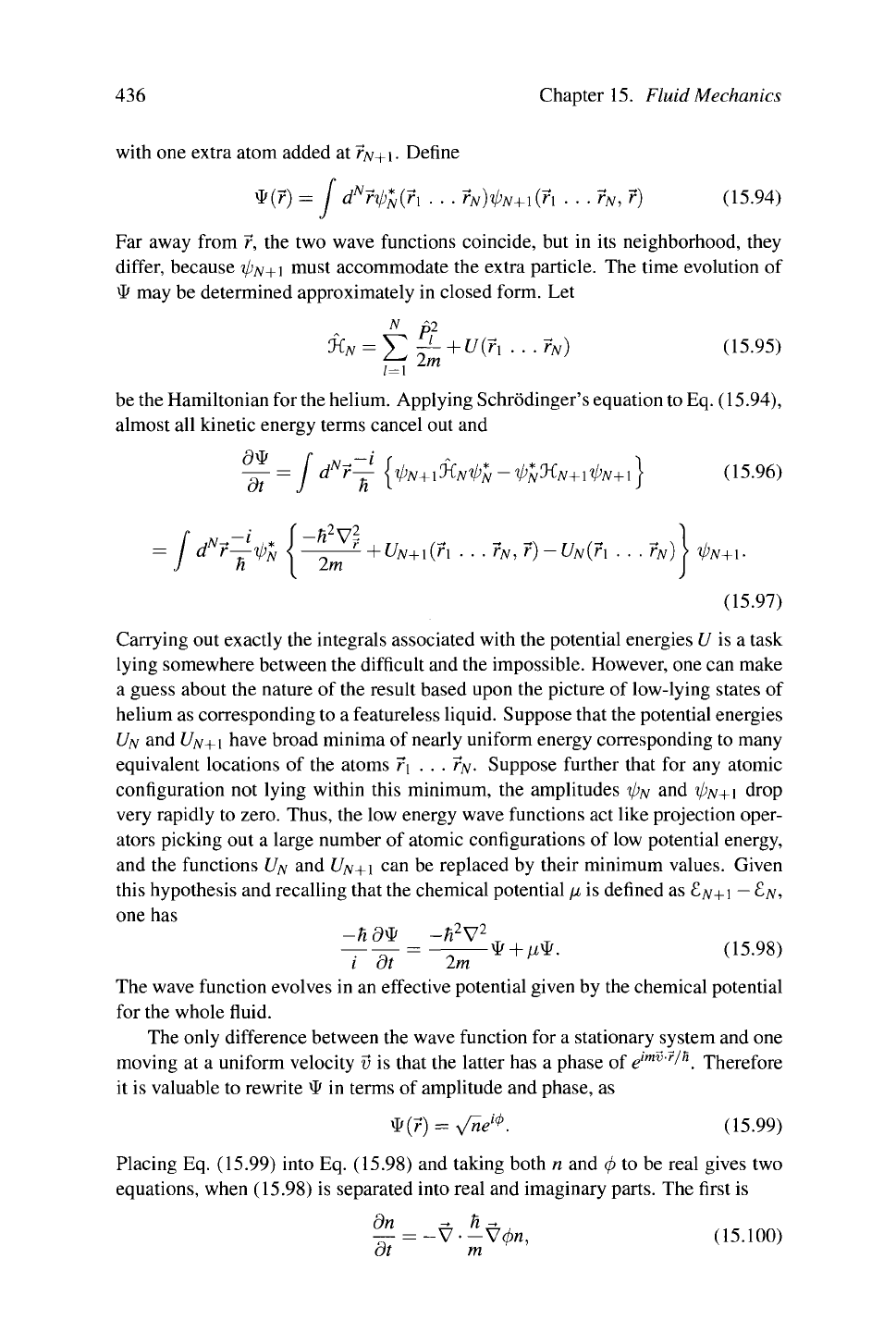
Define
Φ(Γ) = J d
N
rr
N
{h
■ ■ ■
7Ν)ΨΝ+Ι (n . . . 7
N
, 7) (15.94)
Far away from r, the two wave functions coincide, but in its neighborhood, they
differ, because
ΨΝ+Ì must accommodate the extra particle. The time evolution of
Φ may be determined approximately in closed form. Let
N pi
X
N
= V~ + U(n...r
N
) (15.95)
f^2m
be the Hamiltonian for the helium. Applying Schrödinger's equation to Eq.
(
15.94),
almost all kinetic energy terms cancel out and
■
/
d
N
r—
^φ
Ν+λ
%
Ν
'φ*
Ν
-'φ*
Ν
'Κ
Ν+
\'φ
Ν+
\^
(15.96)
/
ά
Ν
7—ψ
Ν
I —-—
r
- +
U
N+l
(n . . . r
N
, r) - U
N
{r\ . . . r
N
) \ φ
Ν+ι
.
(15.97)
Carrying out exactly the integrals associated with the potential energies U is a task
lying somewhere between the difficult and the impossible. However, one can make
a guess about the nature of the result based upon the picture of low-lying states of
helium as corresponding to a featureless liquid. Suppose that the potential energies
UN
and t/#+i have broad minima of nearly uniform energy corresponding to many
equivalent locations of the atoms r\ . . . r^. Suppose further that for any atomic
configuration not lying within this minimum, the amplitudes ψη and
ΨΝ+Ì drop
very rapidly to zero. Thus, the low energy wave functions act like projection oper-
ators picking out a large number of atomic configurations of low potential energy,
and the functions
UN
and ί/jv+i can be replaced by their minimum values. Given
this hypothesis and recalling that the chemical potential μ is defined as £^+i
—
8-N,
one has
-h ΟΦ -/i
2
V
2
— -κ- = ^ * + μΦ· (15-98)
ι at 2m
The wave function evolves in an effective potential given by the chemical potential
for the whole fluid.
The only difference between the wave function for a stationary system and one
moving at a uniform velocity v is that the latter has a phase of
e
imv
'
r
l
n
.
Therefore
it is valuable to rewrite Φ in terms of amplitude and phase, as
*(r) =
y/ne®.
(15.99)
Placing Eq. (15.99) into Eq. (15.98) and taking both n and φ to be real gives two
equations, when (15.98) is separated into real and imaginary parts. The first is
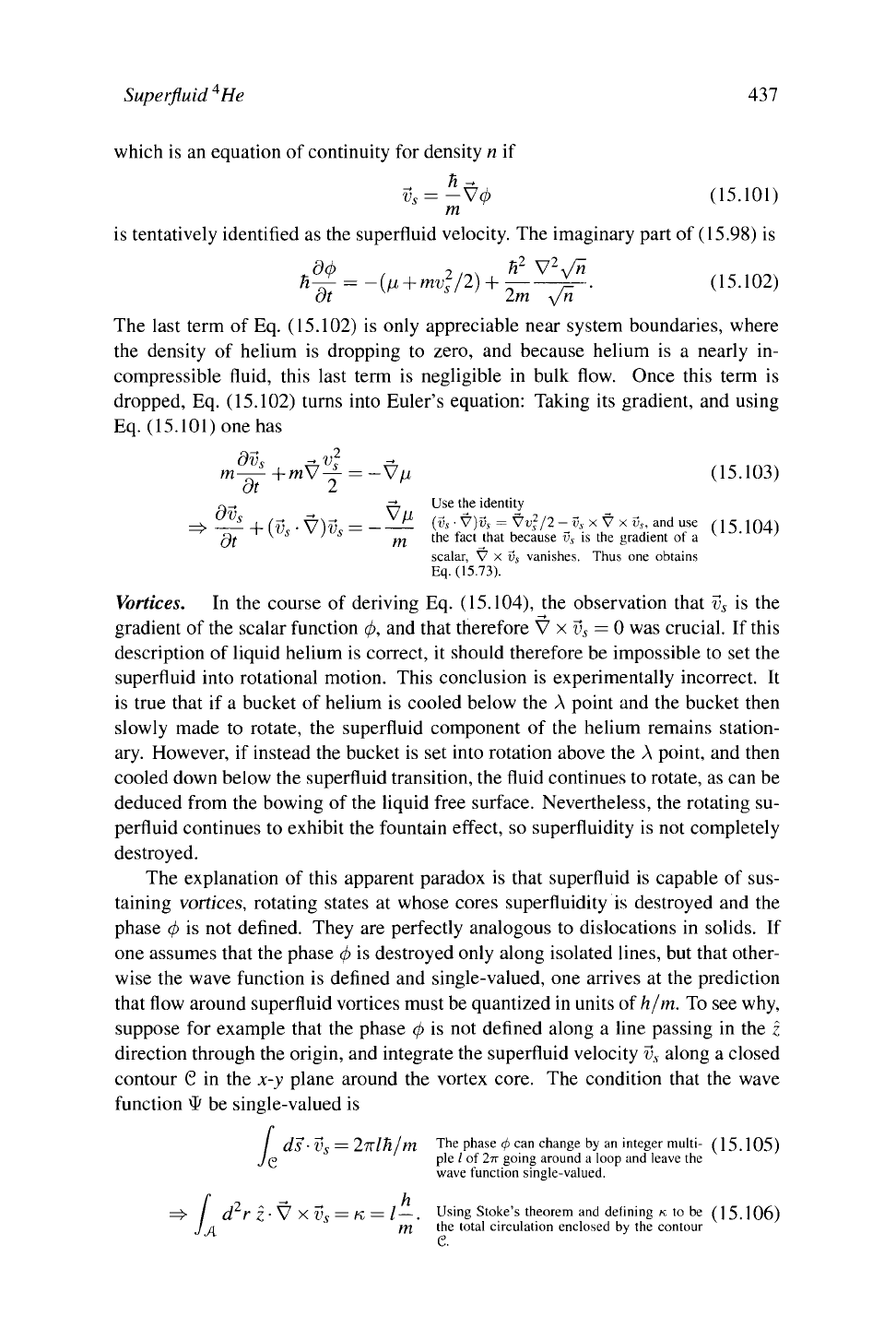
^ = -V--V<M, (15.100)
at m
Superfluid
4
He
437
which
is an
equation
of
continuity
for
density
n if
H
-
w
s
= —V0
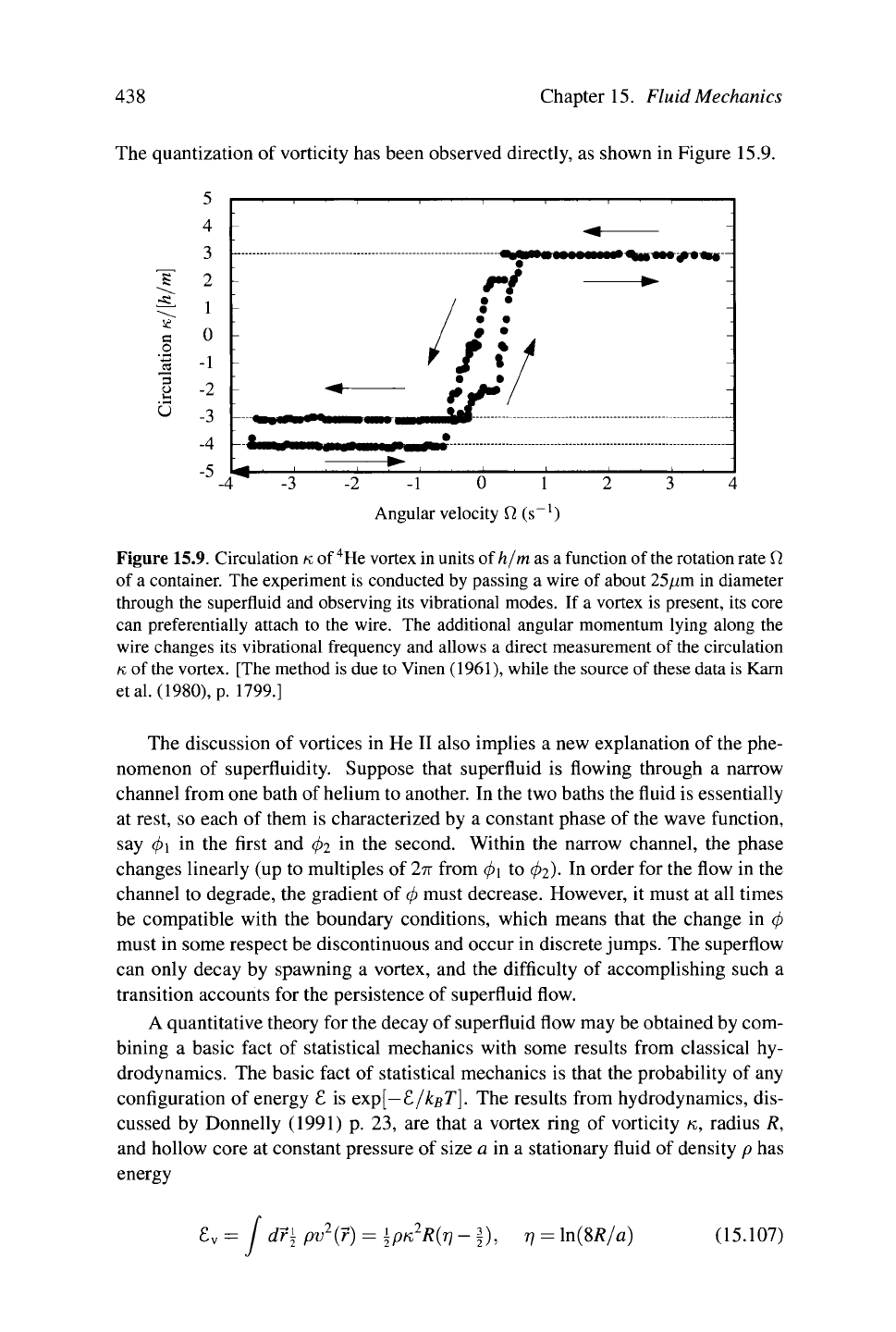
(15.101)
m
is tentatively identified
as the
superfluid velocity.
The
imaginary part
of
(15.98)
is
/^
= -(μ + ^
2
/2) + ^^·
(15.102)
ot
2m ^Jn
The last term
of
Eq. (15.102)
is
only appreciable near system boundaries, where
the density
of
helium
is
dropping
to
zero,
and
because helium
is a
nearly
in-
compressible fluid, this last term
is
negligible
in
bulk flow. Once this term
is
dropped,
Eq.
(15.102) turns into Euler's equation: Taking
its
gradient,
and
using
Eq. (15.101)
one has
m—-+mV^f
= -V/x
(15.103)
at
2
„_
^» Use the
identity
^~
+
(v
s
-V)v
s
=
-—
^7h =
7
v
>
/2
-
TjsX
,î
xT)
ï
an
,
d
T
(15.104)
ßl
v
■> ' jjj the
tact that because
v
s
is the
gradient
ot a
scalar,
V x v
s
vanishes. Thus
one
obtains
Eq. (15.73).
Vortices.
In the
course
of
deriving
Eq.
(15.104),
the
observation that
v
s
is the
gradient
of
the scalar function
φ, and
that therefore
V x v
s
= 0 was
crucial.
If
this
description
of
liquid helium
is
correct,
it
should therefore
be
impossible
to set the
superfluid into rotational motion. This conclusion
is
experimentally incorrect.
It
is true that
if a
bucket
of
helium
is
cooled below
the λ
point
and the
bucket then
slowly made
to
rotate,
the
superfluid component
of the
helium remains station-
ary. However,
if
instead
the
bucket
is set
into rotation above
the λ
point,
and
then
cooled down below
the
superfluid transition,
the
fluid continues
to
rotate,
as can be
deduced from
the
bowing
of
the liquid free surface. Nevertheless,
the
rotating
su-
perfluid continues
to
exhibit
the
fountain effect,
so
superfluidity
is not
completely
destroyed.
The explanation
of
this apparent paradox
is
that superfluid
is
capable
of
sus-
taining vortices, rotating states
at
whose cores superfluidity
is
destroyed
and the
phase
φ is not
defined. They
are
perfectly analogous
to
dislocations
in
solids.
If
one assumes that
the
phase
φ is
destroyed only along isolated lines,
but
that other-
wise
the
wave function
is
defined
and
single-valued,
one
arrives
at the
prediction
that flow around superfluid vortices must
be
quantized
in
units
of h/m. To see why,
suppose
for
example that
the
phase
φ is not
defined along
a
line passing
in the z
direction through
the
origin,
and
integrate
the
superfluid velocity
v
s
along
a
closed
contour
C in the x-y
plane around
the
vortex core.
The
condition that
the
wave
function
Φ be
single-valued
is
/
ds-V
s
=
2πΙΗ/ίΠ
The
P
hase
Φ
can
change
by an
integer multi-
(
15.105
)
JQ
pie / of 2π
going around
a
loop
and
leave
the
wave function single-valued.
f
? h
=>
/ d r Z· V X V
s
= K = I —.
Using Stoke's theorem
and
defining
K to be
(15.106)
J j{
' m the
total circulation enclosed
by the
contour
e.
438
Chapter 15. Fluid Mechanics
The quantization of vorticity has been observed directly, as shown in Figure 15.9.
a
o
3
o
}-<
U
5
4
3
2
1
0
-1
-2
-3
-4
-5
-4
-2-101234
Angular velocity
Ω
(s
_1
)
Figure 15.9. Circulation κ of
4
He vortex in units of h/m
as a
function of
the
rotation rate
Ω
of
a
container. The experiment is conducted by passing a wire of about 25μπι in diameter
through the superfluid and observing its vibrational modes. If a vortex is present, its core
can preferentially attach to the wire. The additional angular momentum lying along the
wire changes its vibrational frequency and allows a direct measurement of
the
circulation
K
of
the
vortex. [The method is due to Vinen (1961), while the source of
these
data is Karn
et
al.
(1980), p. 1799.]
The discussion of vortices in He II also implies a new explanation of the phe-
nomenon of superfluidity. Suppose that superfluid is flowing through a narrow
channel from one bath of helium to another. In the two baths the fluid is essentially
at rest, so each of them is characterized by a constant phase of the wave function,
say φ\ in the first and
Φ2
in the second. Within the narrow channel, the phase
changes linearly (up to multiples of 2π from φ\ to 02). In order for the flow in the
channel to degrade, the gradient of φ must decrease. However, it must at all times
be compatible with the boundary conditions, which means that the change in φ
must in some respect be discontinuous and occur in discrete
jumps.
The superflow
can only decay by spawning a vortex, and the difficulty of accomplishing such a
transition accounts for the persistence of superfluid flow.
A quantitative theory for the decay of superfluid flow may be obtained by com-
bining a basic fact of statistical mechanics with some results from classical hy-
drodynamics. The basic fact of statistical mechanics is that the probability of any
configuration of energy δ is exp[—t/kßT]. The results from hydrodynamics, dis-
cussed by Donnelly (1991) p. 23, are that a vortex ring of vorticity κ, radius R,
and hollow core at constant pressure of size a in a stationary fluid of density p has
energy
w
dr\ pv
2
{r) = \ρκ
2
ΙΙ(η - §), η = ln(SR/a)
(15.107)
Superfluid He
439
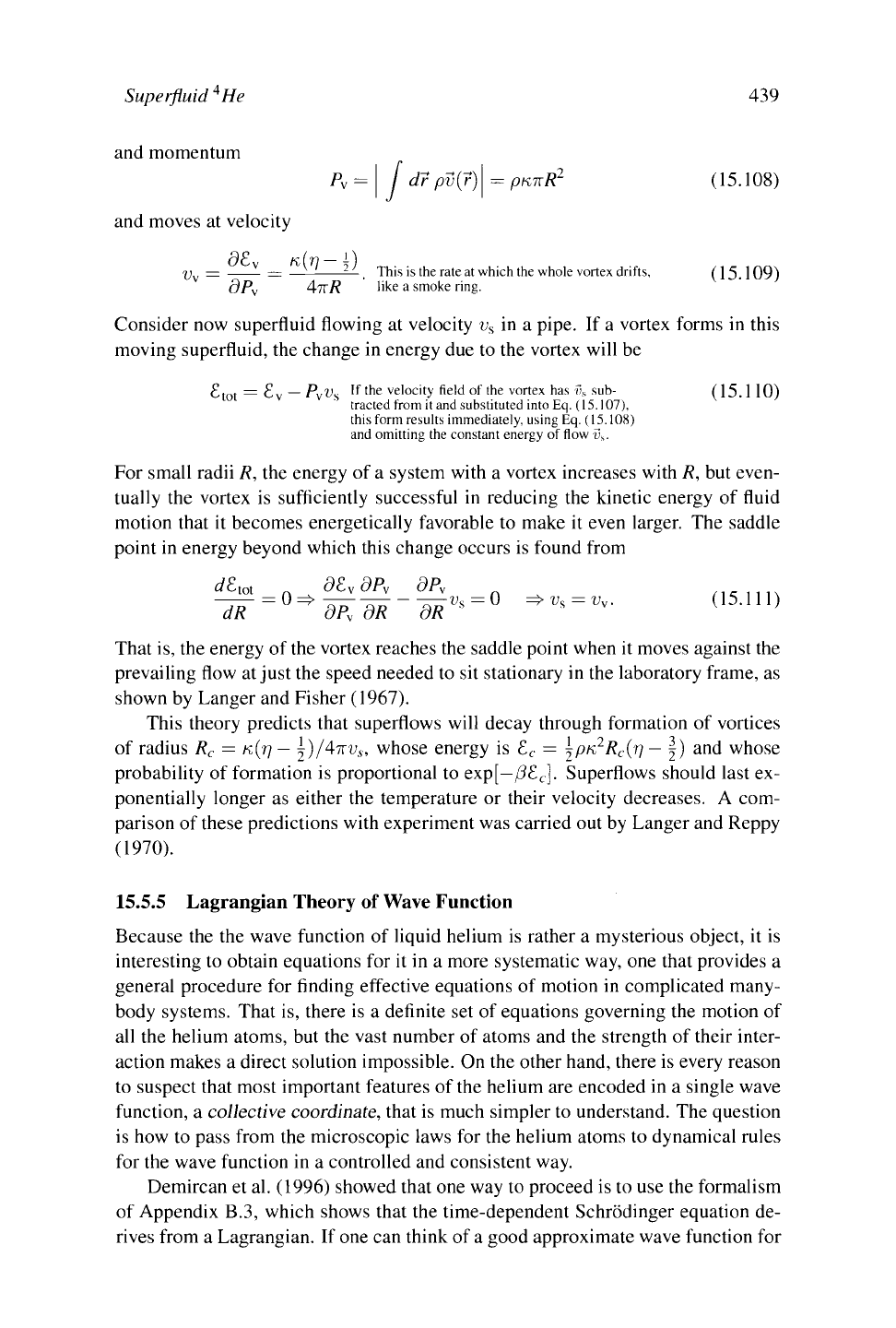
and momentum
P
v
and moves at velocity
<9£
v
κ(η—\
[ dr pv{7) = pnnR
2
(15.108)
This is the rate at which the whole vortex drifts, (15.109)
dP\/
ATÏR
'ike a smoke ring
Consider now superfluid flowing at velocity
v
%
in a pipe. If a vortex forms in this
moving superfluid, the change in energy due to the vortex will be
£
tot
=
£
v
— Ρ
ν
ν$ If the velocity field of the vortex has
<3
S
sub- (15.1 10)
tracted from it and substituted intoEq. (15.107),
this form results immediately, using Eq. (15.108)
and omitting the constant energy of flow v
s
.
For small radii R, the energy of a system with a vortex increases with R, but even-
tually the vortex is sufficiently successful in reducing the kinetic energy of fluid
motion that it becomes energetically favorable to make it even larger. The saddle
point in energy beyond which this change occurs is found from
-dR-
= 0
^W
v
^R--jR-
V
*
= 0
^
V
*
= V
-
(15
·
Π1)
That is, the energy of the vortex reaches the saddle point when it moves against the
prevailing flow
at
just the speed needed to sit stationary in the laboratory frame, as
shown by Langer and Fisher (1967).
This theory predicts that superflows will decay through formation of vortices
of radius R
c
= κ(η
—
^)/4πν
5
, whose energy is £
c
=
^pn
2
R
c
^
—
|) and whose
probability of formation is proportional to exp[—/3£
c
]. Superflows should last ex-
ponentially longer as either the temperature or their velocity decreases. A com-
parison of these predictions with experiment was carried out by Langer and Reppy
(1970).
15.5.5 Lagrangian Theory of Wave Function
Because the the wave function of liquid helium is rather a mysterious object, it is
interesting to obtain equations for it in a more systematic way, one that provides a
general procedure for finding effective equations of motion in complicated many-
body systems. That is, there is a definite set of equations governing the motion of
all the helium atoms, but the vast number of atoms and the strength of their inter-
action makes a direct solution impossible. On the other hand, there is every reason
to suspect that most important features of the helium are encoded in a single wave
function, a collective
coordinate,
that is much simpler to understand. The question
is how to pass from the microscopic laws for the helium atoms to dynamical rules
for the wave function in a controlled and consistent way.
Demircan et al. (1996) showed that one way to proceed is to use the formalism
of Appendix B.3, which shows that the time-dependent Schrödinger equation de-
rives from a Lagrangian. If one can think of a good approximate wave function for
440
Chapter 15. Fluid Mechanics
helium, the formalism describes how it will evolve in time. Feynman (1953) sug-
gested a way of building a wave function. Imagine that the ground-state wave func-
tion of helium in some experimental geometry is known, and call it φ{τ\ . . . r#).
This ground state wave function may be tremendously complicated, and cannot be
found in practice, but in the end one will need to know surprisingly little about it.
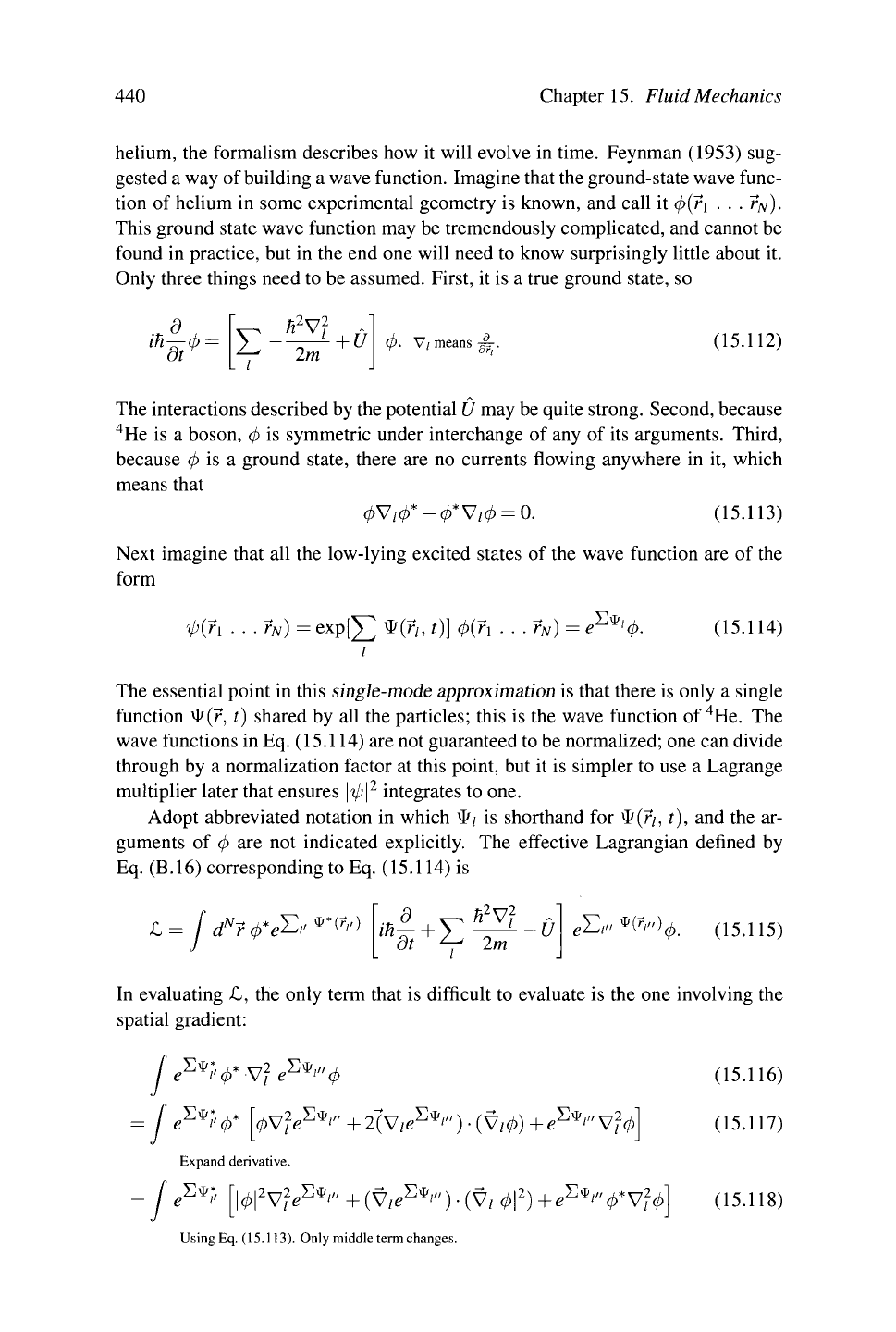
Only three things need to be assumed. First, it is a true ground state, so
ih.
d
dt*
Σ
L
/
2m
V/ means -â-.
(15.112)
The interactions described by the potential Ü may be quite strong. Second, because
4
He is a boson, φ is symmetric under interchange of any of its arguments. Third,
because φ is a ground state, there are no currents flowing anywhere in it, which
means that
-0*V,<;
Φν
0.
(15.113)
Next imagine that all the low-lying excited states of the wave function are of the
form
V>(n . . . r
N
) = exp[^ Φ(?/, ή] Φ(λ · ·
-
r
N
)
„ΣΦ,
(15.114)
The essential point in this single-mode approximation is that there is only a single
function *(r, t) shared by all the particles; this is the wave function of
4
He. The
wave functions in Eq. (15.114) are not guaranteed to be normalized; one can divide
through by a normalization factor at this point, but it is simpler to use a Lagrange
multiplier later that ensures \ψ\
2
integrates to one.
Adopt abbreviated notation in which Ψ/ is shorthand for *(r/, t), and the ar-
guments of φ are not indicated explicitly. The effective Lagrangian defined by
Eq. (B.16) corresponding to Eq. (15.114) is
L
= J ά
Ν
7φ*β^^^)
■ a ^
h
2
vì
dt
ι
1m
■U
,Σ,» *«»),
(15.115)
In evaluating L, the only term that is difficult to evaluate is the one involving the
spatial gradient:
/
ΣΦ;
e i'
ΣΦ;
■V?
e
E
*'"<
7
2„Σφ„
φνΐβ^
ψ
>"
+2(ν
/<?
Σφ
'")
·
(V/0) +*
Σφ
'" V^
Expand derivative.
|0|2
ν
2
β
ΣΨ,„
+
(ν
/ί?
ΣΨ,„ ). (ν
;
|0|
2
) + β
Σφ
/"0*V?<î
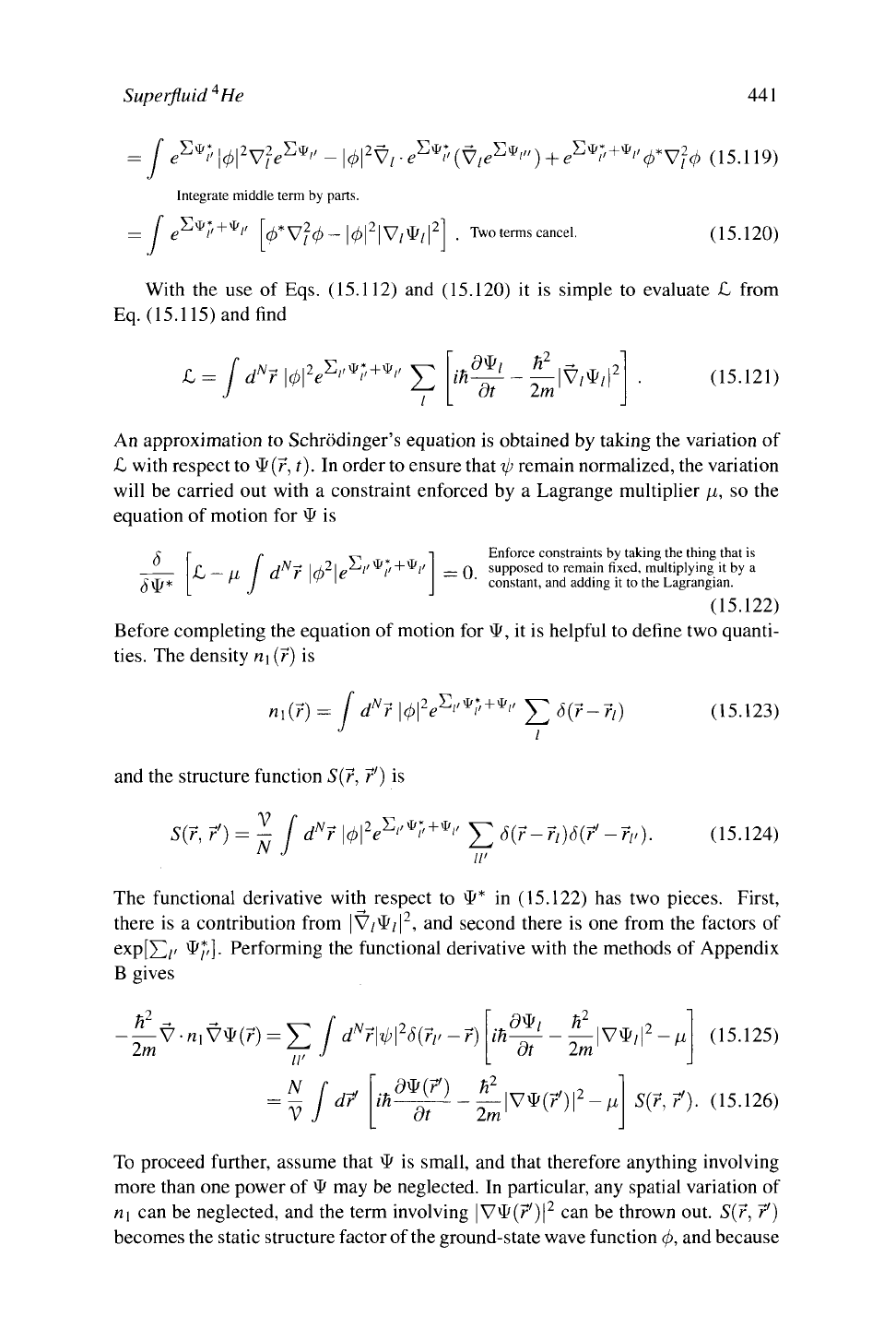
Using Eq. (15.113). Only middle term changes.
ΣΦΓ/
e i'
(15.116)
(15.117)
(15.118)
Superfluid
4
He
441
Ί β
Έ
^'\φ\
2
ν^^>'-\φ\
2
^
Γ
β
Έ
^Ην
ι
β^''')
+
ε
Έ
^
+
^>'φ*Ψ
ι
φ (15.119)
Integrate
middle
term
by parts.
*V72J.
|j.|2|
6
ΣΦ;,+Φ,,
'vfa-ΗΊν,Φ,
Two
terms
cancel.
(15.120)
With the use of Eqs. (15.112) and (15.120) it is simple to evaluate L from
Eq. (15.115) and find
L = j ά
Ν
Τ\φ\
2
β
Έ
>'*ϊ
+
*>'Σ
' 0Φ; h
2
.-.
τ
.,'
(15.121)
An approximation to Schrödinger's equation is obtained by taking the variation of
L with respect to
Φ(Γ,
t). In order to ensure that φ remain normalized, the variation
will be carried out with a constraint enforced by a Lagrange multiplier μ, so the
equation of motion for Φ is
5Φ*
L-μ
I
/rl^l^'*?^
Enforce
constraints
by
taking
the
thing
that
is
_ n
supposed
to
remain
fixed,
multiplying
it by a
constant,
and
adding
it to the
Lagrangian.
(15.122)
Before completing the equation of motion for Φ, it is helpful to define two quanti-
ties.
The density n\ (r) is
„,(?) = f d
N
r |</>|
2
ί>
Σ
<'
φ
*'
+φ
'' Σ δ(?-7ι) (15.123)
·* ι
and the structure function S(r, ?') is
S(r, r') = ^ f d
N
f \φ\
2
ε
Έ
>'^>
+
*' Σ
δ
(7-
7ι
)
δ
ρ-
7ιι
). (15.124)
J
w
The functional derivative with respect to Φ* in (15.122) has two pieces. First,
there is a contribution from (V/Φ/Ι
2
, and second there is one from the factors of
εχ
ρ[Σ/'
Φ*']- Performing the functional derivative with the methods of Appendix
B gives
2m
ν·«,νΦ(?) = ^ j d
N
r\i)\
2
8{r
v
-r)
11
N
V
. ΟΦ, H
2
|πτ |2
ίΤζ^τ
1
-—|νΦ,|
2
-μ
dt 2m
(15.125)
df
ih- '
IV7,T,«'M2
dt 2m
\νπη-μ
S{r,Y).
(15.126)
To proceed further, assume that Φ is small, and that therefore anything involving
more than one power of Φ may be neglected. In particular, any spatial variation of
n\
can be neglected, and the term involving |νΦ(Γ')|
2
can be thrown out. S(r, r')
becomes the static structure factor of
the
ground-state wave function φ, and because
442
Chapter 15. Fluid Mechanics
the ground state should be translationally invariant, S should depend only upon
r
—
r'. Taking the Fourier transform of
Eq.
(15.126) gives
2 ;,2
2m
■Ψ(& α;) = [hw*{q, ω) -
ß
ö{q)ö{u)]S{q)
(15.127)
Hijj(q)
■
h
2
q
2
6.02k
B
[q
·
Â]
2
2mS(q)
S(q)
K So long as one stays away from (
1
5 128)
'
ω
= o, q = 0.
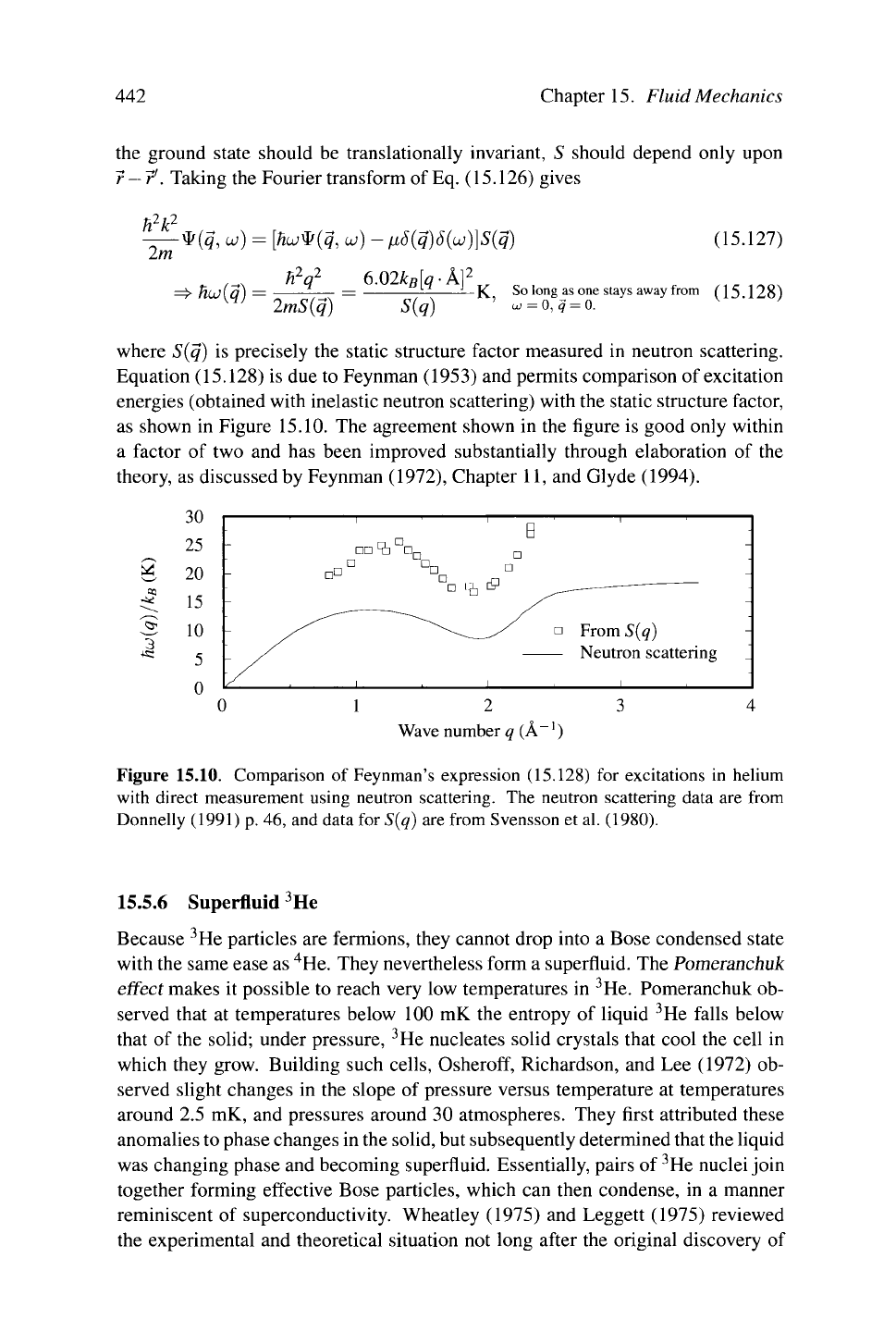
where S(q) is precisely the static structure factor measured in neutron scattering.
Equation (15.128) is due to Feynman (1953) and permits comparison of excitation
energies (obtained with inelastic neutron scattering) with the static structure factor,
as shown in Figure 15.10. The agreement shown in the figure is good only within
a factor of two and has been improved substantially through elaboration of the
theory, as discussed by Feynman (1972), Chapter 11, and Glyde (1994).
□ From S(q)
- Neutron scattering
1 2
Wave number
q
(Â~
' )
Figure 15.10. Comparison of Feynman's expression (15.128) for excitations in helium
with direct measurement using neutron scattering. The neutron scattering data are from
Donnelly (1991) p. 46, and data for
S(q)
are from Svensson et
al.
(1980).
15.5.6 Superfluid
3
He
Because
3
He particles are fermions, they cannot drop into a Bose condensed state
with the same ease as
4
He. They nevertheless form a superfluid. The Pomeranchuk
effect makes it possible to reach very low temperatures in
3
He. Pomeranchuk ob-
served that at temperatures below 100 mK the entropy of liquid
3
He falls below
that of the solid; under pressure,
3
He nucleates solid crystals that cool the cell in
which they grow. Building such cells,
Osheroff,
Richardson, and Lee (1972) ob-
served slight changes in the slope of pressure versus temperature at temperatures
around 2.5 mK, and pressures around 30 atmospheres. They first attributed these
anomalies to phase changes in the solid, but subsequently determined that the liquid
was changing phase and becoming superfluid. Essentially, pairs of
3
He nuclei join
together forming effective Bose particles, which can then condense, in a manner
reminiscent of superconductivity. Wheatley (1975) and Leggett (1975) reviewed
the experimental and theoretical situation not long after the original discovery of