
Marder M.P. Condensed Matter Physics
Подождите немного. Документ загружается.

Noninteracting Electrons in
an
Electric Field 463
x
=
£-
g
/eE
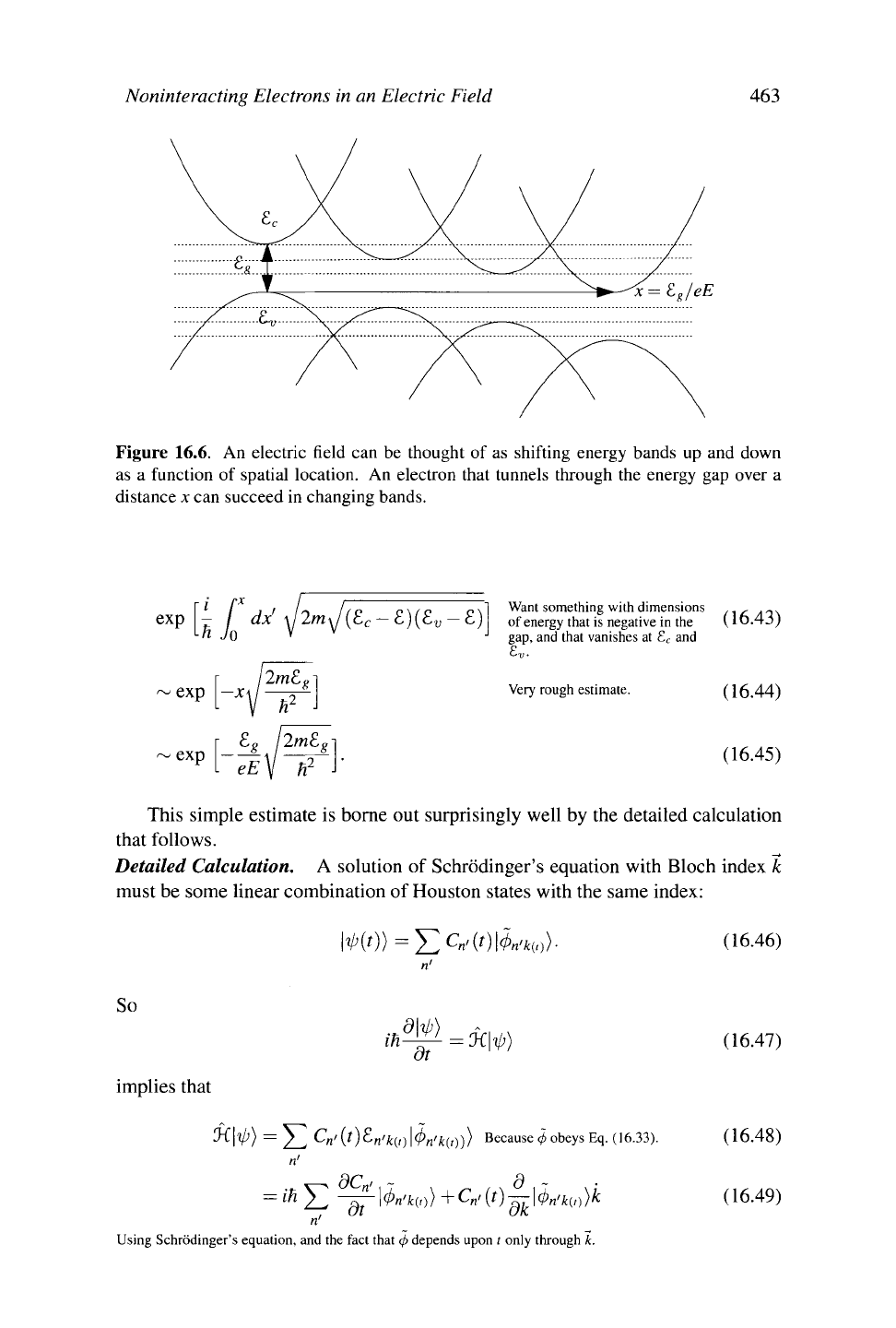
Figure 16.6. An electric field can
be
thought
of
as shifting energy bands up and down
as
a
function
of
spatial location. An electron that tunnels through the energy gap over
a
distance
x
can succeed in changing bands.
exp
1
f J I /-> /7c c\7c cTl
Want something with dimensions
.
0
-dX y Zmy {t
c
—
t){t
v
— t) of
energy
that is negative in the (16.43)
L
« JO '
J
gap, and that vanishes at
£
c
and
exp
exp
2mE
t
Very rough estimate.
I2m£
e
eE\
H
2
(16.44)
(16.45)
This simple estimate
is
borne out surprisingly well
by
the detailed calculation
that follows.
Detailed Calculation.
A
solution
of
Schrödinger's equation with Bloch index
k
must be some linear combination
of
Houston states with the same index:
So
implies that
M0>
=
£
c
»'(')l^'*<.)>-
ih-
dt
= W>
^IV')
= z2
Cn'(.
t
)£n'k(.t)\
(
i
)
n'k(t))) Because
<f>
obeys Eq. (16.33).
n'
"
ih
^2 -^-\4>n'k(,))+C„'(t)
—
\4)
n
>
kil)
)k
n'
Using Schrödinger's equation, and the fact that
(j>
depends upon
t
only through
k.
(16.46)
(16.47)
(16.48)
(16.49)
464 Chapter 16. Dynamics of Block Electrons
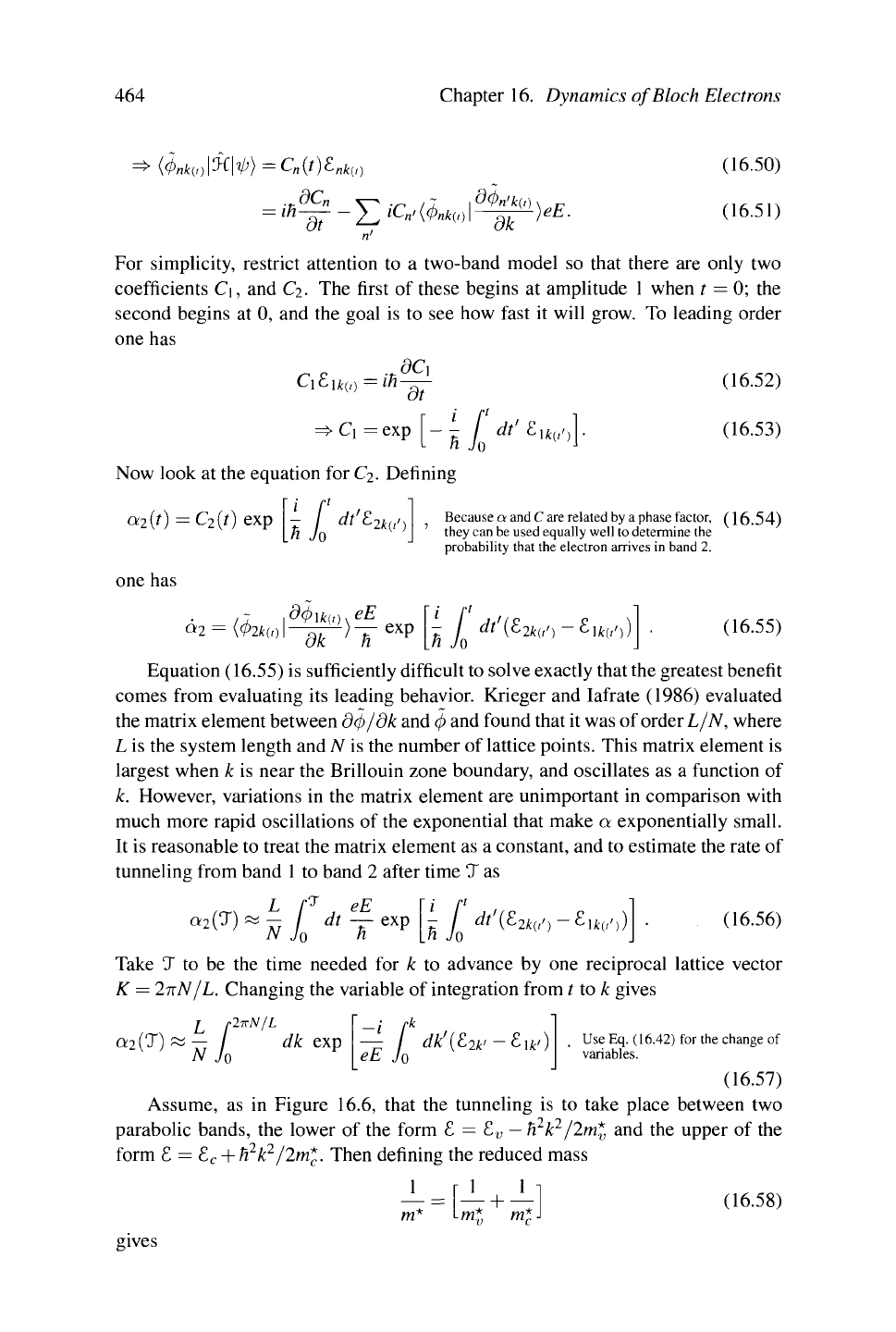
{<l>nk(,)\W\lp)
=C
n
(t)£.
nk(l)
ih
9Cn
dt
£
iC
n
i
Pnk(t) I
ß(j)
n
'*(<)
dk
eE.
(16.50)
(16.51)
For simplicity, restrict attention to a two-band model so that there are only two
coefficients C\, and C
2
. The first of these begins at amplitude 1 when t = 0; the
second begins at 0, and the goal is to see how fast it will grow. To leading order
one has
dC\
C\£\k(,)
= ih-
dt
=> C\ = exp
Now look at the equation for C
2
. Defining
dt' £
\k(,')
(16.52)
(16.53)
«2(0 = C2W e
x
P
one has
dt'l
2k(,')
Because a and C are related by a phase factor, ( 16.54)
they can be used equally well to determine the
probability that the electron arrives in band 2.
a.2
5
2*(0
I
wo
eE
exp
ft
Jo
dt
'
{2
-
lk(,,)
■\k(i'))
(16.55)
dk ' h
Equation (16.55) is sufficiently difficult to solve exactly that the greatest benefit
comes from evaluating its leading behavior. Krieger and Iafrate (1986) evaluated
the matrix element between d(p/dk and
4>
and found that it was of order L/N, where
L is the system length and N is the number of lattice points. This matrix element is
largest when k is near the Brillouin zone boundary, and oscillates as a function of
k. However, variations in the matrix element are unimportant in comparison with
much more rapid oscillations of the exponential that make a exponentially small.
It is reasonable to treat the matrix element as a constant, and to estimate the rate of
tunneling from band 1 to band 2 after time 7 as
dt {&2k(i') — &\k(,'))
a
2
{7)
N
o
T
eE
dt -r- exp
ft
0
(16.56)
Take 7 to be the time needed for k to advance by one reciprocal lattice vector
K = 2nN/L. Changing the variable of integration from t to k gives
a
2
(7)
L
N
2-KN/L
dk exp
dk?(£
2k'
■\k'
Use Eq. (16.42) for the change of
variables.
— I
o
\_eE JO
(16.57)
Assume, as in Figure 16.6, that the tunneling is to take place between two
parabolic bands, the lower of the form £ = E
v
—
ft k
2
/2m* and the upper of the
form £ = £,
c
+ h
2
k
2
/2m*. Then defining the reduced mass
1
m
gives
f
1
-ml
+
1 i
m*-
(16.58)
Semiclassical Equations from
Wave
Packets 465
2t/2
'■■2k'
■Ik' £,+
2m*
(16.59)
Placing Eq. (16.59) into Eq. (16.57) produces an integral that is impossible to per-
form exactly, but that easily can be estimated by the method of steepest descents
(Appendix B.4). Let q be the point in the complex plane where
2^2
£,+
¥q
2m*
0.
(16.60)
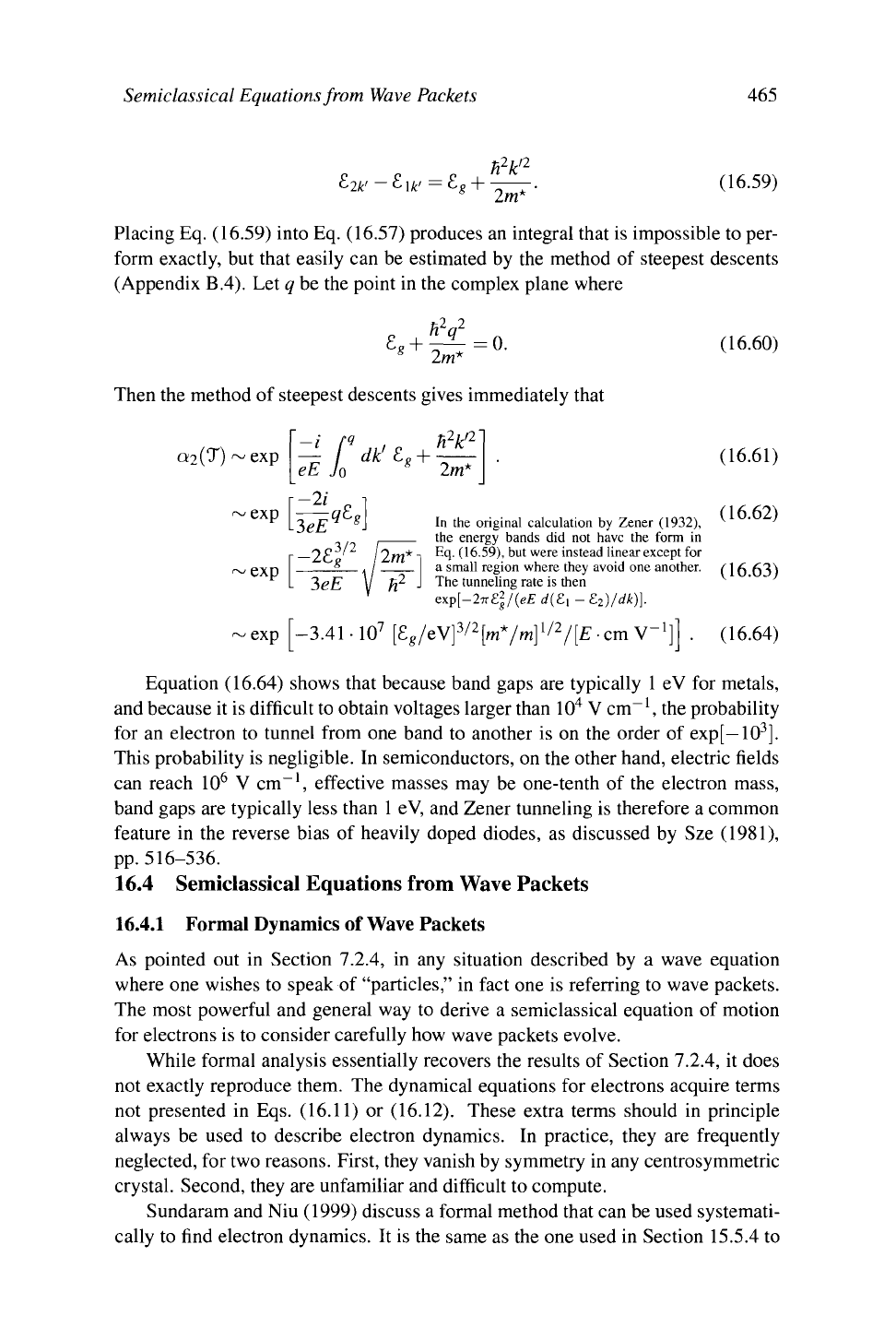
Then the method of steepest descents gives immediately that
&2{T)
~exp
exp
exp
' -i H _,,, .
h
2
k'
2
-2I
3eE
<?
£
«
-28
3/2
12m*
3eE
2m*
In the original calculation by Zener (1932),
the energy bands did not have the form in
Eq. (16.59), but were instead linear except for
a small region where they avoid one another.
The tunneling rate is then
exp[-2TTE
2
g
/(eE rf(£, - E
2
)/dk)].
exp f—3.41
■
10
7
[£,
g
/éV]
3
/
2
[m*/m]
l
'
2
/[E-cmV-
(16.61)
(16.62)
(16.63)
(16.64)
Equation (16.64) shows that because band gaps are typically 1 eV for metals,
and because it is difficult to obtain voltages larger than 10
4
V cm
-
', the probability
for an electron to tunnel from one band to another is on the order of exp[—10
3
].
This probability is negligible. In semiconductors, on the other hand, electric fields
can reach 10
6
V cm
-1
, effective masses may be one-tenth of the electron mass,
band gaps are typically less than
1
eV, and Zener tunneling is therefore a common
feature in the reverse bias of heavily doped diodes, as discussed by Sze (1981),
pp.
516-536.
16.4 Semiclassical Equations from Wave Packets
16.4.1 Formal Dynamics of Wave Packets
As pointed out in Section 7.2.4, in any situation described by a wave equation
where one wishes to speak of "particles," in fact one is referring to wave packets.
The most powerful and general way to derive a semiclassical equation of motion
for electrons is to consider carefully how wave packets evolve.
While formal analysis essentially recovers the results of Section 7.2.4, it does
not exactly reproduce them. The dynamical equations for electrons acquire terms
not presented in Eqs. (16.11) or (16.12). These extra terms should in principle
always be used to describe electron dynamics. In practice, they are frequently
neglected, for two reasons. First, they vanish by symmetry in any centrosymmetric
crystal. Second, they are unfamiliar and difficult to compute.
Sundaram and Niu (1999) discuss a formal method that can be used systemati-
cally to find electron dynamics. It is the same as the one used in Section 15.5.4 to
466 Chapter 16. Dynamics of Block Electrons
find an equation of motion for the wave function of superfluid helium, the effective
Lagrangian of Appendix B.
It is first necessary to define carefully a wave packet W-
7.
(r) centered in space
at r
c
and dominated by wave vector k
c
. In the presence of a magnetic induction
whose vector potential is A, the proper definition is
]
r
• 2/—i-/s
-Z
~ N is the number of unit cells in the system. £
W- r (r) = / Wrr e~ '
r
'
''ll>7
(V). '
s
summed over a single Brillouin zone, ip];
' ' vAf _ ' are solutions of Schrödinger's equation, all
k sharing band index n.
(16.65)
The phase factors in
(
16.65) are needed in order to ensure that W vary slowly as
r
c
and
~k
c
vary. Bloch functions naturally oscillate with phase factor e'
kr
and, in the
presence of a magnetic field, acquire an additional phase factor e~'
e
J
drA
(
r
)/
nc
^
by
incorporating these phase factors into the definition of the wave packet, the hope is
to eliminate wild oscillations in W. The wave packet must be normalized, so
i =
KiKi) =4 E /0^-
l)
-
fe
^^T&wm
=
E
w
u,
w
kM
kk' ' kk'
(16.66)
=> 1 = \ \wrr I . ^ is normalized over the volume V of the crystal. (16.67)
k
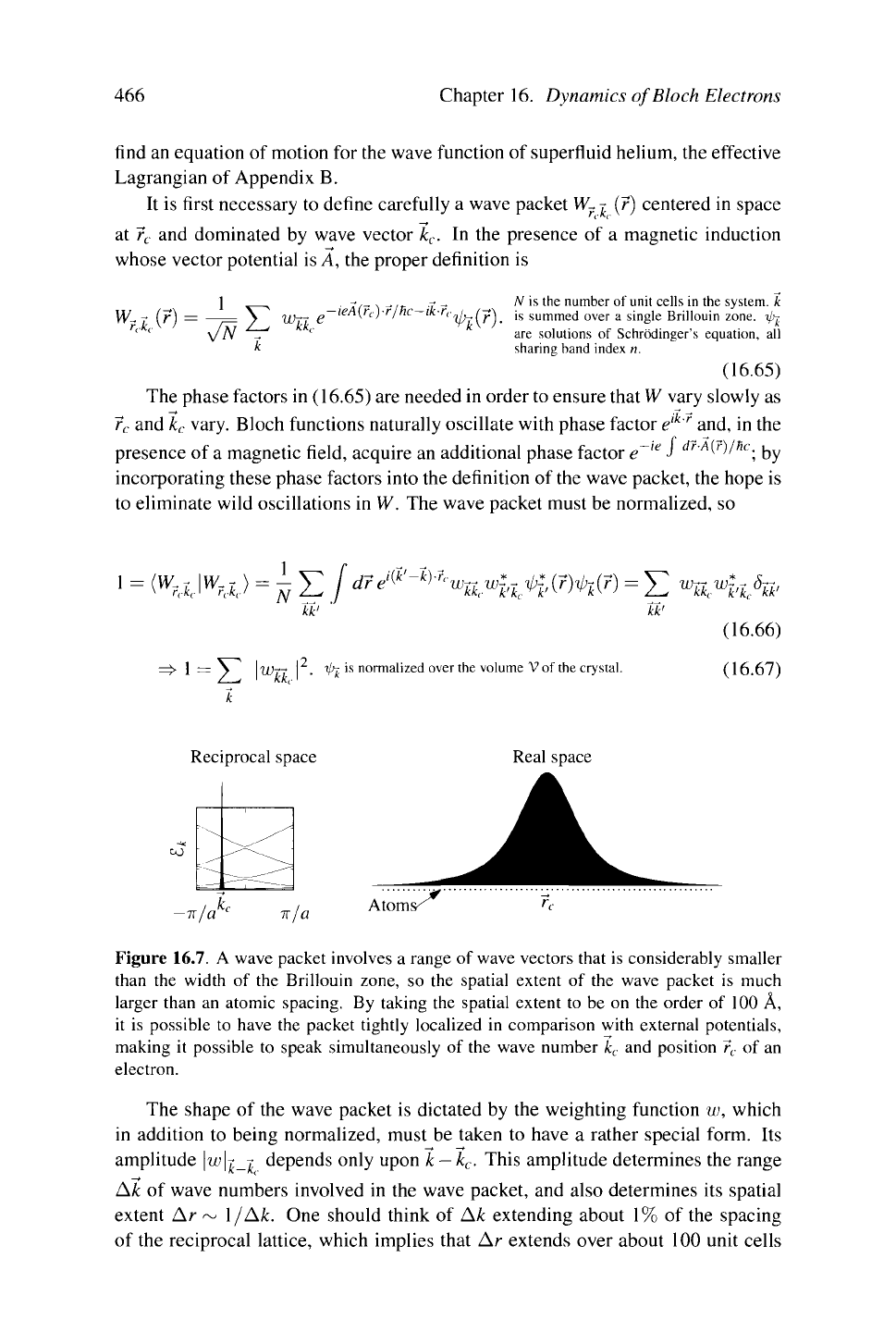
Reciprocal space Real space
Figure 16.7. A wave packet involves a range of wave vectors that is considerably smaller
than the width of the Brillouin zone, so the spatial extent of the wave packet is much
larger than an atomic spacing. By taking the spatial extent to be on the order of 100 Â,
it is possible to have the packet tightly localized in comparison with external potentials,
making it possible to speak simultaneously of the wave number k
c
and position ?
c
. of an
electron.
The shape of the wave packet is dictated by the weighting function w, which
in addition to being normalized, must be taken to have a rather special form. Its
amplitude
|^|j_^
depends only upon k
—
k
c
. This amplitude determines the range
A^ of wave numbers involved in the wave packet, and also determines its spatial
extent Ar ~ l/Ak. One should think of Ak extending about 1% of the spacing
of the reciprocal lattice, which implies that Ar extends over about 100 unit cells
Semiclassical Equations from
Wave
Packets 467
as shown in Figure 16.7. Electrical fields, magnetic fields, and other external po-
tentials must therefore vary slowly on a scale of around 100 Â, a limitation being
violated more and more frequently in modern electronics.
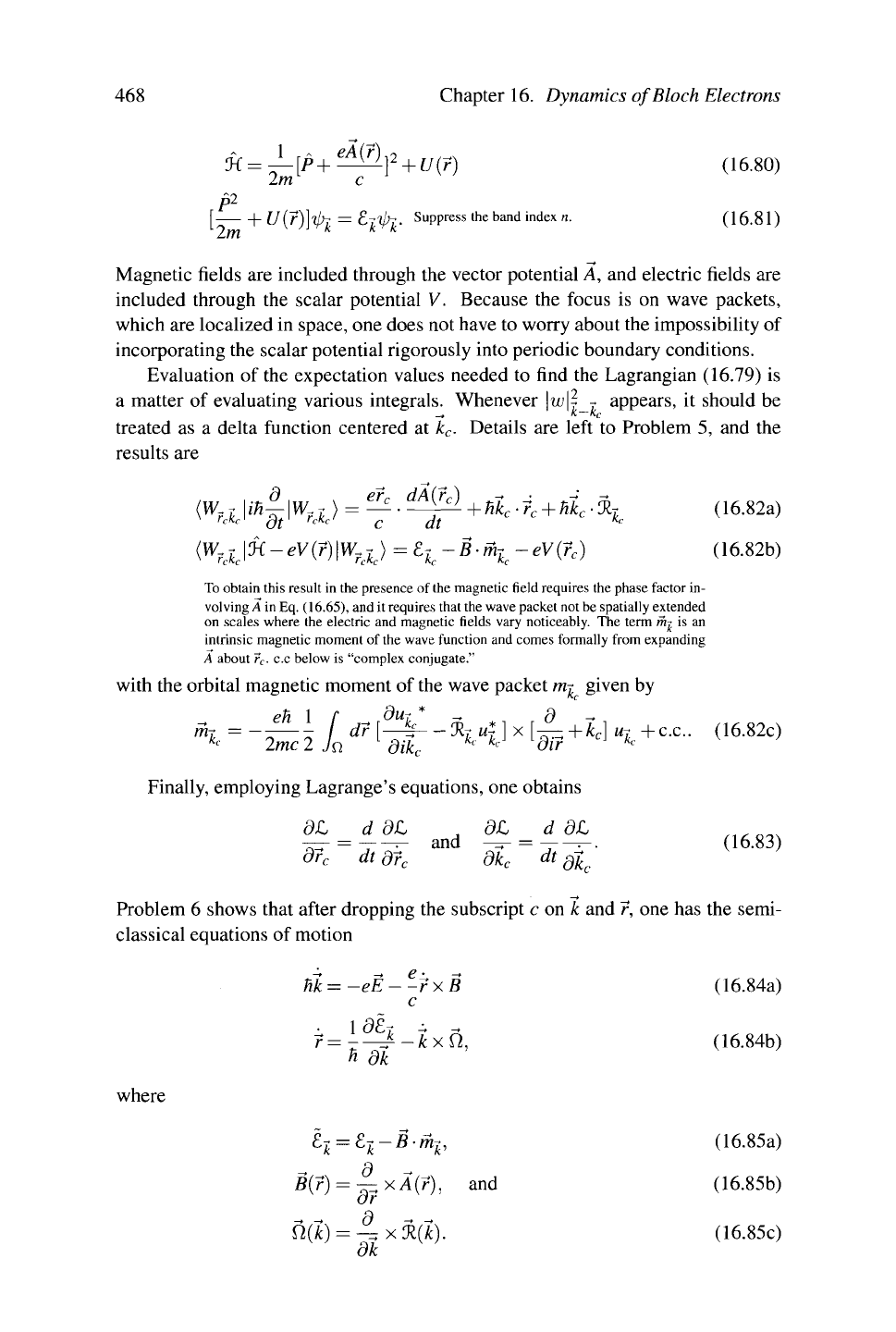
The phase of w carries information about the actual spatial location of
the
wave
packet, and it must be chosen carefully if it truly is to be centered at r
c
. In particu-
lar,
u
U
=
l
u;
lt-*
c
c,
'
(
*~*
c)
'^'
(16
-
68)
where
%^
is precisely the Berry connection of
Eq.
(8.59),
%l=i
/
d7ui(7)—u
l
(7). (16.69)
h
Jn
k
< 'dk
c
k
^
'
The demonstration that such a wave packet truly is centered at
7
C
follows from the
computation
(W
7
î\r-r
c
\W
7l
)
=
(W
7
? \r\W
7
?)-r
c
Because the packet is
(16.70)
rc^c
r
c
K
c
r
c
Kc
r
c
K
c
normalized.
Use Eq. (7.45) for the periodic function u to replace ip in (16.65). (16.72)
=
/ —Y
v& m,z w^rW,(r)^lv(*'-*H^) (16.73)
J
N tr!
kk
<
kkc k k
dik'
k'k
=
- j
d
i
E
^«î^^^-^^^^Wl
(16-V4)
k'k
Change the
k!
sum to an integral with (6.11), integrate by parts, and return to the sum.
=
-
J
n
d7
E hk'
w
k
u
t^^
w
k
r
kM
7
^
(16
-
75)
k'k
As in Eq. (7.26),
J
indicates integration over a single unit cell. No reciprocal lattice
vectors K needed because k and k' lie in a single zone.
/^
1
d
=
- [ drY Hr
r
uUr)
^\w
u
ur(7)}
(16.76)
k
KKc
=
/
dr m- (7)—U7 (7) In
w
u
, , =
ftr
-Dk
=0
(16.77)
Jn
k
< '
dk
c
kc
' dik
kkc
k=k
c
k
c
<<c
\u\
2
integrates to 1; \w\
2
sums to 1; and
d\w\-
k
_~
k
/dk
=
0 because of the maximum
a.tk
c
.
=> (W-r \r\W~7
) =
7
C
Hence the definition in
(16.78)
r
c
k
c
> r
c
k
c
i (16.69).
16.4.2 Dynamics from Lagrangian
Given this wave packet, one can obtain equations of motion for r
c
and k
c
by evalu-
ating the Lagrangian
468 Chapter 16. Dynamics of Block Electrons
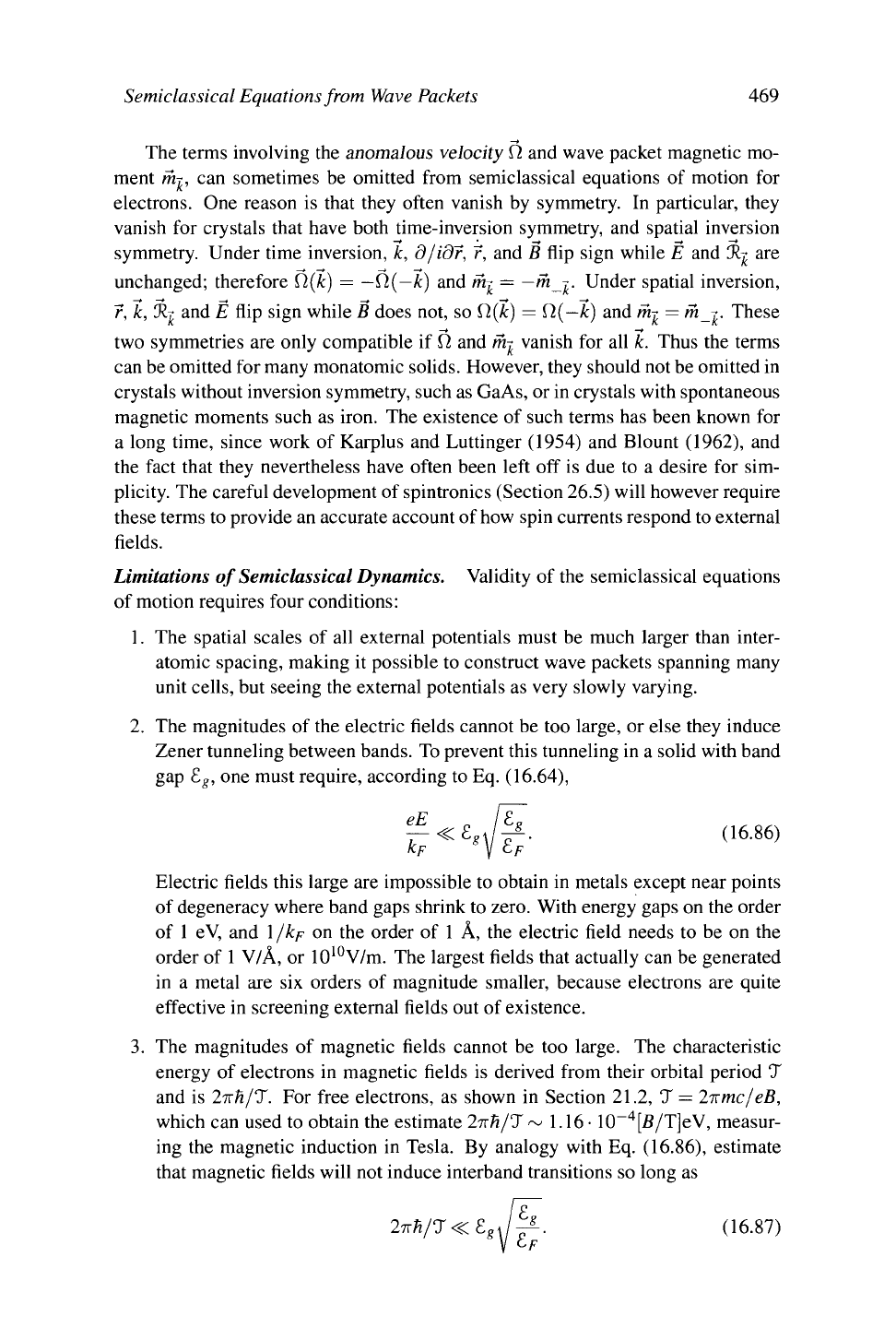
$i=—[P+^Q\
1
+ U{r) (16.80)
2m
c
[
2m
+ U{r)]ll>i
=
fijV^- Suppress the band index
rc.
(16.81)
Magnetic fields are included through the vector potential A, and electric
fields
are
included through the scalar potential V. Because the focus is on wave packets,
which are localized in space, one does not have to worry about the impossibility of
incorporating the scalar potential rigorously into periodic boundary conditions.
Evaluation of the expectation values needed to find the Lagrangian (16.79) is
a matter of evaluating various integrals. Whenever \w\Z
-
appears, it should be
treated as a delta function centered at k
c
. Details are left to Problem 5, and the
results are
(J
€,Y
dA(Y
) —* • —■ —*
<rç&
i
/Ä
ä
lw
&
}
=
~f '
^r
+hkc
'
?c+hkc
►
^
(16
-
82a)
(W
Tcl
\%-eV(r)\W
Tcl
) = £
l
-B.m
l
-eV(r
c
) (16.82b)
To obtain this result in the presence of the magnetic field requires the phase factor in-
volving A in Eq. (16.65), and it requires that the wave packet not be spatially extended
on scales where the electric and magnetic fields vary noticeably. The term m^ is an
intrinsic magnetic moment of the wave function and comes formally from expanding
A about r
c
. c.c below is "complex conjugate."
with the orbital magnetic moment of the wave packet
m-^
given by
eft
1 f
dm *
d
in?
= /
dr\—Z--%i uy
1
x [— +k
c
] u? +c.c. (16.82c)
*< 2mc2 Jn
[
dik
c
kc
k
<
dir
cj
^
Finally, employing Lagrange's equations, one obtains
ö£
d
dC
_, du d
dL
,^
0
„
N
— = -—r-
and — =
—
^. (16.83)
dr
c
dtdr
c
dk
c
dt
^
Problem 6 shows that after dropping the subscript c on k and r, one has the semi-
classical equations of motion
nk=-eE--7xB
(16.84a)
c
•
\dh i -,
r= ^-kxQ, (16.84b)
n Ok
where
£j = £
]E
-B-%, (16.85a)
d
-
B(r) = — xA(r),
and
(16.85b)
or
d
- -
n(k) = —
x%(k).
(16.85c)
dk
Semiclassical Equations from
Wave
Packets 469
The terms involving the anomalous velocity Q and wave packet magnetic mo-
ment rhp can sometimes be omitted from semiclassical equations
of
motion
for
electrons. One reason is that they often vanish by symmetry. In particular, they
vanish for crystals that have both time-inversion symmetry, and spatial inversion
symmetry. Under time inversion, k, d/idr, r, and B flip sign while
E
and
%^
are
unchanged; therefore Ù(k)
=
—Çl(—k)
and
m~
k
=
—«*_-£. Under spatial inversion,
r, k,
%£
and
E
flip sign while B does not, so Q(k) = Q(—k) and
in-^
= m_^. These
two symmetries are only compatible
if
Ù and
m-
k
vanish for all k. Thus the terms
can be omitted for many monatomic solids. However, they should not be omitted in
crystals without inversion symmetry, such as GaAs, or in crystals with spontaneous
magnetic moments such as iron. The existence of such terms has been known for
a long time, since work
of
Karplus and Luttinger (1954) and Blount (1962), and
the fact that they nevertheless have often been left off is due to
a
desire for sim-
plicity. The careful development of spintronics (Section 26.5) will however require
these terms to provide an accurate account of how spin currents respond to external
fields.
Limitations of Semiclassical Dynamics. Validity of the semiclassical equations
of motion requires four conditions:
1.
The spatial scales
of
all external potentials must be much larger than inter-
atomic spacing, making it possible to construct wave packets spanning many
unit cells, but seeing the external potentials as very slowly varying.
2.
The magnitudes of the electric fields cannot be too large, or else they induce
Zener tunneling between bands. To prevent this tunneling in a solid with band
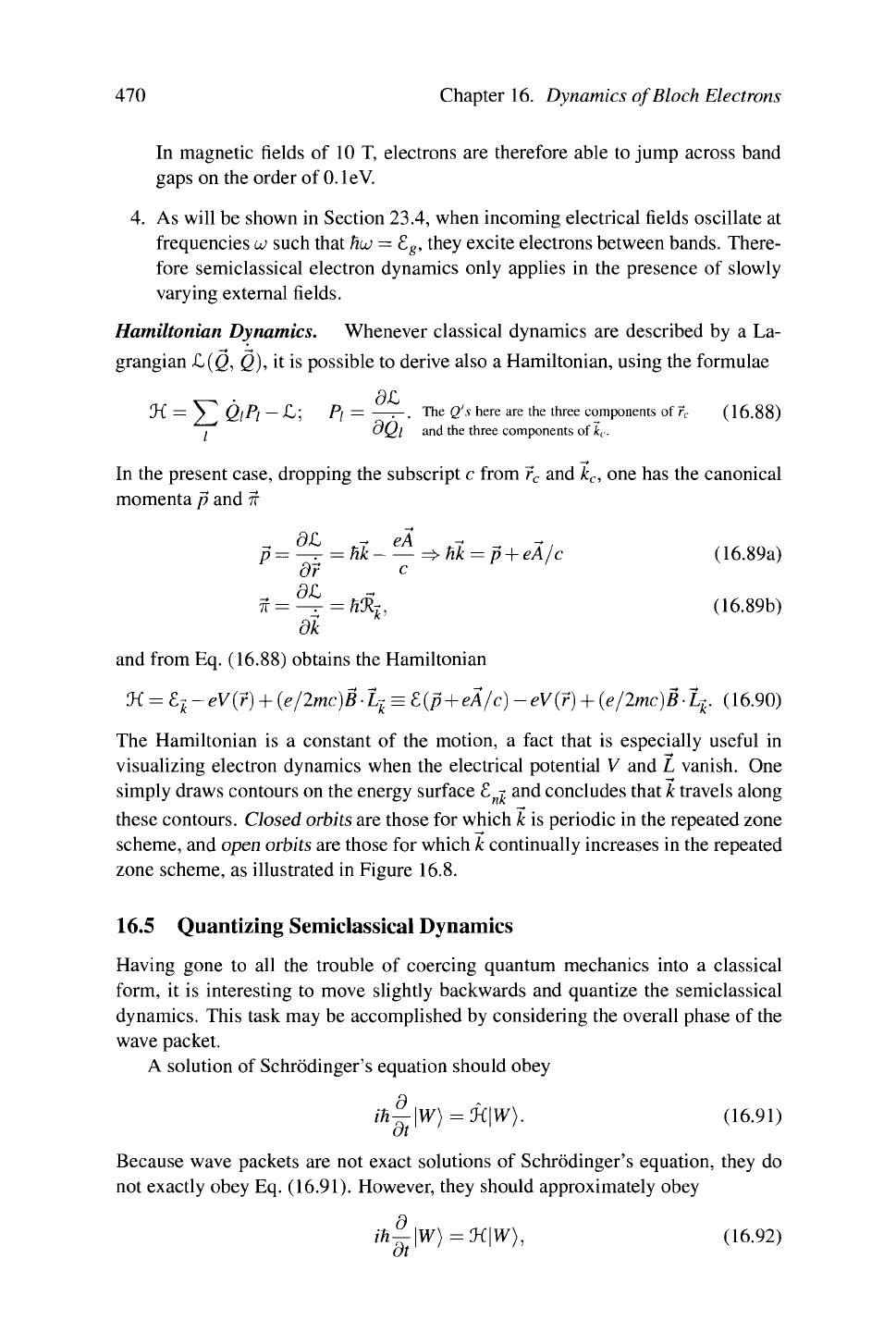
gap £„, one must require, according to Eq. (16.64),
(16.86)
Electric fields this large are impossible to obtain in metals except near points
of degeneracy where band gaps shrink to zero. With energy gaps on the order
of
1
eV, and
\/kp
on the order
of
1 Â, the electric field needs to be on the
order of
1
V/Â, or 10
10
V/m. The largest fields that actually can be generated
in
a
metal are six orders
of
magnitude smaller, because electrons are quite
effective in screening external fields out of existence.
The magnitudes
of
magnetic fields cannot be too large. The characteristic
energy of electrons in magnetic fields
is
derived from their orbital period
7
and is 2TTH/7. For free electrons, as shown in Section 21.2, T
=
2irmc/eB,
which can used to obtain the estimate 2nh/7
~
1.16- 10
_4
[Z?/T]eV, measur-
ing the magnetic induction in Tesla. By analogy with Eq. (16.86), estimate
that magnetic fields will not induce interband transitions so long as
2irh/7<^E
g
J-f-.
(16.87)
470
Chapter 16. Dynamics of Block Electrons
p-
TX
=
on
dr
dL
dk
_t
= hk-
—*
= #%,
eA
c
In magnetic fields of 10 T, electrons are therefore able to jump across band
gaps on the order of
0.
leV.
4.
As will be shown in Section 23.4, when incoming electrical fields oscillate at
frequencies
to
such that
Hu>
= £
g
, they excite electrons between bands. There-
fore semiclassical electron dynamics only applies in the presence of slowly
varying external fields.
Hamiltonian Dynamics. Whenever classical dynamics are described by a La-
grangian £(ß, Q), it is possible to derive also a Hamiltonian, using the formulae
"K = y^
QlPl
— £; Pi = ——
•
The
Q'
s here are the three
components of r
c
(16.88)
I OQi and the three components of ï
c
.
In the present case, dropping the subscript c from r
c
and
~k
c
,
one has the canonical
momenta p and
TT
hk = p + eA/c (16.89a)
(16.89b)
and from Eq. (16.88) obtains the Hamiltonian
■X = Z-
k
-eV(r) + {e/2mc)B-L
l
=
8,(p
+ eA/c) -eV(r) + {e/2mc)B-L
l
. (16.90)
The Hamiltonian is a constant of the motion, a fact that is especially useful in
visualizing electron dynamics when the electrical potential V and L vanish. One
simply draws contours on the energy surface £
-^
and concludes that k travels along
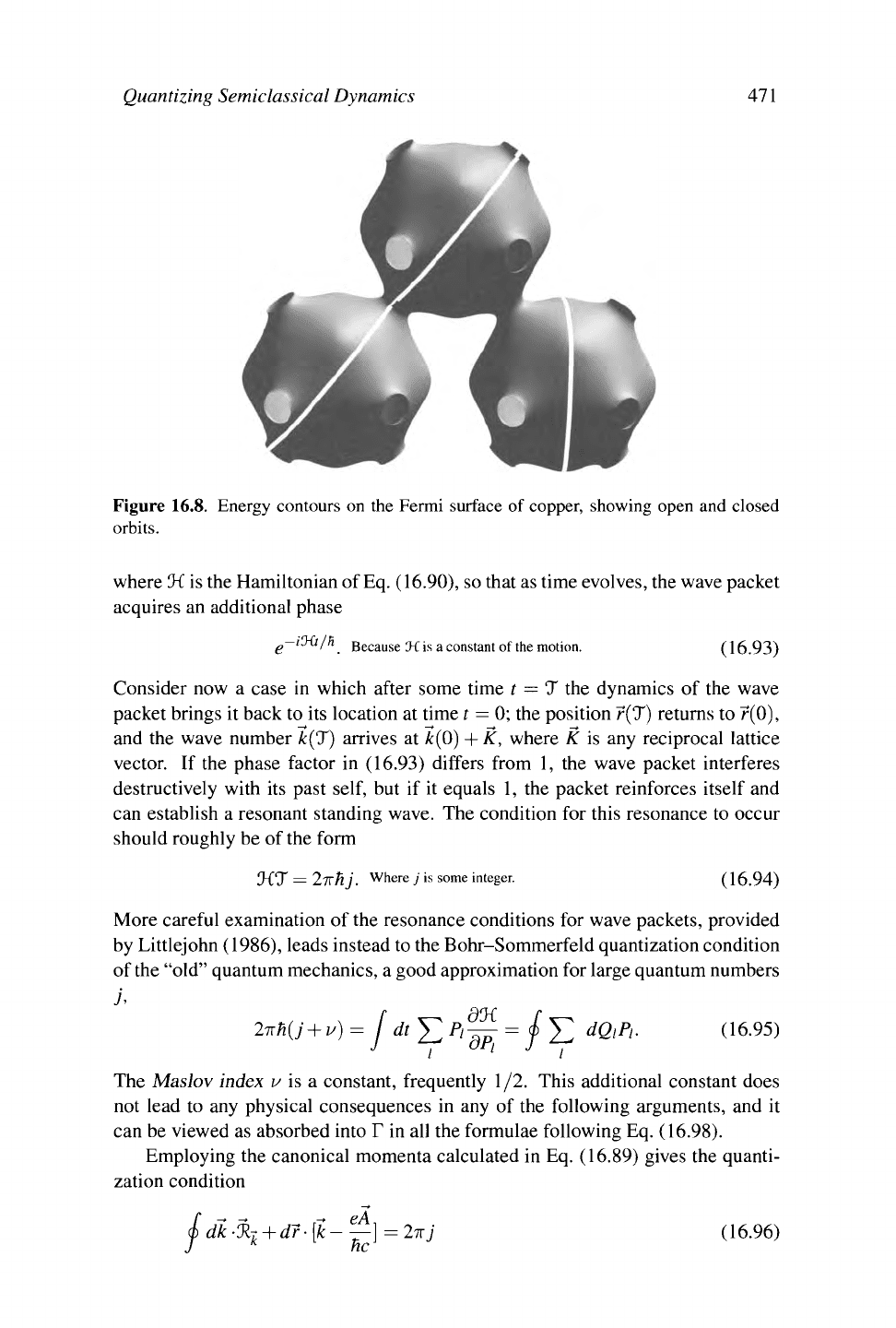
these contours. Closed orbits are those for which k is periodic in the repeated zone
scheme, and open orbits are those for which k continually increases in the repeated
zone scheme, as illustrated in Figure 16.8.
16.5 Quantizing Semiclassical Dynamics
Having gone to all the trouble of coercing quantum mechanics into a classical
form, it is interesting to move slightly backwards and quantize the semiclassical
dynamics. This task may be accomplished by considering the overall phase of the
wave packet.
A solution of Schrödinger's equation should obey
d
ih—\W) = H\W). (16.91)
Because wave packets are not exact solutions of Schrödinger's equation, they do
not exactly obey Eq. (16.91). However, they should approximately obey
d
ih—\W)=M\W), (16.92)
at
Quantizing Semiclassical Dynamics 471
Figure 16.8. Energy contours on the Fermi surface of copper, showing open and closed
orbits.
where
"K
is the Hamiltonian of
Eq.
(16.90), so that as time evolves, the wave packet
acquires an additional phase
g~' I . Because
"K
is a constant of the motion. (16.93)
Consider now a case in which after some time t = T the dynamics of the wave
packet brings it back to its location at time t = 0; the position ?(T) returns to r(0),
and the wave number k(7) arrives at Ä:(0) + K, where K is any reciprocal lattice
vector. If the phase factor in (16.93) differs from 1, the wave packet interferes
destructively with its past
self,
but if it equals 1, the packet reinforces itself and
can establish a resonant standing wave. The condition for this resonance to occur
should roughly be of the form
"KJ = 2nhj. Where ; is some integer. (16.94)
More careful examination of the resonance conditions for wave packets, provided
by Littlejohn (1986), leads instead to the Bohr-Sommerfeld quantization condition
of
the
"old" quantum mechanics, a good approximation for large quantum numbers
2Trh(j
+ v) =
I dtJ2
p
'^
=
fj2
d
Qi
p
i-
(
16
-
95
)
The Maslov index v is a constant, frequently 1/2. This additional constant does
not lead to any physical consequences in any of the following arguments, and it
can be viewed as absorbed into T in all the formulae following Eq. (16.98).
Employing the canonical momenta calculated in Eq. (16.89) gives the quanti-
zation condition
/
- - eÄ
dk-Jl~
k
+ dr-[k-—} = 2irj (16.96)
472
Chapter 16. Dynamics of Block Electrons
'
- - eA
dk
•
($£ — 7) —
d?
■
— =
2-nj. Integrating by parts.
(16.97)
16.5.1 Wannier-Stark Ladders
One way in principle to send electrons into closed orbits is to consider
a
system
with uniform electric field
E =
—VV and no magnetic field. The wave vector
k evolves linearly in time as
k =
—eEt/H.
Because 7 = d8./dhk flips sign when
k
—>
K
—
k, so long as
E
points in the direction of a reciprocal lattice vector, the
electron is supposed to execute periodic motion. Defining
T= i dk-%,
Because k returns to itself by increasing by a
(16.98)
J reciprocal lattice vector, the integral is a line
integral from 0 to K.
Eq. (16.97) becomes
2TTJ=6
dk-(ül
l
-r)
=
r-
dk-r =
T-K
(r)
(7) is defined to be the time average of
7,
and gives the center of the
orbit.
r =
r-2nj
K
(16.99)
(16.100)
Q
o>
O)
o>
o>
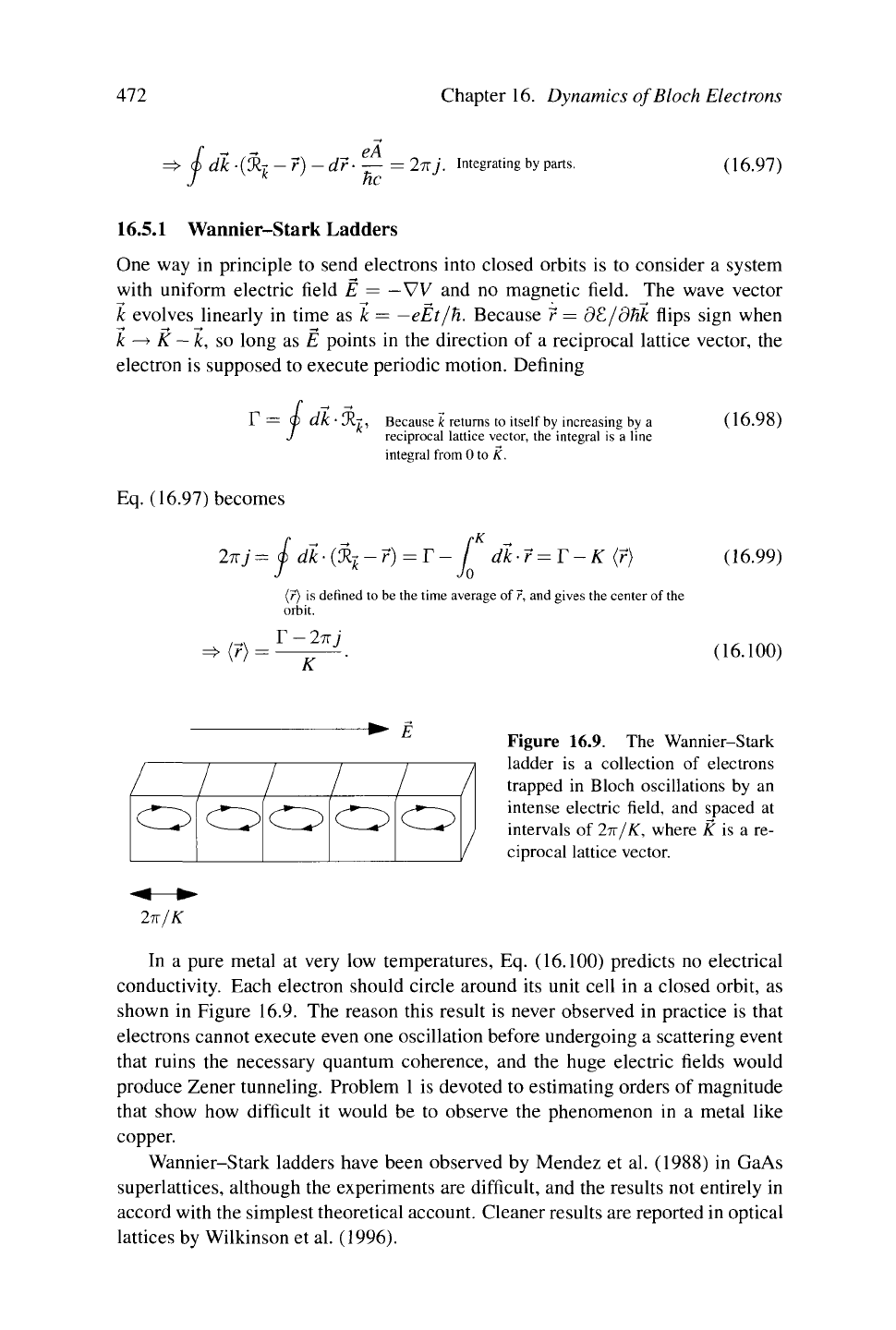
Figure 16.9. The Wannier-Stark
ladder
is a
collection
of
electrons
trapped in Bloch oscillations by an
intense electric field, and spaced at
intervals of
2TT/K,
where K is a re-
ciprocal lattice vector.
2-K/K
In
a
pure metal at very low temperatures, Eq. (16.100) predicts no electrical
conductivity. Each electron should circle around its unit cell in a closed orbit, as
shown in Figure 16.9. The reason this result is never observed in practice is that
electrons cannot execute even one oscillation before undergoing a scattering event
that ruins the necessary quantum coherence, and the huge electric fields would
produce Zener tunneling. Problem 1 is devoted to estimating orders of magnitude
that show how difficult
it
would be to observe the phenomenon in
a
metal like
copper.
Wannier-Stark ladders have been observed by Mendez et al. (1988) in GaAs
superlattices, although the experiments are difficult, and the results not entirely in
accord with the simplest theoretical account. Cleaner results are reported in optical
lattices by Wilkinson et al. (1996).