
Marder M.P. Condensed Matter Physics
Подождите немного. Документ загружается.

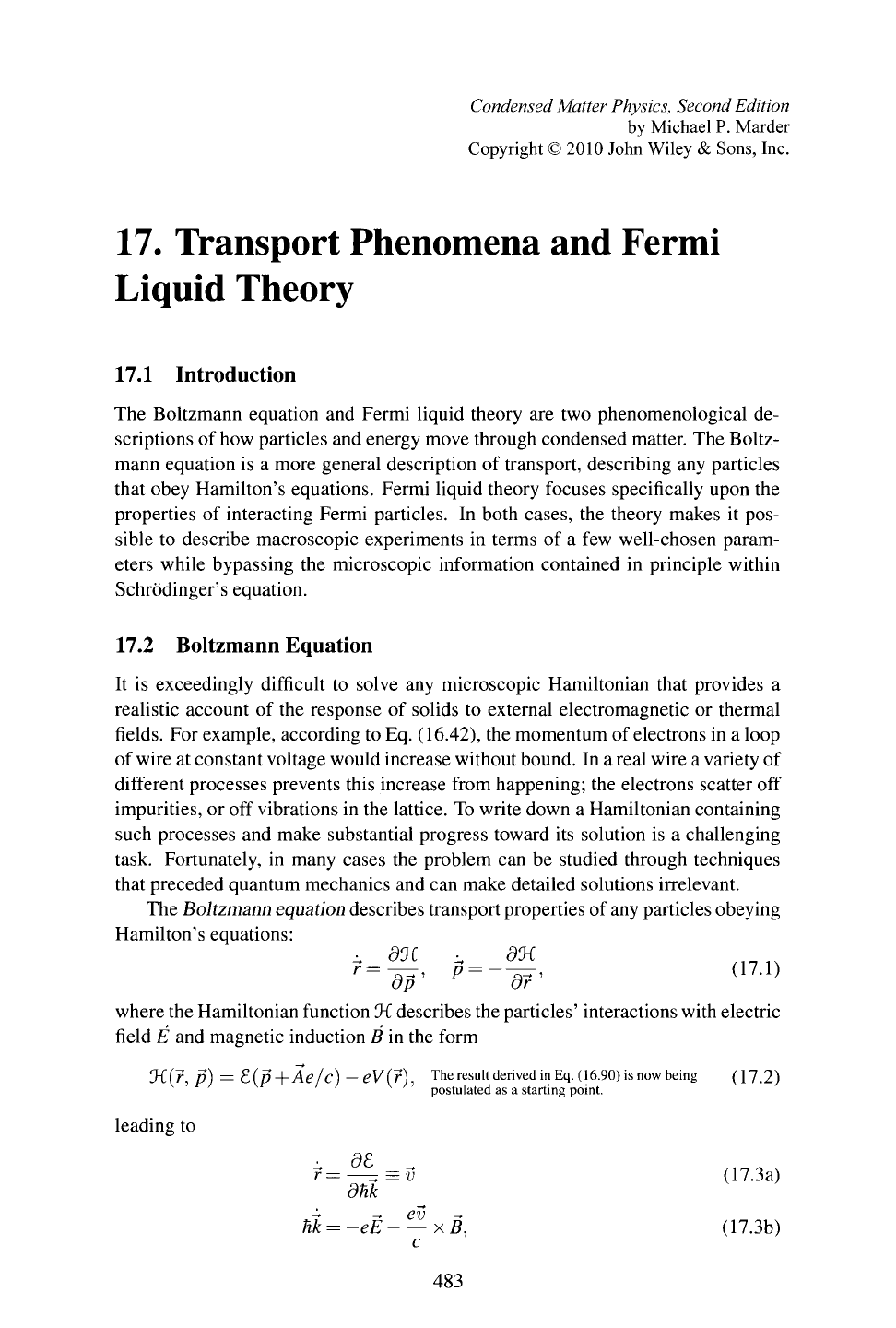
17.
Transport Phenomena and Fermi
Liquid Theory
17.1 Introduction
The Boltzmann equation and Fermi liquid theory are two phenomenological de-
scriptions of how particles and energy move through condensed matter. The Boltz-
mann equation is a more general description of transport, describing any particles
that obey Hamilton's equations. Fermi liquid theory focuses specifically upon the
properties of interacting Fermi particles. In both cases, the theory makes it pos-
sible to describe macroscopic experiments in terms of a few well-chosen param-
eters while bypassing the microscopic information contained in principle within
Schrödinger's equation.
17.2 Boltzmann Equation
It is exceedingly difficult to solve any microscopic Hamiltonian that provides a
realistic account of the response of solids to external electromagnetic or thermal
fields. For example, according to Eq. (16.42), the momentum of electrons in a loop
of wire at constant voltage would increase without bound. In a real wire a variety of
different processes prevents this increase from happening; the electrons scatter off
impurities, or off vibrations in the lattice. To write down a Hamiltonian containing
such processes and make substantial progress toward its solution is a challenging
task. Fortunately, in many cases the problem can be studied through techniques
that preceded quantum mechanics and can make detailed solutions irrelevant.
The Boltzmann equation describes transport properties of any particles obeying
Hamilton's equations:
op or
where the Hamiltonian function
IK
describes the particles' interactions with electric
field E and magnetic induction B in the form
"Kir, p) = E(p+Âe/c)-eV(r), The result derived in Eq.
( 16.90)
is now being (17.2)
postulated as a starting point.
leading to
r
—
Hk
=
as.
_
dhk~
-eÈ-
~-
v
ev
c
xB.
(17.3a)
(17.3b)
483
Condensed Matter
Physics,
Second Edition
by Michael P. Marder
Copyright © 2010 John Wiley & Sons, Inc.
484
Chapter 17. Transport Phenomena and Fermi Liquid Theory
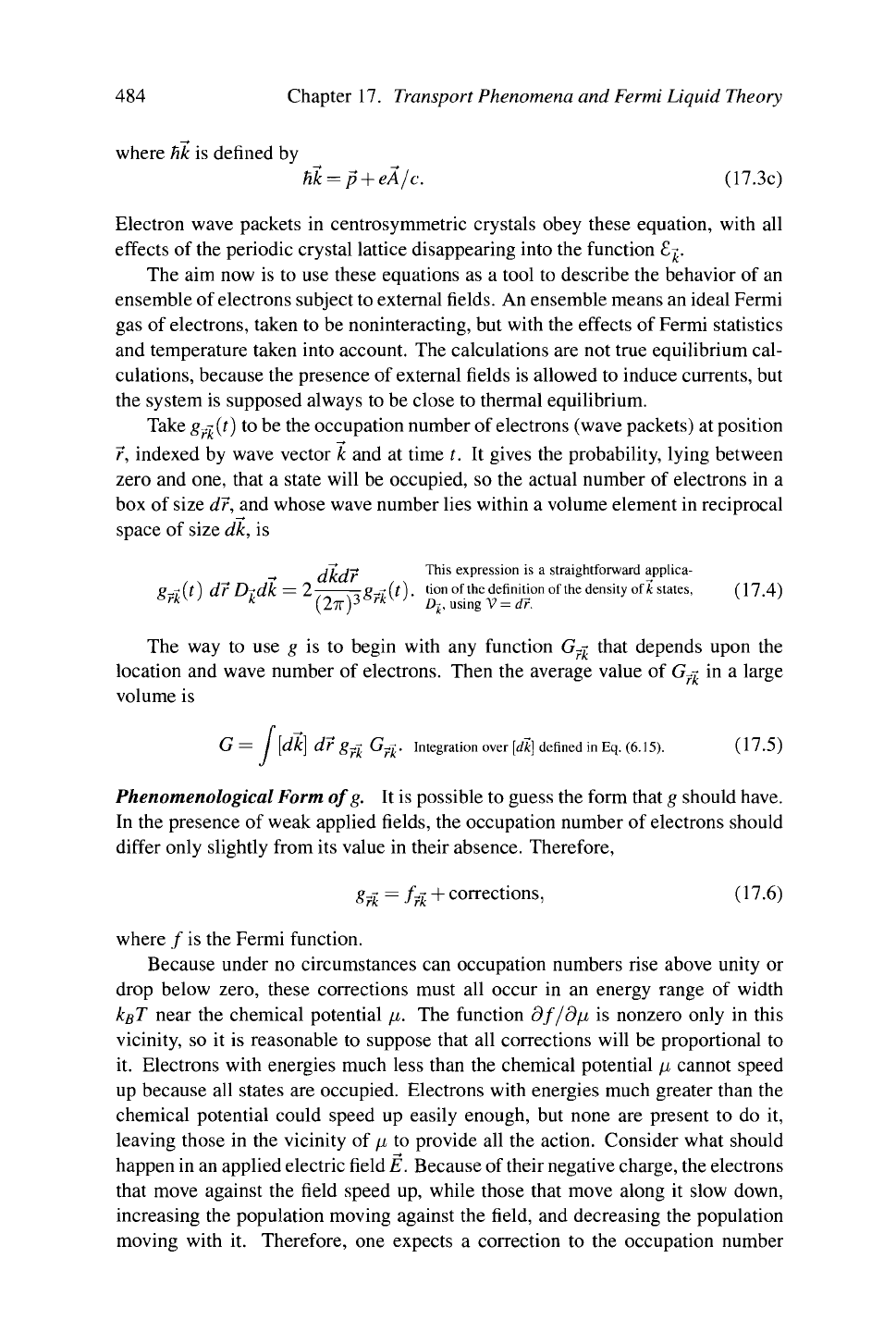
where
hk is
defined by
hk
= p
+ eA/c. (17.3c)
Electron wave packets
in
centrosymmetric crystals obey these equation, with
all
effects
of
the periodic crystal lattice disappearing into the function
£^.
The
aim
now
is to use
these equations
as a
tool
to
describe the behavior
of
an
ensemble
of
electrons subject to external fields. An ensemble means an ideal Fermi
gas
of
electrons, taken
to
be noninteracting,
but
with the effects
of
Fermi statistics
and temperature taken into account. The calculations are not true equilibrium cal-
culations, because the presence
of
external fields
is
allowed to induce currents,
but
the system
is
supposed always
to
be close
to
thermal equilibrium.
Take
gj%(t)
to be the occupation number
of
electrons (wave packets) at position
r, indexed
by
wave vector
k and at
time
t. It
gives
the
probability, lying between
zero
and
one, that
a
state will
be
occupied,
so the
actual number
of
electrons
in a
box
of
size
dr,
and whose wave number lies within
a
volume element in reciprocal
space
of
size
dk, is
rfkd7
^'
s
ex
P
ress
'
on
'
s a
straightforward applica-
, S-ir(t) tion
of
the definitioi
(27T)
3
rk
Oj, using V
=
dr.
g~t(t) d7Dtdk =
2.
ï8-t{t)-
ti°
no
''
t
'
le
definition
of
the density
oft
states, (17.4)
The
way to use
g is
to
begin with
any
function
Gf
k
that depends upon
the
location
and
wave number
of
electrons. Then
the
average value
of G^ in a
large
volume
is
J[dk\
df
gf
k
Gf
k
.
Integration over
[dk]
defined
in
Eq. (6.15). (17.5)
Phenomenological Form of g.
It
is possible to guess the form that g should have.
In the presence
of
weak applied fields, the occupation number
of
electrons should
differ only slightly from its value
in
their absence. Therefore,
Sfk
= ffk +
corrections, (17.6)
where
/
is the Fermi function.
Because under
no
circumstances
can
occupation numbers rise above unity
or
drop below zero, these corrections must
all
occur
in an
energy range
of
width
kßT near
the
chemical potential \x.
The
function df/dß
is
nonzero only
in
this
vicinity,
so it is
reasonable
to
suppose that
all
corrections will
be
proportional
to
it. Electrons with energies much less than
the
chemical potential
/i
cannot speed
up because
all
states
are
occupied. Electrons with energies much greater than
the
chemical potential could speed
up
easily enough,
but
none
are
present
to do it,
leaving those
in the
vicinity
of
\x
to
provide
all the
action. Consider what should
happen in an applied electric field
E.
Because of their negative charge, the electrons
that move against
the
field speed
up,
while those that move along
it
slow down,
increasing
the
population moving against
the
field,
and
decreasing
the
population
moving with
it.
Therefore,
one
expects
a
correction
to the
occupation number
Boltzmann Equation
485
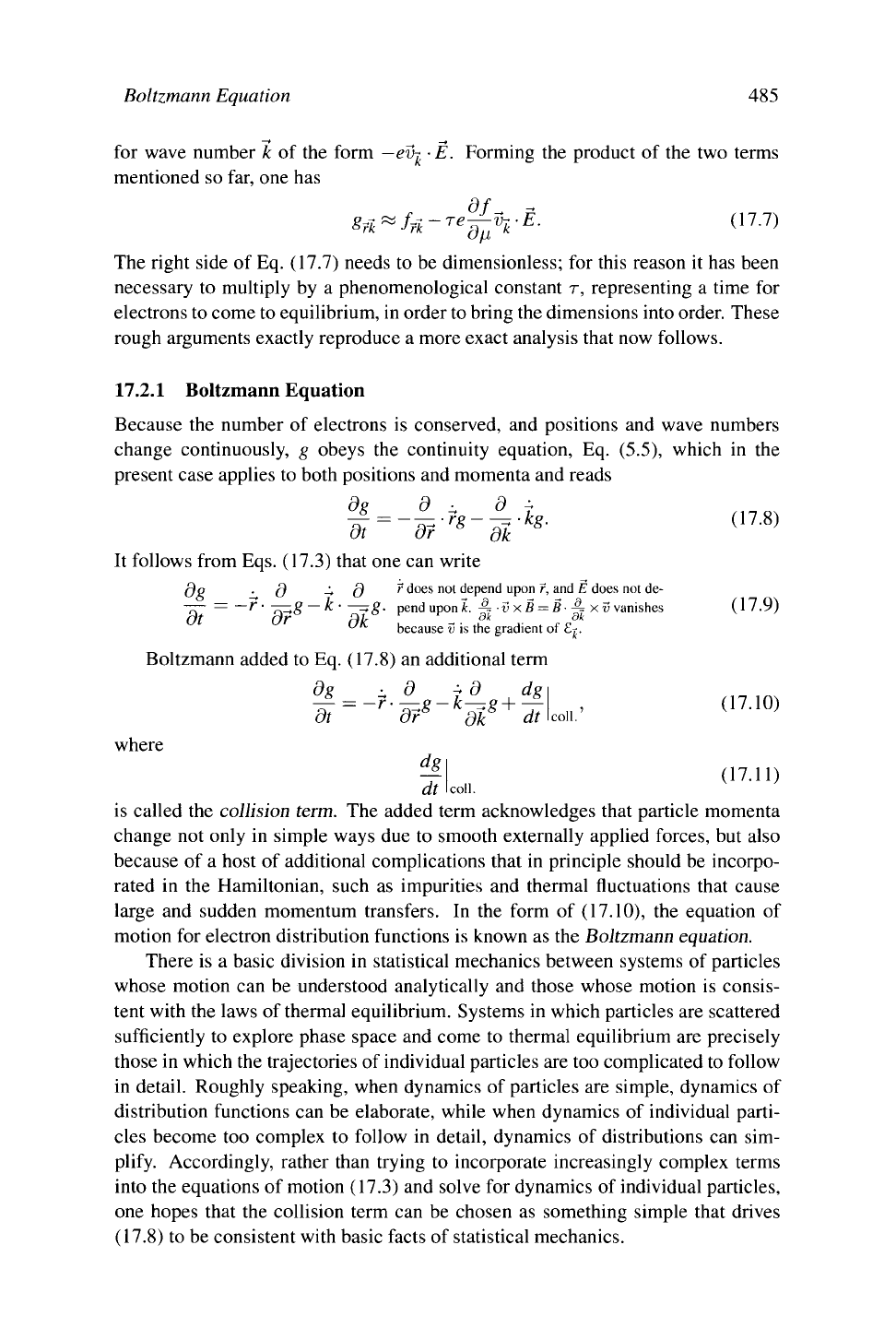
fk^ffk-Te^n-E. (17.7)
for wave number k of the form — ev^
■
Ê. Forming the product of the two terms
mentioned so far, one has
du
The right side of Eq. (17.7) needs to be dimensionless; for this reason it has been
necessary to multiply by a phenomenological constant r, representing a time for
electrons to come to equilibrium, in order to bring the dimensions into order. These
rough arguments exactly reproduce a more exact analysis that now follows.
17.2.1 Boltzmann Equation
Because the number of electrons is conserved, and positions and wave numbers
change continuously, g obeys the continuity equation, Eq. (5.5), which in the
present case applies to both positions and momenta and reads
dg d • d ^
5
-- '- (17.8)
(17.9)
dt dr
rg
-Jk
k8
It follows from Eqs. (17.3) that one can write
ßp ■ d -* 9 ^ ^
oes n0
' depend upon r, and E does not de-
~jr~ = —r
■
T^g — k
■
—^ig- pend upon k. 4= -v xB = B- 4* x v vanishes
eft
ctr f)k
w
because v is the gradient of £j.
Boltzmann added to Eq. (17.8) an additional term
dg i d f d dg
dt dr dk dt
where
dg
dt
coll.'
coll.
(17.10)
(17.11)
is called the collision term. The added term acknowledges that particle momenta
change not only in simple ways due to smooth externally applied forces, but also
because of a host of additional complications that in principle should be incorpo-
rated in the Hamiltonian, such as impurities and thermal fluctuations that cause
large and sudden momentum transfers. In the form of (17.10), the equation of
motion for electron distribution functions is known as the Boltzmann equation.
There is a basic division in statistical mechanics between systems of particles
whose motion can be understood analytically and those whose motion is consis-
tent with the laws of thermal equilibrium. Systems in which particles are scattered
sufficiently to explore phase space and come to thermal equilibrium are precisely
those in which the trajectories of individual particles are too complicated to follow
in detail. Roughly speaking, when dynamics of particles are simple, dynamics of
distribution functions can be elaborate, while when dynamics of individual parti-
cles become too complex to follow in detail, dynamics of distributions can sim-
plify. Accordingly, rather than trying to incorporate increasingly complex terms
into the equations of motion (17.3) and solve for dynamics of individual particles,
one hopes that the collision term can be chosen as something simple that drives
(17.8) to be consistent with basic facts of statistical mechanics.
486 Chapter 17.
Transport
Phenomena and
Fermi
Liquid Theory
17.2.2 Including Anomalous Velocity
In crystals that are not centrosymmetric, the semi-classical equations of motion
include the anomalous velocity of Eqs. (16.84). Xiao et al. (2005) showed a way
to modify the Boltzmann equation to include these dynamical effects. The reason
one cannot just write down the Boltzmann equation with new equations for the
evolution of 7 and k is that 7 and k no longer obey Hanultonian's equation in the
form Eq. (17.1). However, this turns out not to be a fatal problem. Essentially, the
result is to change the density of states.
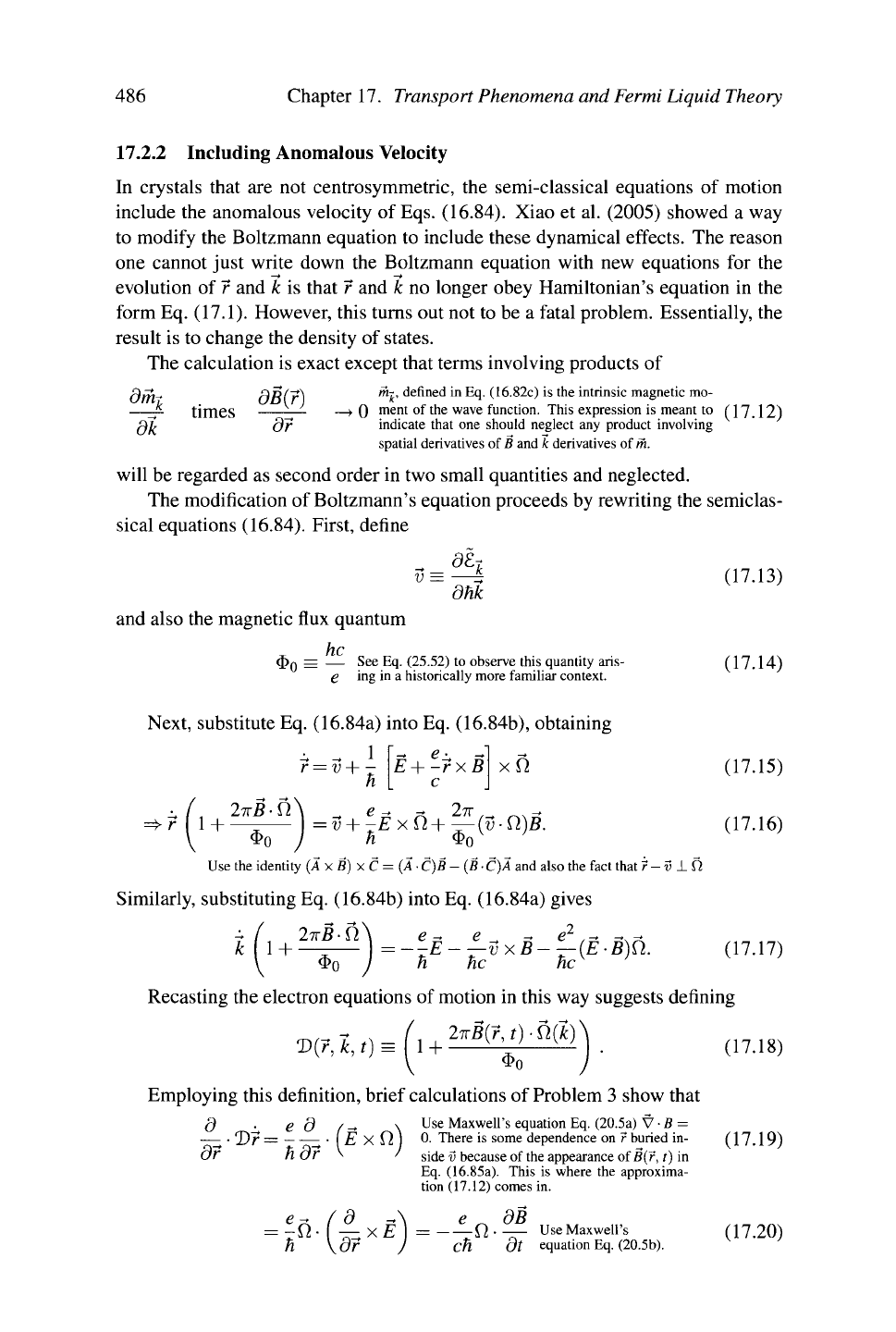
The calculation is exact except that terms involving products of
ßm-*
ßR(7\
mj, defined in Eq. (16.82c) is the intrinsic magnetic mo-
—=7^
times
——
—>0 nient of the wave function. This expression is meant to (17.12)
ßfc
07
indicate that one should neglect any product involving
spatial derivatives of B and k derivatives of in.
will be regarded as second order in two small quantities and neglected.
The modification of Boltzmann's equation proceeds by rewriting the semiclas-
sical equations (16.84). First, define
v = —h (17.13)
dhk
and also the magnetic flux quantum
he
CJ>Q
= —
See Eq. (25.52) to observe this quantity aris- (17.14)
e ing in a historically more familiar context.
Next, substitute Eq. (16.84a) into Eq. (16.84b), obtaining
1
r = v+-
h
É + -7xB
c
xfi (17.15)
1+
* '
)=v + -ÈxÛ+ — (v-Q)B. (17.16)
*0
/ » $0
Use the identity (A x B) x C = (A
■
C)B
-
(B
■
C)A and also the fact that Ï
-
v
_1_
Û
Similarly, substituting Eq. (16.84b) into Eq. (16.84a) gives
i(l
+
^^-)=-
e
-È-^vxB-^(È-B)Û.
(17.17)
v
$o
/ h he he
Recasting the electron equations of motion in this way suggests defining
B(
,,ï,
0
=
(
1
+
^LMJ.
(„.,„
Employing this definition, brief calculations of Problem 3 show that
ß
. e 0 /
->
\
Use Maxwell's equation Eq. (20.5a) V
•
B =
— • Tyf
=
•
(
E
X ÇI
1
0. There is some dependence on 7 buried in- (17.19)
Or
hör ^ '
side v because of the appearance of B(r,t) in
Eq. (16.85a). This is where the approxima-
tion (17.12) comes in.
= ^n-(—xÉ)=--^-n-^-
Use
Maxwell's
(17.20)
h
\Ô7 ) ch dt
equation Eq. (20.5b).
Boltzmann Equation
487
Similarly,
d -
. ]^J) = 0 No approximations needed here. (17 21)
dl
Assembling Eqs. (17.20) and (17.21) gives
dT> d i d -
— \- — -1>r-\
=i ■
T>k = 0 H depends explicitly on* but not on t. (17.22)
ot dr dk
While g(r, k, t) obeys the continuity equation Eq. (17.8), it does not obey (17.9)
when all terms are included in the semi-classical equations of motion. However,
one can define g by
g = Vg. (17.23)
Multiplying
Eq.
(17.22) by
g/T>,
and subtracting it from Eq. (17.8) using Eq. (17.23),
dg d ~ d
-£ =
-7-^8-k--;g.
(17.24)
ot dr dk
Therefore, Boltzmann's equation (17.10) will continue to hold so long as one re-
places g with g.
In summary, here is how to view the consequences of anomalous velocities for
Boltzmann's equation. In any given problem, solve Eq. (17.10) using the full semi-
classical equations of motion to obtain g. Then, when computing any observable,
as in Eq. (17.5), write instead
G
=
J[dk]drVg
fk
G
fk
.
(17.25)
Thus D(r, k, t) can be viewed as a modification of the density of states. There is
no reason not to use the notation g for g just so long as one remembers to use the
modified density of states D. Thus g will not appear again explicitly, but if the
anomalous velocity cannot be neglected, that is what g should mean.
17.2.3 Relaxation Time Approximation
Ask what properties the collision term must have. The basic property is that it must
cause the distribution g to relax toward thermal equilibrium. The relaxation time
approximation consists of nothing more or less than the simplest functional form
of the collision term with this property. It is
dg_
dt
coll.
T- °rk
■>
rk
(17.26)
where
One might want to replace £7 by £7
—
eV/.
f- — Doing so amounts to a redefinition of ß and (17.27)
r
k gßr(£-i—ßf) _i_ 1 is not necessary if
ßj.
is defined to be the con-
stant that produces the correct density n(r).
is the Fermi function appropriate for the density and temperature at position r.
488
Chapter 17. Transport Phenomena and Fermi Liquid Theory
The effect of the collision term is to make g rise wherever it is smaller than
/, and make it shrink wherever it is greater. Allowing / to depend upon position
through
\x
and ß allows study of systems that are slightly out of equilibrium, such
as bars of metal with uniform temperature gradients. The distribution g will try to
relax everywhere to the local equilibrium distribution /. However, the dependence
of / on position through density and temperature must be included. Otherwise
there is no reason to expect g to be close to / even for very small external fields
and temperature gradients, because total changes in temperature and density over
large distances may be large. The constant out front, r, is the relaxation time.
The relaxation time provides an approximate but effective way to incorporate
a variety of complicated processes tending to bring condensed matter toward equi-
librium. In the simplest possible approximation, r is simply a constant, and all
electrons decay toward zero velocity at the same rate, regardless of their energy or
direction. This approximation is useful for simple estimates, but does not survive
careful comparison either with experiment or calculation. For example, theoretical
calculations in Section 18.2.1 show that above the Debye temperature, the relax-
ation time of an electron with energy £ is proportional to £
-3
'
2
. In general, there
is no reason why the relaxation time of an electron with Bloch index k should not
depend in detail upon k, but the balance between simplicity and accuracy recom-
mends allowing r to depend upon k only through £^, and r
£
will generally be
understood to depend upon £ in what follows.
Method of Characteristics. Once the relaxation time approximation is employed,
the Boltzmann equation has a simple formal solution. Because g depends upon t,
k, and r, the total time derivative of g is
dg dg ■ dg
7
dg
dt dt dr dk
and Boltzmann's equation (17.10) becomes
dg g-f
dt
T
£
dt'f(t')-
-(t-t')/TZ
Te
(17.28)
(17.29)
(17.30)
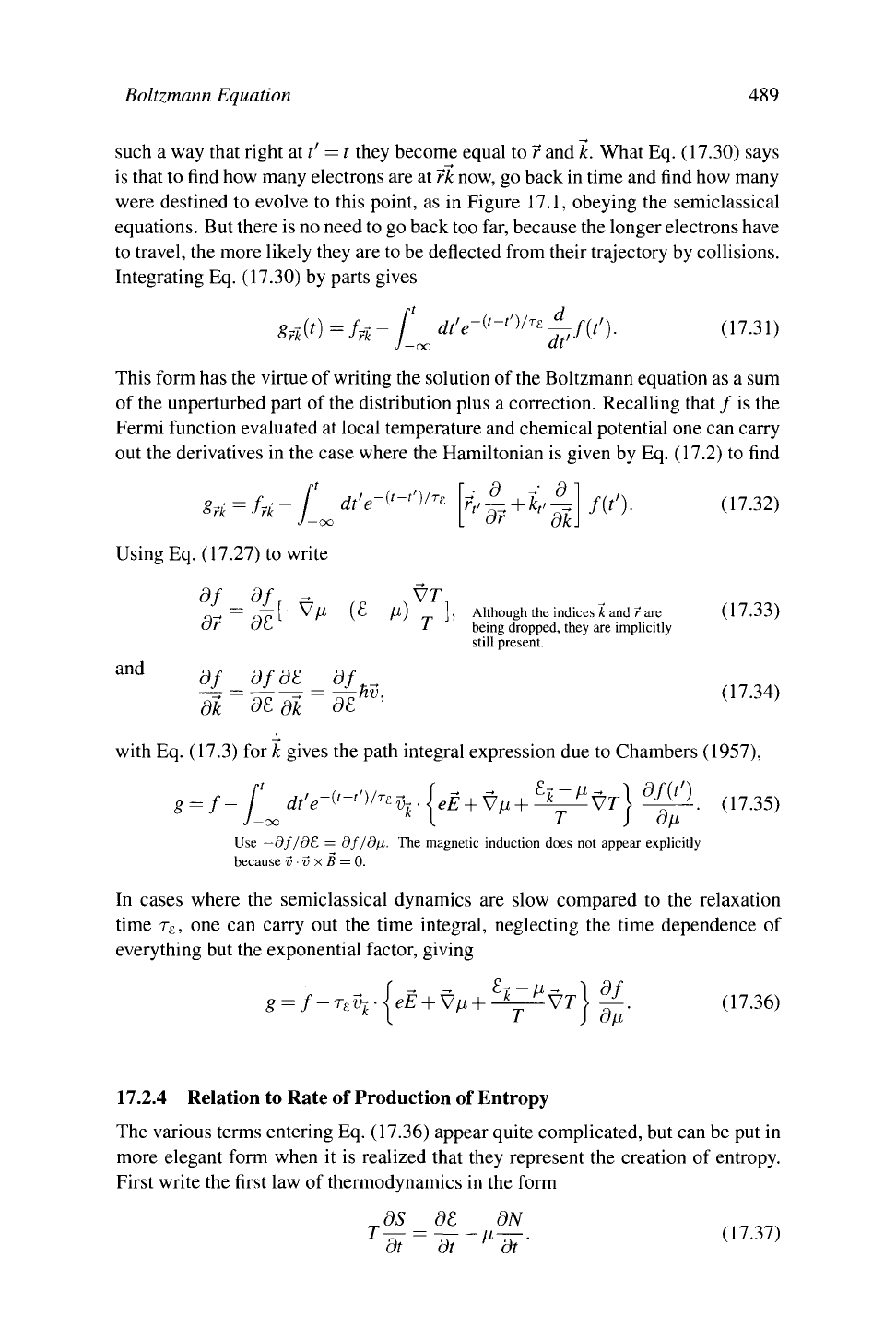
Figure 17.1. The distribution function g re-
sults from time averages over the histories of
electrons that at time t end up at r and k.
In Eq. (17.30), f{t') is shorthand for/(?(?'),
k(t')),
in which r(t') and jfc(f') are
solutions of the semiclassical equations of motion (17.3). They evolve in time in
Boltzmann Equation 489
such a way that right at t'
= t
they become equal to r and k. What Eq. (17.30) says
is that to find how many electrons are at rk now, go back in time and find how many
were destined to evolve to this point, as in Figure 17.1, obeying the semiclassical
equations. But there is no need to go back too far, because the longer electrons have
to travel, the more likely they are to be deflected from their trajectory by collisions.
Integrating Eq. (17.30) by parts gives
J — oo
-(t-t')/T
E
dt
7
/(0
(17.31)
This form has the virtue of writing the solution of the Boltzmann equation as a sum
of the unperturbed part of the distribution plus a correction. Recalling that
/
is the
Fermi function evaluated at local temperature and chemical potential one can carry
out the derivatives in the case where the Hamiltonian is given by Eq. (17.2) to find
>r*
:
Jrk
dt'e-(
t
-
,
">l
T
*
d
-.• d
r,'-
87
+
k
t
>
dk\
A').
Using Eq. (17.27) to write
df
df. -
vr
(e-^-Vl
Although the indices
k
and
f
are
being dropped, they are implicitly
still present.
and
dl dS. dk
du
V
'
(17.32)
(17.33)
(17.34)
with Eq. (17.3) for k gives the path integral expression due to Chambers (1957),
g =
f-
f Jt'e-^''^v
r
[eE
+
V
ß
+
^VT] ^M.
(17.35)
Use —df/dE
=
df/dfi. The magnetic induction does not appear explicitly
because
v
■
v x
B
=
0.
In cases where the semiclassical dynamics are slow compared
to
the relaxation
time
r
£
,
one can carry out the time integral, neglecting the time dependence of
everything but the exponential factor, giving
,
oc
^
v
^__vrj—.
g =
f
~ nm.
■
\eE +
V//
+
(17.36)
17.2.4 Relation to Rate of Production of Entropy
The various terms entering Eq. (17.36) appear quite complicated, but can be put in
more elegant form when
it
is realized that they represent the creation of entropy.
First write the first law of thermodynamics in the form
,dS
dt
9£
dt
H
dN_
dt'
(17.37)
490
Chapter 17.
Transport
Phenomena and
Fermi
Liquid Theory
Defining
IN = Nv and J^ = £
N
to be particle current and energy current, one has
dN
dt
+ V-J
N
= 0
and
9£
dt
+ VJ
£
= FJ
N
,
(17.38)
(17.39)
(17.40)
where F is the external set of forces upon particles. It follows from combining
Eqs.
(17.37), (17.39), and (17.40) that
.dS
T^--ßV-J
N
+ V-Jz = F-J
N
dt
so the rate S at which entropy is generated is
JE
—
HJN
(17.41)
S.- + V-
^-v(f)-/„ + v(i).y
£
(17.42)
V"'
(17.43)
Identifying the external force F with — eË
—
ev/c x B, and combining terms
from the right-hand side of Eq. (17.42).
The right hand side of Eq. (17.43) describes heat produced per time Q, be-
cause the left-hand side of Eq. (17.42) is a continuity equation for entropy of type
Eq. (5.5). Define
Qa
fk
-eE
- V/x
►
vr
(h-v)
_, . £j is the energy of one particle ...
• V^ t ^ - (17.44)
k
J
k with wave number k.
to be heat production per wavenumber per volume. Then Eq. (17.35) may be writ-
ten as
Sf
k
-ff
k
+ j[jt'e-^')^Q{t')j-Xnm Both Q(t') and /(/') are evaluated along tra-.
jectories
7{t'),
k(t').
(17.45)
17.3 Transport Symmetries
The solution of the Boltzmann equation is now in a form that reveals the natural
symmetries of transport phenomena.
The question to answer is the following. Suppose one applies a weak forcing
field to a system, perhaps an electric or magnetic field or a thermal gradient. What
response should be associated with that force? For example, applying a heat gra-
dient will in general induce an electric current as well. Should one define "heat
Transport Symmetries
491
current" to include some electric current? The answer is that one should define
the flux induced by a force to be the derivative of heat (entropy times temperature)
generation with respect to that force. The reason for this definition is that it leads
to symmetries.
In general, define the flux X
a
associated with the force x
a
to be
X
a
= ^-. (17.46)
uX
n
Examples of Forces and Fluxes. Take the force x in Eq.
( 17.46)
to be the electric
field E. Going to Eq. (17.43) and taking the gradient of Q with respect to E gives
-e%=l (17.47)
So the flux conjugate to an applied electric field is the electrical current. Or, take
the force to be a temperature gradient VT. Then the flux is
-j{Z-A%-
(17-48)
The product of a flux with its force always has dimensions of energy per time per
volume.
17.3.1 Onsager Relations
Suppose now that a system is subjected to several forces simultaneously. If each
of them is sufficiently weak, then the fluxes which are induced should be linearly
proportional to what has been applied. However, the results are not obvious. For
example, a temperature gradient will in general induce an electrical current. There-
fore,
one has to consider a general
linear response
of the form
X
a
= y L
a
gXg. The coefficients L
a
ß are arbitrary for the moment. (17.49)
ß
The
Onsager relations
state that
The flux of ß in response to force a is the
L
a
R
(B) = Lß
a
(-B) . same as the flux of a in response to force/J, (17.50)
provided that one also reverses the sign of the
magnetic induction B.
The Onsager relations can be derived by computing L
a
ß. Starting with Eq. (17.5)
for total heat production, evaluating the occupation number of r and k states with
Eq. (17.45), Problem 4 shows that
-a/3
,dQ[f),
t
_
t
,
)/TF
vd ,„ „.jdQ(t'
l^U'^'-'^w«
1
«
dxß
(17.51)
From Eq. (17.51), one can see the origin of Onsager's symmetries, as well as
the conditions under which they fail. The main ideas are as follows:
492
Chapter 17.
Transport
Phenomena and Fermi Liquid Theory
As a consequence of Liouville's theorem, one can choose to integrate either
with respect to k
t
and r
t
or with respect to k
t
i and 7y; the integration measures
are the same. Therefore, if it were not for the troublesome term
df(t')/d^,
the
integrand of Eq. (17.51) would be quite symmetrical. The condition for Onsager
reciprocity is therefore that it not matter whether df/d/i is evaluated at k, r or at
~kt',
r
t
'-
This requirement permits Onsager's symmetries to survive large magnetic fields,
because although magnetic fields make
k
t
r
rotate, they do it in such a way that the
energy of the particle does not change, and
k =
k,,=>f(
t
)
=
f(
t
')-
(
17
-
52
)
By contrast, electric fields conserve £
—
eV rather than £, so electric fields are not
allowed to be too large. However, one only has to worry about times on the order
of the relaxation time r
£
, or electron motions through a mean free path, because
otherwise the exponential becomes small. So the condition for the symmetries
(17.50) to hold is that all externally imposed electrical and thermal potentials must
vary negligibly on the scale of
the
electron mean free path. Under these conditions,
the integrand of
Eq.
(17.51) has the following symmetries. Send
f
' (17.53a)
If
one
starts out with some initial condition k, r, then run-
ning it forwards in time by t
—
;' is the same as reversing (17.53b)
the sign of B and k, and running it backward in time by
amount t
—
t'.
Using the symmetries Eq. (17.53) and switching to an integral over
k
t
>,
r
t
i in
Eq. (17.51) results in the Onsager symmetry (17.50).
17.4 Thermoelectric Phenomena
Boltzmann's equation in the form of (17.36) provides everything needed to explore
the response of solids to electrical, magnetic, and thermal fields. In what follows,
all electrons are assumed to belong to some particular band n, and therefore the
band index n will not be written explicitly. When more than one band crosses
the Fermi surface, contributions of the several bands would need to be summed
together.
17.4.1 Electrical Current
Consider first a solid immersed only in a uniform electrical field. The electrical
current per volume j is
t^>
B^
h-
r,'~
t'- t'
-B
y-k.
>r-
t
>
7*
ç This integral will find the current contributed by
7 „ I \yft] 75-, p -, electrons in the nth band, and accordingly the in- /IT C^\
J
-
v
- c J ^ »,
S7k
.
tegrai
is over the first Brillouin zone, not all of k