
Marder M.P. Condensed Matter Physics
Подождите немного. Документ загружается.

Quantizing Semiclassical Dynamics 473
16.5.2 de Haas-van Alphen Effect
A second and considerably more important case in which electrons execute closed
orbits occurs when the electric field vanishes, but a uniform magnetic induction B,
derived from vector potential
A = — ß x
~r
This gauge is not unique, but is convenient (16.101)
2 for this calculation.
is present. The wave vector evolves according to
-* —cr -,-*-* —p -,
k=^xB =>k(t)-k(0) = —[r(t)-r(0)]xB (16.102)
ne ne
=>
B x (k(t)-k(0)) = ^[r(t)-r(0)}B
2
+ ^-B-[r{t)-r(0)]B. (16.103)
ne ne
Because A x (B x C) = B(A
■
C) - C(A
■
B).
Some orbits in k space are pictured in Figure 16.8. De Haas and van Alphen (1930)
measured the magnetization of bismuth in a field of 20 kG and found that magne-
tization oscillated as a function of magnetic field. The original measurements ob-
served only two periods of oscillation, but with improvements in technique, many
due to Shoenberg (1984), hundreds of periods (including periods of one frequency
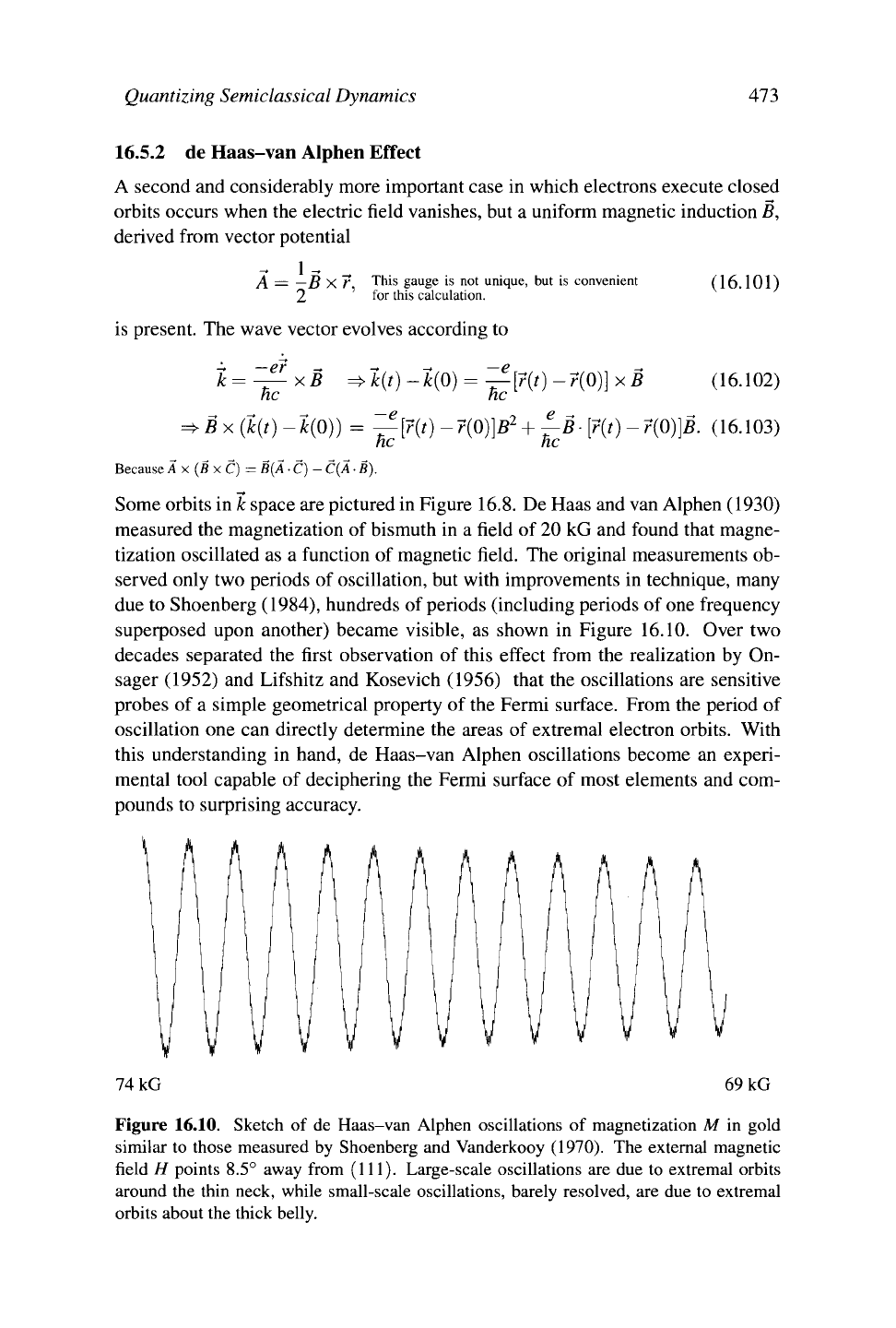
superposed upon another) became visible, as shown in Figure 16.10. Over two
decades separated the first observation of this effect from the realization by On-
sager (1952) and Lifshitz and Kosevich (1956) that the oscillations are sensitive
probes of a simple geometrical property of the Fermi surface. From the period of
oscillation one can directly determine the areas of extremal electron orbits. With
this understanding in hand, de Haas-van Alphen oscillations become an experi-
mental tool capable of deciphering the Fermi surface of most elements and com-
pounds to surprising accuracy.
Ill«
74 kG
69
kG
Figure 16.10. Sketch of de Haas-van Alphen oscillations of magnetization M in gold
similar to those measured by Shoenberg and Vanderkooy (1970). The external magnetic
field H points 8.5° away from (111). Large-scale oscillations are due to extremal orbits
around the thin neck, while small-scale oscillations, barely resolved, are due to extremal
orbits about the thick belly.
474
Chapter 16. Dynamics of Block Electrons
Origin of Oscillations in Quantization. The quantization condition (16.97) when
only a magnetic induction B is present becomes
Using the definition of
T
from
2TTJ
= T- dt
y—-r-—(rxB)-r\ Eq. (16.98), and inserting (16.104)
(16.84a) for/t.
T
= T+ / dt^r-r-^xB)
(16.105)
Jo
2«c
„T
<- n
Use
Eqs.
(16.84a) and (16.103).
= T
+ / J?
(
- x
A;
) •
k
Constant offsets in
*
or
r
vanish
- ( 16.106)
Jo 2eB\B
I
=
r +
/^-2^(ß
X
")
(16
-
107)
2TTJ
= T+A —,
dk
■ (n
x k) is twice (16.108)
^ß the area element.
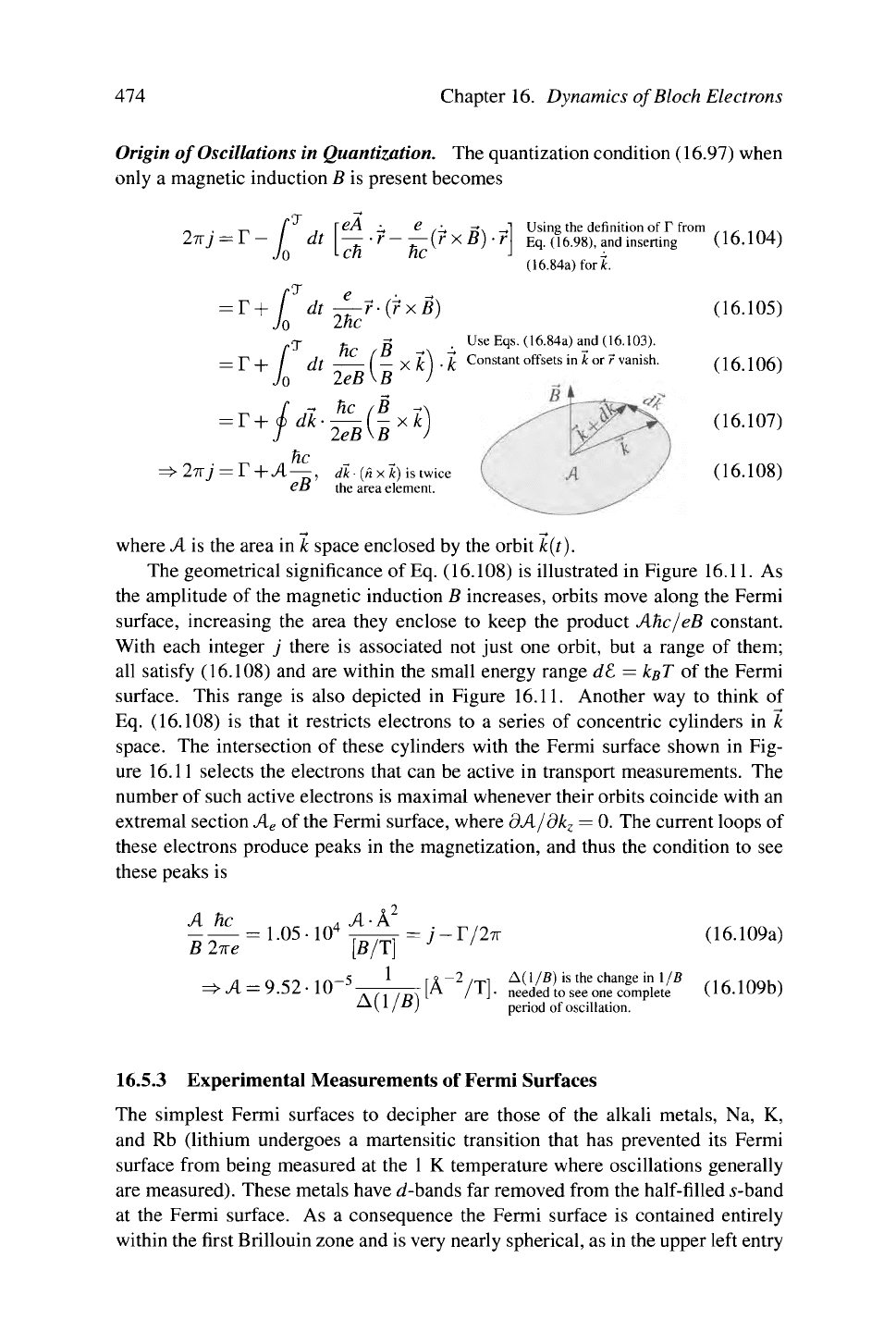
where A is the area in k space enclosed by the orbit k(t).
The geometrical significance of
Eq.
(16.108) is illustrated in Figure
16.11.
As
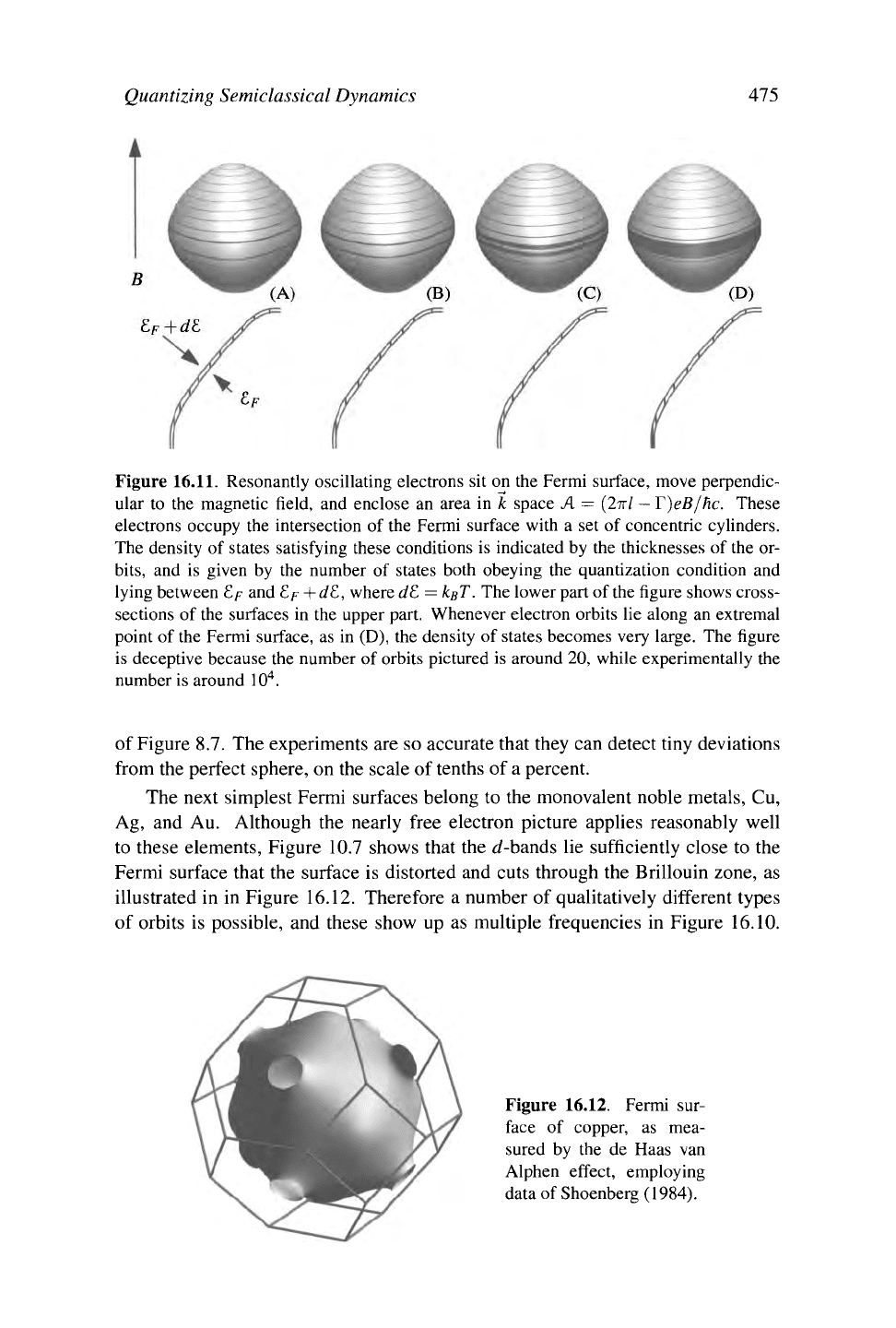
the amplitude of the magnetic induction B increases, orbits move along the Fermi
surface, increasing the area they enclose to keep the product AHc/eB constant.
With each integer
j
there is associated not just one orbit, but
a
range of them;
all satisfy (16.108) and are within the small energy range dZ
=
kßT of the Fermi
surface. This range is also depicted in Figure
16.11.
Another way to think of
Eq. (16.108) is that
it
restricts electrons to
a
series of concentric cylinders in k
space. The intersection of these cylinders with the Fermi surface shown in Fig-
ure 16.11 selects the electrons that can be active in transport measurements. The
number of such active electrons is maximal whenever their orbits coincide with an
extremal section A
e
of the Fermi surface, where dA/dk
z
= 0. The current loops of
these electrons produce peaks in the magnetization, and thus the condition to see
these peaks is
=
1.05-10
4
r
—-r=j-T/2ir (16.109a)
B 2-Ke
'
[fl/T]
^ J_QO
in-5 1
[A~
2
/Tl AO/ß)'
8
the
chan
g
e
m'/.B
^
s*-
—
7--J4-
1U
[/\ /
1J. needed to see one complete ^lo.iuyrjj
\
I )
period of oscillation.
16.5.3 Experimental Measurements of Fermi Surfaces
The simplest Fermi surfaces to decipher are those of the alkali metals, Na,
K,
and Rb (lithium undergoes
a
martensitic transition that has prevented its Fermi
surface from being measured at the
1
K temperature where oscillations generally
are measured). These metals have d-bands far removed from the half-filled s-band
at the Fermi surface. As a consequence the Fermi surface is contained entirely
within the first Brillouin zone and is very nearly spherical, as in the upper left entry
Quantizing Semiclassical Dynamics
475
Figure
16.11.
Resonantly oscillating electrons sit on the Fermi surface, move perpendic-
ular to the magnetic field, and enclose an area in k space A = (2irl
—
T)eB/Hc. These
electrons occupy the intersection of the Fermi surface with a set of concentric cylinders.
The density of states satisfying these conditions is indicated by the thicknesses of the or-
bits,
and is given by the number of states both obeying the quantization condition and
lying between Ep and £
F
+d£., where
d£.
= kßT. The lower part of the figure shows cross-
sections of the surfaces in the upper part. Whenever electron orbits lie along an extremal
point of the Fermi surface, as in (D), the density of states becomes very large. The figure
is deceptive because the number of orbits pictured is around 20, while experimentally the
number is around 10
4
.
of Figure 8.7. The experiments are so accurate that they can detect tiny deviations
from the perfect sphere, on the scale of tenths of a percent.
The next simplest Fermi surfaces belong to the monovalent noble metals, Cu,
Ag,
and Au. Although the nearly free electron picture applies reasonably well
to these elements, Figure 10.7 shows that the (/-bands lie sufficiently close to the
Fermi surface that the surface is distorted and cuts through the Brillouin zone, as
illustrated in in Figure 16.12. Therefore a number of qualitatively different types
of orbits is possible, and these show up as multiple frequencies in Figure 16.10.
Figure 16.12. Fermi sur-
face of copper, as mea-
sured by the de Haas van
Alphen effect, employing
data of Shoenberg (1984).
476 Chapter 16. Dynamics of Block Electrons
One way to interpret the experimental data is to write down a tight-binding model
with a number of free parameters and vary them until the extremal Fermi surface
orbits match those seen experimentally.
Three of the divalent metals (Ca, Sr, Ba) would be insulators if the Fermi sur-
face did not cut across the first Brillouin zone, creating isolated pockets of elec-
trons.
The hexagonal divalents (Be, Mg, Zn, and Cd) have the unpleasant feature
that important aspects of their band structure are produced by spin-orbit coupling,
and the fields applied to measure the de Haas-van Alphen effect are sufficient to
cause magnetic breakdown. The net effect is that the Fermi surface changes before
one's eyes during the measurements, essentially from the second column of Figure
8.8 to the third column of Figure 8.8, and this fact must be taken into account in
interpreting the measurements.
Elements with more than one or two mobile electrons per unit cell sometimes
continue to be described by the nearly free electron picture, as in the case of alu-
minum. More commonly, however, the nearly free-electron picture breaks down
altogether. For example, in the transition metals, the d-bands reach right up to
the Fermi surface, and the surfaces bear no particular resemblance to free electron
surfaces. It is difficult to interpret their de Haas-van Alphen oscillations with-
out theoretical guidance from band structure calculations about the shapes of the
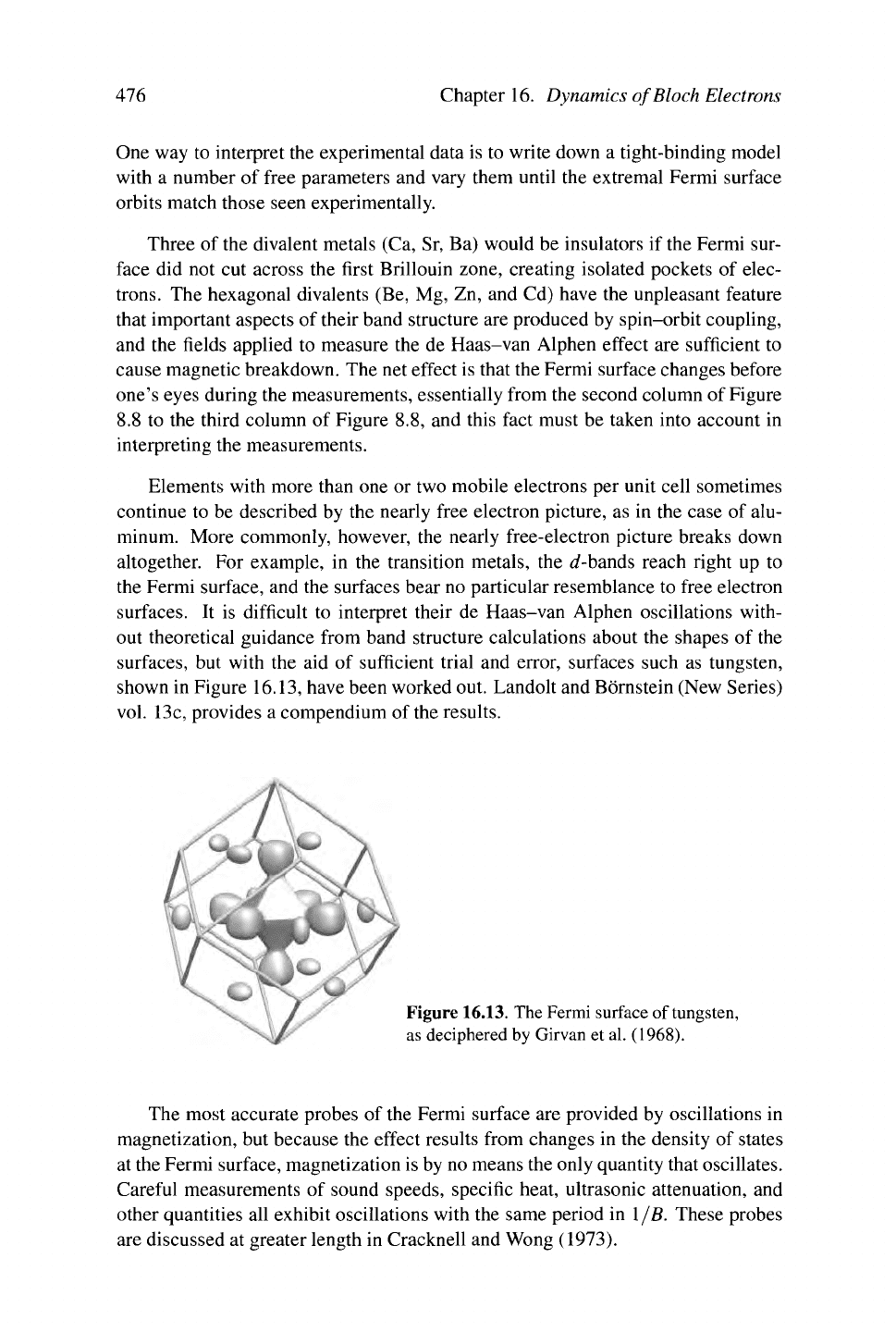
surfaces, but with the aid of sufficient trial and error, surfaces such as tungsten,
shown in Figure
16.13,
have been worked out. Landolt and Börnstein (New Series)
vol.
13c, provides a compendium of the results.
Figure 16.13. The Fermi surface of tungsten,
as deciphered by Girvan et al. (1968).
The most accurate probes of the Fermi surface are provided by oscillations in
magnetization, but because the effect results from changes in the density of states
at the Fermi surface, magnetization is by no means the only quantity that oscillates.
Careful measurements of sound speeds, specific heat, ultrasonic attenuation, and
other quantities all exhibit oscillations with the same period in
1
jB. These probes
are discussed at greater length in Cracknell and Wong (1973).
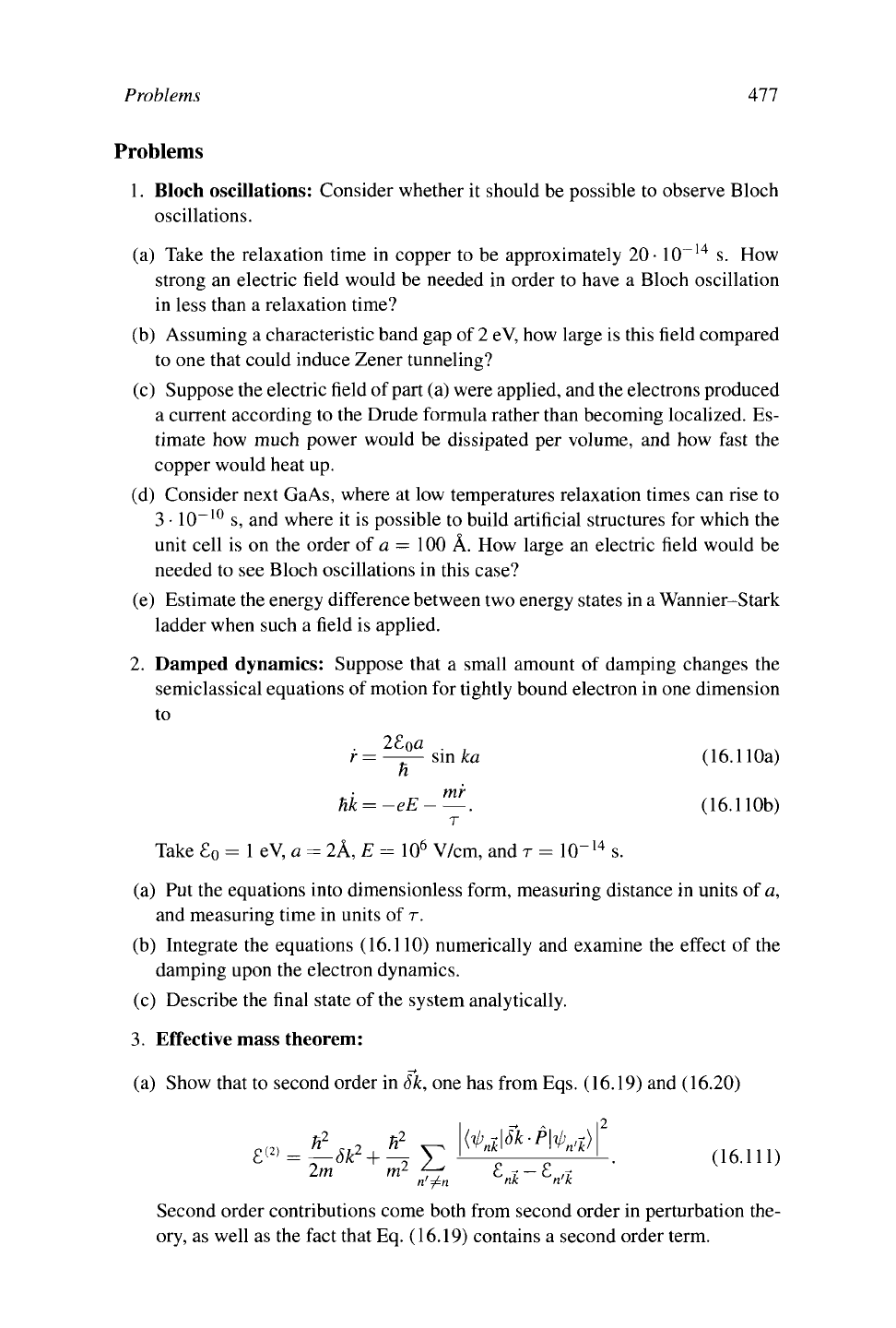
Problems
All
Problems
1.
Bloch oscillations: Consider whether it should be possible to observe Bloch
oscillations.
(a) Take the relaxation time in copper to be approximately 20-10~
14
s. How
strong an electric field would be needed in order to have a Bloch oscillation
in less than a relaxation time?
(b) Assuming a characteristic band gap of 2 eV, how large is this field compared
to one that could induce Zener tunneling?
(c) Suppose the electric field of part (a) were applied, and the electrons produced
a current according to the Drude formula rather than becoming localized. Es-
timate how much power would be dissipated per volume, and how fast the
copper would heat up.
(d) Consider next GaAs, where at low temperatures relaxation times can rise to
3
■
10
-10
s, and where it is possible to build artificial structures for which the
unit cell is on the order of a = 100 Â. How large an electric field would be
needed to see Bloch oscillations in this case?
(e) Estimate the energy difference between two energy states in a Wannier-Stark
ladder when such a field is applied.
2.
Damped dynamics: Suppose that a small amount of damping changes the
semiclassical equations of motion for tightly bound electron in one dimension
to
2£QΦ
H
sin ka (16.110a)
mr
Hk
= -eE . (16.110b)
r
Take £
0
= 1 eV, a = 2À, E = 10
6
V/cm, and r = 10"
14
s.
(a) Put the equations into dimensionless form, measuring distance in units of a,
and measuring time in units of r.
(b) Integrate the equations (16.110) numerically and examine the effect of the
damping upon the electron dynamics.
(c) Describe the final state of the system analytically.
3.
Effective mass theorem:
(a) Show that to second order in ôk, one has from Eqs. (16.19) and (16.20)
h
1
h
2
\(il)?\ök-P\i) ,■'
1m m
2
~-f £
7
—
£ ,-t
n'^én nk n'k
(16.111)
Second order contributions come both from second order in perturbation the-
ory, as well as the fact that Eq. (16.19) contains a second order term.
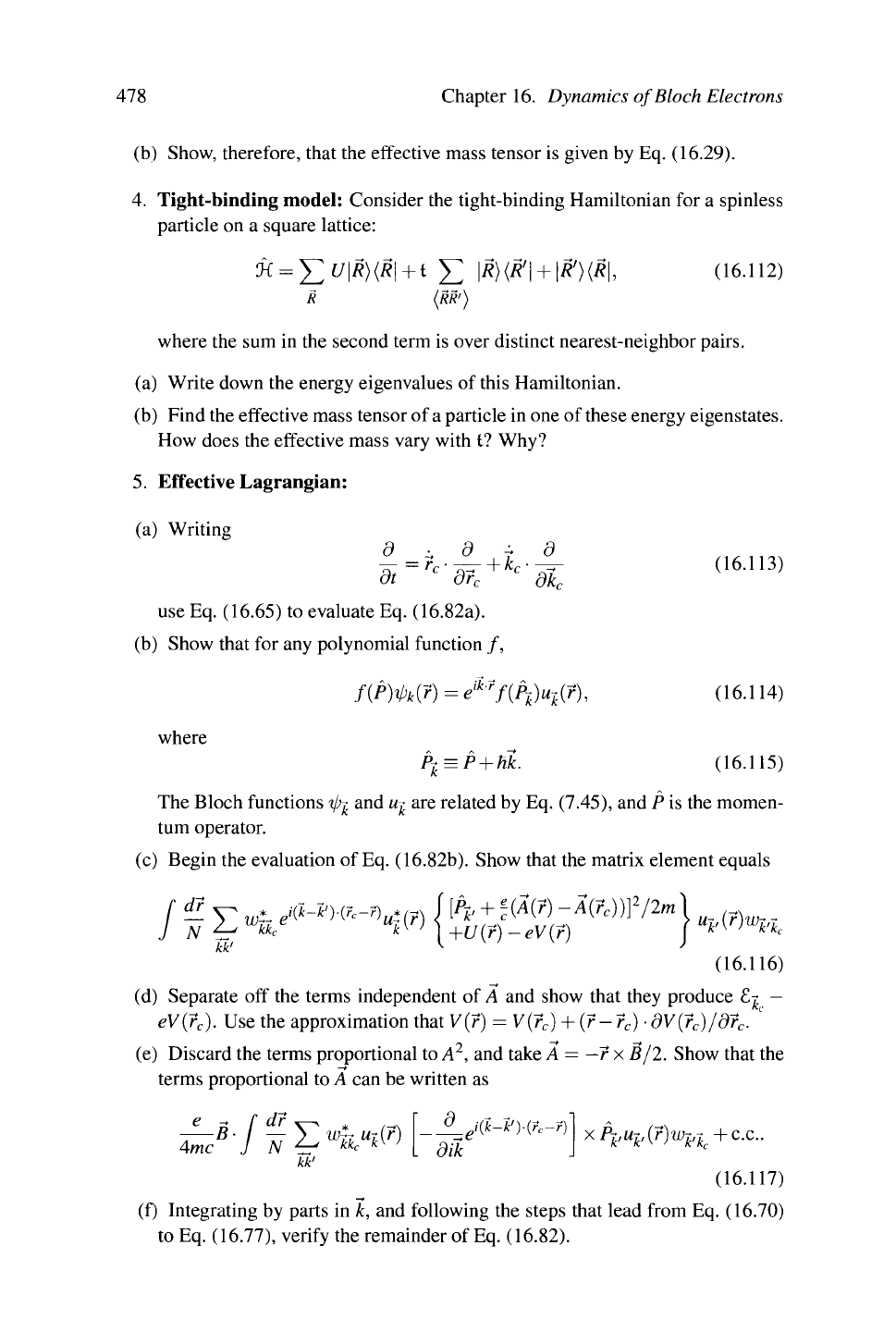
478 Chapter 16. Dynamics of Block Electrons
(b) Show, therefore, that the effective mass tensor is given by Eq. (16.29).
4.
Tight-binding model: Consider the tight-binding Hamiltonian for a spinless
particle on a square lattice:
^i = Y^U\â}{R\ + i Y^ I^X^'I+ l#')(#!, (16.112)
R
(RR')
where the sum in the second term is over distinct nearest-neighbor pairs.
(a) Write down the energy eigenvalues of this Hamiltonian.
(b) Find the effective mass tensor of
a
particle in one of these energy eigenstates.
How does the effective mass vary with t? Why?
5.
Effective Lagrangian:
(a) Writing
d • d ~ d
^ =
r
c
-
1
-+k
c
--
r
(16.113)
dt dr
c
dk
c
use Eq. (16.65) to evaluate Eq. (16.82a).
(b) Show that for any polynomial function /,
f(P)M7) =
e^ttPjiHW,
(16-114)
where
P\
= P + hk. (16.115)
The Bloch functions ^ and
u^
are related by Eq. (7.45), and P is the momen-
tum operator.
(c) Begin the evaluation of
Eq.
(16.82b). Show that the matrix element equals
/ - £ «& ^-*™-MV) \
[h
' + &W-A(?c))?/2
m
1
J
N
Z-, kk
c
k^ ) ^
+
u(y)-eV(r) J
kK
'
kkc
(16.116)
(d) Separate off the terms independent of A and show that they produce £j —
eV(r
c
).
Use the approximation that V(r) = V(r
c
) + (r
—
r
c
)
■
dV(r
c
)/dr
c
.
(e) Discard the terms proportional to A
2
, and take A = — r x B/2. Show that the
terms proportional to A can be written as
B-
/ — V iu~ u
t
(r)
J N tr'
kkc
Arne J N tr'
kkc
I dik
kk'
<L
e
i{k-k')-(r
c
~r)
XPl,U7,(r)w7,
h
+C.C.
(16.117)
(f) Integrating by parts in k, and following the steps that lead from Eq. (16.70)
to Eq. (16.77), verify the remainder of
Eq.
(16.82).
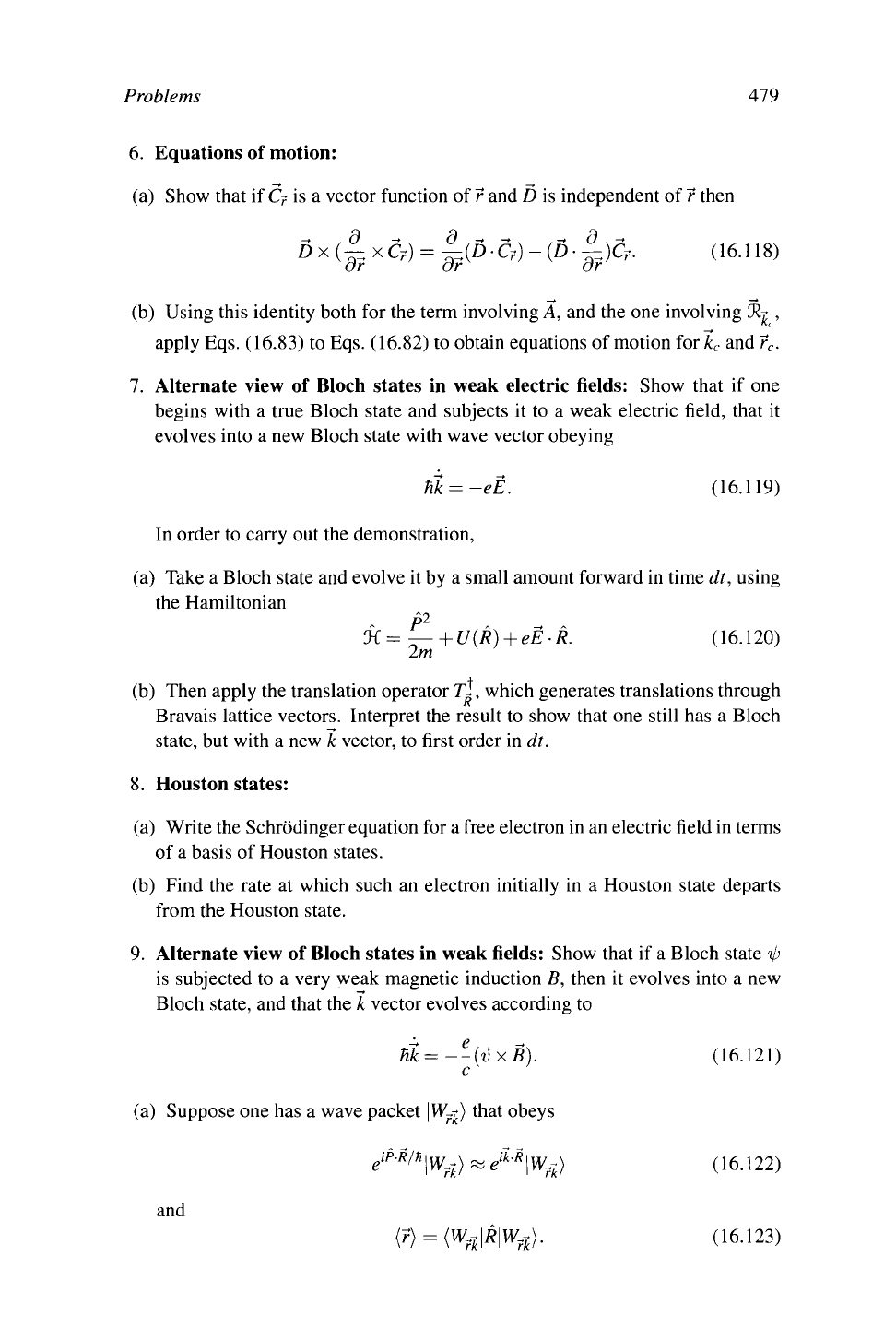
Problems
479
6. Equations of motion:
(a) Show that if Q is a vector function of r and D is independent of r then
D x (— x C
r
) = -^{D-C?)
-
(D
•
—)C
7
. (16.118)
or
or or
(b) Using this identity both for the term involving A, and the one involving 3^
,
apply Eqs. (16.83) to Eqs. (16.82) to obtain equations of motion
fork
c
and r
c
.
7.
Alternate view of Bloch states in weak electric fields: Show that
if
one
begins with a true Bloch state and subjects it to a weak electric field, that it
evolves into a new Bloch state with wave vector obeying
Hk
= -eE. (16.119)
In order to carry out the demonstration,
(a) Take a Bloch state and evolve it by a small amount forward in time dt, using
the Hamiltonian
-
P
2
.. ,
JC
=—
+ U(R) + eE-R. (16.120)
2m
(b) Then apply the translation operator Tl, which generates translations through
R
Bravais lattice vectors. Interpret the result to show that one still has a Bloch
state,
but with a new k vector, to first order in dt.
8. Houston states:
(a) Write the Schrodinger equation for a free electron in an electric field in terms
of a basis of Houston states.
(b) Find the rate at which such an electron initially in a Houston state departs
from the Houston state.
9. Alternate view of Bloch states in weak fields: Show that if a Bloch state ip
is subjected to a very weak magnetic induction B, then it evolves into a new
Bloch state, and that the k vector evolves according to
Hk=--(vxB).
(16.121)
(a) Suppose one has a wave packet \W^) that obeys
e
ip
-
â
/
n
\W
fk
)
^
e
iU
\W
fk
) (16.122)
and
(r) = (W
fk
\R\W
fk
). (16.123)
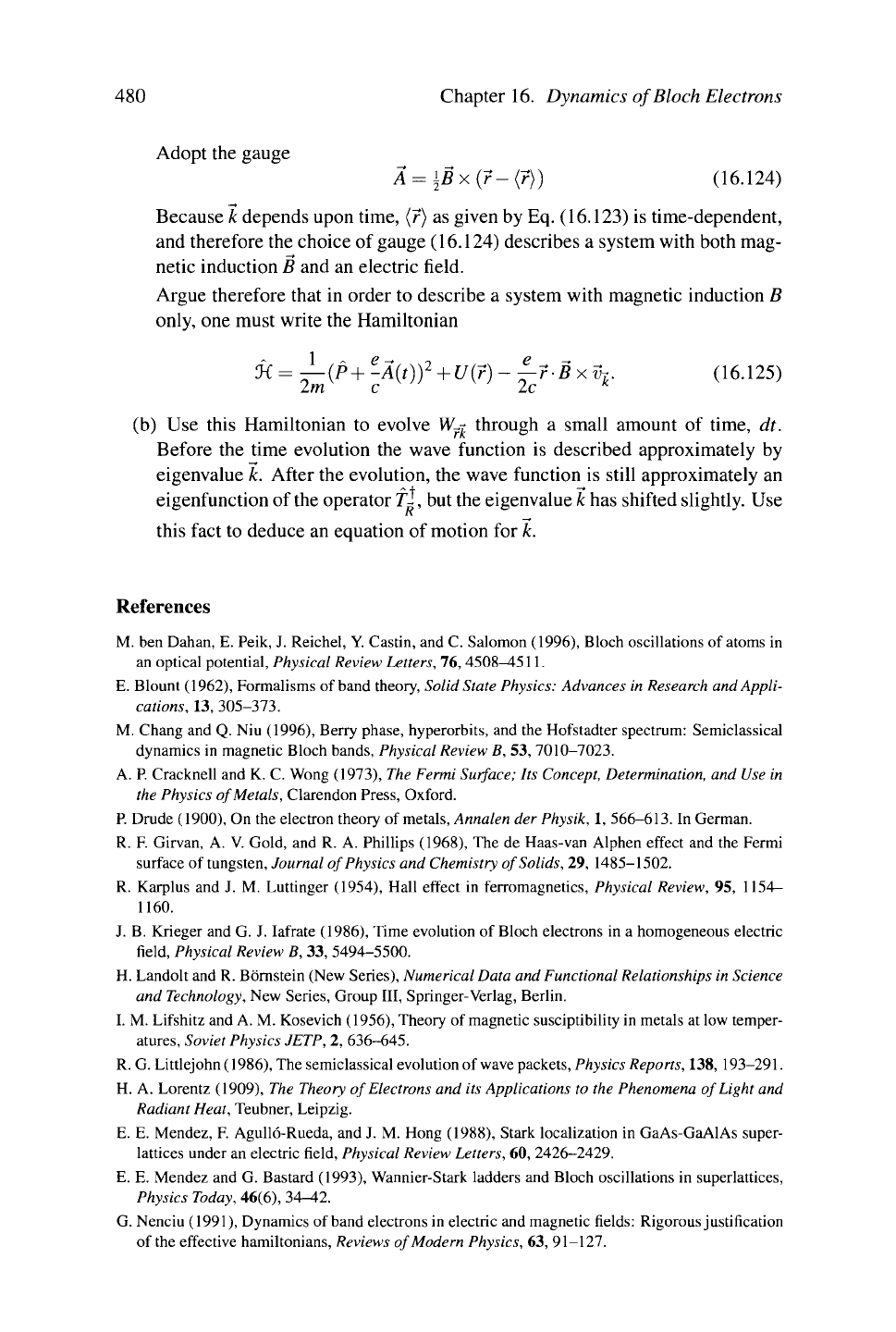
480
Chapter 16. Dynamics of Bloch Electrons
Adopt the gauge
 = ±Bx(r-(r)) (16.124)
Because k depends upon time, (r) as given by Eq. (16.123) is time-dependent,
and therefore the choice of gauge (16.124) describes a system with both mag-
netic induction B and an electric field.
Argue therefore that in order to describe
a
system with magnetic induction B
only, one must write the Hamiltonian
Ä = -î-(P+ -Ä{t)f
+ U(r)
-^-r-Bxv^
(16.125)
2m
c Le
K
(b) Use this Hamiltonian
to
evolve W^ through
a
small amount
of
time,
dt.
Before the time evolution the wave function
is
described approximately by
eigenvalue k. After the evolution, the wave function is still approximately an
eigenfunction of
the
operator f-J, but the eigenvalue k has shifted slightly. Use
this fact to deduce an equation of motion for
k.
References
M. ben Dahan, E. Peik, J. Reichel, Y. Castin, and C. Salomon (1996), Bloch oscillations of atoms in
an optical potential, Physical Review Letters, 76, 4508^4511.
E. Blount (1962), Formalisms of band theory, Solid State Physics: Advances in Research and Appli-
cations, 13, 305-373.
M. Chang and Q. Niu (1996), Berry phase, hyperorbits, and the Hofstadter spectrum: Semiclassical
dynamics in magnetic Bloch bands, Physical Review B, 53, 7010-7023.
A. P. Cracknell and K. C. Wong (1973), The Fermi Surface; Its Concept, Determination, and Use in
the Physics of Metals, Clarendon Press, Oxford.
P.
Drude (1900), On the electron theory of metals, Annalen der
Physik,
l,
566-613. In German.
R. F. Girvan, A. V. Gold, and R. A. Phillips (1968), The de Haas-van Alphen effect and the Fermi
surface of tungsten, Journal of Physics and Chemistry of Solids, 29, 1485-1502.
R. Karplus and J. M. Luttinger (1954), Hall effect
in
ferromagnetics, Physical Review, 95, 1154—
1160.
J. B. Krieger and G. J. lafrate (1986), Time evolution of Bloch electrons in
a
homogeneous electric
field, Physical Review B, 33, 5494-5500.
H. Landolt and R. Börnstein (New Series), Numerical Data and Functional Relationships in Science
and Technology, New Series, Group III, Springer-Verlag, Berlin.
I. M. Lifshitz and A. M. Kosevich (1956), Theory of magnetic susciptibility in metals at low temper-
atures, Soviet Physics JETP, 2, 636-645.
R. G. Littlejohn (1986), The semiclassical evolution of wave packets, Physics Reports, 138,193-291.
H. A. Lorentz (1909), The Theory of Electrons and its Applications to the Phenomena of Light and
Radiant Heat, Teubner, Leipzig.
E. E. Mendez, F. Agullö-Rueda, and J. M. Hong (1988), Stark localization in GaAs-GaAlAs super-
lattices under an electric field, Physical Review Letters, 60, 2426-2429.
E. E. Mendez and G. Bastard (1993), Wannier-Stark ladders and Bloch oscillations in superlattices,
Physics Today, 46(6), 34-42.
G. Nenciu (1991), Dynamics of band electrons in electric and magnetic fields: Rigorous justification
of the effective hamiltonians, Reviews of Modern Physics, 63, 91-127.
References 481
L. Onsager (1952), Interpretation of the de Haas-van Alphen effect, Philosophical Magazine, 43,
1006-1008.
A. B. Pippard (1988), Magnetoresistance in Metals, Cambridge University Press, Cambridge.
M. Raizen, C. Salomon, and Q. Niu (1997), New light on quantum transport, Physics Today, 50(7),
30-34.
D.
Shoenberg (1984), Magnetic Oscillations in Metals, Cambridge, Cambridge University Press.
D.
Shoenberg and J. Vanderkooy (1970), Absolute amplitudes in the de Haas-van Alphen effect,
Journal of Low
Temperature
Physics, 2, 483^-97.
G. Sundaram and Q. Niu (1999), Wave-packet dynamics in slowly perturbed crystals: Gradient cor-
rections and Berry-phase effects, Physical Review B, pp. 14915-14925.
S. M. Sze (1981), Physics of Semiconductor Devices, 2nd ed., John Wiley and Sons, New York.
J. J. Thomson (1907), The Corpuscular Theory of Matter, Charles Scribner's Sons, New York.
G. Wiedemann and R. Franz
(
1853),
On the thermal conductivity of metals, Annalen der
Physik,
89,
497-531.
in German.
S. R. Wilkinson, C. F. Bharucha, K. W. Madison, Q. Niu, and M. G. Raizen (1996), Observation of
atomic Wannier-Stark ladders in an accelerating optical potential, Physical Review Letters, 76,
4512-4515
J. Zak (1972), The /^-representation in the dynamics of electrons in solids, Solid State Physics:
Advances in Research and Applications, 27, 1-62.
C. Zener (1932), Non-adiabatic crossing of energy levels, Proceedings of
the
Royal Society of
Lon-
don,
A137, 696-702.