
Marder M.P. Condensed Matter Physics
Подождите немного. Документ загружается.

Thermoelectric Phenomena
493
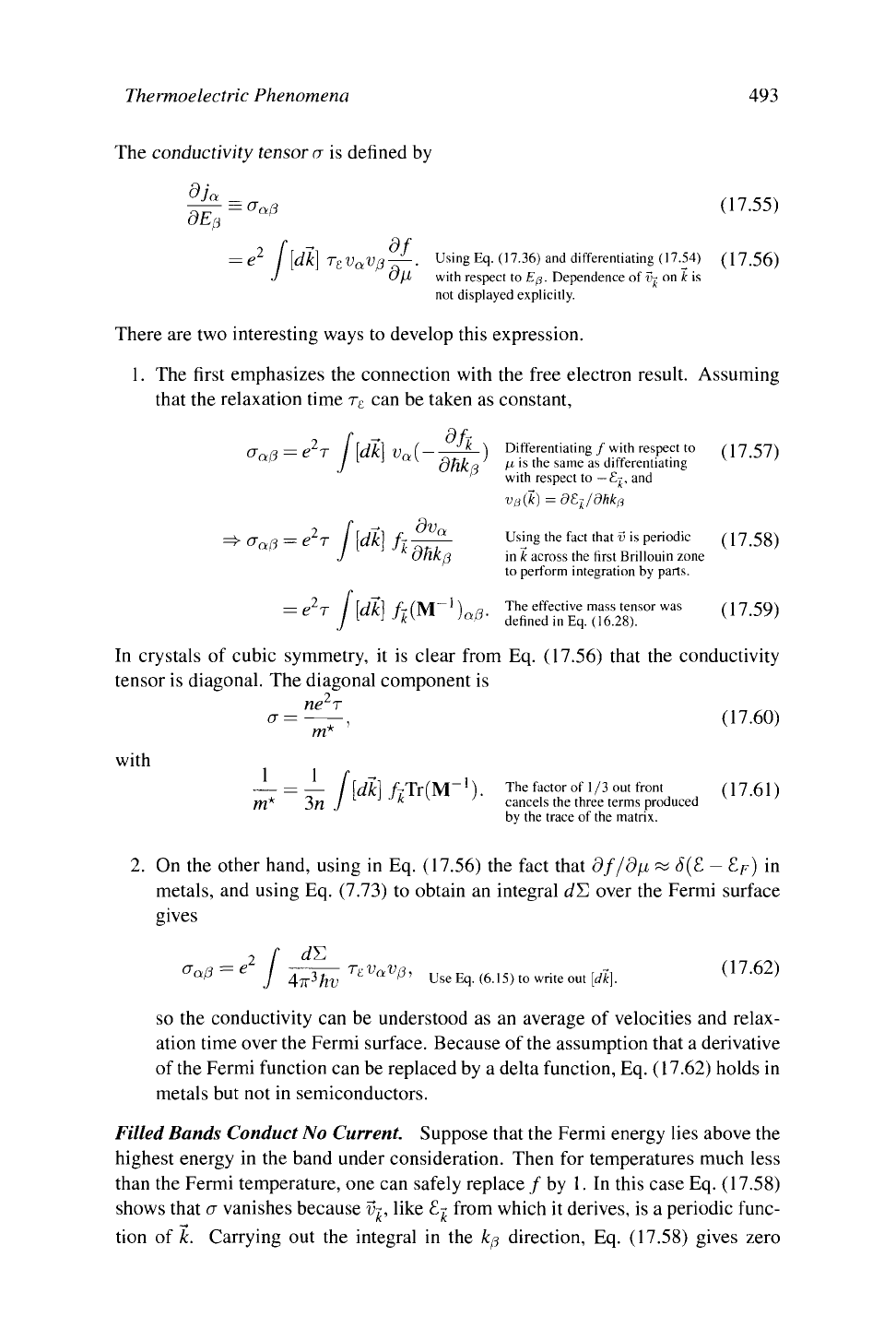
The conductivity tensor
a is
defined
by
djoc
a
aß
(17.55)
<J^ß
=
e
2
[dk]T
E
V
a
Vß^-. Using Eq. (17.36) and differentiating (17.54) (17.56)
.1
u[i
with respect
to Ep.
Dependence
of üj on k is
not displayed explicitly.
There are two interesting ways
to
develop this expression.
1.
The
first emphasizes
the
connection with
the
free electron result. Assuming
that the relaxation time
r
£
can
be taken
as
constant,
a
a0
= e
2
T f\dk}
vJ~—-*-) Differentiating
/
with respect
to
(17.57)
p
J
L J v
dhkn
V
1S the
same
as
differentiating
v
'
P with respect
to—£j,
and
v
B
(k)
=
d£
l
/dhk
ß
/
->
dv
[dk}f-
k
—-^-
Using
the
fact that
C
is
periodic (17.58)
Öhkß
in k
across
the
first Brillouin zone
to perform integration
by
parts.
—
P^T I \rlk\
f-CM~^\
a
The effective mass tensor was
(\ 1 ^Q\
-
e T J
[ÜK\
J
k
[M
)
aß
.
defined
jn Eq (l6
2g)
(1
I.W)
In crystals
of
cubic symmetry,
it is
clear from
Eq.
(17.56) that
the
conductivity
tensor
is
diagonal. The diagonal component
is
ne
2
r
0
= -^T,
(17.60)
m*
with
1
1 f ->
=
\dk]
fvTr(M-
!
). The factor
of 1/3 out
front (17.61)
m*
3n J
cancels
the
three terms produced
by
the
trace
of
the matrix.
2.
On the
other hand, using
in Eq.
(17.56)
the
fact that df/dfi
« 6(8
—
8f) in
metals,
and
using Eq. (7.73)
to
obtain
an
integral
JS
over the Fermi surface
gives
aaß
= e
J
4^Jw
TEVaVß
' Use Eq. (6.15)
to
write
out
[dk].
(1?
-
62)
so
the
conductivity
can be
understood
as an
average
of
velocities
and
relax-
ation time over the Fermi surface. Because
of
the assumption that a derivative
of the Fermi function can be replaced by
a
delta function, Eq. (17.62) holds
in
metals
but not in
semiconductors.
Filled Bands Conduct No Current. Suppose that the Fermi energy lies above
the
highest energy
in the
band under consideration. Then
for
temperatures much less
than the Fermi temperature, one
can
safely replace
/ by 1. In
this case Eq. (17.58)
shows that
a
vanishes because v^, like
£^
from which
it
derives,
is a
periodic func-
tion
of k.
Carrying
out the
integral
in the kß
direction,
Eq.
(17.58) gives zero
494 Chapter 17.
Transport
Phenomena and
Fermi
Liquid Theory
immediately. Equation (17.62) incorporates the same lesson. The integral dT, must
be carried
out
over the Fermi surface,
and if
there
is no
Fermi surface,
it
vanishes.
Thus completely filled bands contribute nothing
to
electrical current.
The
rea-
son
is
that
in
order
to
carry current, electrons must accelerate slightly
in the
pres-
ence
of an
electric field, which means that their index
k
must increase slightly.
However,
in a
filled band,
all the k are
occupied,
the
rate
of
Zener tunneling
out
of
the
band
is
tremendously
low, and the
Pauli principle prevents electrons from
altering their states
at all.
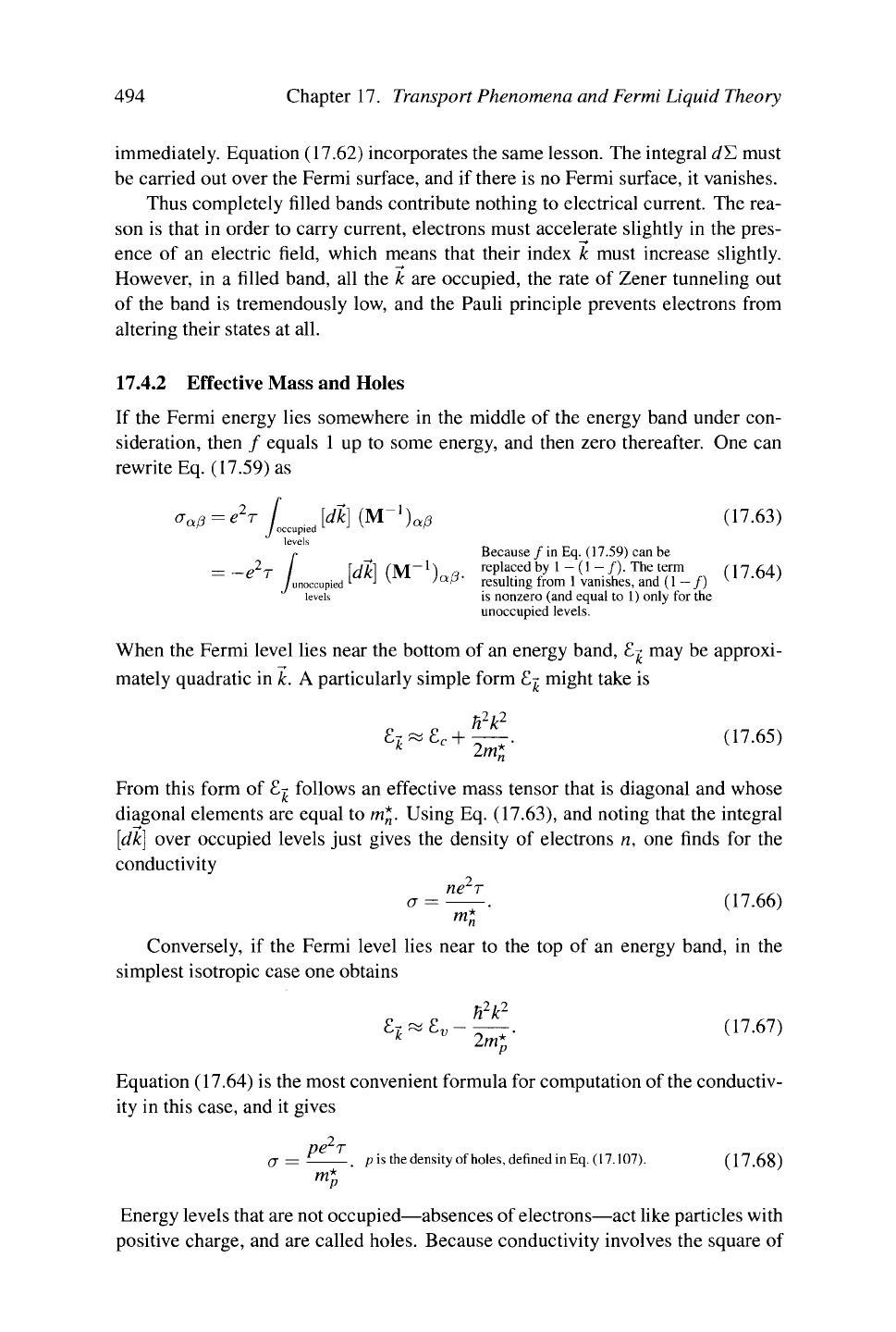
17.4.2 Effective Mass and Holes
If
the
Fermi energy lies somewhere
in the
middle
of the
energy band under con-
sideration, then
/
equals
1 up to
some energy,
and
then zero thereafter.
One can
rewrite Eq. (17.59)
as
°aß
= e
2
r
^
ccupjed
[dk]
(M-
]
)
aß
(17.63)
levels
n Because
/ in Eq.
(17.59)
can be
=
-e
2
T [dk]
(M.-
l
)
a0
.
replaced
by 1-(1-/). The
term (17.64)
/unoccupied
1
'
v
'
p
resulting from
1
vanishes,
and (1
—
/)
v
'
levels
is
nonzero
(and
equal
to
1 )
only
for the
unoccupied levels.
When
the
Fermi level lies near
the
bottom
of an
energy band,
£^ may be
approxi-
mately quadratic
in k. A
particularly simple form
£^
might take
is
h
2
k
2
K
2m*
From this form
of £j
follows
an
effective mass tensor that
is
diagonal
and
whose
diagonal elements
are
equal
to
m*.
Using Eq. (17.63),
and
noting that
the
integral
[dk]
over occupied levels just gives
the
density
of
electrons
n, one
finds
for the
conductivity
2
ne
T
<r
= .
(17.66)
K
Conversely,
if the
Fermi level lies near
to the top of an
energy band,
in the
simplest isotropic case
one
obtains
hV
2m
£*«£«-—•
(
17
-
67
)
p
Equation (17.64)
is the
most convenient formula
for
computation
of
the conductiv-
ity
in
this case,
and it
gives
2
ne
T
g
= p
is the density
of
holes,
defined in Eq. (17.107).
(17 68)
Energy levels that are not occupied—absences
of
electrons—act like particles with
positive charge,
and are
called holes. Because conductivity involves
the
square
of
Thermoelectric Phenomena
495
the charge, conductivity cannot reveal
the
sign
of the
charge carrier.
In a
mag-
netic field, electrons
and
holes orbit
in
opposite directions, allowing experiments
in crossed electrical
and
magnetic fields
to
distinguish between them.
The discussion
of
Bloch oscillations and Wannier-Stark ladders may have left
the impression that
it is not
realistic
to
expect electrons
to
travel
in
unexpected
directions against applied fields. This impression
is
wrong. Electron mean free
paths rarely permit them
to
travel
far
enough
to
complete
a
Bloch oscillation.
But
in solids where the Fermi level lies near the top
of
an energy band rather than near
the bottom,
the
mobile electrons
do
move opposite
the
expected direction, leading
to their interpretation
as
holes. Such solids are extremely common.
17.4.3 Mixed Thermal and Electrical Gradients
Solids subject
to
simultaneous electrical
and
thermal gradients often
act
little like
free-electron gases. Appreciating that strong interactions with the lattice can change
the dynamics
of
electrons near the Fermi surface
is the key to
understanding qual-
itatively why this
is so.
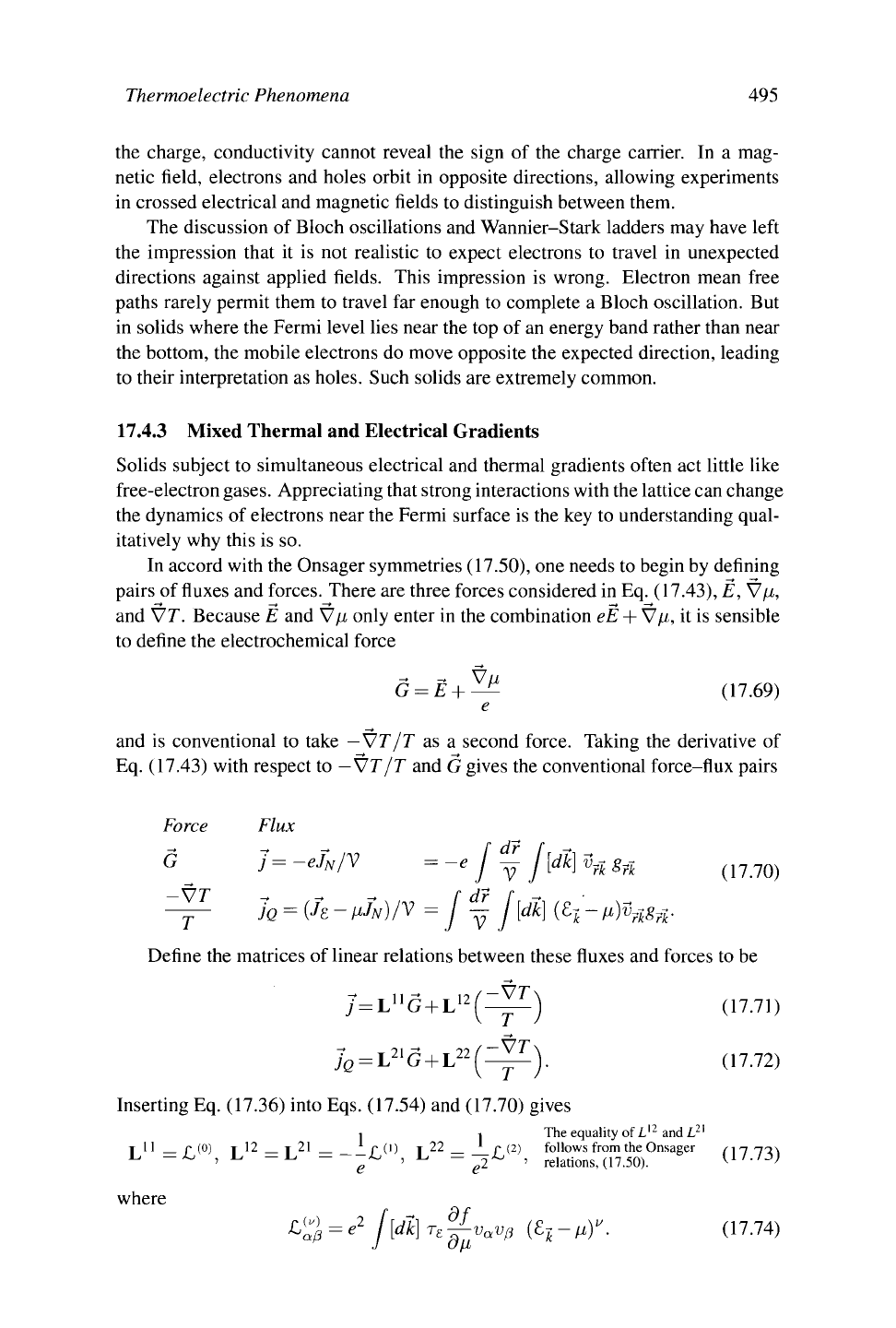
In accord with the Onsager symmetries (17.50), one needs
to
begin by defining
pairs
of
fluxes and forces. There are three forces considered
in
Eq. (17.43),
E, Viz,
and
V7\
Because
E and
V/x only enter
in the
combination eE
+
V/i,
it is
sensible
to define the electrochemical force
G
= £ + —
(17.69)
e
and
is
conventional
to
take —VT/T
as a
second force. Taking
the
derivative
of
Eq. (17.43) with respect
to
—VT/T
and
G gives
the
conventional force-flux pairs
Force Flux
dr
G j
=
-ef
N
/V =-
e
J -L Jldk}v
fk
g
fk
(n JQ)
JQ
=
(JE
-
ßf
N
)/V
= J Y / l
d
^\ (
£
* "
^fkSfk-
-VT
_. ,,. ? , ,„„ r dr
T
Define the matrices
of
linear relations between these fluxes
and
forces
to be
7=L
]1
G
+
L
12
(-^) (17.71)
J
G
=
L
21
G
+
L
22
(^). (17.72)
Inserting
Eq.
(17.36) into
Eqs.
(17.54) and (17.70) gives
i
«
The equality
of L
n
and L
2
'
ill
p (0) T 12 y 21 r (') T 22 r (2)
follows from
the
Onsager
,\n TX\
L -^ , L, -L ---^ '
L
~ ^2 '
relations, (17.50).
(U./i)
where
La
= e
1
j[dk] r
£
J-v
a
v
ß
(£j -
/x)".
(17.74)
dß
496
Chapter 17.
Transport
Phenomena and Fermi Liquid Theory
Defining
o"a/?(£)
= ne
1
/
[dk]
v
a
v
ß
Ö(E
-
£^), (17.75)
one has
L%
= j dE^-{e.-ii)
v
a
aß
{Z).
(17.76)
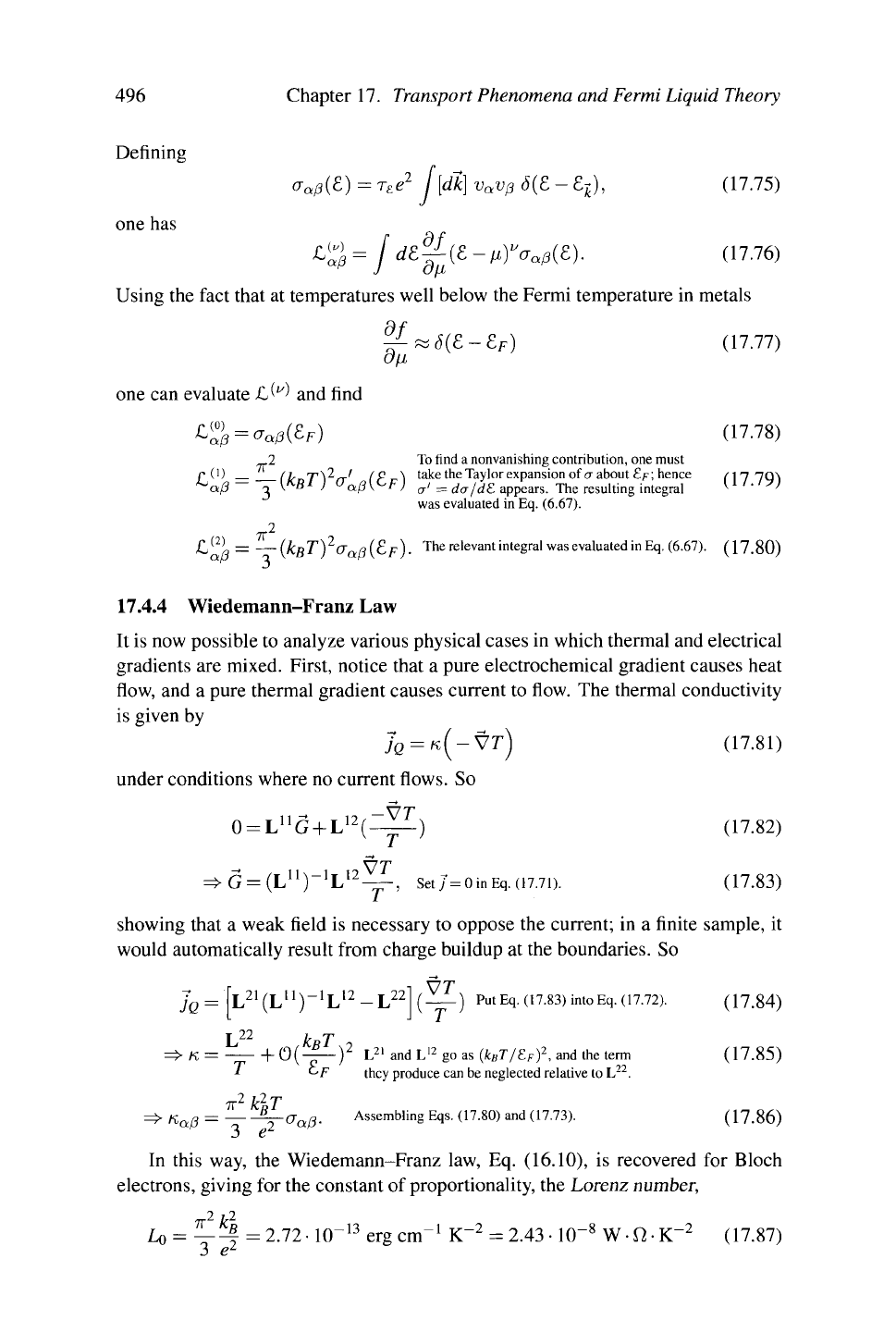
Using the fact that at temperatures well below the Fermi temperature in metals
|£«<J(£-£F) (17.77)
O/J,
one can evaluate
L^
and find
£% =
<T
a
ß(£>F)
(17-78)
2
To
find
a
nonvanishing
contribution,
one must
£<>>
=
—(k
B
T)
2
a'J8,
F
) taketheTaylorexpansionofaabout2
F
;hence (I7.79)
aß
3 P °
—da/dt appears. The resulting integral
v
'
was
evaluated in Eq. (6.67).
7T
2
^ß
=
—(k
B
T)
2
a
a
ß(8.
F
). The relevant integral was evaluated in
Eq.
(6.67). (17.80)
17.4.4 Wiedemann-Franz Law
It is now possible to analyze various physical cases in which thermal and electrical
gradients are mixed. First, notice that a pure electrochemical gradient causes heat
flow, and
a
pure thermal gradient causes current to flow. The thermal conductivity
is given by
JQ
=
K(-VT)
(17.81)
under conditions where no current
flows.
So
-» — VT
0
=
L
n
G
+
L
12
(
)
(17.82)
^G=(L
I1
)-
1
L
12
—-,
Set 7=0 in Eq. (17.71). (17.83)
showing that
a
weak field
is
necessary to oppose the current; in
a
finite sample,
it
would automatically result from charge buildup at the boundaries.
So
JQ
1
VT
L
21
(L
U
)
_1
L
12
-L
22
( )
Put Eq. (17.83) into Eq. (17.72). (17.84)
T 22
k T
=>K=
hO(-|— )
2
L
21
andL
12
goas(fc
B
77£
F
)
2
, and the term (17.85)
*
^F
they produce can be neglected relative to L
22
.
7T
2
k
2
T
Ara
a
ß.
Assembling Eqs. (17.80) and (17.73). (17.86)
3
e
l
In this way, the Wiedemann-Franz law, Eq. (16.10),
is
recovered
for
Bloch
electrons, giving for the constant of proportionality, the Lorenz number,
Lo
=
—
^f =
2.72
•
10"
13
erg cm"
1
K"
2
=
2.43
•
10"
8
W
•
fi
•
K"
2
(17.87)
3
e
l
Thermoelectric Phenomena 497
This simple relation between thermal and electrical conductivity applies compo-
nent by component to electrical and thermal conductivity so long as the relaxation
time approximation is valid. As shown in Table 17.1, it describes many metals
rather well at 300 K. The comparison of theory and experiment is considerably
less successful at 20 K, because at low temperatures the relaxation time approxi-
mation is less reliable.
17.4.5 Thermopower—Seebeck Effect
It follows from Eqs. (17.71) and (17.72) that it should be possible to measure a po-
tential drop across the ends of a sample between which there exists a temperature
gradient. Actually to measure this temperature gradient requires a clever choice
of geometry, as shown in Figure 17.2. Two separate metals are required, because
otherwise a temperature gradient across one's measuring device will induce addi-
tional potential drops within the voltmeter and distort the measurement. It should
be pointed out that although the leads to which the voltmeter is attached have the
same temperature, so there is no thermal gradient across the voltmeter, the chem-
ical potentials of different metals at the same temperature are in general different,
and contribute to current flow. This argument explains why the electrochemical
force in Eq. (17.69) was defined to contain both electric field and chemical po-
tential gradient. The thermopower or absolute Seebeck coefficient a is defined by
An ideal voltmeter permits no current to flow, so one has only to
OtSJT return to Eq. (17.71) and set y to zero. Despite being named a
coef-
(17.88)
ficient, a is properly a tensor.
T
12 2 u2
T
UsingEqs. (17.79), (17.80), and
(L
11
)-
1
—
= - — ^-o--V Eq. (17.73) in Eq. (17.71). (17 89)
V
' T 3 e
The fact that Eq. (17.89) involves er~'er' suggests that the relaxation time might
cancel out, just as in the ratio of electrical to thermal conductivity, and make the
Seebeck coefficient a good testing ground for theory. In fact, it is very sensitive
to the derivative of the relaxation time with respect to energy, a quantity that is
very difficult to calculate with precision, so experimental values of the Seebeck
coefficient are hard to predict or interpret.
G =
Figure 17.2. In order to measure thermopower, it is necessary to create a temperature
gradient across two separate metals, so as to avoid temperature gradients across the leads
of
the
voltmeter.
498 Chapter 17.
Transport
Phenomena and
Fermi
Liquid Theory
Typical measured values of the thermopower are on the order of microvolts
per degree, and some values are listed in Table 17.1. The table does not go into
great detail. For example, the thermopower of bismuth is highly anisotropic; ther-
mopower parallel to the main symmetry axis is —110
p\
K"
1
while that perpen-
dicular to it is -54 pV K
-1
.
17.4.6 Peltier Effect
The Peltier effect occurs when current flows in a bimetallic circuit without temper-
ature gradients. The flow of electrical current induces a heat flow defined to have
magnitude
j
Q
=
Uj. (17.90)
One sees from Eq. (17.72) that
IT
= L (L )
=Tct. The matrices L
11
and L
21
must commute to obtain (17.91)
the relation to the Seebeck coefficient
a.
This result applies to
a
single metal. If two metals are arranged in series, then
different heat currents will flow in each, and
the
junctions will either emit or absorb
heat. This heat must be extracted or absorbed if temperature gradients are not to
build up, so the Peltier effect can be used for heating and refrigeration. Problem
7 shows how heat transport is related to Peltier coefficients, and it shows that the
usefulness of a piece of material either for refrigeration or for generating electric
current from thermal gradients is characterized by a figure of merit:
2
The
figure
of merit in the problem is defined in terms of
— two materials in a junction. The quantity here is loosely
i\n
çyy\
' incr\itv*H
\\\r Pn (
1
*7
1
Q*7"\
QTIH
it
nun Kf>
nc*»^
\n
Hicnncc
\ ' /
PK
inspired by Eq. (17.197), and
it
can be used to discuss
the merits of a single material.
where
p
is its resistivity and K is its thermal conductivity. Z has dimensions of
inverse kelvin, and sometimes ZT is reported instead. A few materials with partic-
ularly high figures of merit are Bi2Te3 with ZT
«
0.6 at room temperature (used for
refrigerators), and SiGe with ZT ss 0.5 at 1000 K (converts heat to electric power
in space satellites). The highest figure of merit at room temperature and pressure is
1.14 in the alloy (Bi2Te3)o.25(Sb2Te3)o.72(Sb2Se
3
)o.o33Ettenberg et al. (1996), but
an even higher figure of merit is found in superlattices. These are 5 pm thick films
in which crystals of Bi2Te3 and Sb2Te3 alternate with a period on the order of 50
ÂVenkatasubramanian et al. (2001), and the figure of merit reaches 2.4.
17.4.7 Thomson Effect
The Thomson effect is the name given to the fact that heat dissipation is different
in a wire where electric currents flow along with a temperature gradient than it is
in the same wire when the direction of the current is reversed. The effect is the
subject of Problem 8. The final result is that the contribution to heat evolution
which is influenced by a current reversal is
dca —
— -> ->
-T—VT-j
=
-pVT-j,
(17.93)
dl
Thermoelectric Phenomena
499
Table 17.1. Thermoelectric data for selected elements
Element Z L/L
0
L/L
0
a (/^VK"
1
) a(^Vr')
300 K 20 K 300 K 100 K
Rnnec
300 K
Rfinec
100 K
Li ]
Na
K
Rb
Cs
Cu
Ag
Au
0.90
0.91
0.92
I 0.91
0.96
I 0.96
0.22
0.30
0.31
0.70
0.76
10.6
-5.8
-13.7
-10.2
-0.9
1.9
1.5
1.9
4.3
-2.6
-5.2
-3.6
1.2
0.7
0.8
-1.02
-0.54
-0.89
-0.86
-0.99
-0.72
-0.84
-0.69
-0.16
-0.50
-0.95
-0.91
-0.78
-0.84
-0.68
Be
Mg
Ca
Sr
Ba
Zn
Cd
Hg
Al
Ga
In
Sn
Pb
Sb
Bi
Mn
Fe
Co
Ni
2
2
2
2
2
2
2
2
3
3
3
4
4
5
5
4
2
2
2
0.97
0.97
0.92
0.97
1.49
0.89
1.58
1.07
1.36
0.83
0.23
0.78
0.67
0.65
0.65
0.72
0.98
1.7
-1.5
10.3
1.1
12.1
2.4
2.6
-1.7
1.8
1.7
-0.9
-1.3
-10.0
16.2
-30.8
-19.2
-2.5
-2.1
1.1
-3.0
-4.0
0.7
-0.1
-2.2
0.5
0.6
-0.0
-0.6
-2.5
11.6
-8.4
-8.5
-30.49
-1.15
3.03
2.06
-1.97
-0.96
-0.96
-1.00
-0.05
0.21
4.41
-30.49
3.89
1.48
-0.84
-0.50
-23.51
The Lorenz number is compared to Sommerfeld's value LQ given in
Eq. (17.87). The Hall coefficient is compared to the ideal value —nee given
after Eq. (17.108). The Seebeck coefficient a does not compare well with
free electron theory. Measurements at 300 K encompass those taken from
290-300; those at 100 K range from 80K-100K. In some cases samples are
single crystals, and measurements are reported parallel to c axis. Measure-
ments along other axes may differ by factors of 2, and may even have oppo-
site sign. Other samples are polycrystalline, and results depend upon grain
size.
Details should be sought in the sources, which are Burkov and Ved-
ernikov (1995) p. 390, Landolt and Börnstein (1959) p. 97, and Grigoriev and
Meilkhov(1997)p. 692.
500
Chapter 17.
Transport
Phenomena and Fermi Liquid Theory
where ß is the Thomson coefficient, equal to
T% (17.94)
a measure of the temperature derivative of the thermopower. Thomson coefficients
are on the order of hundredths of microvolts per degree. Wilson (1954) shows
that the coefficients can be calculated to about 50 percent accuracy on the basis of
free-electron theory for the alkali metals.
17.4.8 Hall Effect
The effect found by Hall
( 1879)
determines the sign of charge carriers in metals,
and showed that holes are as real for transport purposes as electrons. The original
experiment was carried out in a strip of metal, with a magnetic field H of several
kilogauss in the z direction, and an electric field pointing along x, as in Figure 17.3.
The electric field drives a current along x,
j
x
= aE. The magnetic field needs to be
large enough, the samples pure enough, and the temperature low enough that the
time required for an electron to execute an orbit around the Fermi surface is smaller
than the relaxation time r. This high-field limit produces electron orbits such as
those shown in Figure 17.4. What happens next depends upon the boundaries in
the y direction. If current can flow across them, then the electric field along
x
induces a transverse current
j
y
along y indefinitely. If current cannot flow across
them, then charge builds up on the y boundaries, creating an electric field E
y
that
eliminates the transverse current. Hall's results can be deduced from either of these
measurements.
B
A
w
x
Figure 17.3. Geometry of
the
Hall effect.
In the presence of crossed electric and magnetic fields, electrons obey
hk=-e-xB-eE
(17.95)
c
—
j> — — -> V -
e _
9
Where vx is the component of v
BxM + eBxE = -eB x (- x B) = —v
±
B
z
perpendicular to
g.
(17.96)
hcBxk
BxÈ
=4>
y
,
= c
Only this component of v contributes .(17.97)
e
B^ B^
to current.
Thermoelectric Phenomena 501
With this relation between velocity and wave vector, it is possible to evaluate
the path integral solution (17.35) of Boltzmann's equation, giving
where
-/=/'
dt'
g
-('-'')A*
J —oo
chBxk
dt
'
e
-«-n/T
E
E*%
B
2
e B
2
ExB
■eE—
d[i
df . . .
— (AxB)-C--
°f
1
(CxA)-B.
£(*-«
ExB
df
dfj,
l r'
{k) = — / dt'
<<-'')/ra,.,
AC')-
(17.98)
(17.99)
(17.100)
(17.101)
Electron
like
Hole
like
Open
orbits
Figure 17.4. Electron-like, hole-like, and open orbits for the Hall effect.
There now are two cases to consider, shown in Figure 17.4, depending upon
whether k describes a closed or open orbit. In a closed orbit, k traverses a circular
closed path; the integral of k over one cycle vanishes, and (k) must be smaller than
k by a typical factor of T/r, where T is the period of an orbit. So when all orbits at
the Fermi surface are closed, one can neglect (k) and write as in Eq. (17.54) that
r 7l
^ df
he
k
dfiB
2
k-(ExB)
J[dk]
df hc
r
,-.
s
.
~^k-{ExB)
%J
[d1i]
m(
fUÊxS)
(17.102)
(17.103)
nee ,-±
Since V{AB) = AVB + BVA,
~{EXB) |*.A=i,and« = /[Ä]/(17.104)
Because all orbits at the Fermi surface are closed, the Brillouin zone boundaries
can be located in such a way that no orbits pass through the boundaries. Choosing
the Brillouin zone in this fashion, either all states at the zone boundary are occupied
or all are unoccupied. If all are unoccupied, / vanishes there, and the first integral
in Eq. (17.104) vanishes, giving
;
nee
(ExB).
(17.105)
502
Chapter 17.
Transport
Phenomena and
Fermi
Liquid Theory
If on the other hand all states at the Brillouin zone edge are occupied, replace / in
Eq. (17.103) by (/— 1) and repeat the argument, obtaining
i = ^(£xß), (17.106)
where
J[dk](l-f~
k
)
(17.107)
is the density of holes.
The Hall coefficient
RH
is defined to be
R
H
= -^r. (17.108)
It equals —l/nec in the case of Eq. (17.105), where transport is electron-like, and
it equals l/pec for Eq. (17.106), where transport is hole-like. Some values of the
Hall coefficient appear in Table 17.1.
17.4.9 Magnetoresistance
In the presence of open orbits, such as shown in Figure 16.8 for copper, matters
are become complicated, because (k) can no longer be neglected in Eq. (17.100),
and orbits must pass through the Brillouin zone boundary. Rather than trying to
perform a calculation in this case, the section will close with a comment upon
magnetoresistance. The resistivity
tensor p
is the inverse of the conductivity tensor
a and satisfies
E = pj (17.109)
In strong magnetic fields with all orbits at the Fermi surface closed, the conduc-
tivity tensor relating currents and fields along in the plane perpendicular to the
magnetic field has the form
r
£
B B
a
oc
RH
p ^ RH
V
B~
~T~
e
B I
The off-diagonal components are given by the (17.110)
definition (17.108). The diagonal components,
as argued after
Eq.
(
17.100),
are roughly 7/TE
7~£ B / smaller; 6 is an unknown constant.
Because k should be proportional to B for large B, T/r
;
. ~
1
/B, and the diago-
nal components of the conductivity decrease as \/B
2
. Inverting this matrix in the
large B limit gives the curious result that the diagonal components of the resistivity
tensor, the magnetoresistance, become independent of B and equal
BCJJRHTZ-
In the presence of open orbits, (k) cannot be neglected in Eq. (17.100), and
the result is that both diagonal and off-diagonal components of (17.110) are of the
same order of magnitude, going as
1
/B. The magnetoresistance therefore diverges
as B. The noble metals have such open orbits, shown in Figure 16.8. Their mag-
netoresistance is highly anisotropic, as shown in Figure 17.5, and grows without
bound as the magnetic field becomes stronger.