
Marder M.P. Condensed Matter Physics
Подождите немного. Документ загружается.

Thermoelectric Phenomena 503
CL
<
15
10
40 60
Angle
<f>
(degrees)
100
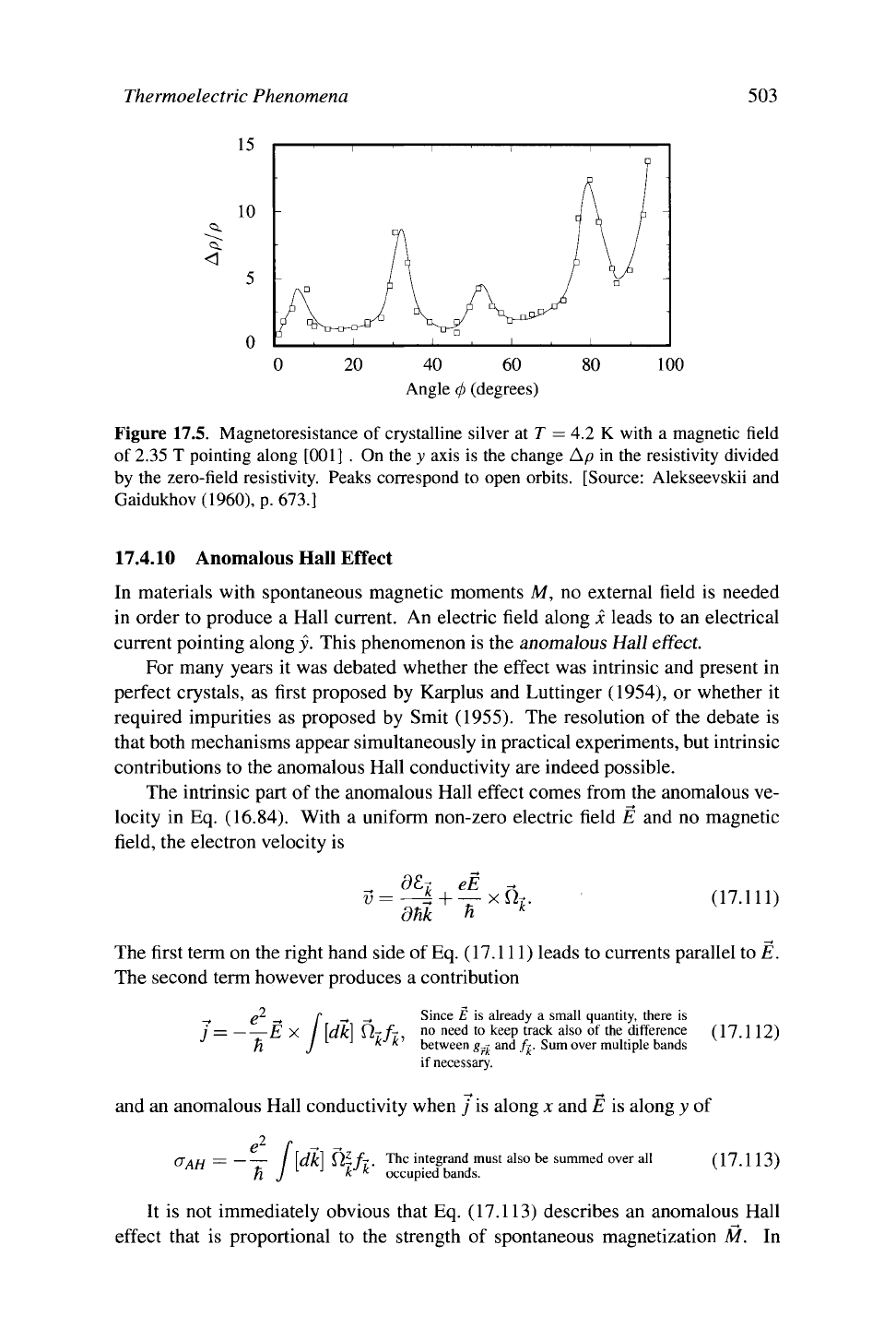
Figure 17.5. Magnetoresistance of crystalline silver at T = 4.2 K with a magnetic field
of 2.35 T pointing along [001] . On the y axis is the change Ap in the resistivity divided
by the zero-field resistivity. Peaks correspond to open orbits. [Source: Alekseevskii and
Gaidukhov(1960), p. 673.]
17.4.10 Anomalous Hall Effect
In materials with spontaneous magnetic moments M, no external field is needed
in order to produce a Hall current. An electric field along i leads to an electrical
current pointing along y. This phenomenon is the anomalous Hall effect.
For many years it was debated whether the effect was intrinsic and present in
perfect crystals, as first proposed by Karplus and Luttinger (1954), or whether it
required impurities as proposed by Smit (1955). The resolution of the debate is
that both mechanisms appear simultaneously in practical experiments, but intrinsic
contributions to the anomalous Hall conductivity are indeed possible.
The intrinsic part of the anomalous Hall effect comes from the anomalous ve-
locity in Eq. (16.84). With a uniform non-zero electric field E and no magnetic
field, the electron velocity is
d£r eE -
—I + — X fir.
dhk n
k
(17.111)
The first term on the right hand side of
Eq.
(17.111) leads to currents parallel to Ë.
The second term however produces a contribution
; =
h
-Ex
J[dk]
Vï.
Since Ë is already a small quantity, there is
no need to keep track also of the difference
between g
?
^ and
/j.
Sum over multiple bands
if necessary.
(17.112)
and an anomalous Hall conductivity when j is along x and Ë is along y of
„2
&AH =
e
~h~
J[dk]
Cli f-. The integrand must also be summed over all
k k occupied bands.
(17.113)
It is not immediately obvious that Eq. (17.113) describes an anomalous Hall
effect that is proportional to the strength of spontaneous magnetization M. In
504 Chapter 17. Transport Phenomena and Fermi Liquid Theory
1000
T
6
o
7 500
g,
X
<
b
0'
0 12 3
M
z
(/VMn)
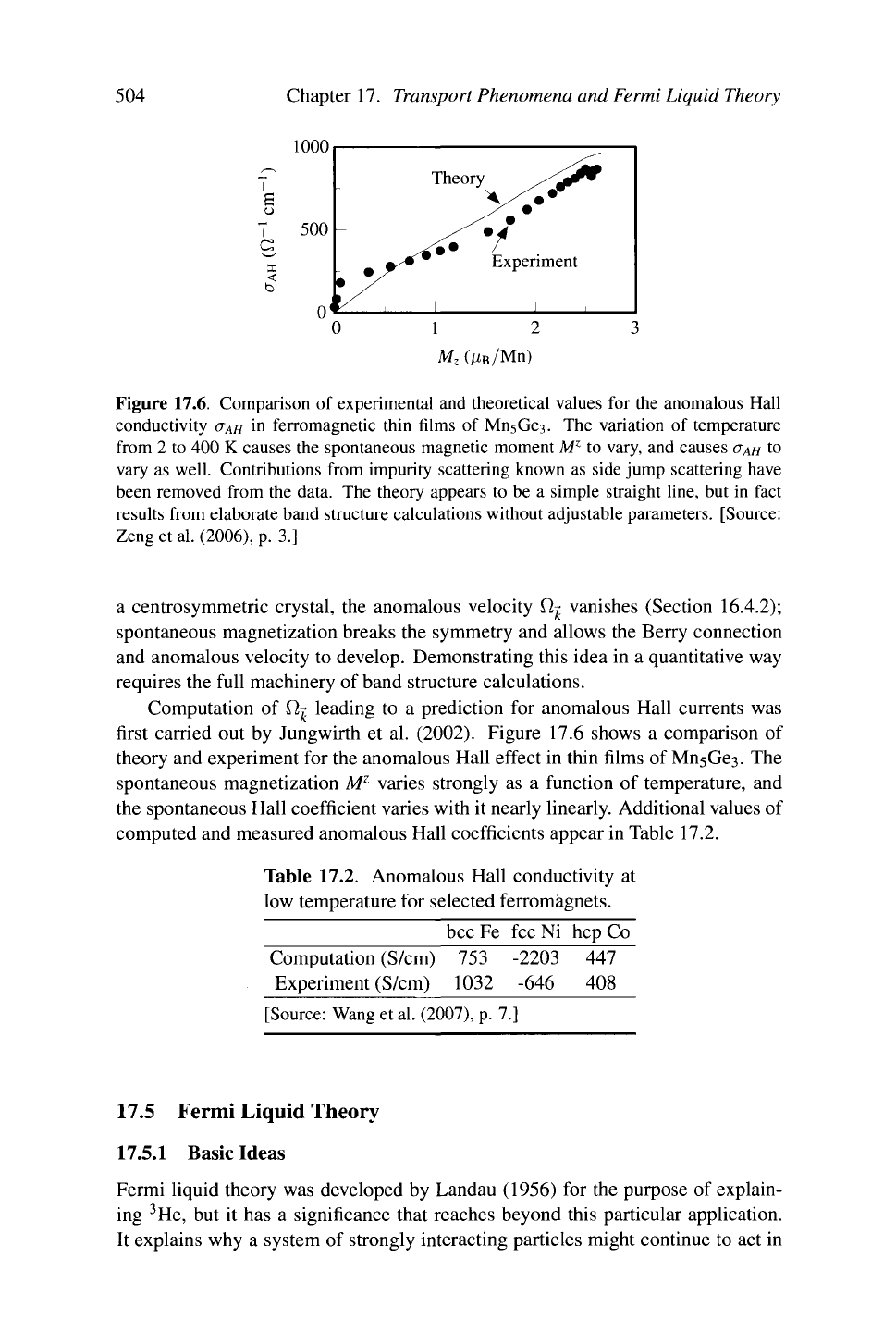
Figure 17.6. Comparison of experimental and theoretical values for the anomalous Hall
conductivity a
AH
in ferromagnetic thin films of Mn5Ge3. The variation of temperature
from 2 to 400 K causes the spontaneous magnetic moment M
z
to vary, and causes a
AH
to
vary as well. Contributions from impurity scattering known as side jump scattering have
been removed from the data. The theory appears to be a simple straight line, but in fact
results from elaborate band structure calculations without adjustable parameters. [Source:
Zeng et al. (2006), p. 3.]
a centrosymmetric crystal, the anomalous velocity f^ vanishes (Section 16.4.2);
spontaneous magnetization breaks the symmetry and allows the Berry connection
and anomalous velocity to develop. Demonstrating this idea in a quantitative way
requires the full machinery of band structure calculations.
Computation of Q^ leading to a prediction for anomalous Hall currents was
first carried out by Jungwirth et al. (2002). Figure 17.6 shows a comparison of
theory and experiment for the anomalous Hall effect in thin films of
Mn5Ge3.
The
spontaneous magnetization M
z
varies strongly as a function of temperature, and
the spontaneous Hall coefficient varies with it nearly linearly. Additional values of
computed and measured anomalous Hall coefficients appear in Table 17.2.
Table 17.2. Anomalous Hall conductivity at
low temperature for selected ferromàgnets.
bcc Fe fee Ni hep Co
Computation (S/cm) 753 -2203 447
Experiment (S/cm) 1032 -646 408
[Source: Wang et
al.
(2007), p. 7.]
17.5 Fermi Liquid Theory
17.5.1 Basic Ideas
Fermi liquid theory was developed by Landau (1956) for the purpose of explain-
ing
3
He, but it has a significance that reaches beyond this particular application.
It explains why a system of strongly interacting particles might continue to act in
Fermi Liquid Theory
505
accord with the single-particle approximation, and it provides a way to quantify
the changes produced by interactions. The basic idea is that one should focus on
excitations of the strongly interacting system, without worrying about the precise
nature of the ground state. These elementary excitations act like particles, and
therefore are also called quasi-particles. Their energies are nearly additive, and
one can build complicated excited states by adding together many quasi-particles.
Quasi-particles do interact with each other, but less strongly than the original par-
ticles from which they are constructed.
(A) (B)
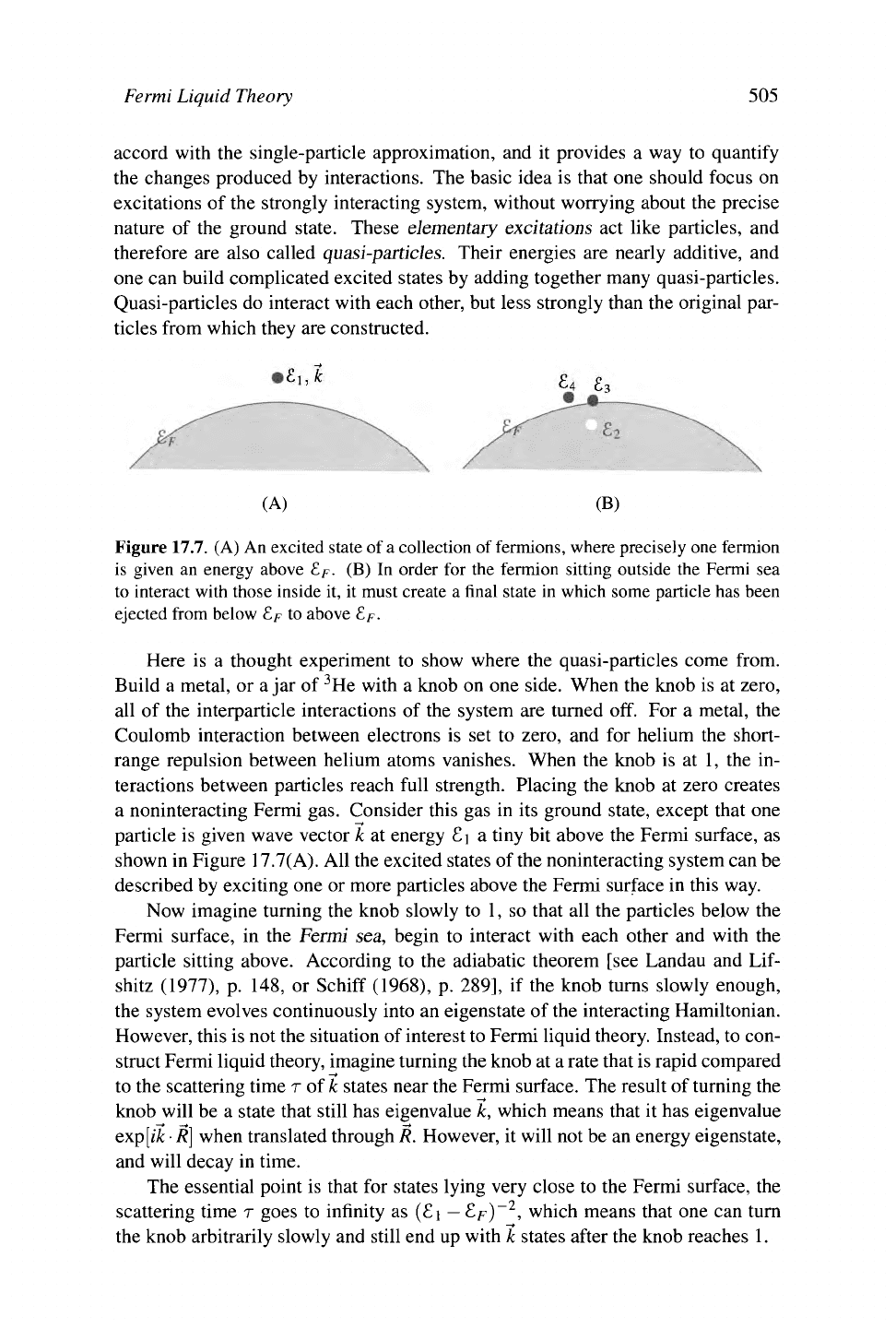
Figure 17.7. (A) An excited state of
a
collection of
fermions,
where precisely one fermion
is given an energy above
£.
F
.
(B) In order for the fermion sitting outside the Fermi sea
to interact with those inside it, it must create a
final
state in which some particle has been
ejected from below 8.f to above Ef.
Here is a thought experiment to show where the quasi-particles come from.
Build a metal, or ajar of
3
He with a knob on one side. When the knob is at zero,
all of the interparticle interactions of the system are turned off. For a metal, the
Coulomb interaction between electrons is set to zero, and for helium the short-
range repulsion between helium atoms vanishes. When the knob is at 1, the in-
teractions between particles reach full strength. Placing the knob at zero creates
a noninteracting Fermi gas. Consider this gas in its ground state, except that one
particle is given wave vector k at energy £] a tiny bit above the Fermi surface, as
shown in Figure 17.7(A). All the excited states of the noninteracting system can be
described by exciting one or more particles above the Fermi surface in this way.
Now imagine turning the knob slowly to 1, so that all the particles below the
Fermi surface, in the Fermi sea, begin to interact with each other and with the
particle sitting above. According to the adiabatic theorem [see Landau and Lif-
shitz (1977), p. 148, or Schiff (1968), p. 289], if the knob turns slowly enough,
the system evolves continuously into an eigenstate of the interacting Hamiltonian.
However, this is not the situation of interest to Fermi liquid theory. Instead, to con-
struct Fermi liquid theory, imagine turning the knob at a rate that is rapid compared
to the scattering time r of k states near the Fermi surface. The result of turning the
knob will be a state that still has eigenvalue k, which means that it has eigenvalue
expD'À:
• R]
when translated through R. However, it will not be an energy eigenstate,
and will decay in time.
The essential point is that for states lying very close to the Fermi surface, the
scattering time r goes to infinity as (£i
—
£F)~
2
, which means that one can turn
the knob arbitrarily slowly and still end up with k states after the knob reaches 1.
506
Chapter 17. Transport Phenomena and
Fermi
Liquid Theory
It is possible to explain the divergence of
r
by examining the structure of the
electron scattering problem, without performing
a
detailed calculation. As shown
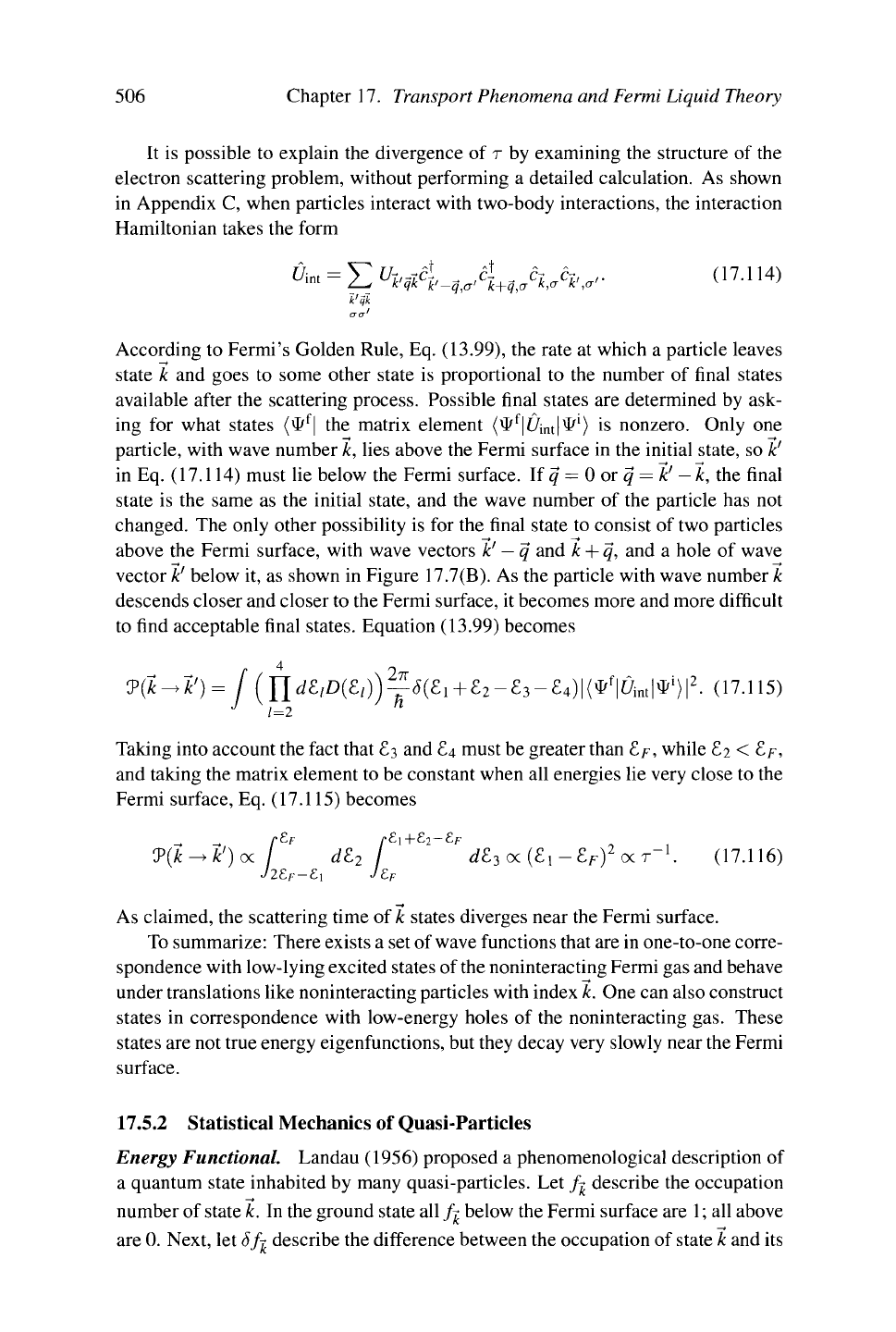
in Appendix C, when particles interact with two-body interactions, the interaction
Hamiltonian takes the form
Û
[nt
= V
Ih,-ret
_ Â _ Cr Cr, ,.
(17.114)
lm
Z^ k'qk k'-q,<r' k+q,a k,a k',a'
v
'
k'qk
According to Fermi's Golden Rule, Eq. (13.99), the rate at which a particle leaves
state
k
and goes to some other state is proportional to the number
of
final states
available after the scattering process. Possible final states are determined by ask-
ing
for
what states
(^
f
|
the matrix element (^^f/intl*
1
)
is
nonzero. Only one
particle, with wave number k, lies above the Fermi surface in the initial state, so k'
in Eq. (17.114) must lie below the Fermi surface. If q
=
0 or q = k'
—
k, the final
state is the same as the initial state, and the wave number
of
the particle has not
changed. The only other possibility is for the final state to consist of two particles
above the Fermi surface, with wave vectors K
—
q and k
+
q, and
a
hole
of
wave
vector
k!
below it, as shown in Figure 17.7(B). As the particle with wave number k
descends closer and closer to the Fermi surface, it becomes more and more difficult
to find acceptable final states. Equation (13.99) becomes
T(^^)
=
/(n^/0(£/))Y5(£
1
+£
2
-£3-£4)|(*
f
|^nt|*
i
)|
2
. (17.115)
Taking into account the fact that £3 and £4 must be greater than
£f,
while £2
<
£F,
and taking the matrix element to be constant when all energies lie very close to the
Fermi surface, Eq. (17.115) becomes
y(k^k')(x
[
F
d£
2
[ '
2
F
rf£
3
oc(£i-£
f
)
2
ocr-
1
. (17.116)
J2£.
F
-£.\
JEF
As claimed, the scattering time of k states diverges near the Fermi surface.
To summarize: There exists a set of
wave
functions that are in one-to-one corre-
spondence with low-lying excited states of the noninteracting Fermi gas and behave
under translations like noninteracting particles with index k. One can also construct
states in correspondence with low-energy holes of the noninteracting gas. These
states are not true energy eigenfunctions, but they decay very slowly near the Fermi
surface.
17.5.2 Statistical Mechanics of Quasi-Particles
Energy Functional. Landau (1956) proposed a phenomenological description of
a quantum state inhabited by many quasi-particles. Let /^ describe the occupation
number of state k. In the ground state all f^ below the Fermi surface are
1 ;
all above
are 0. Next, let 8f^ describe the difference between the occupation of state k and its
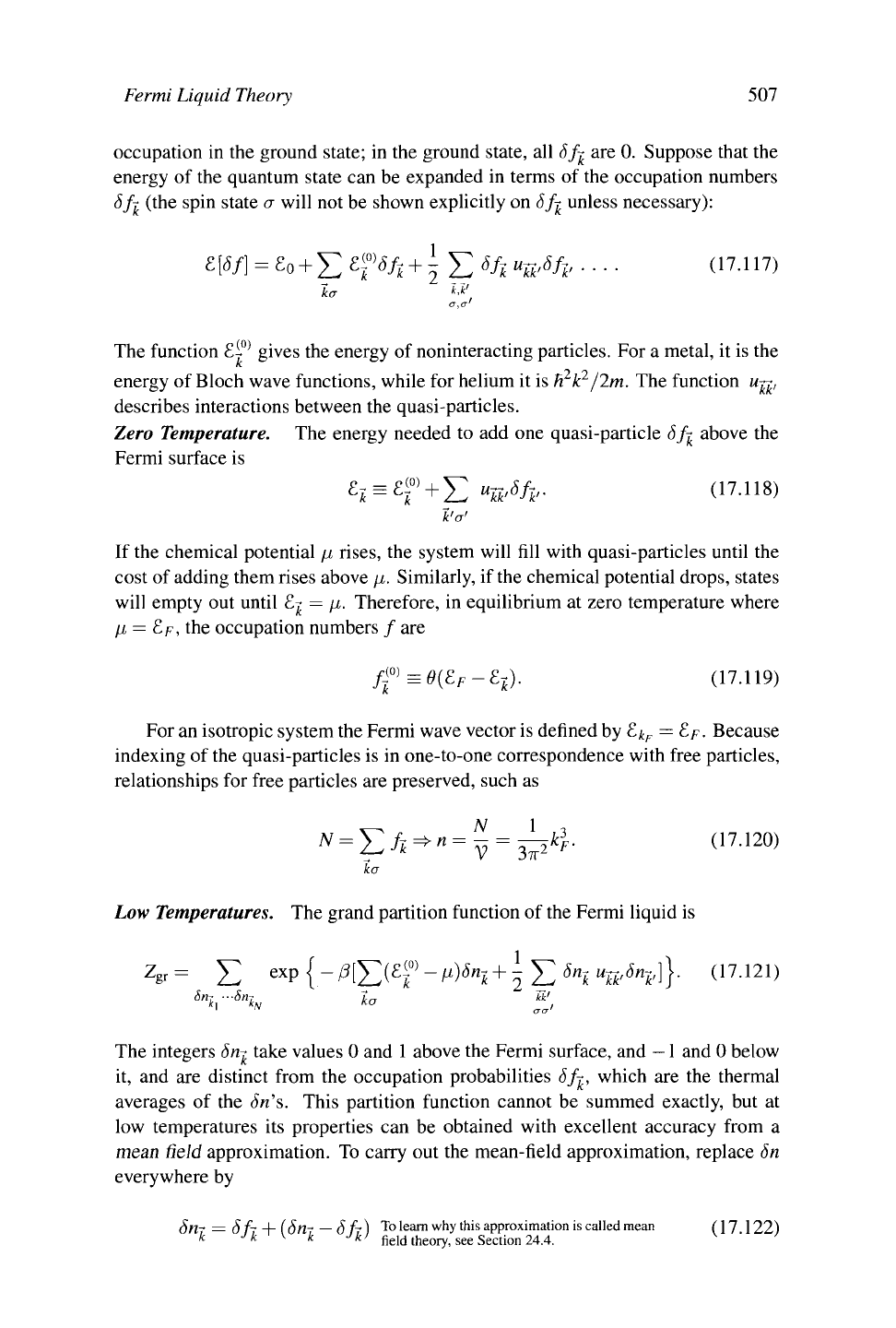
Fermi Liquid Theory 507
occupation in the ground state; in the ground state, all 8
fa
are 0. Suppose that the
energy of the quantum state can be expanded in terms of the occupation numbers
8fa (the spin state a will not be shown explicitly on 8fa unless necessary):
ka *.*'.
The function £i
0)
gives the energy of noninteracting particles. For a metal, it is the
energy of Bloch wave functions, while for helium it is h
2
k
2
/2m. The function u^,
describes interactions between the quasi-particles.
Zero Temperature. The energy needed to add one quasi-particle 8fa above the
Fermi surface is
l'a
1
If the chemical potential ji rises, the system will fill with quasi-particles until the
cost of adding them rises above /i. Similarly, if the chemical potential drops, states
will empty out until £^ = /z. Therefore, in equilibrium at zero temperature where
ß =
8.F,
the occupation numbers / are
/j<
o)
= 0(£f-£
z
). (17.119)
For an isotropic system the Fermi wave vector is defined by £^ = £f. Because
indexing of the quasi-particles is in one-to-one correspondence with free particles,
relationships for free particles are preserved, such as
*=E/*=*
= ^ = 3^-
(
17
-
12
°)
kcr
Low Temperatures. The grand partition function of the Fermi liquid is
Z
gr
= ]T exp { -/3[£(£f -ß)8n
l +
\ Ç 8
H
u
Vk
,8n^\ (17.121)
Srir —5rtj trr kk'
The integers 8n^ take values 0 and
1
above the Fermi surface, and
— 1
and 0 below
it, and are distinct from the occupation probabilities 8fa, which are the thermal
averages of the ôn's. This partition function cannot be summed exactly, but at
low temperatures its properties can be obtained with excellent accuracy from a
mean field approximation. To carry out the mean-field approximation, replace 8n
everywhere by
8n~
= S f~ + (8n of-) To learn why this approximation is called mean (
1
7 122)
k Jk K k Jk
> field theory, see Section 24.4.
508
Chapter 17.
Transport
Phenomena and
Fermi
Liquid Theory
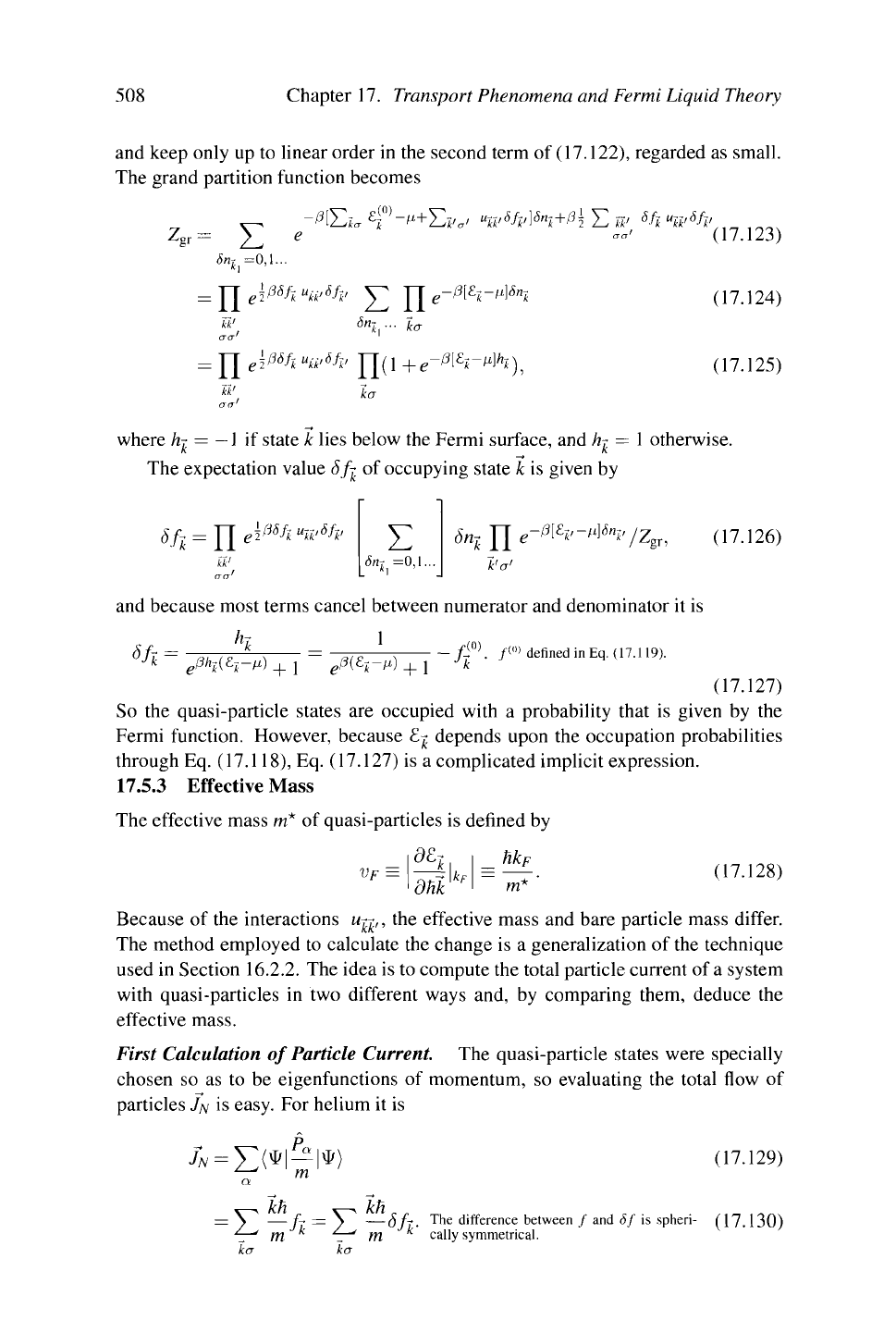
and keep only up to linear order in the second term of (17.122), regarded as small.
The grand partition function becomes
Z
gr =
E
e
Stir
=0,1...
^E*
CT
£
Î -/
j
+E*'
CT
'
u
Vk'
h
h'\
&n
i
+
^\
E
«' v*
u
w
5
fv
n
ist'
e
~
2
ß5f-
k
u
ü
,6f
v
En
-ί[£?-p]önj
JJ
e
iW;
««,*/*,
TJ(j
+e
-ß[£
i
-iAh
i
(17.123)
(17.124)
(17.125)
**'
No-
where
hj.
=
— 1
if state k lies below the Fermi surface, and
h-
k
=
1
otherwise.
The expectation value <5/j of occupying state £ is given by
*/Ï=n
gl W*
"M"
5
/*'
CTO"'
E
<5nj =0,1.
Sn
l
II
e-ft
£
i'->4
Sn
v/Zg,, (17.126)
Fa'
and because most terms cancel between numerator and denominator it is
1
Vï
h
—
fi '. f
m
defined
in Eq.
(17.119).
'k
e
ph
l
(^-
ß
)
+ l e
ß(e
i
-ß)
+ l
n
(17.127)
So the quasi-particle states are occupied with a probability that is given by the
Fermi function. However, because £^ depends upon the occupation probabilities
through Eq. (17.118), Eq. (17.127) is a complicated implicit expression.
17.5.3 Effective Mass
The effective mass m* of quasi-particles is defined by
Hkf
VF
m"
(17.128)
Because of the interactions w-g,, the effective mass and bare particle mass differ.
The method employed to calculate the change is a generalization of the technique
used in Section 16.2.2. The idea is to compute the total particle current of a system
with quasi-particles in two different ways and, by comparing them, deduce the
effective mass.
First Calculation of Particle Current. The quasi-particle states were specially
chosen so as to be eigenfunctions of momentum, so evaluating the total
flow
of
particles 7/v is easy. For helium it is
Ä=E(*I-I*
(17.129)
kh
kh
\
—f-, = \
—Of?. The
difference
between
/
and
Sf
is
spheri-
(17.130)
"tr"*
m
'T
-
'
nt
cally
symmetrical.
ko
ko
Fermi Liquid Theory 509
For a metal, the matrix element (17.129) would be evaluated as following Eq. (16.24),
and it would give an effective mass due to interactions with the lattice, rather than
simply m.
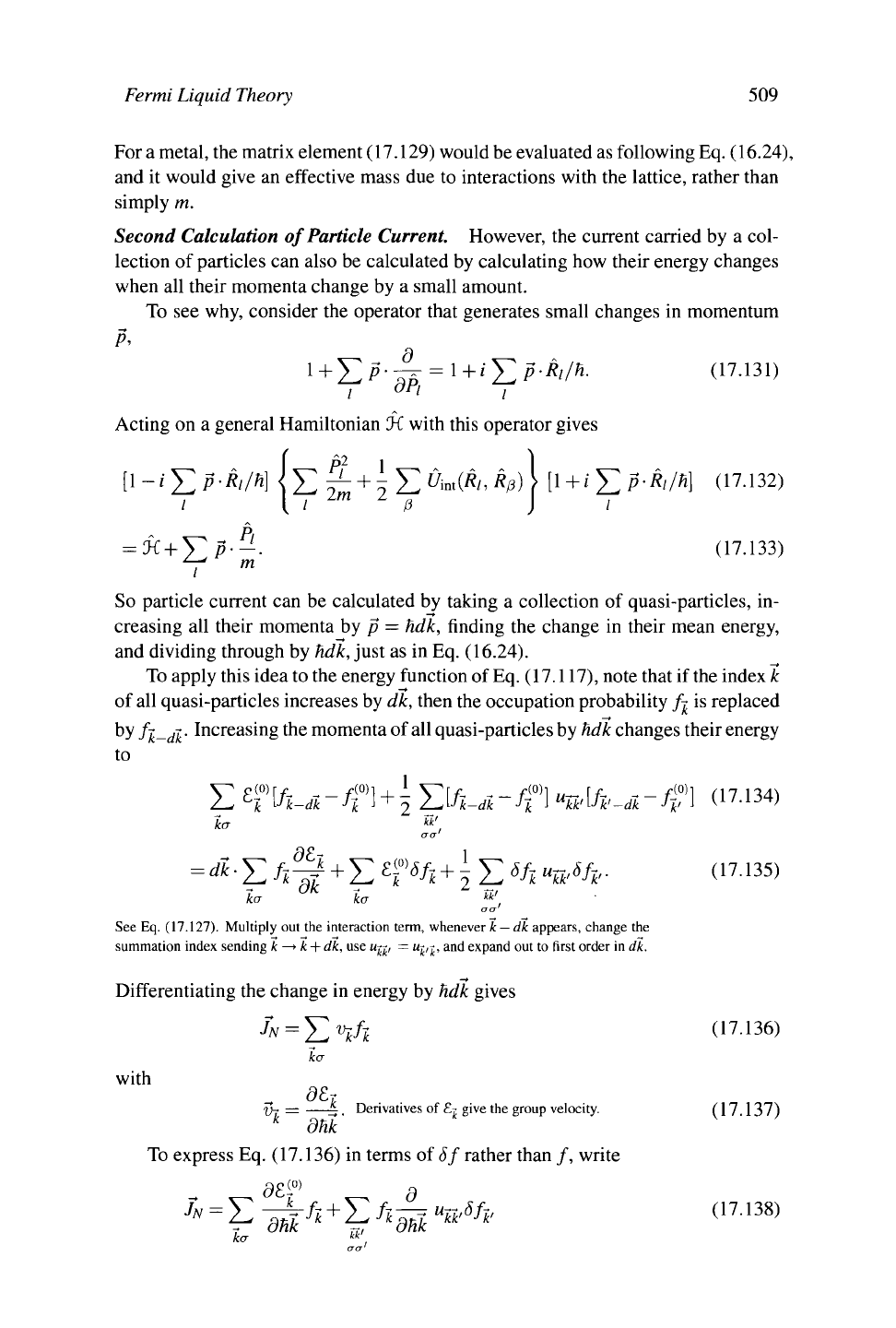
Second Calculation of Particle Current. However, the current carried by a col-
lection of particles can also be calculated by calculating how their energy changes
when all their momenta change by a small amount.
To see why, consider the operator that generates small changes in momentum
P-
/
dp
i i
Acting on a general Hamiltonian "K with this operator gives
[i-t£p-Rt/h] I Yl £;
+
\ E tfinttö.Rß) I [i+'Ep-RiW
(
17
-
132
)
= Ä + Vf-.
(17.133)
^ m
So particle current can be calculated by taking a collection of quasi-particles, in-
creasing all their momenta by p = hdk, finding the change in their mean energy,
and dividing through by
Hdk,
just as in Eq. (16.24).
To apply this idea to the energy function of
Eq.
(17.117), note that if
the
index k
of all quasi-particles increases by dk, then the occupation probability fa is replaced
by fa_
d
i- Increasing the momenta of
all
quasi-particles by hdk changes their energy
to
EtfVi-A-f?\+\ YVi-*-f?\*&\fv-A-$\
(
17
-
134
)
la
kk
',
era'
d£- 1
=<**■£
fi-w+T,
£
f^+2 E Hi
«**/*■
<
17
-
135
)
la
OK
la »,
era'
See Eq. (17.127). Multiply out the interaction term, whenever l
—
dl appears, change the
summation index sending J
—> &
+ dk, use u^, =
«J,J,
and expand out to first order in dl.
Differentiating the change in energy by hdk gives
•^=Ev*
(
17
-
136
)
la
with
lh = Derivatives of £r give the group velocity. M 7 137)
k
dhk
To express Eq. (17.136) in terms of of rather than /, write
A-L^ + E^-»«* <'7,38,
ka
kk
<J<J'
510
Chapter
17.
Transport Phenomena
and
Fermi Liquid Theory
<9£
(0)
Ft
:
E
-sA-Vi
+
ElVi+Zflss
"r^h
<
17
-'»>
ka
*
OTT
8F~ dfi
0)
= y^
èSfr
—
'S^ ^r
Urr,Sfr, Regroup integrals, then integrate (17.140)
^
Ôhk
k
j^
dhk
kk Jk
"y parts.
ka
kk
,
era'
ka
**'.
era
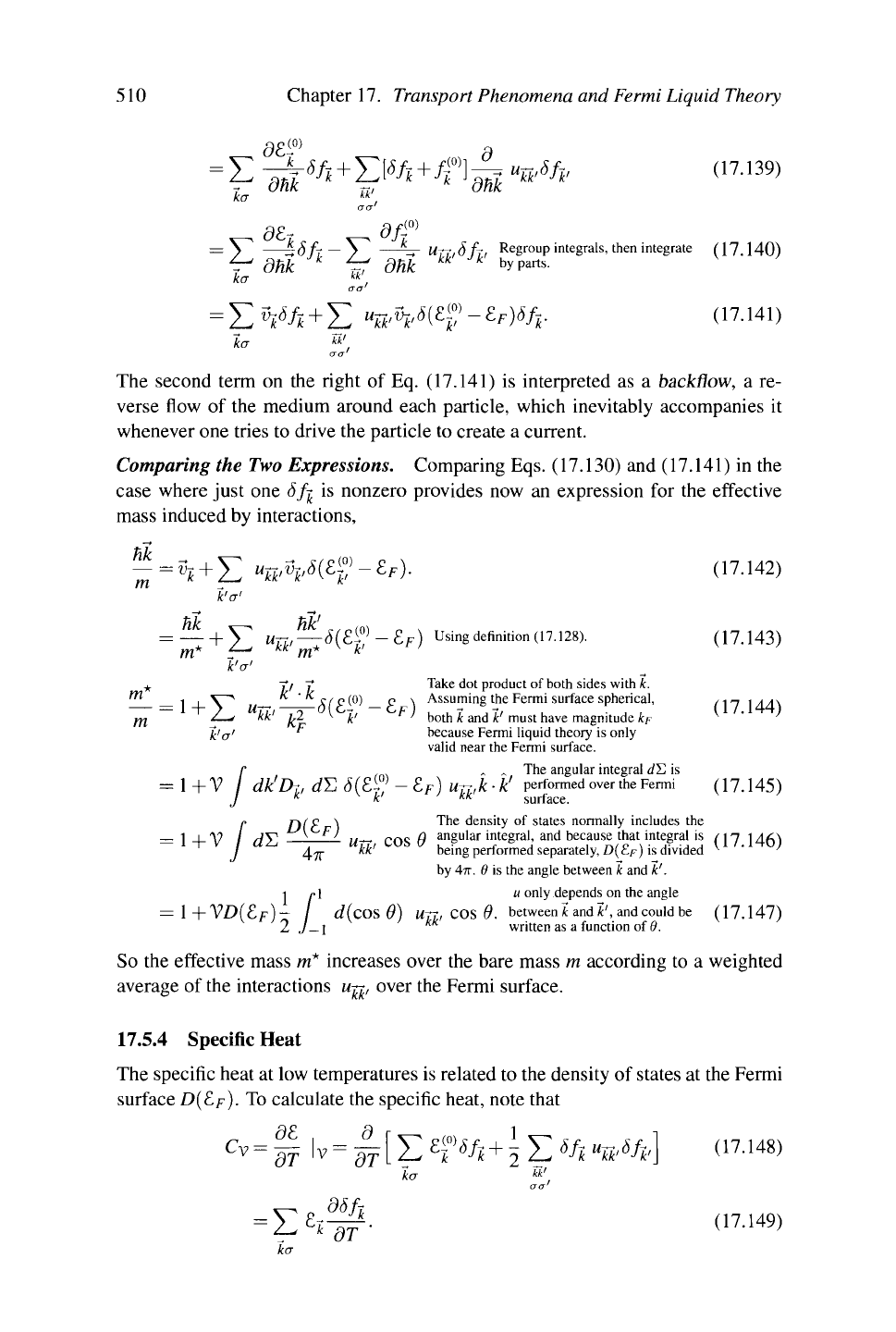
The second term
on the
right
of
Eq. (17.141)
is
interpreted
as
a
backflow,
a re-
verse flow
of the
medium around each particle, which inevitably accompanies
it
whenever one tries
to
drive
the
particle
to
create
a
current.
Comparing
the
Two Expressions. Comparing Eqs. (17.130)
and
(17.141)
in the
case where just
one Sf^ is
nonzero provides
now an
expression
for the
effective
mass induced
by
interactions,
^•
+ E
^^(E^-EF).
(17.142)
nk
—
=h
k
m
"
k'o'
Hk
hk'
=
+ V
Wrr,
5(£??-£
F
) Using definition (17.128). (17.143)
m*
^-^ m*
k
k'a'
*
-fj
■?
Take
dot
product
of
both sides with
k.
m
-, . S~^
srcW
c "\
Assuming
the
Fermi surface spherical,
,*
n
,
A A
^
—
=
1
+ /
u
Tit—T
-
o(ci —tf) ,
u7
6
j7
, , . . ,
(17.144)
m
Z-^i kk' fol v if
r
i
both
k and
k! must have magnitude
k
F
v
'
%'
a
i
F
because Fermi liquid theory
is
only
valid near the Fermi surface.
/
„
„
1
he angular integral di-,
is
dk'Dr,
dE
S(oi°
- Of)
U
U
,k
■
k'
performed over
the
Fermi
(
17.145)
*
K' ' KK
surface.
/
r\i
p
\
The
density
of
states normally includes
the
dZ
-V-^ «77, COS
6
*"P
ular
intégral,
and
because that integral
is (
17
.
146
)
4TJ-
kk'
being performed separately, D(
tf
)
is
divided
v 7
by
47T. Ö
is the
angle between
k and k!.
i
/■
1
u
only depends
on the
angle
= \+VD(£
F
)-
/
d(cOs6)
«77, COS 6>.
between* and*',
and
could
be
(17.147)
2 J—
1
written
as a
function
of 6.
So
the
effective mass
m*
increases over
the
bare mass
m
according
to a
weighted
average
of
the interactions
u-^,
over
the
Fermi surface.
17.5.4 Specific Heat
The specific heat
at
low temperatures
is
related
to the
density
of
states
at the
Fermi
surface D(£.p).
To
calculate
the
specific heat, note that
la
kk'
aa'
E
£
Ï-»F-
<
17
-
149
)
dT
ka
Fermi Liquid Theory 511
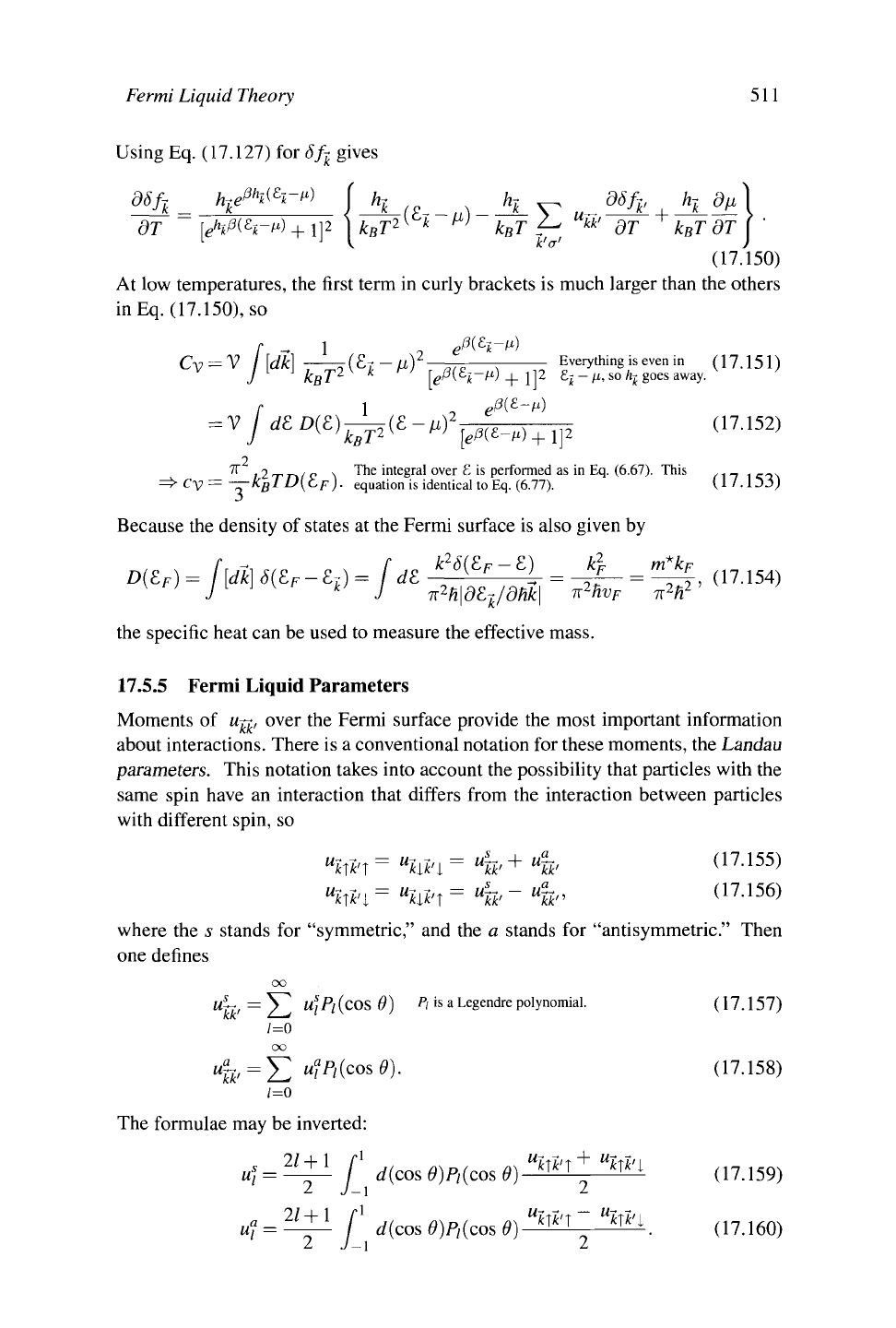
Using Eq. (17.127) for 5f^ gives
as/-
h^ik-v)
r
kj
h-
k
v
dôfp
h.
k
dß
ÖT [«VM + lp
jtjr
21
*
Mj
k
B
T ^
Ukk
' ÖT k
B
T
ÖT
(17.150)
At low temperatures, the first term in curly brackets is much larger than the others
in Eq. (17.150), so
C
V
= V [dk] ~(£r-/u)
2
—^ r Everything is even in (17.151)
V
J
[ J
k
B
T
2K
k
*' [eß(£i-ß) + l]2 % -n, so
h
%
goes away.
= V
/
J£ D(£)
^
(£
"
^[^-,)
+
l]2
(17
-
152)
2
VT j , . The integral over £ is performed as in Eq. (6.67). This . _ _
^ Cy——k
B
l U[tf). equation is identical to Eq. (6.77). (1/.153)
Because the density of states at the Fermi surface is also given by
D(£
F
)= f[dk]ö(£
F
-Er)= i dl
^
£f
-
£
),
=
Jj_ =
!??!**
(17.154)
the specific heat can be used to measure the effective mass.
17.5.5 Fermi Liquid Parameters
Moments of
U-Q,
over the Fermi surface provide the most important information
about interactions. There is a conventional notation for these moments, the Landau
parameters. This notation takes into account the possibility that particles with the
same spin have an interaction that differs from the interaction between particles
with different spin, so
"ïît'î =
u
hl'i =
U
U' +
u
Vv
(17
-
155
>
u
M<i =
u
k\k<\
=
u
ïï>
~ "8" (17.156)
where the s stands for "symmetric," and the a stands for "antisymmetric." Then
one defines
oo
U
Ik'
=
'^2
M
/^/(
cos
0)
p
/is a Legendre polynomial. (17.157)
/=0
oo
u
h = Y. «Wcos0). (17.158)
1=0
The formulae may be inverted:
"? = ^ /' *(«* 0)fl(cos
ö)
JMl±^Mi
(
i7.i59)
2 7-i 2
/ d(cos 8)Pi(cos 0) "
kW
\ "^^ (17.160)
7-i 2
2/+1
512
Chapter 17.
Transport
Phenomena and
Fermi
Liquid Theory
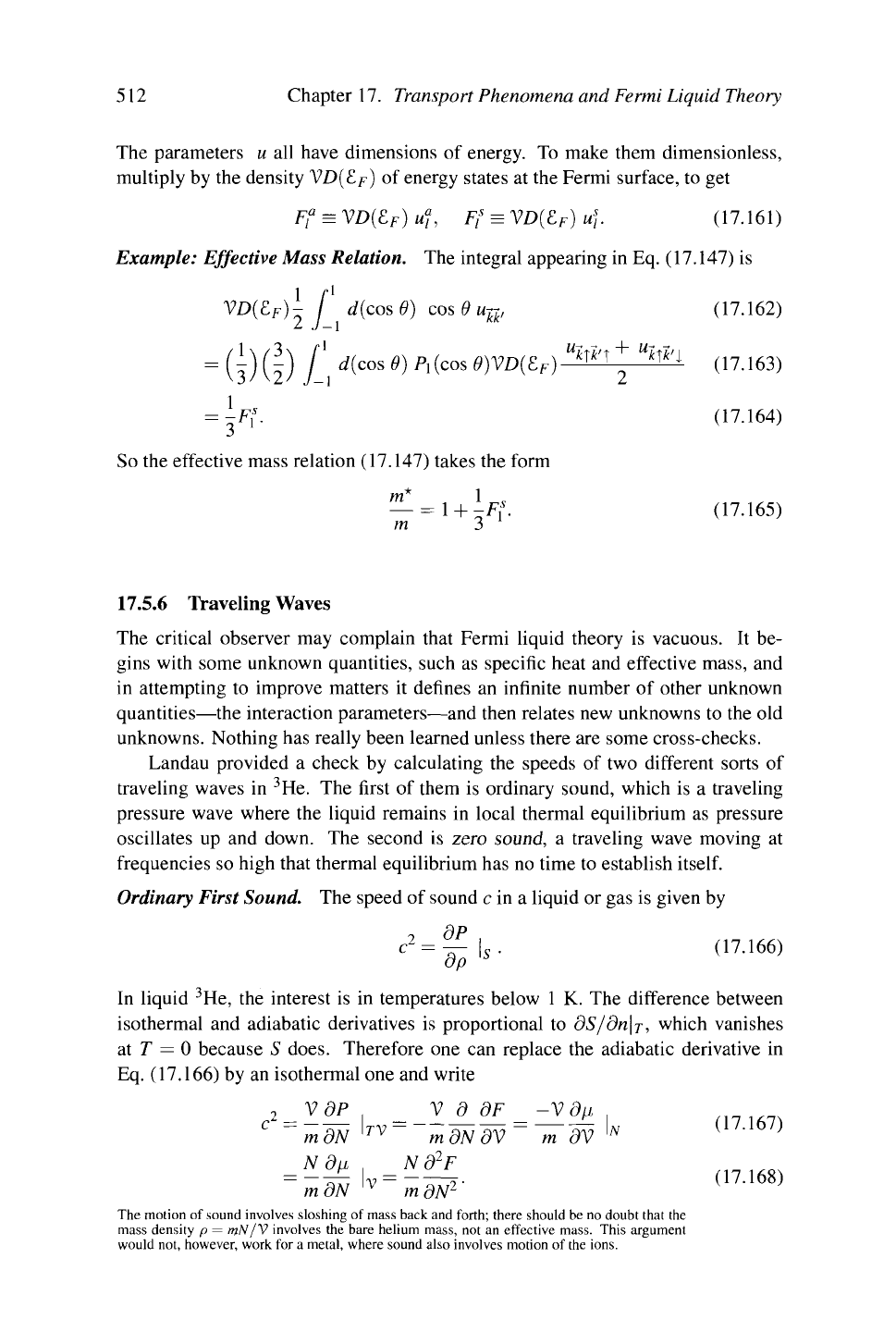
The parameters u all have dimensions of energy. To make them dimensionless,
multiply by the density VD(8.
F
) of energy states at the Fermi surface, to get
F,
a
=
VD(E
F
)uf,
Ff = VD(E
F
) u\. (17.161)
Example: Effective Mass Relation. The integral appearing in Eq. (17.147) is
i r
1
VD(£
F
)-
/ d(cos9) cos6u
rk
, (17.162)
I) (J) f d(cos 9) A (cos e)VD(£
F
)
Uïfk
'î
+
2
Uîfk,i
(17.163)
Ff. (17.164)
So the effective mass relation (17.147) takes the form
m*
1
— =
1
+ -Ff. (17.165)
m 3
17.5.6 Traveling Waves
The critical observer may complain that Fermi liquid theory is vacuous. It be-
gins with some unknown quantities, such as specific heat and effective mass, and
in attempting to improve matters it defines an infinite number of other unknown
quantities—the interaction parameters—and then relates new unknowns to the old
unknowns. Nothing has really been learned unless there are some cross-checks.
Landau provided a check by calculating the speeds of two different sorts of
traveling waves in
3
He. The first of them is ordinary sound, which is a traveling
pressure wave where the liquid remains in local thermal equilibrium as pressure
oscillates up and down. The second is zero
sound,
a traveling wave moving at
frequencies so high that thermal equilibrium has no time to establish
itself.
Ordinary First Sound. The speed of sound c in a liquid or gas is given by
2 =
dP
dp
c
=— \s
■
(17.166)
In liquid
3
He, the interest is in temperatures below 1 K. The difference between
isothermal and adiabatic derivatives is proportional to dS/dn\
F
, which vanishes
at T = 0 because S does. Therefore one can replace the adiabatic derivative in
Eq. (17.166) by an isothermal one and write
PIP -V ft,,
(17.167)
(17.168)
The motion of sound involves sloshing of mass back and forth; there should be no doubt that the
mass density p = rr/N/V involves the bare helium mass, not an effective mass. This argument
would not, however, work for a metal, where sound also involves motion of the ions.
2
VdP
mdN
N dp,
m dN
V d dF
^
TV
~~m~dN~dV~
Nd
2
F
lv
~
mdN
2
'
-Vdp
m dV