
Marder M.P. Condensed Matter Physics
Подождите немного. Документ загружается.

Metal-Insulator Transitions in Disordered Solids
533
polarize slightly in response. Continuing to view the phosphorus as producing a
weakly bound hydrogen-like state, its polarizability is
9 -,
(X =
—
ß See, for example, Landau and Lifshitz
( 1977)
(18 24)
2 ' pp. 286 and 290.
The Clausius-Mossotti relation (Section 22.2.3) relates the polarizability a of the
phosphorus to the dielectric constant of Si:P through
e-1 4TT
—- = --
np
a (18.25)
e + 2 3
3 + 87T«pa
3
—
4irnpa '
where np is the density of the phosphorus.
(18.26)
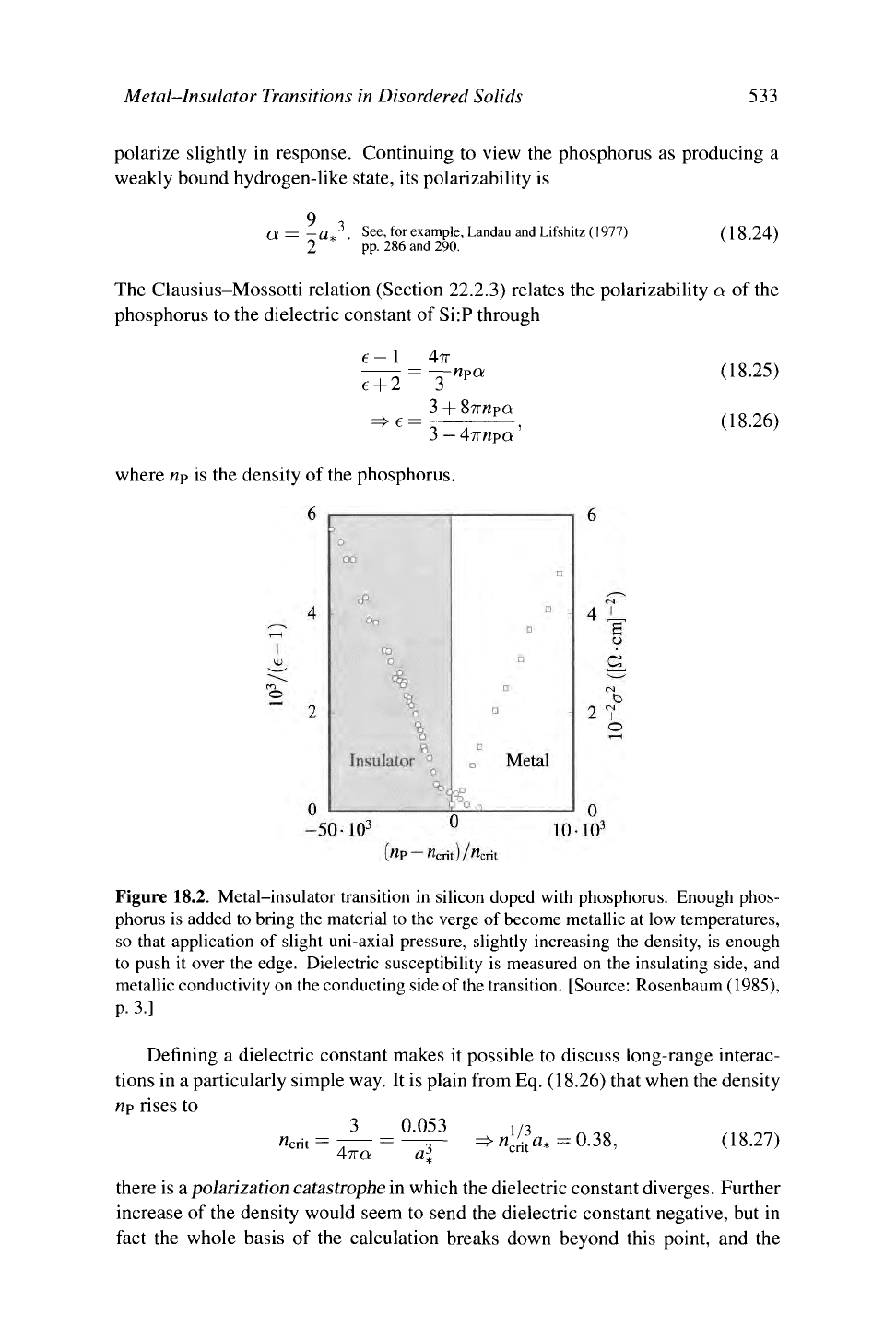
Figure 18.2. Metal-insulator transition in silicon doped with phosphorus. Enough phos-
phorus is added to bring the material to the verge of become metallic at low temperatures,
so that application of slight uni-axial pressure, slightly increasing the density, is enough
to push it over the edge. Dielectric susceptibility is measured on the insulating side, and
metallic conductivity on the conducting side of the transition. [Source: Rosenbaum (1985),
P-3.]
Defining a dielectric constant makes it possible to discuss long-range interac-
tions in a particularly simple way. It is plain from Eq. (18.26) that when the density
np rises to
3 0.053
1/3
n
C
nt
= -. = —5- ^»rit
fl
* =
°-
38
>
(
18
-
27
>
47ra a%
Lm
there is a polarization catastrophe in which the dielectric constant diverges. Further
increase of the density would seem to send the dielectric constant negative, but in
fact the whole basis of the calculation breaks down beyond this point, and the
534
Chapter 18. Microscopic Theories of
Conduction
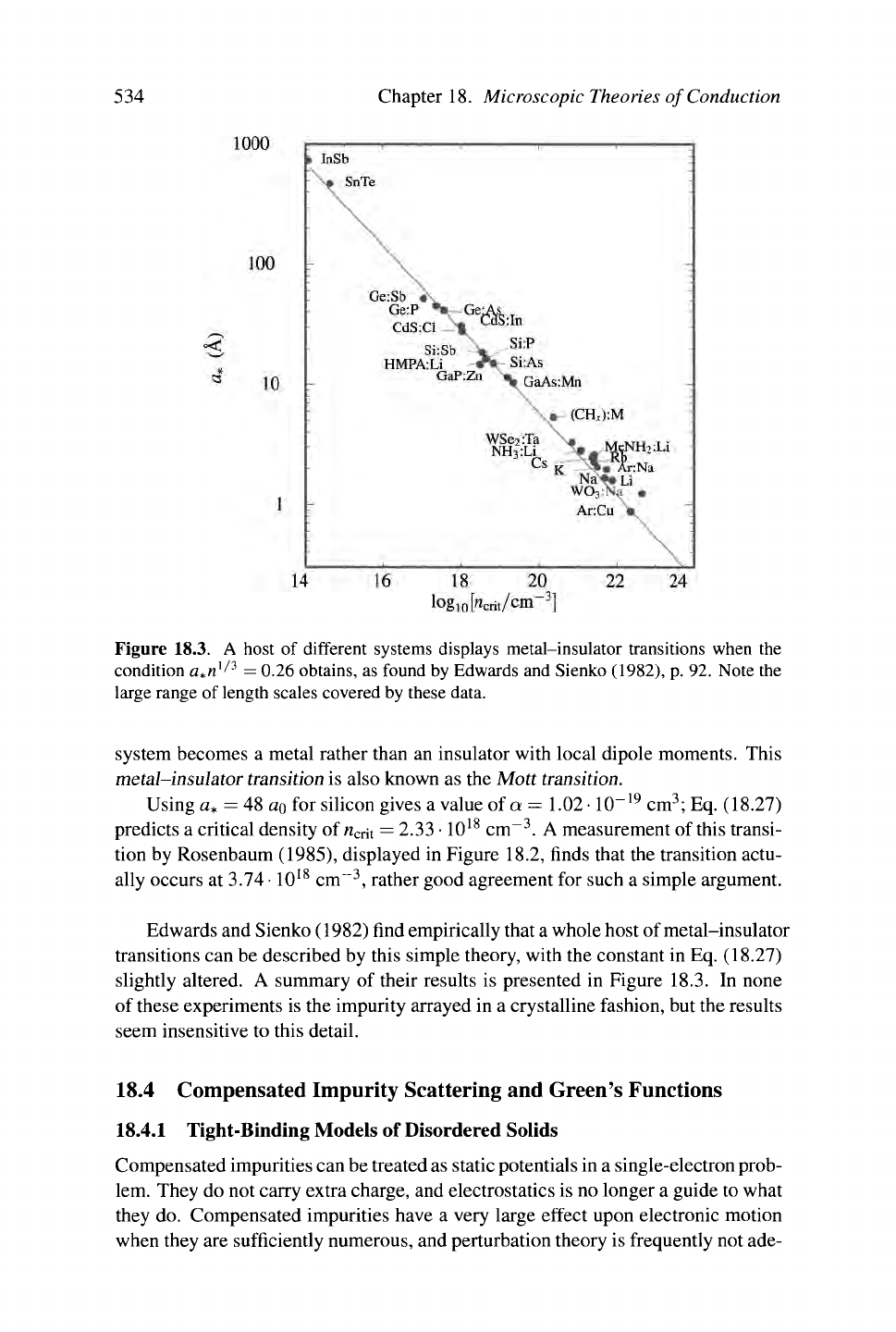
Figure 18.3. A host of different systems displays metal-insulator transitions when the
condition
a*n
1//3
= 0.26 obtains, as found by Edwards and Sienko (1982), p. 92. Note the
large range of length scales covered by these data.
system becomes a metal rather than an insulator with local dipole moments. This
metal-insulator
transition
is also known as the Mott transition.
Using a* = 48
ÜQ
for silicon gives a value of a
—
1.02
•
10
-19
cm
3
; Eq. (18.27)
predicts a critical density of
n
CT
\t
= 2.33
•
10
18
cm
-3
. A measurement of this transi-
tion by Rosenbaum (1985), displayed in Figure 18.2, finds that the transition actu-
ally occurs at 3.74
•
10
18
cm"
3
, rather good agreement for such a simple argument.
Edwards and Sienko (1982) find empirically that a whole host of metal-insulator
transitions can be described by this simple theory, with the constant in Eq. (18.27)
slightly altered. A summary of their results is presented in Figure 18.3. In none
of these experiments is the impurity arrayed in a crystalline fashion, but the results
seem insensitive to this detail.
18.4 Compensated Impurity Scattering and Green's Functions
18.4.1 Tight-Binding Models of Disordered Solids
Compensated impurities can be treated as static potentials in a single-electron prob-
lem. They do not carry extra charge, and electrostatics is no longer a guide to what
they do. Compensated impurities have a very large effect upon electronic motion
when they are sufficiently numerous, and perturbation theory is frequently not ade-
Compensated Impurity Scattering and Green's Functions 535
quate to understand their effect upon electronic states. In trying to understand such
processes, simple models have proved particularly useful. The most basic of these
is the tight-binding model, introduced in Section 8.4.4.
Tight-Binding Hamiltonian. The tight-binding Hamiltonian may be dismissed
by lovers of accuracy and realism, but it provides a simple starting point for con-
ceptual advances. Following Eq. (8.67), it can be written
ÄTB
= J2
U
R\
ä
)fi\ + E
t|Ä>(#1
+t|#>(4 (18.28)
R {RR')
where the sum over {RR') is over nearest-neighbor pairs only. Notice that the
diagonal components U$ depend upon R, allowing the possibility that different
sites have different energies. By allowing
U$
to vary randomly from site to site one
models a disordered solid.
It is convenient to ask questions of the tight-binding Hamiltonian that are more
difficult in a general context. For example, one can ask what happens after adding
an impurity to one site in a crystal, altering the energy
UQ
at the origin. This
problem can be solved exactly. The impurity Hamiltonian is
;>£] = (/o|0)(0|. Without loss of generality, take the disturbance (18.29)
to be at the origin.
Taking
"KQ
to be the tight-binding Hamiltonian (18.28) with all diagonal energies
Uß = 0, the goal is to solve
£|V>}= (Äo + Äi)
\i>)-
(18.30)
To solve this problem requires a certain amount of formal development, so it is
useful to summarize the main results in advance.
One dimension. Adding an impurity to a one-dimensional chain always produces
precisely one bound state, localized about the impurity.
Two dimensions. Adding an impurity to a two-dimensional net also always pro-
duces precisely one bound state. However, if the impurity potential is weak,
the binding energy is exponentially small.
Three dimensions. Adding an impurity to a three-dimensional crystal produces a
bound state only if the impurity is strong enough. A weak impurity warps the
traveling waves in its vicinity but does not change them qualitatively.
To verify these claims, it is necessary to introduce some formalism concerning
Green's functions.
536
Chapter 18. Microscopic Theories of
Conduction
18.4.2 Green's Functions
Green's functions originate in the question, "Starting with a particle at site |0) at
time 0, what is the amplitude for finding it at site \R) at time ??." The answer to
this question is that the amplitude is
(R\G(t)\0) = {R\e-
iiu/n
\0}. (18.31)
It is more convenient to work with Fourier transform of this operator, so define
1 r°°
G(£) = - / dte
iEt
l
h
G{t) (18.32)
in JQ
=>G(£) = (£-Ä)
_1
. (18.33)
Equation (18.32) can only be expected to converge if £ has a positive imaginary
part; this fact signals that £ must be allowed to vary in the complex plane, and
warns that the physical significance of Green's functions may depend in an im-
portant way on the complex part of the energy, even when it is very small. The
operator defined in Eq. (18.32) obtains its information from the future of a particle,
starting at t = 0; if instead one had chosen to look at the past history of the particle,
then one would have defined
G{Z)=
l
-
[ dt e
iE
'/
n
G{t), (18.34)
n J-oo
which is in fact identical to Eq. (18.33) except that now £ must have a negative
imaginary part in order for the integral to converge. So Green's function contains
full information about the time evolution of a particle: When £ has a positive
imaginary part, the information is about the future, and when £ has a negative
imaginary part, the information is about the past. From Eq. (18.33), it should be
clear that Green's function has a pole whenever
"K
has an eigenvalue, because if
|£„) are the eigenstates of 3ï with energies £„, then
|p \/p I
G=(£-J{)~
1
= ^(£-?{)-
1
|£„)(£
f!
| = ^y^-^. (18.35)
The poles of G identify all the energy eigenvalues of
"K.
Letting £ =
£,.
±
irj,
with
£
r
and
r\
real, in the neighborhood of one of the poles gives
^ !£„)(£„!(£,-£„)
T
ir,\£
n
)(E
n
\
h^yje^y-
^
%)
(£
r
— £„) +7/ (£
r
— £„) +
77
superscript on G tells which
sign for
77
was chosen.
= |£»>v5»l (^TW^r-2«)) • If
»7.
i?
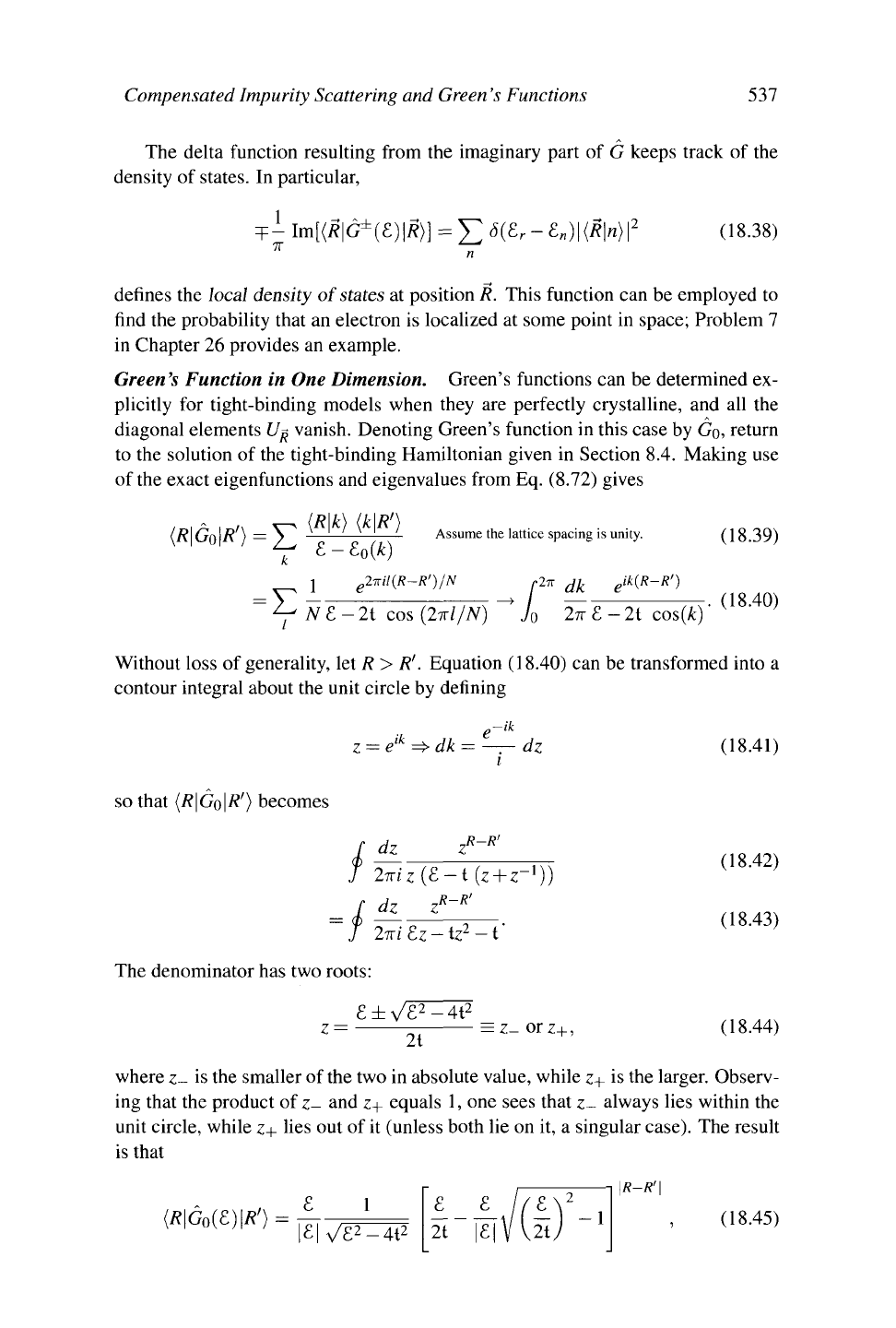
very small and (18.37)
[ t
r
— £„ J positive,
nS(x) =
7
1
/(x
2
+
V
2
).
Compensated Impurity Scattering
and
Green's Functions 537
The delta function resulting from
the
imaginary part
of G
keeps track
of the
density
of
states.
In
particular,
T-Im[(
J
R|G
±
(£)|
J
R)]
=
^5(£
r
-£„)|(^)|
2
(18.38)
n
n
defines
the
local density
of
states
at
position R. This function
can be
employed
to
find the probability that
an
electron
is
localized
at
some point
in
space; Problem
7
in Chapter
26
provides
an
example.
Green's Function
in
One Dimension. Green's functions
can be
determined
ex-
plicitly
for
tight-binding models when they
are
perfectly crystalline,
and all the
diagonal elements
U^
vanish. Denoting Green's function
in
this case
by
Go, return
to
the
solution
of
the tight-binding Hamiltonian given
in
Section
8.4.
Making
use
of the exact eigenfunctions
and
eigenvalues from Eq. (8.72) gives
(R\k) (k\R'\
(R\GO\R')
= y^ -— —-
Assume the lattice spacing
is
unity.
(18 39)
~
Y N £ - 2t cos (2TT///V) "*
Jo 2^£-2t cos(Jk)'
(18
'
40)
Without loss
of
generality,
let R > R'.
Equation (18.40)
can be
transformed into
a
contour integral about
the
unit circle
by
defining
Jk
e
~ik
z
=
e
lli
^dk=^
dz
(18.41)
so that
{R\GQ\R')
becomes
dz
z
R
-
R
'
2vnz(£-t(z
+ z-
1
))
dz
z
R
-
R
'
27i7 £z
—
tz
2
—
t
(18.42)
(18.43)
The denominator has two roots:
z=
^
=Z-orz
+
, (18.44)
where
z~ is
the smaller
of
the two
in
absolute value, while
z+
is
the larger. Observ-
ing that
the
product
of
z~
and
z+ equals
1, one
sees that
z~
always lies within
the
unit circle, while z+ lies
out of it
(unless both
lie on it, a
singular case).
The
result
is that
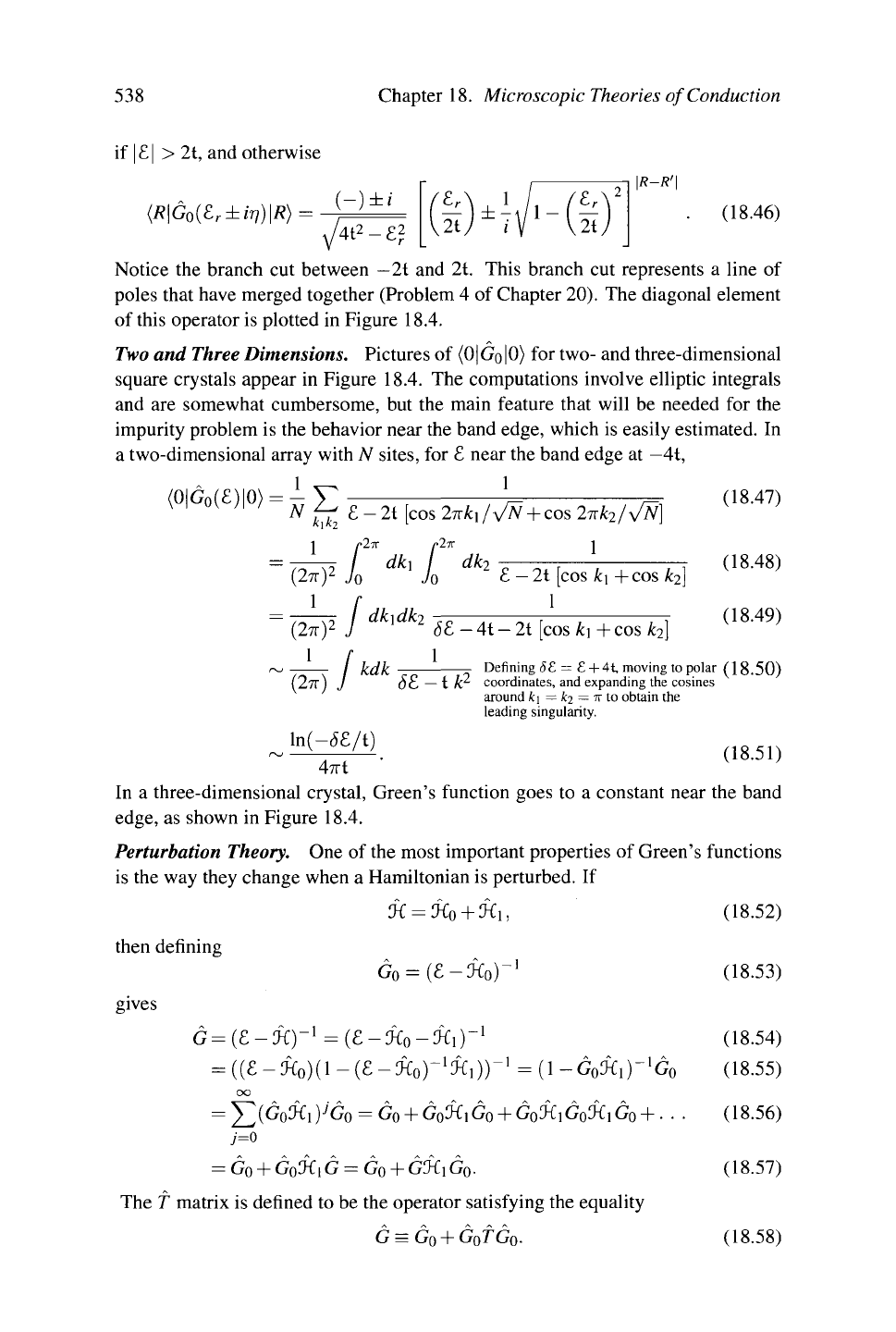
<#|Go(£)|tf')=
£ 1
|£|v
/
£
2
-4t
2
£
£ /£
x2
2t |£IVV2t
\R-R'\
(18.45)
538
Chapter 18. Microscopic Theories
of
Conduction
if
| £ |
> 2t, and
otherwise
\R-R'\
(R\G
0
(£
r
±ir,)\R)^
( )±l
4t
2
- £?
IWHD'
(18.46)
Notice
the
branch
cut
between — 2t
and 2t
This branch
cut
represents
a
line
of
poles that have merged together (Problem
4 of
Chapter 20).
The
diagonal element
of this operator
is
plotted
in
Figure
18.4.
Two
and
Three
Dimensions. Pictures
of
(0|Go|0)
for
two-
and
three-dimensional
square crystals appear
in
Figure
18.4. The
computations involve elliptic integrals
and
are
somewhat cumbersome,
but the
main feature that will
be
needed
for the
impurity problem
is the
behavior near the band edge, which
is
easily estimated.
In
a two-dimensional array with
N
sites,
for £
near the band edge
at
—4i,
(0|Go(£)|0)
= - Y \= 7=-
(18.47)
N
t^
2
&-2t[cos2Tr^/VN + cos27rk
2
/VN]
dki
/ dk
2
- „
r
: rr
(18.48)
(2-7r)
2
JO JO £
—
2t [cos k\ +
cos k
2
]
1 f
dkidk
2T7
,— 7T-r—,
rr
(18.49)
(2vr)
2
J
OS.
- 4t - 2t
[cos
ife]
+
cos k
2
]
1
/• 1
~
/ kdk — ~
Defining
ö£ = £ +
4t, moving
to
polar (18.50)
(27T)
J
O£
—
t /t
coordinates,
and
expanding the cosines
around
k\ =
&2
= f to
obtain
the
leading
singularity.
~""-^'>.
(,8.5,)
4vrt
In
a
three-dimensional crystal, Green's function goes
to a
constant near
the
band
edge,
as
shown
in
Figure
18.4.
Perturbation Theory.
One of
the most important properties
of
Green's functions
is
the way
they change when
a
Hamiltonian
is
perturbed.
If
3~C
=
!Ko
+
3~Ci,
(18.52)
then defining
Go
=
(£-Äor' (18.53)
gives
G=(£-Ä)"
1
=
(£-Äo-Äi)~
1
(18.54)
=
((£
-Ä
0
)(l
- (£
-Äor'Ä,))-
1
=
(1 -GoÄiT'Go (18.55)
oo
= 2^(GoÄi)
;
Go
=
Go
+ GQ"K\GQ + GQ'KIGQ'KXGQ +. . .
(18.56)
=
Go
+
GQO~CIG
=
GQ
+ G3{,\GQ.
(18.57)
The
f
matrix
is
defined
to be the
operator satisfying the equality
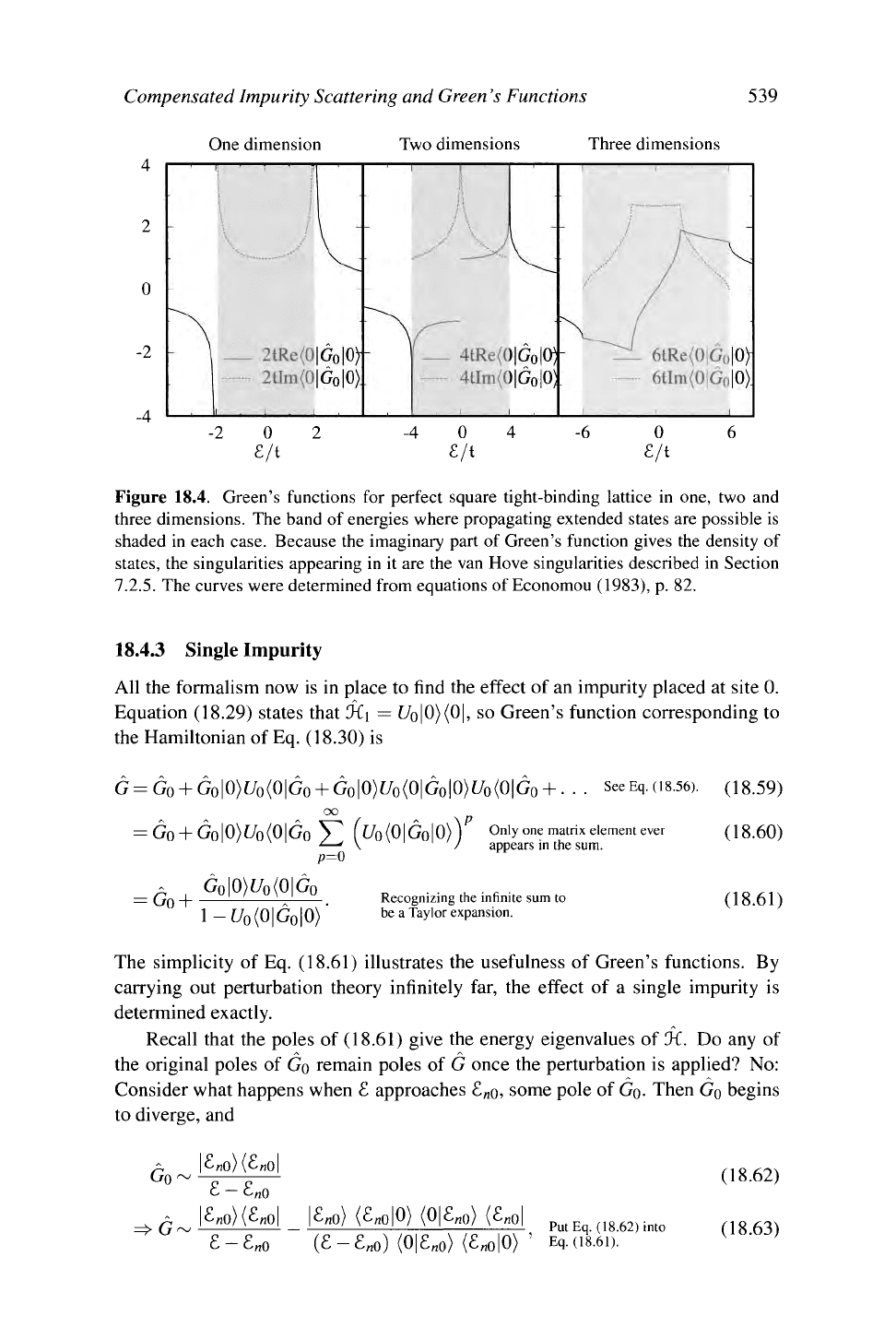
G
=
Go
+
GofG
0
. (18.58)
Compensated Impurity Scattering and Green's Functions
539
One dimension Two dimensions Three dimensions
4
-2
-4
-2 0 2 _4 0 4-6 0 6
£/t £/t £/t
Figure 18.4. Green's functions for perfect square tight-binding lattice in one, two and
three dimensions. The band of energies where propagating extended states are possible is
shaded in each case. Because the imaginary part of Green's function gives the density of
states,
the singularities appearing in it are the van Hove singularities described in Section
7.2.5.
The curves were determined from equations of Economou (1983), p. 82.
18.4.3 Single Impurity
All the formalism now is in place to find the effect of an impurity placed at site 0.
Equation (18.29) states that "K\ = L/n|0)(0|, so Green's function corresponding to
the Hamiltonian of Eq. (18.30) is
G = G
0
+ Go|0)C/o(0|Go + Go|0)f/o(0|Go|0)[/o(0|Go + . . . See Eq.(l8.56). (18.59)
oo
= Go + Go|0)£/
0
(0|Goy^ fî/o(0|G
0
|0>y Only one matrix element ever (18.60)
z
—' V / appears in the sum.
p=0
= Go -I °^ ' °' J——. Recognizing the infinite sum to (18.61)
1 -f/o(0|Go|0)' be a Taylor expansion.
The simplicity of Eq. (18.61) illustrates the usefulness of Green's functions. By
carrying out perturbation theory infinitely far, the effect of a single impurity is
determined exactly.
Recall that the poles of (18.61) give the energy eigenvalues of "K. Do any of
the original poles of Go remain poles of G once the perturbation is applied? No:
Consider what happens when £ approaches £„n, some pole of Go. Then Go begins
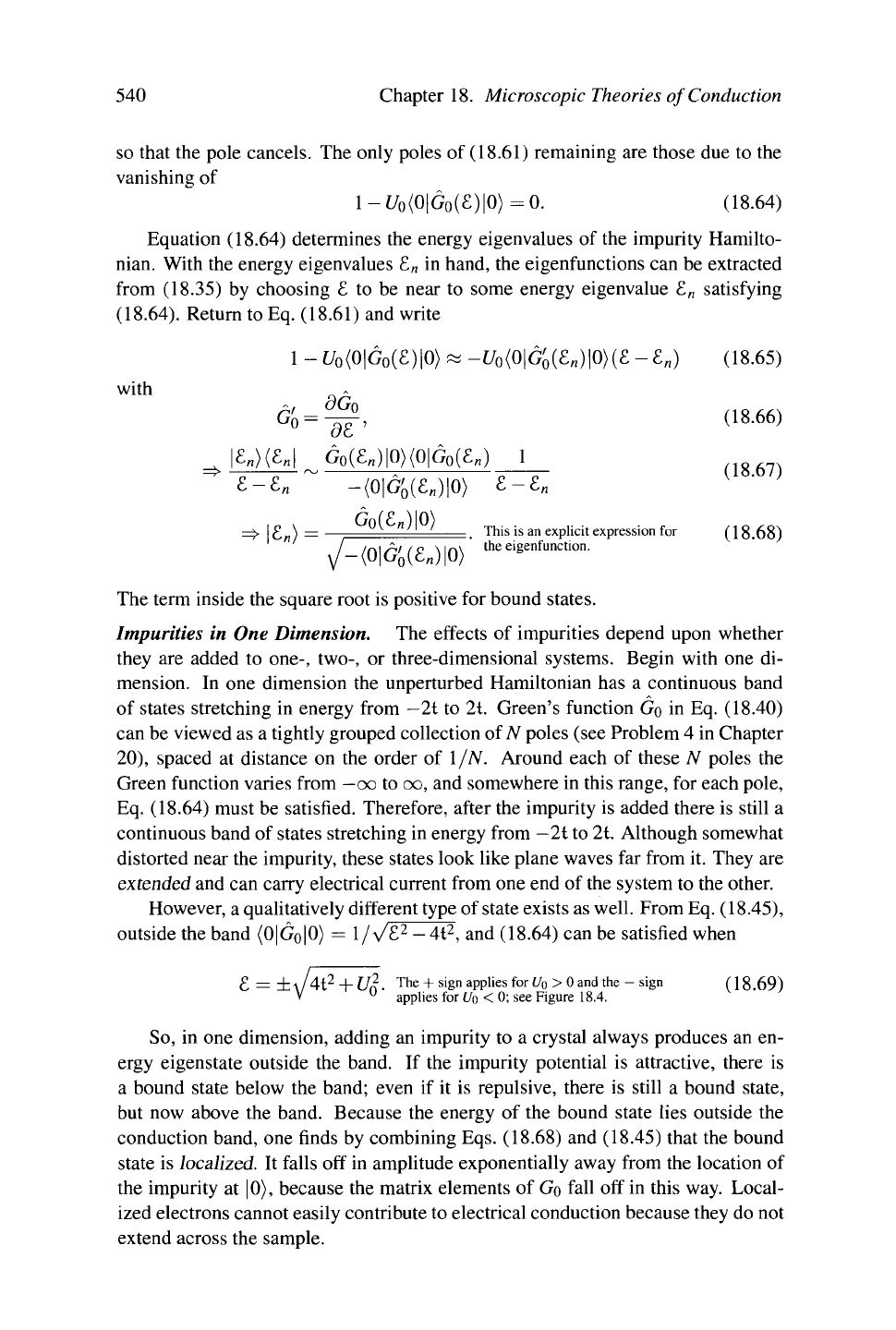
to diverge, and
^
J£*o)(£,,o|
(1862)
£
—
£„o
|£«o)(£«o| |£/io) (£no|0) (0|£„o) (£«o|
£-£„0 (£-£
n0
)(0|£„o) (£n0|0) ' Eq. (18.61).
Put Eq. (18.62) into (18.63)
540
Chapter 18. Microscopic Theories of Conduction
so that the pole cancels. The only poles of (18.61) remaining are those due to the
vanishing of
l-£/o(0|Go(£)|0>=0. (18.64)
Equation (18.64) determines the energy eigenvalues of the impurity Hamilto-
nian. With the energy eigenvalues £„ in hand, the eigenfunctions can be extracted
from (18.35) by choosing £ to be near to some energy eigenvalue £„ satisfying
(18.64).
Return to Eq. (18.61) and write
1 - t/
0
(0|Go(£)|0) « -t/
0
(0|G
o
(£„)|0)(£ - £„) (18.65)
with
dG
0
9£ '
!£„)(£„! Go(£„)|0)<0|Go(£„) 1
G
0
= ^, (18.66)
(18.67)
£-£„ -(0|G
0
(£„)|0) £-£„
C (F )\0)
|£ \ = ——-— This is an explicit expression for (18 68)
/_(0|^(£„)|0>"
theei
8
enfunction
-
The term inside the square root is positive for bound states.
Impurities in One Dimension. The effects of impurities depend upon whether
they are added to one-, two-, or three-dimensional systems. Begin with one di-
mension. In one dimension the unperturbed Hamiltonian has a continuous band
of states stretching in energy from —2t to 2t. Green's function Go in Eq. (18.40)
can be viewed as a tightly grouped collection of N poles (see Problem 4 in Chapter
20),
spaced at distance on the order of
1
/N. Around each of these
TV
poles the
Green function varies from —oo to oo, and somewhere in this range, for each pole,
Eq. (18.64) must be satisfied. Therefore, after the impurity is added there is still a
continuous band of states stretching in energy from — 2t to 2t. Although somewhat
distorted near the impurity, these states look like plane waves far from it. They are
extended and can carry electrical current from one end of the system to the other.
However, a qualitatively different type of state exists as well. FromEq. (18.45),
outside the band (0|G
0
|0) = l/V£
2
-4t
2
, and (18.64) can be satisfied when
£ = ±
J4t
2
+ UZ.
The
+
si
g
n
a
PP
lies for u
o > 0 and the - sign ( 18.69)
V applies for
Uo
< 0; see Figure 18.4.
So,
in one dimension, adding an impurity to a crystal always produces an en-
ergy eigenstate outside the band. If the impurity potential is attractive, there is
a bound state below the band; even if it is repulsive, there is still a bound state,
but now above the band. Because the energy of the bound state lies outside the
conduction band, one finds by combining Eqs. (18.68) and (18.45) that the bound
state is localized. It falls off in amplitude exponentially away from the location of
the impurity at |0), because the matrix elements of Go fall off in this way. Local-
ized electrons cannot easily contribute to electrical conduction because they do not
extend across the sample.
Compensated Impurity Scattering and Green's Functions 541
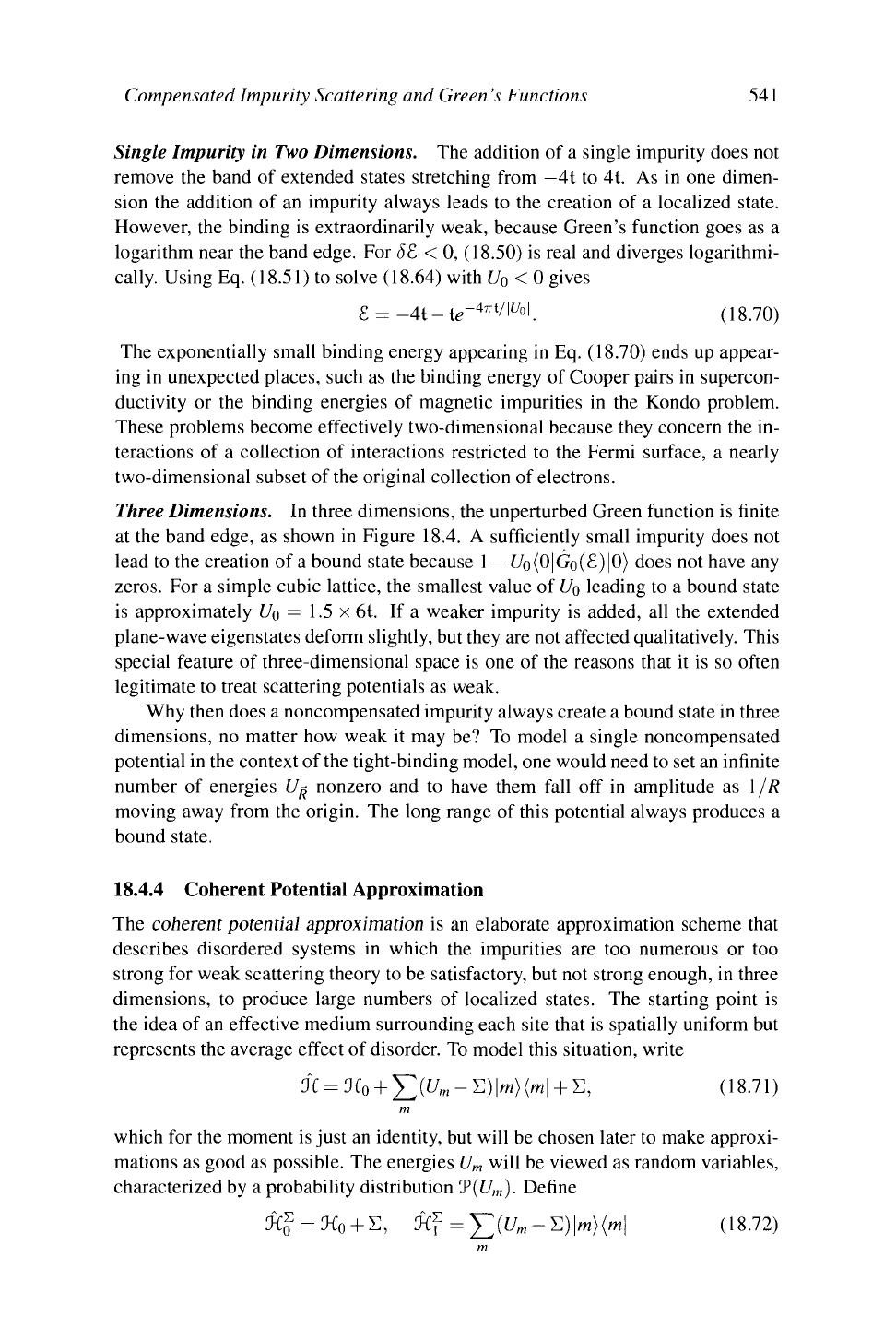
Single Impurity in
Two
Dimensions. The addition of a single impurity does not
remove the band of extended states stretching from —4t to 4L As in one dimen-
sion the addition of an impurity always leads to the creation of a localized state.
However, the binding is extraordinarily weak, because Green's function goes as a
logarithm near the band edge. For
ÖE-
< 0, (18.50) is real and diverges logarithmi-
cally. Using Eq. (18.51) to solve (18.64) with t/
0
< 0 gives
E = -4t-te~
47ri/m
. (18.70)
The exponentially small binding energy appearing in Eq. (18.70) ends up appear-
ing in unexpected places, such as the binding energy of Cooper pairs in supercon-
ductivity or the binding energies of magnetic impurities in the Kondo problem.
These problems become effectively two-dimensional because they concern the in-
teractions of a collection of interactions restricted to the Fermi surface, a nearly
two-dimensional subset of the original collection of electrons.
Three Dimensions. In three dimensions, the unperturbed Green function is finite
at the band edge, as shown in Figure 18.4. A sufficiently small impurity does not
lead to the creation of a bound state because
1 —
UO(0\GQ(E)
|0)
does not have any
zeros.
For a simple cubic lattice, the smallest value of
UQ
leading to a bound state
is approximately
UQ
= 1.5 x 6t. If a weaker impurity is added, all the extended
plane-wave eigenstates deform slightly, but they are not affected qualitatively. This
special feature of three-dimensional space is one of the reasons that it is so often
legitimate to treat scattering potentials as weak.
Why then does a noncompensated impurity always create a bound state in three
dimensions, no matter how weak it may be? To model a single noncompensated
potential in the context of
the
tight-binding model, one would need to set an infinite
number of energies U$ nonzero and to have them fall off in amplitude as \/R
moving away from the origin. The long range of this potential always produces a
bound state.
18.4.4 Coherent Potential Approximation
The coherent potential approximation is an elaborate approximation scheme that
describes disordered systems in which the impurities are too numerous or too
strong for weak scattering theory to be satisfactory, but not strong enough, in three
dimensions, to produce large numbers of localized states. The starting point is
the idea of an effective medium surrounding each site that is spatially uniform but
represents the average effect of disorder. To model this situation, write
<k
=
aCo
+ ^(f/
m
-E)|/n)(/n| + E, (18.71)
m
which for the moment is just an identity, but will be chosen later to make approxi-
mations as good as possible. The energies U
m
will be viewed as random variables,
characterized by a probability distribution 7{U
m
). Define
!K£
=
:KO
+ £, Äf = ^(£/
m
-£)|m)(m| (18.72)
m
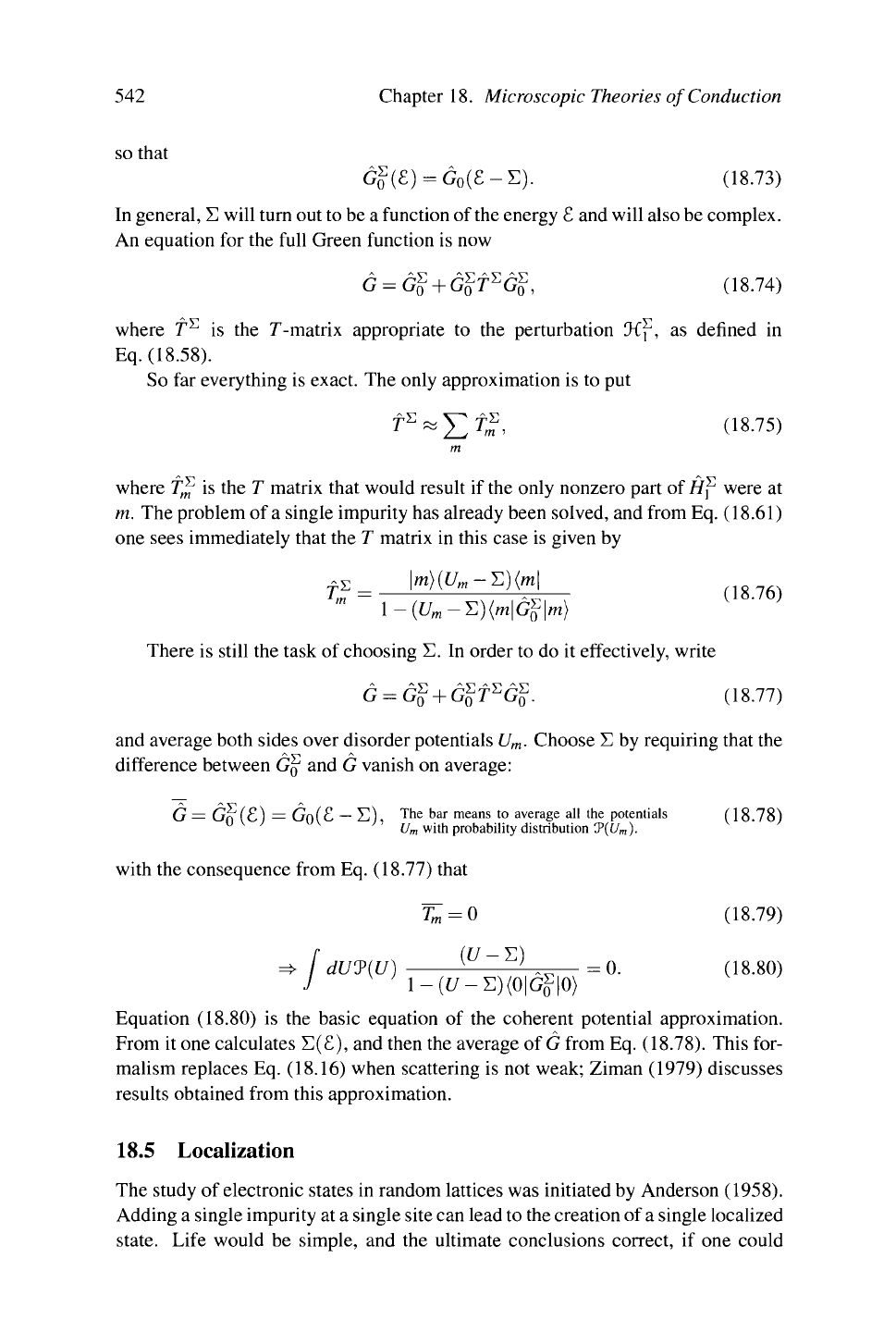
542
Chapter 18. Microscopic Theories of
Conduction
so that
G^(£) = G
0
(£-E). (18-73)
In general, £ will turn out to be a function of
the
energy £ and will also be complex.
An equation for the full Green function is now
G =
G%
+ G$T
T
'G%, (18.74)
where T^ is the T-matrix appropriate to the perturbation 'Kf, as defined in
Eq. (18.58).
So far everything is exact. The only approximation is to put
f
E
~E
f
m, (18.75)
m
where T^ is the T matrix that would result if the only nonzero part of Hf were at
m.
The problem of a single impurity has already been solved, and from Eq. (18.61)
one sees immediately that the T matrix in this case is given by
T-'ZJ
\m)(U
m
-T,)(m\
T£ = '
/v
^ (18.76)
l-(f/
m
-S)(m|Gf|m)
There is still the task of choosing £. In order to do it effectively, write
G = G$ +
G%f
s
G%.
(18.77)
and average both sides over disorder potentials U
m
. Choose E by requiring that the
difference between G^ and G vanish on average:
G = Gn(£.) = Gn(£ — E) The bar means to average all the potentials (18 78)
vy J v n
U
m
with probability distribution 7{U
m
).
with the consequence from Eq. (18.77) that
7^
= 0 (18.79)
/
dU7{U) -—
/r
; ^
N
J,
As
^ = 0. (18.80)
(t/-s)
l-(£/-£)(0|G
0
^|0)
Equation (18.80) is the basic equation of the coherent potential approximation.
From it one calculates E(£), and then the average of
G
from Eq. (18.78). This for-
malism replaces Eq. (18.16) when scattering is not weak; Ziman (1979) discusses
results obtained from this approximation.
18.5 Localization
The study of electronic states in random lattices was initiated by Anderson (1958).
Adding a single impurity at a single site can lead to the creation of
a
single localized
state.
Life would be simple, and the ultimate conclusions correct, if one could