
Marder M.P. Condensed Matter Physics
Подождите немного. Документ загружается.

Luttinger Liquids 553
on the assumption that
IT
is a power of T. The results are in satisfactory agreement
with theory.
Localization in Other Systems. Localization is a phenomenon involving wave
motion in a random medium, and it is not particular to the Schrodinger equation.
Many of the first calculations arose from studies of phonons in disordered solids,
as discussed by Ziman (1979) and Economou (1983). John (1991) discusses the
localization of light in random dielectric media, and Storzer et al. (2006) have
obtained the best evidence to date that random media can indeed cause light to
localize.
18.6 Luttinger Liquids
One of the persistent questions in the study of many electrons is when the Fermi
surface exists. Impurities and disorder can disrupt the ability of electrons to carry
charge over long distances, but there is a more worrisome issue, which is whether
interactions between electrons themselves, even in the perfect crystal, can cause
the whole picture of independent electrons traveling near a Fermi surface to break
down.
There are few exact results available to provide guidance. The hope has long
been for a soluble and realistic model of many electrons. One of the few candidates
is a model due to Tomonaga (1950) and Luttinger (1963), which however can only
be solved in one dimension. Luttinger's solution of the model was partly incorrect,
and the right answer was found by Mattis and Lieb (1965). Recent development
of the subject is best sought in Giamarchi (2003).
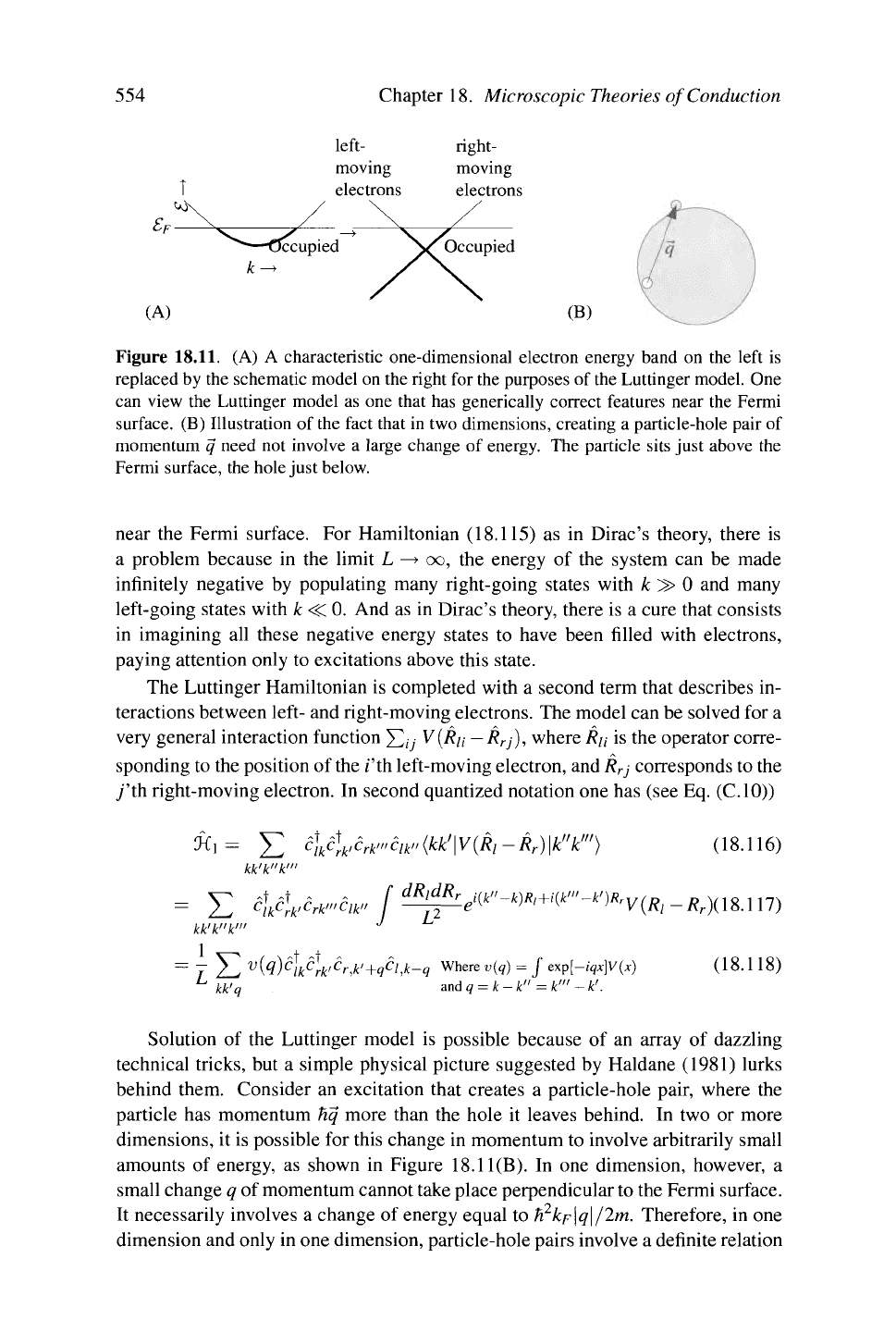
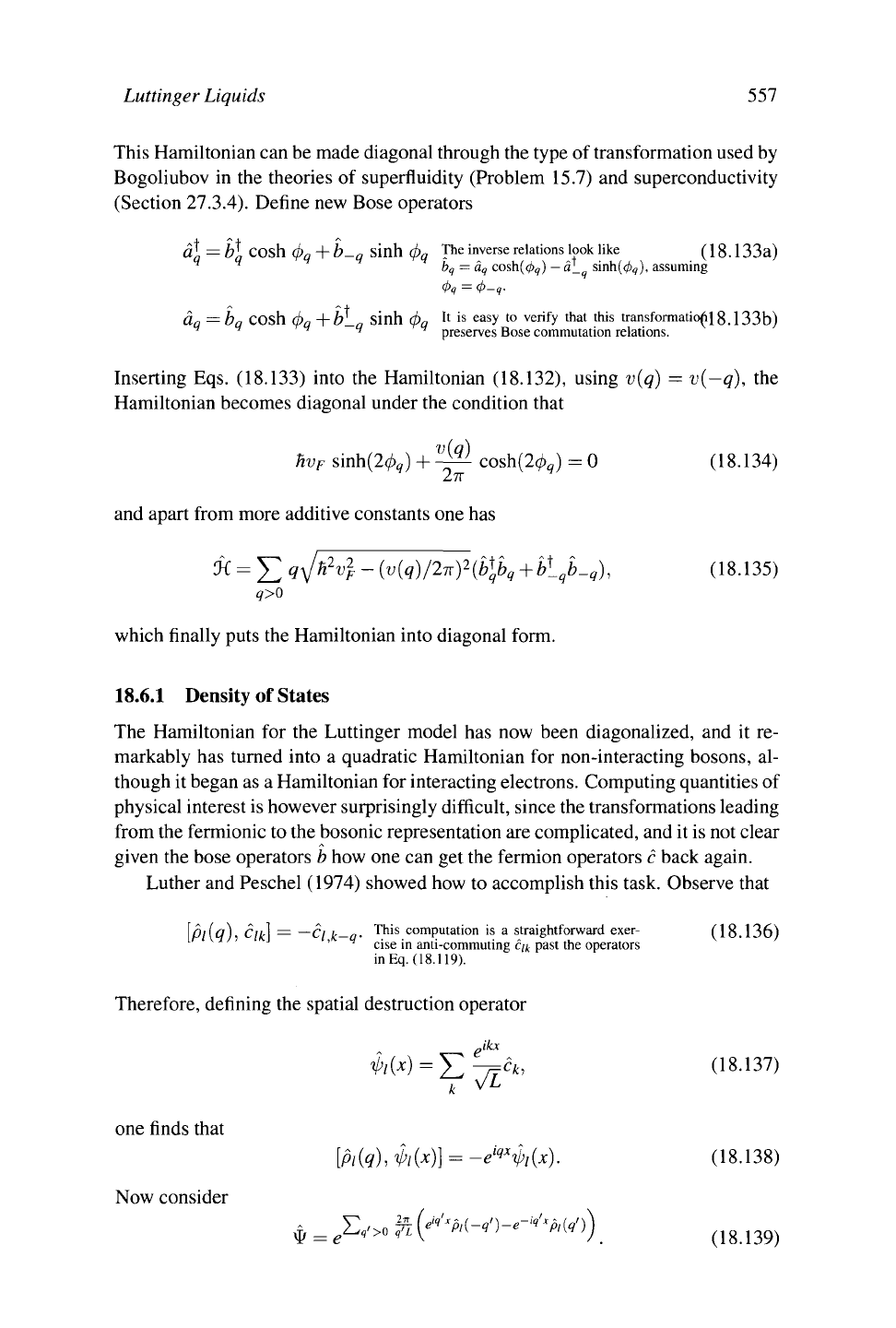
One way to express the basic idea of the model is to look at a generic energy
band diagram for one-dimensional electrons, Figure 18.11(A). A parabolic band
occupied up to the Fermi surface is replaced by two linear bands, one for electrons
moving to the left near the Fermi surface, the other for electrons moving to the
right. This model should generically capture the low-energy behavior of electrons
in one dimension.
Luttinger's model features electrons of two types, living in a one dimensional
space of length L subject to periodic boundary conditions. The two types of elec-
trons are sometimes called left-moving and right-moving electrons, but really they
are defined by the fact that the first have an energy that increases linearly with wave
number k, and the second have an energy that decreases linearly with wave number
k. Thus the Hamiltonian begins with a first contribution
!Ko = hvp V^ k (cj.Cik — C
.ark).
Think of Hv
F
= d£/dk
F
as coming from a (18.115)
~
d
linearization of
the
electron energy at the Fermi
* surface.
Here
c]
k
creates a left-moving electron with wave number k and c\
k
creates a right-
moving electron with wave number k. The linear dependence of energy on electron
wave number was inspired by Dirac's theory for relativistic electrons, although
in this case it can be thought of as resulting from linearizing electron energies
554 Chapter 18. Microscopic Theories of Conduction
left- right-
moving moving
electrons electrons
(B)
Figure
18.11.
(A) A characteristic one-dimensional electron energy band on the left is
replaced by the schematic model on the right for the purposes of the Luttinger model. One
can view the Luttinger model as one that has generically correct features near the Fermi
surface. (B) Illustration of the fact that in two dimensions, creating a particle-hole pair of
momentum q need not involve a large change of energy. The particle sits just above the
Fermi surface, the hole just below.
near the Fermi surface. For Hamiltonian (18.115) as in Dirac's theory, there is
a problem because in the limit L
—>
oo, the energy of the system can be made
infinitely negative by populating many right-going states with k S> 0 and many
left-going states with k <C 0. And as in Dirac's theory, there is a cure that consists
in imagining all these negative energy states to have been filled with electrons,
paying attention only to excitations above this state.
The Luttinger Hamiltonian is completed with a second term that describes in-
teractions between left- and right-moving electrons. The model can be solved for a
very general interaction function J2ij V{Ru ~ Rrj), where /?// is the operator corre-
sponding to the position of the i'th left-moving electron, and R
r
j corresponds to the
j'th
right-moving electron. In second quantized notation one has (see Eq. (C.10))
^i= E c\
k
c\
kl
c
rk>l
,c
lkll
(kk'\V{R
l
-R
r
)\k"k"') (18.116)
kk'k"k'"
= E à]&c*„c
w
, f
d
^e^^>^'
l
^^V{R
l
-R
r
)^All)
kk'k"k'"
= 7 E
V
{
(
l)c\kc\k'Cr,k>+qCl,k-q Where v(q) = j exp[-iqx]V(x)
(18.118)
L
kk'q and q = k - k" = k'" - k!.
Solution of the Luttinger model is possible because of an array of dazzling
technical tricks, but a simple physical picture suggested by Haldane (1981) lurks
behind them. Consider an excitation that creates a particle-hole pair, where the
particle has momentum Hq more than the hole it leaves behind. In two or more
dimensions, it is possible for this change in momentum to involve arbitrarily small
amounts of energy, as shown in Figure 18.11(B). In one dimension, however, a
small change q of momentum cannot take place perpendicular to the Fermi surface.
It necessarily involves a change of energy equal to h
2
kf\q\/2m. Therefore, in one
dimension and only in one dimension, particle-hole pairs involve a definite relation
Luttinger Liquids
555
between energy and momentum. In this respect they themselves are like particles.
Because these virtual particles are made from a pair of Fermions, they are bosons.
Thus the Luttinger model can be solved by bosonization, which means rewrit-
ing the Hamiltonian in terms of operators that correspond to creation of particle-
hole pairs. This may be accomplished by defining density operators for q > 0:
p,(q)=
V c[
k+a
c
lk
- pi(-q)= T c,W
+(?
Note,
<?>().
(18.119a)
7-9
E 4*+?^*
;
-^<k
a
--q
a ^
/ ,
C
r,k+q
C
r,k'i
-^<k
pi{-q) =
pr{-q) =
7"<?
~-1
=
E
C
r,k
C
r,k+<l
Pr{q)= 2^
ê
r,k+
q
â
r,k; Pr{~q) = 2^
^c
r
^
+?
(18.119b)
The subtlety lies in the choice of upper and lower limits for the sum over k. Ordi-
narily, k is viewed as periodic, and when k reached the top of the Brillouin zone,
k + q would flip over to the bottom. With the definitions in Eq. (18.119), the top
and bottom of
the
Brillouin zone are kept completely separate, and the system takes
the form of a filled Fermi sea.
For the sake of definiteness take q > q' and compute
(18.120)
[pi(-q)
7-9
E
-7<*
-
7-9
E
-7<*
"
i, piW)}
a ^
~7<*'
ê
lk'+q'
ê
lk'}
7-<?' 4 -
x
ST^
C
l,k'
C
lk
d
k+q,k'+q'
-i
<k
> -Ci,k'+q'
è
iMqàk,k'
a
1
?-(?-9')\
4.
l
c
lk
c
l,k+q-q' '
i
Use Eqs. (C.3) repeatedly. (18.121)
Requires about a page of algebra. It is
helpful to write the limits on the sums
as products of theta functions, and then (18.122)
use the delta function to eliminate k' in
terms of k.
The operators in Eq. (18.122) have canceled out completely except when k is near
the top or the bottom of the Brillouin zone. Suppose one is interested only in low-
energy excitations; that is, q
<C
ir/a. One can restrict attention to the space of wave
functions where all the k states down at — ir/a are completely filled, and all the
states up at tr/a are completely empty. In this space the first sum in Eq. (18.122)
can be replaced by X^=-Wa *W
an<
^
tne secon
d vanishes. One arrives at the same
result, by a slightly different route, if q <
q
1
.
Thus one has finally
-7+?
L
\Pi(-q),Pi{rf)\=
E V = r«V
(18
-
123)
Similarly
2TT
[p
r
(q),p
r
(-q')} =
J2 V = ^V
(
18
-
124
)
556
Chapter 18. Microscopic Theories of
Conduction
while pi and p
r
commute. Mattis and Lieb (1965) comment about the temptation
to think Eq. (18.122) vanishes that
there is a large difference between very large determinants and infinite
ones....It was first observed by Julian Schwinger... that the very fact that
one postulates the existence of a ground state (i.e. the filled Fermi sea)
forces certain commutators to be nonvanishing even though in first quan-
tization they automatically vanish. The "paradoxical contradictions" of
which Schwinger speaks seem to anticipate the difficulties of the Lut-
tinger model. —Mattis and Lieb (1965), p. 304
Comparing with Eq. (13.44), note that
pi
and p
r
obey the commutation relations
for boson creation and annihilation operators once one rescales them as
(18.125a)
(18.125b)
The goal is now to rewrite the Luttinger Hamiltonian in terms of these new op-
erators. The interaction term (18.118) is easy to rewrite. Inserting the density
operators from Eq. (18.119) gives
1
L
q>0
£ £»<«>
<?>0
2TT
â_„âl + â-
(18.126)
Remember assumption that v(q) is even. ( L8.127)
The noninteracting Hamiltonian is less straightforward to represent in terms of the
density operators, but the task can be accomplished by computing that
[[K
0
, pi{±q)} = ±q pi{±q)
['Ko,
Pr{±q)} = ^qpi{±q)i
which means that
[[Ko,
â±
q
]
qâ
]
±q
-qâ±
q
(18.128)
(18.129)
(18.130)
(18.131)
Thus [Kn has the same commutation relations as J2
q
>o q(â
q
â
q
+ â_ â-
q
). Identi-
fying this quantity with [Ko, up to an additive constant which can be neglected, the
Luttinger Hamiltonian equals
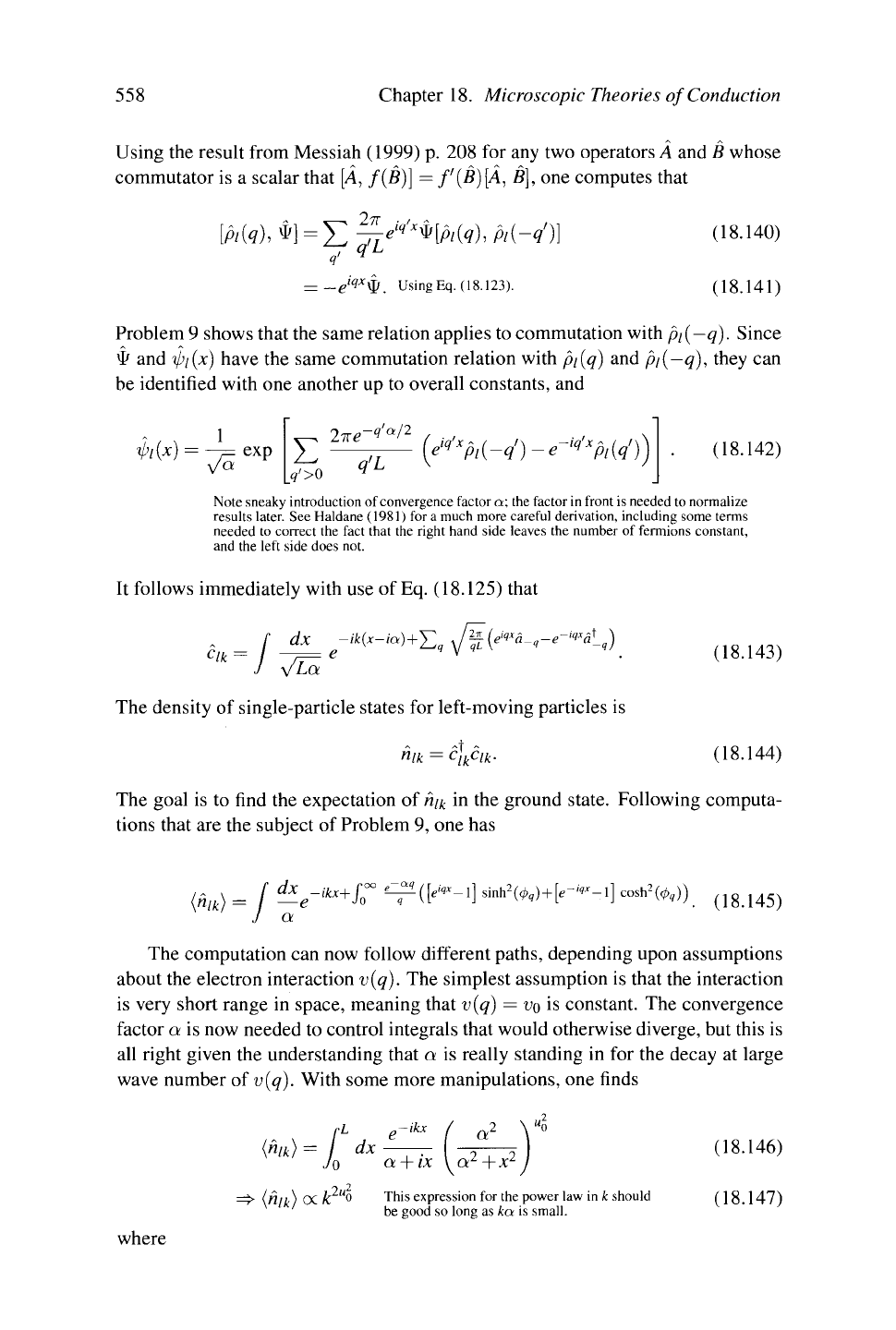
[K = 2_\
Q (
h
v
F
q>0 ^
â
q
â
q
+ â[_
q
â-
q
+
2TT
â_
q
â
q
+ â.
(18.132)
Luttinger Liquids 557
This Hamiltonian can be made diagonal through the type of transformation used by
Bogoliubov in the theories of superfluidity (Problem 15.7) and superconductivity
(Section 27.3.4). Define new Bose operators
â\ = b\ COSh
4>
q
+ b-
q
sinh (j)
q
T
he
inverse relations look like (18.133a)
b
q
= â
q
coû\{<t>
q
)
—
â_ sinh(0,), assuming
<f>q
=4>-q-
an = bn COSh
4>q
+ b
[
_
a
Sinh (j)
q
u is eas
y
t0 verif
y
that this
transformation8.133b>)
^ preserves Bose commutation relations.
Inserting Eqs. (18.133) into the Hamiltonian (18.132), using v(q) =
v(—q),
the
Hamiltonian becomes diagonal under the condition that
hv
F
sinh(20,) + ~- cosh(20„) = 0 (18.134)
271"
and apart from more additive constants one has
•K
= Y, q\l*
2
4 - (v(q)/27ry
(b\b
q
+
bl
q
b.
q
),
(18.135)
q>0
which finally puts the Hamiltonian into diagonal form.
18.6.1 Density of States
The Hamiltonian for the Luttinger model has now been diagonalized, and it re-
markably has turned into a quadratic Hamiltonian for non-interacting bosons, al-
though it began as a Hamiltonian for interacting electrons. Computing quantities of
physical interest is however surprisingly difficult, since the transformations leading
from the fermionic to the bosonic representation are complicated, and it is not clear
given the bose operators b how one can get the fermion operators c back again.
Luther and Peschel (1974) showed how to accomplish this task. Observe that
\pi(q),
CiA = —Ci k-q.
This
computation is a straightforward exer- (18.136)
' eise in anti-commuting % past the operators
in Eq. (18.119).
Therefore, defining the spatial destruction operator
^/W =
E
f
7f^'
(18
-
137)
one finds that
Now consider
[pi{l),Mx)] = -e
iqx
Mx)- (18.138)
ü
=
e
T,<
>0
f
L
{
t
*
x
»
{
-*
)
-
e
~*
XM)
).
(18.139)
558
Chapter 18. Microscopic Theories of
Conduction
Using the result from Messiah (1999) p. 208 for any two operators A and B whose
commutator is a scalar that [Â, f(B)] =
f'(Ê)[Â,
B],
one computes that
[M?),*] = £^
,V
**[M?),P/(-</)] (18.140)
=
_£<<?*xj/. Using Eq. (18.123). (18.141)
Problem 9 shows that the same relation applies to commutation with pi(—q). Since
\I/
and V>/(x) have the same commutation relation with pi(q) and pi(—q), they can
be identified with one another up to overall constants, and
V
;
/W = -7=
ex
P
fco
«
L
V
(18.142)
Note sneaky introduction of convergence factor a; the factor in front is needed to normalize
results later. See Haldane (1981) for a much more careful derivation, including some terms
needed to correct the fact that the right hand side leaves the number of fermions constant,
and the left side does not.
It follows immediately with use of
Eq.
(18.125) that
c
lk
=\^=e
>^\j^\
-d_ (18.143)
The density of single-particle states for left-moving particles is
nik = c\
k
c
lk
. (18.144)
The goal is to find the expectation of hi
k
in the ground state. Following computa-
tions that are the subject of Problem 9, one has
(n
lk
) = f ^
e
-
ik
*+r ^([^-'] sinh^H*-*-!] cosh^,)^
(18145)
J
a
The computation can now follow different paths, depending upon assumptions
about the electron interaction v(q). The simplest assumption is that the interaction
is very short range in space, meaning that v(q) =
VQ
is constant. The convergence
factor a is now needed to control integrals that would otherwise diverge, but this is
all right given the understanding that a is really standing in for the decay at large
wave number of v(q). With some more manipulations, one finds
f
L
e~
ikx
( a
2
\"°
(n
lk
) = / dx —— -^-—
2
(18.146)
Jo a + ix ya
z
+x
z
J
=$■
(nib) (X k ° This expression for the power law in k should (18.147)
be good so long as ka is small.
where
Problems
559
u\
h
2
v
2
F
- (V(2TT))
2
(18.148)
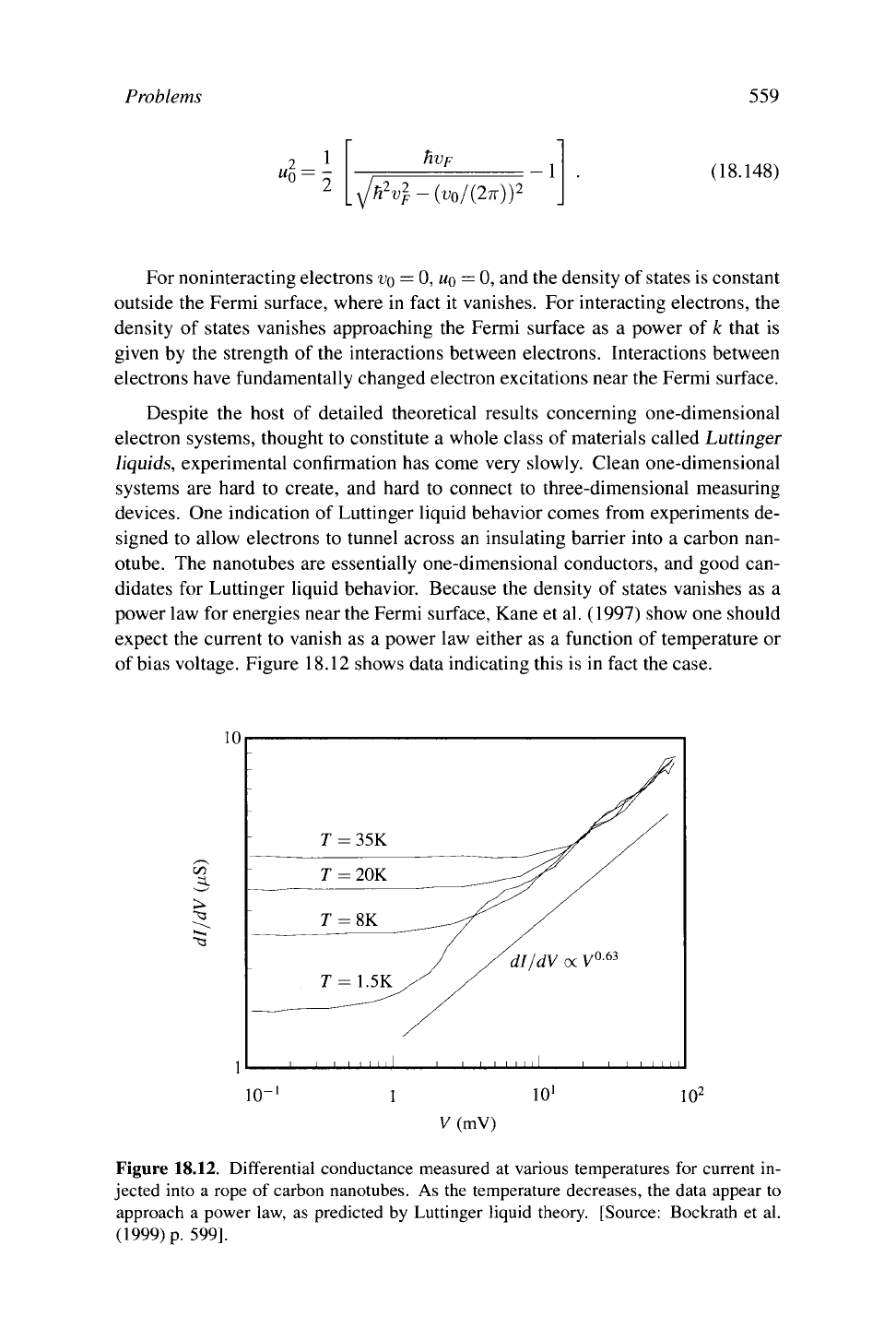
For noninteracting electrons
vo
= 0,uo = 0, and the density of states is constant
outside the Fermi surface, where in fact it vanishes. For interacting electrons, the
density of states vanishes approaching the Fermi surface as a power of k that is
given by the strength of the interactions between electrons. Interactions between
electrons have fundamentally changed electron excitations near the Fermi surface.
Despite the host of detailed theoretical results concerning one-dimensional
electron systems, thought to constitute a whole class of materials called Luttinger
liquids, experimental confirmation has come very slowly. Clean one-dimensional
systems are hard to create, and hard to connect to three-dimensional measuring
devices. One indication of Luttinger liquid behavior comes from experiments de-
signed to allow electrons to tunnel across an insulating barrier into a carbon nan-
otube. The nanotubes are essentially one-dimensional conductors, and good can-
didates for Luttinger liquid behavior. Because the density of states vanishes as a
power law for energies near the Fermi surface, Kane et al. (1997) show one should
expect the current to vanish as a power law either as a function of temperature or
of bias voltage. Figure 18.12 shows data indicating this is in fact the case.
C/5
io-
10
1
10
2
V (mV)
Figure 18.12. Differential conductance measured at various temperatures for current in-
jected into a rope of carbon nanotubes. As the temperature decreases, the data appear to
approach a power law, as predicted by Luttinger liquid theory. [Source: Bockrath et al.
(1999) p. 599].
560
Chapter 18. Microscopic Theories of Conduction
Problems
1.
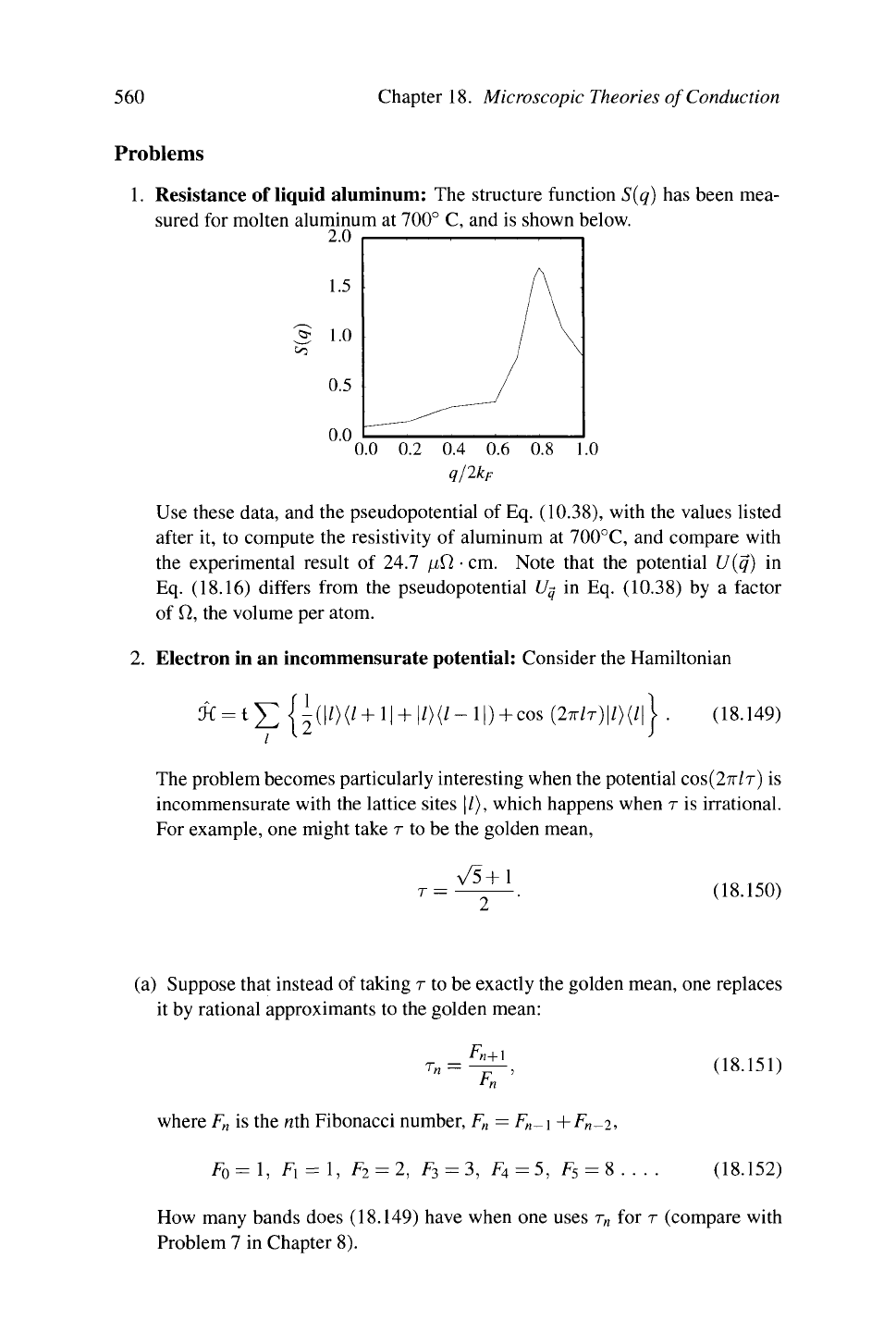
Resistance of liquid aluminum: The structure function S(q) has been mea-
sured for molten aluminum at 700° C, and is shown below.
2.0
0.0 0.2 0.4 0.6 0.8 1.0
q/2k
F
Use these data, and the pseudopotential of Eq. (10.38), with the values listed
after it, to compute the resistivity of aluminum at 700°C, and compare with
the experimental result of 24.7
fiQ,
■
cm. Note that the potential U(q) in
Eq. (18.16) differs from the pseudopotential U$ in Eq. (10.38) by a factor
of
Ç},
the volume per atom.
2.
Electron in an incommensurate potential: Consider the Hamiltonian
Ä = t 53
{^(I0('
+
1|
+ |/)</- 1|) +cos (2TT/T)|/)(/| j . (18.149)
The problem becomes particularly interesting when the potential cos(27r/r) is
incommensurate with the lattice sites |/), which happens when r is irrational.
For example, one might take r to be the golden mean,
v^+l
T =
(18.150)
(a) Suppose that instead of taking r to be exactly the golden mean, one replaces
it by rational approximants to the golden mean:
T„
=
F
n
+\
F
n
where
F„
is the nth Fibonacci number, F
n
= F„_i +F„_2,
F
0
= 1, Fi = l, F
2
= 2, F
3
= 3, F
4
= 5, F
5
= S.
(18.151)
(18.152)
How many bands does (18.149) have when one uses
T„
for r (compare with
Problem 7 in Chapter 8).
Problems
561
(b) For r now given by Eq. (18.150), the wave functions of the Hamiltonian are
a curious intermediate between localized and extended. Demonstrate this fact
by assuming that there is an eigenstate at £ = 0, taking
tpo
= (0|V>) = 1 and
ip\
=
(1\4>)
= 1. Then use Eq. (18.149) to compute
i\)
m
—
(m\ip) form on the
order of 10
4
and observe how the magnitude of
ip
m
scales with m.
One way to do this is to plot the
participation
ratio
Pim) =
ÈuW-
(18
'
153)
In order to calculate P(m), make use of quantities calculated in order to find
P(m
— 1 ) ;
do not carry out a sum starting at 0 and going up to m for each
individual P(m).
Compare the behavior of the participation ratio with what would be expected
for localized states, and what would be expected for extended states.
3.
Introduction to transfer matrices: Consider a tight-binding model for a
one-dimensional chain of atoms with random impurities scattered along it:
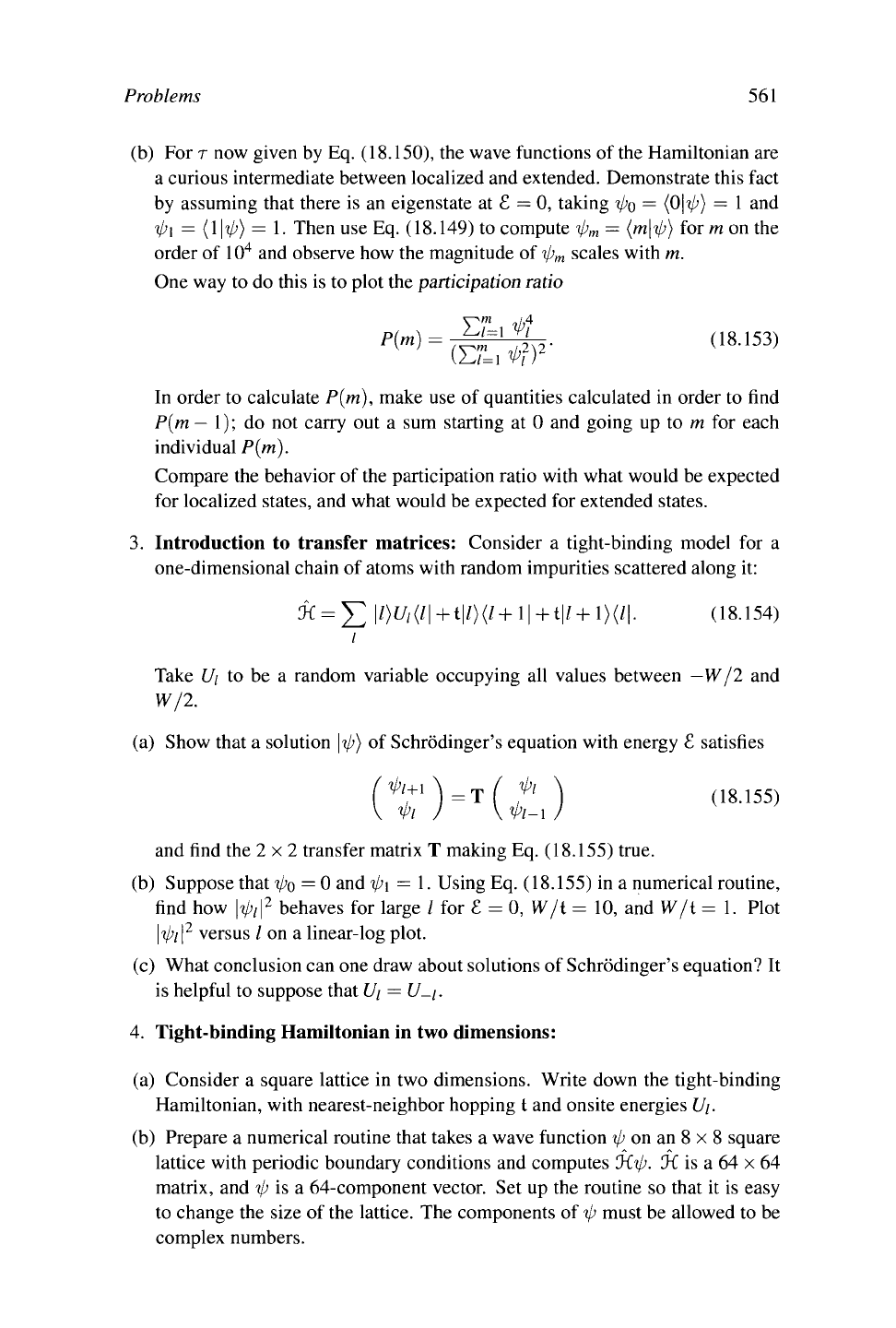
& = £ |/)£//(/|+t|/)(/+l| + t|/ + l)</|. (18.154)
Take £// to be a random variable occupying all values between —W/2 and
W/2.
(a) Show that a solution
\X/J)
of Schrödinger's equation with energy £ satisfies
and find the 2 x 2 transfer matrix T making Eq. (18.155) true.
(b) Suppose that
V'o
= 0 and
ipi
= I. Using Eq. (18.155) in a numerical routine,
find how \ipi\
2
behaves for large / for £ = 0, W/t = 10, and W/t = 1. Plot
\ipj\
2
versus / on a linear-log plot.
(c) What conclusion can one draw about solutions of Schrödinger's equation? It
is helpful to suppose that [// = £/_/.
4.
Tight-binding Hamiltonian in two dimensions:
(a) Consider a square lattice in two dimensions. Write down the tight-binding
Hamiltonian, with nearest-neighbor hopping t and onsite energies £//.
(b) Prepare a numerical routine that takes a wave function
ip
on an 8 x 8 square
lattice with periodic boundary conditions and computes
"Kip.
"K
is a 64 x 64
matrix, and ip is a 64-component vector. Set up the routine so that it is easy
to change the size of the lattice. The components of
tp
must be allowed to be
complex numbers.
562
Chapter 18. Microscopic Theories of Conduction
(c) Set the onsite energy
U[
to zero. Set ^(0,0)
=
1
an
d
a
^ other components of
ip to zero. Set idt/h = 0.01 Compute the time evolution of
ip
by
i>
(«)_
l
idt
~h
•K
i>
(«-0
(18.156)
Actually, this is not a good way to solve Schrödinger's equation, because it
does not preserve normalization and is not accurate to high order , but it will
(n)
do for the present. Find
V'o
o
f°
r
4096 values of n, and prepare a plot of the
real and imaginary parts of "0(0,0)
as a
function of time.
(d) Multiply ifj(t) by exp[—0At/(h/t)}, take the fast Fourier transform of the
result, and plot real and imaginary parts. To what function computed in this
chapter should the result correspond?
5.
Scaling theory of localization I:
(a) Consider a three-dimensional tight-binding model on a square lattice. Show
that solutions ip of Schrödinger's equation must obey the equation
( Vv+i
where
T =
-!H/2
0
(18.157)
(18.158)
Here 'K2 is the tight-binding Hamiltonian for the two-dimensional square lat-
tice,
and ipi is condensed notation for
ipj,k,i-
The three indices on tp label the
three-dimensional sites of the tight-binding model, ipi is a vector (whose val-
ues can be indexed by j and k) with as many components as a two-dimensional
tight-binding model and where the final index / is being treated separately for
use with the transfer matrix T.
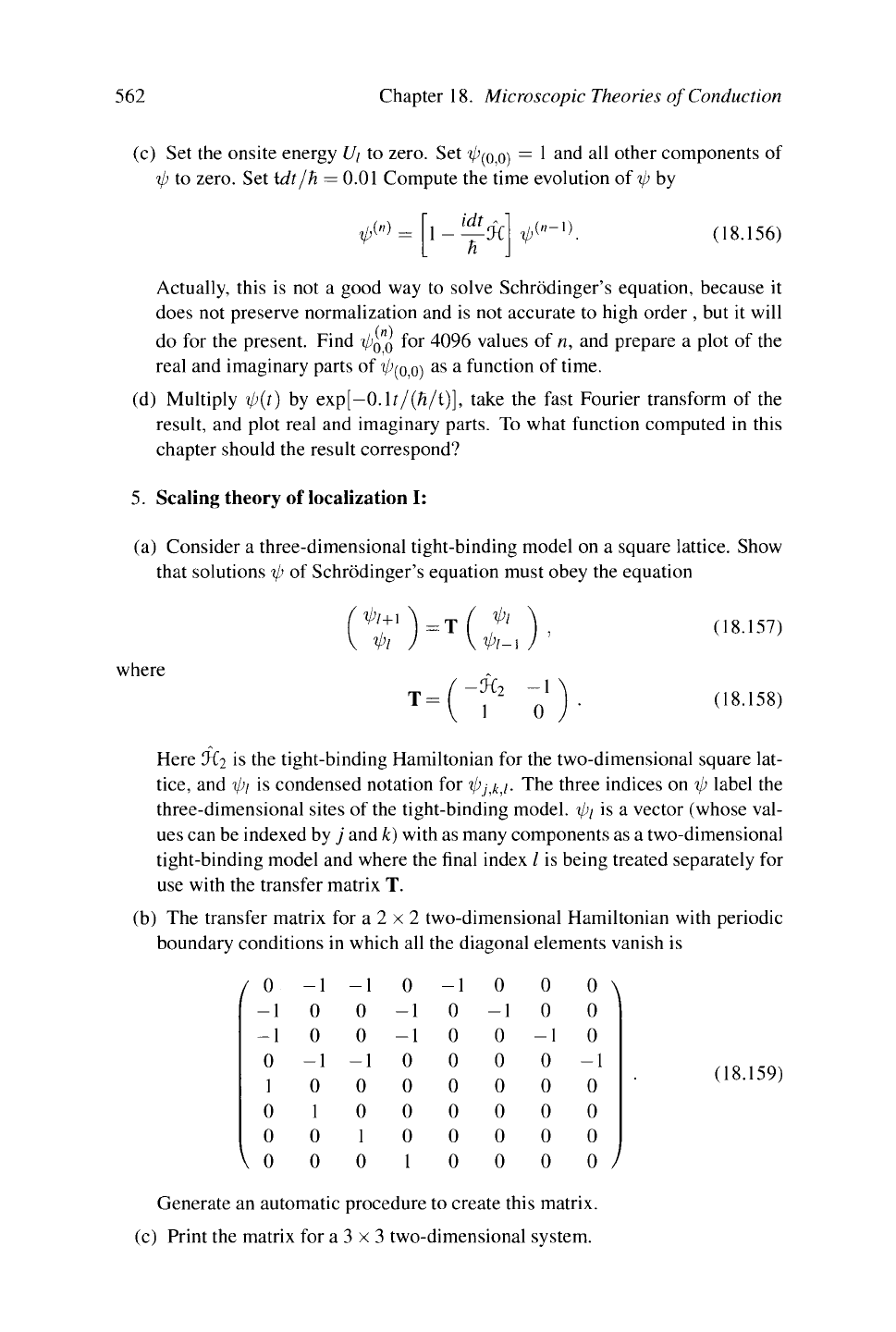
(b) The transfer matrix for a 2 x 2 two-dimensional Hamiltonian with periodic
boundary conditions in which all the diagonal elements vanish is
(
°
-1
-1
0
1
0
0
\. 0
-1
0
0
-1
0
1
0
0
-1
0
0
-1
0
0
1
0
0
-1
-1
0
0
0
0
1
-1
0
0
0
0
0
0
0
0
-1
0
0
0
0
0
0
0
0
-1
0
0
0
0
0
0
\
0
0
-1
0
0
0
0 /
(18.159)
Generate an automatic procedure to create this matrix.
(c) Print the matrix for a 3 x 3 two-dimensional system.