
Marder M.P. Condensed Matter Physics
Подождите немного. Документ загружается.

Problems 563
6. Scaling theory of localization II: Let T be the transfer matrix for a tight-
binding Hamiltonian on an L x L square lattice,
£
"
1
IK/
"
0
!
). (18.160)
The subscript / is needed because the matrices Ä/ have random diagonal ele-
ments, chosen with equal probability to lie within [-W/2, W/2]. Let
Q=n
T
'-
<
18
-
161
)
i=\
Then according to Pichard and André (1986), the conductance G of an L x
Lx L cube, in units of e
2
/h, is
i =
Tr
R
(18.162)
LQQ*
+ (QQ*)-'+2j
(a) Rewrite the expression for G in terms of the eigenvalues of the matrix QQ*.
(b) Calculate the resistance of a 3 x 3 x 3 block at W = 0 and £ = 0 and find
In R= 1.4818.
(c) Find the resistance of a single 3x3x3 block at W
—
10 and £ = 0.
(d) The resistance found in the previous part will depend greatly upon the partic-
ular values of the random disorder. To obtain a more meaningful result, carry
out averages over many realizations of the randomness. That is, compute In R
for one 3x3x3 block, obtaining In R\. Without initializing the random num-
ber generator, find the resistance of a second 3x3x3 block, obtaining In Rj.
Continue in this way, generating the series of resistances In /?/. The fluctua-
tions in resistance are so large that R is not well defined, but In R will average
well. Let In /?/ be the average of In R after / computations. Keep computing
until the fluctuations in In /?/ settle down to within around 4%.
7.
Scaling theory of localization III:
Use the numerical routine of problem 6 to compute the conductance G, de-
fined in Eq. (18.162), and therefore find the scaling function for localization
in three dimensions. That is, reproduce Figure 18.9. This figure was produced
by using tens of thousands of cubes of size up to 7 x 7 x 7, but if systems this
size are too time-consuming, an adequate figure can be produced with cubes
of size up to 5 x 5 x 5.
8. Weak localization: The goal of this problem is to carry out the calculations
leading from Eq. (18.101) to Eq. (18.103). Specialize to the center of the
band, £ = 0, and write 3(g, £ = 0) = 5(g).
(a) Show that
\~
]
= -J dg?(g) In \g\. (18.163)
564 Chapter 18. Microscopic Theories of Conduction
(b) Show that if
5
>
(f/)
is very narrow and centered on zero, then to leading order
in
W/i
one obtains
?(g) =
\?(-l/g).
(18.164)
8
(c) Verify that Eq. (18.164) has solution
3"=
.
C
,
(18.165)
where C is a constant.
(d) Show that to normalize 3
r
,C = 0.2696
....
(e) Equation (18.165) is completely independent of the probability distribution
3\
From Eq. (18.101), an approximate form for
5"
that involves
0
3
is
t
r . ,„, t . „ C
f(s)
</,v
n
i-
lg
<)
.
(,8,66,
Iterating Eq. (18.101) further would produce even better approximations for
U, but to leading order in
W/i
it is not necessary.
(f) Inserting
Eqs.
(18.166) and (18.81) into Eq. (18.163), and working to leading
order in W/i, verify Eq. (18.103).
9. Luttinger Liquids:
(a) Verify that
[pti-q),
*] = - £ ^re-V'VM-q),
p,(</)]
(18.167)
=
-e
iqx
Ü.
(18.168)
(b) Verify Eq. (18.145). Use Eq. (13.119) to treat averages of exponentials of
Bose operators. Keep only terms that survive the expectation value
in
the
ground state.
(c) Verify Eq. (18.146).
References
E. Abrahams, P. W. Anderson, D. C. Licciardello, and T. V. Ramakrishnan (1979), Scaling theory
of localization: Absence of quantum diffusion in two dimensions, Physical Review Letters, 42,
673-676.
M. Ahlskog, R. Menon, A. J. Heeger, T. Noguchi, and T. Ohnishi (1997), Metal-insulator transition
in oriented poly(p-phenylenevinylene), Physical Review B, 55, 6777-6787.
B.
L. Al'tshuler and P. A. Lee (1988), Disordered electronic systems, Physics
Today,
41(12), 36-44.
P.
W. Anderson (1958), Absence of diffusion incertain random lattices, Physical Review, 109, 1492-
1505.
References
565
N.
W. Ashcroft and L. J. Guild (1965), The resistivity of liquid aluminium, Physics Letters, 14,
23-24.
N.
W. Ashcroft and D. Stroud (1978), Theory of the thermodynamics of simple liquid metals, Solid
State Physics: Advances in Research and Applications, 33, 1-81.
J. Bass, W. P. Pratt, and
P.
A. Schroeder (1990), The temperature-dependent electrical resistivities of
the alkali metals, Reviews of Modern Physics, 62, 645-744.
D.
Belitz and T. R. Kirkpatrick (1994), The Anderson-Mott transition, Reviews of Modern Physics,
66,
261-380.
A. B. Bhatia and K. S. Rrishnan (1948), "Diffuse scattering" of the Fermi electrons in monovalent
metals in relation to their electrical resistivities, Proceedings of
the
Royal Society of London, A
194,
185-205.
M. Bockrath, D. H. Cobden, J. Lu, A. G. Rinzler, R. E. Smalley, L. Balents, and
P.
L. McEuen (1999),
Luttinger-liquid behaviour in carbon nanotubes, Nature, 397,
598-601.
A. R. Bulsara and L. Gammaitoni (1996), Tuning in to noise, Physics Today, 49(3), 39^45.
D.
Chattopadhyay and H. J. Queisser (1981), Electron scattering by ionized impurities in semicon-
ductors, Reviews of Modern Physics, 53, 745-768.
N.
E. Cusack (1987), The Physics of Structurally Disordered Matter, Adam Hilger, Bristol.
P.
Dean (1972), The vibrational properties of disordered systems: Numerical studies, Reviews of
Modern Physics, 44, 127-168.
P.
Dutta and P. M. Horn (1981), Low-frequency fluctuations in solids: 1/f noise, Reviews of Modern
Physics, 53, 497-516.
E. N. Economou (1983), Green's Functions in Quantum Physics, Springer-Verlag, Berlin.
P.
P. Edwards and M. J. Sienko (1982), The transition to the metallic state, Accounts of Chemical
Research, 15,
87-93.
R. J. Elliott, J. A. Krumhansl, and P. L. Leath (1974), The theory and properties of randomly disor-
dered crystals and related physical systems, Reviews of Modern Physics, 46, 465-543.
H. Fritzsche (1984), Noncrystalline semiconductors, Physics
Today,
37(10),
34^41.
T. Giamarchi (2003), Quantum Physics in One Dimension, Oxford University Press, Oxford.
I. S. Grigoriev and E. Z. Meilkhov, eds. (1997), Handbook of Physical Quantities, CRC Press, Boca
Raton, FL.
F.
D. M. Haldane (1981), 'luttinger liquid theory' of one-dimensional quantum fluids. I. Properties of
the Luttinger model and their extension to the general ID interacting spinless Fermi gas, Journal
of Physics C: Solid State Physics, 14(19), 2585-2609.
S. John (1991), Localization of light (in dielectric microstructures), Physics Today, 44(5), 32^10.
J. B. Johnson (1927), Thermal agitation of electricity in conductors, Physical Review, 29, 367-
368.
The complete text of the article reads: Ordinary electric conductors are sources of random
voltage fluctuations, as a result of thermal agitation of the electric charges in the conductor. The
average effect of the fluctuations has been measured by means of a vacuum tube amplifier, where
it manifests itself as a component of the phenomenon commonly called "tube noise." A part of
the "tube noise" arises in the first tube and other elements of the apparatus; the remainder in
the input resistance, with a mean square voltage fluctuation (V )
m
which is proportional to the
resistance R ofthat conductor. The ratio (V )
m
/R, of the order of 10 watt at room temperature,
is independent of the material and shape of the conductor, but is proportional to its absolute
temperature. In the range of audio frequencies, at least, the noise contains all frequencies at equal
amplitudes. The noise of an input resistance of only 5000 ohms may exceed that of the rest of the
circuit, so that the limit of useful amplification is at times set by the thermal agitation of charges
in the input resistance of the amplifier.
C. Kane, L. Balents, and M. P. A. Fisher (1997), Coulomb interactions and mesoscopic effects in
carbon nanotubes, Physical Review Letters, 79, 5086-5089.
A. Kawabata (2007), Electron conduction in one-dimension, Reports on Progress in Physics, 70,
566 Chapter 18. Microscopic Theories of
Conduction
219-254.
W. Kohn (1957), Shallow impurity states in silicon and germanium, Solid State Physics: Advances
in Research and Applications, 5, 257-320.
B.
Kramer and A. MacKinnon (1993), Localization: Theory and experiment, Reports on Progress in
Physics, 56, 1469-1564.
L. D. Landau and E. M. Lifshitz (1977), Quantum Mechanics (Non-relativistic Theory), 3rd ed.,
Pergamon Press, Oxford.
A. Luther and I. Peschel (1974), Single-particle states, Kohn anomaly, and pairing fluctuations in
one dimension, Physical Review B, 9, 2911-2919.
J. M. Luttinger (1963), An exactly soluble model of a many-fermion system, Journal of Mathemati-
cal Physics, 4, 1154-1162
N.
March (1990), Liquid Metals: Concepts and Theory, Cambridge University Press, Cambridge.
D.
C. Mattis and E. H. Lieb (1965), Exact solution of a many-Fermion system and its associated
boson field, Journal of Mathematical Physics, 6, 304-312
R. Menon, C. O. Yoon, D. Moses, A. J. Heeger, and
Y.
Cao (1993), Transport in polyaniline near the
critical regime of the metal-insulator transition, Physical Review B, 48,
17
685-17 694.
A. Messiah (1999), Quantum Mechanics, Dover, New York.
N.
F. Mott (1978), Metal-insulator transitions, Physics
Today,
31(11), 42-47.
N.
F. Mott (1990), Metal-Insulator Transitions, 2nd ed., Taylor and Francis, London.
N.
F. Mott and E. A. Davis (1979), Electronic Processes in Non-Crystalline Materials, 2nd ed.,
Clarendon Press, Oxford.
H. Nyquist (1928), Thermal agitation of electric charge in conductors, Physical Review, 32, 110-113.
S. T. Pantelides (1978), The electronic structure of impurities and other point defects in semiconduc-
tors,
Reviews of Modern Physics, 50, 797-858.
R. E. Peierls (1929), On the kinetic theory of heat transport in crystals, Annalen der
Physik,
3, 1055-
1101.
In German.
J. L. Pichard and G. André (1986), Many-channel transmission: Large volume limit of the distribu-
tion of localization lengths and one-parameter scaling, Europhysics Letters, 2, 477^86.
T. F. Rosenbaum (1985), The disordered insulator: Electron glasses and crystals, in Localization and
Metal-Insulator Transitions, H. Fritzsche and D. Adler, eds., pp. 1-8, Plenum, New York.
M. V. Sadovskii (1981), Electron localization in disordered systems: Critical behavior and macro-
scopic manifestations, Soviet Physics Uspekhi, 24, 96-115.
P.
Sheng (1995), Introduction to Wave Scattering, Localization, and Mesoscopic Phenomena, Aca-
demic Press, San Diego.
M. Störzer, P. Gross, C. M. Aegerter, and G. Maret (2006), Observation of the critical regime near
Anderson localization of light, Physical Review Letters, 96(6), 063 904.
A. P. Sutton (1993), Electronic Structure of Materials, Clarendon Press, Oxford.
S. Tomonaga (1950), Remarks on Bloch's method of sound waves applied to many-fermion prob-
lems,
Progress of Theoretical Physics, 5, 544-569.
R. A. Webb and S. Washburn (1988), Quantum interference fluctuations in disordered metals, Physics
Today,
41(12),
46-53.
J. M. Ziman (1961), A theory of the electrical properties of liquid metals. I The monovalent metals,
Philosophical Magazine, 6, 1013-1034.
J. M. Ziman (1979), Models of Disorder : The Theoretical Physics of Homogeneously Disordered
Systems, Cambridge University Press, Cambridge.
A. Zunger (1986), Electronic structure of 3d transition-atom impurities in semiconductors, Solid
State Physics: Advances in Research and Applications, 39, 275-464.
19.
Electronics
19.1 Introduction
Electronics is the art of controlling the flow of electrons. It began with the dis-
covery of the ancient Greeks that a piece of amber (rjXexxpov) could attract and
hold small objects after being rubbed. The path leading to electrons' controlled
removal from matter included the observation early in the eighteenth century that
the electrical conductivity of air increases in the vicinity of a hot poker, continued
with Franklin's kite experiment relating lightning to static electricity, and culmi-
nated in the middle of the nineteenth century with experiments of Crookes who
passed electricity between high-voltage plates in evacuated tubes. Edison noticed
in 1883 that if he placed a metal plate inside a light bulb, current would flow to the
plate if it was at a positive voltage with respect to the filament, but not otherwise.
Edison did not think this observation of
rectification
particularly significant, but it
has turned out to have as many consequences as his electric lights.
Credit for the discovery of the electron is given to J. J. Thomson, whose exper-
iments on the flow of electricity from heated filaments in evacuated tubes isolated
it as a particle with a definite ratio of charge to mass. The name "electron" was
proposed by G. J. Stoney in 1894 for the unit of charge equal to 10~
19
coulombs,
and this term gradually superseded Thomson's term "corpuscle" for the new par-
ticle.
The first practical electronic device was built by J. A. Fleming, who built
upon the work of Thomson and Edison to create a cathode ray tube with a heated
filament capable of rectifying oscillating currents. He called it a "valve," but it is
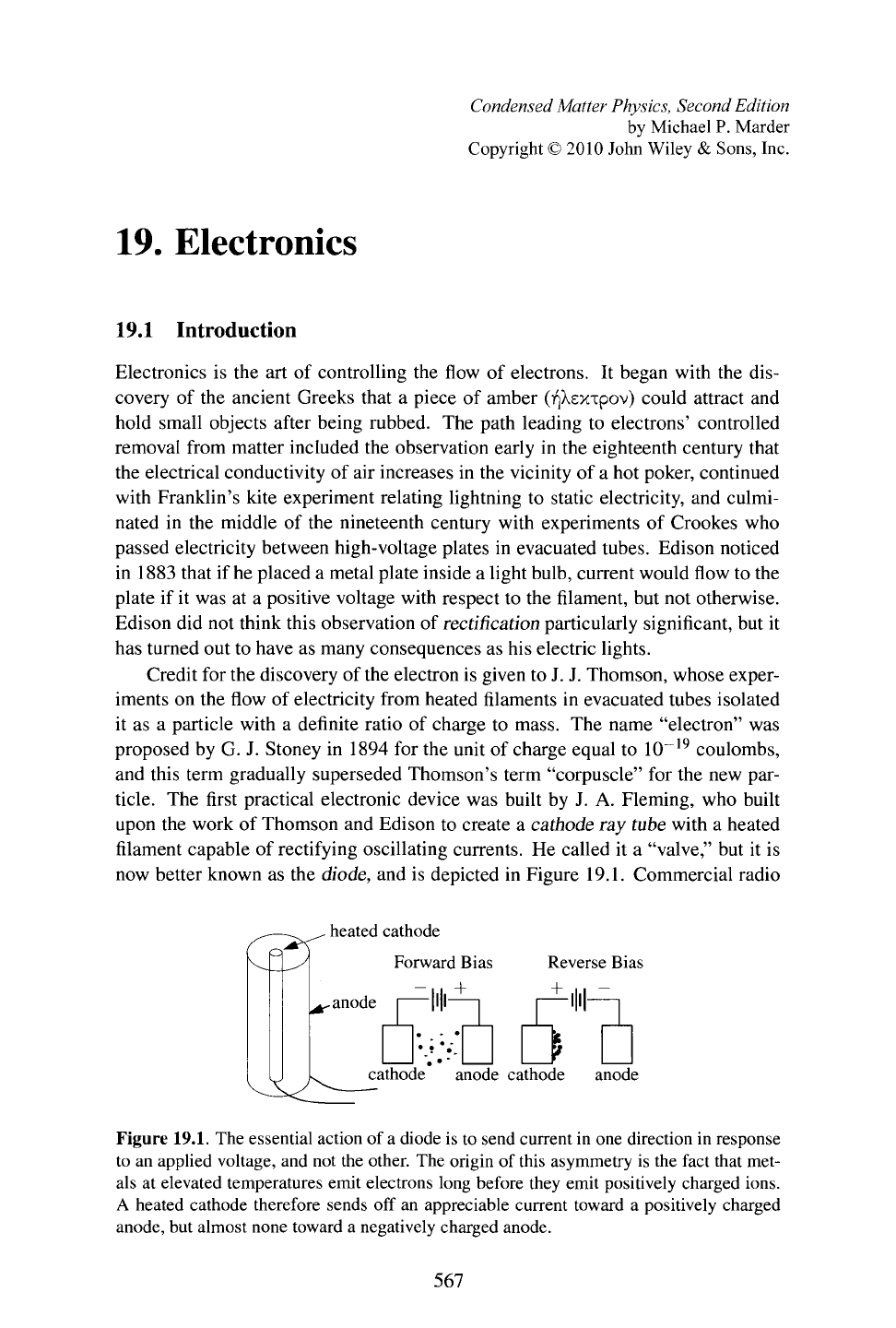
now better known as the diode, and is depicted in Figure 19.1. Commercial radio
heated cathode
Forward Bias
.anode I |l|l
Reverse Bias
+
J—
PII—|
I——l|l|——"I
cathode anode cathode anode
Figure 19.1. The essential action of
a
diode is to send current in one direction in response
to an applied voltage, and not the other. The origin of
this
asymmetry is the fact that met-
als at elevated temperatures emit electrons long before they emit positively charged ions.
A heated cathode therefore sends off an appreciable current toward a positively charged
anode, but almost none toward a negatively charged anode.
567
Condensed Matter
Physics,
Second Edition
by Michael P. Marder
Copyright © 2010 John Wiley & Sons, Inc.
568 Chapter 19. Electronics
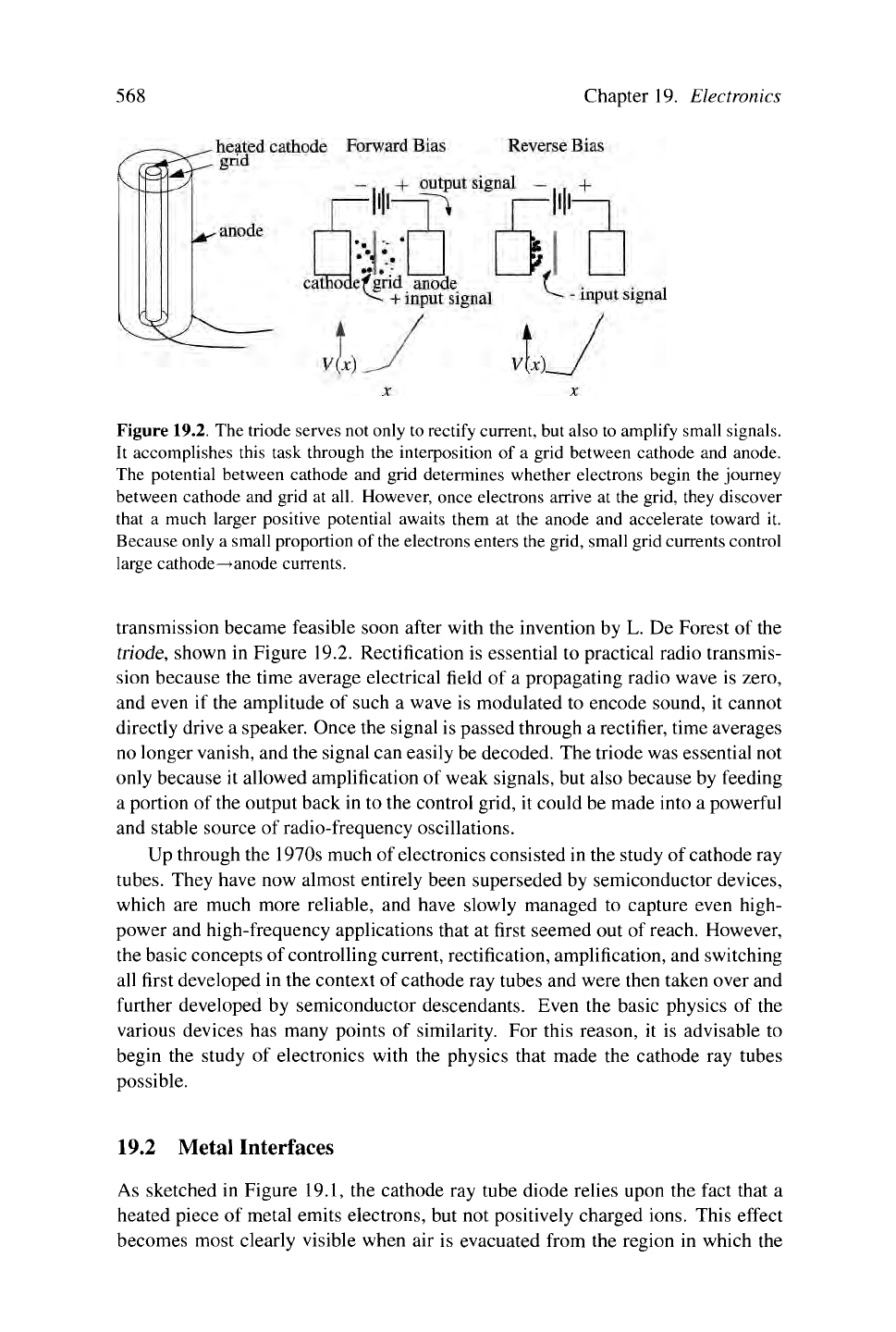
Figure 19.2. The triode serves not only to rectify current, but also to amplify small signals.
It accomplishes this task through the interposition of a grid between cathode and anode.
The potential between cathode and grid determines whether electrons begin the journey
between cathode and grid at all. However, once electrons arrive at the grid, they discover
that a much larger positive potential awaits them at the anode and accelerate toward it.
Because only a small proportion of the electrons enters the grid, small grid currents control
large cathode—+ anode currents.
transmission became feasible soon after with the invention by L. De Forest of the
triode, shown in Figure 19.2. Rectification is essential to practical radio transmis-
sion because the time average electrical field of a propagating radio wave is zero,
and even if the amplitude of such a wave is modulated to encode sound, it cannot
directly drive a speaker. Once the signal is passed through a rectifier, time averages
no longer vanish, and the signal can easily be decoded. The triode was essential not
only because it allowed amplification of weak signals, but also because by feeding
a portion of the output back in to the control grid, it could be made into a powerful
and stable source of radio-frequency oscillations.
Up through the 1970s much of electronics consisted in the study of cathode ray
tubes.
They have now almost entirely been superseded by semiconductor devices,
which are much more reliable, and have slowly managed to capture even high-
power and high-frequency applications that at first seemed out of reach. However,
the basic concepts of controlling current, rectification, amplification, and switching
all first developed in the context of cathode ray tubes and were then taken over and
further developed by semiconductor descendants. Even the basic physics of the
various devices has many points of similarity. For this reason, it is advisable to
begin the study of electronics with the physics that made the cathode ray tubes
possible.
19.2 Metal Interfaces
As sketched in Figure 19.1, the cathode ray tube diode relies upon the fact that a
heated piece of metal emits electrons, but not positively charged ions. This effect
becomes most clearly visible when air is evacuated from the region in which the
Metal Interfaces 569
electrons are to travel, and for this reason cathode ray tubes are also known as
vacuum tubes or electron tubes. The physical question that needs to be answered
is how a metal surface in contact with vacuum emits electrons as a function of
temperature and electrical potential.
19.2.1 Work Functions
All the calculations of electronic energy levels up until now have been carried out
relative to one another. For example, the Fermi level was sometimes calculated
relative to the energy of the lowest single-particle electronic level, and in the band
structure diagrams of Section 10.4, the Fermi level was defined to be zero. None of
these calculations answers the question of the amount of energy needed to remove
an electron from an electrically neutral solid in vacuum. This energy is defined to
be the work function and is often denoted by
cf>.
It can be measured by optical meth-
ods to be discussed in Section
23.6.1,
or by properties of thermal emission to be
discussed immediately below. To calculate it requires understanding what happens
when an electron is dragged through the interface between metal and vacuum.
The work function must be contrasted with the chemical potential, which is
the energy required to take an electron from the bulk and remove it to infinity.
Inspection of Table 23.2 shows that the experimentally measured energy required
to pass an electron through one crystal surface typically differs by 10-20% from
the energy required to move it through an inequi valent one. As the energy required
for transit from bulk to infinity cannot depend upon path, it is necessary to establish
carefully what the experiments actually determine.
metal
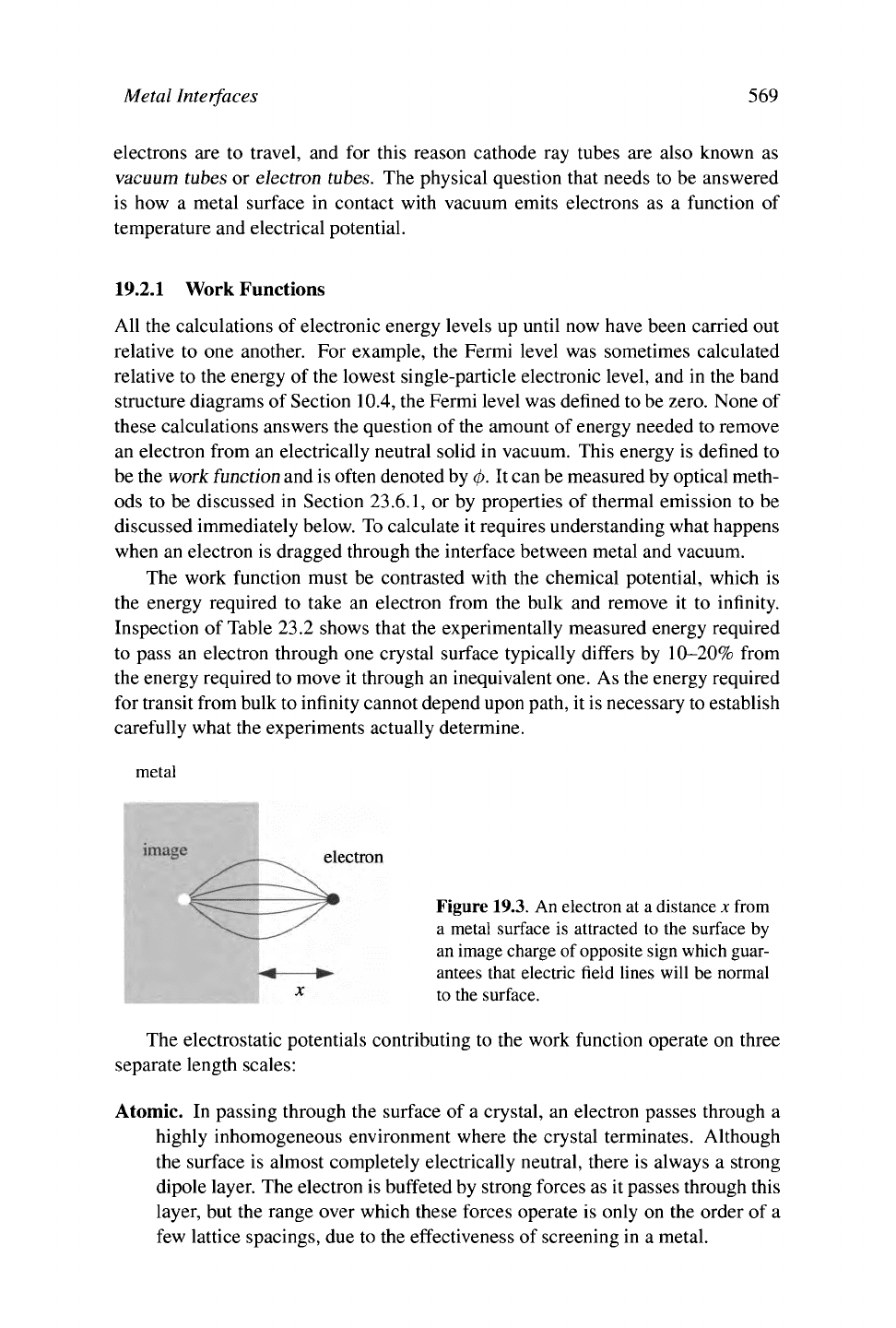
Figure 19.3. An electron at a distance x from
a metal surface is attracted to the surface by
an image charge of opposite sign which guar-
antees that electric field lines will be normal
to the surface.
The electrostatic potentials contributing to the work function operate on three
separate length scales:
Atomic. In passing through the surface of a crystal, an electron passes through a
highly inhomogeneous environment where the crystal terminates. Although
the surface is almost completely electrically neutral, there is always a strong
dipole layer. The electron is buffeted by strong forces as it passes through this
layer, but the range over which these forces operate is only on the order of a
few lattice spacings, due to the effectiveness of screening in a metal.
570
Chapter 19. Electronics
Micron. After the electron exits the metal, it interacts with an image charge,
whose presence enforces the boundary condition that the tangential electric
field vanish on the surface, as shown in Figure 19.3. The force F at distance x
from the surface is
e
2
which implies that the electron has a potential energy
e
2
1
U(x) = = —3.6-10~VmeV. (19.2)
4x x
Work functions are on the order of several electron volts, and therefore further
changes due to the image charge energy become negligible by the time an
electron has traveled a few microns from the surface.
Macroscopic. Because different crystal faces have different dipole layers, the re-
gions outside them must be at different electrical potentials, produced by
minute shifts in electron density near the crystal surface. The existence of
this potential is absolutely necessary, because there is no other way to bring
an electron out of the bulk through one surface, return it through another sur-
face,
and have it return to the original bulk energy. The spatial scale for the
variation of this potential is the size of the crystal
itself.
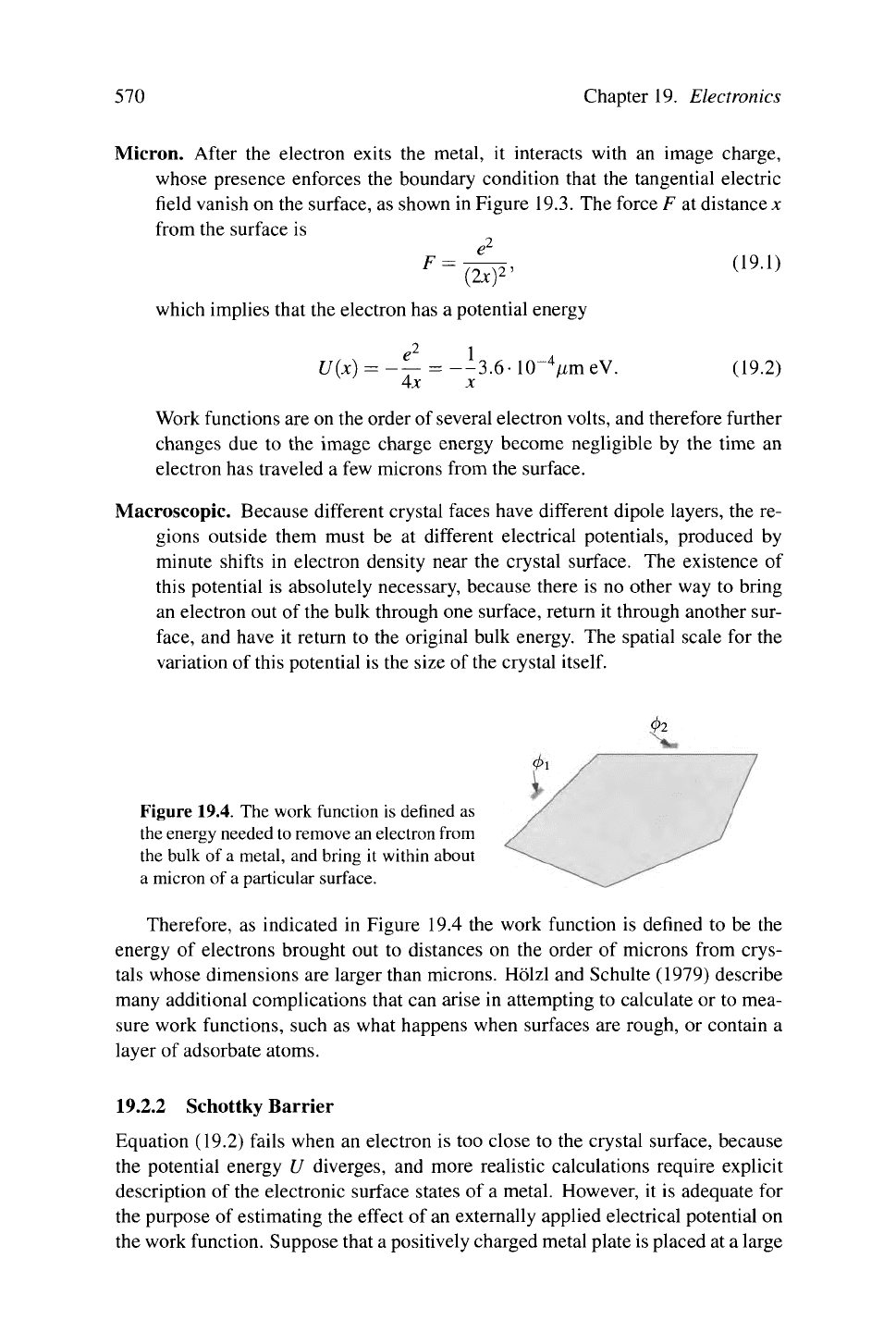
Figure 19.4. The work function is denned as
the energy needed
to
remove
an
electron from
the bulk of
a
metal, and bring it within about
a micron of
a
particular surface.
Therefore, as indicated in Figure 19.4 the work function is defined to be the
energy of electrons brought out to distances on the order of microns from crys-
tals whose dimensions are larger than microns. Hölzl and Schulte (1979) describe
many additional complications that can arise in attempting to calculate or to mea-
sure work functions, such as what happens when surfaces are rough, or contain a
layer of adsorbate atoms.
19.2.2 Schottky Barrier
Equation (19.2) fails when an electron is too close to the crystal surface, because
the potential energy U diverges, and more realistic calculations require explicit
description of the electronic surface states of a metal. However, it is adequate for
the purpose of estimating the effect of an externally applied electrical potential on
the work function. Suppose that a positively charged metal plate is placed at a large
Metal Interfaces 571
distance to the right of the metal surface, creating a linear electric field of strength
—E. Now the potential energy U(x) of the electron is
e
2
U(x) = -—-e\E\x, (19.3)
Ax
which creates a barrier, shown in Figure 19.5, at distance
x
0
=J—^>U(x
0
)
=
-e^e\E\.
(19.4)
Therefore an externally applied electric field changes the barrier restraining an
Positive potential
electron within the metal by
e\Je\E\.
Ground
i
K
1
^______ No electric field
/^~~
*o
Small electric field
Larger electric field
Figure 19.5. An externally applied electric field, created by placing at a distance a large
plate at an elevated voltage, lowers the barrier an electron must surpass in order to exit a
metal.
Having first found the effect of applied electric fields, the next goal is to exam-
ine the thermionic emission of electrons that results from heating the metal. This
task is accomplished by considering the electrons in the metal to be in equilibrium
with a dilute gas of electrons hovering outside it. For simplicity the electrons are
treated within the semiclassical approximation, which makes
it
possible to speak
of the probability for an electron to have wave number
k
at position
x
outside the
metal
f-. = : .
Compare with Eq. (17.27). Here
it
is more (19.5)
•** ß(£S+U(x)—n)
A
convenient
to
keep
ß
constant and describe
"i"
the spatial change in potential through
U
(?).
The probability of finding electrons does not vanish as x travels far from the metal.
Finding the vacuum full of electrons may seem unacceptable, but is an inevitable
consequence of
the
fact that no solid or liquid can ever be in equilibrium with a vac-
uum at nonzero temperature. Entropy always favors total evaporation. However,
a
solid can exist in equilibrium with a dilute vapor of a particular concentration, and
that is what Eq. (19.5) implies for the electrons in
a
metal. The properties of the
electron vapor are fixed by the observation that because
it
is in equilibrium with
the metal, the two must have the same chemical potential. Taking "far from the
572
Chapter 19. Electronics
metal" to denote distances on the order of a micron, the chemical potential must
be replaced by the negative of the work function,
4> —
~l
l
> 0- Work functions
are typically on the order of several electron volts, as shown in Table 23.2, so for
temperatures much less than 10000 K, Eq. (19.5) can be replaced by
/^««-^
+t/W+0)
.
(19.6)
In order to find the current drawn from the metal
in
the presence
of
an applied
electric field, one should write down the Boltzmann equation and calculate the
nonequilibrium function g ^. However, it is adequate to consider a simple approx-
imation, which is to assume that the electron gas is in equilibrium at all points to
the left of
XQ
and that all electrons that reach
XQ
and are traveling to the right escape
over the barrier and run off as a current. This idea predicts a current
hk
x
Eq. (6.15).
j=-eexp{-ß[<j> + U(xo)]} f[dk] ^9(k
x
)e~^
2k2
/
2m
For [dit],
see (19.7)
J m
Eq. (6.15).
AT
2
exp l-ß 4>-e^fë\Ë\ \ ,
From
Eq.
(19.4).
(19.8)
where
A=^—rk
l
B
= 120.2 Acm"
z
r
z
. (19.9)
em
o il
jj-
nn i A
„™—2- v—2.
2n^
kB
Equation (19.8)
is
called the Richardson-Dushman equation when used
for
E = 0, while the reduction of the work function by the square root of an applied
field is called the Schottky effect. The current does not vanish when the electric
field E goes away, which means that
if
one places a cold grounded plate at some
distance from the heated metal and provides a path for the electrons departing from
the metal to return to it, current will flow through the vacuum even in the absence
of a voltage difference. The factors outside the exponential in Eq. (19.8) are not
particularly to be trusted, but the exponential scaling with temperature and electric
field can be verified experimentally and can be used to measure the work function
</>. Equation (19.9) was derived by Schottky (1938), and
it
provided theoretical
underpinning for the development of cathode-ray tube electronics.
19.2.3 Contact Potentials
Whenever two dissimilar materials are brought together, charge moves between
them. The reason is that they have in general different work functions, and elec-
trons from the material with the smaller work function rush into the material with
the larger one. As this process occurs, charge builds up in the second material, and
at some point Coulomb repulsion brings the charge transfer to a halt. The effects
of Coulomb repulsion can, however, be minimized if the electrons that flow to the
second material are located as close as possible to the (positive) holes flowing to the
first material. For this reason, the electrons and holes arrange themselves as surface
charges along the interface between the two materials, the electrons on the side of
the second material, the holes on the side of the first. Variations on this basic sce-
nario follow mainly from the widths of the regions with surface charge. When two