
Marder M.P. Condensed Matter Physics
Подождите немного. Документ загружается.

Diodes and Transistors
583
When both donors and N
a
acceptors per volume are present, then similarly
n-p
=
X
d
-Xa.
(19.36)
Using the law
of
mass action Eq. (19.28), one now easily solves for n and
p,
and
finds
1
1
n=-[N
d
-X
a
]
+
- pi
d
-yi
a
Y
+ Anj\ (19.37a)
1/2
1
1
1/2
n
s
P-
*Xd
~Kd
P=^a-X
d
}
+
^ l(Xj~N
a
)
2
+
4nj\''- .
(19.37b)
To check that everything is consistent, one needs to make sure that the chemical po-
tential is in fact in the middle of the gap, making
f
d
and
f
a
small. From Eq. (19.29)
n-p = 2m sinh ß
(jj,
-
fii)
=>
fi
= fii + k
B
T sinh'
1
([J<
d
-Ji
a
]/2ni)
.
(19.38)
Thus dopants must exceed by many orders of magnitude the intrinsic carrier density
before the chemical potential departs
far
enough from the center
of
the gap
to
endanger the conditions for nondegeneracy in (19.16).
Equation (19.37) simplifies when
Ji
d
»
N
a
, and it becomes
The number of mobile electrons is essentially
(
]
9.39a)
the number of donors.
Holes are the minority carrier.
(
19.39b)
There
is a
similar result when the number
of
acceptors exceeds the number
of
donors; in this case,
P
~ y^n
The number of mobile holes is essentially the (19.40a)
number of acceptors.
n
2
Il
ça —— Electrons are the minority carrier. (19 40b)
19.4 Diodes and Transistors
The first semiconductor device was the point-contact rectißer or Schottky
diode,
in
which a metal whisker was placed against a semiconducting crystal. The contact of
metal with semiconductor remains an important element in electronic design, and
it is worth understanding the conditions under which this junction rectifies current.
Ideal Schottky Diode. Suppose that an ideal contact between semiconductor and
metal
is
possible,
in
which the atoms
of
the metal join seamlessly with those of
the semiconductor. Such a joint is actually extremely difficult to create in practice
for numerous reasons. Immediately after cleaving, semiconductor surfaces acquire
oxide layers; any sort of mechanical polishing produces surfaces that are far from
atomically flat; and even conventional molecular beam epitaxy often fails
to
lay
584 Chapter 19. Electronics
metal smoothly down upon a semiconductor surface, producing instead blobs and
islands. Nevertheless, suppose that a smooth contact has been achieved. After
examining this ideal case, the consequences of a defective interface will also be
mentioned.
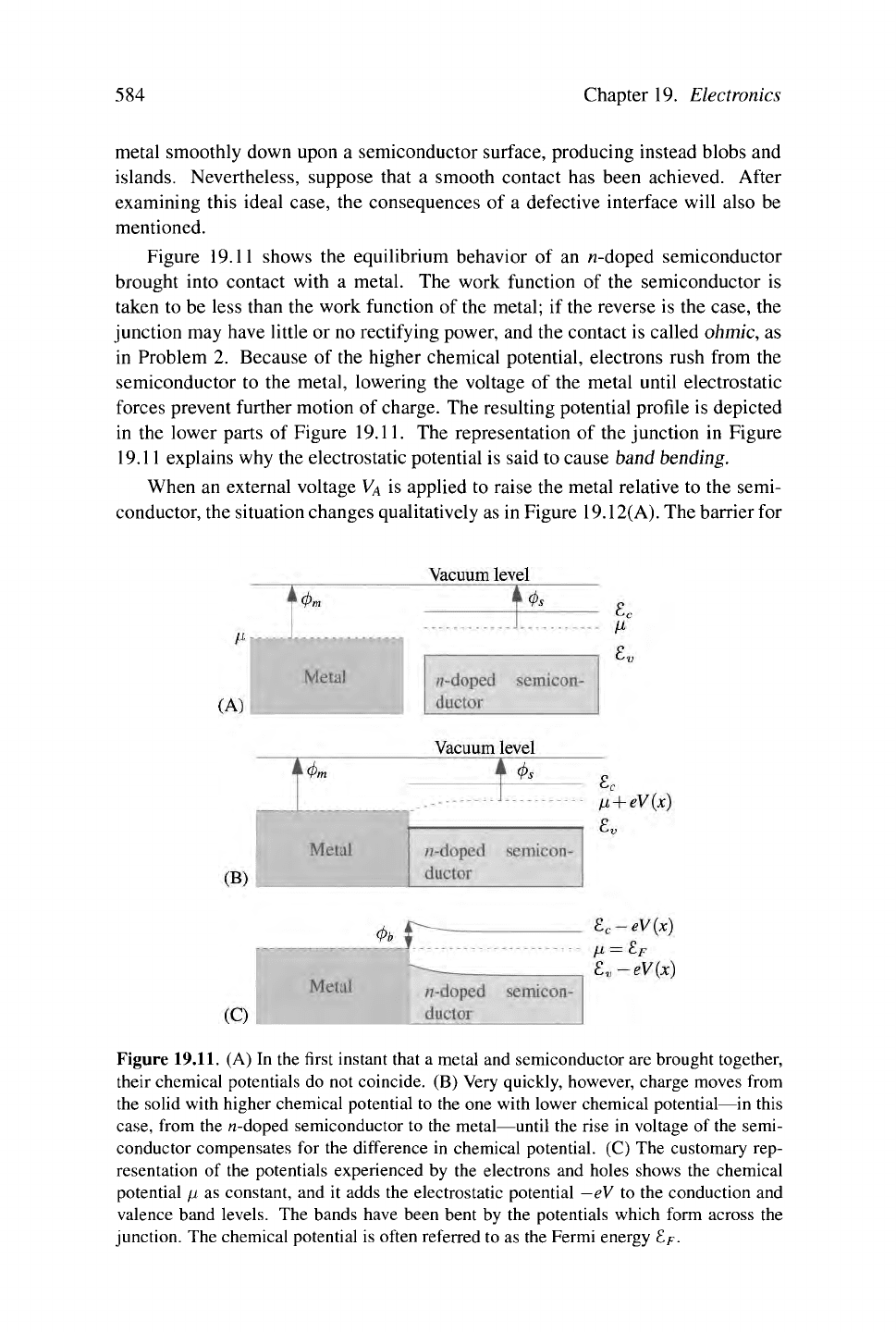
Figure 19.11 shows the equilibrium behavior of an rc-doped semiconductor
brought into contact with a metal. The work function of the semiconductor is
taken to be less than the work function of the metal; if the reverse is the case, the
junction may have little or no rectifying power, and the contact is called ohmic, as
in Problem 2. Because of the higher chemical potential, electrons rush from the
semiconductor to the metal, lowering the voltage of the metal until electrostatic
forces prevent further motion of charge. The resulting potential profile is depicted
in the lower parts of Figure
19.11.
The representation of the junction in Figure
19.11 explains why the electrostatic potential is said to cause band bending.
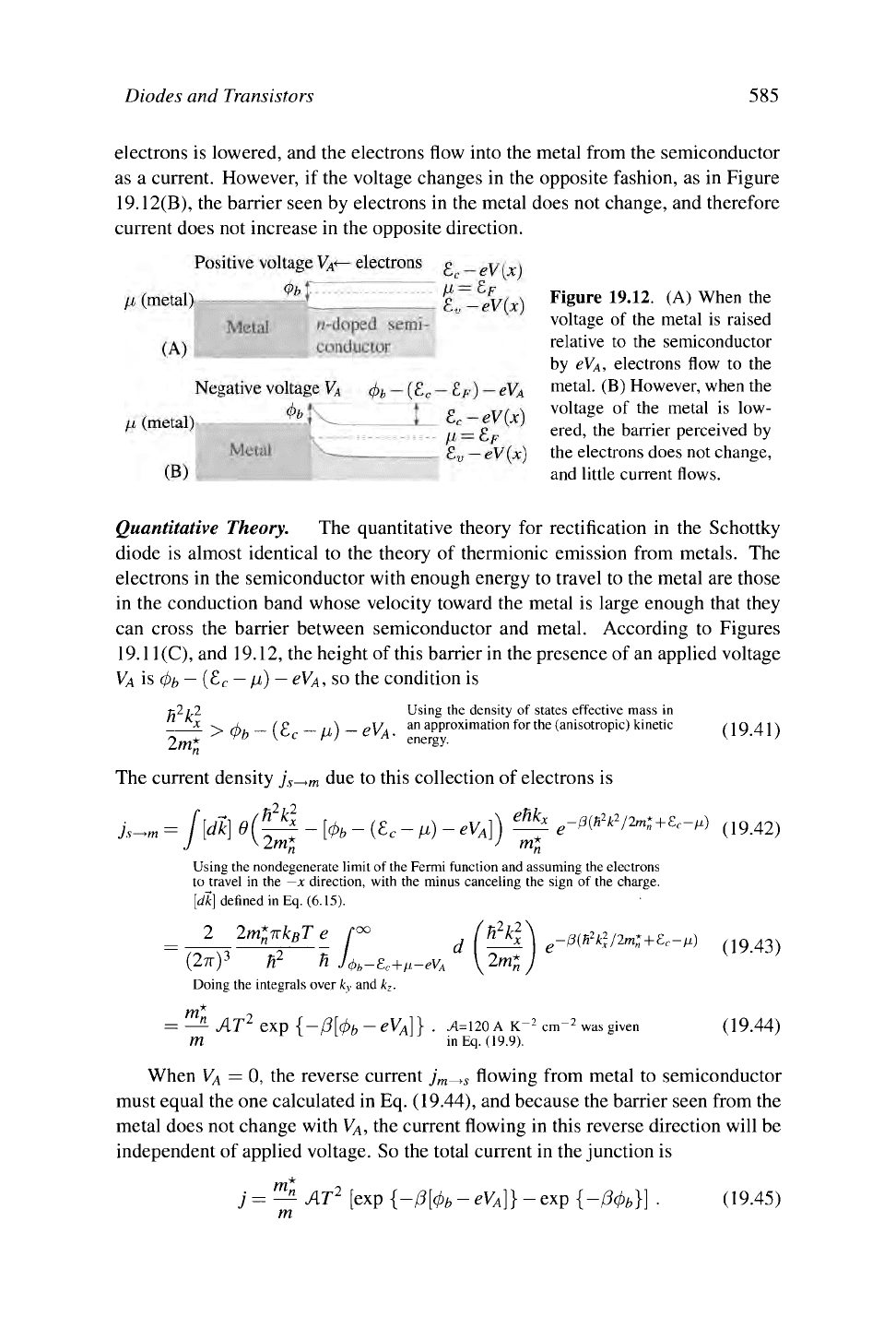
When an external voltage
VA
is applied to raise the metal relative to the semi-
conductor, the situation changes qualitatively as in Figure 19.12(A). The barrier for
Figure
19.11.
(A) In the first instant that a metal and semiconductor are brought together,
their chemical potentials do not coincide. (B) Very quickly, however, charge moves from
the solid with higher chemical potential to the one with lower chemical potential—in this
case,
from the «-doped semiconductor to the metal—until the rise in voltage of the semi-
conductor compensates for the difference in chemical potential. (C) The customary rep-
resentation of the potentials experienced by the electrons and holes shows the chemical
potential \i as constant, and it adds the electrostatic potential — eV to the conduction and
valence band levels. The bands have been bent by the potentials which form across the
junction. The chemical potential is often referred to as the Fermi energy £f.
Diodes
and
Transistors 585
electrons
is
lowered,
and the
electrons flow into
the
metal from
the
semiconductor
as
a
current. However,
if
the voltage changes
in the
opposite fashion,
as in
Figure
19.12(B),
the
barrier seen
by
electrons
in the
metal does
not
change,
and
therefore
current does
not
increase
in the
opposite direction.
Figure 19.12.
(A)
When
the
voltage
of
the metal
is
raised
relative
to the
semiconductor
by
e\?A,
electrons flow
to the
metal. (B) However, when the
voltage
of
the
metal
is
low-
ered,
the
barrier perceived
by
the electrons does not change,
and little current flows.
Quantitative Theory.
The
quantitative theory
for
rectification
in
the
Schottky
diode
is
almost identical
to the
theory
of
thermionic emission from metals.
The
electrons
in the
semiconductor with enough energy
to
travel
to the
metal
are
those
in
the
conduction band whose velocity toward
the
metal
is
large enough that they
can cross
the
barrier between semiconductor
and
metal. According
to
Figures
19.11
(C),
and
19.12, the height
of
this barrier
in the
presence
of
an applied voltage
VA
is
4>b —
(£
c
—
/i)
—
eVA,
so the
condition
is
jz212 Using
the
density
of
states effective mass
in
—•>(!),
—IF
//)
—
eVi
an approximation for the (anisotropic) kinetic
(19 411
9m*
c
energy.
^ ' '
The current density
j
s
^
m
due to
this collection
of
electrons
is
/_
= j[dk]
É»(||
-
[&
-
(£
c
-
„)
-
eV
A
})
^
e-ßWK+ec-ß) (19.42)
Using the nondegenerate limit
of
the Fermi function and assuming the electrons
to travel
in the
—x direction, with
the
minus canceling
the
sign
of
the charge.
[dk]
defined
in
Eq. (6.15).
2 a
2m*nk
B
T
e f°° h
A
k
f°°
d
(nA\
e
-ß(HV
x
/2
m
*
n+
£
c
-
ß
)
(1943)
(2vr)
3
h
2
h
J
4>h
-
£
.
c+ß
-
eVA
Doing the integrals over
k
y
and
k
z
.
=
— AT
2
exp
{-ß\4>
b
-eV
A
X\
■
A=\20h
K-
2
cm"
2
was given (19.44)
m
in
Eq. (19.9).
When
VA
=
0, the
reverse current
j
m
^
s
flowing from metal
to
semiconductor
must equal the one calculated
in
Eq. (19.44), and because the barrier seen from
the
metal does
not
change with VA,
the
current flowing
in
this reverse direction will
be
independent
of
applied voltage.
So the
total current
in
the junction
is
j=
K
AT
2
[exp
{_ßty
b
_
eVA
\}_
exp
{-ßfo}] .
(19.45)
m
586 Chapter 19. Electronics
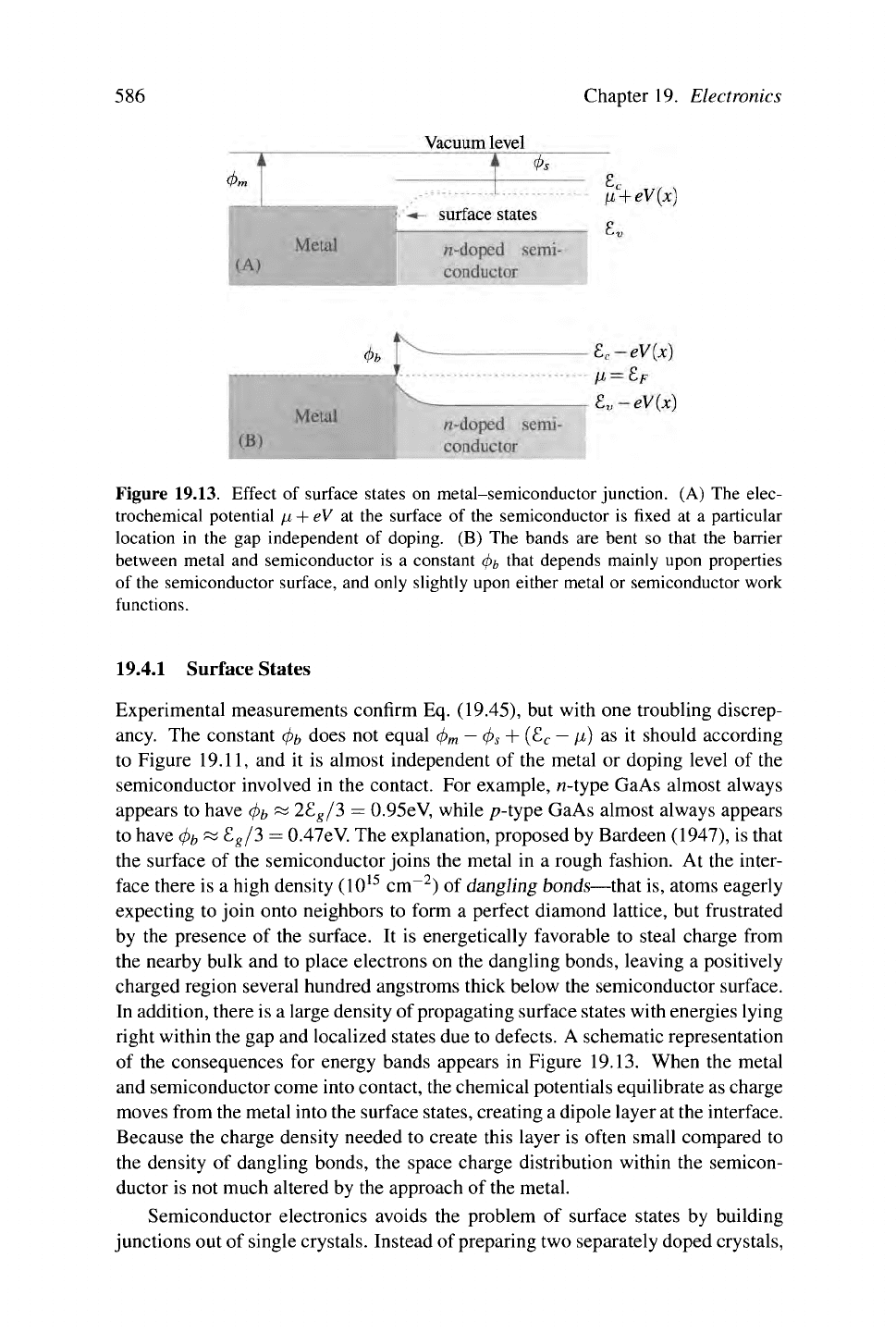
Figure 19.13. Effect of surface states on metal-semiconductor junction. (A) The elec-
trochemical potential
[i + eV
at the surface of the semiconductor is fixed at a particular
location in the gap independent of doping. (B) The bands are bent so that the barrier
between metal and semiconductor is a constant
<fib
that depends mainly upon properties
of the semiconductor surface, and only slightly upon either metal or semiconductor work
functions.
19.4.1 Surface States
Experimental measurements confirm Eq. (19.45), but with one troubling discrep-
ancy. The constant
<pb
does not equal
4>
m
—
4>
s
+ (£
c
—
fi) as it should according
to Figure
19.11,
and it is almost independent of the metal or doping level of the
semiconductor involved in the contact. For example, n-type GaAs almost always
appears to have
<fib
~ 2£
g
/3 = 0.95eV, while p-type GaAs almost always appears
to have
<fib
~ £
g
/3 = 0.47eV. The explanation, proposed by Bardeen (1947), is that
the surface of the semiconductor joins the metal in a rough fashion. At the inter-
face there is a high density (10
15
cm
-2
) of dangling bonds—that is, atoms eagerly
expecting to join onto neighbors to form a perfect diamond lattice, but frustrated
by the presence of the surface. It is energetically favorable to steal charge from
the nearby bulk and to place electrons on the dangling bonds, leaving a positively
charged region several hundred angstroms thick below the semiconductor surface.
In addition, there is a large density of propagating surface states with energies lying
right within the gap and localized states due to defects. A schematic representation
of the consequences for energy bands appears in Figure
19.13.
When the metal
and semiconductor come into contact, the chemical potentials equilibrate as charge
moves from the metal into the surface states, creating a dipole layer at the interface.
Because the charge density needed to create this layer is often small compared to
the density of dangling bonds, the space charge distribution within the semicon-
ductor is not much altered by the approach of the metal.
Semiconductor electronics avoids the problem of surface states by building
junctions out of single crystals. Instead of preparing two separately doped crystals,
Diodes and Transistors 587
polishing the surfaces, and gluing them together, the dopants are injected into
a
single sample at desired locations, either as an ion beam or by diffusion.
19.4.2 Semiconductor Junctions
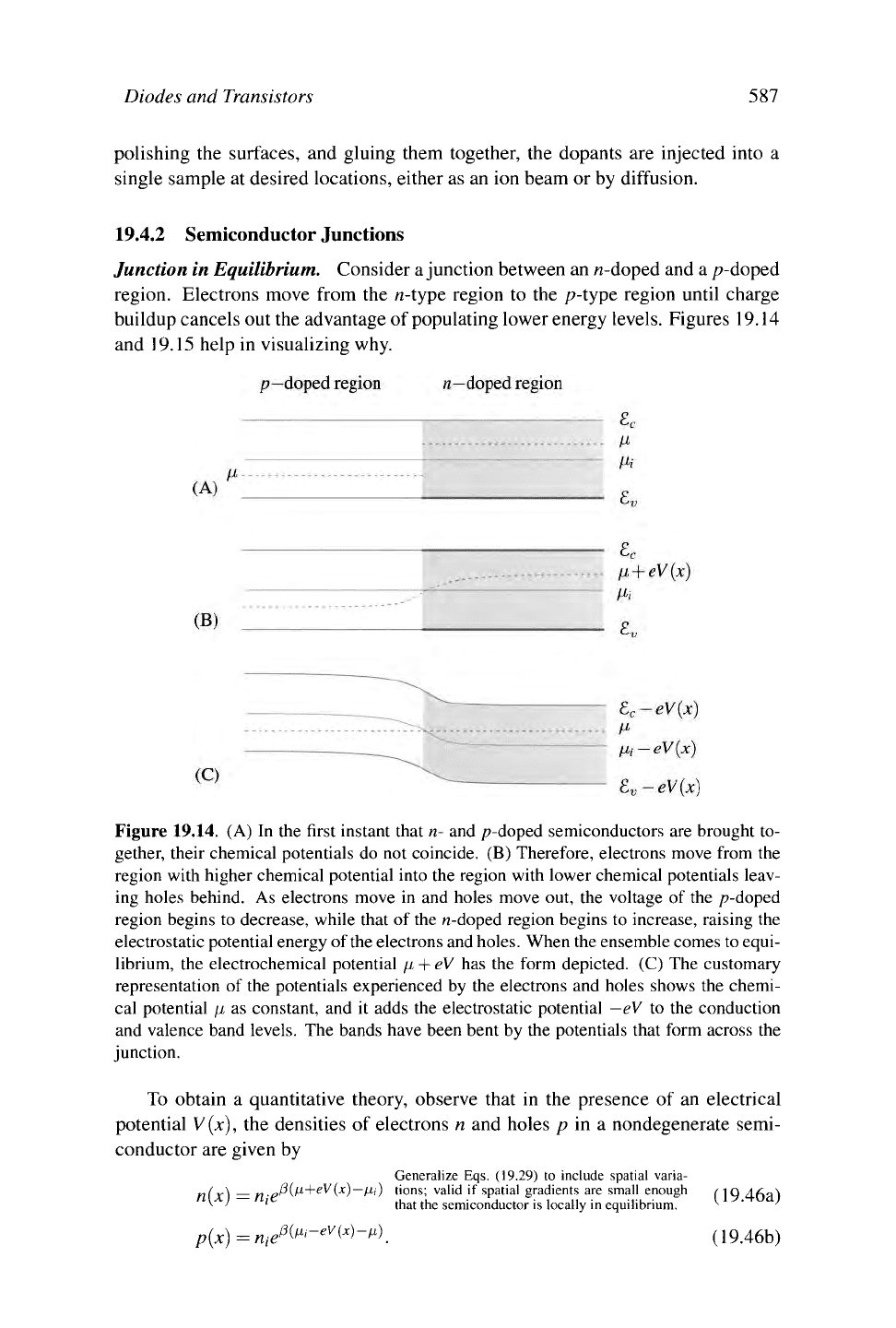
Junction in Equilibrium. Consider
a
junction between an n-doped and a p-doped
region. Electrons move from the «-type region
to
the
p-type.
region until charge
buildup cancels out the advantage of populating lower energy levels. Figures 19.14
and 19.15 help in visualizing why.
Figure 19.14. (A) In the first instant that n- and /?-doped semiconductors are brought to-
gether, their chemical potentials do not coincide. (B) Therefore, electrons move from the
region with higher chemical potential into the region with lower chemical potentials leav-
ing holes behind. As electrons move in and holes move out, the voltage of the p-doped
region begins to decrease, while that of the «-doped region begins to increase, raising the
electrostatic potential energy of the electrons and holes. When the ensemble comes to equi-
librium, the electrochemical potential (i + eV has the form depicted. (C) The customary
representation of the potentials experienced by the electrons and holes shows the chemi-
cal potential
ß
as constant, and
it
adds the electrostatic potential — eV to the conduction
and valence band levels. The bands have been bent by the potentials that form across the
junction.
To obtain
a
quantitative theory, observe that
in
the presence
of
an electrical
potential V(x), the densities
of
electrons
n
and holes
p in a
nondegenerate semi-
conductor are given by
Generalize Eqs. (19.29)
to
include spatial varia-
n
(
x
\
=
n
.pß(ß+
e
^(
x
)~ßi) tions; valid
if
spatial gradients are small enough
/in Aßn\
^
' '
that the semiconductor is locally in equilibrium.
^ ' '
p{x) =
me
ß
^-
eV
^-ri.
(19.46b)
588
Chapter 19. Electronics
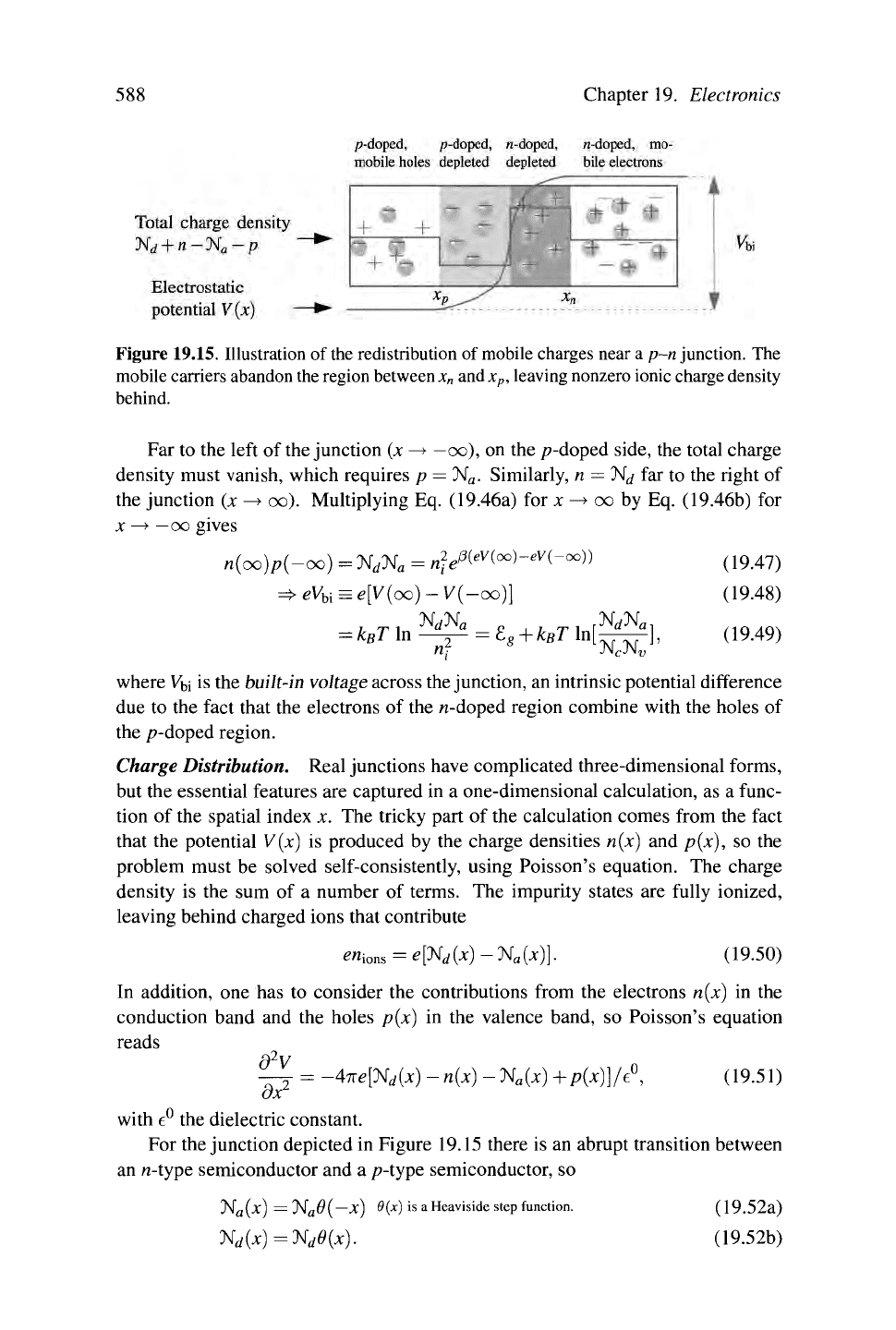
Figure 19.15. Illustration of
the
redistribution of mobile charges near a p-n
junction.
The
mobile carriers abandon
the
region between
x
n
and
x
p
, leaving nonzero ionic charge density
behind.
Far to the left of the junction (x
—>
—oo), on the
p-doped
side, the total charge
density must vanish, which requires p = N
a
. Similarly, n = N^ far to the right of
the junction (x
—>
oo). Multiplying Eq. (19.46a) for x
—>
oo by Eq. (19.46b) for
x
—>
— oo gives
ll(00)p(-00) = W
fl
=
n
j
e
ß(eV{cc)-eV(-oc))
(19 4?)
=>eV\A
= e[V(oo)-V(-oo)] (19.48)
= &
ß
7 1n—
T
- =
E.g
+ k
B
Tln[—r
r
], (19.49)
«
N,N„
where
Vbi
is the built-in
voltage
across
the
junction, an intrinsic potential difference
due to the fact that the electrons of the n-doped region combine with the holes of
the p-doped region.
Charge Distribution. Real junctions have complicated three-dimensional forms,
but the essential features are captured in a one-dimensional calculation, as a func-
tion of the spatial index x. The tricky part of the calculation comes from the fact
that the potential V(x) is produced by the charge densities n(x) and p(x), so the
problem must be solved self-consistently, using Poisson's equation. The charge
density is the sum of a number of terms. The impurity states are fully ionized,
leaving behind charged ions that contribute
en
ioBS
= e[N
d
(x)-K
a
{x)]. (19.50)
In addition, one has to consider the contributions from the electrons n(x) in the
conduction band and the holes p(x) in the valence band, so Poisson's equation
reads
^ = -4irepf
d
(x)-n(x)-X
a
{x)+p(x)]/e
0
, (19.51)
dx
with e° the dielectric constant.
For the junction depicted in Figure 19.15 there is an abrupt transition between
an
rc-type
semiconductor and a p-type semiconductor, so
N
a
(x)
=N
a
9(—
X) 0(x) is
a
Heaviside step function. (19.52a)
N
d
(x)
=
N
d
9(x).
(19.52b)
Diodes and Transistors 589
Junctions are not actually infinitely sharp, but they can certainly be less than 100
Â, which is going to be the scale of the depletion regions in which charge builds
up.
Equation (19.46) shows that once the potential begins to deviate from its value
at infinity, the number of carriers n or p drops below N</ or N
n
like a stone. It is
therefore reasonable to construct an approximation in which the charge density is
zero everywhere up to x
p
< 0, at which point the charge density abruptly changes
to — eN
a
. At x = 0 the charge density rises to eN^, and finally at some x
n
> 0, it
falls abruptly back to zero. The potential produced by such a charge density is
V(x)
'V(-oo) forx<x
p
V( — oo)+2ire—^-(x
—
x
p
)
2
for 0 > x > x
p
Xd,.. ,2
N
a
V(oo) —lire—^-ix
—
Xn)
1
for0<x<jc„
k
V(oo) forx>x„.
(19.53)
Equation (19.53) is obviously a solution of Eq. (19.51), and the only thing left to
check is that the solution and its first derivative are continuous at x = 0. Continuity
of (19.53) at 0 demands that
V{-oo)+2Tte-^x
2
p
= V(oo)-2ire-txl, (19.54)
while continuity of the derivative requires that
ïi
d
x
n
= -JS
a
x
p
. (19.55)
Solving Eq. (19.54) and Eq. (19.55) for the lengths x
n
andx
/;
gives
e°KV
bi
2neN
d
[Ji
a
+ N
d
]
e°W
bi
27reN
fl
[N
a
+ N
d
]'
(19.56a)
(19.56b)
using again the built-in voltage
Vbi
defined in Eq. (19.48). Placing typical numerical
values into Eq. (19.56), dopant densities on the order of 10
18
cm"
3
, and potential
differences eVbi on the order of 0.1 eV gives depletion layers on the order of a
few hundred angstroms. Because the depletion region has no mobile change, its
resistance is considerably greater than that of the doped regions to either side.
When an external voltage
VA
is applied to such a junction, the net effect de-
pends greatly upon the direction in which it happens. If the potential of the left-
hand side is raised relative to the right-hand side, electrons are attracted to the left,
and holes are attracted to the right. As a consequence, x
n
moves further to the
left, and x
p
moves further to the right. Conversely, if the potential is lowered to
the left, electrons are repelled from the left, and the size of the depletion region
590
Chapter 19. Electronics
increases. Quantitatively, applying a voltage corresponds to a case in which the
system departs slightly from equilibrium, so that the chemical potential ß is no
longer constant, but instead changes by amount
eVA
from one end of the sample to
the other. Most of the voltage drop occurs in the depletion region. One does not
need to determine the spatial profile to observe, however, that because ß is now
dif-
ferent on the two sides of the sample, the potentials V(oo) and V(—oo) must also
change accordingly so as to maintain charge neutrality, and the difference between
them also changes by V^. According to Eq. (19.56), the effect of applied voltage is
to send Vbi
—>
Hi
—
VA
and thereby change the lengths of
x„
and x
p
by a factor of
Vl-V^/Vbi.
The applied voltage
VA
is taken positive if it raises the voltage of the /7-doped
region with respect to the «-doped region in Figure 19.15. As the size of the deple-
tion region varies, the amount of current that flows through the junction changes
dramatically, increasing exponentially as
VA
increases. The reason for the expo-
nential rise is that for an electron to flow through the depletion region, it must be
a mobile carrier on the left side of Figure 19.15 with enough thermal energy to
surmount the potential barrier
eVbi ;
the number of such electrons is proportional to
exp[—ßeVbi\ and changes in response to external voltages as exp[/3eV/i]. When the
external voltage is zero, the number of electrons returning from the left must ex-
actly equal the number jumping over the potential barrier from the right; electrons
in the /7-doped region are always attracted back to the «-doped region and have no
barrier to cross. This electron current from left to right should not change much
while external voltage rises from zero, so the total current J has the form
J(xe
0eVA
-\, (19.57)
showing the exponential dependence upon external voltage that characterizes rec-
tification.
19.4.3 Boltzmann Equation for Semiconductors
Once an external voltage
VA
is applied across
a
junction and current begins to flow,
equilibrium equations such as (19.46) no longer directly apply. One must return
to the Boltzmann equation, Section 17.2, and solve for the distribution function
g
7
p
The most convenient form of the Boltzmann equation for semiconductors is
somewhat different from the most convenient form for metals because:
1.
It is valuable to write the equations in a form that emphasizes the separate
roles of electrons and holes.
2.
It is useful to simplify the equations by averaging over wave vectors k.
Using the Hamiltonian structure (17.1), rewrite Eq. (17.10) in the relaxation time
approximation as
d
8 9 i 9 y f-g
Mû
„.
~K7
= -^-
r
8--?-kg + • (19.58)
at dr dk r
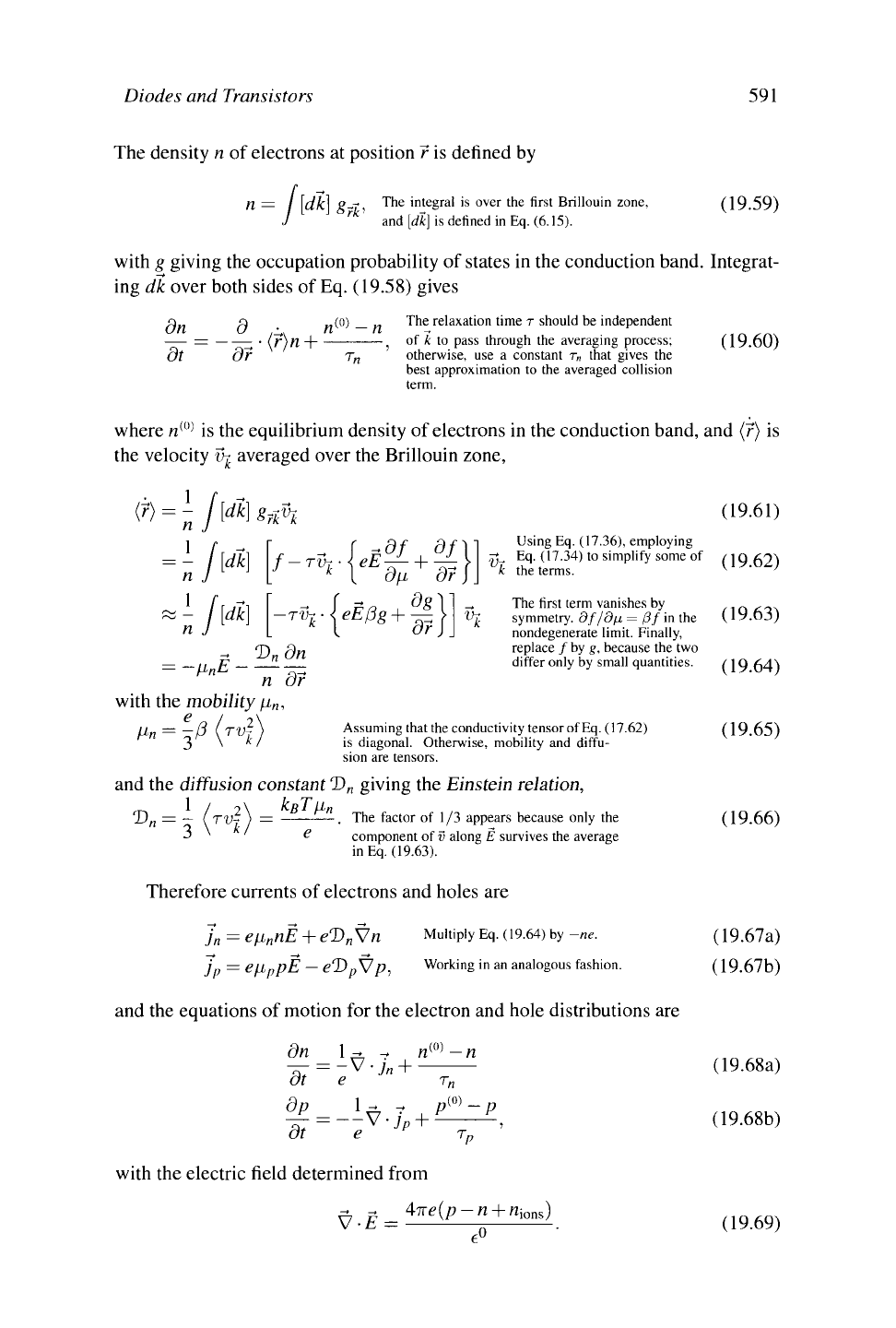
Diodes and Transistors
591
The density n of electrons at position ? is defined by
II = / \dk\ Q-r The integral is over the first Brillouin zone, (19.59)
J and
[dk]
is
defined
in
Eq. (6.15).
with g giving the occupation probability of states in the conduction band. Integrat-
ing dk over both sides of Eq. (19.58) gives
Q
Q _ (o) _ „
The relaxation time
T
should
be
independent
= —
• Cr)n -\ of k to pass through the averaging process; (19.60)
Qt 97 T
n
otherwise,
use a
constant
r„
that gives
the
best approximation
to the
averaged collision
term.
where n
m
is the equilibrium density of electrons in the conduction band, and (?) is
the velocity v^ averaged over the Brillouin zone,
(?) = - f[dk)g
f
3r (19.61)
rk
v
k
Using Eq. (17.36), employing
[dk]
[dk]
f -9/ df
f
-
TV
r{
eE
oï
+
W
-Tv
r
\eEßg+-^
7ß_ Eq. (17.34)
to
simplify some
of no ti)
k the
terms.
^ ' '
_,
The first term vanishes
by . ,.
Vl
symmetry, df/dß = ßf in the ( 19.6.3)
nondegenerate limit. Finally,
-. T) Bn
replace
/ by g,
because
the two
I,
g 2.
differ only
by
small quantities.
(1 q
f.A\
n dr
with the mobility u.
n
,
n —-R (TIP ) Assuming that the conductivity tensor of
Eq.
(17.62) (19.65)
3 \ k I is diagonal. Otherwise, mobility and diffu-
sion are tensors.
and the diffusion constant D„ giving the Einstein relation,
'J)
n
= — ( TIP ) = . The factor of 1/3 appears because only the (19.66)
•J 6 component of v along Ê survives the average
in Eq. (19.63).
Therefore currents of electrons and holes are
J
n
=e^
n
nE + e1)
n
Vn Multiply Eq. (19.64) by -ne. (19.67a)
j
p
= eflppE — eT)pVp, Working in an analogous fashion. ( 19.67b)
and the equations of motion for the electron and hole distributions are
dn 1-s- n
m
-n
-7T
= -y-in + (19.68a)
at e T
n
dp
1
- - p
w
- p
-£ =
—V-J
P
+ - -, (19.68b)
ot e T
P
with the electric field determined from
V-g
=
47rg(/?
~;
+ nions)
. (19.69)
592
Chapter 19. Electronics
Recombination and Generation. Several different physical processes may be
encompassed by the relaxation times
T„
and T
P
. In addition to scattering off impu-
rities,
electrons and holes can collide and recombine; they can also be generated
by very energetic collision events. Therefore, the collision term in semiconductors
is thought of as a recombination and generation current. The relaxation times T
P
and
T„
are impossible to tabulate, because they depend sensitively upon sample
purity and temperature, and can vary from 10~
9
to 10~
14
s. They can be measured
in any given sample—for example, by exposing the crystal to a flash of light that
excites electrons into the conduction band and by then measuring the decay of the
conductivity.
19.4.4 Detailed Theory of Rectification
Solving Eqs. (19.67)—(19.69) poses numerous difficulties. The equations are non-
linear, because they involve products of n and p with the electric field E. Exact
analytical solution is out of the question, even in the simplified one-dimensional
situation upon which attention is now focused. Numerical solution is also not en-
tirely straightforward because of the wide range of scales over which the various
quantities vary. For example, the characteristic scale of depletion layers is from
l(T
6
to 1(T
4
cm, while the characteristic scale for variation of n and p outside the
depletion layers turns out to be on the order of 10~
2
cm. In addition, the magni-
tudes of the charge distributions vary over many orders of magnitude.
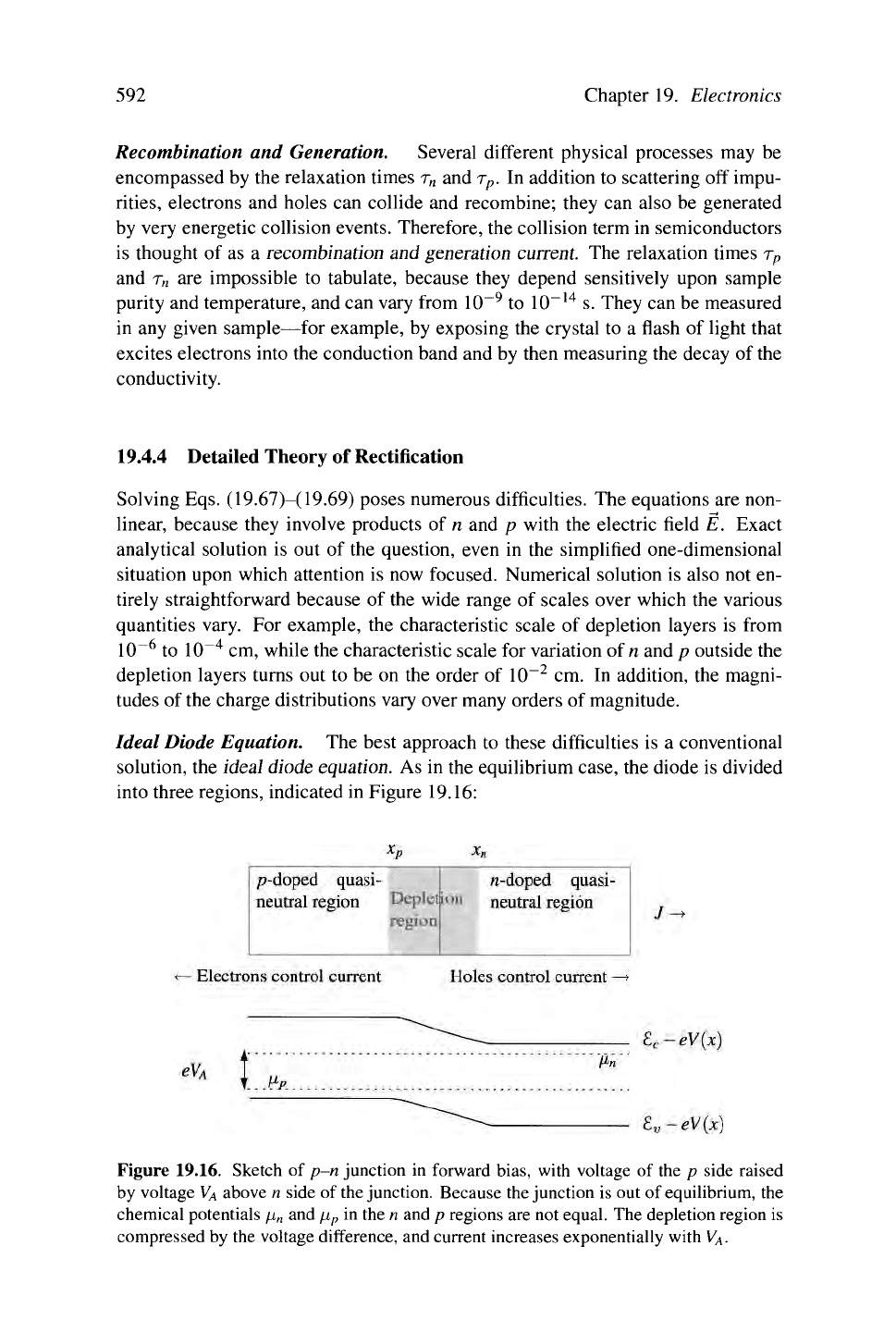
Ideal Diode Equation. The best approach to these difficulties is a conventional
solution, the ideal diode equation. As in the equilibrium case, the diode is divided
into three regions, indicated in Figure 19.16:
Figure 19.16. Sketch of p-n junction in forward bias, with voltage of the p side raised
by voltage
VA
above n side of
the
junction.
Because
the
junction is out of equilibrium, the
chemical potentials \i
n
and ß
p
in the n and p regions are not equal. The depletion region is
compressed by the voltage difference, and current increases exponentially with
VA-