
Masters G.M. Renewable and Efficient Electric Power Systems
Подождите немного. Документ загружается.


398 THE SOLAR RESOURCE
From (7.9) the sine of the azimuth angle is
sin φ
S
=
cos δ sin H
cos β
=
cos 23.45
◦
· sin(−45
◦
)
cos 48.8
◦
=−0.9848
But the arcsine is ambiguous and two possibilities exist:
φ
S
= sin
−1
(−0.9848) =−80
◦
(80
◦
west of south)
or φ
S
= 180 − (−80) = 260
◦
(100
◦
west of south)
To decide which of these two options is correct, we apply (7.11):
cos H = cos(−45
◦
) = 0.707 and
tan δ
tan L
=
tan 23.45
◦
tan 40
◦
= 0.517
Since cos H ≥
tan δ
tan L
we conclude that the azimuth angle is
φ
S
=−80
◦
(80
◦
west of south)
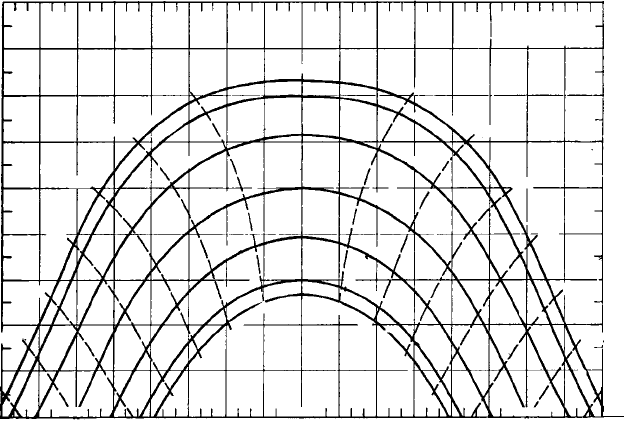
Solar altitude and azimuth angles for a given latitude can be conveniently
portrayed in graphical form, an example of which is shown in Fig. 7.12. Similar
sun path diagrams for other latitudes are given in Appendix B. As can be seen,
in the spring and summer the sun rises and sets slightly to the north and our need
for the azimuth test given in (7.11) is apparent; at the equinoxes, it rises and sets
precisely due east and due west (everywhere on the planet); during the fall and
winter the azimuth angle of the sun is never greater than 90
◦
.
7.5 SUN PATH DIAGRAMS FOR SHADING ANALYSIS
Not only do sun path diagrams, such as that shown in Fig. 7.12, help to build
one’s intuition into where the sun is at any time, they also have a very practical
application in the field when trying to predict shading patterns at a site—a very
important consideration for photovoltaics, which are very shadow sensitive. The
concept is simple. What is needed is a sketch of the azimuth and altitude angles
for trees, buildings, and other obstructions along the southerly horizon that can
be drawn on top of a sun path diagram. S ections of the sun path diagram that
are covered by the obstructions indicate periods of time when the sun will be
behind the obstruction and the site will be shaded.
SUN PATH DIAGRAMS FOR SHADING ANALYSIS 399
120 105 90 75 60 45 30 15 −15 −30 −45 −60 −75 −90 −105 −1200
90°
80°
60°
70°
50°
40°
30°
20°
10°
0°
40 N
6AM
7AM
8AM
9AM
10AM
11AM
NOON
J
U
N
E
2
1
M
A
Y
2
1
APR 21
MAR 21
FEB 21
JAN 21
DEC 21
JUN 21
JUL 21
AUG 21
SEP 21
OCT 21
NOV 21
DEC 21
1PM
2PM
3PM
4PM
5PM
6PM
SOLAR AZIMUTH
SOLAR ALTITUDE
EAST SOUTH WEST
Figure 7.12 A sun path diagram showing solar altitude and azimuth angles for 40
◦
latitude. Diagrams for other latitudes are in Appendix B.
There are several site assessment products available on the market that make
the superposition of obstructions onto a sun path diagram pretty quick and easy to
obtain. You can do just as good a job, however, with a simple compass, plastic
protractor, and plumb bob, but the process requires a little more effort. The
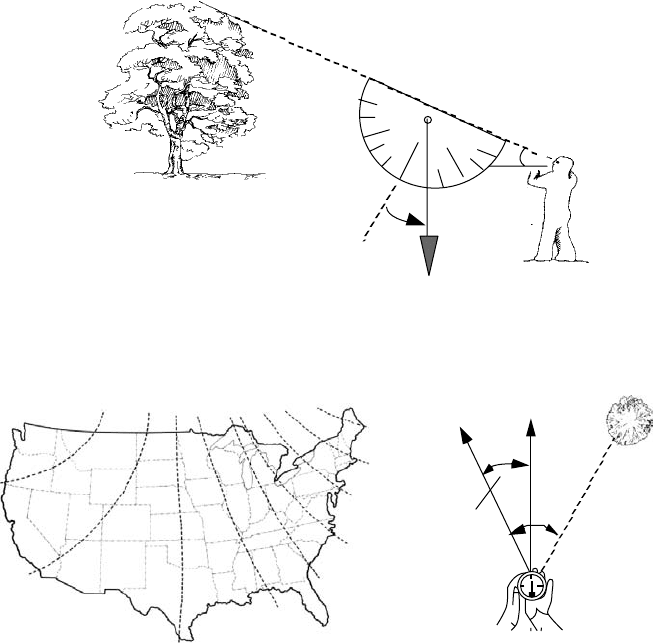
compass is used to measure azimuth angles of obstructions, while the protractor
and plumb bob measure altitude angles.
Begin by tying the plumb bob onto the protractor so that when you sight
along the top edge of the protractor the plumb bob hangs down and provides
the altitude angle of the top of the obstruction. Figure 7.13 shows the idea. By
standing at the site and scanning the southerly horizon, the altitude angles of
major obstructions can be obtained reasonably quickly and quite accurately.
The azimuth angles of obstructions, which go along with their altitude angles,
are measured using a compass. Remember, however, that a compass points to
magnetic north rather than true north; this difference, called the magnetic dec-
lination or deviation, must be corrected for. In the continental United States,
this deviation ranges anywhere from about 22
◦
E in Seattle (the compass points
22
◦
east of true north), to essentially zero along the east coast of Florida, to
22
◦
W at the northern tip of Maine. Figure 7.14 shows this variation in magnetic
declination and shows an example, for San Francisco, of how to use it.
400 THE SOLAR RESOURCE
Protractor
Plumb bob
Altitude angle
Obstruction
b
b
Figure 7.13 Measuring the altitude angle of a southerly obstruction using a plumb bob
and protractor.
Magnetic
south
True
south
Magnetic
declination
17°
20
15
10 5 0 5
10
15
20
azimuth
angle of
tree
Tree
f
EASTERLY VARIATION WESTERLY VARIATION
Figure 7.14 Lines of equal magnetic declination across the United States. The example
shows the correction for San Francisco, which has a declination of 17
◦
E.
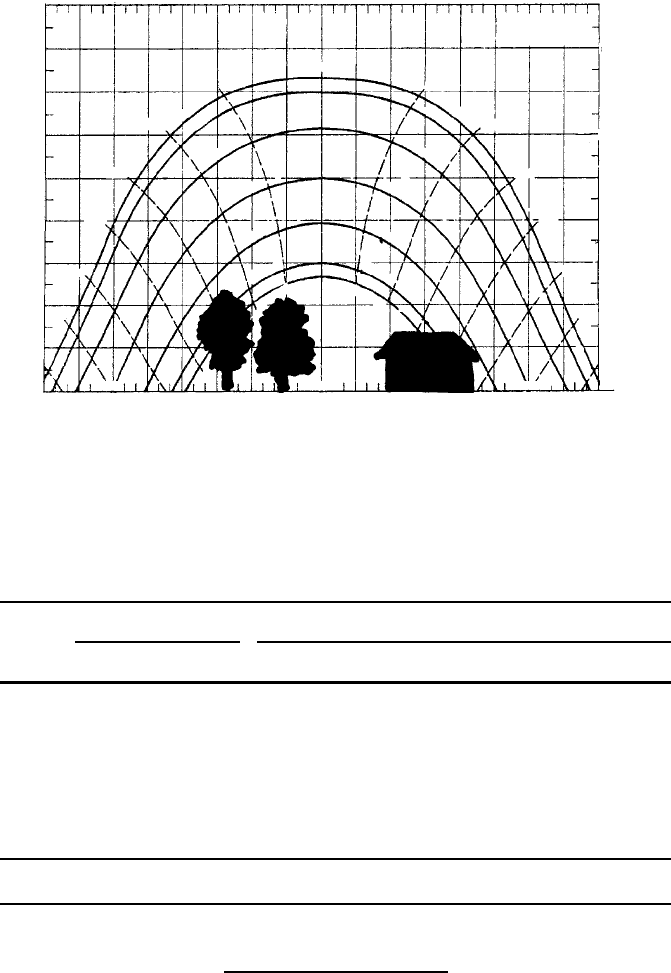
Figure 7.15 shows an example of how the sun path diagram, with a superim-
posed sketch of potential obstructions, can be interpreted. The site is a proposed
solar house with a couple of trees to the southeast and a small building to the
southwest. In this example, the site receives full sun all day long from February
through October. From November through January, the trees cause about one
hour’s worth of sun to be lost from around 8:30
A.M. to 9:30 A.M., and the small
building shades the site after about 3 o’clock in the afternoon.
When obstructions plotted on a sun path diagram are combined with hour-by-
hour insolation information, an estimate can be obtained of the energy lost due to
shading. Table 7.3 shows an example of the hour-by-hour insolations available
on a clear day in January at 40
◦
latitude for south-facing collectors with fixed tilt
angle, or for collectors mounted on 1-axis or 2-axis tracking systems. Later in
this chapter, the equations that were used to compute this table will be presented,
and in Appendix C there is a full set of such tables for a number of latitudes.
SUN PATH DIAGRAMS FOR SHADING ANALYSIS 401
120 105 90 75 60 45 30 15 −15 −30 −45 −60 −75 −90 −105 −1200
90°
80°
60°
70°
50°
40°
30°
20°
10°
0°
40 N
6AM
7AM
8AM
9AM
10AM
11AM
NOON
JUNE 21
MAY 21
APR 21
MAR 21
FEB 21
JAN 21
DEC 21
JUN 21
JUL 21
AUG 21
SEP 21
OCT 21
NOV 21
DEC 21
1PM
2PM
3PM
4PM
5PM
6PM
SOLAR AZIMUTH
SOLAR ALTITUDE
EAST SOUTH WEST
Figure 7.15 A sun path diagram with superimposed obstructions makes it easy to esti-
mate periods of shading at a site.
TABLE 7.3 Clear Sky Beam Plus Diffuse Insolation at 40
◦
Latitude in January
for South-Facing Collectors with Fixed Tilt Angle and for Tracking Mounts (hourly
W/m
2
and daily kWh/m
2
-day)
a
Solar Tracking Tilt Angles Latitude 40
◦
Time
One-Axis Two-Axis 0 20 30 40 50 60 90
January 21 (W/m
2
)
7,5 0 0 0 0000 0 0
8, 4 439 462 87 169 204 232 254 269 266
9, 3 744 784 260 424 489 540 575 593 544
10, 2 857 903 397 609 689 749 788 803 708
11, 1 905 954 485 722 811 876 915 927 801
12 919 968 515 761 852 919 958 968 832
kWh/d: 6.81 7.17 2.97 4.61 5.24 5.71 6.02 6.15 5.47
a
A complete set of tables is in Appendix C.
Example 7.4 Estimate the insolation available on a clear day in January on a
south-facing collector with a fixed, 30
◦
tilt angle at the site having the sun path
and obstructions diagram shown in Fig. 7.15.

402 THE SOLAR RESOURCE
Solution. With no obstructions, Table 7.3 indicates that the panel would be
exposed to 5.24 kWh/m
2
-day. The sun path diagram shows loss of about 1 h of
sun at around 9
A.M., which eliminates about 0.49 kWh. After about 3:30 P.M. there
is no sun, which drops roughly another 0.20 kWh. The remaining insolation is
Insolation ≈ 5.24 − 0.49 − 0.20 = 4.55 kWh/m
2
≈ 4.6kWh/m
2
per day
Notice it has been assumed that the insolations shown in Table 7.3 are appropriate
averages covering the half-hour before and after the hour. Given the crudeness
of the obstruction sketch (to say nothing of the fact that the trees are likely to
grow anyway), a more precise calculation isn’t warranted.
7.6 SOLAR TIME AND CIVIL (CLOCK) TIME
For most solar work it is common to deal exclusively in solar time (ST), where
everything is measured relative to solar noon (when the sun is on our line of
longitude). There are occasions, however, when local time, called civil time or
clock time (CT), is needed. There are two adjustments that must be made in order
to connect local clock time and solar time. The first is a longitude adjustment
that has to do with the way in which regions of the world are divided into time
zones. The second is a little fudge factor that needs to be thrown in to account
for the uneven way in which the earth moves around the sun.
Obviously, it just wouldn’t work for each of us to set our watches to show
noon when the sun is on our own line of longitude. Since the earth rotates 15
◦
per
hour (4 minutes per degree), for every degree of longitude between one location
and another, clocks showing solar time would have to differ by 4 minutes. The
only time two clocks would show the same time would be if they both were due
north/south of each other.
To deal with these longitude complications, the earth is nominally divided into
24 1-hour time zones, with each time zone ideally spanning 15
◦
of longitude. Of
course, geopolitical boundaries invariably complicate the boundaries from one
zone to another. The intent is for all clocks within the time zone to be set to the
same time. Each time zone is defined by a Local Time Meridian located, ideally,
in the middle of the zone, with the origin of this time system passing through
Greenwich, England, at 0
◦
longitude. The local time meridians for the United
States are given in Table 7.4.
The longitude correction between local clock time and solar time is based on the
time it takes for the sun to travel between the local time meridian and the observer’s
line of longitude. If it is solar noon on the local time meridian, it will be solar noon
4 minutes later for every degree that the observer is west of that meridian. For
example, San Francisco, at longitude 122
◦
, will have solar noon 8 minutes after
the sun crosses the 120
◦
Local Time Meridian for the Pacific Time Zone.
The second adjustment between solar time and local clock time is the result
of the earth’s elliptical orbit, which causes the length of a solar day (solar noon
SOLAR TIME AND CIVIL (CLOCK) TIME 403
TA BLE 7.4 Local Time Meridians for U.S.
Standard Time Zones (Degrees West of Greenwich)
Time Zone LT Meridian
Eastern 75
◦
Central 90
◦
Mountain 105
◦
Pacific 120
◦
Eastern Alaska 135
◦
Alaska and Hawaii 150
◦
to solar noon) to vary throughout the year. As the earth moves through its orbit,
the difference between a 24-hour day and a solar day changes following an
expression known as the Equation of Time, E:
E = 9.87 sin 2B − 7.53 cos B − 1.5sinB (minutes) (7.12)
where
B =
360
364
(n − 81) (degrees) (7.13)
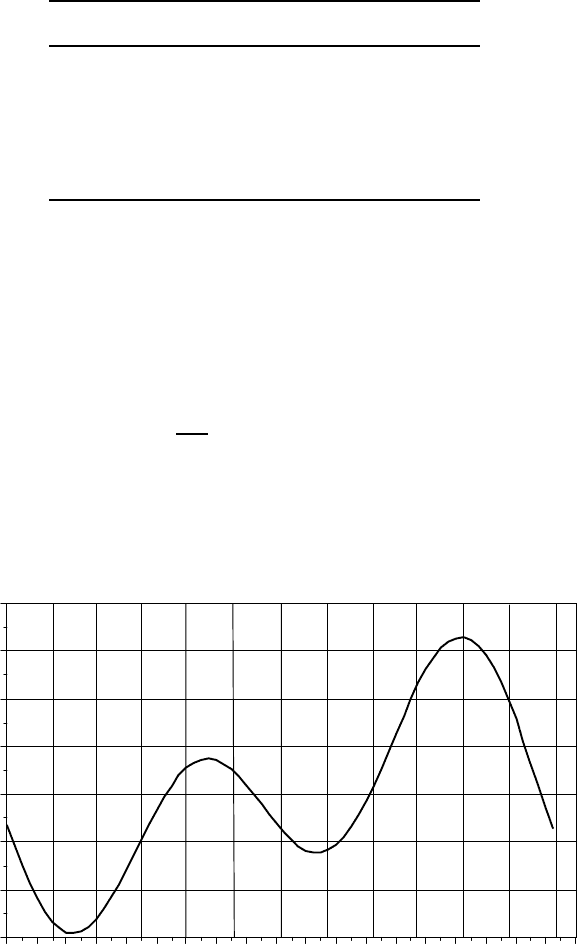
As before, n is the day number. A graph of (7.12) is given in Fig. 7.16.
380
360
340
320
300
280
260
240
220
200
180
160
140
120
100
80
60
40
20
0
−15
−10
−5
0
5
10
15
20
Day number, n
E
(minutes)
Jan 1
Feb 1
Mar 1
Apr 1
June 1
May 1
July 1
Aug 1
Sept 1
Oct 1
Nov 1
Dec 1
Jan 1
Figure 7.16 The Equation of Time adjusts for the earth’s tilt angle and noncircular orbit.

404 THE SOLAR RESOURCE
Putting together the longitude correction and the Equation of Time gives us
the final relationship between local standard clock time (CT) and solar time (ST).
Solar Time (ST) = Clock Time (CT) +
4min
degree
(Local Time Meridian
− Local longitude)
◦
+ E(min) (7.14)
When Daylight Savings Time is in effect, one hour must be added to the local
clock time (“Spring ahead, Fall back”).
Example 7.5 Solar Time to Local Time. Find Eastern Daylight Time for solar
noon in Boston (longitude 71.1
◦
W) on July 1
st
.
Solution. From Table 7.1, July 1 is day number n = 182. Using (7.12) to (7.14)
to adjust for local time, we obtain
B =
360
364
(n − 81) =
360
364
(182 − 81) = 99.89
◦
E = 9.87 sin 2B − 7.53 cos B − 1.5sinB
= 9.87 sin[2 · (99.89)] − 7.53 cos(99.89) − 1.5sin(99.89) =−3.5min
For Boston at longitude 71.7
◦
in the Eastern Time Zone with local time merid-
ian 75
◦
CT = ST − 4(min /
◦
)(Local time meridian −Local longitude) − E(min)
CT = 12:00 − 4(75 − 71.1) − (−3.5) = 12:00 − 12.1min
= 11:47.9A.M.EST
To adjust for Daylight Savings Time add 1 h, so solar noon will be at about
12:48
P.M. EDT.
7.7 SUNRISE AND SUNSET
A sun path diagram, such as was shown in Fig. 7.12, can be used to locate the
azimuth angles and approximate times of sunrise and sunset. A more careful

SUNRISE AND SUNSET 405
estimate of sunrise/sunset can be found from a simple manipulation of (7.8). At
sunrise and sunset, the altitude angle β is zero, so we can write
sin β = cos L cos δ cos H + sin L sin δ = 0 (7.15)
cos H =−
sin L sin δ
cos L cos δ
=−tan L tan δ (7.16)
Solving for the hour angle at sunrise, H
SR
,gives
H
SR
= cos
−1
(−tan L tan δ) (+ for sunrise)(7.17)
Notice in (7.17) that since the inverse cosine allows for both positive and negative
values, we need to use our sign convention, which requires the positive value to
be used for sunrise (and the negative for sunset).
Since the earth rotates 15
◦
/h, the hour angle can be converted to time of sunrise
or sunset using
Sunrise(geometric) = 12:00 −
H
SR
15
◦
/h
(7.18)
Equations (7.15) to (7.18) are geometric relationships based on angles mea-
sured to the center of the sun, hence the designation geometric sunrise in (7.18).
They are perfectly adequate for any kind of normal solar work, but they won’t
give you exactly what you will find in the newspaper for sunrise or sunset. The
difference between weather service sunrise and our geometric sunrise (7.18) is
the result of two factors. The first deviation is caused by atmospheric refrac-
tion; this bends the sun’s rays, making the sun appear to rise about 2.4 min
sooner than geometry would tell us and then set 2.4 min later. The second is
that the weather service definition of sunrise and sunset is the time at which
the upper limb (top) of the sun crosses the horizon, while ours is based on the
center crossing the horizon. This effect is complicated by the fact that at sun-
rise or sunset the sun pops up, or sinks, much quicker around the equinoxes
when it moves more vertically than at the solstices when its motion includes
much more of a sideward component. An adjustment factor Q that accounts
for these complications is given by the following (U.S. Department of Energy,
1978):
Q =
3.467
cos L cos δ sin H
SR
(min) (7.19)
Since sunrise is earlier when it is based on the top of the sun rather than
the middle, Q should be subtracted from geometric sunrise. Similarly, since the
upper limb sinks below the horizon later than the middle of the sun, Q should
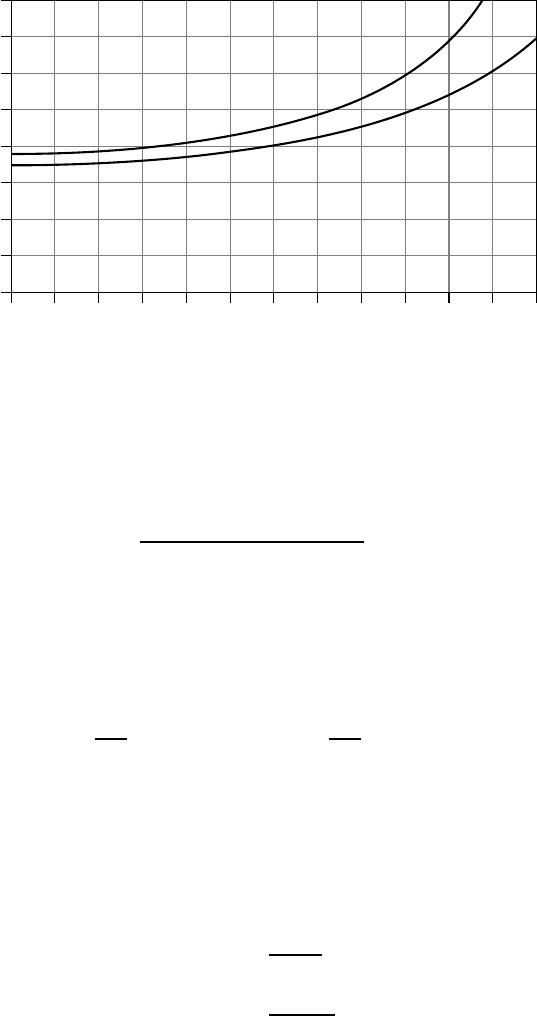
be added to our geometric sunset. A plot of (7.19) is shown in Fig. 7.17. As
406 THE SOLAR RESOURCE
0
0
1
2
3
4
Q
(minutes)
5
6
7
8
5 1015202530
Latitude
35 40 45 50
d = 0
d = ± 23.45°
55 60
Figure 7.17 Sunrise/sunset adjustment factor to account for refraction and the
upper-limb definition of sunrise. The range of solar declinations is shown.
can be seen, for mid-latitudes, the correction is typically in the range of about 4
to6min.
Example 7.6 Sunrise in Boston. Find the time at which sunrise (geometric
and conventional) will occur in Boston (latitude 42.3
◦
)onJuly1(n = 182).
Also find conventional sunset.
Solution. From (7.6), the solar declination is
δ = 23.45 sin
360
365
(n − 81)
= 23.45 sin
360
365
(182 − 81)
= 23.1
◦
From (7.17), the hour angle at sunrise is
H
SR
= cos
−1
(−tan L tan δ) = cos
−1
(−tan 42.3
◦
tan 23.1
◦
) = 112.86
◦
From (7.18) solar time of geometric sunrise is
Sunrise (geometric) = 12:00 −
H
SR
15
◦
/h
= 12:00 −
112.86
◦
15
◦
/h
= 12:00 − 7.524 h
= 4:28.6
A.M. (solar time)

SUNRISE AND SUNSET 407
Using (7.19) to adjust for refraction and the upper-limb definition of sunrise gives
Q =
3.467
cos L cos δ sin H
SR
(min)
=
3.467
cos 42.3 cos 23.1
◦
sin 112.86
◦
= 5.5min
The upper limb will appear 5.5 minutes sooner than our original geometric cal-
culation indicated, so
Sunrise = 4:28.6
A.M. − 5.5min= 4:23.1 A.M. (solar time)
From Example 7.5, on this date in Boston, local clock time is 12.1 min earlier
than solar time, so sunrise will be at
Sunrise (upper limb) = 4:23.1 − 12.1 = 4:11
A.M. Eastern Standard Time
Similarly, geometric sunset is 7.524 h after solar noon, or 7:31.4
P.M. solar time.
The upper limb will drop below the horizon 5.5 minutes later. Then adjusting
for the 12.1 minutes difference between Boston time and solar time gives
Sunset (upper limb) = 7:31.4 + (5.5 − 12.1) min = 7:24.8
P.M. EST
There is a convenient website for finding sunrise and sunset times on the web
at http://aa.usno.navy.mil/data/docs/RS
OneDay.html.
A fun, but fairly useless, application of these equations for sunrise and sunset is
to work them in reverse order to navigate—that is, to find latitude and longitude,
as the following example illustrates.
Example 7.7 Where in the World Are You? With your watch set for Pacific
Standard Time (PST), you travel somewhere and when you arrive you note that
the upper limb sunrise is at 1:11
A.M. (by your watch) and sunset is at 4:25 P.M.
It is July 1
st
(δ = 23.1
◦
,E=−3.5 min). Where are you?
Solution. Between 1:11 am and 4:25
P.M. there are 15 h and 14 min of daylight
(15.233 h). With solar noon at the midpoint of that time—that is, 7 h and 37 min
after sunrise—we have
Solar noon = 1:11
A.M. + 7:37 = 8:48 A.M. PST