
Masters G.M. Renewable and Efficient Electric Power Systems
Подождите немного. Документ загружается.

388 THE SOLAR RESOURCE
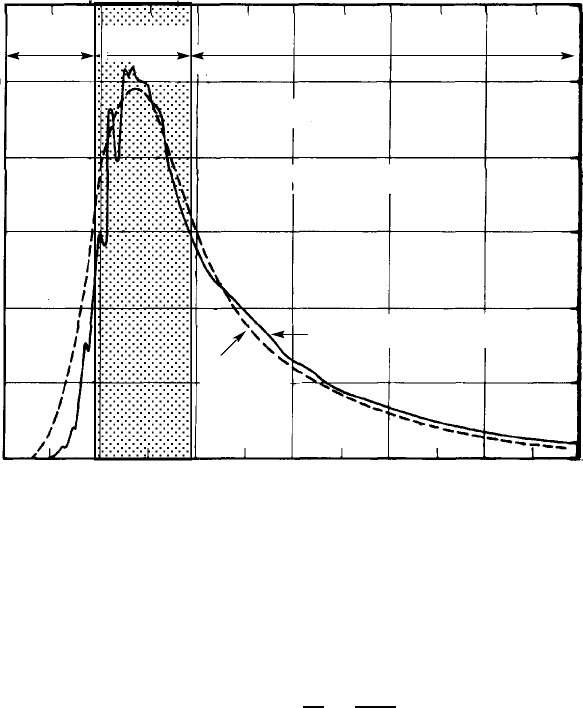
Ultraviolet Visible Infrared
7%
47% 46%
Extraterrestrial solar flux
2400
2000
1600
1200
800
400
0
0.0 0.2 0.4 0.6 0.8 1.0 1.2 1.4 1.6 1.8 2.0 2.2 2.4
Wavelength, µm
Intensity, W/m
2
-µm
5800 K
Blackbody
Figure 7.2 The extraterrestrial solar spectrum compared with a 5800 K blackbody.
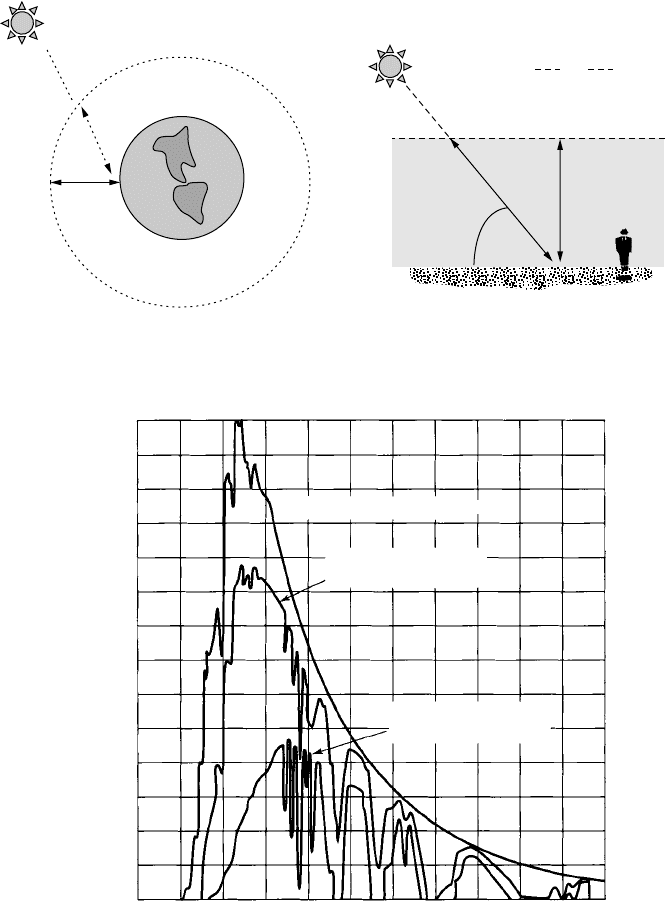
the sun is directly overhead, is called the air mass ratio, m. As shown in
Figure 7.3, under the simple assumption of a flat earth the air mass ratio can
be expressed as
Air mass ratio m =
h
2
h
1
=
1
sin β
(7.4)
where h
1
= path length through the atmosphere with the sun directly overhead,
h
2
= path length through the atmosphere to reach a spot on the surface, and
β = the altitude angle of the sun (see Fig. 7.3).
Thus, an air mass ratio of 1 (designated “AM1”) means that the sun is directly
overhead. By convention, AM0 means no atmosphere; that is, it is the extrater-
restrial solar spectrum. Often, an air mass ratio of 1.5 is assumed for an average
solar spectrum at the earth’s surface. With AM1.5, 2% of the incoming solar
energy is in the UV portion of the spectrum, 54% is in the visible, and 44% is
in the infrared.
The impact of the atmosphere on incoming solar radiation for various air
mass ratios is shown in Fig. 7.4. As sunlight passes through more atmosphere,
less energy arrives at the earth’s surface and the spectrum shifts some toward
longer wavelengths.
THE SOLAR SPECTRUM 389
b
h
2
h
2
I
O
h
1
h
2
h
1
"top" of atmosphere
h
1
1
sin b
m
==
Figure 7.3 The air mass ratio m is a measure of the amount of atmosphere the sun’s
rays must pass through to reach the earth’s surface. For the sun directly overhead, m = 1.
2100
1800
1500
1200
900
600
300
0
0 0.2 0.4 0.6 0.8 1.0 1.2 1.4 1.6 1.8 2.0 2.2
Wavelength, microns
Direct solar radiation intensity at normal incidence
W/m
2
-micron
Outside the atmosphere,
m
= 0
At the earth's surface
sea level,
m
= 1
At the earth's surface
sea level,
m
= 5
Figure 7.4 Solar spectrum for extraterrestrial (m = 0), for sun directly overhead
(m = 1), and at the surface with the sun low in the sky, m = 5. From Kuen et al. (1998),
based on Trans. ASHRAE, vol. 64 (1958), p. 50.

390 THE SOLAR RESOURCE
7.2 THE EARTH’S ORBIT
The earth revolves around the sun in an elliptical orbit, making one revolution
every 365.25 days. The eccentricity of the ellipse is small and the orbit is, in
fact, quite nearly circular. The point at which the earth is nearest the sun, the
perihelion, occurs on January 2, at which point it is a little over 147 million
kilometers away. At the other extreme, the aphelion, which occurs on July 3, the
earth is about 152 million kilometers from the sun. This variation in distance is
described by the following relationship:
d = 1.5 × 10
8
1 + 0.017 sin
360(n − 93)
365
km (7.5)
where n is the day number, with January 1 as day 1 and December 31 being day
number 365. Table 7.1 provides a convenient list of day numbers for the first day
of each month. It should be noted that (7.5) and all other equations developed
in this chapter involving trigonometric functions use angles measured in degrees,
not radians.
Each day, as the earth rotates about its own axis, it also moves along the
ellipse. If the earth were to spin only 360
◦
in a day, then after 6 months time
our clocks would be off by 12 hours; that is, at noon on day 1 it would be the
middle of the day, but 6 months later noon would occur in the middle of the
night. To keep synchronized, the earth needs to rotate one extra turn each year,
which means that in a 24-hour day the earth actually rotates 360.99
◦
,whichisa
little surprising to most of us.
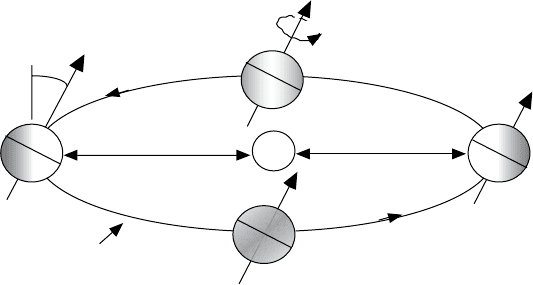
As shown in Fig. 7.5, the plane swept out by the earth in its orbit is called
the ecliptic plane. The earth’s spin axis is currently tilted 23.45
◦
with respect to
the ecliptic plane and that tilt is, of course, what causes our seasons. On March
21 and September 21, a line from the center of the sun to the center of the
earth passes through the equator and everywhere on earth we have 12 hours of
daytime and 12 hours of night, hence the term equinox (equal day and night).
On December 21, the winter solstice in the Northern Hemisphere, the inclination
of the North Pole reaches its highest angle away from the sun (23.45
◦
), while
on June 21 the opposite occurs. By the way, for convenience we are using the
TA BLE 7.1 Day Numbers for the First Day of Each
Month
January n = 1July n = 182
February n = 32 August n = 213
March n = 60 September n = 244
April n = 91 October n = 274
May n = 121 November n = 305
June n = 152 December n = 335
ALTITUDE ANGLE OF T HE SUN AT SOLAR NOON 391
152 Mkm
147 Mkm
Vernal
Equinox
Mar 21
Autumnal
Equinox
Sept 21
Summer
Solstice
June 21
Winter
Solstice
Dec 21
Sun
Ecliptic
plane
23.45°
Figure 7.5 The tilt of the earth’s spin axis with respect to the ecliptic plane is what
causes our seasons. “Winter” and “summer” are designations for the solstices in the
Northern Hemisphere.
twenty-first day of the month for the solstices and equinoxes even though the
actual days vary slightly from year to year.
For solar energy applications, the characteristics of the earth’s orbit are con-
sidered to be unchanging, but over longer periods of time, measured in thousands
of years, orbital variations are extremely important as they significantly affect
climate. The shape of the orbit oscillates from elliptical to more nearly circular
with a period of 100,000 years (eccentricity ). The earth’s tilt angle with respect
to the ecliptic plane fluctuates from 21.5
◦
to 24.5
◦
with a period of 41,000 years
(obliquity). Finally, there is a 23,000-year period associated with the precession
of the earth’s spin axis. This precession determines, for example, where in the
earth’s orbit a given hemisphere’s summer occurs. Changes in the orbit affect
the amount of sunlight striking the earth as well as the distribution of sunlight
both geographically and seasonally. Those variations are thought to be influential
in the timing of the coming and going of ice ages and interglacial periods. In
fact, careful analysis of the historical record of global temperatures does show
a primary cycle between glacial episodes of about 100,000 years, mixed with
secondary oscillations with periods of 23,000 years and 41,000 years that match
these orbital changes. This connection between orbital variations and climate
were first proposed in the 1930s by an astronomer named Milutin Milankovitch,
and the orbital cycles are now referred to as Milankovitch oscillations. Sorting
out the impact of human activities on climate from those caused by natural varia-
tions such as the Milankovitch oscillations is a critical part of the current climate
change discussion.
7.3 ALTITUDE ANGLE OF THE SUN AT SOLAR NOON
We all know that the sun rises in the east and sets in the west and reaches its
highest point sometime in the middle of the day. In many situations, it is quite
392 THE SOLAR RESOURCE
useful to be able to predict exactly where in the sky the sun will be at any time,
at any location on any day of the year. Knowing that information we can, for
example, design an overhang to allow the sun to come through a window to help
heat a house in the winter while blocking the sun in the summer. In the context
of photovoltaics, we can, for example, use knowledge of solar angles to help
pick the best tilt angle for our modules to expose them to the greatest insolation.
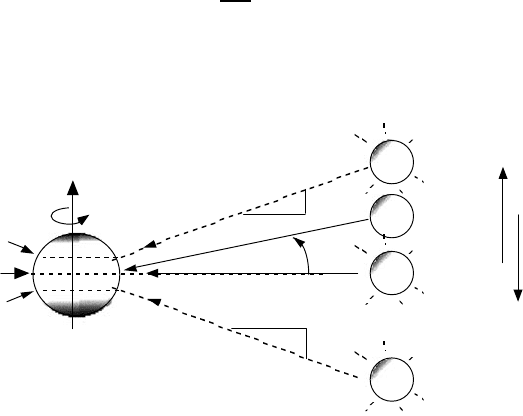
While Fig. 7.5 correctly shows the earth revolving around the sun, it is a
difficult diagram to use when trying to determine various solar angles as seen
from the surface of the earth. An alternative (and ancient!) perspective is shown
in Fig. 7.6, in which the earth is fixed, spinning around its north–south axis; the
sun sits somewhere out in space, slowly moving up and down as the seasons
progress. On June 21 (the summer solstice) the sun reaches its highest point, and
a ray drawn at that time from the center of the sun to the center of the earth
makes an angle of 23.45
◦
with the earth’s equator. On that day, the sun is directly
over the Tropic of Cancer at latitude 23.45
◦
. At the two equinoxes, the sun is
directly over the equator. On December 21 the sun is 23.45
◦
below the equator,
which defines the latitude known as the Tropic of Capricorn.
As shown in Fig. 7.6, the angle formed between the plane of the equator and
a line drawn from the center of the sun to the center of the earth is called the
solar declination, δ. It varies between the extremes of ± 23.45
◦
, and a simple
sinusoidal relationship that assumes a 365-day year and which puts the spring
equinox on day n = 81 provides a very good approximation. Exact values of
declination, which vary slightly from year to year, can be found in the annual
publication The American Ephemeris and Nautical Almanac.
δ = 23.45 sin
360
365
(n − 81)
(7.6)
Computed values of solar declination on the twenty-first day of each month are
given in Table 7.2.
Tropic of Cancer
Latitude 23.45°
Equator
Tropic of Capricorn
Latitude −23.45°
23.45°
N
June 21
March 21
Sept 21
Dec 21
−23.45°
Sun
Earth
d
Figure 7.6 An alternative view with a fixed earth and a sun that moves up and down.
The angle between the sun and the equator is called the solar declination δ.
ALTITUDE ANGLE OF T HE SUN AT SOLAR NOON 393
TA BLE 7.2 Solar Declination δ for the 21
st
Day of Each Month (degrees)
Month: Jan Feb Mar Apr May Jun July Aug Sept Oct Nov Dec
δ: −20.1 −11.2 0.0 11.6 20.1 23.4 20.4 11.8 0.0 −11.8 −20.4 −23.4
While Fig. 7.6 doesn’t capture the subtleties associated with the earth’s orbit,
it is entirely adequate for visualizing various latitudes and solar angles. For
example, it is easy to understand the seasonal variation of daylight hours. As
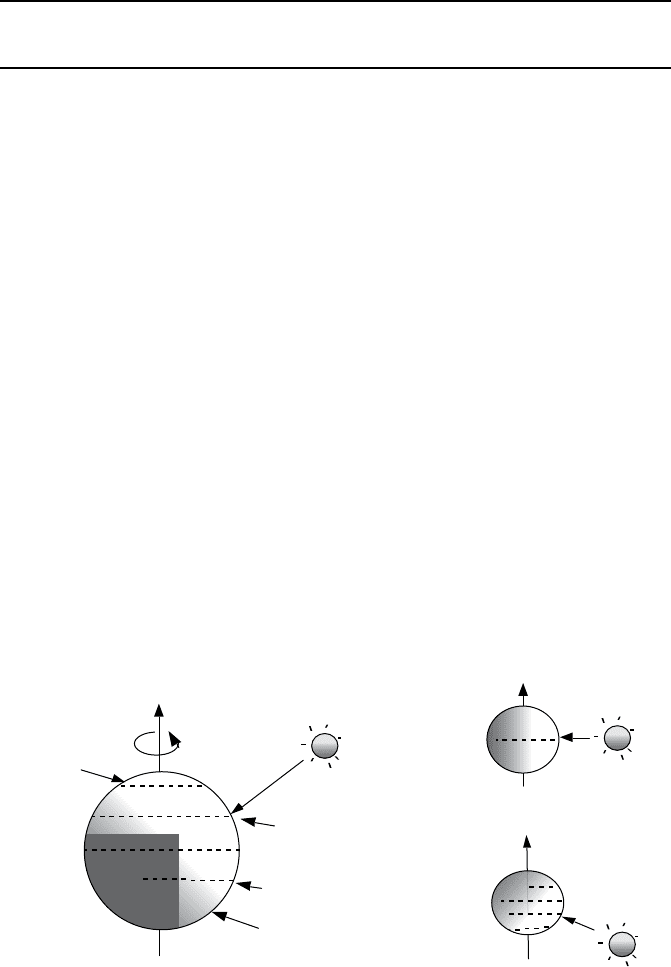
suggested in Fig. 7.7, during the summer solstice all of the earth’s surface above
latitude 66.55
◦
(90
◦
− 23.45
◦
) basks in 24 hours of daylight, while in the Southern
Hemisphere below latitude 66.55
◦
it is continuously dark. Those latitudes, of
course, correspond to the Arctic and Antarctic Circles.
It is also easy to use Fig. 7.6 to gain some intuition into what might be a good
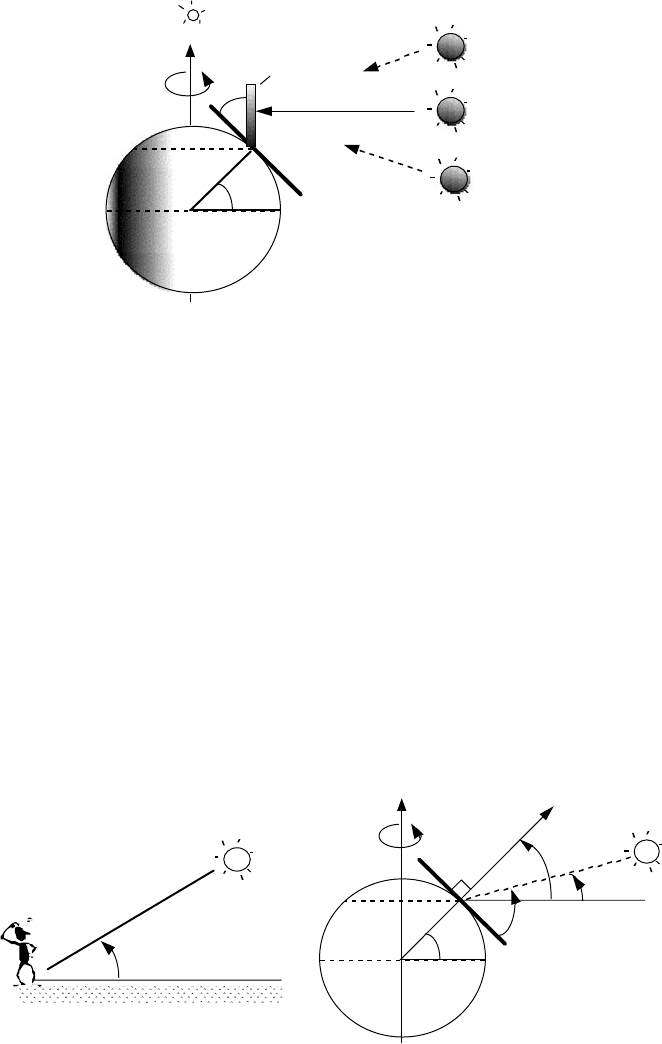
tilt angle for a solar collector. Figure 7.8 shows a south-facing collector on the
earth’s surface that is tipped up at an angle equal to the local latitude, L. As can
be seen, with this tilt angle the collector is parallel to the axis of the earth. During
an equinox, at solar noon, when the sun is directly over the local meridian (line
of longitude), the sun’s rays will strike the collector at the best possible angle;
that is, they are perpendicular to the collector face. At other times of the year
the sun is a little high or a little low for normal incidence, but on the average it
would seem to be a good tilt angle.
Solar noon is an important reference point for almost all solar calculations.
In the Northern Hemisphere, at latitudes above the Tropic of Cancer, solar noon
occurs when the sun is due south of the observer. South of the Tropic of Capri-
corn, in New Zealand for example, it is when the sun is due north. And in
the tropics, the sun may be either due north, due south, or directly overhead at
solar noon.
Equinox
December 21
Arctic circle
Lat 66.55
Antarctic circle
Lat - 66.55
Tropic of Cancer
Equator
N
Tropic of Capricorn
June 21
Figure 7.7 Defining the earth’s key latitudes is easy with the simple version of the
earth–sun system.
394 THE SOLAR RESOURCE
L
L
N
Polaris
Local
horizontal
June
December
Equinox
L = latitude
Collector
Equator
Figure 7.8 A south-facing collector tipped up to an angle equal to its latitude is per-
pendicular to the sun’s rays at solar noon during the equinoxes.
On the average, facing a collector toward the equator (for most of us in the
Northern Hemisphere, this means facing it south) and tilting it up at an angle
equal to the local latitude is a good rule-of-thumb for annual performance. Of
course, if you want to emphasize winter collection, you might want a slightly
higher angle, and vice versa for increased summer efficiency.
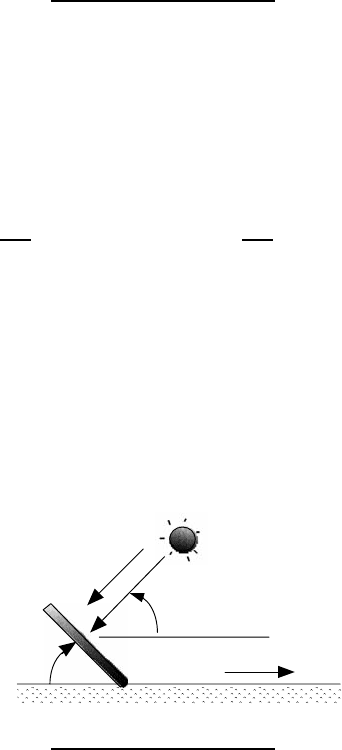
Having drawn the earth-sun system as shown in Fig. 7.6 also makes it easy to
determine a key solar angle, namely the altitude angle β
N
of the sun at solar noon.
The altitude angle is the angle between the sun and the local horizon directly
beneath the sun. From Fig. 7.9 we can write down the following relationship
by inspection:
β
N
= 90
◦
− L + δ(7.7)
where L is the latitude of the site. Notice in the figure the term zenith is intro-
duced, which refers to an axis drawn directly overhead at a site.
N
L
Local
horizontal
L
Zenith
Equator
Altitude angle b
N
d
b
N
Figure 7.9 The altitude angle of the sun at solar noon.
SOLAR POSITION AT ANY TIME OF DAY 395
Example 7.2 Tilt Angle of a PV Module. Find the optimum tilt angle for
a south-facing photovoltaic module in Tucson (latitude 32.1
◦
) at solar noon on
March 1.
Solution. From Table 7.1, March 1 is the sixtieth day of the year so the solar
declination (7.6) is
δ = 23.45 sin
360
365
(n − 81)
= 23.45
◦
sin
360
365
(60 − 81)
◦
=−8.3
◦
which, from (7.7), makes the altitude angle of the sun equal to
β
N
= 90
◦
− L + δ = 90 − 32.1 − 8.3 = 49.6
◦
The tilt angle that would make the sun’s rays perpendicular to the module at
noon would therefore be
Tilt = 90 − β
N
= 90 − 49.6 = 40.4
◦
Altitude angle b
N
= 49.6°
Tilt 40.4°
S
PV module
7.4 SOLAR POSITION AT ANY TIME OF DAY
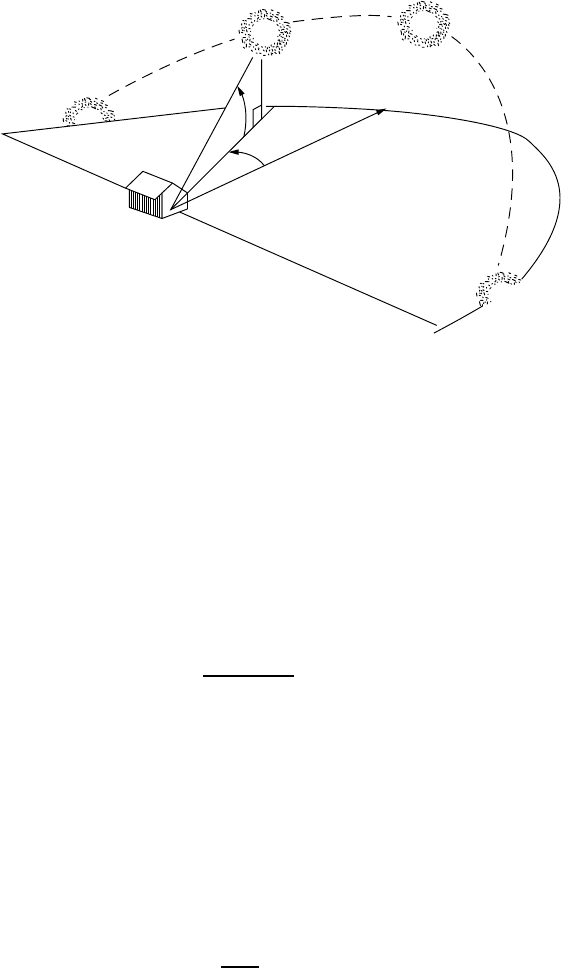
The location of the sun at any time of day can be described in terms of its
altitude angle β and its azimuth angle φ
s
as shown in Fig. 7.10. The subscript
s in the azimuth angle helps us remember that this is the azimuth angle of the
sun. Later, we will introduce another azimuth angle for the solar collector and a
different subscript c will be used. By convention, the azimuth angle is positive in
the morning with the sun in the east and negative in the afternoon with the sun
in the west. Notice that the azimuth angle shown in Fig. 7.10 uses true south as
its reference, and this will be the assumption in this text unless otherwise stated.
For solar work in the Southern Hemisphere, azimuth angles are measured relative
to north.
396 THE SOLAR RESOURCE
sunrise
noon
E
W
S
East of S:
f
s
> 0
West of S: f
s
< 0
f
s
sunset
b
Figure 7.10 The sun’s position can be described by its altitude angle β and its azimuth
angle φ
S
. By convention, the azimuth angle is considered to be positive before solar noon.
The azimuth and altitude angles of the sun depend on the latitude, day number,
and, most importantly, the time of day. For now, we will express time as the number
of hours before or after solar noon. Thus, for example, 11
A.M. solar time is one
hour before the sun crosses your local meridian (due south for most of us). Later
we will learn how to make the adjustment between solar time and local clock time.
The following two equations allow us to compute the altitude and azimuth angles
of the sun. For a derivation see, for example, T. H. Kuen et al. (1998):
sin β = cos L cos δ cos H + sin L sin δ (7.8)
sin φ
S
=
cos δ sin H
cos β
(7.9)
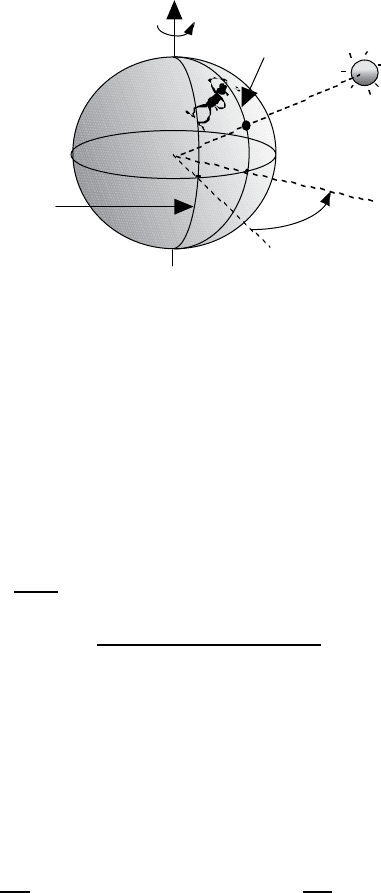
Notice that time in these equations is expressed by a quantity called the hour
angle, H . The hour angle is the number of degrees that the earth must rotate
before the sun will be directly over your local meridian (line of longitude). As
shown in Fig. 7.11, at any instant, the sun is directly over a particular line of
longitude, called the sun’s meridian. The difference between the local meridian
and the sun’s meridian is the hour angle, with positive values occurring in the
morning before the sun crosses the local meridian.
Considering the earth to rotate 360
◦
in 24 h, or 15
◦
/h, the hour angle can be
described as follows:
Hour angle H =
15
◦
hour
· (hours before solar noon)(7.10)
Thus, the hour angle H at 11:00
A.M. solar time would be +15
◦
(the earth needs
to rotate another 15
◦
, or 1 hour, before it is solar noon). In the afternoon, the
hour angle is negative, so, for example, at 2:00
P.M. solar time H would be −30
◦
.
SOLAR POSITION AT ANY TIME OF DAY 397
+
Hour angle,
H
Local
meridian
Sun's
meridian
15°/hr
Figure 7.11 The hour angle is the number of degrees the earth must turn before the sun
is directly over the local meridian. It is the difference between the sun’s meridian and the
local meridian.
There is a slight complication associated with finding the azimuth angle of
the sun from (7.9). During spring and summer in the early morning and late
afternoon, the magnitude of the sun’s azimuth is liable to be more than 90
◦
away
from south (that never happens in the fall and winter). Since the inverse of a
sine is ambiguous, sin x = sin (180 − x), we need a test to determine whether
to conclude the azimuth is greater than or less than 90
◦
away from south. Such
atestis
if cos H ≥
tan δ
tan L
, then |φ
S
|≤90
◦
;otherwise|φ
S
| > 90
◦
(7.11)
Example 7.3 Where Is the Sun? Find the altitude angle and azimuth angle
for the sun at 3:00
P.M. solar time in Boulder, Colorado (latitude 40
◦
)onthe
summer solstice.
Solution. Since it is the solstice we know, without computing, that the solar
declination δ is 23.45
◦
. Since 3:00 P.M. is three hours after solar noon, from
(7.10) we obtain
H =
15
◦
h
· (hours before solar noon) =
15
◦
h
· (−3h) =−45
◦
Using (7.8), the altitude angle is
sin β = cos L cos δ cos H + sin L sin δ
= cos 40
◦
cos 23.45
◦
cos(−45
◦
) + sin 40
◦
sin 23.45
◦
= 0.7527
β = sin
−1
(0.7527) = 48.8
◦