
Masters G.M. Renewable and Efficient Electric Power Systems
Подождите немного. Документ загружается.


408 THE SOLAR RESOURCE
Longitude can be determined from (7.14):
Solar Time = Clock Time +
4min
degree
(Local Time Meridian
− Local longitude)
◦
+ E(min)
Using the 120
◦
Local Time Meridian for Pacific Time gives
12:00 − 8:48 = 192 min = 4(120 − Longitude) + (−3.5) min
Longitude =
480 − 3.5 − 192
4
= 71.1
◦
To find latitude, it helps to first ignore the correction factor Q. Doing so, the
daylength is 15.233 h, which makes the hour angle at sunrise equal to
H
SR
=
15.233 hour
2
· 15
◦
/hour = 114.25
◦
A first estimate of latitude can now be found from (7.16)
L = tan
−1
−
cos H
SR
tan δ
= tan
−1
−
cos 114.25
◦
tan 23.1
◦
= 43.9
◦
Now we can find Q, from which we can correct our estimate of latitude
Q =
3.467
cos L cos δ sin H
SR
=
3.467
cos 43.9
◦
cos 23.1
◦
sin 114.25
◦
= 5.74 min
Geometric daylength is therefore 2 × 5.74 min = 11.48 min = 0.191 h shorter
than daylength based on the upper limb crossing the horizon. The geometric
hour angle at sunrise is therefore
H
SR
=
(15.233 − 0.191)h
2
· 15
◦
/h = 112.81
◦
Our final estimate of latitude is therefore
L = tan
−1
−
cos H
SR
tan δ
= tan
−1
−
cos 112.81
◦
tan 23.1
◦
= 42.3
◦
Notice we are back in Boston, latitude 42.3
◦
, longitude 71.1
◦
. Notice too, our
watch worked fine even though it was set for a different time zone.
With so many angles to keep track of, it may help to summarize the termi-
nology and equations for them all in one spot, which has been done in Box 7.1.

SUNRISE AND SUNSET 409
BOX 7.1 SUMMARY OF SOLAR ANGLES
δ = solar declination
n = day number
L = latitude
β = solar altitude angle, β
N
= angle at solar noon
H = hour angle
H
SR
= sunrise hour angle
φ
S
= solar azimuth angle (+ before solar noon, − after)
φ
C
= collector azimuth angle (+ east of south, − west of south)
∗
ST = solar time
CT = civil or clock time
E = equation of time
Q = correction for refraction and semidiameter at sunrise/sunset
= collector tilt angle
θ = incidence angle between sun and collector face
δ = 23.45 sin
360
365
(n − 81)
β
N
= 90
◦
− L + δ
sin β = cos L cos δ cos H + sin L sin δ
sin φ
S
=
cos δ sin H
cos β
If cos H ≥
tan δ
tan L
, then |φ
S
|≤90
◦
;otherwise|φ
S
| > 90
◦
Hour angle H =
15
◦
hour
· (Hours before solar noon)
E = 9.87 sin 2B − 7.53 cos B − 1.5sinB(min)
B =
360
364
(n − 81)
Solar Time (ST) = Clock Time (CT) +
4min
degree
(Local Time Meridian
− Local Longitude)
◦
+ E(min)
H
SR
= cos
−1
(−tan L tan δ) (+ for sunrise)
Q =
3.467
cos L cos δ sin H
SR
(min)
cos θ = cos β cos(φ
S
− φ
C
) sin + sin β cos
∗
Opposite signs in Southern Hemisphere.
410 THE SOLAR RESOURCE
7.8 CLEAR SKY DIRECT-BEAM RADIATION
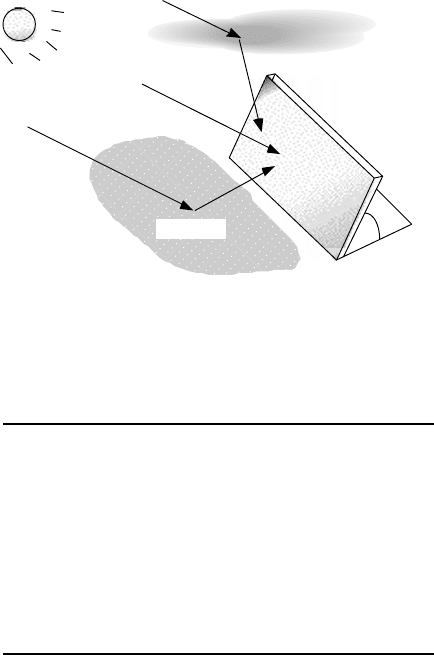
Solar flux striking a collector will be a combination of direct-beam radiation that
passes in a straight line through the atmosphere to the receiver, diffuse radiation
that has been scattered by molecules and aerosols in the atmosphere, and reflected
radiation that has bounced off the ground or other surface in front of the collector
(Fig. 7.18). The preferred units, especially in solar–electric applications, are watts
(or kilowatts) per square meter. Other units involving British Thermal Units,
kilocalories, and langleys may also be encountered. Conversion factors between
these units are given in Table 7.5.
Solar collectors that focus sunlight usually operate on just the beam portion
of the incoming radiation since those rays are the only ones that arrive from
a consistent direction. Most photovoltaic systems, however, don’t use focusing
devices, so all three components—beam, diffuse, and reflected—can contribute
to energy collected. The goal of this section is to be able to estimate the rate
at which just the beam portion of solar radiation passes through the atmosphere
Beam
Diffuse
Collector
I
DC
I
RC
I
BC
Reflected
Σ
Figure 7.18 Solar radiation striking a collector, I
C
, is a combination of direct beam,
I
BC
,diffuse,I
DC
, and reflected, I
RC
.
TA BLE 7.5 Conversion Factors for Various
Insolation Units
1 kW/m
2
= 316.95 Btu/h-ft
2
= 1.433 langley/min
1kWh/m
2
= 316.95 Btu/ft
2
= 85.98 langleys
= 3.60 × 10
6
joules/m
2
1 langley = 1 cal/cm
2
= 41.856 kjoules/m
2
= 0.01163 kWh/m
2
= 3.6878 Btu/ft
2
CLEAR SKY DIRECT-BEAM RADIATION 411
and arrives at the earth’s surface on a clear day. Later, the diffuse and reflected
radiation will be added to the clear day model. And finally, procedures will
be presented that will enable more realistic average insolation calculations for
specific locations based on empirically derived data for certain given sites.
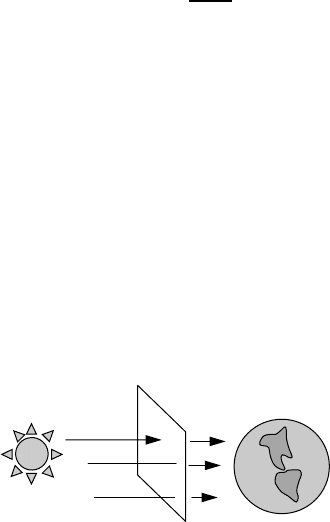
The starting point for a clear sky radiation calculation is with an estimate
of the extraterrestrial (ET) solar insolation, I
0
, that passes perpendicularly
through an imaginary surface just outside of the earth’s atmosphere as shown
in Fig. 7.19. This insolation depends on the distance between the earth and the
sun, which varies with the time of year. It also depends on the intensity of the
sun, which rises and falls with a fairly predictable cycle. During peak periods
of magnetic activity on the sun, the surface has large numbers of cooler, darker
regions called sunspots, which in essence block solar radiation, accompanied
by other regions, called faculae, that are brighter than the surrounding surface.
The net effect of sunspots that dim the sun, and faculae that brighten it, is
an increase in solar intensity during periods of increased numbers of sunspots.
Sunspot activity seems to follow an 11-year cycle. During sunspot peaks, the
most recent of which was in 2001, the extraterrestrial insolation is estimated to
be about 1.5% higher than in the valleys (U.S. Department of Energy, 1978).
Ignoring sunspots, one expression that is used to describe the day-to-day vari-
ation in extraterrestrial solar insolation is the following:
I
0
= SC ·
1 + 0.034 cos
360n
365
(W/m
2
)(7.20)
where SC is called the solar constant and n is the day number. The solar constant
is an estimate of the average annual extraterrestrial insolation. Based on early
NASA measurements, the solar constant was often taken to be 1.353 kW/m
2
, but
1.377 kW/m
2
is now the more commonly accepted value.
As the beam passes through the atmosphere, a good portion of it is absorbed
by various gases in the atmosphere, or scattered by air molecules or particulate
matter. In fact, over a year’s time, less than half of the radiation that hits the
top of the atmosphere reaches the earth’s surface as direct beam. On a clear day,
however, with the sun high in the sky, beam radiation at the surface can exceed
70% of the extraterrestrial flux.
Attenuation of incoming radiation is a function of the distance that the beam
has to travel through the atmosphere, which is easily calculable, as well as factors
I
0
Figure 7.19 The extraterrestrial solar flux.

412 THE SOLAR RESOURCE
TABLE 7.6 Optical Depth k , Apparent Extraterrestrial Flux A, and the Sky
Diffuse Factor C for the 21
st
Day of Each Month
Month: Jan Feb Mar Apr May June July Aug Sept Oct Nov Dec
A (W/m
2
): 1230 1215 1186 1136 1104 1088 1085 1107 1151 1192 1221 1233
k: 0.142 0.144 0.156 0.180 0.196 0.205 0.207 0.201 0.177 0.160 0.149 0.142
C: 0.058 0.060 0.071 0.097 0.121 0.134 0.136 0.122 0.092 0.073 0.063 0.057
Source: ASHRAE (1993).
such as dust, air pollution, atmospheric water vapor, clouds, and turbidity, which
are not so easy to account for. A comm only used model treats attenuation as an
exponential decay function:
I
B
= Ae
−km
(7.21)
where I
B
is the beam portion of the radiation reaching the earth’s surface (normal
to the rays), A is an “apparent” extraterrestrial flux, and k is a dimensionless factor
called the optical depth. The air mass ratio m was introduced earlier as (7.4)
Air mass ratio m =
1
sin β
(7.4)
where β is the altitude angle of the sun.
Table 7.6 gives values of A and k that are used in the American Society of
Heating, Refrigerating, and Air Conditioning Engineers (ASHRAE) Clear Day
Solar Flux Model. This model is based on empirical data collected by Threlkeld
and Jordan (1958) for a moderately dusty atmosphere with atmospheric water
vapor content equal to the average monthly values in the United States. Also
included is a diffuse factor, C, that will be introduced later.
For computational purposes, it is handy to have an equation to work with
rather than a table of values. Close fits to the values of optical depth k and
apparent extraterrestrial (ET) flux A given in Table 7.6 are as follows:
A = 1160 + 75 sin
360
365
(n − 275)
(W/m
2
) (7.22)
k = 0.174 + 0.035 sin
360
365
(n − 100)
(7.23)
where again n is the day number.
Example 7.8 Direct Beam Radiation at the Surface of the Earth. Find the
direct beam solar radiation normal to the sun’s rays at solar noon on a clear day
in Atlanta (latitude 33.7
◦
) on May 21. Use (7.22) and (7.23) to see how closely
they approximate Table 7.6.

TOTAL CLEAR SKY INSOLATION ON A COLLECTING SURFACE 413
Solution. Using Table 7.1 to help, May 21 is day number 141. From (7.22), the
apparent extraterrestrial flux, A,is
A = 1160 + 75 sin
360
365
(n − 275)
= 1160 + 75 sin
360
365
(141 − 275)
= 1104 W/m
2
(which agrees with Table 7.6).
From (7.23), the optical depth is
k = 0.174 + 0.035 sin
360
365
(n − 100)
= 0.174 + 0.035 sin
360
365
(141 − 100)
= 0.197
(which is very close to the value given in Table 7.6).
From Table 7.2, on May 21 solar declination is 20.1
◦
, so from (7.7) the altitude
angle of the sun at solar noon is
β
N
= 90
◦
− L + δ = 90 − 33.7 + 20.1 = 76.4
◦
The air mass ratio (7.4) is
m =
1
sin β
=
1
sin(76.4
◦
)
= 1.029
Finally, using (7.21) the predicted value of clear sky beam radiation at the earth’s
surface is
I
B
= Ae
−km
= 1104 e
−0.197×1.029
= 902 W/m
2
7.9 TOTAL CLEAR SKY INSOLATION ON A COLLECTING SURFACE
Reasonably accurate estimates of the clear sky, direct beam insolation are easy
enough to work out and the geometry needed to determine how much of that will
strike a collector surface is straightforward. It is not so easy to account for the
diffuse and reflected insolation but since that energy bonus is a relatively small
fraction of the total, even crude models are usually acceptable.
7.9.1 Direct-Beam Radiation
The translation of direct-beam radiation I
B
(normal to the rays) into beam inso-
lation striking a collector face I
BC
is a simple function of the angle of incidence
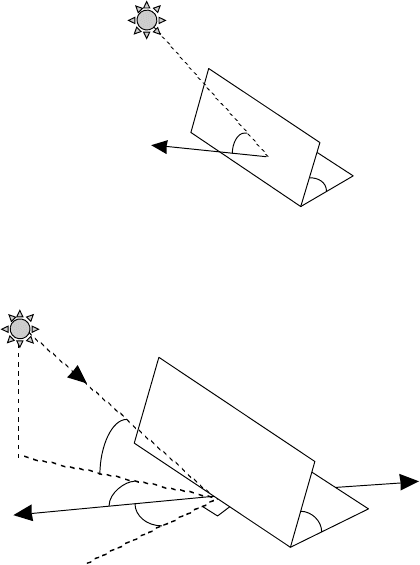
414 THE SOLAR RESOURCE
Incidence angle
q
Σ
Figure 7.20 The incidence angle θ between a normal to the collector face and the
incoming solar beam radiation.
S
N
f
S
f
C
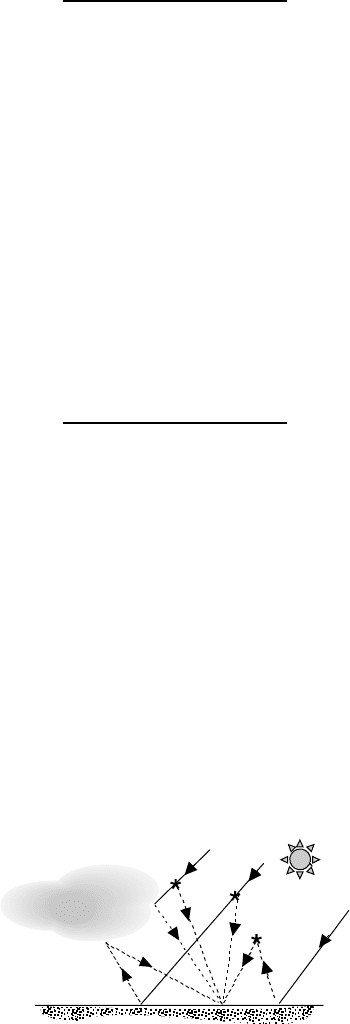
Σ
b
Figure 7.21 Illustrating the collector azimuth angle φ
C
and tilt angle along with the
solar azimuth angle φ
S
and altitude angle β. Azimuth angles are positive in the southeast
direction and are negative in the southwest.
θ between a line drawn normal to the collector face and the incoming beam
radiation (Fig. 7.20). It is given by
I
BC
= I
B
cos θ(7.24)
For the special case of beam insolation on a horizontal surface I
BH
,
I
BH
= I
B
cos(90
◦
− β) = I
B
sin β(7.25)
The angle of incidence θ will be a function of the collector orientation and
the altitude and azimuth angles of the sun at any particular time. Figure 7.21
introduces these important angles. The solar collector is tipped up at an angle
and faces in a direction described by its azimuth angle φ
C
(measured relative to
due south, with positive values in the southeast direction and negative values in
the southwest). The incidence angle is given by
cos θ = cos β cos(φ
S
− φ
C
) sin + sin β cos (7.26)
TOTAL CLEAR SKY INSOLATION ON A COLLECTING SURFACE 415
Example 7.9 Beam Insolation on a Collector. In Example 7.8, at solar noon
in Atlanta (latitude 33.7
◦
) on May 21 the altitude angle of the sun was found to
be 76.4
◦
and the clear-sky beam insolation was found to be 902 W/m
2
.Findthe
beam insolation at that time on a collector that faces 20
◦
toward the southeast if
it is tipped up at a 52
◦
angle.
Solution. Using (7.26), the cosine of the incidence angle is
cos θ = cos β cos(φ
S
− φ
C
) sin + sin β cos
= cos 76.4
◦
cos(0 − 20
◦
) sin 52
◦
+ sin 76.4
◦
cos 52
◦
= 0.7725
From (7.24), the beam radiation on the collector is
I
BC
= I
B
cos θ = 902 W/m
2
· 0.7725 = 697 W/m
2
7.9.2 Diffuse Radiation
The diffuse radiation on a collector is much more difficult to estimate accurately
than it is for the beam. Consider the variety of components that make up diffuse
radiation as shown in Fig. 7.22. Incoming radiation can be scattered from atmo-
spheric particles and moisture, and it can be reflected by clouds. Some is reflected
from the surface back into the sky and scattered again back to the ground. The
simplest models of diffuse radiation assume it arrives at a site with equal inten-
sity from all directions; that is, the sky is considered to be isotropic. Obviously,
on hazy or overcast days the sky is considerably brighter in the vicinity of the
sun, and measurements show a similar phenomenon on clear days as well, but
these complications are often ignored.
The model developed by Threlkeld and Jordan (1958), which is used in the
ASHRAE Clear-Day Solar Flux Model, suggests that diffuse insolation on a
I
DH
Figure 7.22 Diffuse radiation can be scattered by atmospheric particles and moisture or
reflected from clouds. Multiple scatterings are possible.
416 THE SOLAR RESOURCE
horizontal surface I
DH
is proportional to the direct beam radiation I
B
no matter
where in the sky the sun happens to be:
I
DH
= CI
B
(7.27)
where C is a sky diffuse factor. Monthly values of C are given in Table 7.6, and
a convenient approximation is as follows:
C = 0.095 + 0.04 sin
360
365
(n − 100)
(7.28)
Applying (7.27) to a full day of clear skies typically predicts that about 15% of
the total horizontal insolation on a clear day will be diffuse.
What we would like to know is how much of that horizontal diffuse radiation
strikes a collector so that we can add it to the beam radiation. As a first approx-
imation, it is assumed that diffuse radiation arrives at a site with equal intensity
from all directions. This means that the collector will be exposed to whatever
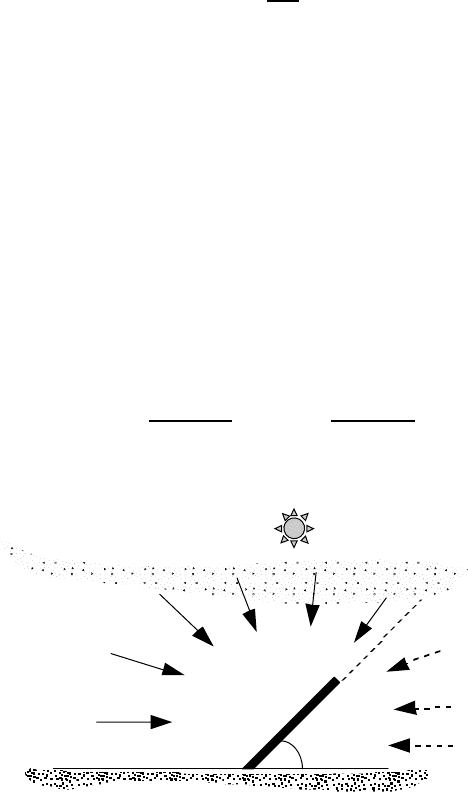
fraction of the sky the face of the collector points to, as shown in Fig. 7.23.
When the tilt angle of the collector is zero—that is, the panel is flat on the
ground—the panel sees the full sky and so it receives the full horizontal diffuse
radiation, I
DH
. When it is a vertical surface, it sees half the sky and is exposed
to half of the horizontal diffuse radiation, and so forth. The following expression
for diffuse radiation on the collector, I
DC
, is used when the diffuse radiation is
idealized in this way:
I
DC
= I
DH
1 + cos
2
= CI
B
1 + cos
2
(7.29)
Collector
Σ
Figure 7.23 Diffuse radiation on a collector assumed to be proportional to the fraction
of the sky that the collector “sees”.

TOTAL CLEAR SKY INSOLATION ON A COLLECTING SURFACE 417
Example 7.10 Diffuse Radiation on a Collector. Continue Example 7.9 and
find the diffuse radiation on the panel. Recall that it is solar noon in Atlanta on
May 21 (n = 141), and the collector faces 20
◦
toward the southeast and is tipped
up at a 52
◦
angle. The clear-sky beam insolation was found to be 902 W/m
2
.
Solution. Start with (7.28) to find the diffuse sky factor, C:
C = 0.095 + 0.04 sin
360
365
(n − 100)
C = 0.095 + 0.04 sin
360
365
(141 − 100)
= 0.121
And from (7.29), the diffuse energy striking the collector is
I
DC
= CI
B
1 + cos
2
= 0.121 ·902 W/m
2
1 + cos 52
◦
2
= 88 W/m
2
Added to the total beam insolation of 697 W/m
2
found in Example 7.9, this gives
a total beam plus diffuse on the collector of 785 W/m
2
.
7.9.3 Reflected Radiation
The final component of insolation striking a collector results from radiation that
is reflected by surfaces in front of the panel. This reflection can provide a consid-
erable boost in performance, as for example on a bright day with snow or water
in front of the collector, or it can be so modest that it might as well be ignored.
The assumptions needed to model reflected radiation are considerable, and the
resulting estimates are very rough indeed. The simplest model assumes a large
horizontal area in front of the collector, with a reflectance ρ that is diffuse, and
it bounces the reflected radiation in equal intensity in all directions, as shown
in Fig. 7.24. Clearly this is a very gross assumption, especially if the surface is
smooth and bright.
Estimates of ground reflectance range from about 0.8 for fresh snow to about
0.1 for a bituminous-and-gravel roof, with a typical default value for ordinary
ground or grass taken to be about 0.2. The amount reflected can be modeled as
the product of the total horizontal radiation (beam I
BH
, plus diffuse I
DH
) times
the ground reflectance ρ. The fraction of that ground-reflected energy that will