
Masters G.M. Renewable and Efficient Electric Power Systems
Подождите немного. Документ загружается.

378 WIND POWER SYSTEMS
Birds do collide with wind turbines, just as they collide with cars, cell-phone
towers, glass windows, and high-voltage power lines. While the rate of deaths
caused by wind turbines is miniscule compared to these other obstacles that
humans put into their way, it is still an issue that can cause concern. Early
wind farms had small turbines with fast-spinning blades and bird kills were more
common but modern large turbines spin so slowly that birds now more easily
avoid them. A number of European studies have concluded that birds almost
always modify their flight paths well in advance of encountering a turbine, and
very few deaths are reported. Studies of eider birds and offshore wind parks in
Denmark concluded that the eiders avoided the turbines even when decoys to
attract them were placed nearby. They also noted no change in the abundance of
nearby eiders when turbines were purposely shut down to study their behavior.
People’s perceptions of the aesthetics of wind farms are important in siting
the machines. A few simple considerations have emerged, which can make them
much more acceptable. Arranging same-size turbines in simple, uniform rows
and columns seems to help, as does painting them a light gray color to blend
with the sky. Larger turbines rotate more slowly, which makes them somewhat
less distracting.
Noise from a wind turbine or a wind farm is another potentially objectionable
phenomenon, and modern turbines have been designed specifically to control that
noise. It is difficult to actually measure the sound level caused by turbines in the
field because the ambient noise caused by the wind itself masks their noise. At
a distance of only a few rotor diameters away from a turbine, the sound level is
comparable to a person whispering.
The air quality advantages of wind are pretty obvious. Other than the very
modest imbedded energy, wind systems emit none of the SO
x
,NO
x
, CO, VOCs,
or particulate matter associated with fuel-fired energy systems. And, of course,
since there are virtually no greenhouse gas emissions, wind economics will get
a boost if and when carbon emitting sources begin to be taxed.
REFERENCES
Bolinger, M., R. Wiser, and W. Golove (2001). Revisiting the “Buy versus Build”
Decision for Publicly Owned Utilities in California Considering Wind and Geothermal
Resources, Lawrence Berkeley National Labs, LBNL 48831, October.
Cavallo, A. J., S. M. Hock, and D. R. Smith (1993). Wind Energy: Technology and Eco-
nomics. Chapter 3 in Renewable Energy, Sources for Fuels and Electricity, L. Burnham,
ed., Island Press, Washington, D.C.
Elliot, D. L., C. G. Holladay, W. R. Barchett, H. P. Foote, and W. F. Sandusky (1987).
Wind Energy Resource Atlas of the United States, Solar Energy Research Institute, U.S.
Department of Energy, DOE/CH 100934, Golden, CO.
Elliot, D. L., L. L. Windell, and G. I. Gower (1991). An Assessment of the Available
Windy Land Area and Wind Energy Potential in the Contiguous United States, Pacific
Northwest Laboratory, PNL-7789, August.
PROBLEMS 379
Grubb, M. J., and N. I. Meyer (1993). Wind Energy: Resources, Systems, and Regional
Strategies. Chapter 4 in Renewable Energy: Sources for Fuels and Electricity,Island
Press, Washington, D.C.
Jacobson, M. Z., and G. M. Masters (2001). Exploiting Wind Versus Coal, Science,24
August, vol. 293, p. 1438.
Johnson, G. L. (1985). Wind Energy Systems, Prentice-Hall, Englewood Cliffs, N.J.
Krohn, S. (1997). The Energy Balance of Modern Wind Turbines, Wind Power Note, #10,
December. Vindmolleindustrien, Denmark (available at www.windpower.dk).
Milborrow, D. J., and P. L. Surman (1987). Status of wake and array loss research. AWEA
Windpower 91 Conference, Palm Springs, CA.
Pacific Northwest Laboratory (1991). An Assessment of the Available Windy Land Area
and Wind Energy Potential in the Contiguous United States.
Patel, M. K. (1999). Wind and Solar Power Systems, CRC Press, New York.
Redlinger, R. Y., P. D. Andersen, and P. E. Morthorst (1999). Wind Energy in the 21st
Century, Macmillan Press, London.
Troen, I., and E. L. Petersen (1991). European Wind Atlas, Risoe National Laboratory,
Denmark.
PROBLEMS
6.1 A horizontal-axis wind turbine with rotor 20 meters in diameter is 30-%
efficient in 10 m/s winds at 1 a tmosphere of pressure and 15
◦
C.
a. How much power would it produce in those winds?
b. Estimate the air density on a 2500-m mountaintop at 10
◦
C.
b. Estimate the power the turbine would produce on that mountain with the
same windspeed assuming its efficiency is not affected by air density.
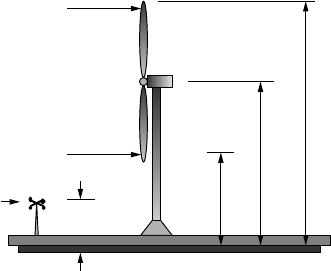
6.2. An anemometer mounted at a height of 10 m above a surface with crops,
hedges and shrubs, shows a windspeed of 5 m/s. Assuming 15
◦
Cand1atm
pressure, determine the following for a wind turbine with hub height 60 m
and rotor diameter of 60 m:
v
top
v
bottom
5 m/s
90 m
60 m
30 m
10 m
Crops, hedges, shrubs
Figure P6.2
380 WIND POWER SYSTEMS
a. Estimate the windspeed and the specific power in the wind (W/m
2
)at
the highest point that a rotor blade reaches.
b. Repeat (a) at the lowest point at which the blade falls.
c. Compare the ratio of wind power at the two elevations using results of
(a) and (b) and compare that with the ratio obtained using (6.17).
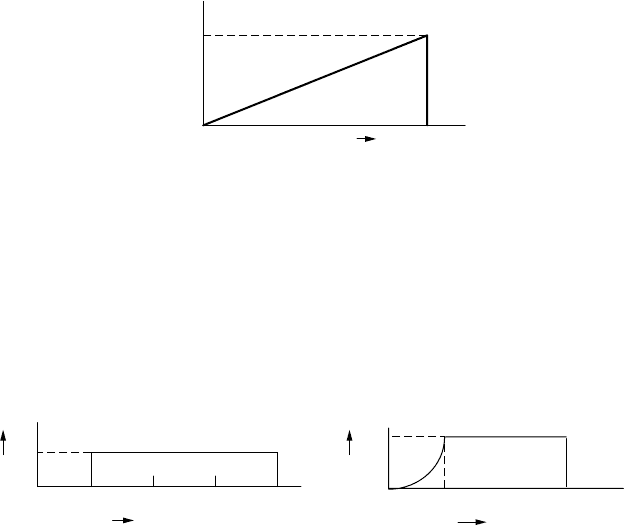
6.3 Consider the following probability density function for wind speed:
f(
V
)
0
k
V
(m/s) 10 m/s
Figure P6.3
a. What is an appropriate value of k for this to be a legitimate probability
density function?
b. What is the average power in these winds (W/m
2
) under standard (15
◦
C,
1 atm) conditions?
6.4 Suppose the wind probability density function is just a constant over the
5 to 20 m/s range of windspeeds, as shown below. The power curve for a
small 1 kW windmill is also shown.
V
(m/s)
f
(
V
)
0 5 10 15 20 0 5 10 15 20
k
V
(m/s)
1 kW
P
(kW)
Figure P6.4
a. What is the probability that the wind is blowing between 5 and 15 m/s?
b. What is the annual energy that the wind turbine would generate?
c. What is the average power in the wind?
6.5 Suppose an anemometer mounted at a height of 10-m on a level field with
tall grass shows an average windspeed of 6 m/s.
a. Assuming Rayleigh statistics and standard conditions (15
◦
C, 1 atm), esti-
mate the average wind power (W/m
2
) at a height of 80 m.
b. Suppose a 1300-kW wind turbine with 60-m rotor diameter is located
in those 80 m winds. Estimate the annual energy delivered (kWh/yr) if
you assume the turbine has an overall efficiency of 30%.
c. What would the turbine’s capacity factor be?
PROBLEMS 381
6.6 In the derivation of the cumulative distribution function, F(V) for a Weibull
function we had to solve the integral F(V) =
V
0
f(v)dv. Show that F(V)
in (6.53) is the correct result by taking the derivative f(v) =
dF(V)
dV
and
seeing whether you get back to the Weibull probability density function
given in (6.41).
6.7 The table below shows a portion of a spreadsheet that estimates the energy
delivered by a NEG Micon 1000 kW/60 m wind turbine exposed to Rayleigh
winds with an average speed of 8 m/s.
v (m/s) kW kWh/yr
000
100
200
300
4 33 23,321
586?
6 ... ...
etc.
a. How many kWh/yr would be generated with 5 m/s winds?
b. Using Table 6.7, how many kWh/yr would be generated in 10 m/s winds
for a Vestas 600/42 machine?
6.8 Consider the Nordex 1.3 MW, 60-m wind turbine with power specifications
given in Table 6.7 located in an area with 8 m/s average wind speeds.
a. Find the average power in the wind (W/m
2
) assuming Rayleigh statistics.
b. Create a spreadsheet similar to the one developed in Example 6.15 to
determine the energy delivered (kWh/yr) from this machine.
c. What would be the average efficiency of the wind turbine?
d. If the turbine’s rotor operates at 70% of the Betz limit, what is the
efficiency of the gearing and generator?
6.9 For the following turbines and average Rayleigh wind speeds, set up a
spreadsheet to find the total annual kWh delivered and compare that with
an estimate obtained using the simple correlation given in (6.65):
a. Bonus 300 kW/33.4 m, 7 m/s average wind speed
b. NEG/Micon 1000 kW/60 m, 8 m/s average wind speed
c. Vestas 600 kW/42 m, 8 m/s average wind speed
d. Whisper 0.9 kW/2.13 m, 5 m/s average wind speed
6.10 Consider the design of a home-built wind turbine using a 350-W automobile
dc generator. The goal is to deliver 70 kWh in a 30-day month.
382 WIND POWER SYSTEMS
a. What capacity factor would be needed for the machine?
b. If the average wind speed is 5 m/s, and Rayleigh statistics apply, what
should the rotor diameter be if the correlation of (6.65) is used?
c. How fast would the wind have to blow to cause the turbine to put out
its full 0.35 kW if the machine is 20% efficient at that point?
d. If the tip-speed-ratio is assumed to be 4, what gear ratio would be needed
to match the rotor speed to the generator if the generator needs to turn
at 1000 rpm to deliver its rated 350 W?
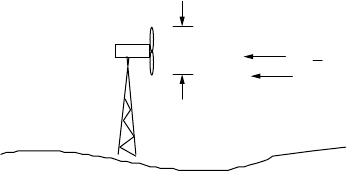
6.11 A 750-kW wind turbine with 45-m blade diameter operates in a wind regime
that is well characterized by Rayleigh statistics with average windspeed
equal to 7 m/s.
750 kW 45 m
v
= 7 m/s
sea level, 15 °C
Figure P6.11
Assuming the capacity factor correlation (6.65), what is the average effi-
ciency of this machine?
6.12 For Rayleigh winds with an average windspeed of 8 m/s:
a. How many hours per year do the winds blow at less than 13 m/s?
b. For how many hours per year are windspeeds above 25 m/s?
c. Suppose a 31-m, 340-kW turbine follows the idealized power curve
shown in Figure 6.32. How many kWh/yr will it deliver when winds
blow between its rated windspeed of 13 m/s and its furling windspeed
of 25 m/s?
d. Using the capacity factor correlation given in (6.65), estimate the fraction
of the annual energy delivered with winds that are above the rated
windspeed?
6.13 Using the simple capacity factor correlation, derive an expression for the
average (Rayleigh) windspeed that yields the highest efficiency for a turbine
as a function of its rated power and blade diameter. What is the optimum
windspeed for
a. The NEG/Micon 1000 kW/60 m turbine
b. The NEG/Micon 1000 kW/54 m turbine?
6.14 Consider a 64-m, 1.5 MW NEG Micon wind turbine (Table 6.7) located at
a site with Rayleigh winds averaging 7.5 m/s.

PROBLEMS 383
a. Using the simple capacity factor correlation (6.65) estimate the annual
energy delivered.
b. Suppose the total installed cost of the wind turbine is $1.5 million
($1/watt) and its annual cost is based on the equivalent of a 20-year, 6%
loan to cover the capital costs. In addition, assume an annual operations
and maintenance cost equal to 1-% of the capital cost. What would be
the cost of electricity from this turbine (¢/kWh)?
c. If farmers are paid 0.1 ¢/kWh to put these towers on their land, what
would their annual royalty payment be per turbine?
d. If turbines are installed with a density corresponding to 4D × 7D sepa-
rations (where D is rotor diameter), what would the annual payment be
per acre?
6.15 This question has 4 different combinations of turbine, average wind speed,
capital costs, return on equity, loan terms, and O&M costs. Using the capac-
ity factor correlation, find their levelized costs of electricity.
(a) (b) (c) (d)
Turbine power (kW) 1500 600 250 1000
Rotor diameter (m) 64 42 29.2 60
Avg wind speed (m/s) 8.5 8.5 8.5 8.5
Capital cost ($/kW) 800 1000 1200 900
Equity % of capital 25 25 25 25
Annual return on equity (%) 15 15 15 15
Loan interest (%) 7 7 7 7
Loan term (yrs) 20 20 20 20
Annual O&M percent of capital 3 3 3 3

CHAPTER 7
THE SOLAR RESOURCE
To design and analyze solar systems, we need to know how much sunlight is
available. A fairly straightforward, though complicated-looking, set of equations
can be used to predict where the sun is in the sky at any time of day for any
location on earth, as well as the solar intensity (or insolation: incident solar
Radiation) on a clear day. To determine average daily insolation under the com-
bination of clear and cloudy conditions that exist at any site we need to start with
long-term measurements of sunlight hitting a horizontal surface. Another set of
equations can then be used to estimate the insolation on collector surfaces that
are not flat on the ground.
7.1 THE SOLAR SPECTRUM
The source of insolation is, of course, the sun—that gigantic, 1.4 million kilo-
meter diameter, thermonuclear furnace fusing hydrogen atoms into helium. The
resulting loss of mass is converted into about 3.8 ×10
20
MW of electromagnetic
energy that radiates outward from the surface into space.
Every object emits radiant energy in an amount that is a function of its tem-
perature. The usual way to describe how much radiation an object emits is to
compare it to a theoretical abstraction called a blackbody. A blackbody is defined
to be a perfect emitter as well as a perfect absorber. As a perfect emitter, it radiates
more energy per unit of surface area than any real object at the same temperature.
As a perfect absorber, it absorbs all radiation that impinges upon it; that is, none
Renewable and Efficient Electric Power Systems. By Gilbert M. Masters
ISBN 0-471-28060-7
2004 John W iley & Sons, Inc.
385
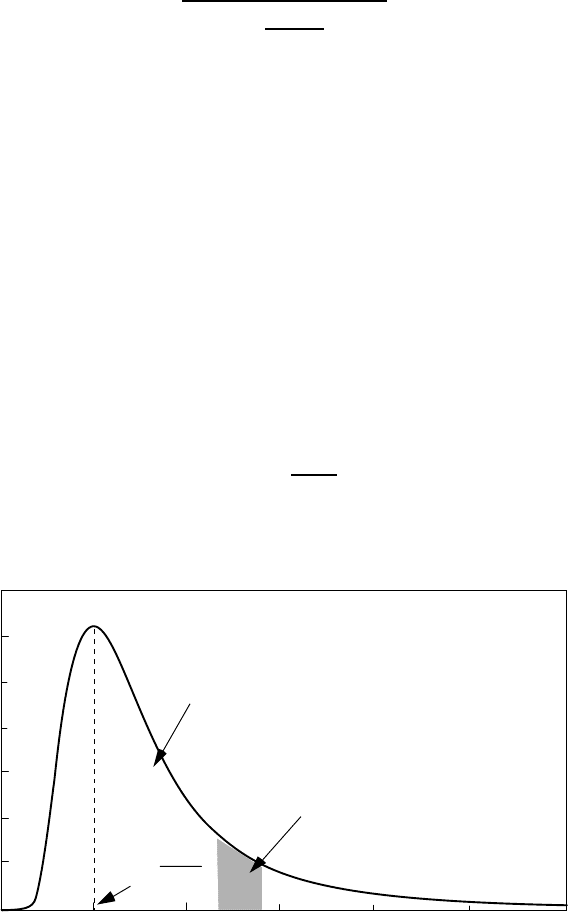
386 THE SOLAR RESOURCE
is reflected and none is transmitted through it. The wavelengths emitted by a
blackbody depend on its temperature as described by Planck’s law :
E
λ
=
3.74 × 10
8
λ
5
exp
14,400
λT
− 1
(7.1)
where E
λ
is the emissive power per unit area of a blackbody (W/m
2
µm), T is
the absolute temperature of the body (K), and λ is the wavelength (µm).
Modeling the earth itself as a 288 K (15
◦
C) blackbody results in the emission
spectrum plotted in Fig. 7.1.
The area under Planck’s curve between any two wavelengths is the power emit-
ted between those wavelengths, so the total area under the curve is the total radiant
power emitted. That total is conveniently expressed by the Stefan–Boltzmann law
of radiation:
E = Aσ T
4
(7.2)
where E is the total blackbody emission rate (W), σ is the Stefan–Boltzmann
constant = 5.67 × 10
−8
W/m
2
-K
4
, T is the absolute temperature of the black-
body (K), and A is the surface area of the blackbody (m
2
).
Another convenient feature of the blackbody radiation curve is given by Wien’s
displacement rule, which tells us the wavelength at which the spectrum reaches
its maximum point:
λ
max
(µm) =
2898
T(K)
(7.3)
where the wavelength is in microns (µm) and the temperature is in kelvins.
5
10
15
20
25
30
35
Intensity (W/m
2
-µm)
Wavelength (µm)
0
01020 405060
l
max
=
2898
T
(K)
Area = (W/m
2
) between l
1
and l
2
Total area = s
T
4
l
1
l
2
Figure 7.1 The spectral emissive power of a 288 K blackbody.

THE SOLAR SPECTRUM 387
Example 7.1 The Earth’s Spectrum. Consider the earth to be a blackbody
with average surface temperature 15
◦
C and area equal to 5.1 × 10
14
m
2
.Find
the rate at which energy is radiated by the earth and the wavelength at which max-
imum power is radiated. Compare this peak wavelength with that for a 5800 K
blackbody (the sun).
Solution. Using (7.2), the earth radiates:
E = σAT
4
= (5.67 × 10
−8
W/m
2
· K
4
) × (5.1 × 10
14
m
2
) × (15 + 273 K)
4
= 2.0 × 10
17
W
The wavelength at which the maximum power is emitted is given by (5.3):
λ
max
(earth) =
2898
T(K)
=
2898
288
= 10.1 µm
For the 5800 K sun,
λ
max
(sun) =
2898
5800
= 0.5 µm
It is worth noting that earth’s atmosphere reacts very differently to the much
longer wavelengths emitted by the earth’s surface (Fig. 7.1) than it does to the
short wavelengths arriving from the sun (Fig. 7.2). This difference is the funda-
mental factor responsible for the greenhouse effect.
While the interior of the sun is estimated to have a temperature of around
15 million kelvins, the radiation that emanates from the sun’s surface has a
spectral distribution that closely matches that predicted by Planck’s law for a
5800 K blackbody. Figure 7.2 shows the close match between the actual solar
spectrum and that of a 5800 K blackbody. The total area under the black-
body curve has been scaled to equal 1.37 kW/m
2
, which is the solar insolation
just outside the earth’s atmosphere. Also shown are the areas under the actual
solar spectrum that corresponds to wavelengths within the ultraviolet UV (7%),
visible (47%), and infrared IR (46%) portions of the spectrum. The visible
spectrum, which lies between the UV and IR, ranges from 0.38 µm (violet)
to 0.78 µm (red).
As solar radiation makes its way toward the earth’s surface, some of it is
absorbed by various constituents in the atmosphere, giving the terrestrial spec-
trum an irregular, bumpy shape. The terrestrial spectrum also depends on how
much atmosphere the radiation has to pass through to reach the surface. The
length of the path h
2
taken by the sun’s rays as they pass through the atmo-
sphere, divided by the minimum possible path length h
1
, which occurs when