
Menon E.S. Liquid Pipeline Hydraulics
Подождите немного. Документ загружается.

Pump Analysis 123
Over the years pipelines have been operated with centrifugal as well as
reciprocating or positive displacement (PD) pumps. In this chapter we will
concentrate mainly on centrifugal pumps, as these are used extensively in
most liquid pipelines that transport water, petroleum products, and
chemicals. PD pumps are discussed as well, since they are used for liquid
injection lines in oil pipeline gathering systems.
Centrifugal pumps develop and convert the high liquid velocity into
pressure head in a diffusing flow passage. They generally have a lower
efficiency than PD pumps such as reciprocating and gear pumps. However,
centrifugal pumps can operate at higher speeds to generate higher flow
rates and pressures. Centrifugal pumps also have lower maintenance
requirements than PD pumps.
Positive displacement pumps such as reciprocating pumps operate by
forcing a fixed volume of liquid from the inlet to the outlet of the pump.
These pumps operate at lower speeds than centrifugal pumps.
Reciprocating pumps cause intermittent flow. Rotary screw pumps and
gear pumps are also PD pumps, but operate continuously unlike
reciprocating pumps. Positive displacement pumps are generally larger in
size and more efficient compared with centrifugal pumps, but require
higher maintenance.
Modern pipelines are mostly designed with centrifugal pumps in
preference to PD pumps. This is because there is more flexibility in
volumes and pressures with centrifugal pumps. In petroleum pipeline
installations where liquid from a field gathering system is injected into a
main pipeline, PD pumps may be used.
The performance of a centrifugal pump is depicted as a curve that
shows variation in pressure head at different flow rates. The pump head
characteristic curve shows the pump head developed on the vertical axis,
while the flow rate is shown on the horizontal axis. This curve may be
referred to as the H-Q curve or the head-capacity curve. Pump
companies use the term capacity when referring to flow rate. Throughout
this section we use capacity and flow rate interchangeably when dealing
with pumps.
Generally, pump performance curves are plotted for water as the liquid
pumped. The head is measured in feet of water and flow rate is shown in
gal/min. In addition to the head versus flow rate curve, two other curves
are commonly shown on a typical pump performance chart. These are
pump efficiency versus flow rate and pump brake horsepower (BHP)
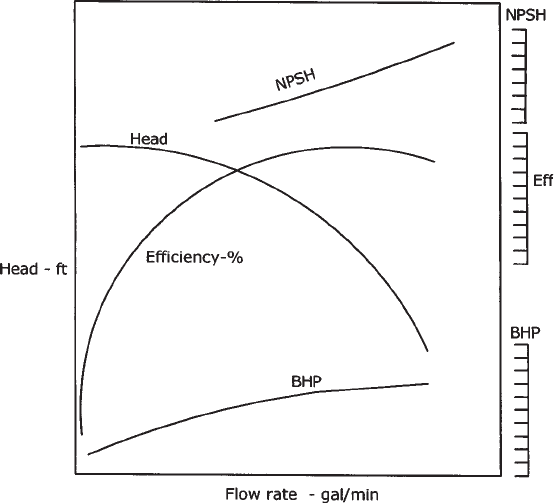
versus flow rate. Figure 7.1 shows typical centrifugal pump performance
curves consisting of head, efficiency and BHP plotted against flow rate (or
capacity). You will also notice another curve referred to as NPSH plotted
against flow rate. NPSH will be discussed later in this chapter.
Copyright © 2004 by Marcel Dekker, Inc.
Chapter 7124
In summary, typical centrifugal pump characteristic curves include the
following four curves:
Head versus flow rate
Efficiency versus flow rate
BHP versus flow rate
NPSH versus flow rate
The above performance curves for a particular model pump are generally
plotted for a particular pump impeller size and speed (example: 10 in.
impeller, 3560 RPM).
In addition to the above four characteristic curves, pump head curves
drawn for different impeller diameters and iso-efficiency curves are
sometimes encountered. When pumps are driven by variable-speed electric
motors or engines, the head curves may also be shown at various pump
speeds. Pump performance at various impeller sizes and speeds will be
discussed in detail later in this chapter.
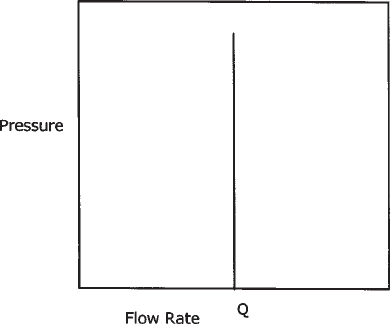
A PD pump continuously pumps a fixed volume at various pressures. It
is able to provide any pressure required at a fixed flow rate. This flow rate
Figure 7.1 Centrifugal pump performance.
Copyright © 2004 by Marcel Dekker, Inc.
Pump Analysis 125
depends on the geometry of the pump such as bore and stroke. A typical
PD pump pressure-volume curve is shown in Figure 7.2.
7.2 Pump Head Versus Flow Rate
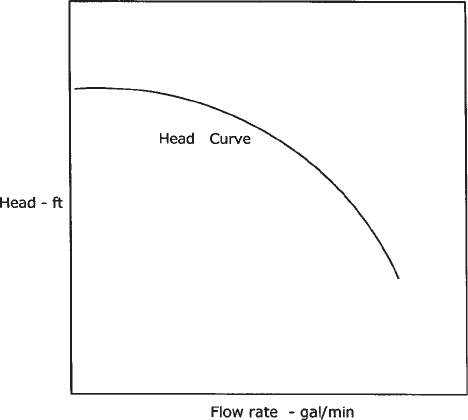
For a centrifugal pump, the head-capacity (flow rate) variation is shown in
Figure 7.3.
The head versus flow rate curve (H-Q curve) is generally referred to as
a drooping head curve that starts at the highest value (shut-off head) at zero
flow rate. The head decreases as the flow rate through the pump increases.
The trailing point of the curve represents the maximum flow and the
corresponding head that the pump can generate.
Pump head is always plotted in feet of head of water. Therefore the
pump is said to develop the same head in feet of liquid, regardless of the
liquid. If a particular pump develops 2000 ft head at 3000 gal/min flow
rate, we can calculate the pressure developed in psi when pumping water
versus another liquid such as gasoline:
With water, pressure developed=2000×1/2.31=866 psi
With gasoline, pressure developed=2000×0.74/2.31=641 psi
This head versus flow rate relationship holds good for this particular pump
that has a fixed impeller diameter D and operates at a fixed speed N. The
diameter of the impeller generally can be increased within a certain range of
sizes, depending on the internal cavity that houses the pump impeller. Thus,
Figure 7.2 Positive displacement pump performance.
Copyright © 2004 by Marcel Dekker, Inc.
Chapter 7126
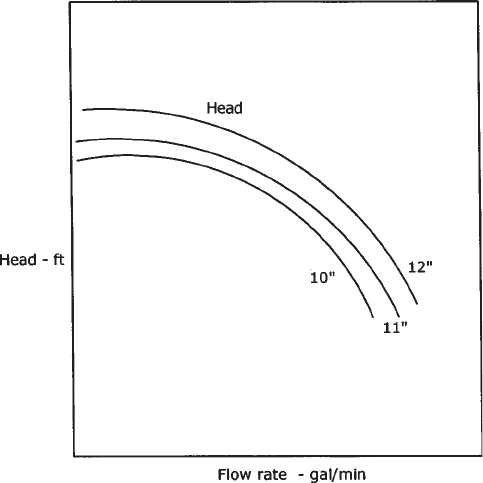
if the H-Q curve in Figure 7.3 is based on a 10 in. impeller diameter,
similar curves can be generated for 9 in. impeller and 12 in. impellers
representing the minimum and maximum sizes available for this particular
pump. The minimum and maximum impeller sizes are defined by the
pump vendor for the particular pump model. The 9 in. curve and 12 in.
curves would be parallel to the 10 in. curve as shown in Figure 7.4. The
variations in pump H-Q curves with impeller diameter follow the Affinity
Laws, discussed in a later section of this chapter.
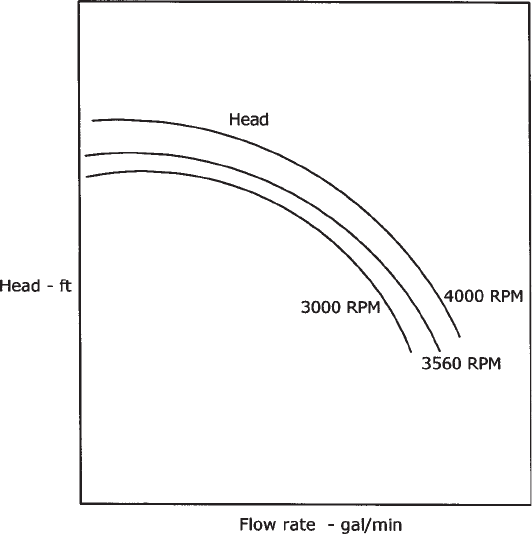
Similar to H-Q variations with pump impeller diameter, curves can be
generated for varying pump impeller speeds. If the impeller diameter is
kept constant at 10 in. and the initial H-Q curve was based on a pump
speed of 3560 RPM (typical induction motor speed), by varying the
pump speed we can generate a family of parallel curve as shown in
Figure 7.5.
It will be observed that the H-Q variations with pump impeller diameter
and pump speed are similar. This is due to the Affinity Laws that the pump
performance is based on. We discuss Affinity Laws and prediction of pump
performance at different diameters and speeds later in this chapter.
A pump may develop the head in stages. Thus single-stage and
multistage pumps are used depending upon the head required. A single-stage
Figure 7.3 Centrifugal pump performance head versus flow rate.
Copyright © 2004 by Marcel Dekker, Inc.
Pump Analysis 127
pump may generate 200 ft head at 3000 gal/min. A three-stage pump of
this design will generate 600 ft head at same flow rate and pump speed.
An application that requires 2400 ft head at 3000 gal/min may be served
by a multi-stage pump with each stage providing 400 ft of head. De-
staging is the process of reducing the active number of stages in a pump
to reduce the total head developed. Thus, the six-stage pump discussed
above may be de-staged to four stages if we need only 1600 ft head at
3000 gal/min.
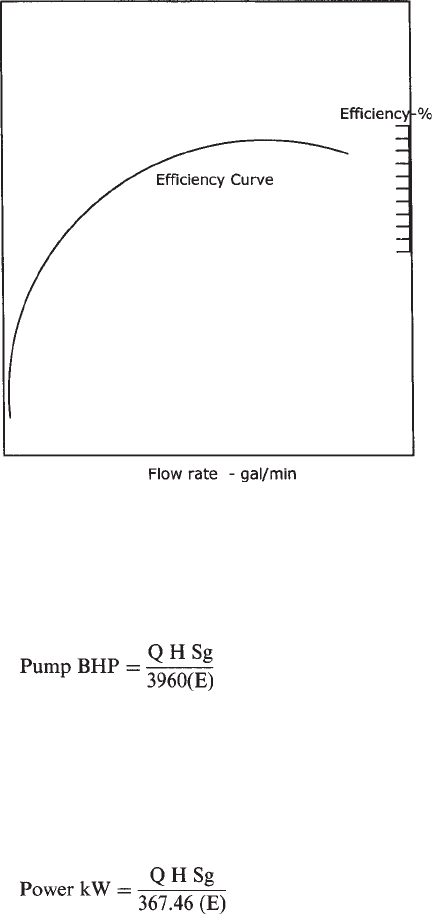
7.3 Pump Efficiency Versus Flow Rate
The variation of the efficiency E of a centrifugal pump with flow rate Q is as
shown in Figure 7.6. It can be seen that the efficiency starts off at zero value
under shut-off conditions (zero flow rate) and rises to a maximum value at
some flow rate. After this point, with increase in flow rate the efficiency
drops off to some value lower than the peak efficiency. Generally centrifugal
pump peak efficiencies are approximately 80–85%. It must be remembered
in all these discussions that we are referring to a centrifugal pump
Figure 7.4 Head versus flow rate for different impeller sizes.
Copyright © 2004 by Marcel Dekker, Inc.
Chapter 7128
performance with water as the liquid being pumped. When heavy, viscous
liquids are pumped, these water-based efficiencies will be reduced by a
correction factor. Viscosity-corrected pump performance using the
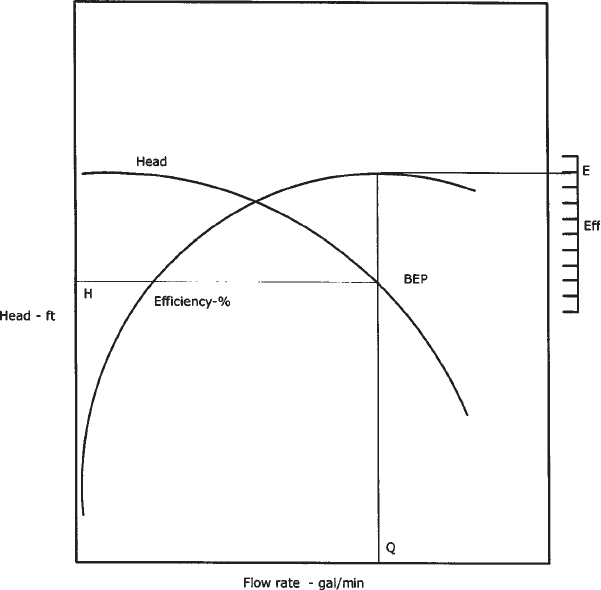
Hydraulic Institute charts is discussed in Section 7.8. The flow rate at
which the maximum efficiency occurs in a pump is referred to as the best
efficiency point (BEP). This flow rate and the corresponding head from the
H-Q curve is thus the best operating point on the pump curve since the
highest pumping efficiency is realized at this flow rate. In the combined H-
Q and efficiency versus flow rate (E-Q) curves shown in Figure 7.7, the
BEP is shown as a small triangle.
When choosing a centrifugal pump for a particular application we try to
get the operating point as close as possible to the BEP. In order to allow for
future increase in flow rates, the initial operating point is chosen slightly to
the left of the BEP. This will ensure that with increase in pipeline
throughput the operating point on the pump curve will move to the right,
which would result in a slightly better efficiency.
Figure 7.5 Head versus flow rate at different speeds.
Copyright © 2004 by Marcel Dekker, Inc.
Pump Analysis 129
7.4 BHP Versus Flow Rate
From the H-Q and E-Q curves we can calculate the BHP required at every
point along the curve using Equation (5.17) as follows:
(7.1)
where
Q=Pump flow rate, gal/min
H=Pump head, ft
E=Pump efficiency, as a decimal value less than 1.0
Sg=Liquid specific gravity (for water Sg=1.0)
In SI units, power in kW can be calculated as follows:
(7.2)
where
Q=Pump flow rate, m
3
/hr
H=Pump head, m
Figure 7.6 Centrifugal pump performance: efficiency versus flow rate.
Copyright © 2004 by Marcel Dekker, Inc.
Chapter 7130
E=Pump efficiency, as a decimal value less than 1.0
Sg=Liquid specific gravity (for water Sg=1.0)
For example, if the BEP on a particular pump curve occurs at a flow rate of
3000 gal/min, 2500 ft head at 85% efficiency, the BHP at this flow rate for
water is calculated from Equation (7.1) as
Pump BHP=3000×2500×1.0/(3960×0.85)=2228
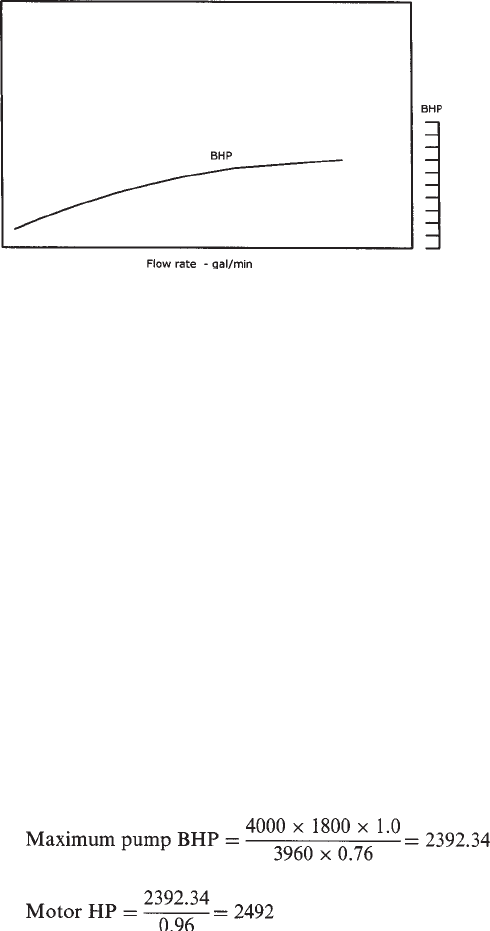
This represents the BHP with water at 3000 gal/min flow rate. Similarly,
BHP can be calculated at various flow rates from zero to 4000 gal/min
(assumed maximum pump flow) by reading the corresponding head and
efficiency values from the H-Q curve and E-Q curve and using Equation
(7.1) as above. The BHP versus flow rate can then be plotted as shown in
Figure 7.8. The BHP versus flow rate curve can also be shown on the same
plot as H-Q and E-Q curves as shown in Figure 7.1.
Figure 7.7 Best efficiency point.
Copyright © 2004 by Marcel Dekker, Inc.
Pump Analysis 131
As discussed in Section 5.6.2, the BHP calculated above is the brake
horsepower demanded by the pump. An electric motor driving the pump
will have an efficiency that ranges from 95% to 98%. Therefore the electric
motor HP required is the pump BHP divided by the motor efficiency as
follows
Motor HP=Pump BHP/Motor efficiency
=2228/0.96
=2321 HP, based on 96% motor efficiency
In determining the motor size required, we must first calculate the
maximum HP demanded by the pump, which will generally (but not
necessarily) be at the highest flow rate. The BHP at this flow rate will then
be divided by the electric motor efficiency to get the maximum motor HP
required. The next available standard size motor will be selected for the
application.
Suppose that for the above pump 4000 gal/min is the maximum flow
rate through the pump and the head and efficiency are 1800 ft and 76%,
respectively. We will calculate the maximum BHP required as
Therefore a 2500 HP electric motor will be adequate for this case. Before
we leave the subject of pump BHP and electric motor HP, we must mention
Figure 7.8 BHP versus flow rate.
Copyright © 2004 by Marcel Dekker, Inc.
Chapter 7132
that electric motors have built into their nameplate rating a service factor.
The service factor for most induction motors is in the range of 1.10 to 1.15.
This simply means that if the motor’s rated HP is 2000, the 1.15 service
factor allows the motor to supply up to a maximum of 1.15×2000 or 2300
HP without burning up the motor windings. However, it is not advisable to
use this extra 300 HP on a continuous basis, as explained below.
At a 1.15 service factor rating, the motor windings will be taking on an
additional 15% electric current compared with their rated current (amps).
This translates to extra heat that will shorten the life of the windings. Even
though the extra current is only 15%, the heat generated will be over 32%,
since electrical heating is proportional to the square of the current
(1.15
2
=1.3225). However, while continuous operation at the service factor
rating is discouraged, in an emergency this additional 15% motor HP
above the rated HP may be used.
7.5 NPSH Versus Flow Rate
In addition to the three pump curves discussed previously—for head versus
capacity (H-Q), efficiency versus capacity (E-Q), and BHP versus capacity
(BHP-Q)—the pump performance data will include a fourth curve for net
positive suction head (NPSH) versus capacity. This curve is generally
located above the head, efficiency, and BHP curves as shown in Figure 7.1.
The NPSH curve shows the variation in the minimum net positive
suction head at the impeller suction versus the flow rate. The NPSH
increases at a faster rate as the flow rate increases. NPSH is defined as the
net positive suction head required at the pump impeller suction to prevent
pump cavitation at any flow rate. It represents the resultant positive
pressure at pump suction after accounting for frictional loss and liquid
vapor pressure. NPSH is discussed in detail in Section 7.12. At present, we
can say that as pump flow rate increases the NPSH required also increases.
We will perform calculations to compare NPSH required (per pump curve)
versus actual NPSH available based on pump suction piping and other
parameters that affect the available suction pressure at the pump.
7.6 Specific Speed
The specific speed of a centrifugal pump is a parameter based on the
impeller speed, flow rate, and head at the best efficiency. It is used for
comparing geometrically similar pumps and for classifying the different
types of centrifugal pumps.
Specific speed may be defined as the speed at which a geometrically
similar pump must be run such that it produces a head of 1 ft at a flow rate
Copyright © 2004 by Marcel Dekker, Inc.