
Menon E.S. Liquid Pipeline Hydraulics
Подождите немного. Документ загружается.

Multi-Pump Station Pipelines 113
calculated for the given flow rate and liquid properties. The hydraulic
gradient with one pump station at the total pressure P
T
is as shown. Since
P
T
may be higher than the pipe MAOP, we will assume that three pump
stations are required to provide the pressures needed within MAOP limits.
Each pump station will discharge at pressure P
D
. If P
S
represents the pump
station suction pressure and P
del
the delivery pressure at the pipeline
terminus, we can state the following, using geometry:
P
D
+(P
D
-P
S
)+(P
D
-P
S
)=P
T
(6.1)
Since the above is based on one origin pump station and two intermediate
pump stations, we can extend the above equation for N pump stations as
follows:
P
D
+(N-1)×(P
D
-P
S
)=P
T
(6.2)
Solving for N we get
N=(P
T
-P
S
)/(P
D
-P
S
) (6.3)
Equation (6.3) is used to estimate the number of pump stations required for
hydraulic balance given the discharge pressure limit P
D
at each pump
station. Solving Equation (6.3) for the common pump station discharge
pressure,
P
D
=(P
T
-P
S
)/N+P
S
(6.4)
As an example, if the total pressure calculated is 2000 psi and the suction
pressure is 25 psi, the number of pump stations required with 1050 psi
discharge pressure is
N=(2000-50)/(1050-50)=1.95
Rounding up to the nearest whole number, we can conclude that two pump
stations are required. Using Equation (6.4), the discharge pressure P
D
at
which each pump station will operate is:
P
D
=(2000-50)/2+50=1025 psi
Once we have calculated the discharge pressure required for hydraulic
balance, as above, a graphical method can be used to locate the pump
stations along the pipeline profile. First the pipeline profile (milepost
versus elevation) is plotted and the hydraulic gradient superimposed upon
it by drawing the sloped line starting at P
T
at A and ending at P
del
at D, as
shown in Figure 6.1. Note that the pressure must be converted to feet of
head, since the pipe elevation profile is plotted in feet. Next, starting at the
first pump station A at discharge pressure P
D
, a line is drawn parallel to the
hydraulic gradient. The location B of the second pump station will be
Copyright © 2004 by Marcel Dekker, Inc.
Chapter 6114
established at a point where the hydraulic gradient between A and B meets
the vertical line at the suction pressure P
S
. The process is continued to
determine the location C of the third pump station.
In the above analysis we have made several simplifying assumptions.
We assumed that the pressure drop per mile was constant throughout the
pipeline, meaning the pipe internal diameter was uniform throughout. With
variable pipe diameter or wall thickness, the hydraulic gradient slopes
between pump station segments may not be the same.
6.2 Telescoping Pipe Wall Thickness
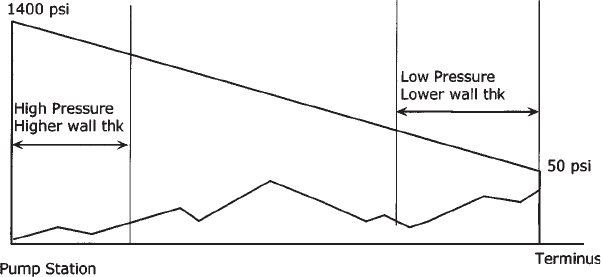
On examining the typical hydraulic gradient shown in Figure 6.2, it is
evident that under steady-state operating conditions the pipe pressure
decreases from pump station to the terminus in the direction of flow. Thus,
the pipeline segment immediately downstream of a pump station will be
subject to higher pressures such as 1000 to 1200 psi while the tail end of that
segment before the next pump station (or terminus) will be subject to lower
pressures in the range of 50 to 300 psi. If we use the same wall thickness
throughout the pipeline, we will be underutilizing the downstream portion of
the piping. Therefore, a more efficient approach would be to reduce the pipe
wall thickness as we move away from a pump station toward the suction side
of the next pump station or the delivery terminus.
The higher pipe wall thickness immediately adjacent to the pump station
will be able to withstand the higher discharge pressure and, as the pressure
reduces down the line, the lower wall thickness would be designed to
withstand the lower pressures as we approach the next pump station or
delivery terminus. This process of varying the wall thickness to compensate
Figure 6.2 Telescoping pipe wall thickness.
Copyright © 2004 by Marcel Dekker, Inc.
Multi-Pump Station Pipelines 115
for reduced pipeline pressures is referred to as telescoping pipe wall
thickness.
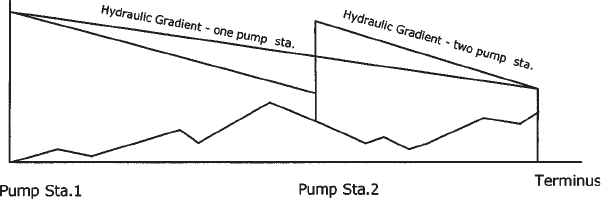
A note of caution regarding wall thickness tapering would be
appropriate here. If a pipeline has two pump stations and the second pump
station is shut down for some reason, the hydraulic gradient is as shown in
Figure 6.3. It can be seen that portions of the pipeline on the upstream side
of the second pump station will be subject to higher pressure than when the
second pump station was online. Therefore, wall thickness reductions
(telescoping) implemented upstream of a pump station must be able to
handle the higher pressures that result from shut-down of an intermediate
pump station.
6.3 Change of Pipe Grade: Grade Tapering
In the same way that pipe wall thickness can be varied to compensate for
lower pressures as we approach the next pump station or delivery terminus,
the pipe grade may also be varied. Thus the high-pressure sections may be
constructed of X-52 grade steel whereas the lower-pressure section may be
constructed of X-42 grade pipe material, thereby reducing the total cost.
This process of varying the pipe grade is referred to as grade tapering.
Sometimes a combination of telescoping and grade tapering is used to
minimize pipe cost. It must be noted that such wall thickness variation and
pipe grade reduction to match the requirements of steady-state pressures
may not always work. Consideration must be given to increased pipeline
pressures when intermediate pump stations shut-down and or under upset
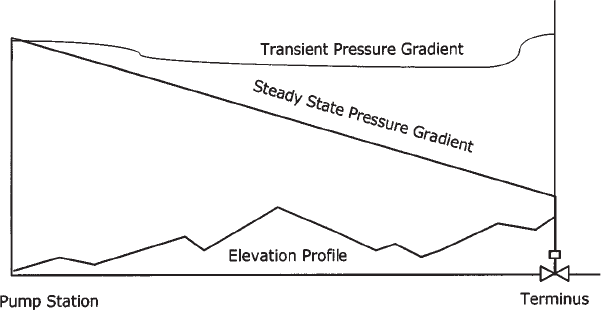
conditions such as pump start up, valve closure, etc. These transient
conditions cause surge pressures in a pipeline and therefore must be taken
into account when selecting optimum wall thickness and pipe grade. This
is illustrated in the modified hydraulic pressure gradient under transient
conditions as depicted in Figure 6.4.
Figure 6.3 Hydraulic gradient: pump station shut-down.
Copyright © 2004 by Marcel Dekker, Inc.
Chapter 6116
6.4 Slack Line and Open Channel Flow
Generally most pipelines flow full with no vapor space or a free liquid
surface. However, under certain topographic conditions with drastic
elevation changes, we may encounter pipeline sections that are partially
full, called open channel flow or slack line conditions. Slack line operation
may be unavoidable in some water lines, refined product and crude oil
pipelines. Such a flow condition cannot be tolerated with high vapor
pressure liquids and in batched pipelines. In the latter there would be
intermingling of batches with disastrous consequences.
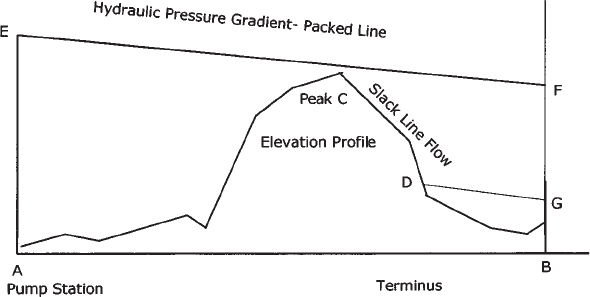
Consider a long pipeline with a very high peak at some point between the
origin A and the terminus B as shown in Figure 6.5. Due to the high
elevation point at C, the pressure at A must be sufficient to take care of the
friction loss between A and C, and the pressure head due to elevation
difference between A and C, and the minimum pressure required at the top
of the hill at C to prevent vaporization of liquid. Once the liquid reaches the
peak at C with the required minimum pressure, the elevation difference
between C and B helps the liquid gain pressure as it flows down the hill from
C to the terminus at B. The frictional pressure drop between C and B has an
opposite effect to the elevation and hence the resultant pressure at the
terminus B will be the difference between the elevation head and the friction
head. If the elevation head between C and B is sufficiently high compared
with the frictional pressure drop between C and B, the final delivery pressure
at B will be higher than the minimum required at the terminus. If the delivery
at B is into an atmospheric storage tank, the hydraulic gradient will be
modified as shown in the dashed line for slack line conditions.
Figure 6.4 Hydraulic gradient: steady-state versus transient.
Copyright © 2004 by Marcel Dekker, Inc.
Multi-Pump Station Pipelines 117
The upper hydraulic gradient depicts a packed line condition where the
delivery pressure at B represented by point F is substantially higher than
that required for delivery into a tank represented by point G. The lower
hydraulic gradient shows that a portion of the pipeline between the peak at
C and a point D will run in a partially full or slack line condition. Every
point in the pipeline between C and D will be at zero gauge pressure. From
D to B the pipe will run full without any slack. The slack line portion CD
of the pipeline where the pipe is only partially full of the liquid is also
referred to as open channel flow.
In this portion of the pipeline both liquid and vapor exists, which is an
undesirable condition especially when pumping high vapor pressure
liquids. Since a minimum pressure has to be maintained at the peak C, to
prevent vaporization, the subsequent open channel flow in section CD of
the pipeline defeats the purpose of maintaining a minimum pressure in the
pipeline. In such instances, the pipeline must be operated in a packed
condition (no slack line or open channel flow) by providing the necessary
back pressure at B using a control valve, thus bringing the hydraulic
gradient back to EF. The control valve at B should have an upstream
pressure equal to the pressure that will produce the packed line hydraulic
gradient showed in Figure 6.5. In crude oil and refined product pipelines
where a single product is transported, slack line can be tolerated. However,
if the pipeline is operated in batched mode with multiple products flowing
simultaneously, slack line cannot be allowed since intermingling and
consequently degradation of the different batches would occur. A batched
pipeline must therefore be operated as a tight line by using a control valve
to create the necessary back pressure to pack the line.
Figure 6.5 Hydraulic gradient: slack line versus packed line.
Copyright © 2004 by Marcel Dekker, Inc.

Chapter 6118
In Figure 6.5, the back pressure valve would maintain the upstream
pressure corresponding to point F on the hydraulic gradient. Downstream
of the valve the pressure would be lower for delivery into a storage tank.
6.5 Batching Different Liquids
Batching is the process of transporting multiple products simultaneously
through a pipeline with minimal mixing. Some commingling of the batches
is unavoidable at the boundary or interface between contiguous batches.
For example, gasoline, diesel, and kerosene may be shipped through a
pipeline in a batched mode from a refinery to a storage terminal. Batched
pipelines have to be run in turbulent mode, with velocities sufficiently high
to ensure a Reynolds number over 4000. If flow were laminar (R<2100),
the product batches would intermingle, thereby contaminating or
degrading the products. Also, as discussed earlier, batched pipelines must
be run in packed conditions (no slack line or open channel flow) to avoid
contamination or intermingling of batches in pipelines with drastic
elevation changes such as the one shown in Figure 6.5.
In a batched pipeline, the total frictional pressure drop for a given flow
rate will be calculated by adding the individual pressure drops for each
product, considering its specific gravity, viscosity, and the batch length.
We will illustrate this using an example.
Example Problem and Solution 6.1
Consider a 16 in. pipeline, 0.250 in. wall thickness, 100 miles long from
Douglas Refinery to Hampton Terminal used to ship three products at a
flow rate of 4000 bbl/hr as shown in Figure 6.6. The three batches shown
represent an instantaneous snapshot condition.
First we calculate the total liquid volume in the pipeline. This is referred
to as the line fill volume. The line fill volume can be calculated using the
following equation:
Line fill volume=5.129L(D)
2
(6.5)
where
D=Pipe internal diameter, in.
L=Pipe length, miles
Figure 6.6 Batched pipeline.
Copyright © 2004 by Marcel Dekker, Inc.
Multi-Pump Station Pipelines 119
In our example,
Line fill=5.129(100)(15.5)
2
=123,224 bbl
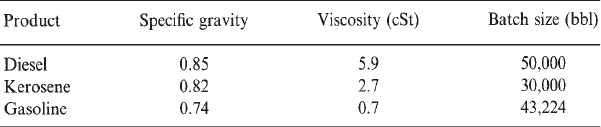
Assuming the following physical properties and batch sizes for the three
liquids, we can calculate the pressure drop for each liquid batch at the
given flow rate:
Using the Colebrook-White equation the frictional pressure drops in the
different batch segments are calculated to be as follows:
Diesel: 10.17 psi/mile Batch length: 40.58 miles
Kerosene: 8.58 psi/mile Batch length: 24.35 miles
Gasoline: 6.56 psi/mile Batch length: 35.07 miles
In the above, for each liquid the pipeline length that represents the batch
volume is shown. Thus the diesel batch will start at milepost 0.0 and end at
milepost 40.58. Similarly the kerosene batch will start at milepost 40.58
and end at milepost (40.58+24.35)=64.93. Finally, the gasoline batch will
start at milepost 64.93 and end at milepost (64.93+35.07)=100.0 for the
snapshot configuration shown in Figure 6.6.
The batch lengths calculated above are based on 1232.24 bbl per mile
of 16 in. pipe calculated using Equation 6.5. The total frictional pressure
drop for the entire 100 mile pipeline is obtained by adding up the
individual frictional pressure drops for each product as follows:
Total pressure drop=10.17(40.58)+8.58(24.35)
+ 6.56(35.07)=851.68 psi.
In addition to the frictional pressure drop, the elevation head and the
delivery pressure are combined to calculate the total pressure required at
Douglas Refinery.
In a batched pipeline, there will be some intermixing of the two
adjacent products, resulting in an interface of commingled product. The
volume of this interface varies with the pipe size, Reynolds number, and
pipe length. Several correlations have been developed to estimate the
amount of contamination in products at the interface.
Copyright © 2004 by Marcel Dekker, Inc.
Chapter 6120
As the batches arrive at the destination, density measuring instruments
or densitometers (or gravitometers) monitor the density (or gravity) and
flow is switched from one tank to another as appropriate. The
contaminated volumes at the batch interface are diverted into a slop tank
and later blended into a lower-grade product.
When batching different products such as gasoline and diesel, flow
rates vary as the batches move through the pipeline, due to the changing
composition of liquid in the pipeline. We will discuss this further in
Chapter 7, when centrifugal pump performance is combined with system
head curves.
In order to operate the batched pipeline economically, by minimizing
pumping cost, there exists an optimum batch size for the various products in
the pipeline system. An analysis needs to be made over a finite period, such
as a week or a month, to determine the flow rates and pumping costs
considering various batch sizes. The combination of batch sizes that results
in the least total pumping cost, consistent with shipper and market demands,
will then be the optimum batch sizes for that particular pipeline system.
6.6 Summary
We have covered hydraulic balance in pipelines with multiple pump
stations and learned that hydraulic balance may not always be possible due
to topographic conditions. We demonstrated an approach to determine the
number of pump stations from the total pressure required, minimum pump
suction pressure, and allowable pump discharge pressure based on pipeline
MAOP. The advantages and cost implications of telescoping wall thickness
and pipe grade tapering were discussed. Slack line and open channel flow
may occur in certain cases but should be avoided in batched pipelines and
when pumping high vapor pressure liquids. Also covered was the method
of calculating hydraulics in a batched pipeline by analyzing a snapshot
configuration of multiple products in a pipeline.
6.7 Problems
6.7.1 A pipeline 150 miles long from Beaumont pump station to a
tank farm at Glendale is used to transport Alaskan North Slope
crude oil (ANS crude). The pipe is 20 in. in outside diameter
and constructed of X-52 steel. It is desired to operate the
system at ANSI 600 pressure level (1440 psi). The pipeline
profile is such that there are two peaks located between
Beaumont and Glendale. The first peak occurs at milepost 65.0
at an elevation of 1500 ft. The second peak is located at
Copyright © 2004 by Marcel Dekker, Inc.
Multi-Pump Station Pipelines 121
milepost 110.0 at an elevation of 2500 ft. Beaumont has an
elevation of 350 ft and Glendale is situated at an elevation of
650 ft. During the initial phase of operation, 6000 bbl/hr of
ANS crude will be pumped at a temperature of 60°F and
delivered to Glendale tankage at a pressure of 30 psi. The
specific gravity and viscosity of ANS crude at 60°F may be
assumed to be 0.895 and 43 cSt respectively.
(a) Determine the minimum wall thickness required to
operate the pipeline system at a pressure of 1400 psi.
(b) At a flow rate of 6000 bbl/hr, how many pump stations
would be required?
(c) During the second phase it is planned to expand the
capacity of pipeline to 9000 bbl/hr. How many additional
pump stations would be required?
(d) Assuming 80% pump efficiency, calculate the total
pumping HP required during the initial phase and under
the expansion scenario. Use a minimum suction pressure
of 50 psi at each pump station.
6.7.2 The pipeline described in Problem 6.7.1 is used to batch ANS
crude along with a light crude (0.85 specific gravity and 15 cSt
viscosity at 60°F). Determine the optimum batch sizes to
reduce pumping costs based on a 30 day operation. Consider a
flow rate of 6000 bbl/hr.
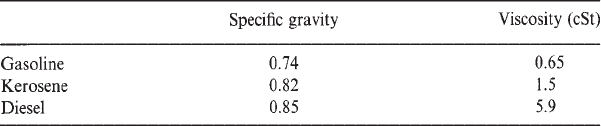
6.7.3 A batched pipeline, 60 km long, is used to ship three grades of
refined products. An instantaneous configuration shows an
8000 m
3
batch of gasoline followed by 10,000 m
3
of diesel, the
remainder of the line consisting of a batch of kerosene. The
pipe size is 500 mm diameter and 10 mm wall thickness and it
traverses essentially flat terrain. Assume 8 MPa for the
operating pressure and a pipeline delivery pressure of 300 kPa.
Calculate the total pressure drop in the pipeline at a flow rate
of 1800 m
3
/hr. The specific gravity and viscosities of the three
products at the flowing temperature of 20°C are:
Copyright © 2004 by Marcel Dekker, Inc.
122
7
Pump Analysis
In this chapter we will discuss centrifugal pumps used in liquid pipelines.
Although other types of pumps such as rotary pumps and piston pumps are
sometimes used, the majority of pipelines today are operated with single-and
multi-stage centrifugal pumps. We will cover the basic design of centrifugal
pumps, their performance characteristics and how the performance may be
modified by changing pump impeller speeds and trimming impellers. We
introduce Affinity Laws for centrifugal pumps, the importance of net
positive suction head (NPSH) and how to calculate horsepower requirements
when pumping different liquids. Also covered is the pump performance
correction for high-viscosity liquids using the Hydraulic Institute chart. We
will also illustrate how the performance of two or more pumps in series or
parallel configuration can be determined and how to estimate the operating
point for a pipeline by using the system head curve.
7.1 Centrifugal Pumps Versus Reciprocating Pumps
Pumps are needed to raise the pressure of a liquid in a pipeline so that the
liquid may flow from the beginning of the pipeline to the delivery terminus
at the required flow rate and pressure. As the flow rate increases more
pump pressure will be required.
Copyright © 2004 by Marcel Dekker, Inc.