
Menon E.S. Liquid Pipeline Hydraulics
Подождите немного. Документ загружается.


Pump Analysis 133
of 1 gal/min. Mathematically, specific speed is defined as
N
S
=NQ
1/2
/H
3/4
(7.3)
where
N
S
=Pump specific speed
N=Pump impeller speed, RPM
Q=Flow rate or capacity, gal/min
H=Head, ft
Both Q and H are measured at the BEP for the maximum impeller
diameter. The head H is measured per stage for a multi-stage pump. Low
specific speed is associated with high-head pumps, while high specific
speed is found with low-head pumps.
Another related term, the suction specific speed, is defined as follows:
N
SS
=NQ
1/2
/(NPSH
R
)
3/4
(7.4)
where
N
SS
=Suction specific speed
N=Pump impeller speed, RPM
Q=Flow rate or capacity, gal/min
NPSH
R
=NPSH required at the BEP
When applying the above equations to calculate the pump specific speed
and suction specific speed, use the full Q value for single or double suction
pumps for N
S
calculation. For N
SS
calculation, use one-half the Q value for
double suction pumps.
Example Problem 7.1
Calculate the specific speed of a five-stage double suction centrifugal pump,
12 in. diameter impeller, that when operated at 3560 RPM generates a head
of 2200 ft at a capacity of 3000 gal/min at the BEP on the head capacity
curve. If the NPSH required is 25 ft, calculate the suction specific speed.
Solution
N
S
=NQ
1/2
/H
3/4
=3560(3000)
1/2
/(2200/5)
3/4
=2030
The suction specific speed is
Copyright © 2004 by Marcel Dekker, Inc.
Chapter 7134
Centrifugal pumps are generally classified as
(a) Radial flow
(b) Axial flow
(c) Mixed flow
Radial flow pumps develop head by centrifugal force. Axial flow pumps
on the other hand develop the head due to the propelling or lifting action of
the impeller vanes on the liquid. Radial flow pumps are used when high
heads are required, while axial flow and mixed flow pumps are mainly
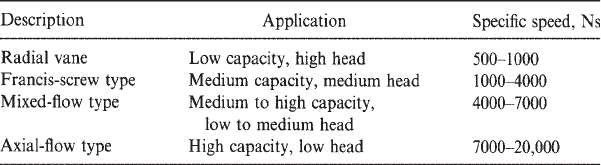
used for low-head/high-capacity applications. Table 7.1 lists the specific
speed range for centrifugal pumps.
7.7 Affinity Laws: Variation with Impeller Speed and
Diameter
Each family of pump performance curves for head, efficiency, and BHP
versus capacity is specific to a particular size of impeller and pump model.
Thus, Figure 7.1 depicts pump performance data for a 10 in. diameter
pump impeller. This particular pump may be able to accommodate a larger
impeller, such as 12 in. in diameter. Alternatively, a smaller, 9 in. impeller
may also be fitted in this pump casing. The range of impeller sizes is
dependent on the pump case design and will be defined by the pump
vendor. Since centrifugal pumps generate pressure due to centrifugal force,
it is clear that a smaller impeller diameter will generate less pressure at a
given flow rate than a larger impeller at the same speed. If the performance
data for a 10 in. impeller is available, we can predict the pump
performance when using a larger or smaller size impeller by means of the
centrifugal pump Affinity Laws.
The same pump with a 10 in. impeller may be operated at a higher or
lower speed to provide higher or lower pressure. Most centrifugal pumps
are driven by constant-speed electric motors. A typical induction motor in
the United States operates at 60 Hz and will have a synchronous speed of
Table 7.1 Specific Speeds of Centrifugal Pumps
Copyright © 2004 by Marcel Dekker, Inc.
Pump Analysis 135
3600 RPM. With some slip, the induction motor would probably run at
3560 RPM. Thus, most constant-speed motor-driven pumps have
performance curves based on 3560 RPM. Some slower-speed pumps
operate at 1700 to 1800 RPM. If a variable-speed motor is used, the pump
speed can be varied from, say, 3000 to 4000 RPM. This variation in speed
produces variable head versus capacity values for the same 10 in. impeller.
Given the performance data for a 10 in. impeller at 3560 RPM, we can
predict the pump performance at different speeds ranging from 3000 to
4000 RPM using the centrifugal pump Affinity Laws as described next.
The Affinity Laws for centrifugal pumps are used to predict pump
performance for changes in impeller diameter and impeller speed.
According to the Affinity Laws, for small changes in impeller diameter the
flow rate (pump capacity) Q is directly proportional to the impeller
diameter. The pump head H, on the other hand, is directly proportional to
the square of the impeller diameter. Since the BHP is proportional to the
product of flow rate and head (see Equation 7.1), BHP will vary as the
third power of the impeller diameter.
The Affinity Laws are represented mathematically as follows:
For impeller diameter change:
Q
2
/Q
1
=D
2
/D
1
(7.5)
H
2
/H
1
=(D
2
/D
1
)
2
(7.6)
where
Q
1
, Q
2
=Initial and final flow rates
H
1
, H
2
=Initial and final heads
D
1
, D
2
=Initial and final impeller diameters
From the H-Q curve corresponding to the impeller diameter D
1
we can
select a set of H-Q values that cover the entire range of capabilities from
zero to the maximum possible. Each value of Q and H on the
corresponding H-Q curve for the impeller diameter D
2
can then be
computed using the Affinity Law ratios per Equations (7.5) and (7.6).
Similarly, Affinity Laws state that for the same impeller diameter, if
pump speed is changed, flow rate is directly proportional to the speed,
while the head is directly proportional to the square of the speed. As with
diameter change, the BHP is proportional to the third power of the impeller
speed. This is represented mathematically as follows:
For impeller speed change:
Q
2
/Q
1
=N
2
/N
1
(7.7)
H
2
/H
1
=(N
2
/N
1
)
2
(7.8)
Copyright © 2004 by Marcel Dekker, Inc.

Chapter 7136
where
Q
1
, Q
2
=Initial and final flow rates
H
1
, H
2
=Initial and final heads
N
1
, N
2
=Initial and final impeller speeds
Note that the Affinity Laws for speed change are exact. However, the
Affinity Laws for impeller diameter change are only approximate and
valid for small changes in impeller sizes. The pump vendor must be
consulted to verify that the predicted values using Affinity Laws for
impeller size changes are accurate or whether any correction factors are
needed. With speed and impeller size changes, the efficiency versus flow
rate can be assumed to be the same.
An example using the Affinity Laws will illustrate how the pump
performance can be predicted for impeller diameter change as well as for
impeller speed change.
Example Problem 7.2
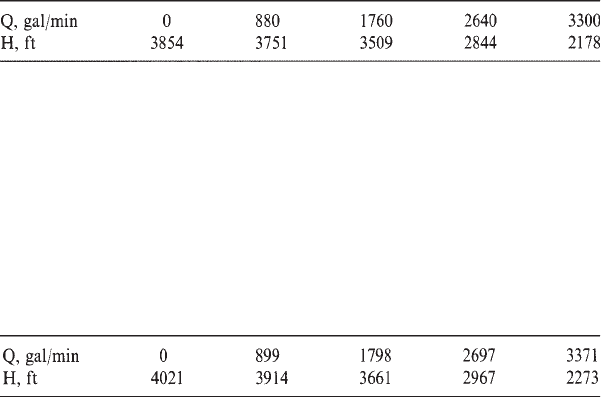
The head and efficiency versus capacity data for a centrifugal pump with a
10 in. impeller is as shown below.
The pump is driven by a constant-speed electric motor at a speed of 3560
RPM.
(a) Determine the performance of this pump with an 11 in. impeller,
using Affinity Laws.
(b) If the pump drive were changed to a variable frequency drive
(VFD) motor with a speed range of 3000 to 4000 RPM, calculate
the new H-Q curve for the maximum speed of 4000 RPM with the
original 10 in. impeller.
Solution
(a) Using Affinity Laws for impeller diameter changes, the multiplying
factor for flow rate is factor=11/10=1.1 and the multiplier for head is
(1.1)
2
=1.21. Therefore, we will generate a new set of Q and H values for
the 11 in. impeller by multiplying the given Q values by the factor 1.1 and
the H values by the factor 1.21 as follows:
Copyright © 2004 by Marcel Dekker, Inc.
Pump Analysis 137
The above flow rate and head values represent the predicted performance
of the 11 in. impeller. The efficiency versus flow rate curve for the 11 in.
impeller will be approximately the same as that of the 10 in. impeller.
(b) Using Affinity Laws for speeds, the multiplying factor for the flow
rate is factor=4000/3560=1.1236 and the multiplier for head is
(1.1236)
2
=1.2625. Therefore we will generate a new set of Q and H values
for the pump at 4000 RPM by multiplying the given Q values by the factor
1.1236 and the H values by the factor 1.2625 as follows:
The above flow rates and head values represent the predicted
performance of the 10 in. impeller at 4000 RPM. The new efficiency
versus flow rate curve will be approximately the same as the given curve
for 3560 RPM.
Thus, using Affinity Laws, we can determine whether we should
increase or decrease the impeller diameter to match the requirements of
flow rate and head for a specific pipeline application.
For example, suppose hydraulic calculations for a particular pipeline
indicate we need a pump that can provide a head of 2000 ft at a flow rate
of 2400 gal/min. The data for the pump in Example Problem 7.2 shows
that a 10 in. impeller produces 2350 ft head at a flow rate of 2400 gal/
min. If this is a constant-speed pump, it is clear that in order to get 2000
ft head, the current 10 in. impeller needs to be trimmed in diameter to
reduce the head from 2350 ft to the 2000 ft required. The Example
Problem 7.4 below will illustrate how the amount of impeller trim is
calculated.
7.8 Effect of Specific Gravity and Viscosity on Pump
Performance
The performance of a pump as reported by the pump vendor is always
based on water as the pumped liquid. Hence the head versus capacity
curve, the efficiency versus capacity curve, BHP versus capacity curve,
Copyright © 2004 by Marcel Dekker, Inc.

Chapter 7138
and NPSH required versus capacity curve are all applicable only when the
liquid pumped is water (specific gravity of 1.0) at standard conditions,
usually 60°F. When pumping a liquid such as crude oil with specific
gravity of 0.85 or a refined product such as gasoline with a specific gravity
of 0.74, both the H-Q and E-Q curves may still apply for these products if
the viscosities are sufficiently low (less than 4.3 cSt for small pumps up to
100 gal/min capacity and less than 40 SSU for larger pumps up to 10,000
gal/min) according to Hydraulic Institute standards. Since BHP is a
function of the specific gravity, from Equation (7.1) it is clear that the BHP
versus flow rate will be different for other liquids compared with water. If
the liquid pumped has a higher viscosity, in the range of 4.3 to 3300 cSt,
the head, efficiency, and BHP curves based on water must all be corrected
for the high viscosity. The Hydraulic Institute has published viscosity
correction charts that can be applied to correct the water performance
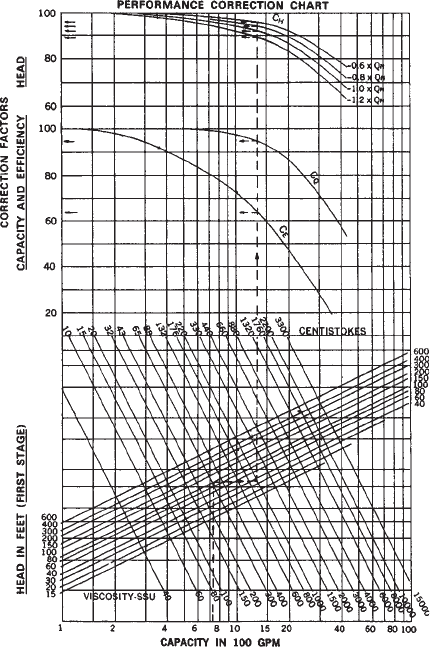
curves to produce viscosity-corrected curves. See Figure 7.9 for details of
this chart. For any application involving high-viscosity liquids, the pump
vendor should be given the liquid properties. The viscosity-corrected
performance curves will be supplied by the vendor as part of the pump
proposal. As an end user you may also use these charts to generate the
viscosity-corrected pump curves.
The Hydraulic Institute method of viscosity correction requires
determining the BEP values for Q, H, and E from the water performance
curve. This is called the 100% BEP point. Three additional sets of Q, H,
and E values are obtained at 60%, 80%, and 120% of the BEP flow rate
from the water performance curve. From these four sets of data, the
Hydraulic Institute chart can be used to obtain the correction factors C
q
, C
h
,
and C
e
for flow, head, and efficiency for each set of data. These factors are
used to multiply the Q, H, and E values from the water curve, thus
generating corrected values of Q, H, and E for 60%, 80%, 100%, and
120% BEP values. Example Problem 7.3 illustrates the Hydraulic Institute
method of viscosity correction. Note that for multi-stage pumps, the values
of H must be per stage.
Example Problem 7.3
The water performance of a single-stage centrifugal pump for 60%, 80%,
100%, and 120% of the BEP is as shown below:
Copyright © 2004 by Marcel Dekker, Inc.
Pump Analysis 139
Calculate the viscosity-corrected pump performance when pumping oil with a
specific gravity of 0.90 and a viscosity of 1000 SSU at pumping temperature.
Solution
By inspection, the BEP for this pump curve is
Q=750
H=100
E=82
We first establish the four sets of capacities to correspond to 60%, 80%,
100%, and 120%. These have already been given as 450, 600, 750, and
Figure 7.9 Viscosity correction chart. (Courtesy of Hydraulic Institute, Parsippany,
NJ; www.pumps.org.)
Copyright © 2004 by Marcel Dekker, Inc.
Chapter 7140
900 gal/min. Since the head values are per stage, we can directly use the
BEP value of head along with the corresponding capacity to enter the
Hydraulic Institute viscosity correction chart at 750 gal/min on the lower
horizontal scale, go vertically from 750 gal/min to the intersection point on
the line representing the 100 ft head curve and then horizontally to
intersect the 1000 SSU viscosity line, and finally vertically up to intersect
the three correction factor curves C
e
, C
q
, and C
h
.
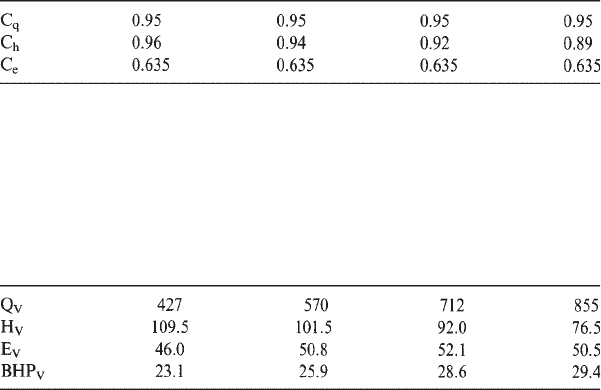
From the Hydraulic Institute chart of correction factors (Figure 7.9) we obtain
the values of C
q
, C
h
, and C
e
for flow rate, head, and efficiency as follows:
corresponding to Q values of 450 (60% of Q
NW
), 600 (80% of Q
NW
), 750
(100% of Q
NW
), and 900 (120% of Q
NW
). The term Q
NW
is the BEP flow
rate from the water performance curve.
Using these correction factors, we generate the Q, H, and E values for
the viscosity-corrected curves by multiplying the water performance value
of Q by C
q
, H by C
h
, and E by C
e
and obtain the following result:
The last row of values for viscous BHP was calculated using Equation
(7.1) as follows:
BHP
V
=(Q
V
)(H
V
)0.9/(39.60×E
V
) (7.9)
where Q
V
, H
V
, and E
V
are the viscosity-corrected values of capacity, head,
and efficiency tabulated above.
Note that when using the Hydraulic Institute chart for obtaining the
correction factors, two separate charts are available. One chart applies to
small pumps up to 100 gal/min capacity and head per stage of 6 to 400 ft.
The other chart applies to larger pumps with capacity between 100 and
10,000 gal/min and head range of 15 to 600 ft per stage. Also, remember
that when data is taken from a water performance curve, the head has to be
corrected per stage, since the Hydraulic Institute charts are based on head
in ft per stage rather than the total pump head. Therefore, if a six-stage
Copyright © 2004 by Marcel Dekker, Inc.

Pump Analysis 141
pump has a BEP at 2500 gal/min and 3000 ft of head with an efficiency of
85%, the head per stage to be used with the chart will be 3000 divided by
6=500 ft. The total head (not per stage) from the water curve can then be
multiplied by the correction factors from the Hydraulic Institute charts to
obtain the viscosity-corrected head for the six-stage pump.
7.9 Pump Curve Analysis
So far we have discussed the performance of a single pump. When
transporting liquid through a pipeline we may need to use more than one pump
at a pump station to provide the necessary flow rate or head requirement.
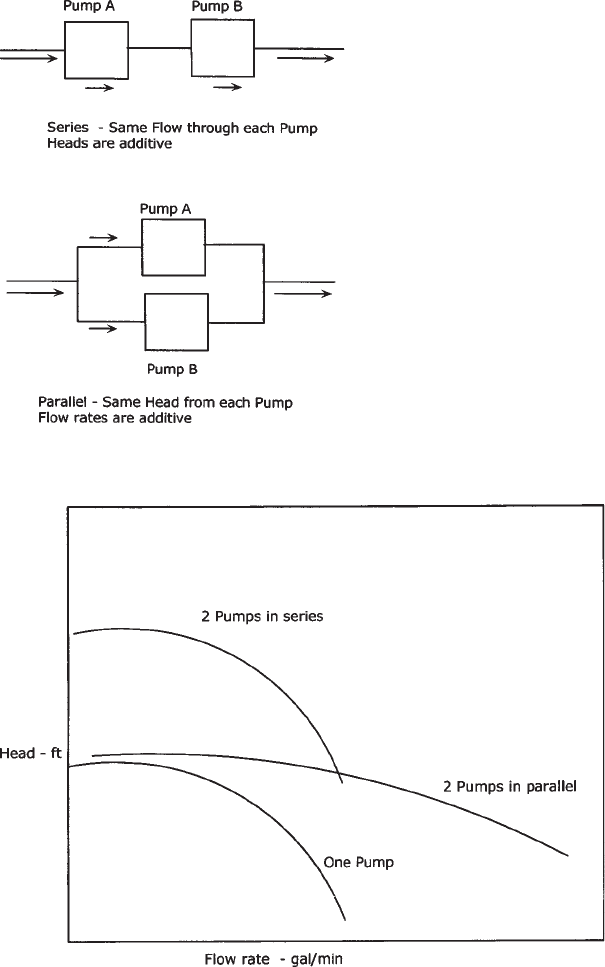
Pumps may be operated in series or parallel configurations. Series pumps are
generally used for higher heads and parallel pumps for increased flow rates.
For example, let us assume that pressure drop calculations indicate that
the originating pump station on a pipeline requires 900 psi differential
pressure to pump 3000 gal/min of gasoline with specific gravity 0.736.
Converting to customary pump units we can state that we require a pump
that can provide the following:
at 3000 gal/min flow rate. We have two options here. We could select from
a pump vendors catalog one large pump that can provide 2825 ft head at
3000 gal/min or select two smaller pumps that can provide 1413 ft at 3000
gal/ min. We would use these two smaller pumps in series to provide the
required head, since for pumps operated in series the same flow rate goes
through each pump and the resultant head is the sum of the heads
generated by each pump. Alternatively, we could select two pumps that can
provide 2825 ft at 1500 gal/min each. In this case these pumps would be
operated in parallel. In parallel operation, the flow rate is split between the
pumps, while each pump produces the same head. Series and parallel
pump configuration are illustrated in Figure 7.10.
The choice of series or parallel pumps for a particular application
depends on many factors, including pipeline elevation profile, as well as
operational flexibility. Figure 7.11 shows the combined performance of
two identical pumps in series, versus parallel configuration. It can be seen
that parallel pumps are used when we need larger flows. Series pumps are
used when we need higher heads than each individual pump. If the pipeline
elevation profile is essentially flat, the pump pressure is required mainly to
overcome the pipeline friction. On the other hand, if the pipeline has
drastic elevation changes, the pump head generated is mainly for the static
Copyright © 2004 by Marcel Dekker, Inc.
Chapter 7142
Figure 7.10 Pumps in series and parallel.
Figure 7.11 Pump performance: series and parallel.
Copyright © 2004 by Marcel Dekker, Inc.