
Mitin V.V., Sementsov D.I., Vagidov N.Z. Quantum mechanics for nanostructures
Подождите немного. Документ загружается.

7.5 Double-quantum-dot structures (artificial molecules) 223
0
d
E
x
(1)
E
x
(0)
E
x
,U
0
2L
x
E
x
(0)
4
1
E
x
U = U =
x
E
x
(2)
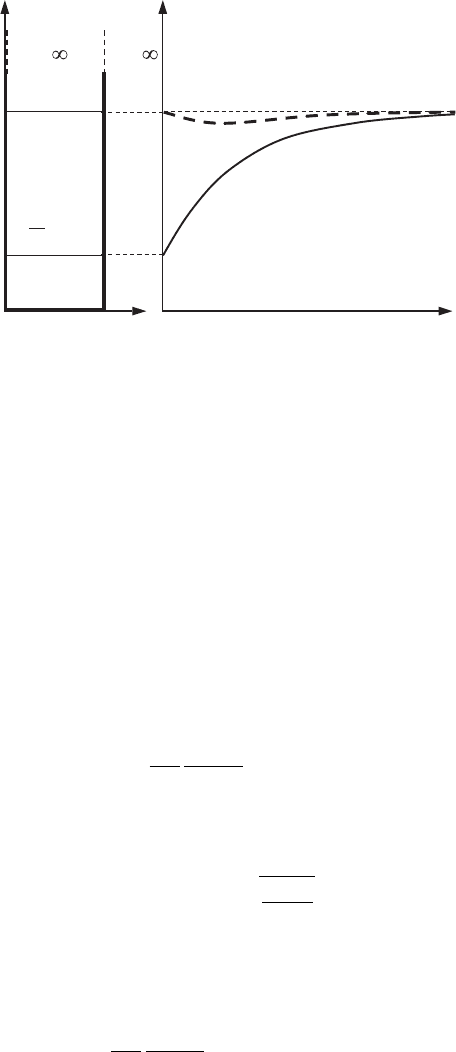
Figure 7.15 The
dependences of the
energies of the
symmetric, E
(1)
x
,and
antisymmetric, E
(2)
x
, states
of the double-
quantum-dot structure on
the width of the barrier, d,
separating individual
quantum dots.
in the structure with two coupled quantum dots are in the state of lowest energy,
then the wavefunction must be symmetric. The electrons in quantum dots in this
state are considered to be in phase. If the electrons are in the state with higher
energy, then the wavefunction must be antisymmetric. The electrons in quantum
dots in such a state are considered to be out of phase.
7.5.2 Double-quantum-dot structures: exact solution
According to Fig. 7.13, for each of the three regions of the symmetric structure
we can write the Schr¨odinger equation and its solution. Here, to simplify the
calculations, we assume that the electron effective mass, m
∗
, in the potential
wells and that in the barriers are the same. We will use this assumption for all
subsequent calculations. For the regions 1 and 3, where d ≤|x|≤d + L
x
,we
have
−
h
-
2
2m
∗
d
2
ψ
j
(x )
dx
2
= E
x
ψ
j
(x ), (7.98)
ψ
j
(x ) = A
j
e
ikx
+ B
j
e
−ikx
, (7.99)
where j = 1, 3 and
k =
2m
∗
E
x
h
-
2
. (7.100)
Let us assume that for the region |x|≤d with j = 2 the electron energy, E
x
,
is smaller than the height of the potential barrier, U
0
. Then, the Schr¨odinger
equation and its solution can be written in the form
−
h
-
2
2m
∗
d
2
ψ
2
(x )
dx
2
+U
0
ψ
2
(x ) = E
x
ψ
2
(x ), (7.101)
ψ
2
(x ) = A
2
e
κx
+ B
2
e
−κx
, (7.102)
224 Quantization in nanostructures
where we introduced the parameter κ:
κ =
2m
∗
(U
0
− E
x
)
h
-
2
. (7.103)
The boundary conditions for this structure are
ψ
1
(−d − L
x
) = ψ
3
(d + L
x
) = 0, (7.104)
ψ
1
(−d) = ψ
2
(−d), (7.105)
ψ
3
(d) = ψ
2
(d), (7.106)
dψ
1
dx
−
dψ
2
dx
x=−d
= 0, (7.107)
dψ
3
dx
−
dψ
2
dx
x=d
= 0. (7.108)
Equation (7.104) reflects the inability of the electron to escape the considered
region and Eqs. (7.105)–(7.108) reflect the continuity of the wavefunction and
its derivative at the boundaries of the potential barrier U
0
. On substituting the
expressions for the wavefunction (7.99) and (7.102) into Eqs. (7.104)–(7.108)
we obtain two dispersion relations:
tan(kL
x
) +
k
κ
coth(κd) = 0, (7.109)
tan(kL
x
) +
k
κ
tanh(κd) = 0, (7.110)
where we introduced the hyperbolic functions tanh and coth:
tanh α =
1
coth α
=
e
α
− e
−α
e
α
+ e
−α
. (7.111)
The dispersion relation (7.109) corresponds to the symmetric states and the
dispersion relation (7.110) to the antisymmetric states. For sufficiently large
distances between the quantum dots, i.e., at κd 1, dispersion relations are
reduced to one, namely to
tan(kL
x
) ≈−
k
κ
=−
E
x
U
0
− E
x
. (7.112)
For the first two deepest levels at E
x
U
0
we obtain from Eq. (7.112)
kL
x
≈ π (7.113)
and, on substituting Eq. (7.100) into Eq. (7.113), we get
E
(1,2)
x
≈
π
2
h
-
2
2m
∗
L
2
x
= E
(0)
x
. (7.114)
Therefore, when the potential wells are positioned far away from each other,
i.e., when d →∞, the levels that correspond to the symmetric wavefunction,
ψ
s
, and the antisymmetric wavefunction, ψ
a
, merge, as shown in Fig. 7.15.
7.5 Double-quantum-dot structures (artificial molecules) 225
U = U =
a
s
2d
x
x
, E
x
, U
0
U
0
−d − L
x
−ddd+Lx
E
x
(2)
E
x
(1)
E
x
> U
0
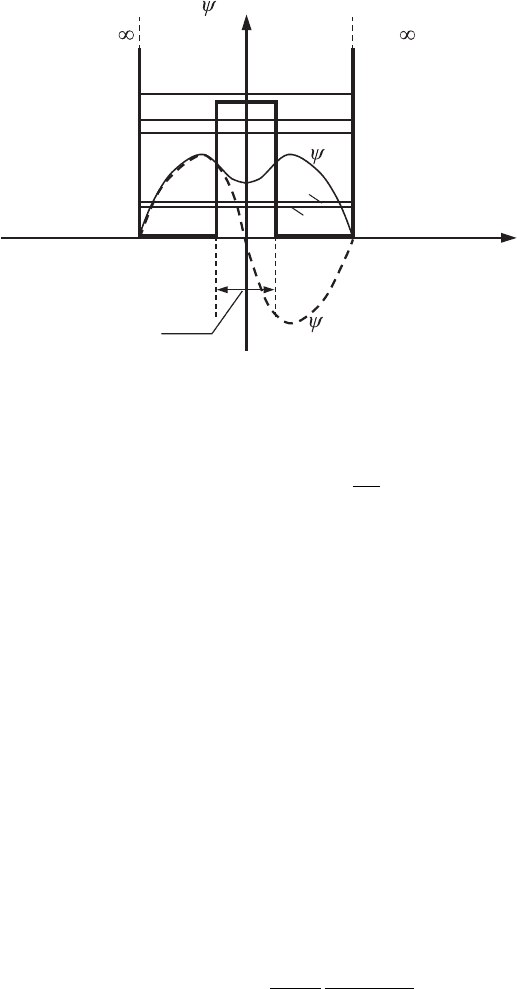
Figure 7.16 The
wavefunctions of a
double-quantum-dot
structure, ψ
s
and ψ
a
,
when the quantum dots
are close to each other.
In the case of a narrow barrier (see Fig. 7.16), i.e., at κd 1, the dispersion
equations (7.109) and (7.110) become
tan(kL
x
) =−
k
κ
2
d
, (7.115)
tan(kL
x
) =−kd. (7.116)
Equation (7.115) corresponds to the symmetric state and Eq. (7.116)tothe
antisymmetric state. Let us rewrite Eq. (7.116)as
kL
x
= arctan(−kd). (7.117)
In the case of small d (i.e., at kd 1) we can obtain from Eq. (7.117)the
dependence of the energy of the antisymmetric state on the distance between the
quantum dots, d. We can expand the right-hand side of Eq. (7.117)inaTaylor
series taking into account only its first two terms. Using this approximation,
arctan t can be written as
arctan t =π+ t. (7.118)
Taking into account Eq. (7.118), we can rewrite Eq. (7.117)as
kL
x
= π − kd. (7.119)
By substituting into Eq. (7.119) the expression for k from Eq. (7.100), we find
E
(2)
x
≈
π
2
h
-
2
2m
∗
L
2
x
1
(1 +d/L
x
)
2
. (7.120)
We see that at d = 0 the energy of the antisymmetric state becomes equal to
the energy of the first excited level of an individual quantum dot with width 2L
x
and the electron wavefunction becomes an antisymmetric function, ψ
a
,ofthe

226 Quantization in nanostructures
individual quantum dot of width 2L
x
(see Fig. 7.14):
E
(2)
x
≈
π
2
h
-
2
2m
∗
L
2
x
= E
(0)
x
. (7.121)
As the distance between quantum dots, d, increases the level E
(2)
x
slightly
decreases, but with further increase of d the level E
(2)
x
tends to E
(0)
x
according to
Eq. (7.114). The dependence of E
(1)
x
, which corresponds to the symmetric state,
on d isshowninFig.7.15, but it can be obtained only by numerical solution of
Eq. (7.109). In the limiting case when d = 0, from Eq. (7.115) it follows that
kL =
π
2
(7.122)
and
E
(1)
x
=
E
(0)
x
4
. (7.123)
Let us consider now the case when the electron energy of motion along the x-
axis in the double-quantum-dot structure is greater than the height of the potential
barrier, U
0
, which separates the potential wells (E
x
> U
0
). The solutions of the
Schr¨odinger equation for regions 1 and 3 have the same form (7.99), and the
solution in region 2 can be written as
ψ
2
(x ) = A
2
e
ik
2
x
+ B
2
e
−ik
2
x
, (7.124)
where
k
2
=
2m
∗
(E
x
−U
0
)
h
-
2
. (7.125)
Compare Eqs. (7.124) and (7.125) with the corresponding Eqs. (7.102) and
(7.103). After substitution of the wavefunctions ψ
j
(x) into the boundary con-
ditions (7.104)–(7.108) we arrive at the following dispersion relations, which
define the energy spectrum of an electron in the quantum-dot structure:
tan(kL
x
) −
k
k
2
cot(k
2
d) = 0, (7.126)
tan(kL
x
) +
k
k
2
tan(k
2
d) = 0, (7.127)
where Eq. (7.126) corresponds to the allowed symmetric states and Eq. (7.127)
to the allowed antisymmetric states. Compare Eqs. (7.126) and (7.127) with the
corresponding Eqs. (7.109) and (7.110).
Finding the general analytical solutions of Eqs. (7.126) and (7.127) is impos-
sible because these are transcendental equations. Therefore, let us consider one
of the possible particular solutions of Eqs. (7.126) and (7.127). Let us assume
that in the region of the quantum dots, 1 and 3, as well as in the region of the
barrier, 2, the electron waves are de Broglie standing waves. For the formation

7.5 Double-quantum-dot structures (artificial molecules) 227
of these waves the following conditions must be satisfied:
k
2
d = mπ and kL
x
=
n +
1
2
π (7.128)
for the symmetric states and
k
2
d = mπ and kL
x
= nπ (7.129)
for the antisymmetric states. Therefore, if condition (7.128) is satisfied the energy
of the stationary symmetric state must be equal to
E
s
x
=
π
2
h
-
2
2m
∗
L
2
x
n +
1
2
2
= U
0
+
π
2
h
-
2
2m
∗
d
2
m
2
. (7.130)
Here, we took into account that the equation for kinetic energy is defined as
E =
h
-
2
k
2
2m
∗
.
We see that m = 1 corresponds to the lowest above-barrier energy state. This
state may exist if the height of the potential barrier is equal to
U
0
=
π
2
h
-
2
2m
∗
(n + 1/2)
2
L
2
x
−
1
d
2
. (7.131)
For the energy of antisymmetric states, from condition (7.129) we get
E
a
x
=
π
2
h
-
2
2m
∗
L
2
x
n
2
= U
0
+
π
2
h
-
2
2m
∗
d
2
m
2
. (7.132)
The lowest energy value corresponds to m = 1. This state can be realized if the
barrier height is equal to
U
0
=
π
2
h
-
2
2m
∗
n
2
L
2
x
−
1
d
2
. (7.133)
Thus, different barrier heights correspond to symmetric and antisymmet-
ric above-barrier states (see Eqs. (7.131) and (7.133)). If the conditions of
Eqs. (7.131) and (7.133) are satisfied only one of these states can be realized.
From the discussion above it follows that by controlling the height and width
of the barrier we can shift the allowed energy levels and change the distance
between them.
From Eqs. (7.130) and (7.132) it follows that for a particular set of nanos-
tructure parameters the realization of the above-barrier regime with symmetric
or antisymmetric states, defined by quantum numbers n and m, is possible only
if one of the following conditions is satisfied:
d >
m
n + 1/2
L
x
, or d >
m
n
L
x
. (7.134)
Example 7.6. Apart from under conditions (7.128) and (7.129), the station-
ary above-barrier states in a double-quantum-dot structure are possible also at

228 Quantization in nanostructures
k
2
d = (m + 1/2)π . Find the lowest energy for the above-barrier symmetric and
antisymmetric states.
Reasoning. For symmetric states, according to Eq. (7.129), the condition kL
x
=
nπ must be satisfied. Then, we have
E
s
x
=
π
2
h
-
2
2m
∗
L
2
x
n
2
= U
0
+
π
2
h
-
2
2m
∗
d
2
m +
1
2
2
. (7.135)
For antisymmetric states the condition kL
x
= (n + 1/2)π must be satisfied.
Then, we have
E
a
x
=
π
2
h
-
2
2m
∗
L
2
x
n +
1
2
2
= U
0
+
π
2
h
-
2
2m
∗
d
2
m +
1
2
2
. (7.136)
From Eqs. (7.135) and (7.136) it follows that in the case considered here the
realization of the above-barrier regime is possible only if one of the following
conditions is satisfied:
d >
m + 1/2
n
L
x
or d >
m + 1/2
n + 1/2
L
x
(7.137)
for symmetric and antisymmetric states, respectively. The lowest possible energy
of the symmetric states corresponds to m = 0 and n = 1, and that of antisymmet-
ric states corresponds to m = 0. The above-barrier symmetric state has energy
greater than that of the antisymmetric state.
Example 7.7. Write the expressions for the wavefunction and the electron energy
for double-quantum-wire and double-quantum-well structures.
Reasoning. From the nanostructures of two coupled quantum dots considered
above we can remove the restriction along one of the directions of quantization.
For example, along the y-direction we can remove the restriction for electron
motion by increasing infinitely the length L
y
. Then, the electron motion in this
direction will be free. As a result we will obtain a nanostructure consisting of
two coupled quantum wires. For an electron in such a structure the wavefunction
and energy can be written as
ψ(x, y, z) =
2
L
z
sin
πn
z
z
L
z
e
ik
y
y
ψ
x
(x ), (7.138)
E = E
x
+
h
-
2
k
2
y
2m
∗
+
h
-
2
π
2
n
2
z
2m
∗
L
2
z
, (7.139)
where ψ
x
(x) and E
x
are defined by the solutions of the one-dimensional
Schr¨odinger equation for the potential U(x) which we have already obtained.
If we remove one more restriction for electron motion along the z-direction by
increasing infinitely the length L
z
, then we will obtain a nanostructure consisting
of two coupled quantum wells. The electron wavefunction and the energy for
such a nanostructure have the forms
ψ(x, y, z) = ψ
x
(x )e
i(k
y
y+k
z
z)
, (7.140)
E = E
x
+
h
-
2
2m
∗
k
2
y
+ k
2
z
. (7.141)
7.6 An electron in a periodic one-dimensional potential 229
The electron motion remains quantized only along the x-axis and electron motion
in the yz-plane is free. The forms of the one-dimensional wavefunction ψ
x
(x)
and energy E
x
are completely defined by the form of the potential U(x). For the
dependence U (x) defined by Eq. (7.92) the wavefunction ψ
x
(x) and energy E
x
have already been found earlier in this section.
7.6 An electron in a periodic one-dimensional potential
The most important structures which are suitable for practical applications whilst
still being simple enough for theoretical analysis are periodic structures consist-
ing of coupled nanoobjects such as quantum dots, quantum wires, or quan-
tum wells. There is a conventional name for periodic structures of repeat-
ing quantum wells. They are called superlattices. The origin of this name
is that each of the quantum wells which are the elements of the periodic
structure has its own lattice and in the superlattice the ordering of quantum
wells is superimposed on the lattice of quantum wells. Therefore it is not
simply a lattice but a superlattice. We can generalize this notion and under-
stand under the term “superlattice” those periodic structures which include not
only quantum wells but, instead of quantum wells, other nanoobjects such as
nanowires or quantum dots. From the point of view of finding solutions of the
Schr¨odinger equation, one-dimensional superlattices, which can be formed by
placing nanoobjects regularly along one of the directions, are the simplest. In
this section we will consider the general properties of electron behavior in a one-
dimensional superlattice, which do not depend on the particular form of a periodic
potential.
7.6.1 Bloch’s theorem
Let us consider the general form of the wavefunction of an electron moving in a
periodic potential (of period D) of a one-dimensional superlattice. The condition
of periodicity of the potential, which has the form
U (x + nD) = U (x), (7.142)
leads to the condition of translational invariance for the electron wavefunction
in the superlattice:
|ψ(x + nD)|
2
=|ψ (x)|
2
. (7.143)
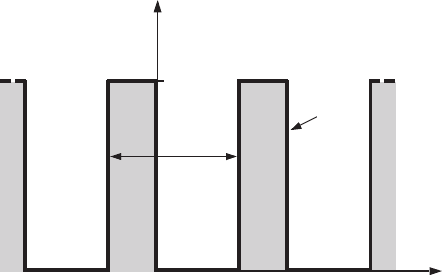
Here n is an arbitrary integer number. The simplest example of a step-like one-
dimensional periodic potential is shown in Fig. 7.17. The last expression shows
that the probability density of finding an electron at the point with the coordinate
x is a periodic function with the period D.
230 Quantization in nanostructures
U
x
0
AB
D
AABBB
U
0
U(x)
L
x
−d d + L
x
−d − L
x
Figure 7.17 The simplest
example of a
one-dimensional step-like
periodic potential. A
denotes the material of
the potential wells and B
the material of the
barriers which separate
potential wells. D is the
superlattice period, U
0
the
height of the barriers, d
the width of the barriers,
and L
x
the width of the
quantum wells.
The wavefunctions ψ(x) and ψ(x + nD) satisfy the same Schr¨odinger equa-
tion with the potential (7.142). Therefore, these functions must be linearly depen-
dent:
ψ(x + nD) = C (nD)ψ(x). (7.144)
From condition (7.143) it follows that
|C(nD)|
2
= 1, (7.145)
and from Eq. (7.145)wehave
C(nD) = e
iK
x
nD
, (7.146)
where K
x
is a real parameter, which has the dimension of the wavenumber.
Thus, the shift of the wavefunction’s argument, x,bynD changes the electron
wavefunction as follows:
ψ(x + nD) = e
iK
x
nD
ψ(x). (7.147)
Let us make the following transformations in Eq. (7.147):
ψ(x) = e
−iK
x
nD
ψ(x + nD) = e
−iK
x
(x +nD)
ψ(x + nD)e
iK
x
x
= ϕ(x + nD)e
iK
x
x
= ϕ(x)e
iK
x
x
. (7.148)
Here we introduced the periodic function
ϕ(x + nD) = e
−iK
x
(x +nD)
ψ(x + nD), (7.149)
which satisfies the following condition:
ϕ(x + nD) = ϕ(x). (7.150)
Note that, according to Eq. (7.150), ϕ(x) is a periodic function, whereas only
the square of the modulus of the function ψ(x), i.e., |ψ (x)|
2
, is periodic

7.6 An electron in a periodic one-dimensional potential 231
(see Eq. (7.143)). The wavefunction ψ (x) itself is a product of a periodic function
ϕ(x) and a free-electron wavefunction, e
iK
x
x
.
Thus, the electron wavefunction, ψ(x), in the periodic potential of a super-
lattice always can be presented as a wavefunction of a free electron, e
iK
x
x
,
modulated by a periodic function, ϕ(x), i.e.,
ψ(x) = ϕ(x)e
iK
x
x
, (7.151)
where the parameter K
x
is an effective wavenumber (and in the general case it is
an effective wavevector) of an electron in a superlattice. This statement constitutes
Bloch’s theorem. The wavefunction (7.151) is called Bloch’s wavefunction.The
wavefunction (7.151) must satisfy the following cyclic boundary conditions:
ψ(x + L
x
) = ψ(x), (7.152)
where L
x
is the superlattice length in the x-direction. The superlattice length,
L
x
, contains a sufficiently large number of superlattice periods, D.Fromthis
condition, taking into account Eq. (7.151), it follows that the wavenumber, K
x
,
must have discrete values:
K
x
=
2π
L
x
l, l = 0, ±1, ±2,... (7.153)
The momentum of the particle p is related to the effective wavevector K as
p = h
-
K, and in the case of one-dimensional motion we have
p
x
= h
-
K
x
=
2π h
-
L
x
l. (7.154)
7.6.2 Quasimomentum
For free electron motion the magnitudes k and p are well defined, in contrast
to the case for electron motion in a superlattice, for which k and p are not
unambiguously defined, which is a consequence of the periodicity of U (x). Let
us change the wavenumber K by K
= K + 2πl/D, where l is an integer number.
Here we have omitted the subscript x from the wavevector K
x
for convenience.
Let us translate the wavefunction, ψ(x)bynD according to Eq. (7.147):
ψ(x + nD) = e
iKnD
ψ(x) = e
i
[
K
−2πl/D
]
nD
ψ(x) = e
iK
nD
ψ(x)e
−i2πln
= e
iK
nD
ψ(x),
(7.155)
where we took into account that the product ln is an integer number and
e
−i2πln
= 1. (7.156)
From a comparison of Eqs. (7.155) and (7.147) it follows that the electron
quantum states with wavenumbers K and K
= K + 2πl/D in the superlattice
correspond to the same physical state. Because of this equivalence for the electron
in the superlattice the magnitude K is called the quasiwavevector rather than just

232 Quantization in nanostructures
the wavevector. We can also talk about the physical equivalence of the states with
magnitudes of momentum in the superlattice p and p + 2πl/D. Therefore, p is
called the quasimomentum.
In Chapter 2 it was shown that for a free particle the principle of conservation
of momentum p holds. This is due to the translational homogeneity of free space
(of vacuum). In the superlattice the homogeneity of space is broken because
the potential energy of the electron becomes a periodic function. The existence
of a periodic potential in the superlattice leads to the conservation not of the
momentum of the electron but of its quasimomentum. Thus, for the electron’s
quasimomentum Newton’s second law is valid:
dp
dt
= F
ext
, (7.157)
where the force F
ext
is related to the external fields and does not include the
periodic force F
SL
related to the superlattice potential, U(r), by
F
SL
=−∇U(r). (7.158)
The interval of quasimomenta which contains all physically non-equivalent states
is symmetric relative to the origin of the coordinates, i.e.,
−
π h
-
D
≤ p ≤
π h
-
D
. (7.159)
This interval is called the first Brillouin zone. The second zone is located sym-
metrically with respect to the first zone with respect to the origin of coordinates.
It includes two intervals:
−
2π h
-
D
, −
π h
-
D
and
π h
-
D
,
2π h
-
D
. (7.160)
Then, the third Brillouin zone is located similarly and so on. The width of the
interval which corresponds to any Brillouin zone is always equal to 2π h
-
/D.
Let us now discuss what values the quasiwavevector K = p/h
-
, which defines
the boundaries of the Brillouin zone, may have. Let us assume that an electron
with wavevector K is moving along the x-direction and that the period of the
superlattice in this direction is equal to D. Let us assume that the interaction
of the electron with an individual nanoobject of the superlattice is weak.This
means that during propagation of the electron wave in the periodic potential of the
superlattice the amplitude of the reflected wave from an individual nanoobject
is much smaller than the amplitude of the incident electron wave. Since the
superlattice contains many nanoobjects, the phase relationships between the
reflected waves play a significant role. If the electron de Broglie wavelength
exceeds the distance between nanoobjects, i.e., exceeds the period D, then the
phase difference between the waves reflected from neighboring objects is small.