
Mitin V.V., Sementsov D.I., Vagidov N.Z. Quantum mechanics for nanostructures
Подождите немного. Документ загружается.


7.7 A one-dimensional superlattice of quantum dots 243
A
1
, and B
1
from Eq. (7.195):
A
1
+ B
1
= A + B,
k
1
(A
1
− B
1
) = k(A − B),
e
iKD
(A
1
e
−ik
1
d
+ B
1
e
ik
1
d
) = Ae
ikL
+ Be
−ikL
,
k
1
e
iKD
(A
1
e
−ik
1
d
− B
1
e
ik
1
d
) = k(Ae
ikL
− Be
−ikL
).
(7.201)
This system of equations has a non-zero solution only if the determinant of this
system is equal to zero. This condition leads to the following dispersion equation,
which relates the parameter K to the known parameters k
1
, k, L, and d:
y
2
− 2Fy + 1 = 0, (7.202)
where we introduced the variable
y = e
iKD
(7.203)
and
F = cos(kL)cos(k
1
d) −
k
2
+ k
2
1
2kk
1
sin(kL)sin(k
1
d). (7.204)
For two roots of the quadratic equation (7.202) the following equalities (Vi`ete’s
formulae) apply:
y
1
y
2
= 1 (7.205)
and
y
1
+ y
2
= 2F. (7.206)
From Eq. (7.205) it follows that
y
1
= e
iKD
(7.207)
and
y
2
= e
−iKD
. (7.208)
Using Eqs. (7.202) and (7.206)–(7.208), the dispersion equation for the super-
lattice may be written as follows:
cos(KD) = cos(kL)cos(k
1
d) −
k
2
+ k
2
1
2kk
1
sin(kL)sin(k
1
d). (7.209)
Equation (7.209) describes the above-barrier regime of electron motion in the
superlattice since it was derived for E ≥ U
0
and for real wavenumbers k
1
.We
considered the general properties of such motion in Section 7.6.4 for a small-
amplitude periodic potential of arbitrary profile, i.e., in the case of weak coupling
of the electron with the individual quantum dots.
The opposite situation in which the electron has the energy E < U
0
and may
be localized in the region of an individual quantum dot is much more interest-
ing. As quantum dots are moved closer to each other they form a superlattice.
Owing to tunneling through the potential barrier between neighboring quantum
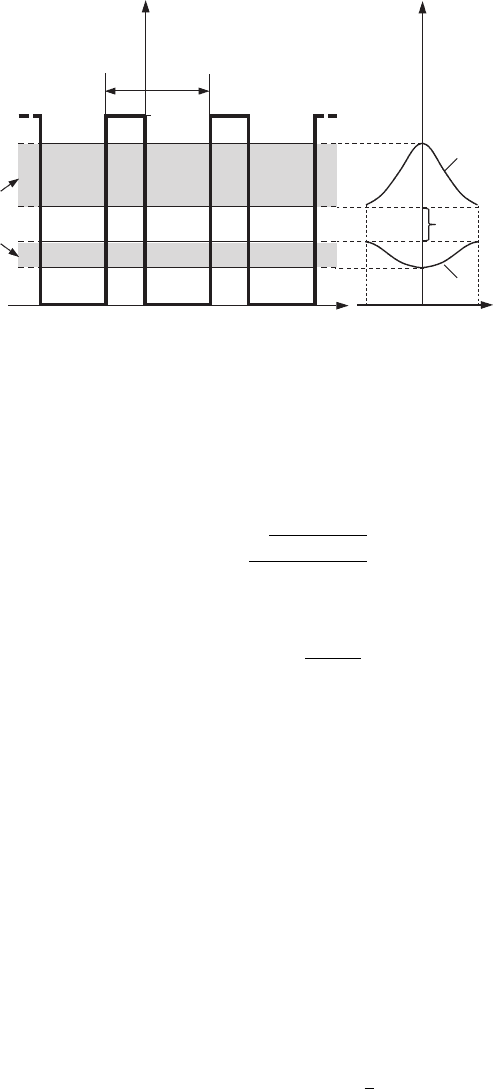
244 Quantization in nanostructures
Minibands
U
0
U,E
x
0
d + L
x
−d − L
x
L
x
−d
E<U
0
AB
D
K
E
E
1g
0
BBAA
E
max
E
min
1
2
Figure 7.23 The potential
profile of the superlattice
in the direction of the
periodicity (the
x-direction). U
0
is the
height of the barrier which
separates neighboring
quantum dots, d is the
width of the potential
barrier, and L
x
is the
width of the potential
well. A denotes the
material of the quantum
dot and B denotes the
material of the barriers
that separate quantum
dots. The first energy
miniband is labeled 1 and
the second is labeled 2.
dots, complete delocalization of the electron is possible, and as a result the elec-
tron belongs to the entire superlattice. If the electron energy E < U
0
, then the
wavenumber k
1
becomes imaginary (see Eq. (7.196)). Therefore, in the expres-
sion for the wavefunction (7.195) and in the dispersion equation (7.209)itis
convenient to substitute k
1
by iκ, where the real parameter κ is equal to
κ =
2m
∗
(U
0
− E)
h
-
. (7.210)
As a result the dispersion equation in this case takes the form
cos(KD) = cos(kL)cosh(κd) −
k
2
− κ
2
2kκ
sin(kL)sinh(κd). (7.211)
Actually, cos(k
1
d) and sin(k
1
d)inEq.(7.209) are replaced by cosh(κd) and
sinh(κd)inEq.(7.211).
The analysis of Eq. (7.211) shows that the energy spectrum of the superlattice
at E < U
0
is divided into a set of minibands with allowed and forbidden energy
values (see Fig. 7.23). The minibands with allowed energies correspond to val-
ues of energy for which the magnitude of the right-hand side of Eq. (7.211) lies
within the interval (−1, 1) and the effective wavenumber K is real. The energy
regions where |cos(KD)| > 1 do not correspond to the real wavenumbers K .
Therefore, they are the minibands with forbidden energies. Electrons with imag-
inary wavenumbers, K , and corresponding energies, E, according to Eq. (7.199),
cannot propagate for long distances in a superlattice.
If the superlattice has wide potential barriers, the lowest minibands with
allowed energies are very narrow and lie near the energy levels of an individual
quantum dot. In the limiting case when d →∞
cosh(κd) ≈ sinh(κd) ≈
1
2
e
κd
. (7.212)
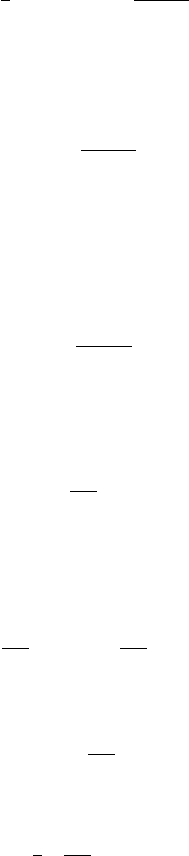
7.7 A one-dimensional superlattice of quantum dots 245
Then, Eq. (7.211)istransformedinto
cos(KD) =
1
2
e
κd
cos(kL) −
k
2
− κ
2
2kκ
sin(kL)
. (7.213)
Since the left-hand side of Eq. (7.213) is in the interval (−1, 1) and the right-hand
side contains the large factor exp(κd), the expression within the large brackets
should be small; in the first approximation it must be equal to zero:
cot(kL) =
k
2
− κ
2
2kκ
. (7.214)
Equation (7.214) defines the energy spectrum of an electron in an individual
symmetric potential well (see Section 3.3.2). To analyze the dispersion relation
in the intermediate region of values of d, for which the coupling between quantum
dots can be considered weak, the dispersion relation (7.211) can be rewritten in
more suitable form. Let us denote the right-hand side of Eq. (7.211)as
F
1
(E) = cos(kL)cosh(κd) −
k
2
− κ
2
2kκ
sin(kL)sinh(κd), (7.215)
and the discrete energy levels in an individual well, defined by Eq. (7.214), as
E
n
. Let us expand the function F
1
(E ) in a Taylor series in the region around the
energy E
n
and let us limit ourselves to two terms of the expansion:
F
1
(E) = F
1
(E
n
) +
dF
1
dE
E=E
n
(E − E
n
), (7.216)
where the derivative, dF
1
/dE, is calculated at E = E
n
. Let us substitute F(E)in
Eq. (7.216)byF
1
(E )fromEq.(7.215) and use Eqs. (7.207) and (7.208) to find
the energy E:
E = E
n
− F
1
(E
n
)
dF
1
dE
−1
E=E
n
+
dF
1
dE
−1
E=E
n
cos(KD). (7.217)
On introducing into this equation the notations
W
n
= F
1
(E
n
)
dF
1
dE
−1
E=E
n
(7.218)
and
A
n
=
1
2
dF
1
dE
−1
E=E
n
, (7.219)
we obtain an expression for the energy in the miniband which corresponds to the
nth level of an individual quantum dot:
E(K ) = E
n
− W
n
+ 2A
n
cos(KD). (7.220)
Thus, by bringing the quantum dots in the superlattice closer to each other,
we make the energy levels corresponding to an individual quantum dot shift by
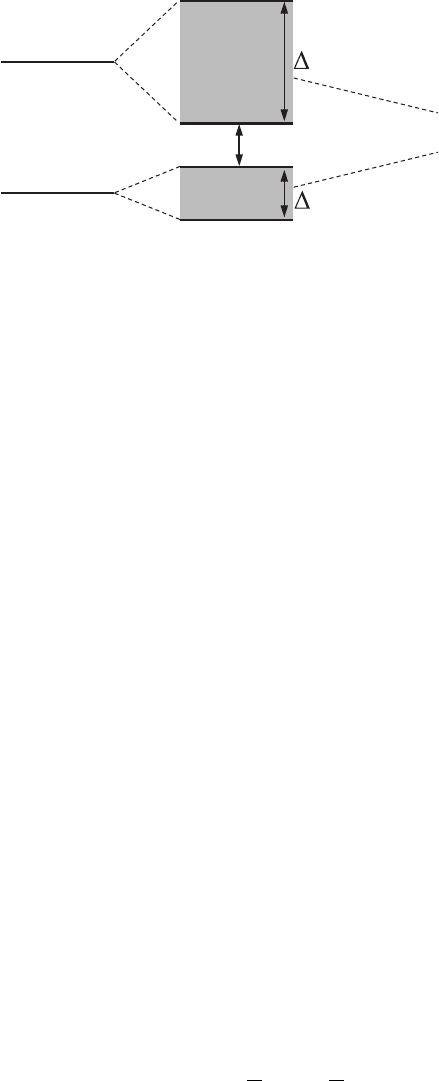
246 Quantization in nanostructures
E
n
=|4A
n
|
E
n−1
= |4A
n−1
|
E
n−1
E
n,max
E
n,min
E
n
Minibands
Individual levels
E
ng
Figure 7.24 The energy
levels of individual
quantum dots, E
n
and
E
n−1
, spread into energy
minibands
E
n
= E
max
− E
min
and
E
n−1
. Here,
E
n, max
= E
n
− W
n
+ 2|A
n
|,
E
n, min
= E
n
− W
n
− 2|A
n
|,
and E
ng
is the energy
minigap.
a magnitude W
n
. In the system of N non-interacting (isolated) quantum dots the
energy level E
n
is N -fold degenerate. The interaction of quantum dots, which
takes place on bringing them closer to each other, lifts this degeneracy and creates
a miniband of finite width. The width of the nth miniband is
E
n
=|4A
n
|. (7.221)
The analysis of F
1
(E ) shows that its derivative, dF
1
/dE, in the first miniband is
always negative (i.e., A
1
< 0). Thus, the lowest-energy state in the first miniband
is at K = 0:
E
1,min
= E
1
(0) = E
1
− W
1
+ 2A
1
. (7.222)
This state corresponds to the lowest energy of the miniband since cos(KD) = 1.
The highest-energy states in the first miniband are at the boundaries of the first
Brillouin zone: K =±π/D. Therefore,
E
1,max
= E
1
(±π/D) = E
1
− W
1
− 2A
1
. (7.223)
These states correspond to the top of the miniband (see Fig. 7.24) since
cos(KD) =−1atK =±π/D.
With decreasing barrier width, d, the minibands with allowed energy states
become wider. In the limit d → 0 the miniband character of the electron energy
spectrum in the superlattice is transformed into the parabolic dispersion relation
ofafreeelectron(seeFig.7.21).
From the dispersion equations (7.209) and (7.211) it follows that the substitu-
tion of the effective wavenumber K by K + 2πl/D, where l is an integer number,
does not lead to any new solutions of these equations. Therefore, the analysis of
the dispersion relation of electrons in a superlattice must be done for physically
different states, i.e., for those values of wavenumber K which correspond to the
first Brillouin zone:
−
π
D
≤ K ≤
π
D
. (7.224)

7.7 A one-dimensional superlattice of quantum dots 247
Let us analyze Eq. (7.211) for small values of parameters L and d satisfying the
following conditions:
kL 1andκd 1. (7.225)
Let us assume that the bottom of the first miniband of allowed energies is located
at the center of the Brillouin zone (K = 0). Then, for small wavenumbers K ,
i.e., for KD 1, the left-hand side of Eq. (7.211) can be presented in the form
cos(KD) ≈ 1 −
(KD)
2
2
. (7.226)
Here we expanded the function cos(KD) in a Taylor series and took into account
terms including the quadratic term of the expansion. On expanding the right-hand
side of Eq. (7.211) in a Taylor series (we took into account conditions (7.225)),
we come to the following dispersion relation:
E(K ) = E
0
+
h
-
2
K
2
2m
∗
, (7.227)
where
E
0
=
d
L + d
U
0
. (7.228)
The magnitude E
0
represents the average value of the potential U (x) throughout
the entire superlattice, i.e.,
E
0
=
U (x )
=
d
D
U
0
. (7.229)
From Eq. (7.227) it follows that, near the bottom of a miniband with allowed
energies
E
min
= E
0
, (7.230)
the electron behaves as a free particle with effective mass m
∗
. The energy of the
bottom of the first miniband with allowed energies, E
0
,atU
0
d → 0 becomes
equal to zero.
The maximum value of energy, i.e., the top of the allowed energy miniband,
is at the Brillouin-zone boundary at K = π/D. By expanding in a Taylor series
the function cos(KD) near this point we obtain
cos(KD) ≡−1 +
1
2
(KD− π )
2
. (7.231)
Finally, we arrive at the following form of the dispersion relation in this region:
E(K ) = E
max
−
h
-
2
2m
∗
D
2
(KD− π )
2
, (7.232)
where the energy at the top of the miniband is equal to
E
max
= E
0
+
2h
-
2
π
2
m
∗
D
2
. (7.233)
248 Quantization in nanostructures
Therefore, the width of the first miniband with allowed energies E
1
is
defined as
E
1
= E
max
− E
min
= 4|A
1
|=
2h
-
2
π
2
m
∗
D
2
. (7.234)
Figure 7.23 shows the dependence of electron energy on the effective
wavenumber, K , for the first miniband. Taking into account the higher terms
in the Taylor-series expansion of Eq. (7.211), we can get a more accurate expres-
sion for the width of the first energy miniband, E
1
,
E
1
=
2h
-
2
π
2
m
∗
D
2
1 +
m
∗
D
3h
-
2
U
0
d
−1
, (7.235)
and the following expression for the electron effective mass, m
SL
, near the bottom
of the miniband:
m
SL
= m
∗
1 +
m
∗
D
3h
-
2
U
0
d
. (7.236)
From Eqs. (7.235) and (7.236), it follows that with increasing height and width
of the barrier the width of the miniband with allowed energies decreases while
the electron effective mass in the superlattice, m
SL
, increases.
Thus, we showed that the lowest energy level of an electron in an individual
quantum dot splits into an energy miniband of the superlattice, which consists
of a system of a large number of coupled quantum dots. An analogous splitting
happens with the higher energy levels of an individual quantum dot. Therefore,
the energy spectrum of an electron in a superlattice consists of a set of minibands
composed of the levels of space quantization of individual quantum dots (see
Fig. 7.24).
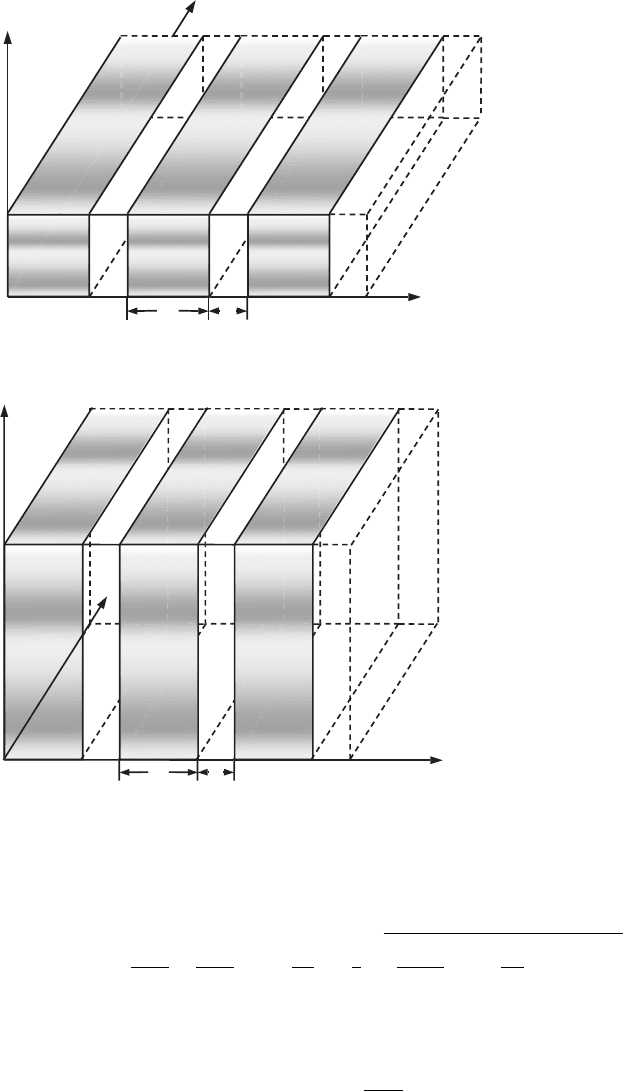
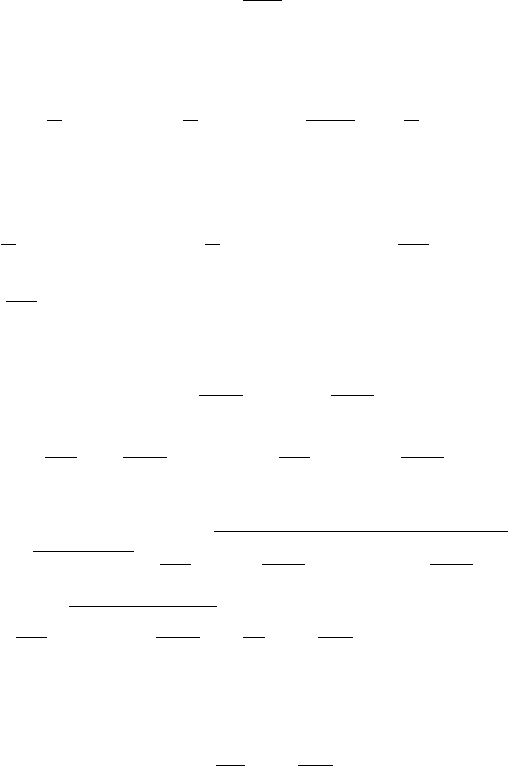
Let us assume that the length of the structure becomes unlimited in the y-
direction (L
y
→∞). If in the other two directions (along the x- and z-axes)
the electron is spatially quantized and in addition to this there is a periodicity
of the structure (and correspondingly a periodicity of the potential U (x, y, z))
along the x-direction, then we obtain a superlattice formed from quantum wires
(Fig. 7.25). If the length of the structure is unlimited along the y- and z-axes , i.e.,
L
y
→∞and L
z
→∞, and we have space quantization and periodicity along
the x-axis, then a superlattice is formed from quantum wells (see Fig. 7.26). For
a superlattice formed from quantum wires, the wavefunctions and energy spectra
can be described by Eqs. (7.138) and (7.139), where the functions ψ
x
(x) and
E
x
(K ) are defined by the type of the periodic potential U (x). For superlattices
formed from quantum wells the wavefunctions and energy spectra are described
by Eqs. (7.140) and (7.141).
Example 7.9. Assuming that the average value of a one-dimensional periodic
potential,
U
, is small in comparison with the kinetic energy of an electron, find
the dependence E(K ) near the Brillouin-zone boundaries for the Kronig–Penney
model.
7.7 A one-dimensional superlattice of quantum dots 249
A
B
x
y
z
0
Ld
A
B
A
B
Figure 7.25 A superlattice
composed from quantum
wires. A denotes the
material of the quantum
wires and B the material
of the barriers which
separate the quantum
wires.
d
x
y
z
0
L
A
B
A
B
A
B
Figure 7.26 A superlattice
composed from quantum
wells. A denotes the
material of the quantum
wells and B the material
of the barriers, which
separate the quantum
wells.
Reasoning. According to Eq. (7.184), in the framework of perturbation theory
the expression for the energy near the boundaries K = π n/D has the form
E(K ) =
U
+
h
-
2
K
2
2m
∗
−
πnh
-
2
m
∗
D
K −
πn
D
±
1
2
2πnh
-
2
m
∗
D
K −
πn
D
2
+ 4|C
n
|
2
.
(7.237)
Here we took into account that
E
(0)
(K ) =
U
+
h
-
2
K
2
2m
∗
. (7.238)
250 Quantization in nanostructures
This expression can be simplified if we take into account the smallness of
(K − πn/D) near the boundaries of the Brillouin zone, K =±π n/D. Then,
E(K ) =
U
+
h
-
2
K
2
2m
∗
±|C
n
|, (7.239)
where the signs “+” and “−” correspond to K >πn/D and K <πn/D, respec-
tively. The magnitude
U
in Eq. (7.239) is defined as
U
=
1
D
D
0
U (x )dx =
1
D
D
L
U
0
dx =
D − L
D
U
0
=
d
D
U
0
(7.240)
(see Fig. 7.23). Let us find the coefficients C
n
, which according to Eq. (7.180)
are the coefficients of the expansion of the function U(x) in a Fourier series:
C
n
=
1
D
D
0
U (x )e
−i2πnx/ D
dx =
1
D
D
L
U
0
e
−i2πnx/ D
dx = i
U
0
2πn
e
−i2πnx/ D
|
D
L
= i
U
0
2πn
1 −e
−i2πnL/D
. (7.241)
Let us find the real and imaginary parts of C
n
, i.e., C
n
= C
n
+ iC
n
:
e
−i2πnL/D
= cos
2πnL
D
− isin
2πnL
D
, (7.242)
C
n
=−
U
0
2πn
sin
2πnL
D
, C
n
=
U
0
2πn
1 −cos
2πnL
D
. (7.243)
Let us find now the modulus of C
n
:
|C
n
|=
(C
n
)
2
+ (C
n
)
2
=
U
0
2πn
sin
2
2πnL
D
+
1 − cos
2πnL
D
2
=
U
0
2πn
2 −2cos
2πnL
D
=
U
0
πn
sin
πnL
D
, (7.244)
where n = 1, 2, 3,...Thus, the discontinuities at the boundaries of the Brillouin
zone, i.e., the minigaps, are equal to
E
ng
= 2|C
n
|=
2U
0
πn
sin
πnL
D
. (7.245)
7.8 A three-dimensional superlattice of quantum dots
The picture of miniband spectra of superlattices we obtained in the previous sec-
tions generally stays the same in the case of superlattices of higher dimensionality.
For an ideal three-dimensional superlattice consisting of identical quantum dots
the potential energy is spatially periodic:
U (r +a
n
) = U (r). (7.246)

7.8 A three-dimensional superlattice of quantum dots 251
Here, the superlattice translation vector, a
n
, is equal to
a
n
= n
x
D
x
+ n
y
D
y
+ n
z
D
z
. (7.247)
The vectors D
α
= e
α
D
α
are the basis vectors whose length is equal to the period
of the superlattice in the respective direction (α = x, y, and z). Let us apply the
methods of perturbation theory to find the energy spectrum of an electron in such
a superlattice.
Let us assume that the solution of the Schr¨odinger equation for the electron
in an individual quantum well with potential U
0
(r) is known. The Schr¨odinger
equation for an electron in the superlattice can be written in the following form:
ˆ
Hψ (r) = Eψ (r), (7.248)
where the Hamiltonian,
ˆ
H, is equal to
ˆ
H =−
h
-
2
2m
e
∇
2
+
n
U
0
(r − a
n
) + W (r). (7.249)
Here, W (r) is the perturbation which takes into account the coupling between
the quantum dots and
n
U
0
(r − a
n
) is the potential energy of the electron in the
superlattice formed by the non-interacting quantum dots. We can represent the
electron wavefunction in the superlattice which corresponds to the j th energy
state in the form of a linear combination of electron wavefunctions ψ
qj
(r − a
n
)
for the individual quantum dots:
ψ
0 j
(r) =
n
exp
(
iK ·a
n
)
ψ
qj
(r −a
n
). (7.250)
On multiplying Eq. (7.248) by the complex-conjugate wavefunction ψ
∗
0 j
(r) and
integrating this equation over the entire volume of the superlattice we find the
average energy of an electron in the superlattice:
E(K) =
ψ
∗
0 j
(r)
ˆ
Hψ
0 j
dV
ψ
∗
0 j
ψ
0 j
dV
. (7.251)
On substituting the wavefunction (7.250) into Eq. (7.251) and taking into account
that the electron wavefunctions of the individual quantum dots, ψ
qj
(r − a
n
), are
normalized, we obtain the following expression for the electron energy:
E(K) = E
(0)
j
+ E
(1)
j
+
l
A(a
l
)e
iK·a
l
. (7.252)
Here, E
(0)
j
is the energy of an electron in an individual quantum dot in the
jth quantum state found for the zeroth approximation. The correction to the
energy in the first approximation does not depend on the wavevector K and is
negative:
E
(1)
j
=
ψ
∗
qj
(r)[U(r −a
n
) + W (r)]ψ
qj
dV < 0. (7.253)

252 Quantization in nanostructures
The third term in Eq. (7.252) originates from the exchange interaction between
two quantum dots at a distance a
l
:
A(a
l
) =
ψ
∗
qj
(r)
r=a
l
U (r −a
n
) + W (r)
ψ
qj
(r −a
l
)dV. (7.254)
The exchange interaction occurs between any pair of quantum dots. It is related
to the overlap of their wavefunctions ψ
qj
(r) and ψ
qj
(r − a
l
). At the same time
the electron becomes non-localized. Taking this into account, the exchange inter-
action leads to the splitting of the energy levels of the individual quantum dot
into a miniband whose width is proportional to the exchange integral A(a
l
).
The exponential factor in Eq. (7.252) takes into account the real structure of
the superlattice. Thus, for a simple cubic superlattice with period D and with six
nearest-neighboring quantum dots, whose wavevectors a
l
have the components
(±D, 0, 0), (0, ±D, 0), (0, 0, ±D), using Eq. (7.252) we obtain the following
expression for the electron energy:
E(K) = E
(0)
j
+ E
(1)
j
+ A
j
(D)
α
e
iK
α
D
+ e
−iK
α
D
= E
(0)
j
+ E
(1)
j
+ 2 A
j
(D)
cos(K
x
D) + cos(K
y
D) + cos(K
z
D)
, (7.255)
where α = x, y, and z. Inside of the miniband the electron energy is a periodic
function of the quasiwavevector with period 2π/D. The sign of the exchange
integral A
j
can be positive as well as negative. For the lowest miniband usually
A
j
< 0. Therefore, the electron energy has its minimum value at the center
of the first Brillouin zone K
α
= 0, and the maximum value at the boundaries
K
α
=±π D, where α = x, y, and z. The minimum and maximum values of the
electron energy are defined as
E
min
= E(0) = E
(0)
j
+ E
(1)
j
− 6|A
j
(D)|, (7.256)
E
max
= E
±
π
D
= E
(0)
j
+ E
(1)
j
+ 6|A
j
(D)|. (7.257)
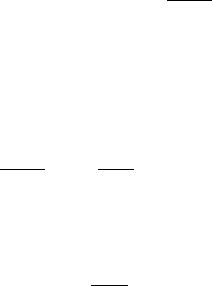
The width of the minibands is proportional to the exchange integral A
j
(D), i.e.,
E
j
= E
max
− E
min
= 12|A
j
(D)|. (7.258)
The magnitude of the exchange integral depends strongly on the distance
between quantum dots, i.e., on the period of the superlattice, D. The overlap of the
wavefunctions of electrons belonging to different quantum dots increases when
the distance between the quantum dots decreases, which leads to an increase
of the width of the minibands. Owing to the high degree of overlap of the
wavefunctions the exchange interaction and the width of minibands are large for
the higher-lying minibands, i.e., with increasing electron energy the width of the
minibands increases (see Fig. 7.22).