
Mitin V.V., Sementsov D.I., Vagidov N.Z. Quantum mechanics for nanostructures
Подождите немного. Документ загружается.


7.6 An electron in a periodic one-dimensional potential 233
For
2D = nλ
Br
, (7.161)
where n is an integer number, the phase difference of reflected waves is a multiple
of 2π. The waves reflected from different nanoobjects are in phase with each
other and their amplitudes are added. Because of this, even in the case of small
amplitudes of the waves reflected from the individual nanoobjects, the electron is
totally reflected from the superlattice as a whole. Therefore, if condition (7.161)
is satisfied the electron wave cannot propagate in the superlattice.
The condition of total reflection (7.161) coincides with Bragg’s law, which was
obtained for the diffraction of an electromagnetic wave on a crystalline lattice. If
we take the diffraction angle equal to θ = π/2 and write the condition for total
reflection for the wavevector of an electron in a one-dimensional superlattice as
k =
2π
λ
Br
, (7.162)
then we find the equation which defines the boundaries of the Brillouin zone, i.e.,
K
n
=±
nπ
D
. (7.163)
Therefore, the boundaries of each Brillouin zone correspond to magnitudes of
the wavevector at which the electron wave in a superlattice cannot propagate.
In this case we can conclude that the electron wave, as a result of diffraction
by a superlattice, undergoes 180
◦
Bragg reflection. As K approaches K
n
the
superlattice slows the traveling electron wave down more and more, and, when
K and K
n
coincide, the traveling wave becomes a standing wave. We can show
that the group velocity of the electron wave,
v
gr
=
dω
dK
=
1
h
-
dE
dK
=
dE
d p
, (7.164)
becomes equal to zero in the case of K = K
n
. This behavior of an electron in
the superlattice is principally different from the behavior of a free electron in
vacuum.
7.6.3 Effective mass
According to Eq. (7.164) the electron velocity in the superlattice is defined by
the dispersion relation E( p). Let us find the acceleration of an electron in a
one-dimensional superlattice:
a =
dv
dt
=
d
dt
dE
d p
=
d
d p
dE
dt
=
d
d p
dE
d p
d p
dt
=
d
2
E
d p
2
d p
dt
=
d
2
E
d p
2
F
ext
=
F
ext
m
∗
, (7.165)

234 Quantization in nanostructures
where we took into account that
d
d p
d p
dt
=
d
dt
d p
d p
= 0. (7.166)
The electron acceleration linearly depends on the external force, F
ext
, and on the
magnitude
1
m
∗
=
d
2
E( p)
d p
2
=
1
h
-
2
d
2
E(K )
dK
2
, (7.167)
which defines the electron effective mass m
∗
in a superlattice. The equation
m
∗
a = F
ext
(7.168)
formally coincides with Newton’s second law, which describes the motion of a
particle with mass m
∗
in free space under the influence of an external force,
F
ext
. The physical meaning of the electron effective mass for a superlattice is the
following: the internal forces (the forces of interaction of the electron with the
superlattice) become apparent in the formation of the dispersion relation E( p)
and they define the behavior of an electron under the influence of external forces
through the effective mass. With the help of Eq. (7.168) the unknown internal
forces which act on an electron by virtue of its presence in the superlattice are
included in the definition of the effective mass. For an electron in vacuum, i.e.,
for a free electron, m
∗
= m
e
because
1
m
∗
=
d
2
E( p)
d p
2
=
d
2
d p
2
p
2
2m
e
=
1
m
e
. (7.169)
The use of the effective mass as a physical parameter that defines the behavior
of an electron in a superlattice is justified in those regions where m
∗
weakly
depends (or does not depend at all) on the quasimomentum p. These conditions
are usually satisfied in the vicinity of points p
0
where the electron energy E( p)
reaches a maximum or a minimum. Let us expand E( p) in a Taylor series near
an extremum point p = p
0
:
E( p) = E(p
0
) +
dE
d p
p=p
0
(p − p
0
) +
1
2!
d
2
E
d p
2
p=p
0
(p − p
0
)
2
+
1
3!
d
3
E
d p
3
p=p
0
(p − p
0
)
3
+···, (7.170)
where the derivatives are calculated at p = p
0
. Limiting ourselves to a small
region around the point p
0
and taking into account that at the extremum the
derivative (dE/d p)
p=p
0
= 0, the dispersion relation can be written as
E( p) = E ( p
0
) +
1
2m
∗
(p − p
0
)
2
. (7.171)
In Eq. (7.171) all terms of order greater than two were disregarded. We intro-
duced the effective mass of an electron, m
∗
, which does not depend on the
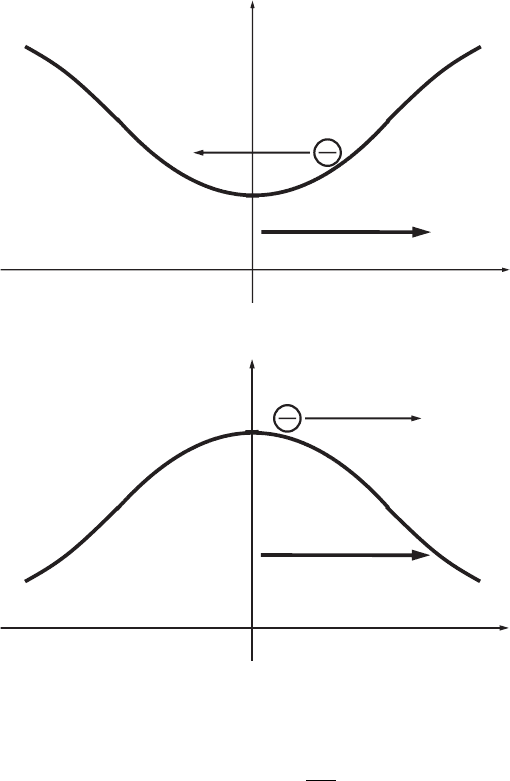
7.6 An electron in a periodic one-dimensional potential 235
p
0
p
E
E
ext
E
min
Figure 7.18 The electron
motion near the energy
minimum is defined by a
parabolic dispersion
relation. An electron near
the energy minimum
moves in a direction
opposite to the applied
external field E
ext
.
p
0
p
E
E
ext
E
max
Figure 7.19 The electron
motion near the energy
maximum is defined by a
parabolic dispersion
relation. An electron near
the energy maximum
moves in the same
direction as the applied
external field E
ext
.
quasimomentum, p:
m
∗
=
d
2
E
d p
2
−1
p=p
0
. (7.172)
The magnitude m
∗
is positive in the region around the energy minimum (see
Fig. 7.18) and is negative near the energy maximum (see Fig. 7.19). In the first
case (near the energy minimum) the electron behavior in a superlattice is similar
to that of a free electron. Thus, in the external electric field, E
ext
, the velocity
of the electron increases in the direction opposite to the direction of the electric
field since the electron is negatively charged. In the second case (near the energy
maximum) the electron accelerates in the direction of the external electric field,
E
ext
, i.e., it behaves as a particle with positive charge and positive mass (see
Fig. 7.19).
Moving far away from the extremum point p = p
0
, i.e., with a large increase
of the difference ( p − p
0
), we have to take into account in the series (7.170)
236 Quantization in nanostructures
U, E
x
0
D
B
AABBB
E
U(x)
E
kin
E
kin
|U (x)|
Figure 7.20 A
one-dimensional
superlattice with an
arbitrary periodic
potential.
not only the quadratic term but also higher-order terms. The effective mass, m
∗
,
becomes dependent on the electron quasimomentum, p,ifweweretowritethe
dispersion relation for large magnitudes of (p − p
0
) in the form of Eq. (7.171).
7.6.4 The energy spectrum
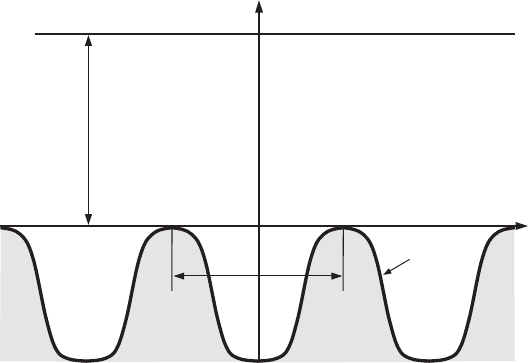
Let us consider the main properties of the electron energy spectrum in a one-
dimensional superlattice with an arbitrary periodic potential U (x). For simplicity
we will assume that the electron potential energy, U (x), is small in comparison
with its kinetic energy, E
kin
(see Fig. 7.20). This allows us to solve the problem of
electron motion in the periodic potential of the superlattice by using the methods
of perturbation theory.
Let us express the electron energy and the wavefunction in the superlattice in
the form of the following expansions:
E(K ) = E
(0)
(K ) + E
(1)
(K ) + E
(2)
(K ) +···, (7.173)
ψ
K
(x ) = ψ
(0)
K
(x ) +ψ
(1)
K
(x ) +ψ
(2)
K
(x ) +··· (7.174)
According to stationary perturbation theory (see Section 5.1), in order to find the
corresponding corrections to E(K ) and ψ
K
(x) for the periodic potential U(x)it
is necessary to find the following matrix elements (for the unperturbed states):
U
K
K
=
L
x
0
ψ
(0)∗
K
(x )U(x)ψ
(0)
K
(x )dx, (7.175)

7.6 An electron in a periodic one-dimensional potential 237
where L
x
is the length of a superlattice. The first-order correction to the energy
coincides with the diagonal matrix element U
KK
, i.e.,
U
KK
= E
(1)
(K ) =
L
x
0
ψ
(0)∗
K
(x )U(x)ψ
(0)
K
(x )dx. (7.176)
The wavefunction in the zeroth approximation describes the motion of a free
electron in vacuum in the interval (0, L
x
):
ψ
(0)
K
(x ) =
1
√
L
x
e
iKx
. (7.177)
Substituting Eq. (7.177) into Eq. (7.176) we obtain that the first-order correction
is equal to the following average value of the electron potential energy:
E
(1)
=
1
L
x
L
x
0
U (x )dx =
U (x )
. (7.178)
From this expression it follows that the correction E
(1)
does not depend on the
wavevector (quasimomentum). This correction is negative since U (x) itself is
negative (see Fig. 7.20) and it shifts the parabolic dispersion of the free electron
by
U (x)
, decreasing the electron energy in the superlattice in comparison with
that of a free electron in vacuum.
In the second-order perturbation theory, according to Eq. (5.19), the correction
E
(2)
to the electron energy in a superlattice can be written in the form
E
(2)
(K ) =
K
n
|U
K
n
K
|
2
E
(0)
(K ) − E
(0)
(K
n
)
=
n
|C
n
|
2
E
(0)
(K ) − E
(0)
(
K − 2π n/D
)
, (7.179)
where we introduced the coefficients, C
n
,
C
n
=
1
D
D
0
U (x )e
−i2πnx/ D
dx, (7.180)
of expansion of the periodic potential U(x) in the Fourier series:
U (x ) =
∞
n=−∞
C
n
e
i2πnx/ D
, (7.181)
where n = 0, ±1, ±2,... Taking into account the zeroth and the first-order
approximations, the electron wavefunction can be written as
ψ
K
(x ) = ψ
(0)
K
(x ) +
K
n
C
n
ψ
(0)
K
n
(x )
E
(0)
(K ) − E
(0)
(K
n
)
, (7.182)
where K
n
= K − 2πn/D. The calculation of the corrections using perturbation
theory becomes incorrect if the difference (E
(0)
(K ) − E
(0)
(K
n
)) becomes small
or comparable to |C
n
|. We can show that this energy difference tends to zero at the
boundaries of the Brillouin zone (see Example 7.8). In this case the corrections to
the energy and the wavefunction become extremely large, i.e., the electron motion

238 Quantization in nanostructures
near the Brillouin-zone boundaries undergoes a strong perturbation. Therefore, at
the Brillouin-zone boundaries at exact equality, E
(0)
(K ) = E
(0)
(K
n
), the energy
level E
(0)
(K ) becomes degenerate since it corresponds to two different wave-
functions ψ
(0)
(K ) and ψ
(0)
(K
n
). Thus, near Brillouin-zone boundaries, even in
the zeroth approximation we have to take degeneracy into account. As a result we
obtain the following expressions using the perturbation theory for the degenerate
states (see Section 5.2):
ψ
K
(x ) = ψ
(0)
K
(x ) +
U
21
E
(0)
(K
n
) +
U
− E
ψ
(0)
K
n
(x ), (7.183)
E(K ) =
U
+
E
(0)
(K ) + E
(0)
(K
n
)
2
±
1
2
[E
(0)
(K ) − E
(0)
(K
n
)]
2
+ 4|C
n
|
2
.
(7.184)
From Eq. (7.184) it follows that the electron energy in the superlattice becomes
discontinuous at the Brillouin-zone boundaries . When approaching, for example,
the Brillouin-zone boundary K = πn/D from the left and from the right, the
electron energy takes the values
E
−
πn
D
=
U
+ E
(0)
πn
D
−|C
n
|, (7.185)
E
+
πn
D
=
U
+ E
(0)
πn
D
+|C
n
|. (7.186)
Thus, the energy discontinuity, E
ng
, at the corresponding Brillouin-zone bound-
ary is equal to
E
ng
= E
+
− E
−
= 2|C
n
|. (7.187)
The discontinuities in the dispersion relation E(K ) indicate the appearance of
forbidden energy minibands, which alternate with the allowed energy minibands,
in the electron energy spectrum of a superlattice.
As has already been noted, all Brillouin zones contain physically equiva-
lent quantum states, which correspond to the same energy level. The analytical
dependence of E on K corresponds to the dispersion relation, which can be
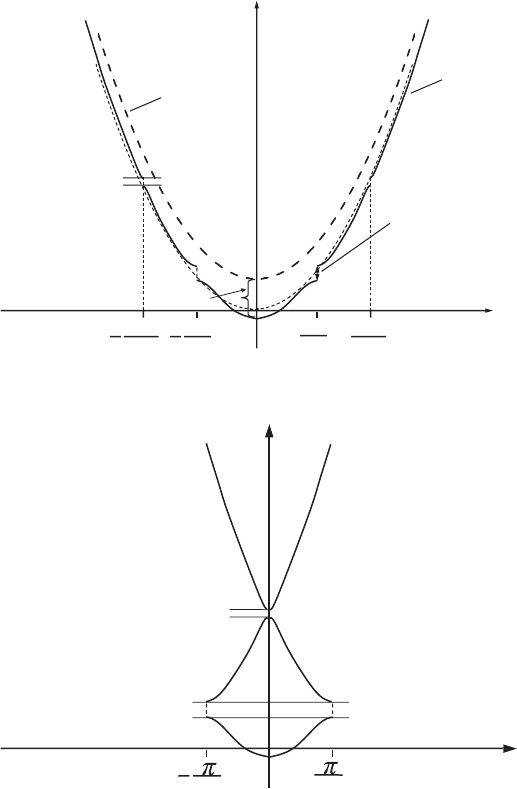
graphically presented in the form of a parabola with discontinuities E
ng
= 2|C
n
|
at the Brillouin-zone boundaries (see Fig. 7.21). Taking into account the physical
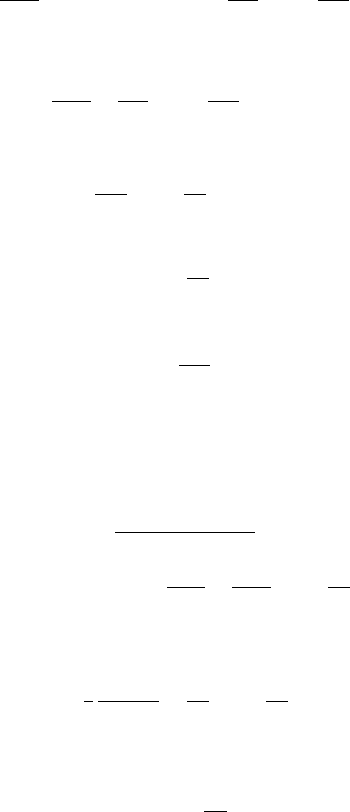
equivalence of the states in different Brillouin zones (see Eq. (7.147)), the dis-
persion relation can be graphically plotted in the first Brillouin zone (the reduced
Brillouin zone, see Fig. 7.22). Then, the electron energy becomes a multivalued
periodic function of the quasimomentum with period 2π h
-
/D. The one-to-one
dependence of energy on momentum occurs only in the limits of an individual
subband of the allowed energies.
The analysis given above corresponds to the case of weak coupling of an elec-
tron with individual nanoobjects of the superlattice, when the periodic potential,
U (x), is small in comparison with the total energy of the electron, E.The
periodic potential introduces weak perturbations in the free electron motion.
7.6 An electron in a periodic one-dimensional potential 239
p
D
0
E
2p
D
2p
D
p
D
K
〈U〉
E
2g
E
1g
1
2
Figure 7.21 The parabolic
dispersion relation of a
free electron (denoted as
1) is shifted down by
U
in a superlattice. The
curve with discontinuities
(denoted as 2) is the
electron dispersion
relation in a superlattice.
D
0
E
D
K
E
2g
E
1g
Figure 7.22 The electron
dispersion relation in the
reduced Brillouin zone.
The coefficients C
n
in the expansion of the potential U (x) in the Fourier series
(Eq. (7.181)) are small in comparison with the energy of an electron at the
corresponding Brillouin-zone boundary, i.e., |C
n
|E
(0)
(nπ/D). Therefore the
width of the forbidden minibands, E
ng
(Eq. (7.187)), is small in comparison with
the width of subbands with allowed energies. As we will show in the next section,
a similar property is characteristic for electrons in quantum-dot superlattices.
Example 7.8. Show that at the boundaries of the Brillouin zone the energy
difference, E
(0)
(K ) − E
(0)
(K
n
), and the group velocity of the electron wave tend
to zero (here K
n
= K − 2πn/D).
240 Quantization in nanostructures
Reasoning. The electron energy in the unperturbed states with wavenumbers K
and K
n
can be written as
E
(0)
(K ) =
h
-
2
K
2
2m
∗
and E
(0)
(K
n
) =
h
-
2
2m
∗
K −
2πn
D
2
. (7.188)
Let us equate the difference of these two quantities to zero:
h
-
2
K
2
2m
∗
−
h
-
2
2m
∗
K −
2πn
D
2
= 0. (7.189)
From Eq. (7.189) we obtain
4πn
D
K −
πn
D
= 0. (7.190)
From Eq. (7.190) it follows that Eq. (7.189) is satisfied for wavenumbers
K
n
=
πn
D
(7.191)
or for quasimomenta
p
n
=
h
-
πn
D
.
The wavenumbers from Eq. (7.191) correspond to the boundaries of the first
Brillouin zone of a one-dimensional superlattice.
Let us rewrite Eqs. (7.185) and (7.186) for the wavenumbers in the immediate
vicinity of the Brillouin-zone boundaries:
E
±
(K ) =
U
+
E
(0)
(K ) + E
(0)
(K
n
)
2
±|C
n
|
=
U
±|C
n
|+
h
-
2
K
2
2m
∗
−
πnh
-
2
m
∗
D
K −
πn
D
. (7.192)
The group velocity of the electron wave in this case is defined by the following
expression:
v
±
gr
=
1
h
-
dE
±
(K )
dK
=
h
-
m
∗
K −
πn
D
. (7.193)
According to Eq. (7.191), at the Brillouin-zone boundaries the magnitudes of
wavenumbers are equal to
K = K
n
=
πn
D
.
Thus, from Eq. (7.192) we see that at the Brillouin-zone boundaries the group
velocity of an electron wave tends to zero and the graphical dependence E(K )
must have a horizontal tangent at Brillouin-zone boundaries (see Fig. 7.22). For a
two-dimensional superlattice the Brillouin-zone boundaries are straight lines and
for three-dimensional superlattices they are planes in the space of wavevectors
where the surface of equal energy has discontinuities and is perpendicular to
them.
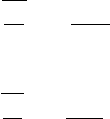
7.7 A one-dimensional superlattice of quantum dots 241
7.7 A one-dimensional superlattice of quantum dots
In Section 7.5 we have shown that in the case of a nanostructure with two coupled
quantum dots the energy level that corresponds to an individual quantum dot
splits into two sublevels. With increasing number of nanoobjects the number of
sublevels also increases. The magnitude of the splitting depends on the barrier
between the nanoobjects, i.e., it depends on the width and height of the potential
barrier. For a large number of nanoobjects the energy level of an individual
nanoobject transforms into an energy miniband. The type of these minibands is
defined mostly by the type of nanoobjects, by the type of the structure itself, and
by the periodicity of the nanoobjects’ distribution in the structure. In the previous
section we considered the general properties of the electron energy spectrum in
a one-dimensional superlattice with an arbitrary profile of a periodic potential,
U (x). As a special case in Section 7.6.4 we have assumed that the potential,
U (x), was small in comparison with the total energy, E. Here we will discuss the
properties of electron motion in superlattices with a specific rectangular potential
profile.
Let us consider a periodic structure consisting of a set of quantum dots
regularly distributed along the x-direction with period D. Let us assume that
along the y- and z-directions the electron is strictly confined to the region defined
by the intervals (0, L
y
) and (0, L
z
), i.e., the height of the potential barriers in these
directions is infinite. In this case the potential energy U (x, y, z) is defined by the
expression Eq. (7.91), where the potential profile in the direction of periodicity
has the form shown in Fig. 7.17. This periodic potential profile in the limits of
the superlattice period, D = d + L
x
, is defined as follows:
U (x ) =
U
0
, −d ≤ x ≤ 0,
0, 0 ≤ x ≤ L
x
.
(7.194)
Here L
x
and d are the widths of quantum wells and barriers in the x-direction,
respectively. Such a potential distribution for an electron in a one-dimensional
periodic structure is called the Kronig–Penney model. The potential profile
(7.194) is written for one superlattice period only. This potential profile repeats
itself over the entire superlattice along the x-direction. In the Schr¨odinger equa-
tion for the potential U (x, y, z) under consideration we can separate variables
and present the total wavefunction, ψ(x, y, z), as the following product:
ψ(x, y, z) = ψ
x
(x )ψ
y
(y)ψ
z
(z).
According to Eq. (7.94), the wavefunctions ψ
y
(y) and ψ
z
(z) are equal to
ψ
y
(y) =
2
L
y
sin
n
y
π y
L
y
and
ψ
z
(z) =
2
L
z
sin
n
z
π z
L
z
.

242 Quantization in nanostructures
The energy according to Eq. (7.95) is defined by the expression
E = E
x
+
π
2
h
-
2
2m
∗
n
2
y
L
2
y
+
n
2
z
L
2
z
.
We will consider two different cases. First, we will deal with the case when the
electron energy, E, is higher than the potential-barrier height, U
0
. Then, we will
consider the opposite case for which E < U
0
.
Let us first consider the case with electron above-barrier motion, i.e., when
E ≥ U
0
. The wavefunction ψ
x
(x) in the interval −d ≤ x ≤ L
x
can be presented
as follows:
ψ
x
(x ) =
A
1
e
ik
1
x
+ B
1
e
−ik
1
x
, −d ≤ x ≤ 0,
Ae
ikx
+ Be
−ikx
, 0 ≤ x ≤ L
x
.
(7.195)
Here the wavenumbers in the barrier region, k
1
, and in the well region, k,are
defined as
k
1
=
2m
e
(E − U
0
)
h
-
, (7.196)
k =
√
2m
e
E
h
-
. (7.197)
Both wavenumbers are written for the above-barrier motion of the electron,
when its energy in the superlattice is greater than U
0
, i.e., when E ≥ U
0
.Onlya
certain type of wavefunction will satisfy the condition of the superlattice potential
periodicity
U (x + nD) = U (x). (7.198)
Here n is an integer number. According to Bloch’s theorem formulated for the
electron wavefunctions in a periodic potential, this function must have the form
ψ
x
(x ) = ϕ(x )e
iK
x
x
. (7.199)
Here ϕ(x) is a periodic function with a superlattice period D and K
x
is the effec-
tive (Bloch) wavenumber in the x-direction, which depends on the parameters of
the nanostructure and the electron energy, E. In our further calculations we will
omit the subscript x from K
x
and L
x
.FromEq.(7.199) the following important
property follows:
ψ
x
(x + D) = ψ
x
(x )e
iKD
, (7.200)
i.e., the wavefunction, ψ
x
, when shifted by one period, D, is multiplied by the
phase factor e
iKD
.UsingEq.(7.200) and the conditions of continuity of the
wavefunction and its derivative at the boundaries x = 0 and x = L,wearriveat
the following system of four linear equations for the unknown coefficients A, B,