
Mitin V.V., Sementsov D.I., Vagidov N.Z. Quantum mechanics for nanostructures
Подождите немного. Документ загружается.

8.1 Methods of fabrication of nanostructures 263
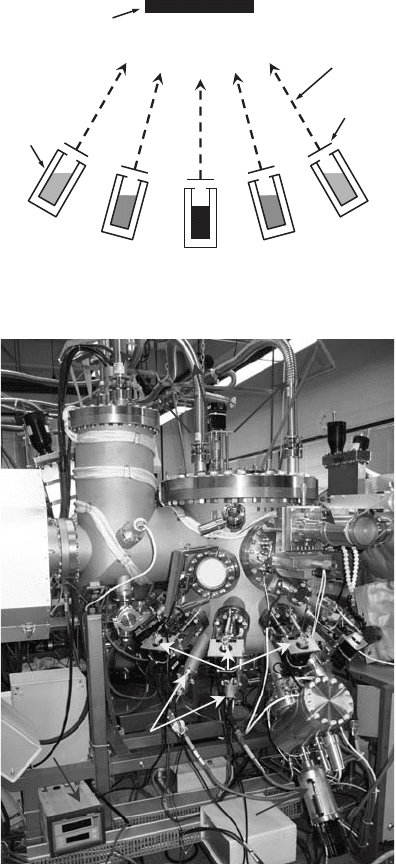
GaAs
Substrate
Sources
Shutters
Molecular beams
Ga
As
Si
Al
Be
Figure 8.2
Molecular-beam epitaxial
growth of
GaAs/Al
x
Ga
1−x
As
heterostructures.
Liquid Nitrogen
Titanium
Sublimation
Pump
Sample Mount
Main Flange
Knudsen Cells
Pyrometer
Actuator
Valve
As Cracker
Shutters
RHEED
Screen
Ionization
Gauge
Ion
Pump
Valve
Figure 8.3 A photograph
of a typical MBE chamber
(University at Buffalo).
GaAs (x = 0) to AlAs (x = 1). Additionally, the growth process can be controlled
by using shutters, which are positioned between the heaters and the substrate.
Using these shutters, we can abruptly interrupt or resume the deposition onto
the substrate of any molecular beam. For the discussed example of Al
x
Ga
1−x
As,
layers of materials with different x can be grown on top of each other. Figure 8.3
shows a picture of an actual MBE chamber used for research.
264 Nanostructures and their applications
One of the main disadvantages of MBE is its low rate of growth – approxi-
mately one monatomic layer per second or about 1 µm per hour. By controlling
the beams that are depositing material onto the substrate we can modulate layer by
layer the doping of the thin-film structure with sufficient accuracy. The dopants
can be of either p- or n-type. In such a way a superlattice with the desired number
of layers and order can be fabricated.
There are many other technologies that use different forms of epitaxy, which
can be realized from vapor, liquid or solid-state phases. Thus, for the growth of
epitaxial layers of A
3
B
5
compounds (compounds of elements from groups III and
V of the Periodic Table of the elements, for example, GaAs) vapor-phase epitaxy
from metallo-organic compounds is used. The methods of molecular-beam and
metallo-organic epitaxy are widely used for the fabrication of certain types of
structures in microelectronics (transistors, integrated circuits, and light-emitting
diodes), in quantum electronics (multilayer semiconductor heterostructures and
injection lasers), in the devices of integrated optics, in computer engineering,
and so on.
8.1.3 Self-organization and self-assembly
As we have already mentioned, the process of formation of complex ordered
structures from simple elements is called self-organization. Self-organization is
one of the most fascinating and interesting natural phenomena, being connected
with the formation of a more complex structure from an initial simpler one. In
physics and chemistry self-organization is the transition from chaotic distribu-
tions of atoms and molecules to ordered structures. The field of science which
studies self-organized systems is called synergetics, which is derived from the
Greek word synergos, which means “working together.” The main idea of syner-
getics is the fundamental possibility of the spontaneous formation of order and
organization from disorder and chaos as a result of self-organization. There are
many types of self-organizing system in nature. A characteristic example is the
self-organization of the efforts of a large number of bees. Despite their apparently
chaotic movements during the formation of honeycombs, the honeycombs take
the form of a plane lattice consisting of practically perfect identical hexagons.
Among prospective approaches to the formation of nanostructures, those tech-
nologies which use the phenomena of self-organization to create nanostructures
from individual atoms (the so-called bottom-up technology) are becoming more
and more popular. One of the most difficult problems that nanotechnology has
to resolve is how to make atoms and molecules group in a certain way, i.e., how
to self-organize them in the most stable structures that can be used for the fab-
rication of new materials and devices. In the near future the self-organization of
atoms and molecules will allow us to assemble materials from their constituents,
and it will not be necessary to assemble a nanostructure by putting it together
atom by atom manually. Manual assembly is not practical because it is a slow
8.1 Methods of fabrication of nanostructures 265
process and it requires disproportionate efforts. Therefore, nowadays the most
natural method of nanostructure fabrication is based on self-organization.
Many of us know how the billiard balls are organized by a rack before the
beginning of a game. In the closed space of the rack the balls spontaneously form
an equilateral triangle. If we were to scatter them into a big box and shake them
slightly, they would spontaneously take the form of a practically ideal box struc-
ture. In some cases atoms of the same type can be considered as homogeneous
spheres, which we can always order in the same way in a closed volume as bil-
liard balls do. In crystallography there is a term that defines such ordering – close
packing. Analogously to billiard balls, nanoparticles can spontaneously pack on
the surface of solid-state materials, forming regular geometrical structures. The
main reasons behind the formation of such orderings of nanoparticles are forces
that tend to decrease the overall surface area of nanoparticles and therefore their
surface energy (we talk about interaction forces between atoms in Appendix C).
Ordered arrays of gold nanoparticles of size 4 nm were obtained by self-
assembly for the first time in 1995. The same year structures of CdSe nanopar-
ticles of size 5 nm were fabricated. Homogeneous initial nanoparticles result
in regular arrays of nanoparticles. The size-homogeneous nanoparticles may
be assembled in spatially ordered structures such as one-dimensional wires,
two-dimensional closely packed layers, and three-dimensional arrays or small
clusters. The type of organization of nanoparticles and the structure of the array
formed depend on the conditions of synthesis, the diameter of the particles,
and the nature of external forces acting on the structure. Two-dimensionally
and three-dimensionally ordered arrays of Pt, Pd, Ag, Au, Fe, Co, FePt, Fe
3
O
4
,
Co
3
O
4
, CoO, CdS, CdSe, CdTe, and PbSe nanocrystals have been synthesized
to date. Orientationally ordered arrays have also successfully been synthesized
from anisotropic nanoparticles.
Nowadays we know methods of self-assembly that allow us to fabricate useful
ordered structures. To establish the special conditions required, the gravitational,
electric or magnetic fields, capillary forces, mutual wettability or non-wettability
of components of the system, and other factors must be taken into account.
Self-assembly processes are actively being used in manufacturing processes – in
particular, for the fabrication of a new generation of computer chips.
8.1.4 Fabrication of carbon nanostructures
One of the most studied types of carbon nanostructure is graphene, because
of its promising applications. Long before the fabrication of graphene it was
theoretically proved that it is impossible to obtain a free ideal two-dimensional
film of monatomic thickness because of the instability caused by folding or
twisting. Moreover, thermal fluctuations must lead to the melting of a two-
dimensional crystal at any non-zero temperature. The first unsuccessful attempts
at making graphene, which was attached to another material, were undertaken
266 Nanostructures and their applications
using ordinary pencil lead and AFM to mechanically remove layers of graphite.
In 2004 graphene on a SiO
2
substrate was obtained, and stabilization of the
two-dimensional film was achieved by bonding of the thin layer with SiO
2
.
The main method of obtaining graphene is either mechanical splitting off
from, or exfoliation of, graphite layers. The method of exfoliation is a relatively
simple and flexible method, since it allows one to work with all crystals that
have weakly coupled layers. This method allows one to obtain graphene samples
of good enough quality, but it is not suitable for mass production of graphene
since it is a manual procedure. The mass production of high-quality samples of
graphene is still a very challenging problem. One of the prospective methods is
the procedure of placing graphene oxide in pure hydrazine, which is a chemical
compound of nitrogen and hydrogen. This procedure reduces graphene oxide to
a graphene single layer. Another method of obtaining graphene, which is more
suitable for mass production, is based on the thermal decomposition of SiC.
The ideal graphene consists exclusively of hexagons. The presence of pen-
tagons or heptagons will lead to the existence of various defects. The presence of
pentagons leads to the warping of the graphene plane into a cone. The presence
of heptagons leads to the formation of a saddle-shaped flexing of the plane. The
combination of such defects and hexagons may lead to the formation of various
types of graphene surfaces. The presence of 12 hexagons leads to the formation
of fullerene.
From the moment of discovery of fullerenes and carbon nanotubes, numerous
methods for their fabrication were developed. The basis of some of these methods
is evaporation of graphite by arc discharge or by laser ablation. Other methods are
based on chemical transport reactions. An arc discharge is created in an evacuated
reactor. After this, its volume is filled by an inert gas, with the pressure being
about 0.5 bar. As a result of an arc discharge between two graphite electrodes
(an electric current of ∼50 A is maintained) carbon atoms leave the electrode
with the positive potential and are deposited onto the electrode with the negative
potential and onto the walls of the reactor. As a result, tiny particles of soot are
formed, which consist of arrays of carbon clusters differing in terms of size and
composition. Among these molecular clusters, fullerenes, C
60
, were discovered
for the first time (see Fig. 1.9).
Carbon nanotubes can be obtained using the same methods: laser heating
(or laser ablation), arc discharge, and chemical vapor deposition (in this case
a catalyst is added). The method of laser heating suggests the existence of a
graphite target containing particles of the catalyst. The graphite target has to
be inserted into the reactor. Particles of Fe, Ni, and Co, and atoms of rare-
earth elements, are used as catalysts. These particles become nucleation centers
of carbon nanostructures. When the high-intensity beam of the pulsed laser is
directed at the target, the carbon evaporates. The flow of argon gas carries carbon
atoms from the high-temperature zone to a cooled collector, where the carbon
nanotubes are formed. In this way single-walled carbon nanotubes of diameter
8.1 Methods of fabrication of nanostructures 267
C
3
C
2
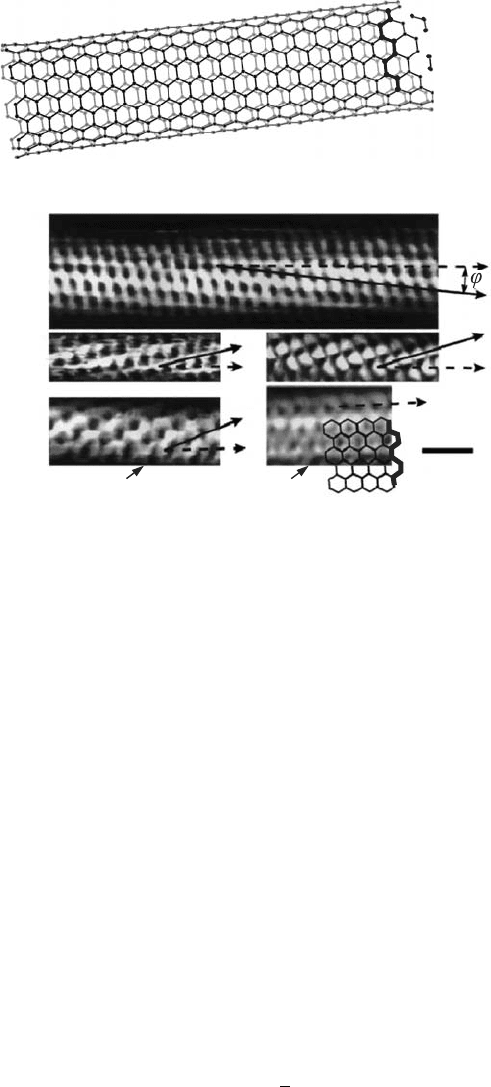
Figure 8.4 Armchair
carbon-nanotube
formation, showing
carbon dimer, C
2
,and
trimer, C
3
, units.
No. 10
No. 11
No. 7
No. 8
No. 1
H
1 nm
T
Chiral nanotube
nanotube
Armchair
Figure 8.5 Atomically
resolved STM images of
single-walled carbon
nanotubes with chirality.
Reprinted with
permission, from
P. Moriarty,
“Nanostructured
materials,” Rep. Prog.
Phys., 64, 369 (2001).
about 1 nm and length up to several millimeters are formed. At the point of
nucleation a carbon nanotube has a closed form, whereas from the side, where
the carbon atoms are added, it is open-ended.
Figure 8.4 shows how carbon atoms are added to a single-walled armchair
nanotube in the process of its growth. The sequential addition of C
2
dimers (clus-
ters of two carbon atoms) leads to the continuous growth of nanotubes. In order
to add hexagons and to eliminate pentagons, it is necessary also to use trimers C
3
(clusters of three carbon atoms). The inclusion of pentagons distorts the tube and
makes the nanotube close, thus the growth of the nanotube ends. The inclusion
of heptagons changes the size of the nanotube and its spatial orientation. More-
over, addition of “pentagon–heptagon” pairs brings about additional variations
of nanotubes. Many properties of single-walled nanotubes are defined not only
by their diameter but also by the so-called chirality or torsion (see Fig. 8.5, where
the torsion (or chirality) of a carbon nanotube is shown).
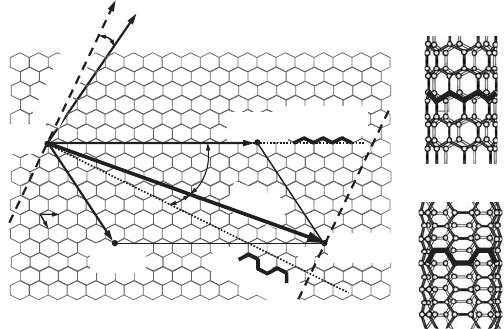
To understand the notion of “chirality” or “chiral angle,” we will start with
a two-dimensional graphite sheet as shown in Fig. 8.6(a). The single sheet of
graphite called graphene has the form of a hexagonal lattice. Let a
1
and a
2
be the
graphene lattice vectors, and let n and m be integers. The diameter and helicity of
the nanotube are uniquely characterized by the vector C = na
1
+ ma
2
≡ (n, m)
that connects crystallographically equivalent sites on a two-dimensional graphene
sheet. Here a
1,2
are in units of a
0
√
3, with a
0
being the carbon–carbon distance.
268 Nanostructures and their applications
(0,0)
(11,7)
(0,7)
zigzag
c
hi
r
a
l
a
r
m
c
h
a
i
r
t
u
b
e
a
x
is
T
H
ϕ
ϕ
θ
a
1
a
2
C
(a)
zigzag
armchair
(b)
(11,0)
Figure 8.6 (a) The relation
between the hexagonal
carbon lattice and the
chirality of carbon
nanotubes. A carbon
nanotube can be
constructed from a single
graphite sheet by rolling
up the sheet along the
wrapping vector C.(b)
Fragments of “armchair”
and “zigzag” carbon
nanotubes.
By using the vector C, a carbon nanotube can be constructed by wrapping a
graphene sheet in such a way that two equivalent sites of the hexagonal lattice
coincide. The wrapping vector C defines the relative location of these two sites.
In Fig. 8.6(a), the wrapping vector C connects the origin (0, 0) and the point with
coordinates (11, 7). Thus, a nanotube denoted by indices (11, 7) is formed. A tube
is called an armchair tube if n equals m, and a zigzag tube in the case of m = 0
(see the fragments of “zigzag” and “armchair” carbon nanotubes in Fig. 8.6(b)).
Having wrapping vectors along the dotted lines leads to tubes that are of zigzag
or armchair form. All other wrapping angles lead to chiral tubes whose wrapping
angle is specified relative to either the zigzag direction θ or the armchair direction
ϕ = 30
◦
− θ .Bothθ and the wrapping angle (chiral angle) ϕ are in the range
(0, 30
◦
) as a result of the hexagonal character of the two-dimensional lattice of
the graphene. Dashed lines are perpendicular to C and run in the direction of the
tube axis indicated by the vector T. The solid vector H is perpendicular to the
armchair direction and specifies the direction of nearest-neighbor hexagon rows.
The angle between T and H is the chiral angle ϕ. The unit cell of a nanotube can
be constructed by finding the smallest lattice vector T which connects equivalent
points of the lattice.
Depending on the magnitude of the diameter and the chiral angle (or chi-
rality), nanotubes may have either metallic or semiconductor properties. In the
process of fabrication two thirds of all nanotubes have semiconductor proper-
ties and the rest have metallic properties. Generally, nanotubes free of defects
and without chirality have metallic properties. Such nanotubes consist of rows of
hexagons parallel to the nanotube axis. If catalyst particles are not used, so-called
multiwalled nanotubes are formed.

8.2 Characterization with nanoscale resolution 269
Example 8.1. A carbon nanotube of radius r = 5 nm is placed in a magnetic
field with magnetic flux density B = 1 T, oriented in the direction of the nanotube
axis, which is parallel to the surface of the nanotube. Find the orbital magnetic
moment of an electron rotating around the nanotube axis and moving along the
nanotube surface. Compare this magnitude with the magnetic moment of the
electron in the hydrogen atom.
Reasoning. When an electron moves with the velocity v perpendicular to the
magnetic field it experiences a magnetic force, F
m
, which is equal to
F
m
= ev B.
The electron undergoes centripetal acceleration and Newton’s second law may
be written as
m
e
v
2
r
= ev B. (8.1)
Finding from the last equation the orbital velocity v, we can write the period of
rotation, T ,as
T =
2πr
v
=
2πm
e
eB
. (8.2)
The rotating electron creates a current, I , equal to
I =
e
T
. (8.3)
Owing to the rotation, the electron acquires the following magnetic moment:
µ = SI = πr
2
I =
e
2
r
2
B
2m
e
. (8.4)
For the electron motion around the nanotube axis the magnetic moment is equal
to µ ≈ 3.5 ×10
−25
Am
2
. The electron magnetic moment in the hydrogen atom
is equal to the Bohr magneton: µ
B
= 9.27 × 10
−24
Am
2
. Therefore,
µ
B
µ
≈ 32. (8.5)
8.2 Tools for characterization with nanoscale resolution
The minimum size of objects that the human eye can discriminate at the distance
of their best visual acuity (about 25 cm) is about 0.1 mm. To study smaller
objects, optical devices are used – from the simplest ones such as a magnifying
glass to more complex ones consisting of several lenses, such as an optical
microscope. Modern optical microscopes have magnifications up to 1500. This
means that, with the help of these devices, we can discern objects of size about
10
−7
m, i.e., objects of size about 100 nm. The increase of the resolution of
optical microscopes is hindered by diffraction. If the objects are separated by
a distance less than d ≈ λ/n, then they are indistinguishable. Here, λ is the
wavelength of the light and n is the index of refraction of a medium. The visible
270 Nanostructures and their applications
Incident light
Wavelength of light
Near field
Far field
Sample surface
Apertured tip
5 nm
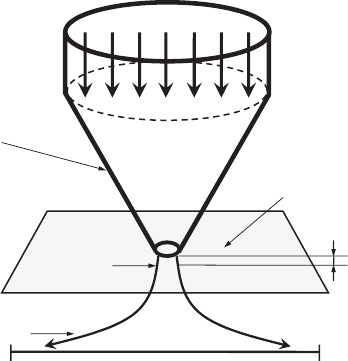
Figure 8.7 Near-field
optical microscopy
(schematic, not to scale).
part of the electromagnetic spectrum ranges from 400 to 800 nm. Therefore, even
theoretically with the help of the most powerful optical microscope possible we
cannot discern objects of size less than 200 nm. Some biological objects such
as cells, whose size is of the order of hundreds and thousands of nanometers,
can be studied using optical systems. Atoms, whose size is about one tenth of a
nanometer, cannot be seen using optical microscopes. The simplest solution for
this problem is to decrease the wavelength of the light. To discern atoms with the
help of such a microscope, we have to decrease the wavelength of the radiation
by a factor of 1000.
8.2.1 Near-field scanning optical microscopy
The near-field scanning optical microscope (NSOM) was introduced in 1972.
This microscope is a special form of scanning-probe microscope, which utilizes
visible light as its probe. The resolution of conventional optical microscopes,
as we have noted, is limited by the diffraction limit of the light, and therefore
it is limited by the wavelength of the light, which is about 0.5 µm. In the
NSOM this limitation is overcome and the resolution is increased by one order
of magnitude. Figure 8.7 illustrates how the diffraction limit of the light could be
overcome in NSOM. The scanning tip used in an NSOM is called an apertured tip.
The apertured tip is actually a “light funnel.” The visible light emanates from
the narrow side of the light funnel, which has a diameter of 10–30 nm. The light
is registered by the detector either after its reflection from the sample or after
transmission through the sample. The intensity of the optical signal is registered
by the detector and the set of data from the scanned surface forms the NSOM
image of the surface. With the help of an NSOM we can form the image of
8.2 Characterization with nanoscale resolution 271
the scanned surface in visible light with a resolution of about 15 nm if the
following condition is satisfied: the distance between the light source and the
sample must be very small – about 5 nm. By making the scanning tip approach
so close to the sample surface, we make the light interact with the surface
before its diffraction, thus increasing the resolution of optical microscopy (see
Fig. 8.7). The systems for placing the apertured tip and maintaining a constant
distance between the sample and the light source are the most complicated parts
of an NSOM. Usually, the apertured tip is made by heating an optical fiber and
stretching it until its end has a small diameter, whereupon the other end of the
fiber is chopped off. After this the optical fiber, except the end of the apertured tip,
is covered with a metallic layer for better optical transmission. Another method
for the fabrication of apertured tips is the following: a small hole is drilled
in the sharp end of an atomic-force-microscope (AFM) cantilever and light is
directed into this hole (we will consider AFM techniques in Section 8.2.3). The
development of effective apertured tips is nowadays a field of intensive research
efforts.
An NSOM must keep the distance between the sharp end of the scanning
tip and the sample constant in order to obtain an optical image of the surface
being studied. To do this, the traditional AFM methods for maintaining constant
deflection of an AFM cantilever may be used. The distinctive feature of the NSOM
compared with other scanning methods is that the image is formed directly in
the optical range including visible light, but its resolution is much higher than
the resolution of traditional optical microscopes.
8.2.2 Scanning-tunneling microscopy
As we have shown previously, the behavior of an electron in an atom is described
by its wavefunction, the square of whose modulus defines the probability density
of the electron being at a given point of space at a given time. The wavefunc-
tions of the electrons which belong to an atom have non-zero values outside of
the atom, i.e., at distances greater than the average size of the atom. Therefore,
when we bring atoms that belong to different objects closer to each other, the
wavefunctions of the valence electrons overlap before the forces of interatomic
repulsion begin to manifest themselves. As a result there is a possibility of
electron transfer from one atom to another, i.e., the exchange of electrons that
belong to different objects is possible without mechanical contact. This effect
may be realized if one of the objects has freely moving electrons, the other has
vacant electron states, and the applied voltage between those objects is equal to
or greater than the breakdown voltage of the air gap. If the voltage is much less
than the breakdown voltage, the electric current occurring under these condi-
tions is due to the tunneling effect and the current itself is called the tunneling
current.
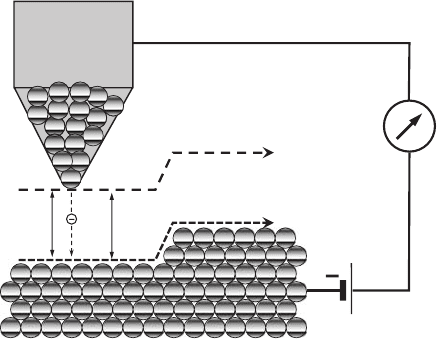
272 Nanostructures and their applications
~0.5 nm
Sample
I
T
Tip
+
U
L
Figure 8.8 The scanning
process in a
scanning-tunneling
microscope.
In tunneling microscopy, the tunneling current between the probe (or tip)
and the conducting surface is measured at each point of the scanned sur-
face (see Fig. 8.8). If we move the tip step by step (with a step of about the
size of the atomic radius) while measuring the tunneling current, we will “feel”
the individual atoms of the scanned surface. By scanning we mean the motion of
the tip along the surface from one point to another. The picture of the distribution
of the current measured over the sample surface is visualized on a computer dis-
play and allows us to study the surface topology on the atomic scale. The tunneling
phenomenon was utilized in 1981 as the basic principle of the scanning-tunneling
microscope (STM). One of the conductors had the form of a sharp needle, which
was called the tip, and the other conductor was the surface of the object being
studied.
In order to move electrons from the end of the tip to the studied surface,
the conduction electrons must gain a certain energy. The energy depends on
the distance, L, between the tip and the surface of the object, the voltage, U ,
between them, and the work functions, A
t
and A
s
, of the tip and the sample,
respectively. On bringing the tip to the surface at a separation of L ≈ 0.5 nm and
applying a voltage U ≈ 0.1−1 V a current, I
T
, is produced due to the tunneling
effect:
I
T
≈ en
0
vS. (8.6)
Here, n
0
and v are the concentration and velocity of electrons, and S is the
cross-section of the electron beam. The concentration of electrons in the beam is
related to the concentration of electrons in the tip, n
0
,by
n
0
= Dn, (8.7)