
Mitin V.V., Sementsov D.I., Vagidov N.Z. Quantum mechanics for nanostructures
Подождите немного. Документ загружается.

8.3 Selected examples of nanodevices and systems 283
GaAs
Al
x
Ga
x
As
(a)
Al
x
Ga
x
As
n
+
-GaAs
n
+
-GaAs
(b)
U
0
L
b
L
w
Quantum well
Potential barrier
Potential barrier
Figure 8.15 (a) The
schematic structure of a
GaAs/Al
x
Ga
1−x
As
resonant-tunneling diode
and (b) its potential
profile. U
0
is the height of
the potential barriers, L
b
the thickness of the
barriers, and L
w
the width
of the quantum well.
x
d
E
1
E
1
E
1
E
c
E
F
E
c
E
F
E
c
E
F
E
c
E
F
E
c
E
F
E
c
E
F
(a)
(b)
(c)
Figure 8.16 The system of
energy levels in a
resonant-tunneling diode:
(a) under equilibrium
conditions, (b) at
resonance under an
applied voltage, and
(c) off resonance under an
applied voltage. The
electron potential energy
and population of the
energy band in contact
n
+
-regions are sketched
in the left and right parts.
E
c
denotes the bottom of
the conduction band.
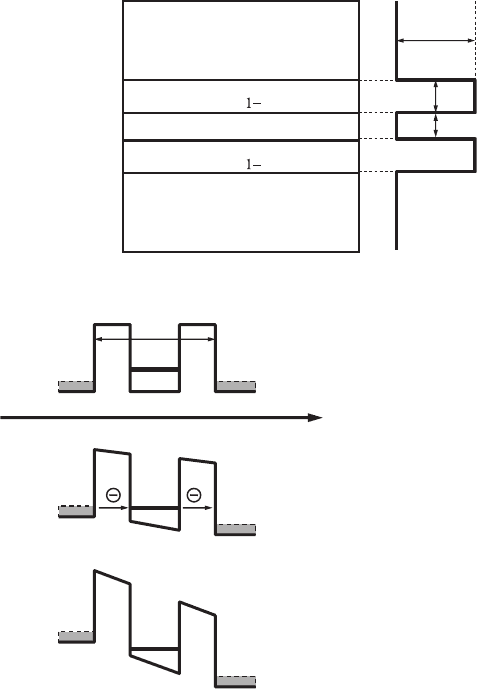
8.3.1 Resonant-tunneling diodes
A nanoscale phenomenon called resonant tunneling can be described as fol-
lows. The current through a nanostructure consisting of two potential barriers
with a quantum well between them (a so-called double-barrier structure), sharply
increases when the Fermi energy of the electrode that supplies electrons becomes
equal to the energy level in the quantum well. Such a double-barrier structure
with two contacts is called a resonant-tunneling diode (RTD). The scheme of
an RTD and its potential profile are shown in Fig. 8.15. The system of energy
levels of such a simple structure is shown in Fig. 8.16. This structure consists
of two barriers divided by a region with low potential energy (a quantum well
with quantized electron levels). Let us assume that the quantum well has only
284 Nanostructures and their applications
(c)
(b)
(d)
(a)
U
I
0
Figure 8.17 An energy
diagram and
current–voltage
characteristic of the
resonant-tunneling diode:
the portions labeled (a),
(b), and (c) correspond to
the physical situations of
Fig. 8.16. Part (d) shows
what happens with the
current when the second
electron state enters into
resonance with the Fermi
level, E
F
.
a single discrete energy level. The thickness of the barriers and width of the
quantum well can be several nanometers. The regions in the right-hand and left-
hand sides from the barriers serve as electron reservoirs, and these regions can be
considered as the contacts to the structure. Such a double-barrier structure has one
distinctive feature: its tunneling probability has a resonant character. Even if the
transmission through each barrier is low, this does not mean that the probability of
electron tunneling through the double-barrier structure is small. When the energy
of electrons incident on the barrier is equal to the energy of one of the discrete
levels of the quantum well between the two barriers, the tunneling probability for
the double-barrier structure increases sharply. The effect of resonant tunneling
can be understood in terms of interference. Indeed, due to the interference of
the transmitted and reflected electron waves the wave that is reflected from the
double barrier returns to the quantum well. Therefore, the wave incident on the
double-barrier structure from the left has a high probability of being transmitted
to the right.
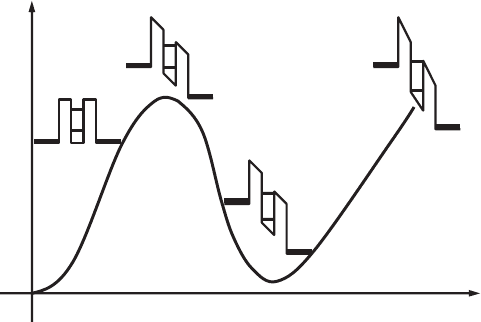
Let us describe how the RTD works. The current that flows through the double-
barrier structure depends on the applied voltage. Note that the voltage is mostly
applied to the double-barrier region, since the regions from the left-hand and
from the right-hand sides of the barriers have higher conductivity. If the applied
voltage is small and the energy of electrons incident on the barrier from the
left is lower than the energy of the discrete energy level in the quantum well,
then the transmission through the barrier and, consequently, the current through
the double-barrier structure will be small (see part (a) of the curve in Fig. 8.17
and Fig. 8.16(a)). The current reaches its maximum at the voltage at which the
energy of electrons becomes equal to the energy of the discrete energy level
(see part (b) of the curve in Fig. 8.17 and Fig. 8.16(b)). At higher voltages the
energy of incident electrons becomes higher than the energy of a discrete energy
level (see part (c) of the curve in Fig. 8.17 and Fig. 8.16(c)). As a result, the

8.3 Selected examples of nanodevices and systems 285
tunneling probability of the double-barrier structure decreases and consequently
the current decreases. Thus, there appears a maximum of the current–voltage
characteristic, which is followed by a region with negative-differential resistance
(NDR), i.e., by a region where the current decreases with increasing voltage.
With the further increase of the applied voltage, the current begins to increase
again. If the potential well between two barriers has several discrete energy levels,
then the current–voltage characteristic will have several maxima, each of them
at a voltage at which the corresponding energy level comes into resonance with
the Fermi energy, E
F
, of the left-hand-side region (see part (d) of the curve in
Fig. 8.17).
Having these regions, the RTD may be used in electronic circuits not only
as a rectifier but also for performing various other functions. The existence
of such an NDR region (or NDR regions) is promising for the development
of multilevel logical elements, memory elements, and solid-state ultra-high-
frequency generators. The addition of a control electrode in the central region
of an RTD transforms it into a resonant-tunneling transistor and increases the
number of its applications. Such transistors have turn-off and turn-on frequencies
of about 10
12
Hz. This is several orders of magnitude higher than the frequencies
of the best silicon transistors in modern integrated circuits. Therefore, such
transistors can be used in the next generation of integrated circuits.
8.3.2 Single-electron transistor s
The operation of single-electron devices is based on the effect of tunneling of
a single electron. Various structures and devices based on this effect have been
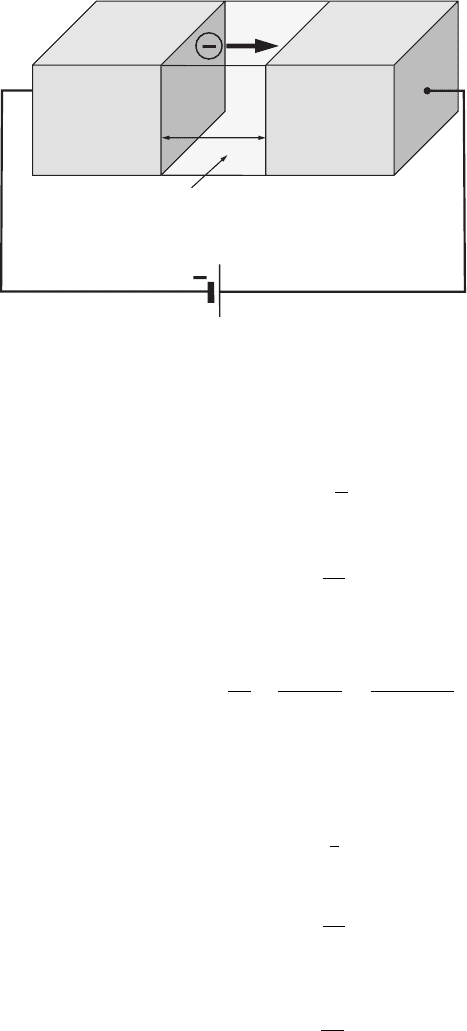
realized experimentally. In the simplest version, this effect can be observed in
a single-electron tunnel junction. The single-electron tunnel junction may be
created in the form of two plates (we consider here the simplest case, in which
both plates are made of the same metal) of small cross-sectional area, S, and a thin
layer of dielectric of thickness d between them (see Fig. 8.18). The capacitance
of this system is given by
C =
0
S
d
, (8.15)
where is the dielectric permittivity of the dielectric separating the metallic
plates. The potential difference between the plates is determined by the charge
accumulated on these plates:
U =
Q
C
. (8.16)
If the charge, Q, is reduced by the charge of one electron, e, then the potential
difference becomes
U =
Q − e
C
. (8.17)
286 Nanostructures and their applications
d
+
S
Metal
Dielectric
Tunnel junction
Metal
+Q−Q
U
Figure 8.18 A capacitor
with an induced charge
and a single-electron
tunnel junction.
As a result of transmission of a single electron from one electrode through
the dielectric layer to the opposite electrode, the voltage at the tunnel junction
changes by the following magnitude:
U =
e
C
. (8.18)
The energy stored in the capacitor is defined as
E =
Q
2
2C
. (8.19)
The change of the energy stored in the capacitor as a result of transfer of a single
electron is equal to
E =
Q
2
2C
−
(Q − e)
2
2C
=
e(Q − e/2)
C
. (8.20)
Electron tunneling occurs only if E > 0, i.e., if energy is decreased due to the
transfer of a single electron. Thus, from Eq. (8.20) it follows that, for electron
tunneling to occur, the initial charge on a metallic plate must satisfy the following
condition:
Q ≥
e
2
. (8.21)
This corresponds to the voltage between plates, U, being equal to
U ≥
e
2C
. (8.22)
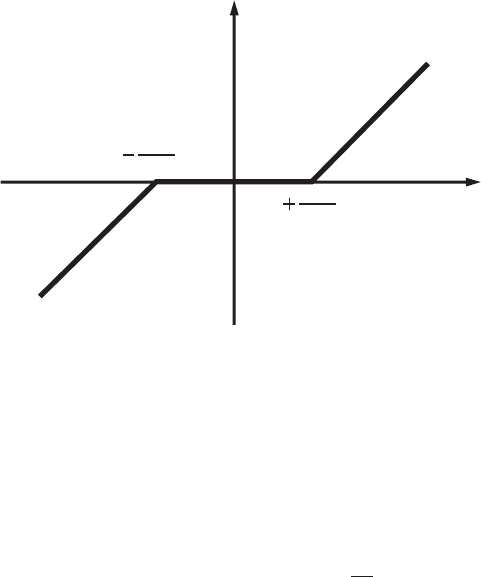
Thus, by applying a voltage higher than e/(2C), we can make current flow. Since
the current cannot flow if
U <
e
2C
, (8.23)
the effect is known as Coulomb blockade. The current–voltage characteristic for
a device with Coulomb blockade is shown in Fig. 8.19.
8.3 Selected examples of nanodevices and systems 287
I
0 U
e
2C
e
2C
Figure 8.19 The
current–voltage
characteristic for a device
with Coulomb blockade.
Because of the nanometer width of the tunnel junction, d, and small capaci-
tance, C, each electron passing through the junction causes a substantial change
in the voltage U (see Eq. (8.18)). If the condition (8.22) is not satisfied, the elec-
tron tunneling is blocked by a large blocking voltage, caused by the tunneling of
a single electron. The energy which is necessary to charge the capacitor in order
to satisfy the condition (8.22) is equal to
E
C
= eU =
e
2
2C
. (8.24)
This is the charging energy required to add a single electron with charge e to the
capacitor. Note that for Q = 0 the expression (8.20) is reduced to Eq. (8.24).
Let us estimate the capacitance, C, and the energy, E
C
, required to transfer
a single electron in nanoscale capacitors. For example, for a capacitor with
S = 100 nm
2
, d = 10 nm, and = 1 (we assume that the dielectric is vacuum)
we get C ≈ 9 × 10
−18
F and E
C
≈ 0.9 eV. The energy needed to transfer a single
electron is equal to almost 1 eV! Let us compare the capacitance and charging
energy of a nanoscale capacitor with those for a macroscopic capacitor with
S = 100 mm
2
, d = 1 mm, and = 1. For these parameters we get C ≈ 9 ×10
−13
F and E
C
≈ 9 × 10
−8
eV. We see that the difference between the energy needed
to transfer a single electron, E
C
, in the case of a nanoscale capacitor and that for
a macroscopic capacitor is enormous. In the case of a macroscopic capacitor, E
C
is almost negligible. The charging energy of the macroscopic capacitor (E
C
=
9 × 10
−8
eV) is lower by six orders of magnitude than the thermal energy of
an electron at room temperature (E
th
= 2.5 × 10
−2
eV)! Therefore, Coulomb
blockade cannot be observed in macroscopic objects.
Let us now consider the Coulomb-blockade effect in a quantum-dot single-
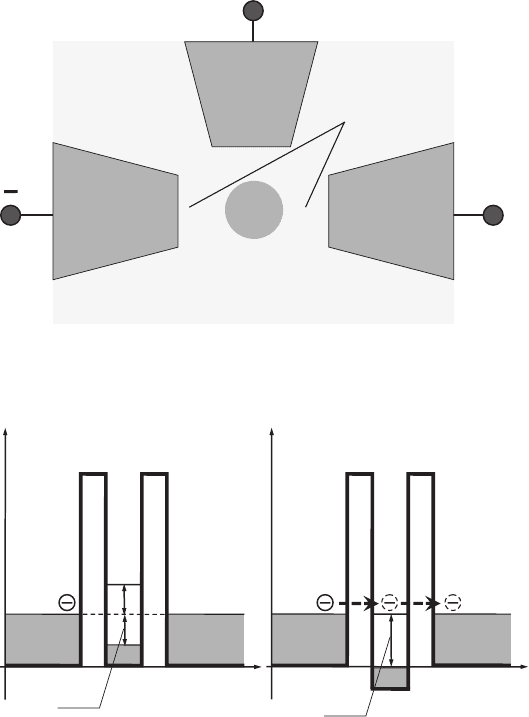
electron transistor, as shown in Fig. 8.20. Just like any conventional transistor,
it has three electrodes: source, drain, and gate. A quantum dot is placed in
288 Nanostructures and their applications
+
+
Gate
Source
Drain
Dielectric
QD
Tunnel
junctions
Figure 8.20 A schematic
representation of a
quantum-dot
single-electron transistor:
the quantum dot (QD) is
isolated from the source,
drain, and gate by
dielectric.
x
E
E
F
E
F
E
vac
(a)
x
E
E
F
E
F
E
vac
(b)
E
C
2E
C
Source
Drain
QD
Figure 8.21 Band
diagrams of a
quantum-dot
single-electron transistor
with source–drain voltage,
U
SD
, equal to zero: (a)
gate voltage U
G
= 0and
(b) gate voltage U
G
> 0.
Here, E
C
= e
2
/ (2C).
the channel, i.e., in the region between the source and the drain. The quantum
dot, which is often called the island, is either a metallic or a semiconductor
nanoparticle, which is isolated from all three electrodes by a dielectric. Electron
motion can take place only through the dielectric, under certain conditions.
Here we give you a very simplified version of the operational principles of
a quantum-dot single-electron transistor. The band diagrams of a quantum-dot
single-electron transistor without and with an applied positive gate voltage, U
G
,
are shown in Fig. 8.21 (the voltage between source and drain, U
SD
, is equal to
zero). The quantum dot (the island) in the channel of a single-electron transistor
is a nanoparticle, which is made from the same metal as the source and the drain.
AsshowninFig.8.21(a), the electrons in the source and the drain have higher
energy than the electrons have in a quantum dot. Therefore, it is energetically
8.3 Selected examples of nanodevices and systems 289
favorable for an electron from the source or the drain to tunnel to the quantum
dot. However, because of Coulomb blockade, the electron must have energy
greater than the charging energy E
C
. At zero gate voltage (U
G
= 0), as shown in
Fig. 8.21(a), the electron in the source has energy lower than E
C
and therefore
tunneling of the electron from the source to the quantum dot cannot happen. If
a positive gate voltage (U
G
> 0) is applied to the gate, as shown in Fig. 8.21(b),
the energy in the dot is decreased by E
C
and the electron from the source will
be able to tunnel to the quantum dot and then to the drain. Thus, by controlling
the potential on the gate we can control the transmission of a single electron
through the dielectric barrier and therefore control the current in a circuit. This
is the essential feature of a transistor. If the electron that tunneled from the source
stayed in the dot rather than going into the drain, then the energy in the dot would
increase by E
C
and tunneling of the next electron would be blocked.
In digital integrated circuits based on single-electron transistors one bit of
information (two possible states, 0 or 1) may be presented as the presence or
absence of a single electron in the quantum dot of the channel. A whole memory
block with a capacity of 10
11
bits (which is 100 times higher than that which
modern chips have) could be placed on a crystal with a surface area of 1 cm
2
.
The practical realization of such devices is the goal of researchers all over the
world.
8.3.3 Quantum-optoelectronic devices
Optoelectronics is a field of physics and technology that is related to the con-
version of optical radiation into electrical signals and vice versa. The number of
optoelectronic devices is large. The operational principles of these devices are
based on quantum mechanics. We can distinguish two main types of optoelec-
tronic devices: (1) light-emitting devices and (2) light-absorbing or photodetect-
ing devices.
Light-emitting devices
These are the devices that convert electric current into light. They can be
incandescent lamps, electroluminescent indicators, semiconductor light-emitting
diodes (LEDs), and lasers. The most widely used devices developed with the help
of nanotechnology are LEDs and lasers. We will talk about lasers – sources of
coherent radiation – later. Now we will discuss the operational principles of the
LEDs with a p–n-junction.
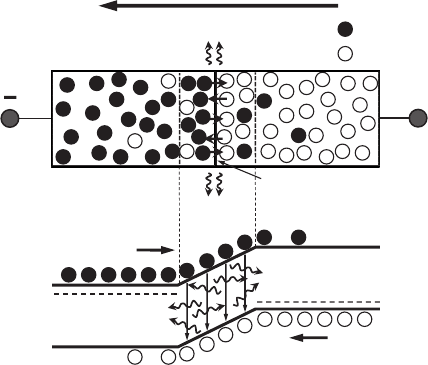
Light-emitting diodes are sources of non-coherent radiation. They emit light
only when the current through the p–n-junction flows in the forward direction.
The forward direction for the p–n-junction corresponds to the case when a
negative potential is applied to the n-region. Electrons come into the junction
region from the n-region and holes come from the p-region. After recombination,
holes and electrons disappear and their energy in the form of a light quantum
290 Nanostructures and their applications
- electron
- hole
Light
(a)
+
p-type
(b)
E
F
E
F
E
c
E
v
electrons
holes
n-type
Forward direction
Interface between
n- and p-type regions
Figure 8.22 A schematic
representation and band
diagram of a
semiconductor
light-emitting diode.
is emitted, as shown in Fig. 8.22. The light intensity should be proportional
to the current flowing through the LED. However, when the current increases
the thermal heating of the LED also increases, leading to an increase of the
non-radiative losses in the LED.
For a long time mass production of LEDs was limited to LEDs emitting only
in the red and infrared regions of the electromagnetic spectrum. Green LEDs
were made first from gallium phosphide (GaP) and blue LEDs from silicon
carbide (SiC). However, these materials either emitted low-intensity radiation or
quickly became overheated due to their low efficiency. Nitrides, materials based
on elements from the third and fifth groups of the Periodic Table of the elements
(AlN, GaN, and InN), have become practical for the fabrication of LEDs in the
visible range of the electromagnetic spectrum. These materials emit throughout
the entire range of the visible and ultraviolet regions of the electromagnetic
spectrum from 240 to 640 nm. During the 1970s scientists from IBM fabricated
violet and blue diodes based on epitaxial films of GaN. However, these diodes
quickly overheated and thus became non-operational.
The development of nanotechnology has allowed the growth of heterostruc-
tures constructed on the basis of GaN, AlN, and InN that can be used for the
fabrication of heterojunction LEDs. The junction is called a heterojunction when
the interface is formed by two different materials. The junction is called a homo-
junction if both parts of the junction are made from the same material with
different doping. The most frequently encountered type of homojunction is the
p–n-junction, which has the same material on both sides of the junction, doped
with donors (in the n-region) and acceptors (in the p-region) (the p–n-junction
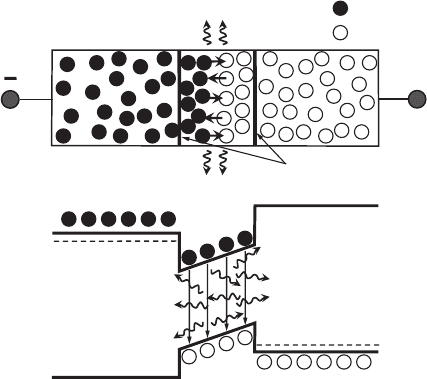
showninFig.8.22 is a homojunction). A GaInN/GaAlN heterojunction is shown
in Fig. 8.23.
8.3 Selected examples of nanodevices and systems 291
(b)
E
F
E
F
E
c
E
v
p-type
- electron
- hole
Light
(a)
+
n-type
GaAlN
GaAlN
GaInN
Heterointerface
Figure 8.23 A schematic
representation and band
diagram of an GaInN/
GaAlN light-emitting
diode.
The advantage of a heterojunction lies in the possibility of controlling the
doping in n- and p-regions independently of the size of the region where electrons
recombine: in the case of the heterostructure shown in Fig. 8.23 the recombination
region is controlled by the thickness of the GaInN layer. Doping is the addition
of impurity atoms to a semiconductor, which defines its type of conductivity,
p or n. The resistance of p- and n-regions significantly decreases when they
are heavily doped. Therefore, when current flows through a more highly doped
heterojunction there is less heat production in the highly doped n- and p-regions
and lower currents may be used if the recombination region is made narrower
than in the case of a homojunction. The concentration of electrons and holes in
the narrow recombination region of the LED will be significantly higher than in
the case of a homojunction and, therefore, the intensity of radiation will also be
higher. The materials that can be grown by means of modern technology allow
one to cover the entirety of the visible spectrum.
Lasers on quantum wells
A laser, which is the acronym of light amplification by stimulated emission
of radiation, is an optical quantum generator, i.e., it is a source of coherent
electromagnetic radiation. Here, we will discuss lasers for the visible or close-
to-visible range of the electromagnetic spectrum. Note that modern lasers cover
all frequencies from X-rays (wavelength ∼10 nm) up to 1 THz (wavelength
∼300 µm). The operation of the laser is based on the utilization of the stimulated
emission (or induced emission) of atoms, molecules, and crystalline structures.
The coherence of laser radiation is due to the fact that light waves are emitted in
a coordinated fashion: the emitted light waves have the same frequency, wave-
length, and direction of propagation. The most compact, efficient, and reliable

292 Nanostructures and their applications
lasers are semiconductor lasers. Because of these properties they are used in
CD and DVD players, laser printers, and computers. Telephony, the Internet, and
optical and other types of cable communications got their second lease of life
due to a wide use of semiconductor lasers.
The operation of any type of laser is based on two important quantum phe-
nomena: (1) the existence of states with population inversion and (2) stimulated
emission. A medium containing a system of quantum particles (atoms, molecules,
or ions), whose quantum state with higher energy (excited state) can be populated
significantly more than the state with lower energy, is called an active medium.
The state of the active medium in which the majority of all particles of the system
is in the excited state is called the state with population inversion. The excita-
tion of a quantum system of particles is done by the pump, i.e., a constant or
pulsed action on the active medium to maintain the state of population inversion
of carriers. As an example, we consider here an active medium that consists of
atoms rather than molecules or more complicated objects. In the active medium
with population inversion photons, which either are injected into the medium or
are created as a result of transitions of atoms from the excited to the non-excited
state, are scattered more often by excited atoms than by non-excited atoms.
The emission radiated during the spontaneous transition of an electron in
the excited atom from a higher energy level to the lower energy level is called
spontaneous emission. Spontaneous emission, which occurs from a large number
of atoms in the active medium, happens incoherently (i.e., in non-coordinated
fashion), since quantum transitions of electrons with the emission of photons
occur in each atom independently. However, the transition of an electron from a
higher energy level, E
2
, to a lower energy level, E
1
, not only may be spontaneous,
but also can happen under the influence of an external electromagnetic field, for
example as a result of an atom’s interaction with the photons which already exist
in the system.
For such a type of transition the photon frequency, ω, must be equal to the
frequency ω
21
:
ω = ω
21
=
E
2
− E
1
h
-
. (8.25)
Such radiation is called stimulated or induced. As a result of such an interaction
of the excited atom with a photon whose frequency is equal to the frequency of
the electron quantum transition from state E
2
to state E
1
, two photons absolutely
identical in energy, direction of propagation phase, and polarization occur (see
Fig. 8.24). Thus, the electrons from the energy levels with population inversion
emitting induced radiation amplify the original light beam, forming a light beam
that is coherent, narrow, and polarized.
For the operation of any type of laser it is necessary to have an optical
resonator, which is usually a system of two parallel mirrors. The role of the
resonator is to confine electromagnetic radiation within the active medium and