
Mitin V.V., Sementsov D.I., Vagidov N.Z. Quantum mechanics for nanostructures
Подождите немного. Документ загружается.

8.3 Selected examples of nanodevices and systems 293
E
1
E
h
2
E
1
E
2
E
1
E
2
E
hw
(a) (b) (c)
hw
h
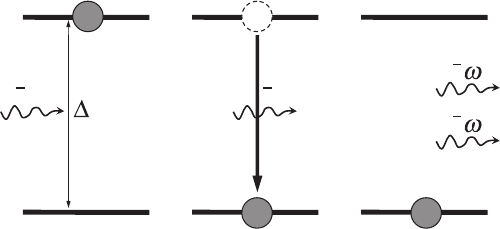
Figure 8.24 Stimulated
emission. The incident
photon with energy h
--
ω
equal to E = E
2
− E
1
induces an electron from
the excited level E
2
to
emit a photon of the same
energy h
--
ω: (a) before the
emission of a photon by
the electron from the
excited level, (b) during
the emission, and (c) after
the emission of a photon.
make it pass through it in the forward and reverse directions several times. The
inverted state of the active medium is maintained by the pump.
To fabricate a laser on the basis of a planar semiconductor structure with
quantum wells, it is necessary to fabricate two contacts through which electrons
and holes are continuously injected into the active medium. Let, for example,
electrons be injected through one of the contacts into the quantum well – a layer
of narrow-bandgap semiconductor, surrounded by wide-bandgap semiconduc-
tor (for example, a narrow layer of InGaN in GaN). Electrons making quantum
transitions from the conduction band to the valence band (i.e., electrons recom-
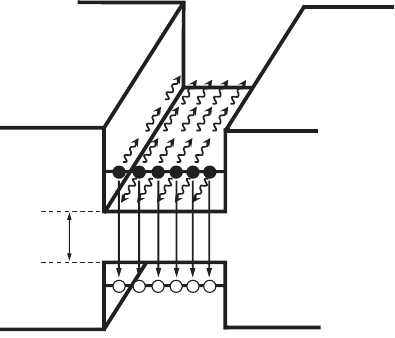
bining with holes) emit photons. In accordance with the energy diagram shown
in Fig. 8.25, the frequency of electron transition from the conduction band to the
valence band is defined by the following condition:
h
-
ω = E
c1
+ E
v1
+ E
g
, (8.26)
where E
c1
and E
v1
are the confinement energy levels of the electrons and holes
in the quantum well, respectively, and E
g
is the bandgap of the narrow-bandgap
semiconductor. It is necessary to confine the radiation generated by the laser
within the active medium of the device. Because of this, the refraction coefficients
of the inner layers must be larger than those of the external layers. In the band
diagram shown in Fig. 8.25 the external layers are the layers of the wide-bandgap
semiconductor GaN. At the front and back facets of this waveguide, mirrors are
deposited, which form the resonator.
Two competing processes take place in a laser during its operation. In one of
them, when an electron recombines with a hole a quantum of light is emitted. In
the second, some of the electrons in the ground state absorb light quanta, making
the intensity and power of radiation smaller. As the current increases, the state
with the population inversion is established and the process of emission begin to
prevail over the absorption process. The use of lasers based on heterostructures
resulted in a significant reduction of the minimum (or threshold) current at
which a laser can emit coherent radiation since the injected electrons and holes
294 Nanostructures and their applications
InGaN
GaN
GaN
E
c
E
v
E
c1
E
v1
E
g
Figure 8.25 The band
diagram of a
semiconductor
heterolaser on a quantum
well.
are concentrated in the narrow region of the quantum well of the narrow-bandgap
semiconductor.
Semiconductor lasers use multiple quantum wells, which form the active
region, instead of one quantum well as is shown in Fig. 8.25. Lasers based
on quantum wells allow one to tune the radiation frequency by controlling the
energy states of quantum wells. Decreasing the width of the quantum wells
results in an increase of E
c1
and E
v1
and consequently of the frequency of laser
emission (see Eq. (8.26)). Therefore, lasers based on quantum structures are
low-cost devices, use low currents, and are highly efficient at producing more
light energy from the power supply. The most important parameter of any laser is
its durability. Early semiconductor lasers working continuously operated for just
several seconds, whereas modern lasers can operate for up to a million hours.
Many groups are now developing lasers based on quantum structures with even
lower dimensionality than quantum wells – lasers based on quantum dots.
Photodetectors based on quantum nanostructures
Detectors of electromagnetic signals, so-called photodetectors, convert light radi-
ation into electric current. Photodetectors are used for the detection of radiation
from the ultraviolet to terahertz frequency and for converting it into an electronic
signal.
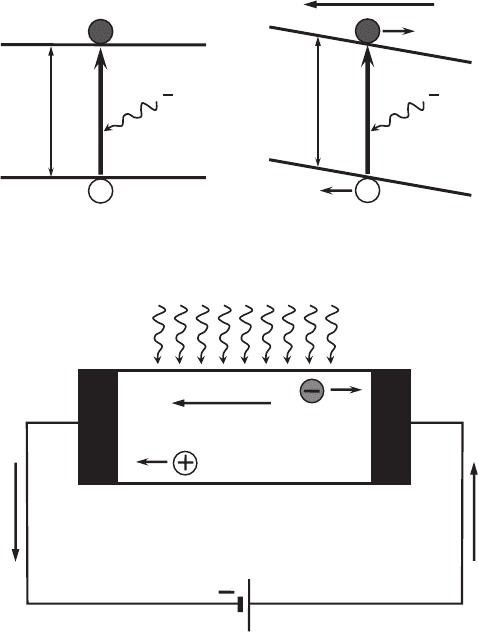
The operation of most photodetectors is based on the internal photoelectric
effect – the phenomenon whereby mobile carriers (electron–hole pairs) are simul-
taneously generated when light is absorbed by a semiconductor (see Fig. 8.26).
For light to be absorbed by the semiconductor, the energy of the incident radiation,
h
-
ω, must be greater than or equal to the energy bandgap of the semiconductor E
g
.
Following absorption of photons, the mobile electrons created in the conduction
band of the semiconductor and holes created in the valence band increase the
8.3 Selected examples of nanodevices and systems 295
E
g
E
c
E
v
hω ≥ E
g
E
g
E
c
E
v
E
(b)(a)
hω ≥ E
g
Figure 8.26 The internal
photoelectric effect.
E
Incident light
I
I
+
Figure 8.27 The operation
of a photocell.
conductivity of the sample. The increase in conductivity after absorption of light
is called photoconductivity. The device whose operation is based on the internal
photoelectric effect is called a photocell (see Fig. 8.27).
Another type of photodetector is based on quantum heterostructures. They
cover a wide range of the spectrum from the red into the infrared and far-infrared
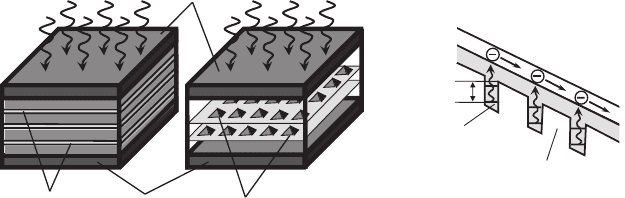
ranges. The operational principle of a heterostructure photodetector (for example,
a photodetector based on quantum wells or quantum dots) is very simple: as a
result of photo-ionization the carriers from a potential well are injected into the
wide-bandgap semiconductor (potential barrier) (see Fig. 8.28). This increases
the conductivity of the structure in the direction perpendicular to the layers of the
heterostructure. The photoconductivity of the structure, as in the case of a simple
photocell, is determined by the product of three factors: (1) the rate of optical
generation, which in turn is proportional to the absorption coefficient; (2) the
296 Nanostructures and their applications
(c)(a) (b)
Emitter
Collector
QWs
QDs
Narrow-bandgap
semiconductor
Wide-bandgap
semiconductor
∆E
Figure 8.28
Photodetectors based on
heterostructures:
(a) a quantum-well
photodetector,
(b) a quantum-dot
photodetector, and (c) the
band diagram of
heterostructure
photodetectors. The
incident light frequency,
ω, must be greater than
E/ h
--
in order to release
confined electrons from
the potential wells.
lifetime of carriers in the delocalized state; and (3) the effective electron mobility
in the delocalized state. Heterostructure photodetectors are highly efficient. For
example, photodetectors based on GaAs/GaAlAs quantum wells have quantum
efficiencies close to 100%, i.e., one electron is released from the quantum well
by each photon of the incident radiation.
One of the most important problems in the field of photodetectors is the devel-
opment of multiwindow or multicolor photodetectors that can register radiation
in different spectral ranges. The best suited devices for fabrication of multiwin-
dow photodetectors are quantum heterostructures. In the case of photocells the
only way to detect radiation with different wavelengths is to use different semi-
conductor materials with different bandgaps. The development of photodetectors
based on heterostructures allows us to change the region of spectral sensitivity not
just by changing the material of the structure as is done with more conventional
photodetectors (photocells) but also by changing the width of the quantum wells
or the size of quantum dots. This opens the possibility of using, for example,
semiconductor heterostructures with different thicknesses of quantum wells to
fabricate monolithic multicolor photodetecting elements that are sensitive for
several specific spectral regions.
8.3.4 Quantum-dot cellular automata
The demand for the development of logic devices with maximum density of logic
elements and minimum energy consumption for a single on/off switch led to the
proposition to use in logical elements conducting islands of very small size –
quantum dots. In such devices arrays of interacting quantum dots can be used for
the implementation of logical Boolean functions. These new devices were called
quantum-dot cellular automata (QCAs). The basic element of this device is a
cell, which consists of four or five quantum dots.
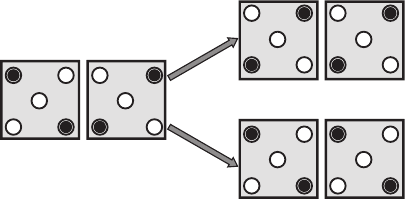
As an example, Fig. 8.29 shows a cell consisting of five quantum dots: four
dots are located at the four corners of a square and one dot is at the cell’s center.
8.3 Selected examples of nanodevices and systems 297
State with higher energy
Two states with lower energy
(a) (b)
Figure 8.29 Quantum-dot
cellular automata.
By applying a gate voltage to the cell, two electrons are injected into quantum
dots, which makes the cell negatively charged. The quantum dots in the cell are
arranged in such a way that tunneling through the central dot is possible. Because
of the electrostatic repulsion between the two additional injected electrons, the
whole system will have its minimum energy only in the case when the electrons
are as far from each other as possible, i.e., when they are located at the corners
along a diagonal. Since there are two such stable states (or two polarizations),
one of them can be considered as a logic “1” state (see the upper part on the
right-hand side of Fig. 8.29) and the other as a logic “0” state (see the lower part
on the right-hand side of Fig. 8.29). When the system transfers from one stable
state to another, the polarization of the system is changed and the distribution
of electric fields around the cell is changed also. With the help of additional
electrodes connected to the cell capacitatively, it is possible to switch the cell
into the desired state – to put it into the logical state “1” or “0”. If we place
near the first cell a second cell, which also has two additional electrons, then
the electrostatic field of the first cell will force the electrons of the second cell
to move in order to minimize the electrostatic energy of the entire system (see
Fig. 8.29).
By making combinations of different cells it is possible to realize various
logic functions and carry out necessary logic transformations and computations.
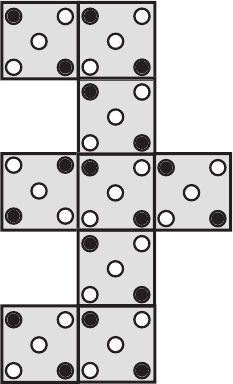
Figure 8.30 shows one of the examples of cell combinations, whose output state
is defined by a majority of input states (this is the so-called “majority”logic
function). Various combinations of cells have been suggested for the realization
of different logic operations. On the basis of these logic elements the creation of
a new “nanocomputer” is possible. It is important that the positional relationship
of cells provides the transmission of a logic signal without charge transport along
the chain of cells, i.e., only the polarization of the state is transmitted along the
chain of cells.
The advantage of logic devices based on quantum-dot cellular automata is that
they require significantly less volume of active region than do their counterparts
based on field-effect transistors (FETs). For example, a summator on the basis of
298 Nanostructures and their applications
“1”
“1”
“0”
“1”
Inputs Outpu
t
Figure 8.30 Combination
of cells, when the output
state is defined by the
majority of input states:
three inputs, 1, 0, and 1,
and one output, 1.
cellular automata with the size of the quantum dot equal to 20 nm can be built on
an area of 1 µm
2
, whereas the same area is occupied practically by one FET. To
build a summator on the basis of FETs, it is necessary to use approximately 40
transistors. If we take into account the area of connections between the transistors,
which is even greater than that of the active devices, then the advantages of using
cellular automata become apparent.
Computation in devices based on cellular automata is done by the transition
of the whole array of cells to the state with minimum energy (or to the ground
state). Since complex computational devices contain many cells, the state with
minimum energy can be achieved in different ways. This may lead to errors
in computations. Moreover, these systems are very sensitive to external factors
and, therefore, they require very strict control of the external conditions. If the
ambient temperature increases, the computational process can be disrupted. For
a cell whose quantum-dot size is about 20 nm, the change of energy during
quantum-dot recharging is about 1 meV, which corresponds to a temperature of
about 12 K and is substantially lower than the 300 K of room temperature. As
in the case of a single-electron transistor, the operation temperature of cellular
automata can be increased by decreasing the cell’s size (and correspondingly
decreasing the size of each quantum dot). Unfortunately, there exists a significant
roadblock, which has to be removed for successful operation of devices based on
cellular automata. Since the electrostatic field of the cell affects the state of the
neighboring cell in the output direction as well as in the input direction, signal
propagation can, because of random influences, be not only from input to output,
but also in the opposite direction. To get rid of this problem, the use of quantum-
dot devices whose direction of signal propagation is controlled by the external

8.3 Selected examples of nanodevices and systems 299
field was suggested. Practical realization of these devices is in the initial stage
and requires the solution of series of problems that are mainly technological.
Example 8.3. Find the temperature equivalent of the laser’s active medium,
which is responsible for the state with population inversion of energy levels:
N
2
> N
1
. Energy level E
2
, which corresponds to the level population N
2
,is
higher than E
1
, which corresponds to the level population N
1
.
Reasoning. Under conditions of thermodynamical equilibrium the lowest energy
level of atoms of the active medium, E
1
, is more populated than the energy level
E
2
. In accordance with the classical law of the particles’ distribution over the
energy (i.e., Boltzmann’s law) the number of particles on a particular energy
level, E
i
, is defined as
N
i
= Ce
−E
i
/(k
B
T )
, (8.27)
where C is a constant that depends on the number of particles per unit volume
of active medium. In the inverted state the thermodynamical equilibrium of the
active medium is violated. However, if we apply to this state Boltzmann’s distri-
bution law, Eq. (8.27), then the ratio of numbers of particles on corresponding
levels will be defined by the following expression:
N
2
N
1
= exp
−
E
2
− E
1
k
B
T
= exp
−
h
-
ω
21
k
B
T
, (8.28)
where the frequency of transition ω
21
> 0. From the last expression we can find
the temperature of the active medium in the inverted state:
T =−
h
-
ω
21
k
B
ln(N
2
/N
1
)
, (8.29)
which in this case becomes negative. Note that the term “negative” can be applied
only to non-equilibrium states, which is the case for a state with population
inversion.
8.3.5 Josephson electronics
Quantum effects play a fundamental role in the operation of superconducting
elements, which include the Josephson junction. The Josephson effect can be
observed in the current–voltage characteristic of two superconductors separated
by a narrow (about 1 nm) dielectric layer. When a sufficiently weak current flows
through the Josephson contact there is no voltage at the contact, i.e., the cur-
rent is purely superconducting. The existence of superconducting current is due
to the existence of Cooper pairs, which are only partially destroyed when they
pass through the thin non-superconducting layer. This phenomenon, called the
stationary Josephson effect, was experimentally discovered in 1963. When the
current through the contact is increased, an alternating voltage occurs between
two superconducting films. This effect is called the AC Josephson effect.Small
300 Nanostructures and their applications
capacitance and the ability to switch from zero to non-zero voltage while exceed-
ing the critical current allows one to use Josephson contacts as logical elements of
computers. One or several Josephson contacts incorporated into a conventional
electric circuit can provide automatic transformation from analog presentation of
information to a discrete one. All free electrons in superconductors form Cooper
pairs, which have double the electron charge. Since each Cooper pair has integer
spin, the ensemble of such quasiparticles obeys Bose–Einstein statistics rather
than the Fermi statistics for free electrons; therefore, all of the quasiparticles
become correlated. The current created by them and the magnetic flux created by
this current are quantized, i.e., within the ring made from Josephson’s contacts
and connected in parallel, only an integer number of electron wavelengths can be
contained. Within such a ring only some multiple of an integer number of quanta
of magnetic flux, equal to
0
= π h
-
/e = 2.07 ×10
−15
Wb, can exist.
Elements of fast one-quantum logic, where the information unit is a quantum
of magnetic flux, allow one to process signals with frequency higher than 100 GHz
with a very low level of energy dissipation. It is especially important that such
a structure is simultaneously a logical element and a memory cell. Since the
volume of data transmitted through the Internet doubles every 3–4 months, even
the best of semiconductor devices currently developed could not in the near future
process such a huge data flow as will be needed. Three-dimensional structures
built from Josephson electronic circuits stacked together seem to be the only
alternative to planar semiconductor electronic circuits.
Nanostructure Josephson electronics is better suited as a physical medium for
the construction of a quantum computer. On the basis of a two-dimensional net
of Josephson contacts, a new type of computer memory can be developed. This
memory is not based on the traditional logic but instead uses associative logic,
distributed over the entire structure’s memory in a manner similar to the neural
networks of living organisms. Such a system will be able to recognize images,
make quick decisions in multifactor situations (for example, in the economy,
defense, and space exploration) in real time without considering all possible
variants. Cryogenic electronics built on superconductors cannot compete with
the traditional semiconductor electronics found in existing applications. The main
purpose of cryogenic electronics is to provide the basis for a new generation of
supercomputers and high-performance supporting telecommunication systems,
whose development will be commercially profitable despite the necessity of
cooling.
Many different types of Josephson elements and devices have been developed
for use as logic elements and memory cells, devices for quantum encryption and
data transfer, generators and detectors of millimeter and submillimeter waves,
highly sensitive sensors of magnetic field, electric charge, voltage, current, heat
flow, and so on. Josephson detectors for the registration of weak signals have
a sensitivity of the level of the fundamental quantum limit, i.e., four orders of
magnitude higher than that of traditional semiconductor devices. This allows one
8.3 Selected examples of nanodevices and systems 301
to use them for the development of non-contact devices for medical diagnos-
tics, for example, magnetocardiographs and magnetoencephalographs. Today’s
agenda is the development of magnetic tomography, which will allow us to look
in real time at the functioning of internal organs, the development of a fetus, and
so on, by analyzing magnetic field data.
8.3.6 Spintronics
The term “spintronics” originates from the contraction of “spin electronics.”
Spintronics is a field of science and technology at the crossroads of nanoelec-
tronics and nanomagnetics. Spintronics studies the properties of magnetic nanos-
tructures and the peculiarities of the interaction of spins of electrons and nuclei
with electromagnetic fields. Spintronics has produced devices used in magnetic
memory, logic, and sensor systems with ultra-high sensitivity that use spin and
spin properties for their operation. As we have already learned, the electron has
a specific quantum property called spin, i.e., internal angular momentum. Its
projection onto any chosen direction can have only two values: +(1/2) h
-
and
−(1/2) h
-
. If we place electrons in a magnetic field, then their spins will line up
along the field. After the magnetic field has been switched off, all spins in a
system of non-interacting electrons will return to their previous states, while the
interacting electrons can preserve their states. The attractiveness of spintronic
devices is based on the fact that the spin flip practically does not require energy. In
between operations the device disconnects from the power supply. If we change
the spin direction, the electron kinetic energy will not change. This means that
practically energy will not be dissipated due to a change of spin direction. The
speed of spin-position change is very high. Experiments have shown that the
spin flip takes several picoseconds. Since electron spin projection has only two
possible values, it is natural that engineers want to use these states for logic
applications, especially because it is expected that silicon processors will reach
the limits of their possibilities in the next 10–15 years.
Interest in spin electronics increased in 1988 with the discovery of the giant-
magnetoresistance effect in multilayered magnetic Fe/Cr nanostructures, whose
total thickness was about 100 nm. It was discovered that the resistance of the
multilayer Fe/Cr structures drops by more than 50% in an external magnetic
field. Since the decrease of the resistance was so large, the researchers called this
effect giant magnetoresistance (GMR).
The GMR effect is based on the phenomenon that electrons with different
spin directions (and, respectively, with different internal magnetic moments)
move differently in an external magnetic field. The discovery of GMR allowed
the fabrication of high-precision magnetic-field sensors, detectors of angular
rotation, and, most importantly, read heads of hard disks. The first GMR heads,
with a density of writing of 2.69 Gb in
−2
, were produced by IBM in 1997 and
nowadays they are used in practically all hard disks. Let us consider the structure
302 Nanostructures and their applications
FeMn
NiFe/Co
Co/NiFe
Cu
Pinned layer
Conducting spacer
Recorded bits of information
Antiferromagnetic
exchange layer
Sensing layer
(or free layer)
1110
Figure 8.31 Layers of read
magnetic head.
of a magnetic read head, which consists of four layers. The upper layer, which is
antiferromagnetic, is called the exchange layer and is designed to fix the direction
of the magnetic field of the second layer, which is called, therefore, the pinned
layer. To have the necessary magnetic properties, the second layer is made of
ferromagnetic material (alloys of nickel, iron, and cobalt). The magnetic field
of the pinned layer is always directed in one direction defined by the exchange
layer, as shown in Fig. 8.31. The third layer, which is called the conducting layer,
is usually made of copper. The last layer, called the sensing layer, is made of
ferromagnetic material. In contrast to that in the pinned layer, the direction of
the magnetic field in the sensing layer is controlled by the external magnetic
field created by the memory cell of the hard disk, which contains one bit of
information. Each memory cell on the hard disk has two different orientations
of the magnetic field that correspond to “0” and “1” states of the recorded
information. The orientation of the magnetic field in the sensing layer changes
depending on the state of magnetization of the cell.
If the orientations of the magnetic field in the sensing layer and in the pinned
layer coincide, then the resistance of a sensor decreases to a minimum value.
This is because electrons whose directions of spins coincide with the direction
of magnetic field do not experience significant resistance and easily pass through
all four layers. The electrons whose spins are directed against the magnetic field
experience significant resistance in both ferromagnetic layers. If the orientations
of the magnetic field in the sensing layer and in the pinned layer have opposite
directions, then, regardless of spin orientation, electrons will experience sig-
nificant resistance in one of the ferromagnetic layers. This effect has a purely
quantum origin since its existence is directly connected with the existence of
electron spin. The interaction of electron spins with a magnetic field provides