
Mitin V.V., Sementsov D.I., Vagidov N.Z. Quantum mechanics for nanostructures
Подождите немного. Документ загружается.

8.3 Selected examples of nanodevices and systems 303
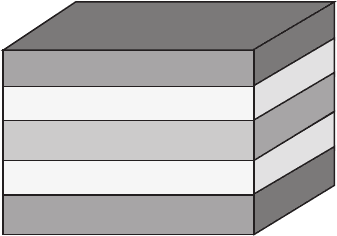
Contact layer
Ferromagnetic layer
Ferromagnetic layer
Contact layer
Insulating layer
Figure 8.32 The structure
of a magnetic tunnel
junction (MTJ).
magnetic read heads whose operation is based on the GMR effect with very high
sensitivity.
High-precision angle, position, and speed sensors based on the GMR are
widely used in automobiles – for example, in an anti-block braking system
(ABS), which provides straight-line motion of the vehicle while braking on a
slippery pavement. Modern computer, television, and video technologies are hard
to imagine without spintronic devices. Besides hard disks, spintronic devices can
be found in high-definition television equipment and in DVD drives. Apart from
in GMR devices, spin is used also in magnetic tunneling junctions (MTJs). The
structure of a valve built on the basis of an MTJ consisting of two ferromagnetic
layers separated by the insulator (for this purpose usually aluminum oxide is
used) is shown in Fig. 8.32.
It looks as if electric current, which flows perpendicularly to the ferromagnetic
layers, will not flow through such a structure at all. However, because of the
tunneling effect electrons are able to move from one ferromagnetic layer, through
the insulator, to another ferromagnetic layer. In MTJ valves, together with the
tunneling effect, the fact that electrons with different spins move differently
in a magnetic field is used. If the magnetic fields in the two ferromagnetic
layers of the valve coincide directionally, then those electrons whose spin is
directed along the magnetic field can easily tunnel from one ferromagnetic layer
to another. Therefore, the resistance of the valve is very low in this case. If
the magnetic fields in these layers are directed in opposite directions, then the
tunneling transmission would be more difficult, since in one of the layers electrons
will be moving against the magnetic field. Because of this, the resistance of the
valve increases by 20%–30%.
A prospective application of spintronics known as magnetic random-access
memory (MRAM) utilizes an MTJ. Its distinctive feature is that information is
saved neither in the form of electric charges on the capacitor plates, as is done in
dynamic memory DRAM, nor in the form of a trigger state as in static random-
access memory (SRAM), but in the form of the magnetization of a ferromagnetic
layer. The advantages of this type of memory are its low energy consumption, high
304 Nanostructures and their applications
speed of operation, and gigantic density of information storage. The maintenance
of the magnetization state does not require energy consumption, which is the case
with hard disks. The high density of information storage is defined by the small
size of the memory cells, for which one requires neither a large number of
transistors, as for SRAM, nor separate circuits of regeneration, as for DRAM.
An MTJ can be used for MRAM to read information from a magnetic cell. The
latest models of MRAM have reached 256 kb. They use a power supply of 3 V
and provide a duration of the write/read cycle of 50 ns. These parameters allow
MRAM to compete directly with flash-memory and offer the prospect of being
able to compete with conventional dynamic memory. Finally, MRAM will allow
the creation of computers whose dynamic memory data will not be lost when the
power supply is turned off.
The potential of spintronics is not exhausted by the technologies which have
already been developed. Despite the fact that research in this direction has been
going on for more than 10 years, there are many unsolved scientific and technical
problems. For example, to change the magnetization of some area of ferromag-
netic material, first of all it is necessary to have a magnetic field. Since we can
create a magnetic field by the use of an electric current (we do not take into
account permanent magnets) there is a problem of localization of the magnetic
field in the limited area. The smaller this area, the higher the density of infor-
mation storage on the magnetic carrier which could be achieved. Recently, a
particular experiment that showed the possibility of changing the magnetization
with the help of spin-polarized electrons was carried out. With the help of pho-
toemission from the semiconductor cathode, which is caused by polarized light, a
beam of spin-polarized electrons was produced, which in its turn was transmitted
through a magnetic film of width several nanometers. When electrons passed
through the film, their spins changed, together with the spins of electrons in the
magnetic film, which means that the magnetization of the film also changed. If
the number of electrons transmitted through the film is comparable to the number
of atoms of the material, then the change of magnetization of the film will be con-
siderable. This effect can be used for writing information as well as for reading
information with a lower intensity of the electron beam. Potentially this technol-
ogy can provide a remagnetization speed (i.e., the speed of reading/writing of
information) up to tens of GHz.
Another interesting effect is the formation of a pure spin flux of electrons
without charge transport. In this experiment two colliding beams with oppositely
directed spins were formed. Thus, the transfer of spin charge was achieved
without an applied voltage. So far this phenomenon has been observed only at
distances of about several nanometers, nevertheless research in this direction
is continuing. One of the most important problems of spintronics is connected
with the materials that are used. In spintronics you have to use ferromagnetics,
whose magnetic properties give rise to various effects related to the spins of
electrons. But ferromagnetic materials are metals, while modern electronics
8.3 Selected examples of nanodevices and systems 305
is based on semiconductors. It is precisely the properties of semiconductors
which allow one to amplify current in transistors, whereas in metals this effect
is impossible. Therefore, in order to create a device that uses electron spin as
well as electron charge, it is necessary to have a ferromagnetic material that is
simultaneously a semiconductor. Research in this direction is very active and new
magnetic semiconductors that do not lose their magnetic properties even at room
temperatures have been fabricated. One such material is titanium dioxide (TiO
2
)
with cobalt (Co) as impurity, which has been grown in the form of nanometer
films by molecular-beam epitaxy. Under high-vacuum conditions the beams of
atoms in certain proportions are directed onto a crystalline surface where they
form the desired crystalline structure. Despite some problems with the growth
of homogeneous films, it is a very tempting material for the development of new
spintronic devices. Another similar material is an epitaxial film of alternating
thin layers of GaSb and GaMn. The magnetic properties of this semiconductor
are preserved up to 130
◦
C, which is quite high enough for the needs of modern
electronics.
Using such materials, spintronics will allow us to process and store informa-
tion on the same wafer, which will lead to an increase in the speed of operations
and to a decrease in energy consumption. Integration of the achievements of elec-
tronics and spintronics will open new horizons in the development of traditional
computers as well as quantum computers and may extend the time of validity of
Moore’s law.
8.3.7 Graphene and carbon nanotubes
The research group at Georgia Institute of Technology announced in 2006 that
they had fabricated a field-effect transistor based on graphene and a device that
uses the phenomenon of quantum interference. They stated that in the near future
a new class of graphene nanoelectronics with a characterististic thickness of
transistors equal to 10 nm will emerge. It is impossible to use graphene directly
to create a field-effect transistor because graphene does not have a bandgap.
This means that we cannot achieve a substantial difference in resistivity at any
applied gate voltage, i.e., it is not possible to create two states for binary logic –
conducting and non-conducting states. Therefore, for device fabrication it is
necessary first to create a gap of substantial width at room temperature in order
to reduce the input into the conductivity of the thermally excited electrons. One of
the possible ways to do this is by the formation of narrow graphene ribbons with
a width that provides quantum-dimensional effects in the plane of the sample.
At the same time, the width of the bandgap, E
g
, must be large enough to provide
the device with a non-conducting state (turn-off state) at room temperature (the
width of 20 nm possessed by the graphene nanoribbon corresponds to a bandgap
width of about 30 meV). Owing to the high mobility of electrons in graphene,

306 Nanostructures and their applications
the operating speed of such a transistor may be substantially higher than that of
the silicon transistors.
When depicting the band structure of graphene it is necessary to take into
account the fact that the outer shell of the carbon atom contains four electrons,
which form bonding with the neighboring atoms of the lattice by creating three
sp
2
-hybridized orbitals. The fourth electron is in the 2p
z
-state. It is precisely
the 2p
z
-state which is responsible in graphite for the formation of interlayer
bondings, whereas in graphene the 2 p
z
-state is responsible for the formation
of energy bands. The bonding energy of atoms in a crystalline lattice rapidly
decreases with increasing interatomic separation. Therefore, the main input into
the bonding energy of an atom with other lattice atoms and the formation of
band structure arise from the atom’s interaction with its nearest neighbors. In
the electron tight-binding approximation, the energy spectrum of electrons in
graphene has the form
E =±
γ
2
0
1 +4cos
2
(πk
y
a) + 4cos(π k
y
a)cos(πk
x
√
3a)
, (8.30)
where the + sign corresponds to electrons and the − sign to holes, and γ
0
is the
overlap integral. This expression is obtained by taking into account interactions
with the nearest neighboring atoms only.
From Eq. (8.30) it follows that near the points of intersection of the valence
band and the conduction band the dispersion law for the carriers in graphene can
be written in the following form:
E =±h
-
v
F
k, (8.31)
where v
F
is the Fermi velocity (its experimental value is v
F
= 10
6
ms
−1
) and
k =
k
2
x
+ k
2
y
is the modulus of the wavevector in two-dimensional k-space. The
photon, whose mass at rest is equal to zero, has a similar spectrum. Therefore, we
can say that electrons and holes with energy defined by Eq. (8.31) have effective
mass equal to zero too. The Fermi velocity, v
F
, plays the role of the effective
speed of light.
Transistors constructed on the basis of carbon nanostructures, as experts
expect to exist in the very near future, will exceed the parameters of the conven-
tional silicon devices. Up to now the efforts of researchers have been concen-
trated on the fabrication of single transistors on the basis of carbon nanotubes.
Researchers from IBM recently announced that they had fabricated the first inte-
grated circuit (IC) constructed on the basis of a single carbon nanotube. The
importance of this achievement lies in the fact that the IC was fabricated using
standard semiconductor-technology processes. This is an important step towards
integration of the new technology with the existing electronic technologies. The
researchers from IBM developed a ring oscillator – an IC with the help of which
the developers can check the possibilities of new production processes or of new
materials.
8.3 Selected examples of nanodevices and systems 307
By fabricating an IC on a single carbon nanotube the researchers from IBM
have achieved a speed of operation a million times higher than that of numerous
ICs on nanotubes, which had been developed earlier. Despite the fact that this
speed is still lower than that which the latest silicon devices have, these researchers
from IBM are confident that new nanotechnologies will help to uncover the
enormous possibilities of carbon nanotube electronics.
Lately an active development of memory modules constructed on the basis of
carbon nanotubes has been undertaken. Such modules may become an alternative
to traditional flash memory. Currently, energy-independent flash memory is used
in various compact systems. In the main types of flash memory double-gate MOS
transistors are used as elementary memory cells and it is expected that in future
memory cells will be based on carbon nanotubes.
8.3.8 Nanoelectromechanical systems
Nanoelectromechanical systems (NEMSs) are integrated nanodevices or sys-
tems that combine electrical and mechanical components, and are fabricated
using technologies that are compatible with the production of integrated circuits.
To realize advanced scientific ideas in this field, it is necessary to utilize the
achievements of various branches of nanotechnology.
An NEMS is a miniature system that has sensory, computational, and produc-
tive functions. Sensory functionality concerns the ability to define the existence
and concentration of chemical or biological components in the environment.
Computational functionality means that the NEMS has a processor, which car-
ries out the necessary computations and prepares information for processing.
Productive functionality means that the NEMS has nanoscale actuating mecha-
nisms, so NEMSs can be used as controllers. Therefore, NEMSs usually contain a
combination of two or more devices operating on the basis of electrical, mechan-
ical, optical, chemical, biological, magnetic, and other properties, which are
integrated on a single chip or on a multichip board. Work on NEMSs has rapidly
become one of the leading fields of cutting-edge nanotechnology. Autonomous
NEMSs, e.g., nanorobots, are actively used in manufacturing, medicine, and
ecology.
Among the various elements of an NEMS, a very important role is played
by the load-bearing elements, which can be made of carbon nanotubes. The
controlled relative motion of layers in multiwalled nanotubes and their unique
elastic properties makes it possible to use them as moving elements of an NEMS.
Devices based on the relative motion of carbon nanotubes have recently been
suggested: rotational nanobearings, nanogears, nanoswitches, GHz oscillators,
Brownian nanoengines, nanorelays, and also a nanonut–nanobolt pair. Moreover,
there are experimentally developed nanomotors, which use as their axle and bush
the layers of multiwalled carbon nanotubes.
308 Nanostructures and their applications
3
2
1
4
(b)
3
2
1
4
(a)
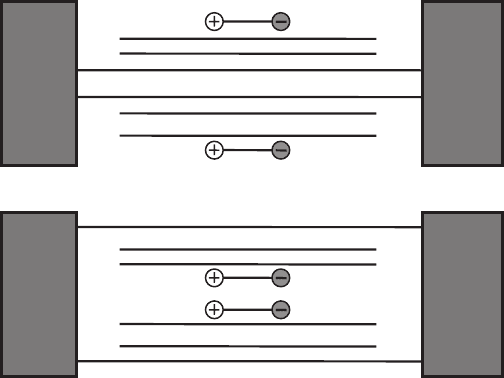
Figure 8.33 Schematic
diagrams of
nanoactuators: (a) with an
inner layer as the stator
and (b) with an external
layer as the stator.
It has recently been shown that a two-walled carbon nanotube with non-
zero chiral angle can be used as a nanonut–nanobolt pair (as can be seen from
Fig. 8.5, the surface of a chiral nanotube is reminiscent of a thread on a bolt),
i.e., the motion along the nanotube axis of the stator is transformed into rotation
of the rotor (outer layers 2 and 4). This can be used for transformation of the
force directed along the nanotube axis into the mechanical torque, which causes
relative rotation of layers. Such a pair can be used in a so-called nanoactuator –
a device that makes an NEMS able to move. The operational principle of such a
device is the same as that of a humming-top toy. The principle of a nanoactuator
is shown schematically in Fig. 8.33.InFig.8.33(a), 1 denotes the inner layer of
a nanotube, whereas in Fig. 8.33(b) 1 denotes the outer layer of a nanotube. It
serves as the stator of the nanomotor and is fixed. Other layers, labeled 2 and 3,
serve as the rotor. The relative position of these layers has to be fixed. The stator
and rotor serve as a rotational nanobearing. We are considering now the motor
depicted in Fig. 8.33(a), but the operation of the motor shown in Fig. 8.33(b) is
analogous. The external layers serve for transformation of the force applied to
layer 4 and directed along the nanotube axis into torque, which rotates the rotor.
Such a transformation is possible if layers 2 and 4 form a nanonut–nanobolt
pair. The charges on the ends of layer 4 can be produced as a result of chemical
adsorption and can be used for the control of a nanoactuator by an external
electric field.
We can force the internal part of a two-walled nanotube to oscillate. In order
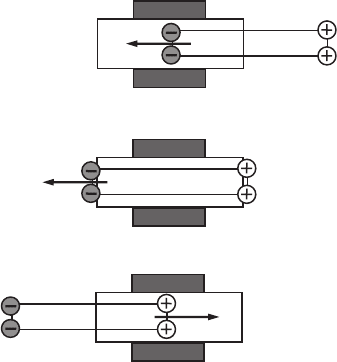
to do this, the external layer has to be fixed (see Fig. 8.34). The inner layer has
to be subjected to additional processing. At one end positive hydrogen ions are
absorbed and at the other end negative fluorine ions. Under the influence of a
8.3 Selected examples of nanodevices and systems 309
(a)
F
(b)
F
(c)
Figure 8.34 Subsequent
positions of the two
layers of a two-walled
nanotube during the
half-period of oscillations:
(a) and (c) show the
maximum amplitude of
telescopic protrusion of
the inner layer of the
nanotube under the
action of the force F.
non-uniform electric field the inner tube, which is a dipole, can move relative
to the external tube, as shown in Fig. 8.34. This oscillatory motion can also be
transformed into a rotational motion.
Currently there are numerous applications of nanotechnology. With its
help, new anticorrosive coatings are made, nanostructures allow a significantly
increased lifetime of steel-work, provide reliable operation of electricity-supply
networks, reduce costs of equipment operation, and so on. According to some
scientists, in the future nanotechnology could save mankind. When we have
exhausted all the oil, coal, and gas on the Earth (which may be even sooner than
we expect), people will be using nanotailored solar batteries that will be able to
use solar energy for the production of hydrogen, oxygen, and electricity. In future
biology and medicine nanoparticles will deliver medicine to the required parts
of the human body. For example, nanoparticles mixed with blood will arrive at a
tumor and then, by exposure to infrared radiation, the tumor will be eradicated
because of overheating caused by absorption of radiation by the nanoparticles.
Nanotechnology for space exploration has great prospects. New nanomaterials
will make flights not only to the Moon but also to Mars a reality. One more per-
spective is the utilization of powdered nanotechnology for the development of a
new generation of fuel cells that can produce electrical energy from any organic
fuel, with an efficiency no less than 60%–70%. It is impossible to mention or
foresee all the possible applications of nanotechnology. We can only mention
that, according to some experts, during the next decade the world market of
nanotechnology will reach the size of a trillion dollars and maybe will exceed
the value of all markets related to electronics, medicine, chemistry, and energy
altogether.

Appendix A
Classical dynamics of particles and waves
In this appendix we will study the basics of the classical mechanics of an individual
particle as well as a system of particles. We will treat, here, a particle as a mate-
rial point, i.e., an ideal object that has a mass and an infinitesimally small size. The
importance of this chapter is defined by the fact that any macroscopic structure or
medium can be considered as an array of material points interacting according to certain
laws.
The famous three laws of classical dynamics formulated by Isaac Newton more than
three centuries ago were for a long time considered as the basis for the description of
motion of all objects – ranging from nanoparticles to cosmic objects. With the development
of physics, it became clear that the region of validity of the classical description of a
particle’s motion is limited. Newton’s mechanics cannot be applied for the description of
motion with velocities close to the speed of light. For the description of such a motion,
relativistic mechanics was introduced at the beginning of the twentieth century. The typical
formulae of relativistic theory, in contrast to the corresponding formulae of classical
mechanics, contain the radical
1 −(v/c)
2
, which contains the square of the ratio of the
particle’s velocity, v, to the speed of light in vacuum, c. For a wide group of problems
the ratio v/c 1; therefore, usage of the classical description at velocities that are lower
than the speed of light by two orders of magnitude leads to an error that is significantly
smaller than the error in measurements of the corresponding physical magnitude. However,
Newton’s mechanics cannot be applied for the description of elementary particles. The
motion of electrons in atoms, molecules, nanostructures, semiconductors, and metals is
not governed by the laws of classical mechanics. Nevertheless, the role of the laws of
classical mechanics in the modern physics of the nanoworld is still significant. These laws
define the motion of heavy particles, for example the motion of atoms or ions, and the
wave motion of atoms or ions in crystalline structures.
In the current appendix we will also study free harmonic and damped oscillations
of an individual particle, discuss their governing equations, and find their solutions. We
will consider small-amplitude oscillations of a particle, with harmonic and anharmonic
approximations for the description of oscillations for an arbitrary profile of the potential
well.
310
A.1 Classical dynamics of particles 311
x
y
z
0
r(t)
i
k
j
x
(t)
y(t)
z(t)
r = xi + yj + z
k
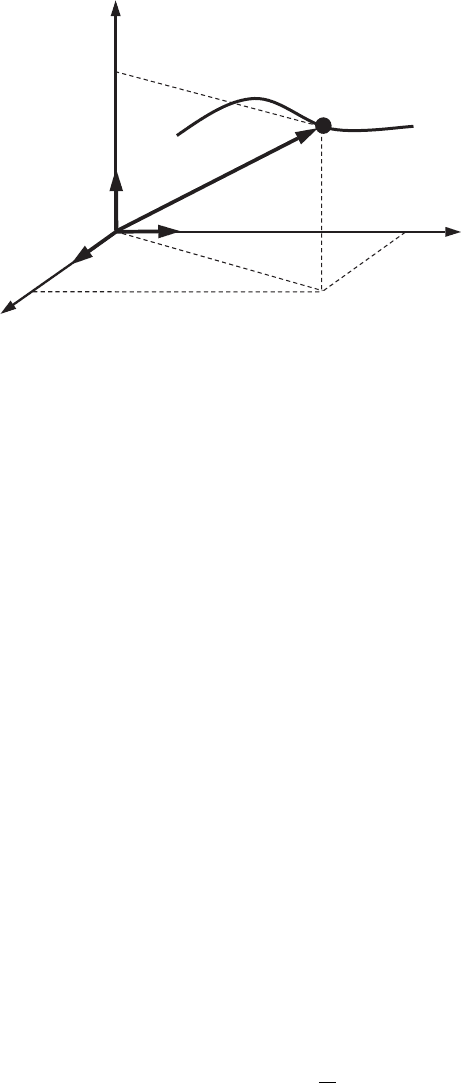
Figure A.1 The Cartesian
system of coordinates and
a particle’s trajectory, r(t).
A.1 Classical dynamics of particles
A.1.1 Newton’s second law of motion
According to the classical description of particle motion, a particle’s location in space
at any instant of time, t , is defined by three spatial coordinates, which depend on the
choice of the system of coordinates. One such system – the Cartesian coordinate system –
consists of three mutually orthogonal axes x , y,andz that intersect at the origin of
coordinates (x = y = z = 0, with respect to which x(t), y(t), and z(t) define the location
of the particle at any given time t (see Fig. A.1)). For convenience the position of a particle
can be written in the form of its radius vector, r(t):
r(t) = ix(t) + jy(t) +kz(t), (A.1)
where i, j,andk are unit vectors directed along their respective coordinate axes. Since
these vectors are perpendicular to each other, their scalar products are:
i · i = j · j = k · k = 1andi ·j = i ·k = j ·k = 0. (A.2)
The array of points defined by the vector r(t) along a particle’s motion defines the trajectory
of the particle (Fig. A.1).
The change of a particle’s state is described by Newton’s second law, which in its
general form can be written through the momentum of a particle, p:
p = mv, (A.3)
where
v =
dr
dt
. (A.4)

312 Appendix A. Classical dynamics of particles and waves
Here, m is the mass and v is the velocity of the particle. According to Newton’s second
law of motion, the derivative of the momentum p with respect to time t is equal to the
sum of all forces acting on the particle:
dp
dt
= F, (A.5)
where the resultant force, F, is defined by a vector sum of all forces F
k
actingonthe
particle:
F = F
1
+ F
2
+···+F
n
=
n
k=1
F
k
, (A.6)
where n is the total number of forces acting on the particle.
Now, let us discuss some of the forces existing in nature that can act on a particle,
which has mass, m, and charge, q.
(a) Gravitational force, F
gr
:
F
gr
= mg, (A.7)
where g, called the acceleration due to gravity, denotes the free-fall acceleration
caused by the gravitational field at a point close to the Earth’s surface where the
particle is located. The acceleration due to gravity, g =|g|, is approximately 9.8
ms
−2
and is directed towards the center of the Earth.
(b) In electric and magnetic fields, the Lorentz force, F
L
, is a sum of electric and magnetic
forces applied to a particle of charge q:
F
L
= q
(
E + v × B
)
, (A.8)
where E is the electric field strength and B is the magnetic flux density. The vector
product, v ×B (which is part of Eq. (A.8)), is given, according to the definition of
the vector-product operation, by the third-order determinant:
v ×B =
ijk
v
x
v
y
v
z
B
x
B
y
B
z
= i
v
y
B
z
− v
z
B
y
+ j
(
v
z
B
x
− v
x
B
z
)
+ k
v
x
B
y
− v
y
B
x
,
(A.9)
where we used the general rule for finding determinants. Let us note that because of
the small masses of the electron and proton the gravitational force is several orders
of magnitude smaller than the force of the electric field under laboratory conditions,
even if the strength of the electric field is weak. For an electron these forces become
of the same order of magnitude, i.e., eE ≈ F
gr
, if the magnitude of the electric field,
E, is about
E =
m
e
g
e
≈ 6 × 10
−11
Vm
−1
, (A.10)