
Mitin V.V., Sementsov D.I., Vagidov N.Z. Quantum mechanics for nanostructures
Подождите немного. Документ загружается.


A.1 Classical dynamics of particles 313
where the mass of an electron is m
e
= 9.1 × 10
−31
kg and the charge of an electron
is e = 1.6 ×10
−19
C. This is a very small electric field and can be neglected in most
practical situations.
For a non-relativistic particle, i.e., a particle that moves with a velocity v that is
substantially smaller than the speed of light in vacuum, c = 3 ×10
8
ms
−1
, Newton’s
second law of Eq. (A.5) is often written, using Eq. (A.3), in the form
m
dv
dt
= F. (A.11)
Here the mass of a particle, m, is considered a constant that does not depend on the velocity
of the particle. In many practical cases, m depends on time and Eq. (A.11) becomes invalid.
This is one of the reasons why we will use Eq. (A.5) rather than Eq. (A.11) throughout
the remainder of the book.
One more standard expression for Newton’s second law is
m
d
2
r
dt
2
= F, (A.12)
which combines Eq. (A.11) with Eq. (A.4). Equation (A.12) is a second-order differential
equation and its solution has two constants of integration. Thus, to find the function r
and its first derivative dr/dt as a function of time, t, it is necessary to have two initial
conditions, for example, r(t
0
) = r
0
and v(t
0
) = v
0
,orp(t
0
) = p
0
.
A.1.2 The dynamics of a system of particles
For n interacting particles the system of equations describing their behavior has the form
dp
i
dt
= F
i
+
n
k=1
F
ik
, i = 1, 2,...,n, (A.13)
where F
i
is the resultant of all external forces acting on the i th particle and F
ik
are the
internal forces acting between the ith and kth particles, while F
kk
= 0. On summing up all
the equations of motion of particles in the system and taking into account that according
to Newton’s third law of motion F
ik
=−F
ki
(therefore
n
i=1
n
k=1
F
ik
= 0), we obtain
the equation
dP
dt
= F, (A.14)
where
P =
n
i=1
p
i
. (A.15)

314 Appendix A. Classical dynamics of particles and waves
Equation (A.14) has exactly the same form as Eq. (A.5) but with two substantial differ-
ences. Here P is the sum of the momenta of all particles of the system and
F =
n
i=1
F
i
(A.16)
is the resultant force equal to the sum of all external forces F
i
acting on the individual
particle denoted by i . It is convenient to introduce other variables characterizing the
system as a whole. The mass of the system is obviously equal to the sum of the masses of
the individual particles that comprise the system:
M =
n
i=1
m
i
. (A.17)
By combining Eqs. (A.15)and(A.17), we can introduce the velocity V
c
of the system
using Eq. (A.3):
V
c
=
P
M
(A.18)
or
V
c
=
n
i=1
m
i
v
i
n
i=1
m
i
. (A.19)
By continuing this analogy, we can introduce the coordinate R
c
of a point:
dR
c
dt
= V
c
. (A.20)
By substituting Eq. (A.19) into Eq. (A.20)wefindthat
R
c
=
n
i=1
m
i
r
i
n
i=1
m
i
. (A.21)
The position vector R
c
(t) describes the trajectory of the system as a whole. Therefore, it is
called the vector of the center of mass of the system. Equations (A.14), (A.18), and (A.20)
for the system of particles are the same as Eqs. (A.5), (A.3), and (A.4) for an individual
particle. This means that we can treat any large system as a point particle with all the
mass of the system, M
c
, concentrated at the so-called center of mass, R
c
, as long as the
positions of the individual particles of the system are not the subject of our interest and
the size of a system is small relative to the coordinate space of interest.

A.1 Classical dynamics of particles 315
For a so-called closed system, the sum of all external forces, F in Eq. (A.14) is equal
to zero. Thus, the resultant momentum of the closed system, P, is constant, i.e.,
dP
dt
= 0, (A.22)
P =
n
i=1
p
i
= constant, (A.23)
and
V
c
=
n
i=1
m
i
v
i
n
i=1
m
i
= constant. (A.24)
Equations (A.22)and(A.23) describe one of the main principles of mechanics written in
mathematical form – the principle of conservation of momentum, which implies that the
sum of the momenta of a closed system of particles that exert forces on each other is a
constant.FromEq.(A.24) it follows that, when the sum of all external forces acting on
the system of interacting particles, F, is equal to zero, then the velocity of the system’s
center of mass, V
c
, is constant.
A.1.3 Rotational motion of a particle
Apart from the particle’s momentum, p, there is another important characteristic of a
moving particle. It is the particle’s angular momentum, L, about a given point:
L = r × p, (A.25)
where r is the position vector that defines the position of a particle with respect to a given
point. The main equation that defines the change of angular momentum, L, of a particle
can be derived from Eq. (A.25), if we take the derivatives of the left-hand and right-hand
sides of this equation:
dL
dt
=
dr
dt
× p + r ×
dp
dt
. (A.26)
Since dr/dt = v and p = mv,
dr
dt
× p = m(v ×v) = 0 (A.27)
because the vector product v × v is equal to zero. Using Eq. (A.5) we arrive at the equation
dL
dt
= τ, (A.28)

316 Appendix A. Classical dynamics of particles and waves
where
τ = r ×F (A.29)
is the so-called torque with respect to the given point. If the resultant torque, τ,ofall
forces acting on the particle is equal to zero, then
dL
dt
= 0andL = constant. (A.30)
The last equation reflects one of the main principles of mechanics – the principle of
conservation of angular momentum: the angular momentum is independent of time and it
is conserved when the net torque is equal to zero.
As an example let us consider the motion of a particle in a field of central forces (or
central field). The vector of force, F, in the central field always coincides with the radius
vector, r, directed from the central point to a point where the particle is located, and its
magnitude depends only on the distance, r , between these two points, i.e.,
F(r) = F(r)e
r
, (A.31)
where e
r
= r/r is a unit vector directed along the radius vector r. Note that in all cases
of a particle’s motion in the central field we have F (r) < 0inEq.(A.31). The torque of
this force with respect to the central point is
τ
c
= r × F = F(r)
(
r × e
r
)
= 0, (A.32)
because the vectors r and e
r
are collinear. This is why in the solar system the motion of
planets around the Sun is along flat elliptic orbits – the angular momentum, L, of each of
the planets is a constant vector.
A.1.4 Work and potential energy
Aforce,F, moving a particle by a certain distance, does a certain work. For the displace-
ment dr, the work done, dW , is defined by the scalar product, F · dr:
dW = F ·dr = F
x
dx + F
y
dy + F
z
dz = F |dr|cos α = F
r
dr, (A.33)
where α is the angle between the direction of force, F, and the direction of displacement,
dr; F
r
= F cos α is the projection of the force, F, on the direction of displacement, dr;
and |dr|=dr. The total work done by the force, F, to move a particle from the point r
1
to the point r
2
is given by the following definite integral:
W
12
=
r
2
r
1
F · dr =
r
2
r
1
F
r
dr. (A.34)
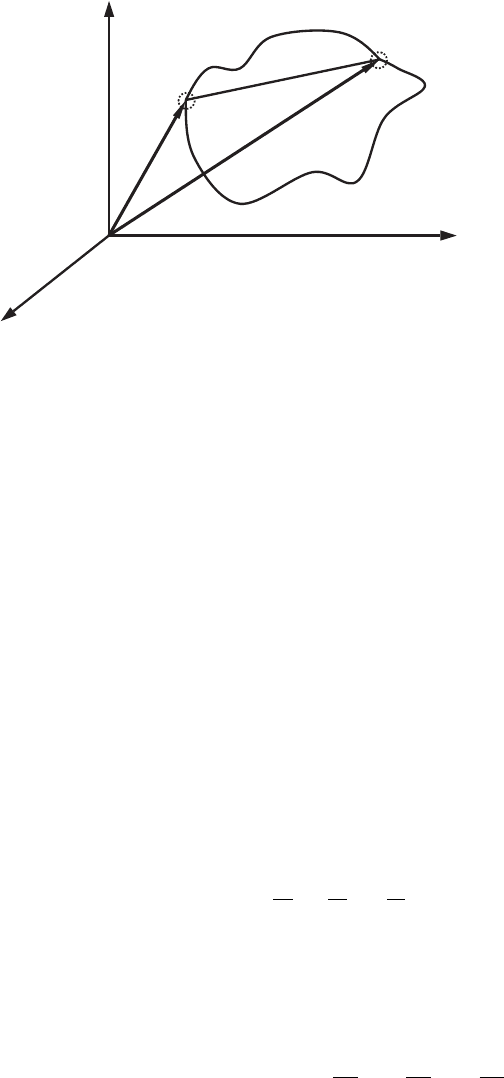
Among all forces that can act on particles, we single out a wide class of forces whose
work does not depend on the path followed between points r
1
and r
2
(i.e., the work done
A.1 Classical dynamics of particles 317
1
2
3
r
1
r
2
z
x
y
0
Figure A.2 The work done
by the conservative forces
around a closed path is
equal to zero.
between points r
1
and r
2
is the same for paths 1, 2, and 3 in Fig. A.2),andforwhichthe
work, W
O
, of moving a particle along a closed path is equal to zero:
W
O
=
F · dr = 0. (A.35)
Here we introduced the symbol of integration around a closed path,
!
. An example of
a closed path is the transfer of a particle from point r
1
to r
2
along path 2 and then from
point r
2
to point r
1
along path 3 (see Fig. A.2). The forces that satisfy Eq. (A.35)are
called conservative forces, and they include, for example, gravitational and electrostatic
forces. Note that for the forces of friction the work done depends on the path and therefore
Eq. (A.35) is not valid for the forces of friction.
For the conservative force, F, we can introduce a function, U (r), that depends on the
coordinate, r, and relates to the force, F,as
F =−∇U(r), (A.36)
where we introduced the so-called differential operator, ∇:
∇ = i
∂
∂x
+ j
∂
∂y
+ k
∂
∂z
. (A.37)
The function U (r) is called potential energy. Taking into account Eq. (A.36) and sub-
stituting it into Eq. (A.34), we obtain the relationship between work W
12
and potential
energy U (r):
W
12
=−
r
2
r
1
∇U (r) ·dr =−
(2)
(1)
∂U
∂x
dx +
∂U
∂y
dy +
∂U
∂z
dz
, (A.38)

318 Appendix A. Classical dynamics of particles and waves
where the function under the integral sign is the so-called total differential,dU (x, y, z),
of the function U(x, y, z). The expression for the work done takes the form
W
12
=−
(2)
(1)
dU(x, y, z) =−
(2)
(1)
dU(r) =−(U
2
−U
1
) =−
[
U (r
2
) − U (r
1
)
]
.
(A.39)
Thus, the work of conservative forces does not depend on the path, but depends on the
initial and final coordinates, r
1
and r
2
, only. Moreover, the work of these forces is equal
to the difference of potential energies at the initial and final positions of the particle, and
hence does not depend on the choice of the origin of the coordinate system for U (r). Let
us consider as examples of potential fields homogeneous and non-homogeneous electric
fields.
A.1.5 Kinetic and total mechanical energy
The total mechanical energy, E, of a particle is defined as the sum of its potential energy,
U (r), and kinetic energy, K :
E = K + U. (A.40)
The expression for a particle’s kinetic energy, K , can be derived from the equation of
motion, Eq. (A.11), after multiplying its right-hand and left-hand sides by the displacement
vector, dr = v dt:
mv ·dv = F ·dr. (A.41)
This expression can be transformed into
d
mv
2
2
= F · dr, (A.42)
because d(v
2
) = 2v · dv. The quantity
K =
mv
2
2
=
p
2
2m
(A.43)
is called the kinetic energy of a particle. If we integrate Eq. (A.42) from r
1
to r
2
, we will
obtain
K
2
− K
1
=
mv
2
2
2
−
mv
2
1
2
=
r
2
r
1
F ·dr. (A.44)
Here, K
i
= (mv
2
i
)/2andv
i
= v(r
i
) is the velocity of the particle at point i,wherei = 1, 2.
The force F under the integral sign is the sum of the conservative, F
c
, and non-
conservative (for example, friction), F
fr
,forces:
F = F
c
+ F
fr
. (A.45)

A.1 Classical dynamics of particles 319
The work of the conservative forces can be defined as the difference of potential energies
of the particle. In accordance with Eq. (A.39),
r
2
r
1
F
c
· dr = U (r
1
) −U (r
2
), (A.46)
where U (r) is the potential energy of the conservative force. Therefore, Eq. (A.44)canbe
rewritten as
K
2
+U
2
− K
1
−U
1
=
r
2
r
1
F
fr
· dr. (A.47)
Equation (A.47) is called the work–energy theorem. The change in total mechanical
energy of a particle, E, is equal to the work of friction forces along the entire path of a
particle’s motion. In the absence of non-conservative forces, the total mechanical energy,
E = K + U , is conserved, i.e.,
K
1
+U
1
= K
2
+U
2
. (A.48)
During the process of a particle’s motion in a potential field the kinetic energy of a particle
is transformed into its potential energy or vice versa:
K
2
− K
1
=−(U
2
−U
1
). (A.49)
A.1.6 Equilibrium conditions for a particle
The conditions of equilibrium play a very important role in the analysis of the motion of
a particle in a potential field. The mechanical equilibrium of a body assumes satisfaction
of two vector conditions:
n
i=1
F
i
= 0, (A.50)
n
i=1
τ
i
= 0. (A.51)
The sum of all forces and the sum of all torques acting on a particle must be equal to
zero. The first of the above-mentioned conditions is required for physical bodies that can
be considered as particles (or material points). With Eq. (A.36) taken into account, the
equilibrium condition for a particle in the potential field can be rewritten in the form
∇U (x, y, z) = 0. (A.52)
From the last expression, we can write the following expressions for the potential energy:
∂U
∂x
= 0,
∂U
∂y
= 0,
∂U
∂z
= 0, (A.53)
320 Appendix A. Classical dynamics of particles and waves
x
2min
x
01
x
02
x
2max
E
2
E
1
E
3
U
x
03
x
1max
x
1min
x
E
First potential well
Second potential well
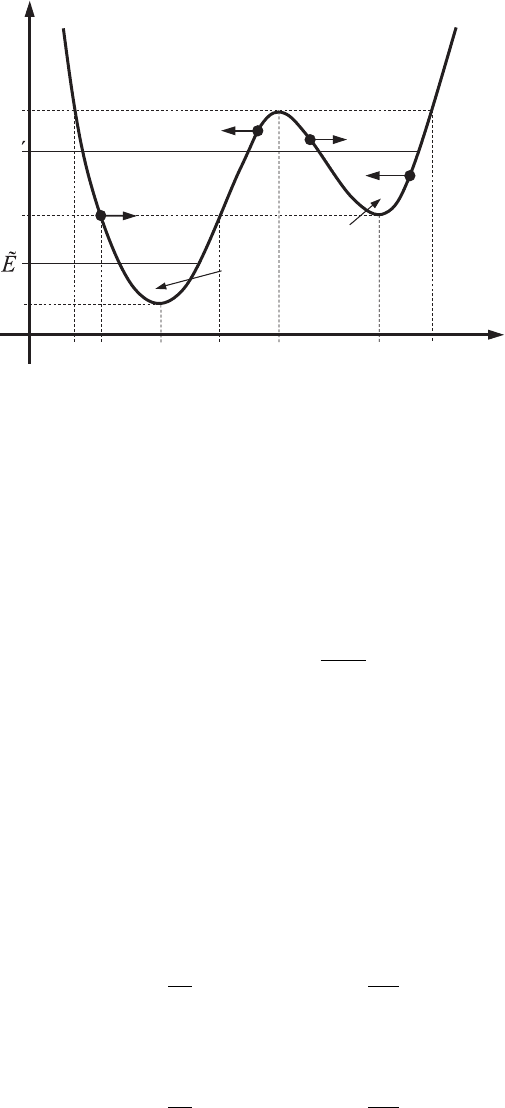
Figure A.3 A potential
profile with two stable
(x
01
and x
03
) equilibrium
positions and one
unstable (x
02
) equilibrium
position.
which have to be satisfied at the position of equilibrium. For convenience the position of
equilibrium is often denoted by the coordinates x
0
, y
0
,andz
0
.
The position of equilibrium can be either stable or unstable. In the case of a stable
equilibrium position, when the particle is displaced out of the equilibrium, the force,
F =−∇U(r), that appears due to the dependence of U (r)onr will return the particle to
the state of equilibrium. In the case of an unstable equilibrium, when the body is displaced
out of the equilibrium, the force F =−∇U(r) will take the particle away from the state
of equilibrium. When the force depends only on a single coordinate (let us choose it to be
the x -coordinate) it is defined as
F =−i
dU(x)
dx
. (A.54)
From Eq. (A.54) it follows that for dU (x)/dx > 0 the force F is directed against the vector
i, and, in the case when dU(x)/dx < 0, F is parallel to the vector i.
In the one-dimensional case we can easily depict the function U (x) near its equilibrium
positions. In Fig. A.3 two positions of stable equilibrium are defined by the coordinates x
01
and x
03
, and near these positions the function U(x) has the form of a “potential well.” At
the position x
02
the state of equilibrium is unstable. The directions of the forces that appear
upon displacement of a particle from the respective equilibrium positions are depicted by
arrows. It is clearly seen that the minimum of potential energy corresponds to the position
of stable equilibrium. The conditions of a stable equilibrium state at an arbitrary point
x = x
0
in the one-dimensional case have the form
dU
dx
x=x
0
= 0and
d
2
U
dx
2
x=x
0
> 0. (A.55)
An unstable equilibrium state is defined by the conditions
dU
dx
x=x
0
= 0and
d
2
U
dx
2
x=x
0
< 0. (A.56)
A.2 Oscillatory motion of a particle 321
mg
l
F
t
F
r
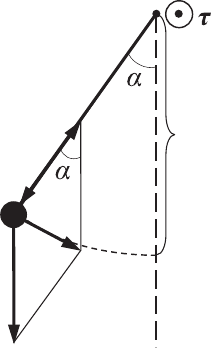
Figure A.4 Asimple
pendulum.
If the particle’s total energy is equal to its minimal possible energy, E
1
= U (x
01
), the
particle can only be at the position of equilibrium x
01
. For a given profile of the potential
energy, the total energy of a particle, E, cannot be less than E
1
; otherwise its kinetic
energy, K , would be negative. With an increase of energy, a particle can oscillate near
its equilibrium position. For example, for the energy E =
˜
E,whereE
1
<
˜
E < E
3
,the
particle will move in the region of positive kinetic energy between points x
1min
and x
1max
.
At E = E
2
the particle is in the position of unstable equilibrium, x
02
. After leaving
the position of equilibrium x
02
, the particle may travel between the first and second
potential wells in the region from x
2min
to x
2max
. A further increase of energy above E
2
leads to an increase of the interval of allowed coordinates, x. At energies E = E
,where
E
3
< E
< E
2
, the “classical” particle can be located only in one of two potential wells
near their equilibrium positions, x
01
or x
03
. In order to transfer the particle from the first
potential well to the second well, it is necessary to supply the energy deficit, i.e., the
energy difference between E
2
and E
. As will be shown later, for “quantum” particles this
ban is lifted.
A.2 Oscillatory motion of a particle
A.2.1 Simple harmonic motion
If a particle follows a motion that is periodic, i.e., repetitive in time, then
r(t + nT) = r(t), (A.57)
where T is a period and n is an integer number. Along each of the Cartesian coordinates
the particle undergoes a periodic motion, which is called an oscillatory motion.
The most famous example of oscillatory motion is the oscillation of a simple pendulum,
i.e., an oscillation of a point mass on a long massless inextensible string with length l
(Fig. A.4). Let the mass of the oscillating particle be m and let us derive the equation that
describes oscillations of such a pendulum. At an arbitrary displacement of a pendulum at
an angle α, two forces act on a particle – the weight, mg, and the tension of the string, F
t
.

322 Appendix A. Classical dynamics of particles and waves
Since the pendulum undergoes rotational motion with respect to the point of suspension
O, we can write the main equation of rotational motion (Eq. (A.28)) in the form of a
projection onto the axis of rotation:
dL
dt
= τ, (A.58)
where L and τ are projections of the angular momentum and torque of an oscillating
particle onto the axis perpendicular to the plane of the pendulum’s oscillations. Since the
line along which the tension force of the string, F
t
, is directed goes through the point of
suspension, this force does not create the torque. The torque that returns the particle to
the equilibrium position is created only by the particle’s weight, mg. The magnitude of
this force’s torque, τ , is equal to
τ =−mgl sin α, (A.59)
where the negative sign occurs because at any angle of displacement, α, the torque τ
is restoring, i.e., torque pushes the particle back to the equilibrium position. For the
pendulum shown in Fig. A.4, the position angle α is positive. Note that the displacement
angle, α, around a fixed axis is considered as a vector directed along the axis of rotation
according to the right-hand rule (see Fig. A.4). The angular momentum according to
Eq. (A.25)is
L = mvl = ml
2
= ml
2
dα
dt
, (A.60)
where the linear velocity of a particle, v, along the arc of a circle of radius l is equal to
v = l (A.61)
and the angular velocity is defined as
=
dα
dt
. (A.62)
After substitution of L and τ into Eq. (A.58), the last equation becomes
ml
2
d
2
α
dt
2
=−mgl sin α. (A.63)
Let us rewrite Eq. (A.63) in the standard form of the equation for a simple pendulum’s
oscillatory motion,
d
2
α
dt
2
+ ω
2
sin α = 0, (A.64)
where
ω =
g
l
(A.65)