
Mitin V.V., Sementsov D.I., Vagidov N.Z. Quantum mechanics for nanostructures
Подождите немного. Документ загружается.

A.2 Oscillatory motion of a particle 323
F
s
F
N
F
g
x
x(t)
0
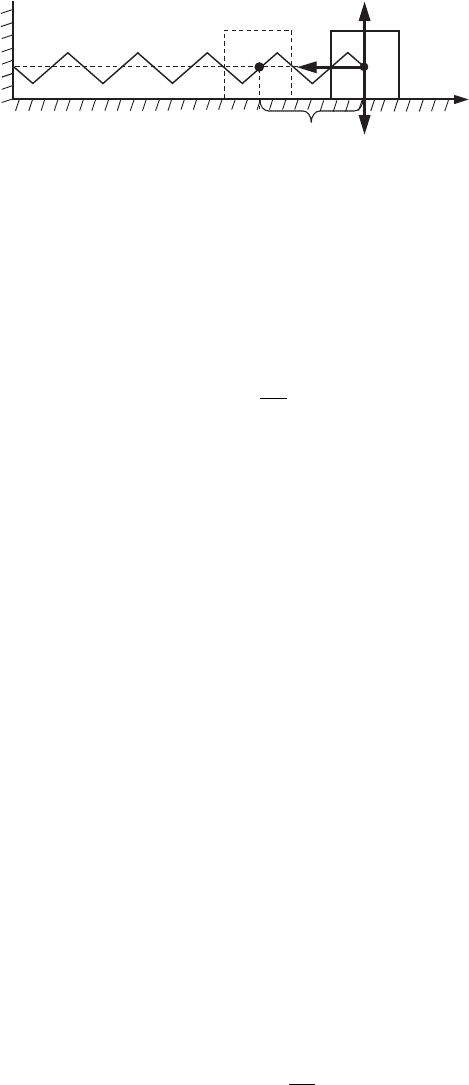
Figure A.5 The
oscillations of a particle
connected to a spring
along a smooth surface.
is the angular frequency of the pendulum’s oscillations. Equation (A.64) is valid at any
displacement of the pendulum from the position of equilibrium. However, its solution at
arbitrary values of the angle α cannot be described by elementary functions. Therefore,
let us consider oscillations with small amplitude when the angle α is much less than 1
(α 1) and sin α ≈ α. In this case, Eq. (A.64) becomes a standard form of equation for
small displacements of a simple pendulum:
d
2
α
dt
2
+ ω
2
α = 0. (A.66)
The following function is the solution of Eq. (A.66):
α(t) = α
0
cos(ωt + φ), (A.67)
where α
0
and φ are the amplitude and phase of oscillations, respectively. This function
defines the angular position of the pendulum at any given time. Oscillatory motion defined
by a function of this type is called simple harmonic motion. These oscillations have the
most simple form, from the mathematical point of view, because they can be described by
an elementary function of Eq. (A.67).
A.2.2 One-dimensional harmonic oscillator
Another example of harmonic motion is that of a particle connected to a spring (see
Fig. A.5). Three forces act on the particle: the gravitational force, F
g
, the normal force,
F
N
, and the spring force, F
s
. The net force is equal to the spring force because the forces
F
N
and F
g
exactly compensate for each other. Here we neglect the force of friction (see
the next section). According to Hooke’s law the spring force F
s
depends linearly on the
displacement x(t) from the equilibrium position x = 0 (we chose the x-axistobeinthe
direction of the force F
s
) as shown in Fig. A.5:
F
s
=−kx(t), (A.68)
where k is a spring constant. Then the equation of motion can be written as
m
d
2
x
dt
2
= F
s
, (A.69)

324 Appendix A. Classical dynamics of particles and waves
or
m
d
2
x
dt
2
=−kx. (A.70)
Introducing the angular frequency of oscillations,
ω =
k
m
, (A.71)
we arrive at the following differential equation:
d
2
x
dt
2
+ ω
2
x = 0, (A.72)
which is the same as Eq. (A.66) for small-amplitude oscillations of a simple pendulum,
which are harmonic oscillations.
The general solution of Eq. (A.72) can be found in the form of any of the following
expressions:
x(t) =
A
1
e
iωt
+ A
2
e
−iωt
,
B
1
cos(ωt) + B
2
sin(ωt),
C cos(ωt + φ),
(A.73)
where the constants A
1,2
, B
1,2
, C,andφ are constants of integration. Since all three
solutions satisfy the same equation, these constants are functionally related and these
relations can easily be established using well-known trigonometric relations.
Let us find first the relationship between the coefficients A
1,2
and B
1,2
. By substituting
the formulae
cos(ωt) =
1
2
e
iωt
+ e
−iωt
and sin(ωt) =
1
2i
e
iωt
− e
−iωt
(A.74)
into the second expression of Eqs. (A.73) and regrouping terms with the same exponents,
we obtain
x(t) =
B
1
2
+
B
2
2i
e
iωt
+
B
1
2
−
B
2
2i
e
−iωt
. (A.75)
On comparing the last equation with the first expression of Eq. (A.73), we get
A
1
=
1
2
(
B
1
− iB
2
)
and A
2
=
1
2
(
B
1
+ iB
2
)
. (A.76)
Inversely,
B
1
= A
1
+ A
2
and B
2
= i( A
1
− A
2
). (A.77)

A.2 Oscillatory motion of a particle 325
Let us define the relation of coefficients C and φ with A
1,2
by rewriting the third expression
of Eq. (A.73) in terms of the exponents:
C cos(ωt + φ) =
C
2
e
i(ωt+φ)
+ e
−i(ωt+φ)
=
C
2
e
iφ
e
iωt
+
C
2
e
−iφ
e
−iωt
. (A.78)
On comparing this equation with the first expression of Eq. (A.73), we get
A
1
=
C
2
e
iφ
and A
2
=
C
2
e
−iφ
. (A.79)
Inversely,
C = 2
A
1
A
2
and φ =
1
2i
ln
A
1
A
2
. (A.80)
By substituting Eq. (A.76) into Eq. (A.80) we can find the relation of the coefficients C
and φ with B
1,2
. The constants themselves are defined from the initial conditions.
A.2.3 The energy of harmonic oscillations
For a particle that follows simple harmonic oscillatory motion, its velocity and accel-
eration are also given by harmonic functions. Choosing the dependence of a particle’s
displacement, x, from its equilibrium position as
x(t) = C cos(ωt + φ), (A.81)
we obtain for the velocity, v,
v(t) =
dx
dt
=−ωC sin(ωt + φ), (A.82)
and for the acceleration, a,
a(t) =
dv
dt
=−ω
2
C cos(ωt + φ) =−ω
2
x(t). (A.83)
From the last equation it follows that, for harmonic oscillations, the acceleration, a,is
directly proportional to the displacement, x, and its proportionality constant is always
equal to the square of the angular frequency with a negative sign, −ω
2
.
Let us define now the total mechanical energy, E, of the oscillating particle. A particle’s
kinetic energy is defined by the expression
K (t ) =
mv
2
(t)
2
=
mω
2
2
C
2
sin
2
(ωt + φ). (A.84)

326 Appendix A. Classical dynamics of particles and waves
The potential energy is related to the force by Eq. (A.36), which for the one-dimensional
case has the form
F
x
=−
dU
dx
=−kx. (A.85)
From Eq. (A.85) we obtain the quadratic dependence of the potential energy, U ,on
the displacement, x:
U (x ) =
kx
2
2
. (A.86)
By substituting the displacement x(t), defined by Eq. (A.81), into Eq. (A.86) we obtain
for the potential energy of an oscillating particle the relation
U (x ) =
kx
2
(t)
2
=
mω
2
2
C
2
cos
2
(ωt + φ). (A.87)
We see that the kinetic as well as the potential energy varies in time with doubled frequency
(since 2 sin
2
β = 1 − cos(2β) and 2 cos
2
β = 1 + cos(2β)), whereas the total mechanical
energy, E, does not depend on time, t, and stays constant:
E = K (t ) +U (t) =
mω
2
C
2
2
. (A.88)
A.2.4 Damped oscillatory motion
The oscillations of a particle become damped if in the process of the oscillatory motion a
particle loses its energy. For a number of problems, e.g., the motion of a particle in viscous
media, the occurrence of damping in an oscillatory system can be taken into account by
introducing into Eq. (A.69)thedamping force, which is proportional to the velocity of a
particle, v = dx/dt:
m
d
2
x
dt
2
=−kx − b
dx
dt
. (A.89)
Let us introduce new parameters, b/m = 2β and k/m = ω
2
,whereβ is the damping
factor and ω is the frequency of the particle’s oscillations at β = 0. As a result, Eq. (A.89)
is reduced to a standard form of the equation with damped oscillations
d
2
x
dt
2
+ 2β
dx
dt
+ ω
2
x = 0. (A.90)
Let us seek the solution of this equation in the form
x(t) = Ae
λt
. (A.91)

A.2 Oscillatory motion of a particle 327
After substitution of x(t) into Eq. (A.90), we obtain the characteristic equation for finding
the parameter λ:
λ
2
+ 2βλ + ω
2
= 0. (A.92)
This equation has two roots:
λ
1,2
=−β ±
β
2
− ω
2
. (A.93)
Depending on the magnitudes of ω and β, we can distinguish two different types of
damped oscillatory motion: aperiodic,
ω ≤ β, (A.94)
and oscillatory,
ω>β. (A.95)
In the first case both roots λ
1
and λ
2
are real numbers and both are negative. Such
a case corresponds to the strong damping when x(t ) exponentially decreases in time
(Eq. (A.91)). The second case, when ω>β, is more interesting for us. Moreover, for a
sufficiently distinctive oscillatory behavior an even stronger inequality has to be fulfilled:
ω β. In this case both roots are complex numbers:
λ
1,2
=−β ±i
ω
2
− β
2
. (A.96)
For these two roots of the characteristic equation, we can write the general solution of
Eq. (A.90)intheform
x(t) = A
1
e
λ
1
t
+ A
2
e
λ
2
t
= e
−βt
A
1
e
it
+ A
2
e
−it
= Ce
−βt
cos(t + φ)
= C(t)cos(t + φ), (A.97)
where =
ω
2
− β
2
is the angular frequency of damped oscillations and C(t) = Ce
−βt
.
Since <ω, the period of damped oscillations, T = 2π/, is always greater than the
period of free oscillations, T
0
= 2π/ω.
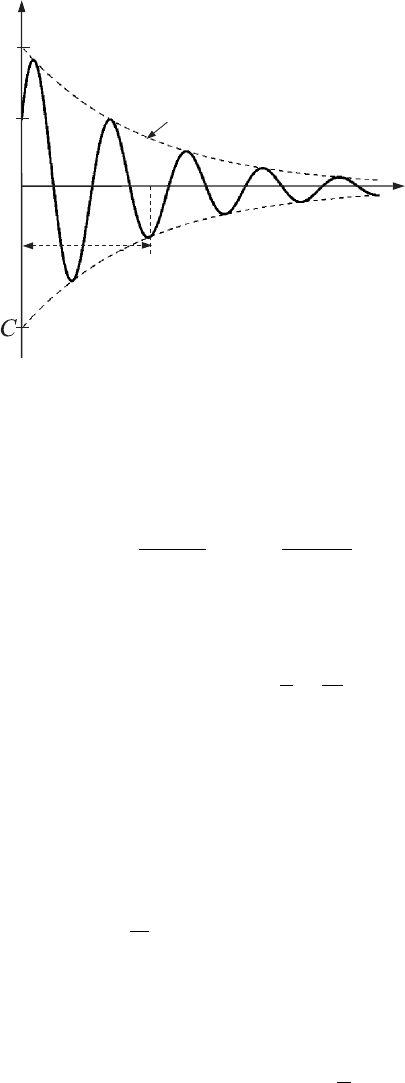
In Fig. A.6 the graph of the time-dependent displacement, x(t), of a particle from its
position of equilibrium, x = x(0) = x
0
, is shown for the case of damped oscillations. At
t = 0, the displacement of a particle from the position of equilibrium is equal to
x(0) = x
0
= C cos φ. (A.98)
To characterize the rate of damping, it is convenient to introduce a number of quantities
apart from the coefficient of damping, β, such as the time of relaxation, τ , and the
logarithmic decrement of damping, δ. The time of relaxation is equal to
τ =
1
β
, (A.99)
328 Appendix A. Classical dynamics of particles and waves
x
(t)
C
e
− βt
t
x
0
0
C
−
τ
Figure A.6 Damped
oscillations.
and it defines the time interval during which the amplitude of oscillations decreases by
afactorofe(e≈ 2.718). The logarithmic decrement of damping, δ, is introduced in the
following way:
δ = ln
C(t)
C(t + T )
= ln
Ce
−βt
Ce
−β(t+T )
= ln e
βT
= β T. (A.100)
Taking into account that β = 1/τ , we obtain
δ =
T
τ
=
1
N
τ
, (A.101)
where N
τ
= τ/T is the number of full periods for which the amplitude of oscillations
decreases by a factor of e. The smaller the logarithmic decrement of damping, δ,thelarger
is the number of oscillations that a particle makes during time τ , and the more evident the
oscillatory character of a particle’s motion.
The velocity of a particle that is oscillating with a damping can be found by taking the
first derivative with respect to time of x(t ) as defined by Eq. (A.97):
v(t) =
dx
dt
=−Ce
−βt
[
sin(t + φ) +β cos(t + φ)
]
. (A.102)
If at t = 0 the particle’s velocity is equal to zero, then it follows from the last equation
that the initial phase of oscillations, φ, is equal to
φ =−arctan
β
. (A.103)

A.2 Oscillatory motion of a particle 329
The total energy of an oscillating particle, E = K +U , decreases after each period of
oscillations by the value of the work done by friction forces, A
T
:
A
T
=−b
x(t+T )
x(t)
v dx =−2βm
t+T
t
v
2
(t)dt. (A.104)
This energy is transformed into the internal energy of the medium, i.e., into the thermal
energy of the medium – heat.
If the damping factor is large, β ≥ ω, the roots of the characteristic equation Eq. (A.92)
are real, and the solution of Eq. (A.90) can be written in the form
x(t) = e
−βt
"
A
1
e
√
β
2
−ω
2
t
+ A
2
e
−
√
β
2
−ω
2
t
#
. (A.105)
The motion of a particle described by this solution is not oscillatory and there is only an
exponential approach of the particle to the equilibrium position. The velocity and energy
of a particle exponentially drop with time, t.
A.2.5 Small-amplitude oscillations
If a particle executes oscillatory motion in an arbitrary potential field, then, near the
position of equilibrium, x
0
, the potential energy of a particle, U(x), can be expanded in a
Taylor series with respect to the displacement from the position of equilibrium:
U (x ) = U
0
+
dU
dx
x=x
0
(x − x
0
) +
1
2
d
2
U
dx
2
x=x
0
(x − x
0
)
2
+
1
6
d
3
U
dx
3
x=x
0
(x − x
0
)
3
+···. (A.106)
Here, U
0
= U (x
0
) is the value of the potential energy at the position of equilibrium. Since,
at the position of equilibrium, the sum of all forces acting on a particle must be equal
to zero, the coefficient (dU/dx)
x=x
0
, which defines the force acting on the particle at the
equilibrium position, is equal to zero. The coefficient (d
2
U/dx
2
)
x=x
0
in the expression for
the potential energy, U (x), is a coefficient of proportionality for the quadratic displacement
of a particle from the equilibrium position. Therefore, this coefficient is actually the spring
constant k, i.e.,
d
2
U
dx
2
x=x
0
= k. (A.107)
In the case of small-amplitude oscillations we can neglect in Eq. (A.106) the terms of
expansion with powers greater than two. Then, the expression for the potential energy
will take the form
U (x ) = U (x
0
) +
1
2
k(x − x
0
)
2
. (A.108)
330 Appendix A. Classical dynamics of particles and waves
r
r
min
0
U(r)
r
0
U
0
E < 0
U(r) = A/r
2
– B/r
U
1
(r) = A/r
2
U
2
(r B/r
r
x
2
x
m
U(x)
K
2
< 0
−x
m
x
1
0
x
K
1
> 0
E
)b()a(
max
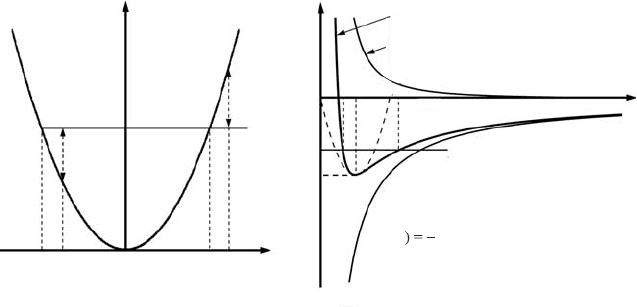
Figure A.7 Small-amplitude oscillations in a parabolic potential (a) and in the
potential defined by Eq. (A.113)(b).
Such a representation of a potential energy is called the harmonic approximation.If
we choose the position of equilibrium at the origin of coordinates, x
0
= 0, and put the
potential energy at this point equal to zero (U (x
0
) = U (0) = 0), the expression for the
potential energy, Eq. (A.108), becomes equivalent to Eq. (A.86). We can conclude that, in
the case of an arbitrary dependence of U on x for small displacements of a particle from
a stable equilibrium position, the motion of the particle is always harmonic. The terms of
the expansion proportional to (x − x
0
)
3
and higher powers of the particle’s displacement
define the anharmonic effects in the oscillatory motion of a particle.
Since the potential energy of a particle in a field of elastic forces is quadratic with
respect to the displacement of the particle from the equilibrium position, we can say that
its motion takes place in a parabolic potential (see Fig. A.7(a)). From Fig. A.7(a) you can
see that the motion of a particle at given total energy, E, takes place within the following
range of displacements:
−x
m
≤ x (t) ≤ x
m
, (A.109)
i.e., inside of the potential well where the kinetic energy is equal to
K = E −U ≥ 0. (A.110)
The particle cannot move outside of this potential well because at x > x
m
or at x < −x
m
the kinetic energy of the particle would have to be negative, which is impossible in classical
physics. Since at the point x
1
the inequality U(x ) < E holds, we have K (x
1
) > 0. At the
point x
2
the value of U (x
2
) is greater than E (U(x
2
) > E), so K (x
2
) < 0. At the points
of maximum displacement, x =±x
m
, the particle’s velocity becomes equal to zero and
K (±x
m
) = 0. At these points the particle’s velocity changes its sign to the opposite. For
this reason these points are called turning points. The turning points of the maximum
displacement are found from the condition
U (x ) = E. (A.111)

A.2 Oscillatory motion of a particle 331
Then, according to Eq. (A.86), the turning points are defined as
x
0
=
2E
k
. (A.112)
The point x = 0 is the particle’s position of stable equilibrium.
In real situations we very often have to solve the problem of finding the period of small-
amplitude oscillations in a given potential field. Since the force acting on the particle in
such a field is defined by Eq. (A.36), by using the corresponding expansion in series of
the given function U (x) we can write the particle’s equation of motion. By limiting the
expansion of U (x) to the quadratic term we can solve the particle’s equation of motion in
the limit of small-amplitude oscillations and find the period of such oscillations.
Example A.1. The potential energy of a particle with mass m is given by the function
U (r) =
A
r
2
−
B
r
, (A.113)
see Fig. A.7(b). Find the position of equilibrium, r
0
, the energy of the particle, U
0
,atthe
position of equilibrium, the angular frequency, ω, and the period, T , of the small-amplitude
oscillations of the particle.
Reasoning. The potential energy, U (r), given above defines the oscillatory motion of ions
in metals. The coordinate r = r
0
as shown in Fig. A.7 is the position of equilibrium of a
particle. The first term in the expression for U (r)(Eq.(A.113)) is related to the forces
of repulsion that define the particle’s behavior at small distances from r = 0, i.e., to the
left of r = r
0
. The second term is related to the forces of attraction that are significant at
large distances, i.e., at r r
0
. At the position of equilibrium, r = r
0
, the potential energy,
U (r), reaches its minimum, U
0
(at the position of equilibrium the sum of repulsion and
attraction forces is equal to zero). Thus,
dU
dr
r=r
0
=−
2A
r
3
0
+
B
r
2
0
= 0. (A.114)
From the last equation we get
r
0
=
2A
B
and U(0) = U (r)
r=r
0
=
A
r
2
0
−
B
r
0
=−
B
2
4A
. (A.115)
To define the frequency of oscillations, we find the coefficient k,usingEq.(A.107):
k =
d
2
U
dr
2
r=r
0
=
2
r
3
3A
r
− B
r=r
0
=
B
4
8A
3
. (A.116)
The potential energy, U (r), near the equilibrium position r
0
can be written in the form
U (r) = U (r)
r=r
0
+
1
2
d
2
U
dr
2
r=r
0
(
r −r
0
)
2
=−
B
2
4A
+
B
4
16A
3
(
r −r
0
)
2
. (A.117)

332 Appendix A. Classical dynamics of particles and waves
The equation of the particle’s oscillatory motion in such a field can be written in the
following form, if we take into account the relation F =−dU/dr:
m
d
2
r
dt
2
=−
B
4
8A
3
(
r −r
0
)
. (A.118)
The right-hand side of Eq. (A.118) was obtained by differentiating Eq. (A.117) with
respect to r. To find the solution of Eq. (A.118), let us make the change of variable
r −r
0
= R. Then, the last equation can be rewritten as
m
d
2
R
dt
2
=−kR (A.119)
or
d
2
R
dt
2
+ ω
2
R = 0, (A.120)
where the angular frequency of oscillations
ω =
k
m
=
B
2
√
8A
3
m
and the period of oscillations
T =
4π
√
2A
3
m
B
2
.
A.2.6 Probability and probability density
of oscillatory motion
Let us consider a particle oscillating harmonically as x(t) = x
0
sin(ωt) in the given region
of one-dimensional space and analyze the probability of finding the particle at a specific
location, x . Since the period of oscillations is
T =
2π
ω
and the time the particle remains within the given interval dx is equal to 2 dt (one dt for
each direction of motion during the period T ), the corresponding probability is the ratio
of the time which the particle spends in the given time interval to the period:
dP(x) =
2dt(x)
T
=
dx
π
x
2
0
− x
2
. (A.121)
To obtain this expression, we carried out the following transformations:
dx
dt
= ωx
0
cos(ωt) = ω
x
2
0
− x
2
0
sin
2
(ωt) = ω
x
2
0
− x
2
(A.122)