
Mitin V.V., Sementsov D.I., Vagidov N.Z. Quantum mechanics for nanostructures
Подождите немного. Документ загружается.

A.2 Oscillatory motion of a particle 333
0
x
0
x
0
x
dP/dx
(2x
0
)
( x
0
)
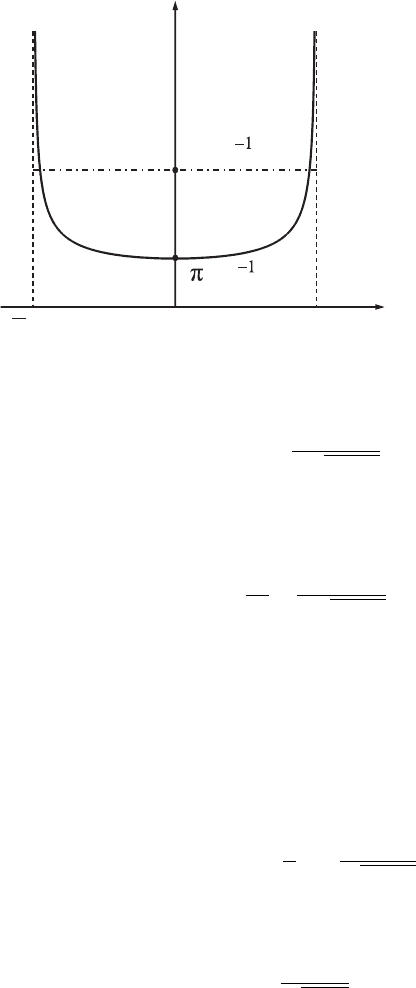
Figure A.8 The probability
density, dP/ dx, of finding
a particle at a given point
x.
and
dt =
dx
ω
x
2
0
− x
2
. (A.123)
Let us introduce the probability density, the entity that is defined by the ratio of the
probability of a particle being in the given interval, dP, to the width of this interval, dx:
dP
dx
=
1
π
x
2
0
− x
2
. (A.124)
From Eq. (A.124) it follows that the probability of finding a particle near the equi-
librium position, x = 0, is minimal, whereas when the particle approaches the turning
points, ±x
0
, where its velocity approaches zero, the probability density tends to infinity
(Fig. A.8). The probability of finding the particle outside of the interval [−x
0
, x
0
] is equal
to zero: d P/dx = 0. At the same time the total probability of finding the particle in the
interval from −x
0
to x
0
is equal to unity. Indeed, the probability of finding the particle in
the interval [−x
0
, x
0
] is equal to
P(−x
0
, x
0
) =
1
π
x
0
−x
0
dx
x
2
0
− x
2
= 1, (A.125)
where we took into account that
1
−1
dξ
1 − ξ
2
= π. (A.126)
Let us compare the above-considered oscillations with the case when a particle oscil-
lates between two vertical parallel walls with distance 2x
0
between them, from which the

334 Appendix A. Classical dynamics of particles and waves
particle is elastically reflected when it hits them perpendicularly (we neglect the influence
of the gravitational force). Let us consider the velocity of a particle equal to the average
velocity of a harmonically oscillating particle, i.e.,
v =
4x
0
T
=
2x
0
ω
π
. (A.127)
Here we took into account that during the period T the particle covers the distance 4x
0
.
Since during elastic reflections the magnitude of a particle’s velocity does not change, the
probability of finding it within the given interval does not depend on the coordinate, i.e.,
dP =
2dx
vT
=
dx
2x
0
. (A.128)
Thus, the probability density is constant (the dash–dotted line in Fig. A.8):
dP
dx
=
1
2x
0
. (A.129)
A.3 Summary
1. Newton’s second law of motion establishes the relationship between the acceleration
of a particle and the sum of forces acting on the particle. Presented in the form of a
differential equation of first or second order, it is one of the main equations of classical
mechanics, with a wide range of applicability – from macroobjects to microparticles
and from the macroscale to the microscale.
2. By force in physics we understand a quantitative measure of the intensity of interaction
of two particles (bodies) or a particle and a field. Among all the forces that affect
bodies and particles, we can distinguish a wide class of conservative forces. For them
the work done does not depend on the form of the trajectory and the work done along
a closed contour is equal to zero. The gravitational, electrostatic, and elastic forces
are conservative.
3. For a conservative force we can always introduce a function U (r), which is called
potential energy, and is connected with force as F = ∇(r). The force that acts on a
particle and the work that is done to displace the particle are real physical magnitudes,
whereas potential energy is defined to within the precision of some constant.
4. The most fundamental laws of physics are the three laws of conservation of momen-
tum, angular momentum, and energy. The first two laws are valid for closed systems,
whereas the law of conservation of energy applies for conservative systems.
5. The total mechanical energy, E, is defined as the sum of the potential energy, U (r),
and kinetic energy, K , which is a quadratic function of the momentum or velocity of
a particle.
6. At mechanical equilibrium of a system of particles two vector conditions must be
satisfied: the sum of all forces and the sum of torques must be equal to zero. For a
system that can be considered a material point it is sufficient if only the first condition
is satisfied and the equilibrium condition can be written as ∇U (r) = 0.
A.4 Problems 335
7. The equilibrium position can be either stable or unstable. In the first case the body
is returned to the stable equilibrium position by the forces which occur during the
displacement, whereas in the second case the body is taken away from the unstable
equilibrium position by the same forces.
8. Oscillations that are harmonic are caused by the influence of an elastic or quasielastic
force. By a quasielastic force we understand a force that is not connected with elastic
interaction, but depends linearly on the displacement, as is the case for elastic force.
9. In harmonic oscillations the kinetic and potential energy separately change with time
at double the frequency; however, the energy of oscillations does not depend on time.
10. If oscillations have small amplitude then terms in the expansion of the potential
energy over the displacement of a particle from the equilibrium position of higher
than second order can be neglected (the harmonic approximation). The terms in the
expansion which are of higher than second order define the anharmonic effects of
oscillatory motion. If the potential energy of a particle is quadratic with respect to the
displacement from the equilibrium position then it is assumed that its motion takes
place in a “parabolic potential.”
11. The probability of finding an oscillating particle near the equilibrium position is the
lowest. The case of a particle approaching the turning points, where the particle has
velocity equal to zero, has a probability density tending to infinity.
A.4 Problems
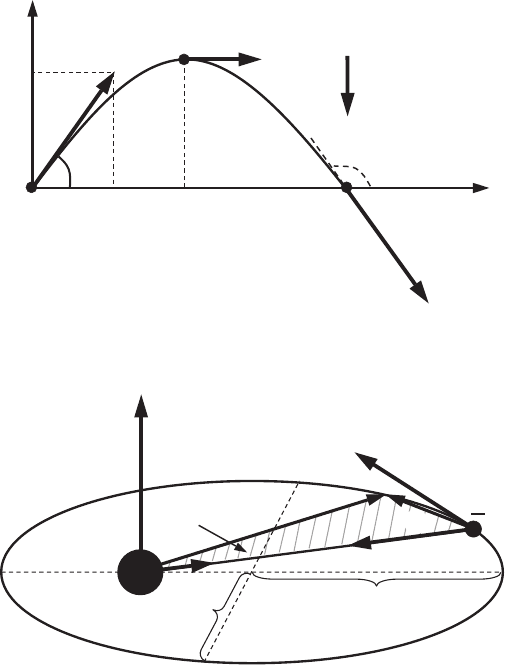
Problem A.4.1. A ball of mass m is thrown at point x = y = 0 at initial time t = 0 with
initial momentum p
0
= mv
0
, at an angle α = 45
◦
(see Fig. A.9). Find the dependence
of the magnitude of the ball’s momentum on time during the ball’s motion, the minimal
magnitude of the ball’s momentum, and the magnitude of the momentum at the time
when the ball hits the ground. Write the expression for the ball’s trajectory. Disregard the
friction of air.
Problem A.4.2. A particle with mass m and initial velocity v
0
enters a fluid, where a
retarding force, F
rt
=−bv, is applied to it. Find the time during which the particle’s
velocity drops to v
0
/n (n is an integer number greater than 1), and find the distance
traveled by the particle during this time. Ignore the gravitational force acting on the
particle.
Problem A.4.3. A particle with mass m begins its motion from the state of rest under
the influence of an oscillating force F(t) = F
0
sin(γ t). Find the particle’s velocity and
the distance traveled at time t
1
, when the force reaches its first maximum, and at time t
2
,
when the force becomes equal to zero.
Problem A.4.4. Two particles, which have masses m
1
and m
2
and velocities before the
collision v
1
and v
2
, undergo a perfect inelastic collision. Find the velocity of the particle
formed after the collision and find the proportion of the mechanical energy that has been
transformed into internal energy.
Problem A.4.5. Find the velocities of two particles after their perfectly elastic central
collision. The initial state of the two particles before the collision is given by the
336 Appendix A. Classical dynamics of particles and waves
0
y
p
o
p
ox
p
ox
p
oy
x
g
x
m
p
fin
α
π−α
Figure A.9 The trajectory
of a ball with initial
momentum p
0
and initial
angle α.
+e
dA
r
1
e
v
L
F(r)
r
2
dr
a
b
e
r
Figure A.10 The elliptic
orbitofanelectroninthe
field of a central force
F (r)e
r
.
parameters m
1
, v
1
, m
2
,andv
2
.Acentral collision is defined as a collision that happens
along the line connecting the centers of the particles.
Problem A.4.6. According to one of the first models of the hydrogen atom (Thomson’s
model), an electron (a particle with mass m
e
= 9.1 × 10
−31
kg and negative charge
−e =−1.6 ×10
−19
C) is located at the center of the atom and all the rest of the atomic
space is uniformly filled by a spherical cloud of positive charge, the total charge of which
is equal to +e, which does not hinder the motion of an electron. Considering that the
hydrogen atom’s radius is known (a ≈ 0.5 ×10
−10
m), estimate the oscillation frequency
of an electron. (Answer: ω
e
≈ 4.5 × 10
16
s
−1
.)
Problem A.4.7. In Sommerfeld’s model of the hydrogen atom the electron rotates around
the proton along stationary elliptic orbits (see Fig. A.10). Find the electron’s angular
momentum in terms of the parameters of the orbit (the semimajor and semiminor axes
of the ellipse are a and b, respectively) and the period of the orbital rotation, T .Findthe
electron’s angular momentum for a circular orbit.

A.4 Problems 337
…
a
+e
+e
+e
a
x
+e +e
Figure A.11 A linear chain
of ions.
Problem A.4.8. An electron with velocity v enters a uniform magnetic field B,whichis
perpendicular to the electron’s velocity. Find the radius, r, of the circle along which the
electron is moving, its angular momentum, L, and its magnetic moment, µ. The magnetic
moment of an electron can be calculated according to the formula
µ =−ISe
B
, (A.130)
where I is the circular current induced by the electron’s motion along a circle, S is the
cross-sectional area of a current loop, and e
B
is a unit vector along vector B.
Problem A.4.9. A particle with positive charge q,massm, and velocity v
1
enters a region
with an electric field. Associated with the electric force there is an electric potential φ.
While moving along the electric field lines from a point with electrostatic potential φ
1
to
a point with electrostatic potential φ
2
, the particle accelerates. Find its final velocity v
2
.
Problem A.4.10. Show that the force acting on a particle in a homogeneous electrostatic
field is conservative and that the field itself is a potential field.
Problem A.4.11. Show that the kinetic energy of a charged particle in a magnetic field
does not change.
Problem A.4.12. Consider an infinite linear chain of ions with mass m and charge e.
The distance between the neighboring ions is a (Fig. A.11). Find the period of linear
oscillations of one of the ions, considering that all other ions are motionless. Estimate the
frequency, ω, of a chain of copper ions having e = 1.6 ×10
−19
C, m = 1.06 ×10
−25
kg,
and a = 3 ×10
−10
m. (Answer: ω ≈ 2 ×10
14
s
−1
.)
Problem A.4.13. Consider a linear chain of ions that consists of ions with opposite
charges. The distance between ions is equal to a. Find the energy of the electrostatic
interaction of a separate ion with all of the others, considering the number of ions, N ,to
be large. Find the energy of the whole chain of ions.
Appendix B
Electromagnetic fields and waves
In Appendix A, Section A.2, we considered the oscillations of particles using Newton’s
laws of classical mechanics. The distinctive feature of Newton’s mechanics, when con-
sidering interactions between particles (for example, the gravitational interaction), is the
instantaneous transmission of the interaction between particles, i.e., transmission occurs
with infinite speed. The interaction between charged particles is realized through an elec-
tromagnetic field, which possesses energy and momentum and is carried through space
with finite speed. Electromagnetic waves can exist without any charges in a space in which
there is no substance, i.e., in vacuum. This is substantiated by the fact that the equations of
classical electrodynamics allow solutions in the form of electromagnetic waves for such
conditions.
The main equations of classical electrodynamics are Maxwell’s equations, which were
formulated after analyzing numerous experimental data. In this sense they are analogous
to Newton’s equations of classical mechanics. Maxwell’s equations are the basis for elec-
trical and radio engineering, television and radiolocation, integrated and fiber optics, and
numerous phenomena and processes that take place in materials placed in an electromag-
netic field. Together with Newton’s equations, Maxwell’s equations are the fundamental
equations of classical physics. Just like Newton’s equations, Maxwell’s equations have
their limits of applicability. For example, they do not sufficiently well describe the state
of an electromagnetic field in a medium at frequencies higher than 10
14
–10
15
Hz. This
limitation is due to the manifestation at high frequencies of the quantum nature of the
interaction of electromagnetic radiation with materials.
In this appendix we will consider Maxwell’s equations, the wave equations derived
from them, and their solutions, which describe electromagnetic waves. In contrast to
elastic waves, in which the material particles take part in the wave movement, in an
electromagnetic wave oscillations of the electric and magnetic vectors take place. Together
with the solution of the boundary problem and the definition of coefficients of reflection
and transmission through the interface between two media, we will consider the most
characteristic wave phenomena – interference and diffraction – which prove the wave
nature of electromagnetic radiation.
B.1 Equations of an electromagnetic field
B.1.1 Characteristics of electric and magnetic fields
The electric, E, and magnetic, B, fields are two vector fields that describe an electro-
magnetic field. Sometimes B, which is measured in tesla ([T]), is called the magnetic
338

B.1 Equations of an electromagnetic field 339
flux density and E, which is measured in volt/meter ([V m
−1
]), is called the electric field
intensity. Charged particles are the sources of electric and magnetic fields. An isolated
particle with charge q creates around itself a field, the electric component of which is
E =
k
e
q
r
3
r, (B.1)
and the magnetic component of which is
B =
k
m
q
r
3
v ×r, (B.2)
where r is the vector directed from the position of charge q to the point where the field is
measured, and v is the velocity of the particle. The coefficients k
e
and k
m
are defined as
k
e
=
1
4π
0
(B.3)
and
k
m
=
µ
0
4π
, (B.4)
where
0
= 8.85 × 10
−12
Fm
−1
(farad/meter) is known as the permittivity of free space
and µ
0
= 4π × 10
−7
Hm
−1
(henry/meter) is known as the permeability of free space.It
follows from Eq. (B.1) that the electric field is created by a charge and it does not matter
whether the charge is moving or not. A magnetic field can be created only by a moving
(in the chosen frame of reference) charge. Stationary charges do not generate magnetic
fields.
If there is a system of n charged particles, the field at an arbitrary point r is defined as
a vector sum of the fields created by particles, E
i
and B
i
:
E =
n
i=1
E
i
(B.5)
and
B =
n
i=1
B
i
. (B.6)
Equations (B.5)and(B.6)describethesuperposition principle of the fields in electro-
magnetism (note that electromagnetism is the field of physics that studies electrical and
magnetic phenomena). The physical quantities E and B are the force-field characteristics
of electric and magnetic fields because they define the electrical, F
e
= qE, and magnetic,
F
m
= qv
0
× B, components of the total force that acts on a point charge, q,placedinthe
electromagnetic field:
F = F
e
+ F
m
= q(E +v ×B), (B.7)
where v is the velocity of the charge q.FromEq.(B.7) it follows that the magnetic force,
F
m
, in contrast to the electric force, F
e
, acts only on a moving charged particle. The

340 Appendix B. Electromagnetic fields and waves
directional movement of charged particles creates an electric current, I, whose density, j,
is given by the expression
j = qnv, (B.8)
where j is measured in ampere/meter
2
([A m
−2
]), q is the charge of the carriers measured
in coulombs ([C]), and n is the concentration of charged carriers (or number of charged
carriers in the volume unit, measured in 1/meter
3
([m
−3
])). The directional movement of
electrons in the conductor creates an electric current, I , whose magnitude in the general
case is given by the expression
I =
S
j · dS, (B.9)
where I is measured in amperes ([A]), S is the cross-section of the conductor, measured
in meter
2
([m
2
]). In the case of a uniform distribution across the cross-section, S,ofthe
current density, j,Eq.(B.9) takes the form
I = jS. (B.10)
Since the magnetic field, B, according to Eq. (B.2) is created by moving charges, it
follows that it can be generated by currents. In accordance with the Biot–Savart law,
dB =
k
m
I
r
3
dl ×r, (B.11)
where dl is the vector element of a linear conductor, the direction of which coincides with
the direction of a current, and r is the vector directed from the element with the current
to the point where the magnetic field element, dB, is measured.
When considering the electromagnetic field in a medium, it is necessary to take into
account the fact that fields can be created by external charges and currents as well as by
bound charges (in dielectrics) and currents of bound charges (in magnetic materials). The
vectors E and B are the characteristics of the total field of external and bound charges and
currents. For convenience, quantities that define only external sources will be introduced.
For an electric field such a vector is the electric displacement D, which is measured in
coulomb/meter
2
([C m
−2
]), and for a magnetic field it is the magnetic field intensity H,
which is measured in ampere/meter ([A m
−1
]). In the case of an isotropic medium the
above-mentioned quantities are defined as
D =
0
E, (B.12)
H =
B
µ
0
µ
, (B.13)
where we introduced the relative permittivity, ,andrelative permeability, µ, of a medium,
which define the ratio of fields in a medium and in vacuum:
E
medium
=
1
E
vacuum
, (B.14)
B
medium
= µB
vacuum
. (B.15)

B.1 Equations of an electromagnetic field 341
From Eqs. (B.14)and(B.15) it follows that and µ are dimensionless quantities. Using
these quantities, an important classification of different media can be made.
All materials can be divided into three broad classes with respect to their magnetic
properties:
(a) diamagnetic materials, for which the static value of µ is less than 1,
(b) paramagnetic materials with µ ≥ 1, and
(c) strongly magnetic materials (ferromagnetic, ferrimagnetic, and antiferromagnetic
materials) with µ 1.
A similar classification can be made on the basis of . Materials with 1 are called
ferroelectrics, whereas materials with ≥ 1areparaelectrics.
Lately, the so-called “left-handed media,” for which and µ are less than zero simul-
taneously, have attracted great attention. The optical properties of such media are very
different from the properties of conventional media with >0andµ>0.
B.1.2 Maxwell’s equations
Maxwell’s equations, which relate electromagnetic fields to charges and currents, can be
written in the form of the following differential equations:
∇ × H =
∂D
∂t
+ j, (B.16)
∇ × E =−
∂B
∂t
, (B.17)
∇ · B = 0, (B.18)
∇ · D = ρ, (B.19)
where ρ is the charge density, measured in coulomb/meter
3
([C m
−3
]), and ∇ is the
gradient operator. From Eqs. (B.16)–(B.19) it follows that (a) not only electric charges
but also time-varying magnetic fields can be the sources of electric fields; and (b) the
sources of magnetic fields are moving electric charges (currents) as well as time-varying
electric fields. The Cartesian coordinates of E, B, H,andD can be written in the following
form:
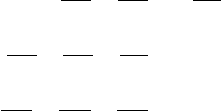
∂ H
z
∂y
−
∂ H
y
∂z
=
∂ D
x
∂t
+ j
x
,
∂ H
x
∂z
−
∂ H
z
∂x
=
∂ D
y
∂t
+ j
y
,
∂ H
y
∂x
−
∂ H
x
∂y
=
∂ D
z
∂t
+ j
z
, (B.20)
∂ E
z
∂y
−
∂ E
y
∂z
=−
∂ B
x
∂t
,
∂ E
x
∂z
−
∂ E
z
∂x
=−
∂ B
y
∂t
,
342 Appendix B. Electromagnetic fields and waves
∂ E
y
∂x
−
∂ E
x
∂y
=−
∂ B
z
∂t
, (B.21)
∂ B
x
∂x
+
∂ B
y
∂y
+
∂ B
z
∂z
= 0, (B.22)
∂ D
x
∂x
+
∂ D
y
∂y
+
∂ D
z
∂z
= ρ. (B.23)
We see that Maxwell’s equations have the form of a system of linear first-order partial
differential equations. Equations (B.12)and(B.13) may be used to reduce the number of
unknown functions in the system of Maxwell’s equations. Let us note that in textbooks
and in the scientific literature the vector product ∇ × A is sometimes denoted as rot A
(rotation of vector A) and the scalar product ∇ · A as div A (divergence of A), i.e.,
∇ × A = rot A, (B.24)
∇ · A = div A. (B.25)
If there is an interface that separates two media, then the following boundary conditions
for the introduced characteristics of electric and magnetic fields have to be satisfied:
(D
2
− D
1
) · n = σ, (B.26)
(E
2
− E
1
) ·ττ = 0, (B.27)
(B
2
− B
1
) · n = 0, (B.28)
n ×(H
2
− H
1
) = j
s
. (B.29)
Here n is the unit vector in the direction perpendicular to the interface of the two media,
which is directed from medium 1 to medium 2; ττ is a unit vector oriented along the
interface; σ is the charge surface density with dimension [C m
−2
]; and j
s
is the vector
of current surface density ([A m
−1
]) at the interface. From Eqs. (B.26)–(B.29) it follows
that the tangential component, E
t
, of the vector E is continuous across the interface,
i.e., E
t
undergoes no change at the interface: E
t1
= E
t2
. The same is true for the normal
component, B
n
, of the vector B, i.e., B
n1
= B
n2
. At an interface without any free charges
and currents, the normal components of the vector D and the tangential components of
the vector H are also continuous. If the interface is charged, then the normal component
of the vector D has a discontinuity, and if there is a current along the interface, then the
tangential component of the vector H has a discontinuity.
B.1.3 Energy and energy density
Electric and magnetic fields have the ability to store energy. The total energy can be
defined through the energy density of the respective fields at each point of the volume
occupied by the field:
W =
V
(w
e
+ w
m
)dV, (B.30)