
Mitin V.V., Sementsov D.I., Vagidov N.Z. Quantum mechanics for nanostructures
Подождите немного. Документ загружается.


B.3 Reflection of a plane wave from an interface 353
On substituting these magnitudes into Eq. (B.69) and averaging over time, we obtain
P
=
1
4
(E + E
∗
) × (H + H
∗
)
=
1
4
E × H + E
∗
× H
∗
+ E
∗
× H + E ×H
∗
.
(B.87)
Taking into account that the dependence on time of the fields from Eq. (B.87) is propor-
tional to e
±iωt
, we obtain for two terms
E × H
=
E
∗
× H
∗
= 0. (B.88)
Let us prove that the first term is equal to zero (for the second term the calculations are
similar):
E × H
= E
0
× H
0
1
T
e
−2ik·r
T
0
e
2iωt
dt =
E
0
× H
0
T
e
−2ik·r
1
2iω
e
2iωT
− 1
= 0,
(B.89)
since ω = 2π/T and
e
2iπ
= cos(2π ) +isin(2π) = 1. (B.90)
As a result, we obtain for the average density of flux
P
=
1
4
E
∗
× H + E ×H
∗
. (B.91)
We have to leave only the real parts in the last equation. Let us show that the real parts
of both terms in Eq. (B.91) are the same. For this purpose, let us present the complex-
conjugate magnitudes we have,
E
∗
= E
0
e
−i(ωt−k·r)
,
H
∗
= H
0
e
−i(ωt−k·r)
.
(B.92)
The results of multiplication of the fields from Eqs. (B.86)and(B.92) show that both
products in Eq. (B.91) are real and that they are the same. Thus, the average density of
flux can be written as follows:
P
=
1
2
Re(E ×H
∗
). (B.93)
B.3 Reflection of a plane wave from the interface
between two media
B.3.1 Plane waves in absorbing media
We have considered so far waves that are not damped while propagating. This is possible
only in vacuum or in a non-absorbing medium. All real media absorb waves to some extent.

354 Appendix B. Electromagnetic fields and waves
The magnitude of such absorption greatly depends on the frequency of the propagating
wave. For some regions of the electromagnetic spectrum this absorption can be so weak
that we can neglect it, but for other regions of the spectrum the absorption can be very
significant. Let us consider the peculiarities of the propagation of plane waves in an
absorbing medium.
Absorption in the medium has to be taken into account if we are dealing with a medium
that has a conductivity, σ , that is not equal to zero. Since the current density, j,ofthe
free charges is related to the intensity of the electric field, E, by Ohm’s law (in differential
form) as
j = σE, (B.94)
Maxwell’s equation (B.16) that contains j can be rewritten in the following form:
∇ × H =
0
∂E
∂t
+ σ E. (B.95)
Using Maxwell’s equation (B.17),
∇ × E =−µµ
0
∂H
∂t
, (B.96)
we can obtain the wave equation for the case considered here (in the same way as we
obtained Eq. (B.52)):
∇
2
E =
µ
c
2
∂
2
E
∂t
2
+ µµ
0
σ
∂E
∂t
. (B.97)
The corresponding wave equation can be obtained for the intensity of the magnetic
field, H:
∇
2
H =
µ
c
2
∂
2
H
∂t
2
+ µµ
0
σ
∂H
∂t
. (B.98)
These wave equations, in contrast to Eqs. (B.52)and(B.53), contain terms with the time
derivative in the first order, which are responsible for the damping of the wave in a medium.
We will seek solutions of Eqs. (B.97)and(B.98) in the form of monochromatic plane
waves, which for convenience can be presented in the exponential form,
E(t, r) = E
0
e
i(ωt−k·r)
, (B.99)
H(t, r) = H
0
e
i(ωt−k·r)
, (B.100)
where E
0
and H
0
are the amplitudes of the electric and magnetic fields of the wave. This
form of presentation of wave equations is generally used in electromagnetism, where
the fields E and H are defined as complex functions, while the real wave processes are
described by the real parts of Eqs. (B.99)and(B.100).

B.3 Reflection of a plane wave from an interface 355
By substitution of Eq. (B.99) into Eq. (B.97), we arrive at the equation
k
2
−
ω
2
c
2
µ
− i
σ
0
ω
E = 0, (B.101)
from which we obtain the dispersion relation that connects the wavenumber, k, with the
wave frequency, ω, and the medium parameters:
k
2
= k
2
0
µ
− i
σ
0
ω
or k = k
0
µ
− i
σ
0
ω
. (B.102)
Here, we introduced the wavenumber, k
0
= ω/c, for the wave propagating in vacuum.
From the expressions obtained it follows that the wavenumber, k, for a wave propagating
in a conducting medium is a complex number, i.e.,
k = k
− ik
. (B.103)
The sign before the imaginary part of the wavenumber is chosen to be negative to make
the wave that propagates in the positive direction in an absorbing medium damped instead
of amplifying it. Let us substitute Eq. (B.103) into Eq. (B.102), and let us separate the real
and imaginary parts. As a result we obtain two equations from which to find k
and k
:
(k
)
2
− (k
)
2
= k
2
0
µ, (B.104)
2k
k
= k
2
0
µσ
0
ω
. (B.105)
By solving the system of (B.104)and(B.105), we obtain the following expressions for
the real, k
, and the complex, k
, parts of the complex wavenumber, k:
k
= k
0
µ
2
1 +
σ
2
2
0
2
ω
2
+ 1
, (B.106)
k
= k
0
µ
2
1 +
σ
2
2
0
2
ω
2
− 1
. (B.107)
The above relations for the real, k
, and imaginary, k
, parts of the wavenumber, k,are
written in the general form and are valid for weakly absorbing media as well as for strongly
absorbing media over a wide frequency range (from ω = 0toω = 10
14
Hz, where quantum
effects become significant). Depending on the media and on the frequency ranges, the
magnitude of σ/(
0
ω) can be either large or small, which can be used for simplification
of the above expressions.

356 Appendix B. Electromagnetic fields and waves
B.3.2 The skin effect
Let us assume that a plane wave, whose electric and magnetic fields are described by
Eqs. (B.99)and(B.100), is propagating in the y-direction. Then, the partial derivatives
with respect to x and z are equal to zero and in Eqs. (B.97)and(B.98) the operator ∇
2
is
simplified to the form
∇
2
=
∂
2
∂y
2
. (B.108)
Taking into account that the wavenumber of Eq. (B.103) is a complex variable, the
solutions (B.99)and(B.100) can be rewritten as
E(t, y) = E
0
e
−k
y
e
i(ωt−k
y)
, (B.109)
H(t, y) = H
0
e
−k
y
e
i(ωt−k
y)
, (B.110)
where E
0
and H
0
are the amplitudes of the wave fields in the plane y = 0. It follows from
Eqs. (B.109)and(B.110) that the amplitudes of wave fields decrease exponentially in the
direction of wave propagation (the y-direction):
E(y) = E
0
e
−k
y
, (B.111)
H(y) = H
0
e
−k
y
. (B.112)
The imaginary part of the wavenumber, k
, defines the rate of the decrease in amplitude
along the direction of wave propagation. Its reciprocal, δ, which is called the skin depth,
δ =
1
k
, (B.113)
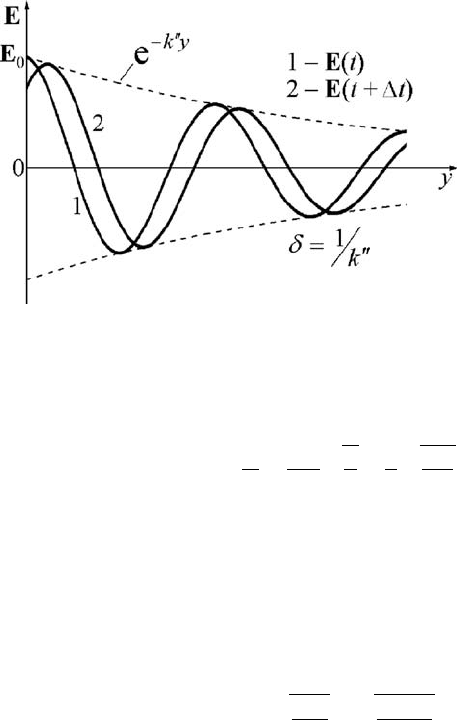
defines the penetration depth of the field in the absorbing medium. At the distance δ the
amplitude of the wave has decreased by a factor of e:
E(δ) = E
0
e
−k
δ
= E
0
e
−1
. (B.114)
Figure B.5 shows the distribution of the electric field of the wave in a medium with
damping for two time instants. If a wave with an amplitude of E
0
penetrates from vacuum
into a medium with non-zero conductivity, then it practically dampens at a depth of several
δ. Since the intensity of the wave I is proportional to E
2
, at the distance y = δ the intensity
of the wave will have decreased by a factor of I
0
/I = e
2
∼
=
7.4, and at the distance y = 2δ
the intensity will have decreased by a factor of I
0
/I = e
4
∼
=
55. We can conclude that the
energy of the transmitted wave in an absorbing medium is located in a layer of depth several
times δ. For media with high conductivity the depth of such a layer can be relatively small
(for example, for copper a wave of frequency f = ω/(2π) = 1 MHz has a penetration
depth of δ ≈ 0.07 mm). This is why the near-surface region of depth δ, where most of the
penetrated electromagnetic wave is concentrated, is called the skin layer, the magnitude δ
is called the skin depth, and the effect itself is called the skin effect. Let us consider two
B.3 Reflection of a plane wave from an interface 357
Figure B.5 The electric
field of an
electromagnetic wave in
an absorbing medium at
two instants of time, t and
t + t. The magnitude of
the skin depth, δ,is
indicated.
limiting cases for Eqs. (B.106)and(B.107) for low and high conductivities.
(a) Low conductivity (or the high-frequency limit), σ
0
ω. In this case
δ =
1
k
=
2
0
c
σ
µ
=
2
σ
0
µ
0
µ
, (B.115)
i.e., the depth of wave penetration into the medium does not depend on its frequency.
With decreasing σ the wave field penetrates further into the medium. In the case
of σ → 0 the medium becomes non-conducting and the penetration depth for the
electromagnetic field tends to infinity, δ →∞.
(b) High conductivity (or the low-frequency limit), σ
0
ω.Inthiscasetheskin
depth, δ,isdefinedas
δ = c
2
0
µσ ω
=
2
µ
0
µσ ω
, (B.116)
i.e., with increasing conductivity, σ , and frequency, ω, the penetration depth
decreases. At ω → 0 the depth of penetration into the medium tends to infinity,
δ →∞. This is a feature of static fields, both electric and magnetic.
B.3.3 Solution of the boundary problem
Real wave-guiding structures always have finite dimensions. Therefore, there is partial
reflection from boundary surfaces and transmission into the neighboring medium during
wave propagation in such structures. Depending on the type of material, the geometry
of the reflecting surfaces, the structure of the incident wave, and the angle of incidence,
the problems of finding fields of reflected and transmitted waves seem to be problems
of different levels of complexity. Let us consider the simplest problem of the reflection
and transmission of a monochromatic plane wave through a plane interface at normal
incidence.
358 Appendix B. Electromagnetic fields and waves
0
E
i
k
i
H
i
E
r
H
r
k
r
k
t
H
t
E
t
y
z
medium 2
e
y
e
z
e
x
medium 1
x
Figure B.6 The interface
between two semi-infinite
homogeneous media:
medium 1 with
1
, µ
1
,and
σ
1
; and medium 2 with
2
,
µ
2
,andσ
2
.
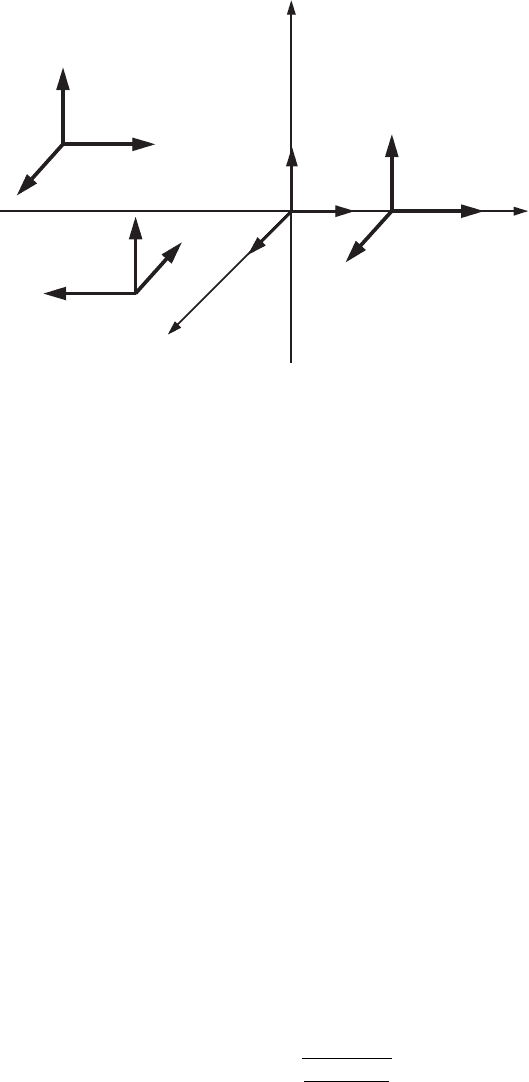
Let the interface between two semi-infinite homogeneous media coincide with the
plane y = 0 (see Fig. B.6). The medium located to the left of the interface (y < 0) is
characterized by the parameters
1
, µ
1
,andσ
1
, whereas the medium located to the right
of the interface (y > 0) is characterized by the parameters
2
, µ
2
,andσ
2
.Aplanewave
of frequency ω and wavevector k
i
= e
y
k
1
is normally incident (along the y-axis). The
reflected wave propagates along the negative y-axis, and the wave transmitted into the
second medium propagates in the positive direction of the y-axis (see Fig. B.6).
To find the amplitude of the reflected and transmitted waves, let us solve the boundary
problem, which includes sewing fields at the interface using the boundary conditions
(B.26)–(B.29). In writing the expressions for the fields we will drop the time factor e
iωt
because it is present in each expression for the fields of each wave.
The field of the incident wave can be written in the following form:
E
i
(y) = e
z
E
i
e
−ik
1
y
, (B.117)
H
i
(y) = e
x
H
i
e
−ik
1
y
, (B.118)
where e
x
and e
z
are the unit vectors of the corresponding coordinate axes, and wave-
number k
1
is defined by Eqs. (B.106)and(B.107). The relation between the amplitudes
of these waves is given by the expression
E
i
= Z
1
H
i
, (B.119)
where the wave resistance Z
1
of the first medium is
Z
1
=
µ
0
µ
1
ω
0
1
ω − iσ
1
. (B.120)

B.3 Reflection of a plane wave from an interface 359
The fields of the reflected wave propagating in the opposite direction have to be written
in the following form:
E
r
(y) = e
z
E
r
e
ik
1
y
, (B.121)
H
r
(y) =−e
x
H
r
e
ik
1
y
, (B.122)
where E
r
= Z
1
H
r
, and the negative sign appears in the expression for H
r
(y) because E
r
,
H
r
,andk
r
constitute a right-handed system.
For the wave transmitted across the interface we can write
E
t
(y) = e
z
E
t
e
−ik
2
y
, (B.123)
H
t
(y) = e
x
H
t
e
−ik
2
y
, (B.124)
where E
t
= Z
2
H
t
; Z
2
is defined analogously to Z
1
:
Z
2
=
µ
0
µ
2
ω
0
2
ω − iσ
2
. (B.125)
At the interface, which does not have any charges and any currents along it, according
to Eqs. (B.26)–(B.29) the tangential components of the field intensities of the electric and
magnetic fields must be continuous. On the left-hand side of the interface (y < 0) the field
is presented as a sum of the incident and reflected waves, and on the right-hand side of
the interface (y > 0) it is given solely by the transmitted wave. So at the interface (y = 0)
we obtain the following system of equations:
E
i
(0) + E
r
(0) = E
t
(0), (B.126)
H
i
(0) + H
r
(0) = H
t
(0). (B.127)
Let us substitute into this system of equations the expressions for the fields of the incident,
reflected, and transmitted waves, and let us drop the common factors. As a result, we will
obtain the following system of equations for the amplitudes of the corresponding fields:
E
i
+ E
r
= E
t
, (B.128)
H
i
− H
r
= H
t
. (B.129)
On proceeding in the second equation with the amplitudes of the electric fields, we obtain
E
i
− E
r
=
Z
1
Z
2
E
t
. (B.130)
By solving this equation self-consistently with Eq. (B.128) we obtain
E
r
=
Z
2
− Z
1
Z
2
+ Z
1
E
i
, (B.131)

360 Appendix B. Electromagnetic fields and waves
E
t
=
2Z
2
Z
2
+ Z
1
E
i
. (B.132)
From these relations we can find the coefficients of reflection, R, and transmission, T :
R =
E
r
E
i
=
Z
2
− Z
1
Z
2
+ Z
1
=|R|e
iϕ
r
, (B.133)
T =
E
t
E
i
=
2Z
2
Z
2
+ Z
1
=|T |e
iϕ
t
. (B.134)
In the general case of absorbing media the coefficients R and T are complex variables.
This means that the phases of reflected and transmitted waves do not coincide with the
phase of the incident wave. The corresponding phase shifts ϕ
r
and ϕ
t
can be found from
Eqs. (B.133)and(B.134).
B.3.4 Analysis of the reflection and transmission coefficients
Let us consider several important special cases for several interfaces.
(1) Let the reflection happen from the interface of two transparent non-magnetic
dielectrics, for which µ
1
= µ
2
= 1andσ
1
= σ
2
= 0. For such media the impedances
are real:
Z
1
=
µ
0
0
1
, (B.135)
Z
2
=
µ
0
0
2
. (B.136)
Then, the coefficients of reflection, R, and transmission, T , we obtain from
Eqs. (B.133)and(B.134),
R =
√
1
−
√
2
√
1
+
√
2
, (B.137)
T =
2
√
1
√
1
+
√
2
, (B.138)
have real values in this case. There is no phase shift between incident and transmitted
waves (i.e., ϕ
t
= 0) regardless of the magnitudes of
1
and
2
. The total electric field
in the region y < 0 has the form
E
1
(y, t) = e
z
E
0
[
cos(ωt − k
1
y) + R cos(ωt + k
1
y)
]
. (B.139)
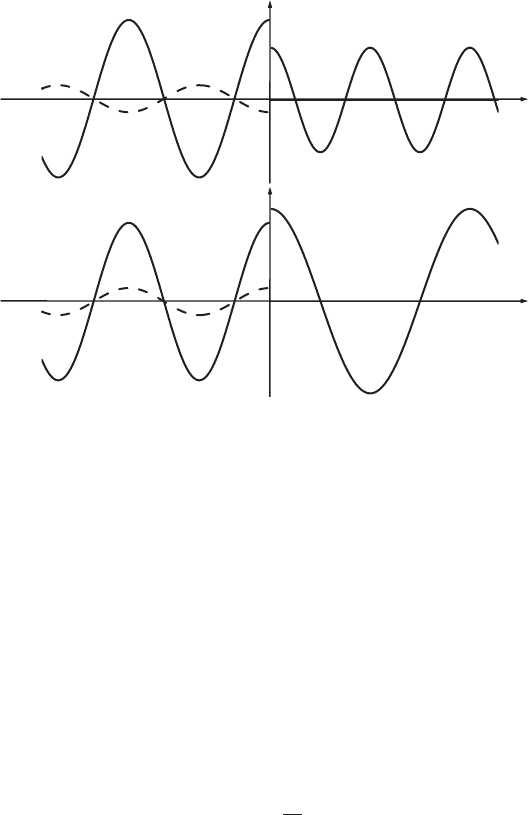
The phase shift between the incident and the reflected wave depends on the relation
between
1
and
2
.If
1
<
2
, there is a phase shift equal to π (ϕ
r
= π ,seeFig.B.7)
B.3 Reflection of a plane wave from an interface 361
E
i
0
y
z
E
r
E
t
2 muidem1 muidem
(a)
E
i
0
y
z
E
r
E
t
(b)
Figure B.7 The incident,
E
i
, reflected, E
r
,and
transmitted, E
t
, waves for
media with (a)
1
<
2
and
(b)
1
>
2
.
between incident and reflected waves. When the wave is incident from the optically
more dense medium to the optically less dense medium (i.e.,
1
>
2
) there is no
phase shift between the incident and reflected waves (see Fig. B.7).
(2) Let the wave be incident from the non-absorbing medium (σ
1
= 0) to the interface
with an ideal conductor (σ
2
→∞). In this case Z
2
= 0, R =−1, and T = 0, i.e.,
the wave does not penetrate into the second medium and the wavenumber k
1
is real.
Therefore, a standing wave is formed in the first medium, and, as we found from
Eq. (B.139)forR =−1,
E
1
(y, t) = 2e
z
E
i
sin(k
1
y)sin(ωt). (B.140)
The expressions for the magnetic field can be obtained analogously:
H
1
(y, t) =
1
Z
1
2e
x
E
i
cos(k
1
y)cos(ωt). (B.141)
From this expression we see that the wave formed as a result of the overlapping of
incident and reflected waves with phase shift ϕ = π is a standing wave. The magnetic
field of this wave has a phase shift equal to π/2 in space as well as in time relative to
the electric field.
Example B.5. For real media the material parameters are functions of frequency. Find
the reflection coefficient of an electromagnetic wave from a medium that has for a given
frequency the dielectric constant
2
(ω) < 0andσ
2
(ω) = 0. The parameters of the medium
in which the wave is initially propagating are
1
(ω) > 0andσ
1
(ω) = 0. Media 1 and 2
are non-magnetic media with µ
1
= µ
2
= 1.
362 Appendix B. Electromagnetic fields and waves
10
12
10
10
10
8
10
6
10
4
10
2
10
14
10
16
10
18
10
20
10
22
10
5
10
3
10
1
1010101010101010
, m
f, Hz
Visible range
Figure B.8 The visible
range of the
electromagnetic
spectrum.
Reasoning. According to Eq. (B.120) the expressions for the wave resistance of each of
the media have the forms
Z
1
=
µ
0
0
1
, (B.142)
Z
2
=
µ
0
0
2
= i
µ
0
0
|
2
|
. (B.143)
On substituting these expressions into Eq. (B.133), which defines the reflection coefficient,
we find
R =
Z
2
− Z
1
Z
2
+ Z
1
=
i
√
1
−
√
|
2
|
i
√
1
+
√
|
2
|
=
√
1
+ i
√
|
2
|
√
1
− i
√
|
2
|
. (B.144)
The expression for the reflection coefficient, R, can be rewritten in the form
R =|R|e
iϕ
r
, (B.145)
where
tan ϕ
r
=
2
√
1
|
2
|
1
+|
2
|
and |R|=1. (B.146)
Therefore, in the case considered here the modulus of the reflection coefficient |R|=
1. The non-absorbing medium with
2
< 0 completely reflects the wave, shifting its
phase by ϕ
r
. In this case it is said that we observe the effect of “metallic reflection.”
Media with (ω) < 0 in the corresponding frequency range are often used in devices
in which complete reflection of a wave with frequency ω is needed. This is important
when for any reason you cannot use metallic layers in the device because of their high
conductivity.
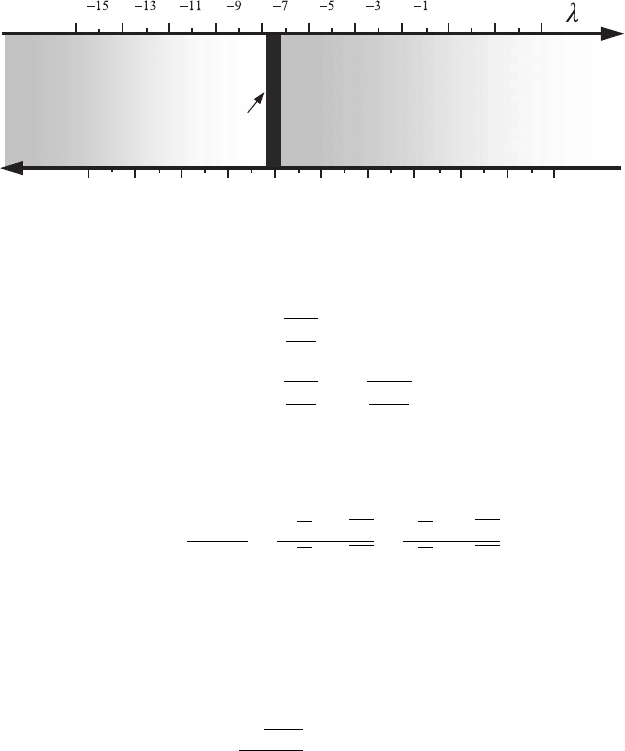
B.4 Light and its wave properties
The electromagnetic radiation that we observe in nature occupies a very wide range
of wavelengths: from 10
−15
m to hundreds of kilometers (see Fig. B.8). Nowadays we