
Mitin V.V., Sementsov D.I., Vagidov N.Z. Quantum mechanics for nanostructures
Подождите немного. Документ загружается.


B.4 Light and its wave properties 363
understand light to be electromagnetic radiation in the range from ultraviolet to infrared
waves, with corresponding wavelengths from 0.01 µm to 100 µm, although these bound-
aries are not exact, whereas the light visible to human beings has much narrower bound-
aries and lies in the interval of wavelengths from 0.35 µmto0.67 µm. It is quite obvious
that all of the properties of electromagnetic waves, such as interference, polarization,
diffraction, and dispersion, apply to light. Let us briefly discuss interference and the last
two phenomena with a specific focus on light.
B.4.1 Interference
During the simultaneous propagation of several waves in a medium, overlapping of the
waves occurs. From the linearity of Maxwell’s equations with respect to the field vectors
E, D, B,andH, and the lack of dependence of the material constants , µ,andσ on
these fields, it follows that the wave processes described by Maxwell’s equations satisfy
the superposition principle. This means that the oscillations of the field vectors at each
point are the vector sum of oscillations of the field vectors of the individual waves, which
propagate separately. Media for which the superposition principle is valid are called
linear media. A linear medium represents an idealized model. We can use this model
for the description of waves propagating through a real medium only if the amplitudes
of propagating waves, E
0i
, are much smaller than the internal electric field, E
int
, acting
on the valence electrons of the constituent atoms. An estimate of the magnitude of this
field is
E
int
∼
k
e
e
a
2
∼ 10
11
Vm
−1
, (B.147)
where a is the radius of the valence electron’s orbit (∼10
−10
m). Such magnitudes
are much larger than most wave fields. For example, the field intensity in the beam
of a continuous-wave laser with power of about 1 W and beam cross-sectional area
1mm
2
attains magnitudes of E
0
∼ 10
4
Vm
−1
, which is many orders of magnitude less
than the internal field intensity of Eq. (B.147). Thus, the medium for such a relatively
powerful laser beam is linear. Vacuum is always a linear medium for electromagnetic
fields of any intensity. Its dielectric and magnetic permittivities,
vac
and µ
vac
,depend
neither on the magnitude of the field nor on its frequency:
vac
= µ
vac
= 1, and the
conductivity σ = 0.
Let us consider the superposition of two plane harmonic waves of the same polar-
ization, propagating in a non-absorbing medium along two arbitrary directions. At any
given point the magnitudes E
j
and H
j
of these two waves undergo harmonic oscilla-
tions. The vectors of the electric and magnetic fields of these oscillations at a point,
r,are
E
j
= e
z
A
j
cos(ω
j
t −
j
) =
e
z
2
A
j
e
i(ω
j
t−
j
)
+ e
−i(ω
j
t−
j
)
, (B.148)
H
j
= e
x
γ A
j
cos(ω
j
t −
j
) =
e
x
2
γ A
j
e
i(ω
j
t−
j
)
+ e
−i(ω
j
t−
j
)
, (B.149)
T

364 Appendix B. Electromagnetic fields and waves
where j = 1, 2;
j
= k
j
· r;andγ =
0
/(µµ
0
). The wavenumber, k
j
,ofeachwave
is related to the frequency, ω
j
, and wavelength, λ
j
,by
k
j
=
ω
j
v
=
2π
λ
j
, j = 1, 2, (B.150)
where the speed of both waves is defined by Eq. (B.55)(v = c/
√
µ). The sums of the
electric and magnetic fields of both waves will depend only on time, t, and will change
from point to point, i.e.,
E(r, t) = E
1
(r, t) +E
2
(r, t), (B.151)
H(r, t) = H
1
(r, t) +H
2
(r, t). (B.152)
Let us calculate the total intensity I =
P
. Using the definitions (B.74)and(B.69), we
obtain
I =
P
=
γ
2
A
2
1
+ A
2
2
+ 2 A
1
A
2
1
T
T
0
cos
[
(ω
1
− ω
2
)t − (
1
−
2
)
]
, (B.153)
where the period, T , of total oscillations is defined in terms of the periods of individual
oscillations, T
j
,as
T =
2π
ω
1
− ω
2
=
T
1
T
2
T
1
− T
2
. (B.154)
If the frequencies, ω
1
and ω
2
, of the added waves are different, then the integral in
Eq. (B.153) becomes equal to zero, and the intensity of the superposition of the two wave
fields is equal to the sum of the intensities of the individual waves. If the two individual
oscillations are not correlated with each other and the total phase difference of oscillations
of added wave fields
= (ω
1
− ω
2
)t + (
2
−
1
) (B.155)
changes with time, then such oscillations are called incoherent. If the phase difference
does not change with time (this occurs when the frequencies of the two waves are
the same), then such oscillations (and, correspondingly, waves) are called coherent.In
the case of incoherent waves their superposition does not produce a so-called interference
pattern, i.e., an increase of the intensity at some points and a decrease at other points.
The intensity of the total field at a particular point for coherent waves (ω
1
= ω
2
), taking
into account Eq. (B.153), is given by the expression
I(r, t) =
γ
2
A
2
1
+ A
2
2
+ 2A
1
A
2
cos(
2
−
1
)
. (B.156)
Since the intensities of the individual waves are equal to
I
j
=
γ
2
A
2
j
, (B.157)

B.4 Light and its wave properties 365
Eq. (B.156) can be rewritten as
I = I
1
+ I
2
+ 2
I
1
I
2
cos , (B.158)
where we introduced the phase difference of the two waves,
=
2
−
1
. (B.159)
The last term in Eq. (B.158),
I
int
= 2
I
1
I
2
cos , (B.160)
is called the interference term. The intensity in the interference pattern greatly depends
on the magnitude of the interference term.
At the points of space where cos >0 the total intensity is I > I
1
+ I
2
.Atthe
points where cos <0 the total intensity I < I
1
+ I
2
. As a result of the superposition
of coherent waves the intensity of waves is redistributed in space – at some points the
intensity increases and at others it decreases. This phenomenon is called the interference
of waves. At the points of space where = 2mπ and cos = 1 the intensity is maximal
(these are the so-called points of constructive interference),
I
max
=
I
1
+
I
2
2
, (B.161)
and at the points where = (2m − 1)π and cos =−1, the intensity is minimal (these
are the so-called points of destructive interference),
I
min
=
I
1
−
I
2
2
. (B.162)
The interference effect becomes especially apparent when the amplitudes of the interfering
waves are equal to each other, I
1
= I
2
. In this case, at the points with maximal intensity
I
max
= 4I , and at the points with minimal intensity I
min
= 0. For incoherent waves in
this case the intensity is the same everywhere, and, according to Eq. (B.158), is given by
I = 2I
1
.
Interference is a natural phenomenon in which wave properties become strikingly
apparent. Interference is characteristic for waves of any nature and it is relatively easily
observed for acoustic (sound) waves or for waves on the surface of water. Interference
of electromagnetic waves, in particular light waves, can be observed only under certain
conditions. Conventional sources (i.e., not laser sources) do not radiate monochromatic
light waves. Non-laser sources of light have a wide spectrum of radiation. Light waves
that originate from such sources are not coherent and do not create a stable interference
pattern. The simplest way to obtain two coherent waves is the following. A wave from
one source (with spectral width λ and mean wavelength λ) is divided into two waves,
which then are brought together at a screen. The two waves formed after the division can
be considered as waves coming from two individual points or linear sources.
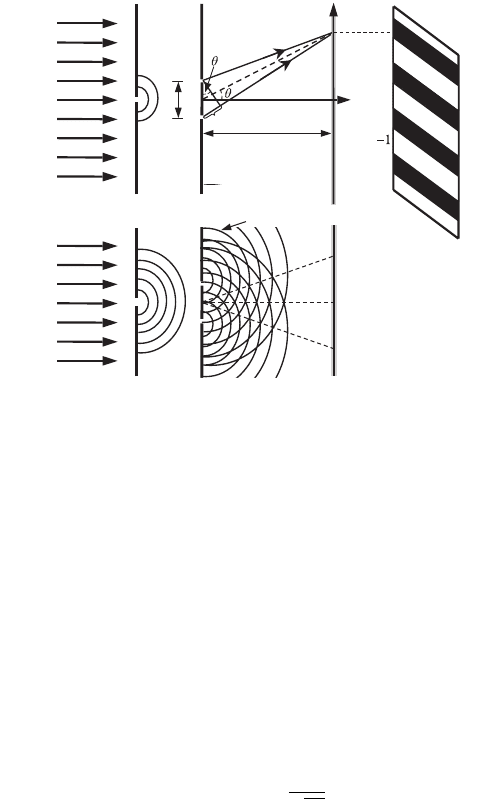
366 Appendix B. Electromagnetic fields and waves
x
r
L
d
0
S
2
S
1
l
SP
y
r
1
r
2
Screen
Screen
m = 0
1
Distant linear light source
(a)
(b)
Wavelets
S
1
S
2
S
0
S
0
Distant linear light source
m = 0
1
−1
Figure B.9 Young’s
double-slit experiment. (a)
White stripes at the
screen correspond to
maxima of intensity and
black stripes to minima.
(b) Plane waves from the
distant linear source (e.g.,
the Sun) are transformed
into concentric wavelets,
which originate from the
slits S
0
,S
1
,andS
2
.
There are many other ways to bring about such division of one wave into two. In
particular, it can be achieved by using two narrow slits, S
1
and S
2
, separated by a small
distance, d, which are illuminated by a distant linear source (e.g., the Sun). This method is
called Young’s scheme. The wavelets coming from the slits overlap, establishing a system
of alternating maxima and minima at the screen (see Fig. B.9). Let us introduce the so-
called path-length difference, L, of two waves propagating from corresponding slits to the
point SP at the screen:
L = r
2
−r
1
. (B.163)
If the path-length difference, L, contains an integer number of wavelengths (in the medium
being considered)
L =
mλ
0
√
µ
= mλ, (B.164)
then the oscillations of the field vectors of these waves at the given point are in phase,
which results in interference maxima. Note that, if the path-length difference, L,ofthese
waves propagating from the source to the point of the screen SP is not greater than a
characteristic length l
coh
= λ
2
/λ, which is called the coherence length, then the random
changes of the amplitude and phase of the fields of the two waves happen coherently, and
a stable interference pattern is established. The points where the path-length difference is
equal to an integer multiple of half-wavelengths correspond to the interference minima.
The formation of a standing wave by two monochromatic waves with the same fre-
quencies and amplitudes, which are propagating in opposite directions, is an important
particular case of interference. For a wave propagating in the positive direction of the
y-axis the field intensities of the electric, E
+
, and magnetic, H
+
, fields are defined by the
B.4 Light and its wave properties 367
expressions
E
+
= e
z
E
0
cos(ωt − ky), (B.165)
H
+
= e
x
H
0
cos(ωt − ky). (B.166)
The equations for the wave propagating in the opposite direction can be written as
E
−
= e
z
E
0
cos(ωt + ky + ϕ), (B.167)
H
−
=−e
x
H
0
cos(ωt + ky + ϕ), (B.168)
where ϕ is the phase shift between the two waves traveling in opposite directions. In
writing the expression for H
−
it is necessary to take into account that the vectors E
−
,
H
−
,andk
−
form a right-handed system. Therefore, the polarization of the field H
−
must
be directed opposite to the x -axis. As a result of overlapping of fields with opposite
directions we obtain a wave whose electric and magnetic fields are given by the following
expressions:
E = E
+
+ E
−
= 2e
z
E
0
cos
ky +
ϕ
2
cos
ωt +
ϕ
2
, (B.169)
H = H
+
+ H
−
= 2e
x
H
0
sin
ky +
ϕ
2
sin
ωt +
ϕ
2
. (B.170)
Each of these equations represents a so-called standing wave, because for such a wave,
in contrast to the case of a traveling wave, there is no displacement of the wavefront in
space. Equations (B.169)and(B.170) describe the oscillations of the field intensities with
the frequency ω and amplitudes, A
e
and A
m
, for electric and magnetic fields that change
from point to point according to the relations
A
e
= 2E
0
cos
ky +
ϕ
2
, (B.171)
A
m
= 2H
0
sin
ky +
ϕ
2
. (B.172)
For each field separately we can indicate the points where the amplitude is maximal (anti-
nodes) or equal to zero (nodes). For the electric field the anti-nodes are located at the
points with coordinates
y
anti-node
=
mπ − ϕ/2
k
, (B.173)
and the nodes are located at the points with coordinates
y
node
=
m +
1
2
π −ϕ/2
k
, (B.174)
where m is an arbitrary integer number. For the magnetic field all anti-nodes and nodes
are shifted along the y-coordinate by y = π/(2k). Thus, at the points where the electric

368 Appendix B. Electromagnetic fields and waves
field has anti-nodes, the magnetic field has nodes, and vice versa. The distance between
adjacent nodes and anti-nodes for each of the fields is equal to the quarter wavelength
of the traveling wave: y
n+1,n
= π/k = λ/4. Between two adjacent nodes of the field it
oscillates in phase. After crossing the node the phase of the field oscillations changes by
π, i.e., the symmetric field oscillations on the two sides of the node are in anti-phase.
The magnitude of the phase difference, ϕ, of the waves propagating in opposite directions
depends on the conditions of their formation. Control of this magnitude allows us to shift
all the nodes and anti-nodes along the space coordinate.
There is a shift of a quarter of the period between the oscillations of electric and
magnetic fields not only in space but also in time. If at some instant in time at all points
|E| attains its maximum and H is equal to zero, then after a time t = T/4 at all points
E = 0and|H |attains its maximum. Thus, during the oscillations in the standing wave the
electric field transforms into the magnetic field and vice versa. The standing wave does not
transfer energy because for each of the fields the energy is concentrated between the nodes
of the field. At the same time, after each quarter of a period, the energy of a standing wave
transforms from electric to magnetic energy, and vice versa. The amplitudes of the fields
satisfy Eq. (B.72), i.e.,
√
0
E
0
=
√
µµ
0
H
0
. Such a process of energy transformation in
a standing wave is analogous to the processes in harmonic oscillators, whereby the energy
is transformed from one type into another. For a spring–mass system and the simple
pendulum, the energy of oscillation is transformed from kinetic to potential energy. Thus,
a standing wave can be considered as a wave harmonic oscillator from the point of view
of energy.
B.4.2 Diffraction
We understand diffraction of light to be the deviation of light waves from direct propagation
in the presence of obstacles in their path, wave bending, and penetration into the region
of geometrical shadow. To observe the effect of diffraction, various types of obstacles
that limit the propagation of a part of the wavefront can be placed in the path of light
waves. If we put a screen behind the obstacle, then under certain conditions a diffraction
picture in the form of a pattern of intensity maxima and minima of the light field appears
on the screen. The interference of the infinite number of coherent spherical wave pulses
(wavelets) emitted by every point of the wavefront is the physical origin of diffraction.
One of the most important examples of electromagnetic wave diffraction is the diffrac-
tion of X-rays on crystalline lattices, by means of which the geometries of many crystalline
structures are investigated. For observation of X-ray diffraction it is necessary to have
the period of the diffraction grating comparable to the wavelength of the X-rays. Natural
diffraction gratings for such radiation are crystalline lattices with period about 0.1−1 nm.
If a monochromatic plane wave is incident on a crystalline lattice with basis vectors a
1
, a
2
,
and a
3
, at angles α
0
, β
0
,andγ
0
with respect to the crystallographic axes, then the directions
of the diffraction maxima, defined by the angles α, β,andγ , satisfy the so-called Laue
equations:
a
1
(cos α − cos α
0
) = m
1
λ,
a
2
(cos β −cos β
0
) = m
2
λ, (B.175)
a
3
(cos γ − cos γ
0
) = m
3
λ,
B.4 Light and its wave properties 369
L/2
d
Sites of crystalline lattice
q
q
q
q
Parallel planes
L/2
Figure B.10 Diffraction of
X-rays from crystalline
planes.
where m
1,2,3
are integer numbers that define the order of the interference maximum.
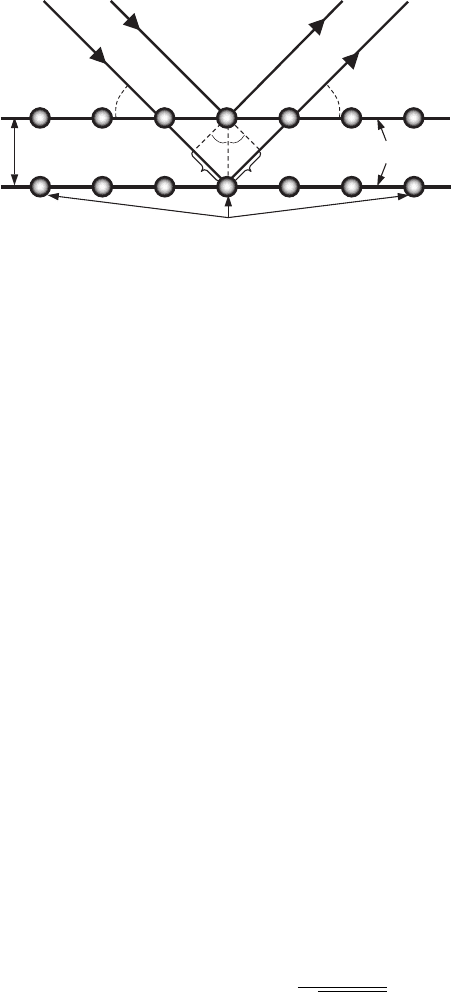
The conditions (B.175) can be formulated in a different way. The diffraction in a
three-dimensional crystalline structure can be considered as a result of mirror reflections
from a system of parallel planes, on which the sites of the crystalline lattice are located
(see Fig. B.10). The wavelets reflected from the different atomic planes are coherent and
may interfere with each other. The path-length difference of two waves that are mirror
reflected from neighboring parallel planes, as in Fig. B.10, is equal to
L = 2d sin θ, (B.176)
where d is the distance between two adjacent planes and θ is the angle between the
incident ray and the plane. The directions for which the diffraction maxima are developed
are defined by Bragg’s law:
2d sin θ
m
= mλ, (B.177)
where m = 1, 2, 3,...We can plot many sets of crystalline planes with different distances
between two adjacent planes. Each set of crystalline planes gives its own diffraction
maxima in the directions defined by Eq. (B.177). However, the diffraction maxima that
occur near the planes with the highest density of atoms have the largest magnitudes of
intensity.
B.4.3 Dispersion
The dependence of the propagation speed, v, of a monochromatic light wave in a medium
on its frequency, ω, is called dispersion. Since the speed of the electromagnetic wave in a
medium, according to Eq. (B.55), is defined by the expression
v(ω) =
c
µ(ω)(ω)
, (B.178)
the dispersion is actually defined by the dependence of the medium’s material parameters,
µ and , on the frequency, ω. All substances are to some extent dispersive, but the
frequency dependence of the dielectric constant, , and magnetic permeability, µ,for
370 Appendix B. Electromagnetic fields and waves
E
x(t)
x
y
0
(a)
P
(b)
-
+
d
q q
+
L
Figure B.11 (a) The
polarization of an atom.
(b) The dipole moment d.
most media becomes apparent only in relatively narrow regions of the spectrum. For
the dielectric constant, , such a dispersive region usually lies in the visible and infrared
regions. In many weakly magnetic materials the magnetic permeability practically does not
depend on frequency and is close to unity throughout the entire frequency range. Only in
strongly magnetic materials (such as ferromagnetic materials and ferrites) is the frequency
dependence, µ(ω), substantial in the ultra-high-frequency region of the spectrum (ω ∼
10
9
−10
11
s
−1
). Therefore, let us concentrate on the analysis of the frequency dependence
of the dielectric constant, (ω), which can be considered qualitatively in the framework
of classical concepts of the behavior of materials in electromagnetic fields.
Let us consider an isotropic dielectric medium, which consists of non-interacting
atoms. Let us suppose that the atoms of the medium do not have a dipole moment in the
absence of an external electric field, i.e., the centers of positive charges of nuclei coincide
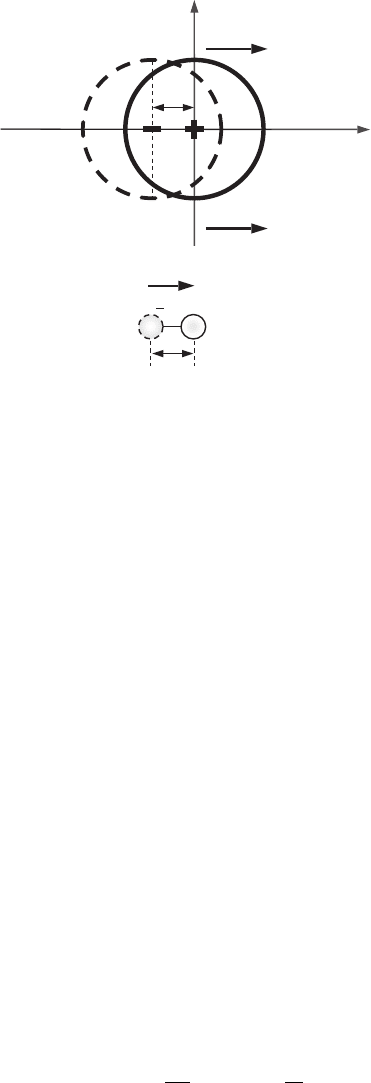
with the centers of negative charges of electrons. In the presence of an electric field
the centers of valence electrons’ orbits shift with respect to the nucleus, atoms acquire a
dipole moment oriented along the direction of the electric field, and the medium in general
acquires polarization (see Fig. B.11(a)). The dipole moment, d, is defined as the product of
two physical magnitudes: the charge q =|q
−
|=q
+
and the distance, L, between charges
q
−
and q
+
. The dipole moment, d, is a vector, which is directed from the negative charge
q
−
to the positive charge q
+
(see Fig. B.11(b)):
d = qL . (B.179)
Considering this, let us take into account that in the electric field of the electromagnetic
wave the center of the valence electron’s orbit, coupled with the atom, undergoes an
oscillatory motion. The motion of the electron can be described by Newton’s second law:
m
e
d
2
x
dt
2
=−kx −b
dx
dt
− eE(t). (B.180)

B.4 Light and its wave properties 371
Here, the first term on the right-hand side of Eq. (B.180) defines the restoring force exerted
on the electron by an atom, whereas the second term is the friction force. The third term
describes the periodic driving force of the wave’s electric field, E(t):
E(t) = E
0
e
iωt
= E
0
e
x
e
iωt
. (B.181)
The steady-state solution of Eq. (B.180) has the form
x(t) = e
x
x(t), (B.182)
with
x(t) = x
0
e
iωt
. (B.183)
Here we introduced the complex amplitude of the electron’s oscillations, x
0
,
x
0
=
ω
2
− ω
2
0
+ 2iβω
ω
2
− ω
2
0
2
+ 4β
2
ω
2
eE
0
m
e
(B.184)
and the standard parameters ω
2
0
= k/m
e
and 2β = b/m
e
. Finally, the dipole moment, d,
that the atom acquires is defined as
d =−ex(t) =−ex(t)e
x
=−e
ω
2
− ω
2
0
+ 2iβω
ω
2
− ω
2
0
2
+ 4β
2
ω
2
eE
0
m
e
e
iωt
e
x
=−
ω
2
− ω
2
0
+ 2iβω
ω
2
− ω
2
0
2
+ 4β
2
ω
2
e
2
m
e
E(t). (B.185)
Then, the dipole moment for unit volume of a medium, which is called the polarization
vector, P,isdefinedas
P = nd =−n
ω
2
− ω
2
0
+ 2iβω
ω
2
− ω
2
0
2
+ 4β
2
ω
2
e
2
m
e
E(t). (B.186)
Here, e is the charge of the electron and n is the number of atoms in the unit volume. The
electric flux density, D, in the medium consists of the flux density of the external electric
field,
0
E, and the internal flux density, which is equal to the polarization vector, P:
D =
0
E + P. (B.187)
For the so-called linear media the polarization vector, P, is linearly proportional to the
external electric field, E:
P = κ
0
E, (B.188)
where we introduced the so-called electric susceptibility, κ, of the material. Thus,
D =
0
E + κ
0
E =
0
E, (B.189)
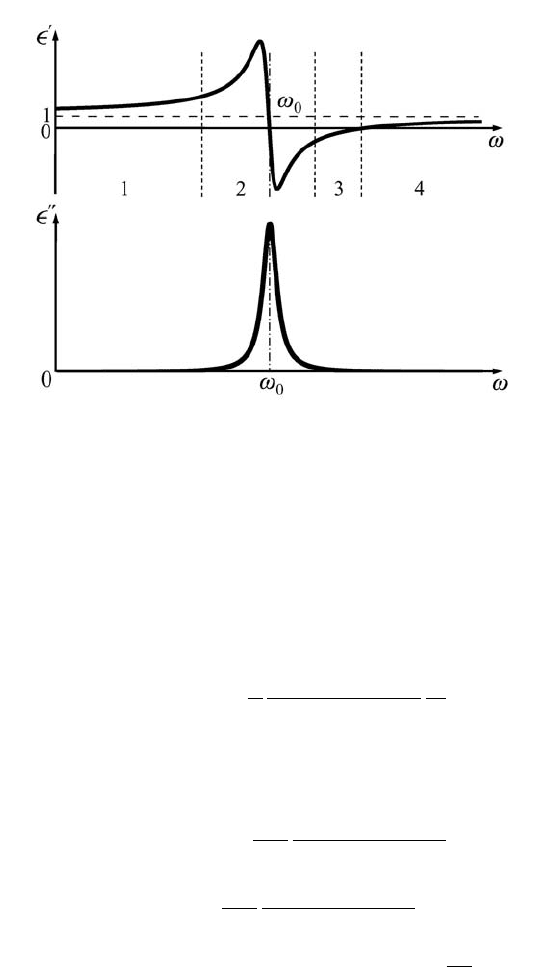
372 Appendix B. Electromagnetic fields and waves
Figure B.12 The
dependences of
and
on the frequency, ω.
where
= 1 + κ. (B.190)
Finally, the polarization vector, P, can also be presented in the form
P = ( − 1)
0
E. (B.191)
By comparing Eqs. (B.186)and(B.191), we find the complex dielectric constant, :
= 1 −
n
0
ω
2
− ω
2
0
+ 2iβω
ω
2
− ω
2
0
2
+ 4β
2
ω
2
e
2
m
e
. (B.192)
Now, we can find the expressions for the real and imaginary parts of the complex dielectric
constant, =
− i
:
= 1 −
ne
2
0
m
e
ω
2
− ω
2
0
ω
2
− ω
2
0
2
+ 4β
2
ω
2
, (B.193)
=
ne
2
0
m
e
2βω
ω
2
− ω
2
0
2
+ 4β
2
ω
2
. (B.194)
The phase velocity of the wave in the medium, v
ph
= c/
µ
, is directly related to
the real part of the dielectric constant,
. The damping of a wave in a medium, which
according to Eqs. (B.104)and(B.105) is proportional to
, is related to the imaginary
part of the dielectric constant,
.
Let us analyze the obtained frequency dependences of the magnitudes
and
,which
are shown in Fig. B.12. The entire frequency interval of change of
and
can be divided