
Moser A.P., Folkman S. Buried Pipe Design
Подождите немного. Документ загружается.

Height of cover. The tests were conducted by installing the test pipe
in the small soil load cell. The test data are reported in terms of height
of cover. Height of cover is calculated from measured vertical soil pres-
sure by using a soil unit weight of 120 lb/ft
3
as follows:
Height of cover (ft)
Load-deflection test 1. The 18-in test pipe was installed in silty-sand
soil compacted to 95 percent standard Proctor density. This type of
installation is considered excellent and is difficult to achieve in field
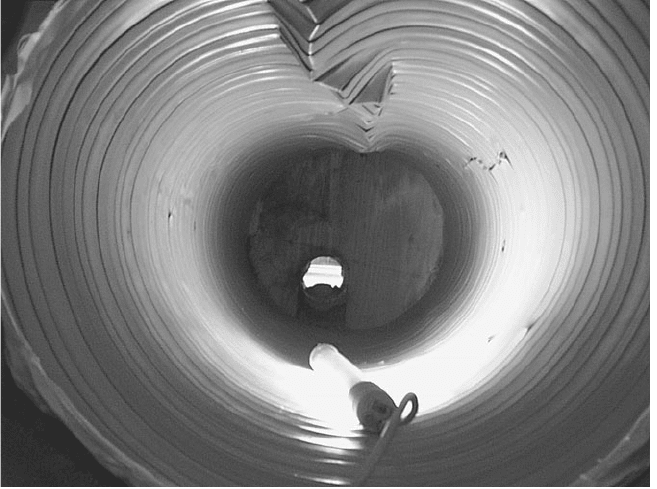
conditions. At about 64 ft of cover and 5.7 percent deflection, the top of
the pipe began to buckle (see Fig. 6.33). A buckling failure is a stiffness
failure and takes place because of low ring stiffness. As the load was
increased the buckling became more pronounced, and at 75 ft of cover
the test was terminated. The results of this test are shown in Fig. 6.34.
Load-deflection test 2. This 18-in test pipe was installed in silty-sand
soil compacted to 90 percent standard Proctor density. This type of
installation would be considered very good and is typically the best that
is achieved in normal practice. At about 30 ft of cover and 8 percent
deflection, the top began to buckle, and the seams started to show some
signs of distress (see Fig. 6.35). As the load was increased, buckling
vertical soil pressure (lb/ft
2
)
120 lb/ft
3
Steel and Ductile Iron Flexible Pipe Products 319
Figure 6.33 Steel-ribbed pipe (18-in diameter) at 75 ft of cover in silty-sand soil at
95 percent density.
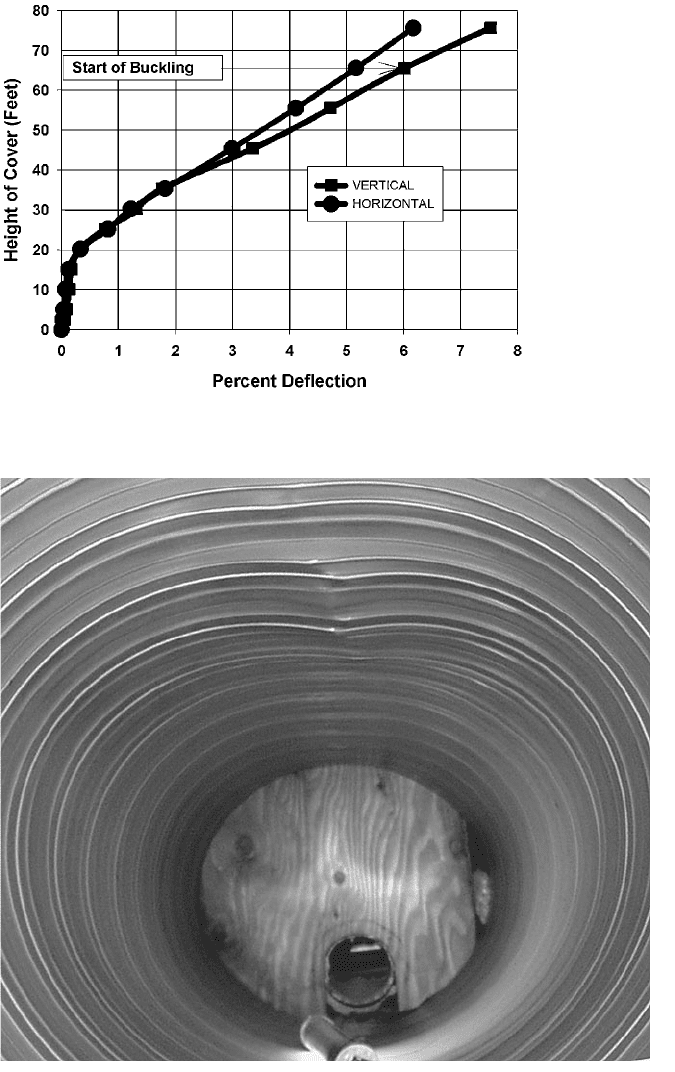
Figure 6.34 Load-deflection curves for 18-in ribbed steel pipe, silty-
sand soil compacted to 95 percent standard Proctor density.
Figure 6.35 Steel-ribbed pipe (18-in diameter) at 30 ft of cover in silty-sand soil at 90 percent
density.
320
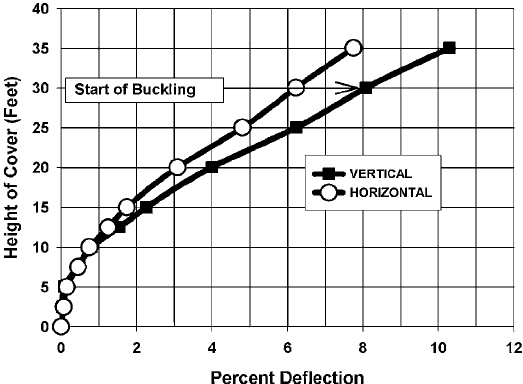
became more pronounced. The test was stopped at 35 ft of cover. The
results of this test are shown in Fig. 6.36.
Load-deflection test 3. This test pipe had 24-in diameter and was
installed in silty-sand soil compacted to 95 percent standard Proctor
density. Agai n, this type of installation would be considered excellent
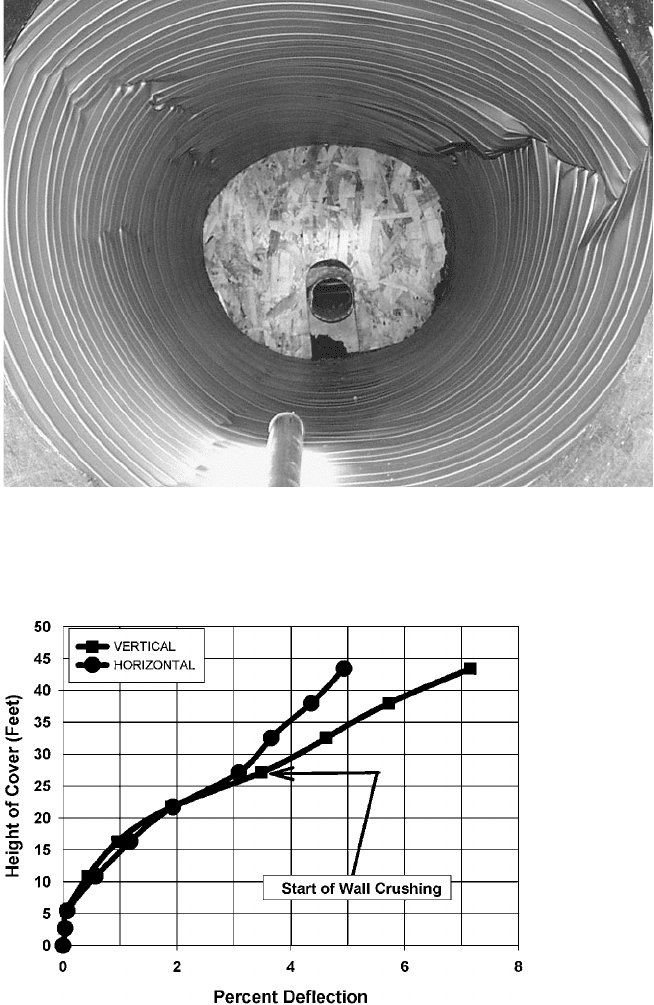
and is difficult to achieve in actual field conditions. At about 27 ft of
cover and 3.5 percent deflection, the sidewalls began to crush (see
Fig. 6.37). A wall crushing failure is a strength failure and takes
place because the wall area is inadequate to support the ring com-
pression stress induced by the soil load. As the load was increased,
wall crushing became more pronounced. The test was stopped at
about 45 ft of cover. The results of this test are shown in Fig. 6.38.
(See footnote to Table 6.3.)
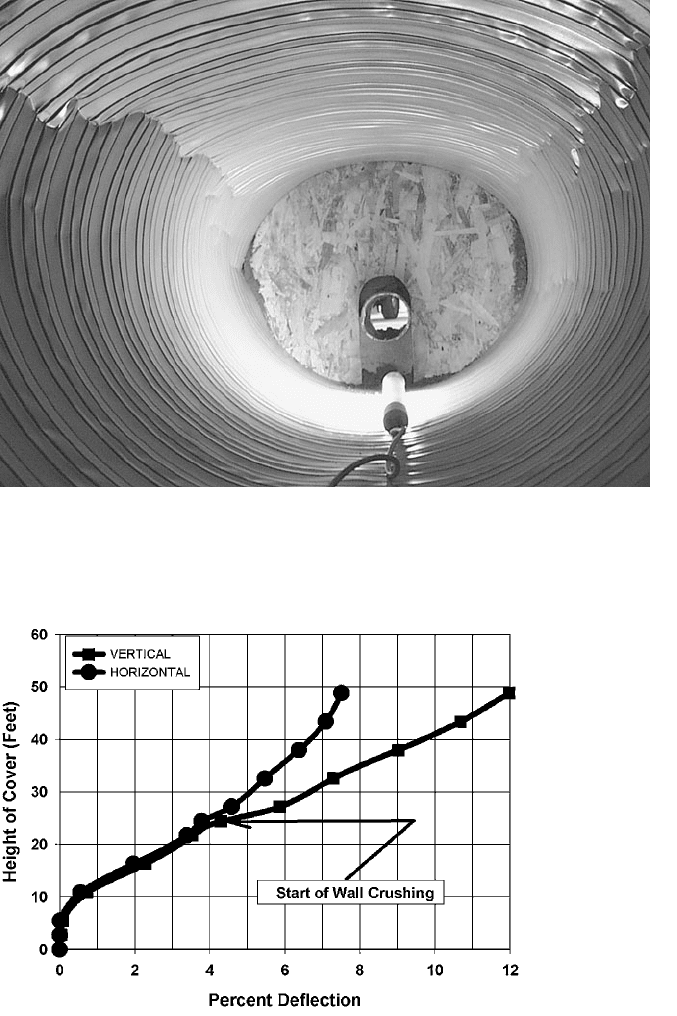
Load-deflection test 4. This 24-in test pipe was installed in silty-sand
soil compacted to 91 percent standard Proctor density. This type of
installation would be considered very good and is typically the best
that is achieved in normal practice. At about 24 ft of cover and 4 per-
cent deflection, the sidewalls began to crush (see Fig. 6.39). As the load
was increased, wall crushing became more pronounced. The test was
stopped at 50 ft of cover. The results of this test are shown in Fig. 6.40.
(See footnote to Table 6.3.)
Load-deflection test 5. This test pipe had 30-in diameter and was
installed in silty-sand soil compacted to 97 percent standard Proctor
density. Agai n, this type of installation would be considered excel-
lent and i s difficult to achieve in actual field conditions. At about
Steel and Ductile Iron Flexible Pipe Products 321
Figure 6.36 Load-deflection curves for 18-in ribbed steel pipe, silty-sand
soil compacted to 90 percent standard Proctor density.
322 Chapter Six
Figure 6.37 Steel-ribbed pipe (24-in diameter) at 43 ft of cover in silty-sand soil at
95 percent density.
Figure 6.38 Load deflection curves for 24-in ribbed steel pipe, silty-
sand soil compacted to 95 percent standard Proctor density.
Steel and Ductile Iron Flexible Pipe Products 323
Figure 6.39 Steel-ribbed pipe (24-in diameter) at 49 ft of cover in silty-sand soil at
91 percent density.
Figure 6.40 Load-deflection curves for 24-in ribbed steel pipe, silty-
sand soil compacted to 91 percent standard Proctor density.
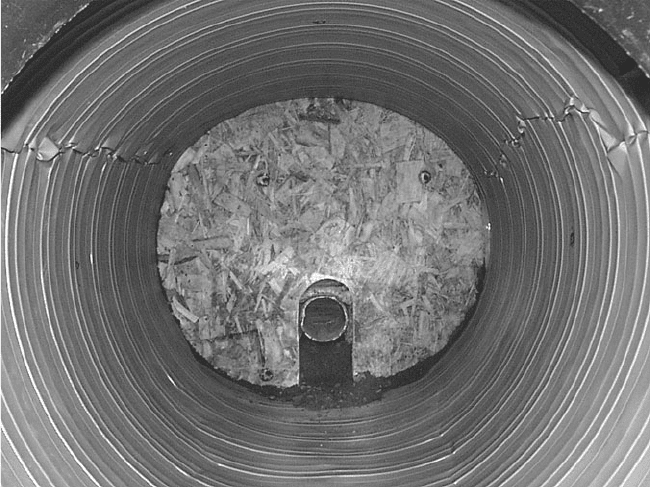
52 ft of cover and 3 percent deflection, the sidewalls began to crush
(see Fig. 6.41). Again, a wall-crushing failure is a strength failure and
takes place because the wall area is inadequate to support the ring
compression stress induced by the soil load. As the load was increased,
wall crushing became more pronounced. The test was stopped at about
65 ft of cover. The results of this test are shown in Fig. 6.42.
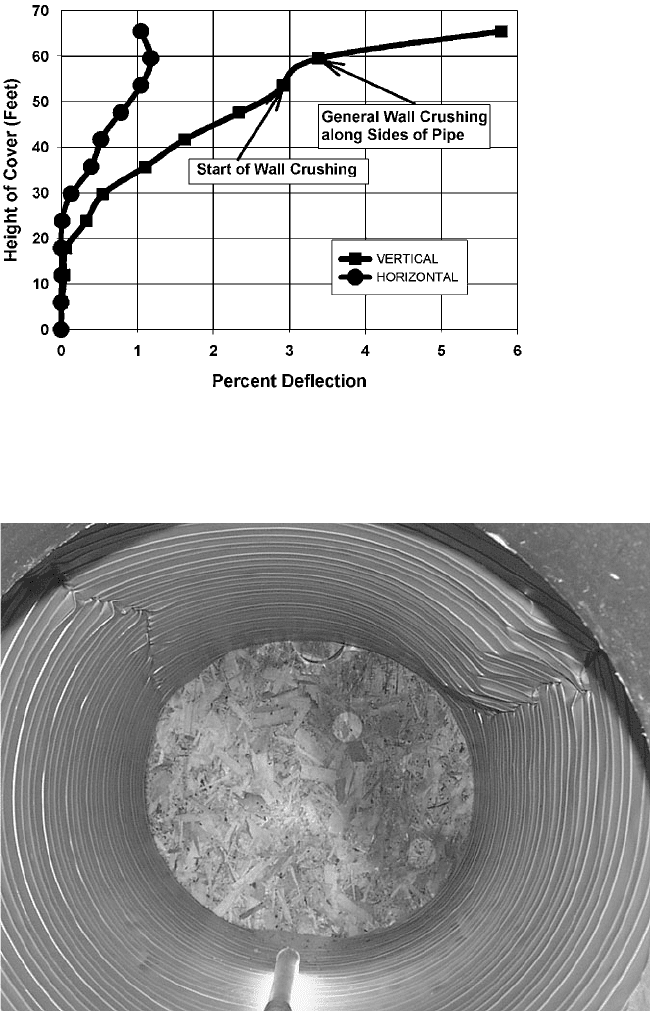
Load-deflection test 6. This 30-in test pipe was installed in silty-sand
soil compacted to 90 percent standard Proctor density. This type of
installation would be considered very good and is typically the best
that is achieved in normal practice. At about 30 ft of cover and 3.4 percent
deflection, the sidewalls began to crush. As the load was increased,
wall crushing became more pronounced, and simultaneously wall
buckling took place (see Fig. 6.43). It is interesting to note that in this
test, the stiffness and the strength performance limits occur almost
simultaneously. The test was stopped at about 47 ft of cover. The
results of this test are shown in Fig. 6.44.
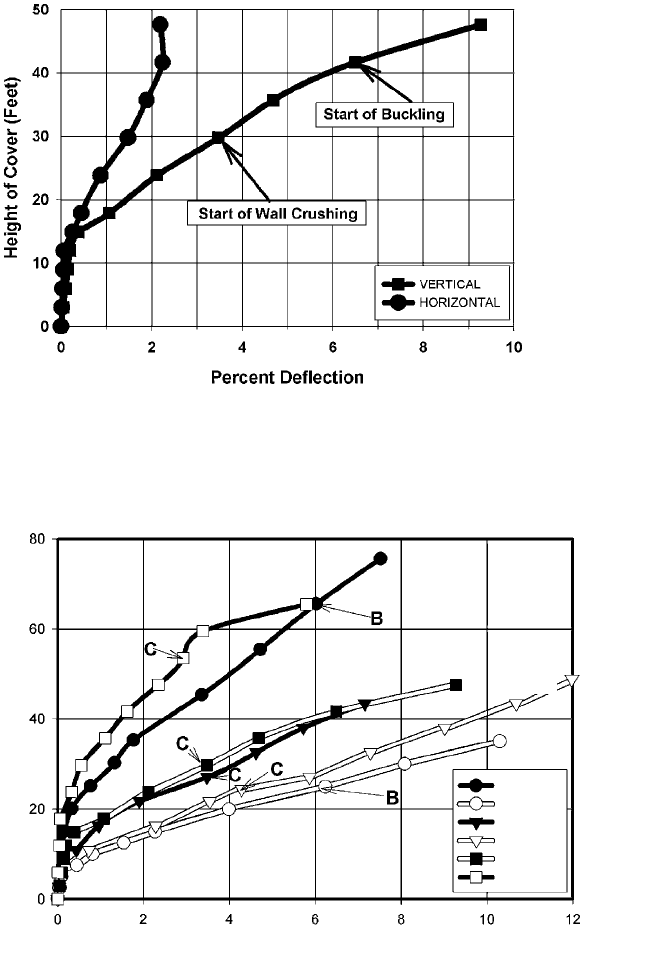
Comparison of results. The vertical deflections of the six tests are
shown in Fig. 6.45. This graph shows the importance of soil density in
the performance of buried pipes. It is interesting to note that for the
24- and the 30-in tests, wall crushing starts at deflections in the range
324 Chapter Six
Figure 6.41 Steel-ribbed pipe (30-in diameter) at 60 ft of cover in silty-sand soil at
97 percent density.
Steel and Ductile Iron Flexible Pipe Products 325
Figure 6.42 Load-deflection curves for 30-in ribbed steel pipe, silty-
sand soil compacted to 97 percent standard Proctor density.
Figure 6.43 Steel-ribbed pipe (30-in diameter) at 42 ft of cover in silty-sand soil at
90 percent density.
326 Chapter Six
Figure 6.44 Load-deflection curves for 30-in ribbed steel pipe, silty-
sand soil compacted to 90 percent standard Proctor density.
Figure 6.45 Vertical deflections for the six load deflection tests. Start of wall
buckling and crushing are noted by B and C, respectively.
Height of Cover (Feet)
Vertical Deflection (Percent)
B = Start of Wall Buckling
C = Start of Wall Crushing
30 in, 97%
30 in, 90%
24 in, 95%
18 in, 90%
24 in, 91%
18 in, 95%
18 in, 95%
18 in, 90%
24 in, 95%
24 in, 91%
30 in, 90%
30 in, 97%
of 3.5 to 4.0 percent. For the 18-in tests, wall buckling occurred first
and took place at about 6.0 percent deflection.
Overall performance. The pipe performed well for a pipe of that level
of stiffness and wall area. The resulting deflections were reasonable
and about what would be expected. The seam integrity was good. No
seams opened or failed during the tests, even at extreme heights of
cover.
Live load tests. In tests with simulated H-20 live load, the pipe did not
perform well in tests with a minimum cover (before loading) of 1 ft.
However, tests showed the pipe would perform well with a cover of 2 ft.
The actual minimum cover at which the pipe will perform well is
between 1 and 2 ft. Additional tests would be required to determine
the actual critical minimum cover. Results show the performance of
the pipe could be enhanced if the ring stiffness and the local longitu-
dinal stiffness were increased.
Load-deflection tests. The 18- and 30-in pipes demonstrated a capacity
for a height of cover (before wall crushing or severe deformation) of
52 to 64 ft in soil at 95 percent of standard Proctor density, and 30 ft
in soil at 90 percent standard density. The 24-in-diameter test pipes
were thinner than intended and, therefore, more flexible than would
be permitted in practice. The performance limits for the 24-in pipes
tested ranged from 24 to 27 ft of cover.
AISI Handbook
Desi gn information for corrugated steel products is available in the
Handbook of Steel Drainage and Highway Construction Products,
whi ch is published by the American Iron and Steel Institute (AISI).
Also, many manufacturers publish design information for their
products. Such information should be secured and considered by
the designer. For corrugated steel pipes with ci rcular sections,
standard analysi s and design procedures which have been dis-
cussed in this book apply and may be used by the design engineer.
See Table 6.4.
Example 6.2—Corrugated steel A 48-in-diameter (3-in by 1-in) corrugated
steel pipe is to be placed in an embankment with 60 ft of soil cover. The soil
in the pipe zone is to be coarse sand with some fines and is to be compacted
to 90 percent Proctor density.
What thickness is required so that the pipe deflection does not exceed
5 percent?
Steel and Ductile Iron Flexible Pipe Products 327
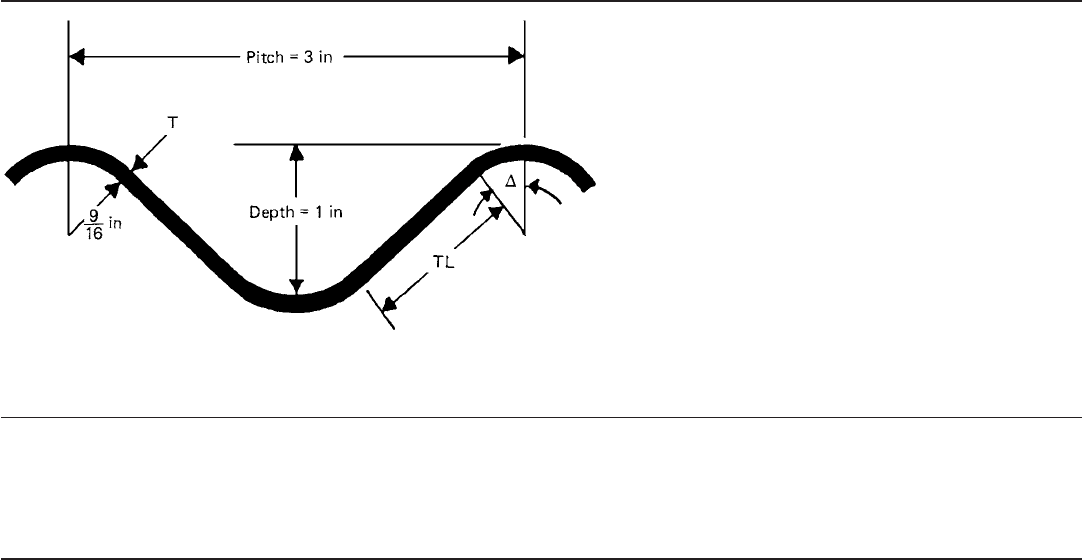
TABLE 6.4 Sectional Properties of Corrugated Steel Sheets
Area of Moment of Section Developed
Specified Uncoated section A, Tangent Tangent angle inertia
†
I, modulus
†
S, Radius of width
‡
thickness, inthickness I, in in
2
/ft length TL, in , deg in
4
/ft in
3
/ft gyration r, in factor
0.040
*
0.0359 0.534 0.963 44.19 0.0618 0.1194 0.3403 1.239
0.052 0.0478 0.711 0.951 44.39 0.0827 0.1578 0.3410 1.240
0.064 0.0598 0.890 0.938 44.60 0.1039 0.1961 0.3417 1.240
0.079 0.0747 1.113 0.922 44.87 0.1306 0.2431 0.3427 1.241
0.109 0.1046 1.560 0.889 45.42 0.1855 0.3358 0.3448 1.243
0.138 0.1345 2.008 0.855 46.02 0.2421 0.4269 0.3472 1.244
0.168 0.1644 2.458 0.819 46.65 0.3010 0.5170 0.3499 1.246
*
Thickness not commonly available. Information only.
†
Per foot of projection about the neutral axis. To obtain A, I, or S per inch of width, divide by 12.
‡
Developed width factor measures the increase in profile length due to corrugating. Dimensions are
subject to manufacturing tolerances.
328