
Moser A.P., Folkman S. Buried Pipe Design
Подождите немного. Документ загружается.

worked under high pressure (via extruder screws) and at a controlled
elevated temperature so that it is converted to a viscous plastic. A die
at the end of the extruder barrel forms the hot viscous plastic into a
cylindrical shape. Outside-diameter tolerances are maintained by
forcing the hot material through a sizing sleeve. After passing
through the extruder head and sizing sleeve, the hot pipe is cooled
from approximately 400
F as it passes through a spray tank and
water bath. The wall thickness and internal diameter dimensions are
controlled by balancing the pipe puller speed with the extruder
speed. The process is continuous. A cutoff saw which moves with the
extruded pipe cuts the pipe in appropriate lengths. The pipe ends are
chamfered, and the pipe proceeds to a rack where it is positioned for
belling (Fig. 7.3).
As explained in Chap. 4, thermoplastics can be heated and
reshaped. The pipe belling operation takes advantage of this impor-
tant property. One end of the pipe is heated and placed in a belling
machine where the bell is formed along with a groove for a rubber
ring, if required. The bell end is then cooled and will maintain its new
shape.
The resulting PVC pipe is extremely durable. It is completely inert
to water and to chemicals commonly encountered in sewage and soil
environments. The surfaces of the pipe are very smooth and resist any
buildup of deposited minerals and other solids. It is totally corrosion
Plastic Flexible Pipe Products 389
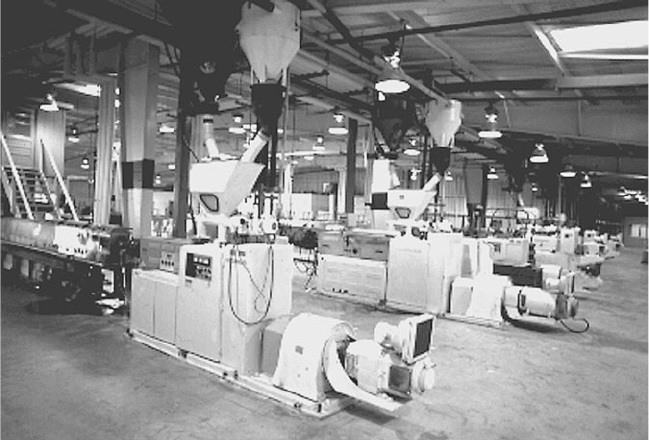
Figure 7.2 PVC pipe extrusion plant. (Reprinted by courtesy of Uni-Bell PVC Pipe
Association.)
resistant. It is not attacked by hydrogen sulfide or the resulting sul-
furic acid. PVC pipe is not subject to biological degradation. Abrasive
resistance is excellent, and no special care for cleaning is needed com-
pared to other pipe products. Dimensional control is excellent, and the
resulting joints are extremely tight. The use of PVC sewer pipe has all
but eliminated infiltration and exfiltration and the accompanying
tree-root problems.
PVC pipe was first produced and installed on a very limited basis in
Germany in the mid-1930s. PVC pipe began to have wide acceptance in
the 1960s. Today it commands a large share of the world market, includ-
ing the market in the United States. It is by far the most widely used
plastic pipe. About 90 percent of all plastic pressure-water pipe is PVC,
and almost 100 percent of plastic sewer pipe is PVC. (Both of these per-
centages are based on weights shipped.) See Tables 7.1 and 7.2.
PVC gravity sewer pipe. PVC sewer pipe is a flexible pipe, and design
methods presented in Chap. 3 for flexible pipe are appropriate.
Specifically, Table 3.9 was developed for any PVC pipe with a pipe stiff-
ness F/y 46 lb/in
2
and diameter of 4 through 18 in.
Pipe stiffness PS 0.559 E
t
3
r
3
6.7EI
r
3
F
y
390 Chapter Seven
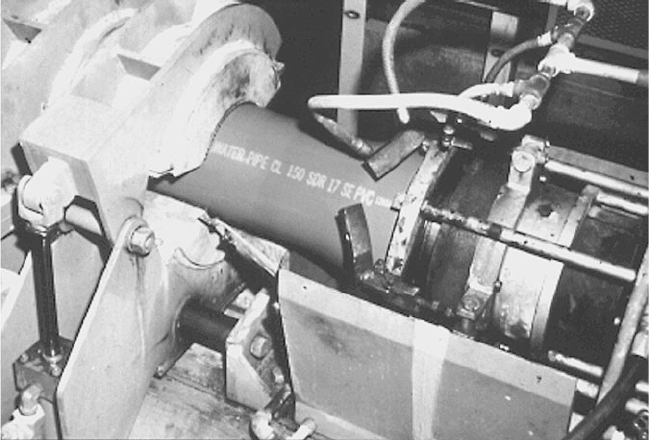
Figure 7.3 PVC pipe belling operation. (Reprinted by courtesy of Uni-Bell PVC Pipe
Association.)

Plastic Flexible Pipe Products 391
TABLE 7.1Typical PVC Pipe Design Properties
Hydrostatic design basis (HDB) 4000 lb/in
2
Hydrostatic design stress (HDS) 1600 to 2000 lb/in
2
Elastic modulus (pressure formulation) 400,000 lb/in
2
Elastic modulus (sewer formulation) 400,000 to 550,000 lb/in
2
Tensile stress 7000 lb/in
2
Hazen-Williams coefficient C 150
Manning’s coefficient n 0.009
TABLE 7.2 Standards for PVC Pipe
AWWA C605 Standard for Underground Installation of Polyvinyl Chloride (PVC)
Pressure Pipe and Fittings for Water
AWWA C900 Polyvinyl Chloride (PVC) Pressure Pipe, 4 in Through 12 in for Water
AWWA C905 Polyvinyl Chloride (PVC) Water transmission Pipe (Nominal
Diameters 14 to 36 in)
AWWA C950 Polyvinyl Chloride (PVC) Water Transmission Pipe, 14 in
Through 36 in
ASTM D 2672 Bell-End Poly(Vinyl Chloride) (PVC) Pipe
ASTM F 800 Corrugated Poly (Vinyl Chloride) Tubing and Compatible Fittings
ASTM D 3915 Poly(Vinyl Chloride) (PVC) and Related Plastic Pipe and Fitting
Compounds
ASTM F 679 Poly(Vinyl Chloride) (PVC) Large-Diameter Plastic Gravity Sewer
Pipe and Fittings
ASTM F 789 Standard Specification for Type PS-46 Poly(Vinyl Chloride) (PVC)
Plastic Gravity-Flow Sewer Pipe and Fittings
ASTM F 794 Poly(vinyl Chloride) (PVC) Large Diameter Ribbed Gravity Sewer
Pipe and Fittings Based on Controlled Inside Diameter
ASTM D 2665 Poly(vinyl Chloride) (PVC) Plastic Drain, Waste, and Vent Pipe
and Fittings
ASTM D 2466 Poly(vinyl Chloride) (PVC) Plastic Pipe Fittings, Schedule 40
ASTM D 1785 Poly(vinyl Chloride) (PVC) Plastic Pipe, Schedules 40, 80, and 120
ASTM D 2241 Poly(vinyl Chloride) (PVC) Plastic Pipe (SDR-PR)
ASTM D 2740 Poly(vinyl Chloride) (PVC) Plastic Tubing
ASTM D 2729 Poly(vinyl Chloride) (PVC) Sewer Pipe and Fittings
ASTM F 599 Poly(vinylidene Chloride) (PVDC) Plastic-Lined Ferrous-Metal
Pipe and Fittings
ASTM F 656 Primers for Use in Solvent Cement Joints of Poly(vinyl Chloride)
(PVC) Plastic Pipe and Fittings
ASTM F 512 Smooth-Wall Poly(vinyl Chloride) (PVC) Conduit and Fittings for
Underground Installation
ASTM D 3036 Socket-Type Poly(vinyl Chloride) (PVC) Plastic Line Couplings
ASTM D 2467 Socket-Type Poly(vinyl Chloride) (PVC) Plastic Pipe Fittings,
Schedule 80
ASTM D 3138 Solvent Cements for Transition Joints Between Acrylonitrile-
Butadiene-Styrene (ABS) Poly(vinyl Chloride) (PVC) Nonpressure
Piping Components
ASTM D 2564 Solvent Cements for Poly(vinyl Chloride) (PVC) Plastic Pipe and
Fittings
ASTM F 758 Smooth-Wall Poly(vinyl Chloride) (PVC) Plastic Underdrain Systems
for Highway, Airport, and Similar Drainage
ASTM F 409 Thermoplastic Accessible and Replaceable Plastic Tube and Tubular
Fittings
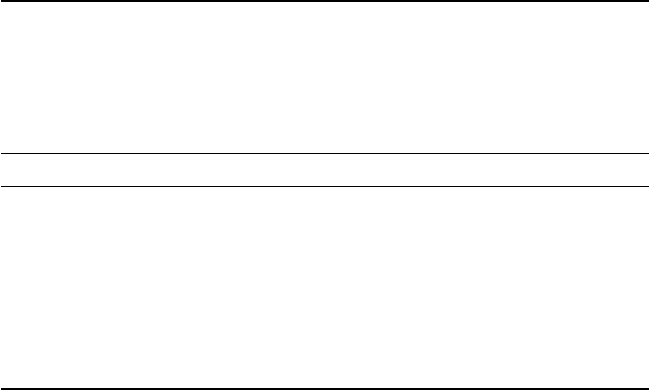
where
r mean radius r
o
Thus
PS
where DR dimension ratio D
o
/t.
For PVC pipes (solid-wall or profile-wall) with diameters larger than
18 in, the manufacturer’s recommendations should be obtained and
followed. Alternately, Table 3.9 may be used.
Most solid-wall PVC sewer pipes have a DR = 35 and a minimum
pipe stiffness of 46 lb/in
2
. PVC gravity sewer pipe with pipe stiffnesses
in the range of 10 lb/in
2
have been tested and performed adequately
when properly installed with a soil density in the pipe zone of at least
85 percent of standard Proctor density. For any pipe with very low pipe
stiffness, extreme care must be taken in preparing and compacting the
soil envelope around the pipe. Pipes with less than 10 lb/in
2
pipe stiff-
ness should be used only if a qualified soils engineer is responsible for
the direction and surveillance of the installation.
Example 7.1—A 12-in gravity sewer pipe A 12-in-diameter gravity sewer pipe
is to be installed in a very deep cut (30 ft). The soil is clay and has been
4.47E
(DR 1)
3
F
y
D
o
t
2
t
2
D
o
2
t
2
392 Chapter Seven
TABLE 7.2 Standards for PVC Pipe (
Continued
)
ASTM D 2464 Threaded Poly(vinyl Chloride) (PVC) Plastic Pipe Fittings,
Schedule 80
ASTM F 789 Type PS-46 Poly(vinyl Chloride) (PVC) Plastic Gravity-Flow
Sewer Pipe and Fittings
ASTM D 3034 Type PSM Poly(vinyl Chloride) (PVC) Sewer Pipe and Fittings
ASTM D 2855 Making Solvent Cemented Joints with Poly(Vinyl Chloride)
(PVC) Pipe and Fittings
Canadian Standards Association
CSA B137.0 Definitions, General Requirements, and Methods of Testing for
Thermoplastic Pressure Piping
CSA B137.3 Rigid Poly(vinyl Chloride) (PVC) Pipe for Pressure Applications
CSA B181.2 PVC Drain Waste and Vent Pipe and Pipe Fittings
CSA B181.12 Recommended Practice for the Installation of PVC Drain Waste and
Vent Pipe and Pipe Fittings
CSA B182.1 Plastic Drain and Sewer Pipe and Pipe Fittings
CSA B182.2 Large-Diameter, Type PSM PVC Sewer Pipe and Fittings
CSA B182.3 Large-Diameter, Type IPS PVC Sewer Pipe and Fittings
CSA B182.4 Large-Diameter, Ribbed PVC Sewer Pipe and Fittings
determined to be corrosive, and the sewage is septic. Select an appropriate
piping material, and design the pipe soil embedment system. The trench
width at the top of the pipe may be as much as 4 ft.
1. Calculate the soil load (see Chap. 2). The rigid pipe load is
W
d
C
d
B
d
2
3.3(120)(4)
2
6336 lb/ft (see Fig. 2.2 for C
d
)
The flexible pipe load is
Prism load H 120(30) 3600 lb/ft
2
or
W 3600 lb/ft
2. Select the piping material. A check will reveal that extra-strength clay
is not strong enough to withstand the 6336 lb/ft soil load. Also, the highest-
strength concrete pipe (class 3) is not strong enough. These corrosive condi-
tions would have eliminated concrete and will usually eliminate iron or steel
pipe. Use SDR 35 ASTM D 3034 PVC pipe.
3. Design the pipe soil embedment system. For SDR 35 PVC, Table 3.9
may be used for design. The pipe should be installed in a manner such that
resulting deflection is less than 7.5 percent. Table 3.9 indicates that class I,
class II, or class III soil may be used if compaction is at least 85 percent (see
Chap. 3 for definitions of soil classes). Specify class II soil to be used for bed-
ding, haunching, and initial backfill (Fig. 7.4). Pipe zone soil, to the level of
the top of the pipe, must be compacted to at least 85 percent of standard
Proctor density. It is evident from Table 3.9 that the 7.5 percent design
deflection will be exceeded if only 80 percent of standard Proctor density is
achieved. Also note that class I soil could have been used without com-
paction since its natural placement density will be sufficient.
4. The alternate design approach (Spangler’s formula), Eq. (3.5), is
x (3.5)
x y
Assume that
K 0.1 (see Chap. 3 for bedding factors)
H prism load
D
L
1.0 when prism load is used
W
c
D
D
L
KW
c
r
3
EI 0.061E′r
3
3600
1
H
D
H
B
c
Plastic Flexible Pipe Products 393
Therefore,
y
or
(7.1)
Pipe stiffness PS
or
Equation (7.1) becomes
or
(7.2)
0.67H
PS 0.41E′
y
D
0.1H
PS/6.7 0.061E′
y
D
PS
6.7
EI
r
3
6.7EI
r
3
F
y
0.1H
EI/r
3
0.061E′
y
D
0.1(DH) r
3
EI 0.061E′r
3
394 Chapter Seven
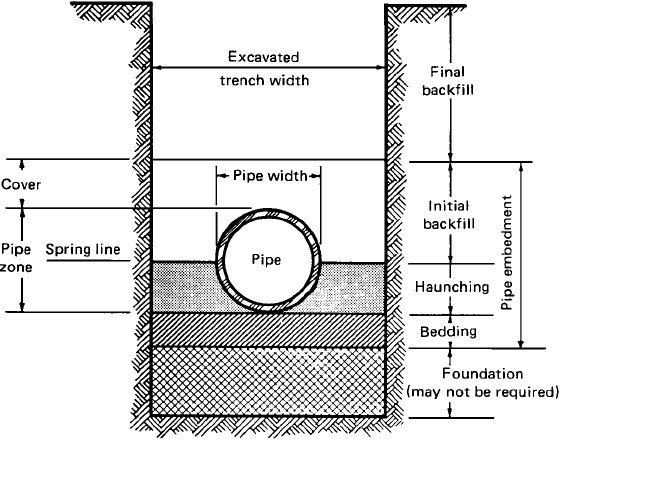
Figure 7.4 Trench cross-section showing terminology. (Reprinted by cour-
tesy of Uni-Bell PVC Pipe Association.)
PS and E
are usually expressed in units of pounds per square inch. If
is in pounds per cubic foot and H is in feet, H is in lb/ft
2
. This must be
divided by 144 to convert to pounds per square inch.
Assuming = 120 lb/ft
3
, Eq. (7.2) becomes
(7.3)
In the above equation, H is feet of cover. The pipe stiffness PS and soil
modulus E′ are to be expressed in pounds per square inch. This equation can
be solved for E′ as follows:
E′ (7.4)
For this example,
H 30 ft
0.075 (or 7.5 percent)
PS 46 lb/in
2
Thus,
Required E′ 434 lb/in
2
Data in Table 3.9 indicate a soil density of 85 percent is required for finer-
grain soils with little or no plasticity. Coarse-grain soils may be used with
little compactive effort required. The two design approaches produce results
which agree fairly well. Obviously the use of empirical data from Table 3.9
is the easier method.
Example 7.2—A 10-in gravity sewer pipe A 10-in gravity sewer pipe is to be
installed 16 ft deep. The native soil is silty clay, and the water table is 10 ft
below the surface. Select a PVC pipe and specify the proper installation
design if the long-term deflection is not to exceed 7.5 percent.
Select an ASTM D 3034, SDR 35, 10-in sewer pipe. This choice allows the
use of Table 3.9 in determining the required embedment soil and soil
density. Because of the water table, the trench condition will be wet, and
the required densities in the pipe zone may not be achievable with native
soil. Required compaction must be achieved before high soil loads are
imposed and the well points removed. Otherwise, the soil will densify with
46
0.41
1.37(30)
0.075
y
D
PS
0.41
1.37H
y/D
0.56H/(y/D) PS
0.41
0.56H
PS 0.41E′
y
D
0.67(120H/144)
PS 0.41E′
y
D
Plastic Flexible Pipe Products 395
the rising water, which may cause excess deflection. However, sufficient
backfill must be placed over the pipe (about 3 ft) to prevent flotation of the
pipe.
Design I. Use a select clean sand or gravel backfill material (class II; Table 3.9)
for bedding, haunching, and initial backfill compacted to 85 percent standard
Proctor density. From Table 3.9, long-term deflection will be about 3 percent (see
Chap. 3 for additional discussion on the use of Table 3.9).
Design II. Use a select silty-sandy gravel backfill material (class III;
Table 3.9) for bedding, haunching, and initial backfill compacted to
85 percent standard Proctor density. From Table 3.9, long-term
deflection will be 3.5 percent.
Note: These deflections are substantially lower than the allowed 7.5 percent
long-term deflection. However, because of the wet condition and the rela-
tively deep cover soil, density in the pipe zone must not be less than the den-
sity at the critical void ratio. This density is often around 90 percent of
Proctor density. For added safety, 90 percent density is recommended. Also
design I is preferred to design II because in wet trench conditions, the com-
paction of class III backfill is more difficult.
Example 7.3—A 27-in gravity sewer pipe A 27-in SDR 35, PS 46, PVC
sewer pipe is to be installed 15 ft deep. The soil is clay, except in most areas
there is some basalt rock which must be blasted. What type of soil embed-
ment system will be required for this installation?
1. Pipe must not be laid directly on hardpan, bedrock, or any sharp stones
with dimensions larger than 1
1
2
in and preferably no stones larger than
3
4
in.
2. Excavate at least 6 in below grade, and prepare a firm uniform bedding
of crushed, well-graded stone.
3. Select haunching and initial backfill material: Consider class I, class II,
class III, or class IV materials as listed in Table 3.9. A Proctor density of
80 percent is sufficient for either class II or class III soils. Class IV soils
are often overlooked as pipe embedment materials, but could be used if
the trench is not wet and the soil is compacted to 85 percent Proctor den-
sity. Of course, class I soil will also meet design requirements (y/D
7.5 percent).
4. Spangler’s method could also be used, but it is not required.
5. Pipe should not be placed directly on sharp rock outcroppings. Also, large
sharp blasted basalt rock should not be placed directly against the pipe.
(A select imported material is recommended.)
Example 7.4—A 48-in ribbed PVC pipe A 48-in ribbed PVC pipe is to be
installed 20 ft deep. The native soil is fine sand with traces of silt and clay.
The pipe stiffness of the ribbed pipe is 10 lb/in
2
. For a special design the
owner has requested that this pipe be installed such that the maximum ver-
tical deflection does not exceed 3 percent. Also, to keep costs down, he would
396 Chapter Seven
like to use the native material for bedding, haunching, and initial backfill.
Are these design requirements possible?
Use Spangler’s formula. From Eq. (7.4)
Required E′
where H 20 ft
0.03
PS 10 lb/in
2
So
Required E′ 886
From Table 3.9, the required density is 95 percent. This is possible to
achieve, but will be difficult to obtain. The owner should be asked to either
relax his 3 percent deflection limit or allow a coarser material to be used in
the pipe zone. Costs associated with compaction may exceed the cost of a
select material. For a 5 percent deflection limit,
E′ 522 lb/in
2
For a 7.5 percent deflection limit,
E′ 340 lb/in
2
The latter can easily be achieved with the native sand used in the pipe zone.
Long-term stress relaxation and strain limit
testing of PVC pipes
In the early 1970s, a concern was voiced for an appropriate material
property design limit for PVC pipe used in gravity applications. One
proposal was to impose a strain limit, derived from constant stress
testing, on buried gravity flow pipes subjected to constant strain. To
shed light on this subject, laboratory tests of pipe ring samples
exposed to various constant strains and temperatures have been
underway since January 1977 on filled and unfilled PVC compound
formulations. Samples of PVC pipe were placed on long-term tests
under various levels of constant strain. The objectives of the tests were
to determine stress relaxation characteristics and constant strain
failure data. These test results were used to draw conclusions concerning
0.56(20)/0.075 10
0.41
0.56(20)/0.05 10
0.41
y
D
PS
0.41
1.37H
y/D
0.56H/(y/D) PS
0.41
Plastic Flexible Pipe Products 397
the applicability of a material strain limit for constant-strain design
conditions.
The first issue of ASTM D 3034 contained material requirements for
a single PVC cell class of 12454B as described in ASTM D 1784. The
second issue published in 1973 contained a 13364B cell class as a sec-
ond option. This option increased the material’s modulus of elasticity
from 400,000 to over 500,000 lb/in
2
through the introduction of higher
amounts of calcium carbonate. These higher-modulus materials are
often called filled compounds. The filled compounds exhibit slightly
less tensile strength and tensile elongation, but do not compromise any
of the finished product requirements of ASTM D 3040. Sewer pipes of
both compounds have found wide use since 1974.
Two fundamental questions which arose in the early 1970s are, what
particular PVC compounds are suitable as sewer pipe? and what mate-
rial property limits should be used for structural design purposes? At
least partial answers to these questions have been published in the liter-
ature over the years. An initial proposal by Chambers and Heger in
1975 was to limit strain to 50 percent of an assumed ultimate strain of
only 1 percent.
14
This suggestion was shown by research to be too con-
servative and was never followed (see Refs. 26, 36, and 39) .
Tests to help fully answer questions concerning strain limits were
established in 1975 and 1977 at Utah State University. An early
reporting of the results of these tests was published by Moser
39
and
Bishop.
11
Another report of the data was published by Moser, Shupe,
and Bishop.
43
At this writing the tests are still underway, and data
through 1999 are included here.
Stress relaxation tests. Researchers have shown that buried pipe and
soil systems stabilize to an equilibrium condition which typifies a fixed
deflection or fixed strain condition (see Moser
37
). Therefore, data from
constant-deformation tests (fixed strain tests) can be used in predict-
ing the performance of PVC pipe.
Stress relaxation tests were performed on ring sections cut from
PVC pipe (see Figs. 7.5 to 7.10). These test specimens were each dia-
metrically deformed to a specified deflection. The load necessary to
hold each deformation constant has been measured at various time
intervals. Each specimen was maintained at one of three tempera-
tures: ambient (70°F), 40°F, and 0°F. The ambient temperature was
held to 5°F. A refrigerator was used to maintain the 40°F tempera-
ture and was found to fluctuate between 38 and 41°F. The 0°F speci-
mens were placed in a freezer, and the temperature varied between 5
and 0°F. The purpose of the lower-temperature test was to slow down
the stress relaxation which would amplify any tendency toward brittle
fracture. (For dimensions of the test specimen, see Table 7.3.) Two PVC
398 Chapter Seven