
Moser A.P., Folkman S. Buried Pipe Design
Подождите немного. Документ загружается.

Load (Pounds)
Time (Years)
Load (Newtons)
Time (Hours)
DATA
Extrapolation to 114 years
90
80
70
60
50
40
30
20
200
300
400
500
600
700
800
900
10
100
10
0
10
1
10
2
10
3
10
4
10
5
10
6
1000
22 yr
11.4 yr
114 yr
50%
25%
15%
10%
5%
0.0001
0.0011
0.011
0.114
1.14
11.4
114
445
400
356
311
222
133
89
44
267
178
890
1334
1779
2224
2669
3114
3559
4003
4448
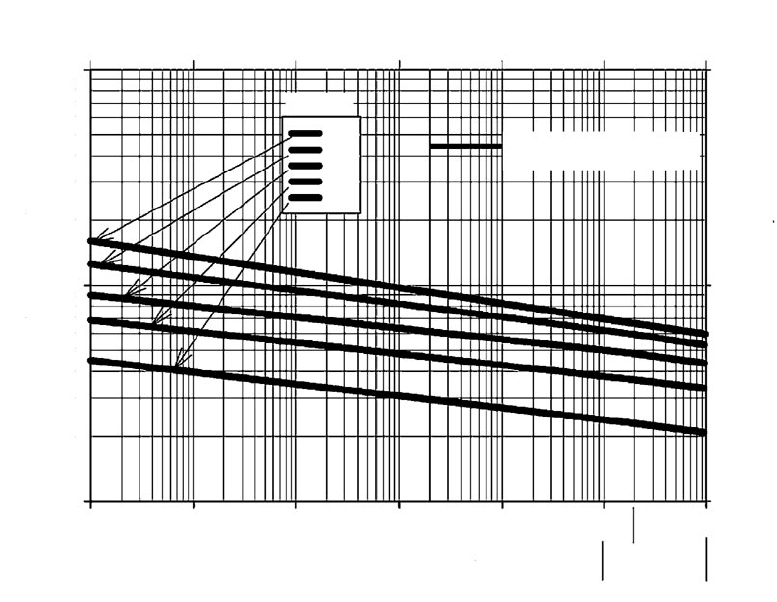
Figure 7.16 Relaxation curves for unfilled, unnotched PVC pipe rings at specified deflec-
tions and a temperature of 70°F.
409
Load (Pounds)
Time (Years)
Load (Newtons)
Time (Hours)
Extrapolation to 114 years
90
80
70
60
50
40
30
20
200
300
400
500
600
700
800
900
10
100
10
0
10
1
10
2
10
3
10
4
10
5
10
6
1000
22 yr
11.4 yr
114 yr
50%
25%
15%
10%
5%
0.0001
0.0011
0.011
0.114
1.14
11.4
114
445
400
356
311
222
133
89
44
267
178
890
1334
1779
2224
2669
3114
3559
4003
4448
DATA
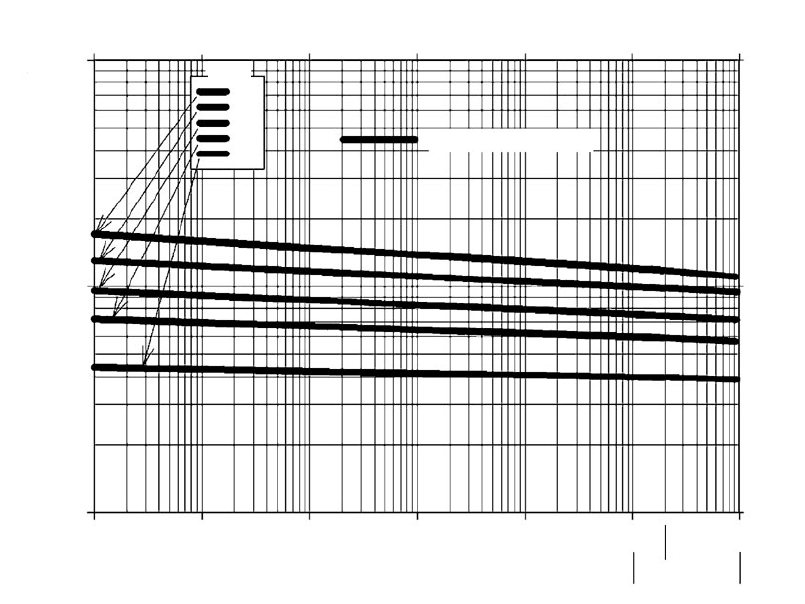
Figure 7.17 Relaxation curves for unfilled, unnotched PVC pipe rings at specified deflec-
tions and a temperature of 0°F.
410
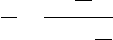
The assumption of an elliptical shape has been shown to be a very
close approximation for PVC pipe.
where maximum strain in pipe wall due to ring bending (can be
assumed to occur at crown or invert of pipe)
t pipe wall thickness
D pipe diameter
y vertical decrease in diameter
For example, if t 0.132, D 4, and the ring deflection is 10 per-
cent, the bending strain is calculated as follows:
0.0124 or 1.24 percent strain
The following simplified equation for calculating maximum strain
due to ring deflection has been proposed. This equation predicts
strains that are too high for low ring deflections. The two equations
predict the same bending strain when the deflection y/D is 0.25,
which is a 25 percent deflection.
6
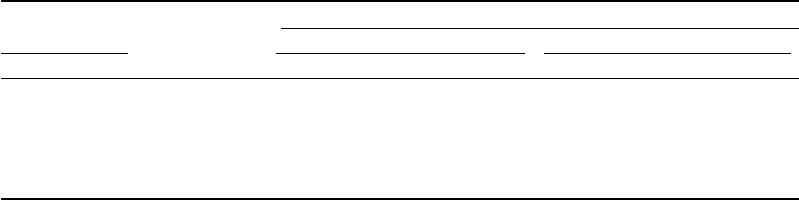
Stiffness data for the stress relaxation specimens are given in
Table 7.5. Stiffness measurements conducted at the end of the 13-year
and 22-year test periods are incremental stiffnesses. Each specimen
was deflected an additional 5 percent from its preset value. The stiff-
nesses were then calculated by dividing the incremental load per
length by the 5 percent incremental deflection. These long-term values
are the instantaneous stiffnesses and are the stiffnesses that resist
any additional deflection. These data show that pipe stiffnesses and
modulus for PVC pipe do not decrease with time.
Uniaxial constant-strain tests. The specimens used for these tests were
taken from filled and unfilled DR 35 PVC pipe. Strips of PVC were
obtained from the pipe in either the horizontal or the circumferential
directions. The circumferential strips were straightened in an oven set
at 180F. Dog-bone type of specimens were machined from these strips.
Each specimen was pulled to a predetermined strain. Some specimens
were notched. The notches (in the two parallel sides of the specimen)
were 0.024 0.006 in deep. Notching the samples intensifies the strain.
The intensified strain in combination with the maintained lower tem-
perature accelerates brittle fracture if it is going to occur.
y
D
t
D
3(0.10)
1 2(0.10)
0.132
4
e Q
t
D
R°
3
y
D
1 2
y
D
¢
Plastic Flexible Pipe Products 411
412
TABLE 7.5Pipe Stiffness of Constant-Strain Ring Samples
Pipe stiffness
Sample 5 percent 25 percent
Filled Notched Temperature* Initial† 13 years‡ 22 years‡ Initial† 13 years‡ 22 years‡
Yes No 0 71 69 70 39 63 64
Yes Yes 40 76 74 74 38 65 62
Yes Yes 0 7 5 69 7 0 41 63 63
No No 40 101 89 90 60 91 90
No No 0 102 91 92 65 110 109
No Yes 40 101 96 98 63 87 89
*Constant temperature during 22-year test. Sample conditioned to 73°F for stiffness testing.
†Pipe stiffness determined by secant method after being held at the specified deflection for 1 h.
‡The 13- and 22-year stiffnesses are determined by applying an additional 5 percent deflection
increment to the specified deflection.
Plastic Flexible Pipe Products 413
These specimens were strained in a range of 1.0 to 95 percent. The
specimens were then placed in the freezer at 0F (see Fig. 7.10). The
samples have now been on test for almost over 22 years. No failures
have occurred, even in the notched specimens. The tests show that,
under a constant-strain condition, if the initial strain can be achieved,
failure will not occur (see Table 7.6).
As has been discussed, the initial bending stress in a pipe, where the
deflection is constant, will relax in the course of time. Consequently, a crit-
ical stress limit for structural design cannot easily be defined. Instead, we
have to consider strain as a geometric parameter that is constant with
time. The strain can also easily be defined and measured as a constant geo-
metric quantity. Some have asked the question, is there a critical strain
limit which must not be exceeded if long term failure is to be prevented?
Additional investigations have been undertaken in recent years
where PVC pipes have been kept constantly deflected for long periods of
time (see Janson
26, 27
). In spite of very high strain values, it has not been
possible to simulate any pipe failure. From all the test pipes subjected
to stress relaxation, some with extremely large deflections and strains,
no failures or cracking has occurred in any PVC samples. This may be
regarded as somewhat strange because the initial bending stresses are
extremely high in many cases and would have caused immediate pipe
failures had the stress been constant and the material free to creep, as
is the case for pipes subjected to constant internal hydrostatic pressure.
A hypothesis has been developed that it is just the stress relaxation
procedure that contributes to the fact that no failure occurs.
Consequently, the hypothesis implies that if no failure occurs immedi-
ately, then it will never occur; and this is independent of the magnitude
of the bending strain. Obviously, this hypothesis is valid only for well-
processed pipes made of high-quality resins. This means, in particular,
that pipes and fittings have to be manufactured of high-molecular-
weight resins. In the case of PE, the actual MFR values meet the
requirements according to current international standards, and for PVC
all studies have been performed on resins with K values exceeding 65.
However, even for high-quality pipes, the hypothesis is not valid if the
pipe material properties change with time from the original values. This
may occur when the chemical stabilization system is no longer intact.
For PE pipes, the material must not become crystalline with time.
Janson reported on tests by Hoechst on small-diameter HDPE pipes
(without carbon black). Hoechst applied a constant tensile stress/strain
equally distributed through the pipe wall by expanding the pipe sam-
ples using internal steel circular, applying constant tensile strains from
2 to 15 percent. Some samples have now been on test for 40 years in
room temperature without failure. He reported failures in samples at
elevated temperatures (40 to 80C). This does not contradict the hypoth-
esis discussed above. On the contrary, it supports the requirement that
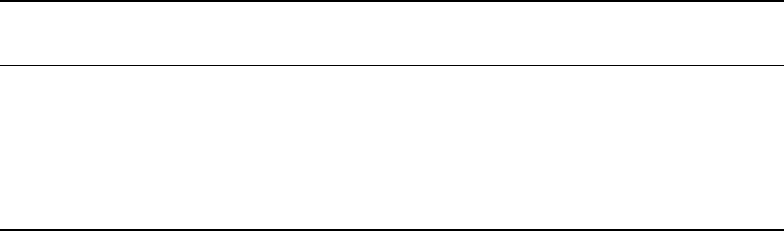
TABLE 7.6Uniaxial Constant-Strain Failure Data—Unfilled Specimens Taken from the Circumferential
Direction of Pipe
Cross- Strain
Specimen sectional level, Starting
number Notched Filled area, in
2
percent time (1978) Failure time Temperature, °F
3 No No 0.0531 48 March 26 No failure 0
4 No No 0.0526 50 March 26 No failure 0
7 Yes No 0.0530 1.0 March 27 No failure 0
8 Yes No 0.0525 1.5 March 27 No failure 0
13 No Yes 0.0560 90 March 30 No failure 0
14 No Yes 0.0564 95 March 30 No failure 0
17 Yes Yes 0.0554 1.5 March 30 No failure 0
18 Yes Yes 0.0561 2.0 March 30 No failure 0
414
the chemical stabilization system be intact for the hypothesis to be
valid. Thus, the reported failures indicated that the chemical aging of
the material is dependent on the temperature and also that the degra-
dation rate will increase with increased strain.
Aging. Studies of both PVC and PE pipes that have been installed for
13 years and 8 years, respectively, show that the consequence of the
physical aging of the polymer material is that the short-term E modu-
lus does not decline after long-term loading. In both studies, section of
pipe were removed and held in the deflected state, and an incremental
load was applied, increasing the deflection. The calculated modulus did
not decrease, but, in fact, increased. Since the ring stiffness is a linear
function of the E modulus, it also means that after a long loading time,
the ring stiffness will retain or improve its short-term value for each
future new impulse of loading. This fact is of great importance for an
adequate understanding of the deflection process undergone by buried
thermoplastics gravity pipes.
Conclusions based on test data:
1. Stress relaxation in filled and unfilled PVC can be approximated
by a straight line on log-log paper, and the relaxation rate is tem-
perature dependent. The rate of relaxation decreased with a
decrease in temperature.
2. Filled or unfilled PVC does not appear to be notch-sensitive when
loaded under constant deformation.
3. Buried PVC pipes maintain the same capacity to resist additional
deflection increments as when initially installed; that is, the mod-
ulus does not decrease with time.
4. PVC pipes manufactured from compounds of cell classes 13364B
and 12454B do not lose stiffness with time.
5. Apparent or creep modulus is an inappropriate property to pre-
dict long-term deflection of buried PVC gravity sewer pipe. Pipes
continue to respond to additional deflection increments by resist-
ing movement at the same stiffness as newly made pipe.
Frozen-in stresses
Stresses caused during pipe manufacture occur in all thermoplastic pipes.
These stresses have their origin in the cooling phase of the manufacturing
process. The cooling of the extruded pipe normally takes place externally in
a water bath inducing stresses in the pipe wall. During cooling, the external
surface layer cools first and contracts while the still warm inner surface layer
of the pipe compresses plastically. Later, as the inside layer subsequently
cools, it attempts to contract as a consequence of the thermal contraction, but
Plastic Flexible Pipe Products 415
416 Chapter Seven
is prevented from doing so by the outer cool surface layer which has already
become solid and assumed its form. The outcome is tensile stresses on the
inside and compressive stress on the outside. The net result is a frozen-in
bending stress in the pipe wall. The greater the material thickness and/or the
greater the cooling rate, the more severe the bending stresses. If a pipe sam-
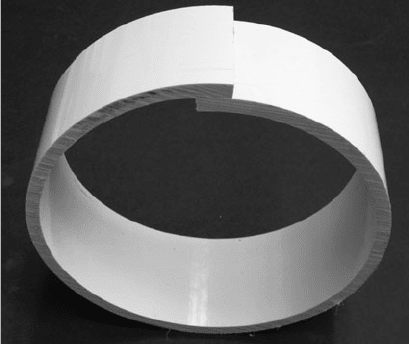
ple is cut in the axial direction along its entire length, the pipe will tend to
close, leaving an angular overlap. See Fig. 7.18.
The solution to the problem of an angular opening or closing in a cir-
cular ring was given by Timoshenko in his book Theory of Elasticity.
66
This can be found on pages 71 to 80. The assumptions he makes is that
the ring is circular and subjected to pure bending. If the pipe is circu-
lar and if it is uniformly cooled around its circumference during man-
ufacture, these conditions will be met.
The frozen-in stresses can be determined by measuring the angular
displacement immediately after the longitudinal cut is made. This
measured gap or overlap is then used in the Timoshenko solution as
follows:
ln
where maximum stress
angular displacement, (radians)
E modulus of pipe material
D
o
outside diameter of pipe
D
i
inside diameter of pipe
ln natural log function
D
i
D
o
1
2D
o
2
D
o
2
D
i
2
E
4
Figure 7.18 Angular closing due to frozen-in stresses.
Plastic Flexible Pipe Products 417
The calculation may require the introduction of the time-dependent
value of E. This means that E must be related to the interval of time
occurring between cutting and measuring. It is recommended that the
measurement be accomplished within 3 min of cutting so that the pub-
lished short-term modulus can be used.
Because of the Poisson effect, axial frozen-in stresses also exist.
These may be observed by sawing out a thin rod in the longitudinal
direction of the pipe which then acquires a bend. The frozen-in stress
in the axial direction is recognized as an inward bending of the pipe
walls at the end of a cutoff pipe. Because of the three-dimensional
state of stress, the length of the sample will have some effect on the
resulting gaps and bending. To avoid this length effect, the sample
length chosen should be at least equal to the diameter of the pipe.
Example 7.5 Suppose that a 24-in-long, 18-in-diameter, AWWA C900 DR 18
PVC pipe sample is tested for frozen-in stresses. Further suppose that when
the sample is cut longitudinally, a 5° overlap occurs. What is the magnitude
of the frozen-in stress?
angular overlap 5
0.087 rad
E modulus 400,000 lb/in
2
D
o
18 in (assumed)
t thickness 1 in
D
i
D
o
2t 18 2 16 in
Using Timoshenko’s equation, we have
ln 1
ln 1
1065 lb/in
2
As has been discussed earlier, a bending stress caused by a constant
strain will decrease in the course of time due to relaxation. Such a
stress alone will not give rise to any failure. However, large frozen-in
stresses, in combination with tensile stresses caused by constant inter-
nal hydrostatic pressure, will give rise to stresses that are not usually
fully evaluated. This is acceptable because thermoplastics pipes have
been pressure-rated by testing with the frozen-in stresses in the pipe
wall. This means the published test results were obtained having the
16
18
2(18)
2
18
2
16
2
0.087(400,000)
4
D
i
D
o
2D
o
2
D
o
2
D
i
2
E
4
18
18
D
o
DR
2
360
418 Chapter Seven
influence of the frozen-in stresses. Nevertheless, these stresses should
not be greater than about one-fourth the hydrostatic design basis.
If the frozen-in stress is very large, the end of the pipe will be bent
inward. This could cause a problem, particularly for PE pipes that are
to be joined by butt welding. Problems arise because of the unpre-
dictable multiaxial stresses in the finished weld joint.
PVC pressure pipe
PVC pressure pipes are considered to be flexible pipes, and methods
presented in Chap. 3 for calculating ring deflection apply. However,
most pressure pipes are installed with about 4 ft of cover. Thus the
resulting vertical soil pressure is relatively small, and consequently
ring deflection is usually not a major concern. Only for the lower pres-
sure classes (larger dimension ratios), where the pipe wall is relatively
thin and the resulting pipe stiffnesses F/y are relatively low is it nec-
essary to consider ring deflection (Table 7.7). As before, pipe stiffness
is calculated as follows:
PS
The procedure for hydrostatic design is given in Chap. 4. Equation (4.15)
is repeated here as Eq. (7.5) for convenience:
P(D t)
2t (7.5)
where P total internal pressure (static plus surge)
D outside pipe diameter
4.47E
(DR 1)
3
F
y
TABLE 7.7 Selected Dimension Ratios (OD/
t
)
and Resulting Pipe Stiffness (
F
/
y
) for PVC Pipes
Minimum E
OD/t DR Minimum E 500,000
or SDR 400,000 lb/in
2
lb/in
2
42 26 32
41 28 35
35 46 57
33.5 52 65
32.5 57 71
28 91 114
26 115 144
25 129 161
21 234 292
18 364 455
17 437 546
14 815 1019
13.5 916 1145